






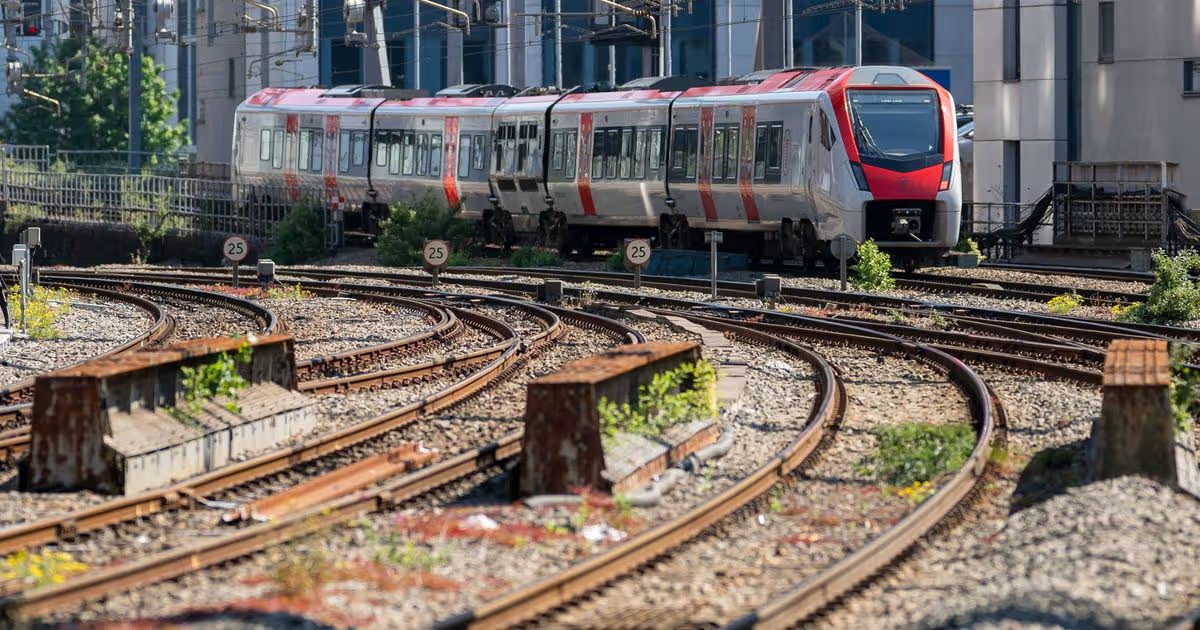
The UK Government has committed to funding seven new train stations in Wales, including a contribution to the proposed Cardiff Parkway mainline project. It has also endorsed a long-term pipeline of rail enhancement schemes worth billions of pounds.
Prime Minister Keir Starmer has given his backing to a wish list of projects set out in a new vision document from Transport for Wales, which over the long term could see £14billion worth of investments across Wales – although that will be a matter for future Westminster governments.
More immediately, he has confirmed that his government will provide the finance to deliver six new stations between Cardiff and the Severn Tunnel, as well as a new station at Deeside that will support efforts to increase the capacity and frequency of train services between north Wales and Merseyside.
READ MORE: Wales bucks UK trend with a fall in unemploymentREAD MORE: Watchdog called in to investigate WRU deal with Y11 amid new Ospreys twist
Ensure our latest news and sport headlines always appear at the top of your Google Search by making us a Preferred Source. Click here to activate or add us as Preferred Source in your Google search settings.
There is currently no additional money for rail enhancement projects in Wales beyond the £445m announced by Chancellor Rachel Reeves in her three-year (four for capital) spending review last July, which takes effect from April. However, tellingly, with the Prime Minister name-checking the stations, it should ensure that further spending will be provided in the next spending review – ahead of the expected 2030 General Election – to ensure that projects not completed, or still in pre-construction, are delivered.
When already agreed projects, such as a £77m UK Government contribution to an upgrade of Cardiff Central station, are taken into account, it leaves only around £300m for new projects, alongside £90m set aside to develop plans for other schemes in the current spending review period. While not specifying which stations, work on five is expected to start this year, with construction of two beginning by 2029.
The five Burns stations were recommended by the South East Wales Transport Commission, set up by the Welsh Government after it decided not to proceed with the £1bn M4 Relief Road, and have an estimated cost of more than £300m.
These are: Magor and Undy; Llanwern; Cardiff East; Newport West; and Somerton. Aside from the smaller Magor and Undy walkway station, each has an indicative price tag of £70m. All are currently going through the design process ahead of planning. It is anticipated that the Magor station will be the first to be completed.
The new station in Flintshire will be located at the Deeside Industrial Park. However, to fund that project, the Treasury will reallocate yet to be deployed funding from the North Wales Growth Deal to co-fund the £30m Padeswood siding project to upgrade its cement works freight facility. This will allow freight trains to move seamlessly off the main line into the works, rather than relying on the current time-consuming manoeuvres. Read our political editor’s view on tonight’s announcement here.
The use of North Wales Growth Deal funding for a non-devolved rail asset – similar to the Welsh Government and the Cardiff Capital Region having to commit to half the £140m cost of upgrading Cardiff Central – can be viewed as another example of the unfairness to rail investment in Wales. There have been repeated calls from opposition parties, as well as a sizeable number of Labour Senedd members, for rail powers to be devolved to Wales.
However, the Welsh Government would first need to negotiate a fair budget adjustment reflecting decades of underinvestment in the rail infrastructure in Wales. It would also likely seek a UK Government financial backstop for liabilities, particularly given climate change and the increased risk of damage to rail infrastructure.

How Cardiff Parkway could look(Image: Wilkinson Eyre)
While not specifying the scale of its commitment, the UK Government has also confirmed it will provide funding to realise the new Cardiff Parkway mainline station at St Mellons. Of the seven stations, it is currently the only one with planning permission and – subject to discharging planning conditions and further assessment of train service capacity – construction could start later this year.
The station would be integrated into a new 900,000 sq ft business park. There is already strong interest from engineering giant Rolls-Royce, which has appraised the site as suitable for a potential new hub that could create thousands of high-skilled jobs. The business park element alone could support up to 6,000 jobs.
Rolls-Royce, which is understood to be also be considering two rival sites in the north-west of England, has evaluated Parkway favourably due to its own rail station, access to a skilled workforce, proximity to nine universities across south Wales and western England, and the security offered by a 200-acre site with close rail links to both Cardiff and Bristol.
Alongside UK Government funding, Transport for Wales would take a long lease to operate the station, with a privately funded securitisation deal against future rents providing upfront capital. TfW’s leasing costs would be covered by increased ticket sales and car-parking income.
The UK Government said it had agreed a plan with the Welsh Government and private investors to take the project forward, with additional funding made available to deliver the station. The company behind the project, Cardiff Parkway Developments, is owned by Investec and the Roberts family, with a 10% equity stake held by the Welsh Government.

First Minister Eluned Morgan with Prime Minister Sir Keir Starmer.(Image: Tamilade Adelaja/PA Wire)
The Prime Minister said: “For too long, Wales has been let down by a UK Government unwilling to do the hard yards and build the future it deserves.
“This government is turning the page on historic dither and delay with seven new stations, thousands of jobs, and a generational commitment to build a rail network fit for Wales’ future.
“This isn’t tinkering or sticking plasters. This is long-term investment – and change communities will feel. This is putting Wales on the front foot and getting Britain building again.”
First Minister Eluned Morgan said: “We are now in an unprecedented position to deliver the next chapter of transformation for rail services in Wales. We have secured long-term commitments to key projects and a renewed ambition for our rail network.
“Changes of this scale don’t happen overnight, but they do happen when there is vision, determination and cooperation. We’ve already proved that with the Core Valley Lines, and we are beginning to see the same momentum with Network North Wales. When you have ambition, commitment and will, real progress follows – and we have all three.”
“Today marks another important milestone as Transport for Wales publishes an exciting and essential pipeline for future investment across the length and breadth of our nation. We warmly welcome the UK Government’s support and its commitment to addressing the historic underfunding of Welsh rail.”
“In the near term, I’m pleased to see backing for essential work at Padeswood and Buckley. This will transform journeys between Wrexham and Liverpool, unlock economic opportunities across north Wales, and allow plans for the new Deeside station to accelerate. I also welcome support for Cardiff Parkway, and we remain committed to working closely with all partners to complete the full business case and development plans.”
Over the next three years, the UK Government will also invest up to £30m in infrastructure enhancements to increase the capacity of a key junction west of Cardiff Central, enabling more services on the Core Valley Lines network. This is needed to increase City Line services from two trains per hour to four, in line with the wider £1.1bn South Wales Metro electrification programme.
The enhancement will be delivered as part of a renewal scheduled for 2028, providing significant efficiency improvements. Further investment will also be needed to increase services on the Coryton Line to four trains per hour through the addition of a passing loop.
Secretary of State for Wales Jo Stevens said: “After years of underinvestment in Welsh infrastructure, this UK Government is modernising and upgrading Welsh rail.
“This investment in seven new stations and other upgrades will boost capacity across our network and transform the experience of thousands of passengers. It forms part of the generational investment we are making to better connect people with well-paid jobs and drive economic growth.”
Vernon Everitt, chair of Transport for Wales, said:”Transport is an enabler of sustainable economic growth, higher productivity, and access to homes, jobs and education, as well as greater opportunity for all. Supporting the Welsh Government’s vision, our ‘Today, Tomorrow, Together’ plan sets out an ambitious agenda to deliver further progress through investment in rail services as part of an integrated transport network.
“In recent years we have delivered major improvements for the people, businesses and communities we serve, including new trains and services, transformation of the Core Valley Lines, and significant enhancements under Network North Wales.
“We now need to go further. Today we set out a potential pipeline of future projects that will bring benefits across the whole of Wales, and I am delighted that both the UK and Welsh Governments have backed this vision.”
Welcoming the funding commitment to Cardiff Parkway, chairman of Cardiff Parkway Developments, Nigel Roberts, said: “We now look forward to breaking ground as soon as possible to bring forward this transformational project for Cardiff and the region.
“This will come as welcome news for the residents of East Cardiff and also provide certainty for those inward investment opportunities we have identified. The site has potential to deliver over £5bn GVA over the next 20 years and create over 6,000 new quality jobs.
” I would like to thank the First Minister, Eluned Morgan for granting planning permission last year and Jo Stephens MP and Vaughan Gethin MS for their tireless support for this project on behalf of their constituents along with Cardiff Council, particularly the local councillors and leader, Huw Thomas, for their unanimous support of this game changing project.”