
Business
Here’s When to Expect Your Money


Millions of Americans are poised to receive some of the largest federal tax refunds in recent history during the 2026 filing season, with average amounts potentially rising by $1,000 or more compared to prior years, thanks to retroactive tax cuts enacted under the One Big Beautiful Bill Act signed by President Donald Trump.

The Internal Revenue Service officially opened the 2026 tax filing season on Jan. 26, allowing taxpayers to begin submitting their 2025 federal income tax returns. The agency expects to process around 164 million individual returns by the April 15 deadline, with most filers opting for electronic submission.
Experts and administration officials project this year’s refunds could mark the largest cycle ever, driven by provisions in the landmark legislation that extended and expanded elements of the 2017 Tax Cuts and Jobs Act, introduced new deductions for overtime pay, tips, certain car loan interest and an additional standard deduction boost for seniors, among other changes. The White House has highlighted the bill’s impact, noting that many workers saw continued higher withholding during 2025 despite the retroactive reductions, leading to larger overpayments that will now return as refunds.
The average refund issued in the 2025 filing season was approximately $3,167, according to IRS data, up slightly from $2,939 in the prior cycle. Analysts from firms like Piper Sandler, Morgan Stanley and the nonpartisan Tax Foundation estimate the 2026 average could climb to between $4,000 and $4,167 or higher for many filers, with some projections suggesting increases of 15% to 30% depending on individual circumstances. The Tax Foundation has calculated that the bill could deliver up to $129 billion in total individual tax relief for 2025, with a significant portion — potentially $60 billion to $100 billion — manifesting as higher refunds rather than reduced withholding throughout the year.
Middle-income households earning between $50,000 and $150,000, families claiming dependents, workers with tip or overtime income, and seniors qualifying for enhanced deductions stand to see the most noticeable boosts. The changes include expanded Child Tax Credit benefits, Adoption Credit adjustments and education-related provisions that could further increase refunds for qualifying families.
To receive refunds as quickly as possible, the IRS strongly recommends electronic filing with direct deposit. Most refunds for e-filed returns with direct deposit are issued within 21 days of acceptance, often faster — sometimes in as little as 10 business days for early filers. Paper returns typically take six weeks or longer, and the IRS has phased out paper refund checks under an executive order modernizing federal payments, meaning those without direct deposit information on file may face temporary holds until they provide banking details or request alternatives.
For early filers who submitted returns shortly after Jan. 26, refunds could have begun arriving as early as Feb. 6. Those accepted in early February might see funds by mid- to late February. The IRS provides estimated timelines based on acceptance dates: returns accepted by Feb. 2 could arrive by Feb. 13, while those from mid-February might land by late February or early March.
Special rules apply to certain credits under the Protecting Americans from Tax Hikes (PATH) Act. Refunds claiming the Earned Income Tax Credit (EITC) or Additional Child Tax Credit (ACTC) face a mandatory review period to prevent fraud. The IRS lifts this hold after Feb. 15 (or the next business day), with most qualifying refunds expected to be available by March 2 for direct deposit filers with no other issues. The “Where’s My Refund?” tool on IRS.gov will show projected deposit dates for most early EITC/ACTC claimants by Feb. 21.
Taxpayers can track their refund status using the “Where’s My Refund?” tool, which updates within 24 hours of e-filing or about four weeks after mailing a paper return. It provides real-time information on processing stages, any holds and expected issuance dates. The agency advises checking with your financial institution if a refund appears processed but funds are not yet visible, as some banks may take additional time to post deposits.
Several factors can delay refunds beyond the standard timeline. Returns requiring manual review — such as those with identity verification issues, math errors, claimed credits needing substantiation or potential fraud flags — may take longer. Amended returns or those involving large refunds over certain thresholds could trigger additional scrutiny from the Joint Committee on Taxation.
New direct deposit rules introduced in 2026 aim to streamline processing but could cause temporary freezes for returns filed without valid bank information. The IRS will hold such refunds until taxpayers update their details via the agency’s online portal or request a paper check, which may take six weeks or more after a 30-day response window. To avoid this, experts urge filers to double-check routing and account numbers before submission.
The filing deadline remains April 15, 2026, for most taxpayers, though extensions to Oct. 15 are available for those needing more time — though any taxes owed must still be paid by April to avoid penalties. The IRS Free File program and other online tools remain accessible for eligible filers, with resources on IRS.gov detailing changes under the One Big Beautiful Bill.
Administration officials, including Treasury Secretary Scott Bessent, have described the upcoming refund wave as potentially historic, injecting significant funds into the economy during the spring. Economists note that while larger refunds provide a short-term boost for consumer spending, the retroactive nature means many Americans effectively loaned the government interest-free money through higher withholding in 2025.
As more returns are processed in the coming weeks, the IRS will release weekly filing season statistics showing actual refund amounts and volumes. Early indicators suggest strong participation, with electronic filing rates historically around 94%.
Tax professionals advise reviewing pay stubs, W-2s and other documents early to maximize credits and deductions. Those unsure about eligibility for new provisions can use interactive tools on IRS.gov or consult a tax preparer.
The combination of tax law changes and efficient processing promises a smoother — and more lucrative — experience for many this year, though patience remains key for those claiming complex credits or facing reviews.


Brent crude futures jumped $6.11, or 6.76%, to $96.49 a barrel by 2327 GMT and U.S. West Texas Intermediate was at $90.38 a barrel, up $6.53, or 7.79%.
The U.S. military had seized an Iranian cargo ship that tried to run its blockade, U.S. President Donald Trump said on Sunday, while Iran said it would not participate in a second round of peace talks despite Trump’s threat of renewed airstrikes.
The United States has maintained a blockade of Iranian ports, while Iran has lifted and then reimposed its own blockade of the Strait, which handled roughly one-fifth of the world’s oil supply before the war began almost two months ago.
“Oil markets continue to gyrate in response to oscillating social media posts by the U.S. and Iran, rather than the realities on the ground which remain challenging for oil flows to resume in a rapid fashion,” Saul Kavonic, MST Marquee’s head of research, said.

Both contracts posted on Friday their largest daily declines since April 18 after Iran said passage for all commercial vessels through the Strait of Hormuz was open for the remaining ceasefire period and Trump said Iran had agreed to never close the strait again.
“The announcement of the Strait opening proved premature,” Kavonic said. “Ship owners will be twice shy about heading towards the Strait again without receiving much more confidence that any announced passage is real.”
More than 20 ships passed the strait on Saturday carrying oil, liquefied petroleum gas, metals and fertilizers, Kpler data showed, the highest number of vessels crossing the waterway since March 1.
The ceasefire in the Iran war, due to run until Tuesday, was in doubt after the U.S. seized an Iranian cargo ship and Tehran’s top military command vowed to retaliate.
Iran has re-imposed its de facto closure of the Strait of Hormuz, though Kpler data showed that more than 20 vessels carrying oil products, metals, gas and fertiliser passed through it on Saturday, the busiest day for the chokepoint since March 1.
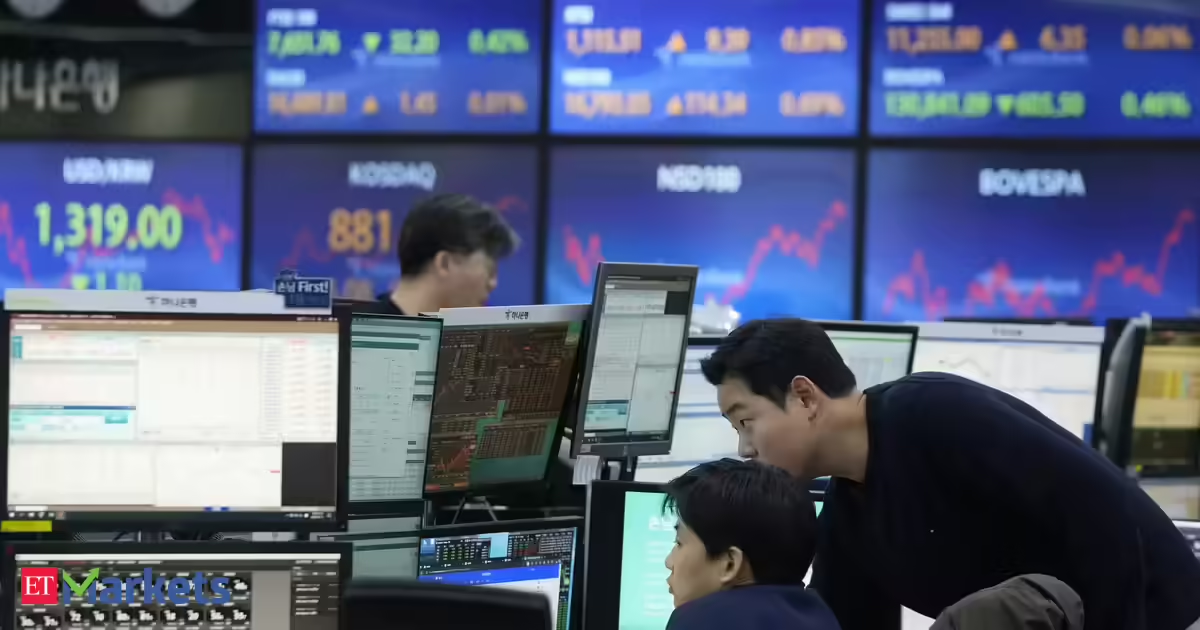
Brent crude futures jumped about 6% to $96 a barrel in early Asia trade. The dollar, which sold off sharply on Friday when the strait briefly opened, rose slightly.
S&P 500 futures fell around 0.7%, a modest move considering the index notched a record closing high on Friday. Asia-Pacific markets were mixed, with Australia’s S&P/ASX 200 down 0.5% and Japan’s benchmark Nikkei up 0.7%.
Bond markets, which rallied on Friday, retreated.
“The headlines look bad; it looks like there’s disagreement … which has led to a little bit of re-escalation,” said Damien Boey, portfolio strategist at Wilson Asset Management in Sydney. “But I think, ultimately, both sides want to be able to do a deal – that’s part of the reason why the market’s optimistic and not selling off too much.”
Iran rejected new peace talks with the U.S., its state news agency reported on Sunday, hours after U.S. President Donald Trump said he was sending envoys for talks in Pakistan and would launch new strikes on Iran unless it accepts his terms.
FOCUS ON HORMUZ
In forex news, the euro was down 0.1% at $1.1735 and the yen eased around 0.3% to 159 per dollar, while the Australian and New Zealand dollars fell slightly.
Bonds likewise partially retraced Friday moves, with benchmark 10-year U.S. Treasury yields, which had fallen 6.5 basis points on Friday, rising by 3.2 bps to 4.276%.
Investors sold fixed income assets through March in anticipation of higher oil prices driving inflation – something they have tempered a little in recent weeks.
“Our base case (AKA guess) is still resolution to the war. Trump is still focused on November midterm elections,” said Paul Chew, head of research at Singapore’s Phillip Securities in a note to clients.
Wall Street indexes touched record highs on Friday, supported by expectations of robust first-quarter earnings, the bulk of which come this week. China is expected to hold benchmark lending rates steady on Monday.
British inflation data, U.S. retail sales and European purchasing managers’ index figures are due later in the week, though much of markets’ focus will be on Gulf shipping.
“The critical barometer of geopolitical risk has been distilled into one data point: The number of ships transiting the Strait of Hormuz,” said Bob Savage, head of markets macro strategy at BNY.
“Peace talks matter, but the immediate focus is on oil and other supply shortages driving inflation.”

National Australia Bank flags $503 million impairment hit on Mideast volatility

The all-cash deal, valued at about ₹1,200 crore, involves a transfer of stressed debt between asset reconstruction platforms and investors. It was closed in March. The exposure dates back to 2018, when Edelweiss ARC, in partnership with Oaktree and other investors, had acquired nearly 90% of GTL Infra’s loans, then valued at around ₹4,000 crore.
The telecom tower company had defaulted on debt exceeding ₹11,000 crore, triggering multiple restructuring efforts over the years.
People familiar with the latest transaction said Edelweiss had put the exposure on the block as its fund lifecycle neared maturity, prompting a takeout by Omkara.
“This is a 100% cash deal between ARCs. Edelweiss exited and we acquired the exposure,” an executive at one of the firms said on condition of anonymity.
Investors are betting on improved recovery prospects this time. “The underlying business is more or less stable now. The towers are operational, and that improves the chances of recovery,” the person said.
Omkara is understood to be targeting an exit over the next two years, either through asset sales or a negotiated settlement. “The idea is to close the account in about two years-through sale of assets or other recovery mechanisms,” the person added. Omkara and Edelweiss ARC spokespersons did not respond to requests for comment until press time Sunday.
In 2018, after a steep revenue and Ebitda decline following the exit of key clients including Aircel, RCom and Tata Teleservices, GTL Infrastructure sought to deleverage, with lenders assigning 79.34% of its ₹3,226-crore debt to Edelweiss ARC. The firm submitted multiple restructuring proposals from April 2018 onward, expecting a swift resolution, but lenders did not act on these plans and some retained their exposure.
In November 2022, the National Company Law Tribunal (NCLT) rejected a plea by Canara Bank to initiate insolvency proceedings, ruling that the company remained a viable going concern and did not meet the threshold for admission under the bankruptcy code.

Stocks and the rupee are seen facing fresh challenges after having recouped losses and strengthened amid easing geopolitical tensions. Last week, the Sensex and Nifty gained up to 1.3%, while broader indices advanced further – the Nifty Midcap 150 rose 3.5% and Smallcap 250 was up 4.4%, extending gains for the second straight week. The rebound faces hurdles if tensions erupt again.
The rupee may open 30-35 paise weaker against the dollar. It closed at 92.93 per dollar on Friday, up 0.30% from the previous close. But traders expect it to slip below 93 due to higher oil prices, after some ships were fired upon as Iran closed the Strait. Satellite imagery late on Sunday showed ships at a standstill, after they had started moving two days before.
“On Friday, things had cooled down a bit after Iran opened the Strait but since then, there have been some volatilities, as a result of which, oil prices have increased,” said Alok Singh, head of treasury at CSB Bank. “It is now turning out to be a market driven by statements from the US and Iran. We should expect volatility to continue till there is clarity.”
Belligerent statements by both sides are balanced by plans for renewed dialogue in Pakistan this week. Mediators and affected Gulf states are also keenly aware that the end of the two-week ceasefire is days away.
 Agencies
 RBI may Help Rupee
“Based on the current news flow, markets on Monday are likely to react primarily to crude prices,” said Shrikant Chouhan, head of equity research, Kotak Securities. “If oil moves back toward $100 per barrel, the market may open near previous closing levels, and then shift focus toward domestic developments.”
When Iran announced on Friday that the Strait of Hormuz would be open as part of peace efforts, Brent crude plunged 9% to $90.38 a barrel, helping Wall Street benchmarks close at record highs later in the day. Before the US-Iran truce, prices were at around $110.
All eyes are on the diplomatic peace talks between the US and Iran, with the ceasefire deadline of April 22 fast approaching, said Siddhartha Khemka, head of research at Motilal Oswal Financial Services. “Now that there has been a sharp rally over the past 10 trading sessions, there should be some consolidation,” he said.
Higher oil prices will push the rupee to open lower on Monday before the Reserve Bank of India (RBI) possibly steps in to prevent a sharp fall, traders said. RBI’s move to take dollar demand by oil companies out of the market by providing them a direct supply of the currency through State Bank of India may also prevent a sharp fall in the rupee.
If the war continues for a longer period and crude again goes back to $100-120 per barrel, it will be negative for the economy, and markets could see a worse reaction, said Mahesh Ojha, vice president, research, Kantilal Chhaganlal Securities. “Fourth quarter results from ICICI are marginally better than expected, while HDFC Bank posted a steady quarter, and this could act as a positive trigger on Monday,” he said. “If conditions turn worse, the banking heavyweights could offer support, while if sentiment improves, they could add further upside.”
Since the ceasefire announcement on April 8, the Sensex and Nifty have gained over 5%, while the Nifty Midcap 150 and Nifty Smallcap 250 advanced roughly 10%.
The market seems well-positioned to extend its uptrend, rather than remain range-bound, said Dhupesh Dhameja, derivatives analyst at Samco Securities.

It seems Brock Lesnar has retired.
Following his loss to Oba Femi during the second night of WrestleMania 42, Lesnar left his gloves and wrestling boots in the ring, a typical sign of retirement that fans last saw when AJ Styles retired in January.
Brock Lesnar Leaves Gloves, Boots in the Ring
Lesnar stayed seated in the ring after the match, soon shocking fans in attendance and watching at home when he began to remove his gloves. Fans soon began to voice their disapproval, continuously chanting “No!” as he went.
A visibly emotional and crying Lesnar then began to remove his boots before leaving them, along with the gloves, at the center of the ring.
Paul Heyman eventually entered the ring, and Lesnar made an “x” sign with his arms before the two shared a hug.
Lesnar waved to the crowd and bowed in gratitude before leaving the ring as chants of “Thank you, Lesnar” echoed throughout the arena.
Is This It for Lesnar?
If his actions in the ring truly meant that his match against Femi is his final match, Lesnar joins the list of recently-retired WWE legends.
It can be recalled that John Cena retired in December after tapping out to Gunther. AJ Styles likewise retired in January after a match with “The Career Killer.”
Fan reaction online has been swift as many grappled with the idea that Lesnar his retired, with many expressing their gratitude to one of the greatest combat athletes WWE has ever seen.
One fan on X expressed shock by saying, “4 minutes 45 seconds for what could be Brock’s last match??”
“Brock hasn’t retired yet,” another fan said. “We will see on Raw when Gunther confronts him.”
One pointed out a sad truth for a generation of WWE fans by saying, “Lesnar, Styles, & Cena all announced their retirement in the span of four months.”
Originally published on sportsworldnews.com

National Australia Bank hikes credit provisions on Iran war; flags $961 mln charge

CStone presents preclinical data on three ADC candidates at AACR

In the first half of April, investors bought a net $500 million of bonds in the lowest tier of investment grade, and sold $7.3 billion of the higher tiers, according to JPMorgan Chase & Co. That helped BBB bonds perform comparatively better than higher-rated notes, pushing the gap between spreads for BBB and A corporates to the tightest since before the war.
There may be good reason for these slightly riskier bonds to be performing better: BBB rated companies have outperformed analysts’ average forecasts more than A companies have, according to a Bloomberg News analysis.
Buyers are hoping a more lasting peace in West Asia can be forged by negotiators, and that companies in the lower edges of investment grade can keep performing well.
“There is some value in the BBB space and issuers there have been good stewards of the balance sheet and generally improving credit quality,” said Gene Tannuzzo, global head of fixed income at Columbia Threadneedle Investments.
Investors have also been snatching up junk bonds, although with a preference for the higher-rated end of the spectrum, implying that money managers still see risk ahead even as they grow moderately more hopeful. Overall spreads for junk bonds are at their tightest since the war began, averaging 2.72% as of Thursday’s close.

ROHAN SHAH
TECHNICAL ANALYST, ASIT C MEHTA INVESTMENT
Where is Nifty headed this week?
Nifty staged a strong comeback this month after a prolonged four-month decline, supported by easing geopolitical tensions and lower crude prices. The index has approached a resistance band of 24,300–24,700, which aligns with multiple technical studies. However, sustained strength above this zone is essential for the continuation of the upward momentum, potentially paving the way toward 25,500. Inability to hold above this zone may trigger profit booking, dragging the index lower towards 23,500–23,200. Trading Strategy: Buy Nifty futures above 24,700 for an upside target of 25,500, maintaining a stop-loss below 24,250.
TOP STOCK BETS
Jubilant FoodWorks
Buy at CMP Rs 459 | Stop-loss Rs 420 | Target Rs 525
The stock shows early reversal signs, backed by one-year high volumes and a high-wave candle near a demand zone, indicating selling exhaustion. The Rs 420–440 zone is key support; RSI shows bullish divergence.
Maruti Suzuki India
Buy at CMP Rs 13,453 | Stop-loss Rs 12,500 | Target Rs 15,500
The stock has witnessed a strong rebound after confirming a bullish ABCD harmonic pattern. The formation of a cup-and-handle pattern alongside improving volumes signals accumulation. RSI holding above its breakout level suggests a positive bias.
AgenciesAJIT MISHRA
SVP – RESEARCH, RELIGARE BROKING
Where is Nifty headed this week?
Nifty is now approaching key moving averages (100 and 200 DEMA) in the 24,600– 24,800 zone. Sustained strength above this band could open room for further upside towards 25,200. In case of profit booking or consolidation, the 23,700–24,000 zone is likely to provide strong support.
Trading Strategies: For the short term, traders may consider a “buy on dip” approach in the 24,150–24,250 range, with a stop-loss at 23,900 and potential targets of 24,800 and 25,200. Among sectoral themes, the Nifty Energy Index has witnessed a fresh breakout after spending more than one-anda-half years in a consolidation phase. Participants can consider playing this theme through an ETF, i.e., Mirae Asset Nifty Energy ETF. It is currently trading at Rs 39.11, and one can accumulate it in the Rs 37–40 zone with a stoploss at Rs 34 for a positional target of Rs 52.
TOP STOCK BETS
Federal Bank Buy. CMP Rs 293 | Stop-loss Rs 278 | Target Rs 325
Federal Bank is in a steady uptrend with higher highs and lows post-base formation. A strong breakout near the 200-DMA signals a sentiment shift; price holds above key averages, with RSI supporting continuation.
JSW Energy
Buy. CMP Rs 538 | Stop-loss Rs 504 | Target Rs 598
JSW Energy is in a stage-2 uptrend, consolidating after a strong rally. The range-bound move near the 200-DMA suggests a healthy pause, with price now attempting an upward breakout supported by improving momentum.
RAJESH PALVIYA
HEAD OF TECHNICAL AND DERIVATIVES, AXIS SECURITIES
Where is Nifty headed this week?
Nifty is fast approaching 24,415—the upper boundary of the bearish gap etched on March 9. A conviction close above 24,500, however, could open the floodgates. The next logical pit stops are 24,762— the 61.8% Fibonacci retracement of the Feb March decline—and the psychologically significant 25,000 mark. A slip below the 24,000–23,900 support band would be a warning shot, potentially dragging the index back to retest its weekly low of 23,555. Traders on the long side would do well to respect this floor. The overall outlook remains positive, as the weekly RSI continues to stay above its reference line. This indicates that positive momentum is still intact and not yet exhausted.
Trading Strategies: The recommended strategy for Nifty options for the April 28, 2026, expiry is a call spread, ideal for a moderately bullish market outlook. The trader buys one lot of the 24,400-strike Call option at a premium of Rs 260–240 and simultaneously sells one lot of the 24,700-strike Call option at a premium of Rs 130–150. This strategy limits both risk and reward, creating a defined range for outcomes. The break-even point is at 24,530, with a maximum potential loss of Rs 8,450 and a maximum profit of Rs 11,050.
TOP STOCK BETS
Mazagon Dock Shipbuilders
Buy at Rs 2,618, CMP Rs 2,620| Stop-loss Rs 2,550 | Target Rs 2,800-2,850
A breakout above Rs 2,430 signals a shift to a primary uptrend, with RSI strength confirming bullish momentum. Resistance lies at Rs 2,800–2,850; sustained strength could extend gains to Rs 3,000–3,050.
Polycab India
Buy at Rs 8,184, CMP Rs 8,188.50 | Stop-loss Rs 7,900 | Target Rs 8,600-8,900
An uptrend supported by a rising trendline and a doublebottom near Rs 6,650 underpins strength. Resistance at Rs 8,700; a breakout could target Rs 9,000+. Maintain Rs 7,600 as a stop-loss; below this, risks a breakdown.
Oil claws back losses as Strait of Hormuz is closed again

45 Highest-Rated Movies on IMDb, Ranked by Votes

Will private credit cause the next financial crisis? | BBC News


-

 Crypto World6 days ago
The SEC Conditionalises DeFi Platforms to Be Avoided for Broker Registration
-

 Fashion2 days ago
Weekend Open Thread: Theodora Dress
-

 NewsBeat6 days ago
Trump and Pope Leo: Behind their disagreement over Iran war
-

 Crypto World6 days ago
SEC Signals Exemption for Crypto Interfaces From Broker Registration
-

 News Videos5 days ago
Secure crypto trading starts with an FIU-registered
-

 Sports3 days ago
NWFL Suspends Two Players Over Post-Match Clash in Ado-Ekiti
-

 Crypto World6 days ago
SEC Proposes Certain Crypto Interfaces Don’t Need to Register as Brokers
-

 Business11 hours ago
Powerball Result April 18, 2026: No Jackpot Winner in Powerball Draw: $75 Million Rolls Over
-

 Politics2 days ago
Palestine barred from entering Canada for FIFA Congress
-

 Crypto World2 days ago
Russia Pushes Bill to Criminalize Unregistered Crypto Services
-

 Sports7 days ago
NWFL opens Pathway for new Clubs ahead of 2026 Season
-
 Business3 days ago
Creo Medical agree sale of its manufacturing operation
-
 Entertainment6 days ago
Brand New Day’ Footage Reveals the Devastating Impact of ‘Now Way Home’
-

 Politics15 hours ago
Zack Polanski demands ‘council homes not luxury flats for foreign investors’
-

 Crypto World7 days ago
Trump whales load up ahead of Mar-a-Lago luncheon.
-
Business7 days ago
Kering slides after Morgan Stanley downgrade, Gucci woes loom
-

 Tech7 days ago
Google adds E2E encryption to Gmail for iOS and Android enterprise users
-

 Tech7 days ago
Apple glasses won’t go brand shopping like Meta did with Ray-Ban and Oakley
-
Entertainment7 days ago
How Euphoria Season 3 Premiere Paid Tribute to Eric Dane After Death
-
 Entertainment6 days ago
Karol G’s ‘Ultra Raunchy’ Coachella Set Gave ‘Satanic Vibes’
You must be logged in to post a comment Login