Connect with us
DAPA Banner

Business

How Consumer Habits Are Forcing the UK Entertainment Sector to Innovate

Published

on

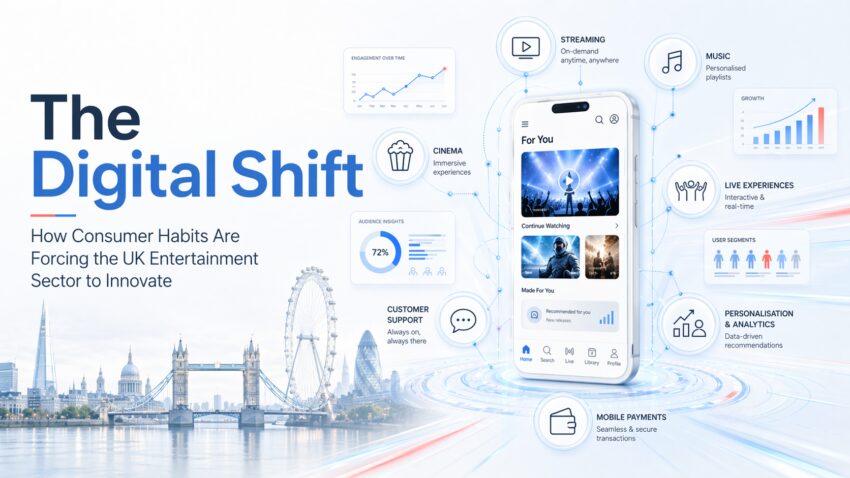
The Digital Shift: How Consumer Habits Are Forcing the UK Entertainment Sector to Innovate

British consumers have stopped being patient. The average UK adult now abandons a mobile app that takes longer than three seconds to load, watches streaming content across four separate subscriptions, and expects a customer service response within the hour rather than the working day.

The cumulative effect on the entertainment sector has been the most significant behavioural shift since the arrival of broadband, and operators across every vertical — from cinemas to casinos, from Spotify to Sky — have spent the past five years rebuilding their businesses around a consumer who will churn for five pence of friction.

According to Ofcom’s Online Nation research, UK adults now spend close to four hours a day online, the majority of it on mobile devices, with attention fragmented across a growing catalogue of competing services. The strategic lesson underneath this pattern is not really about technology. It is about retention economics, and it applies well beyond entertainment. Any UK business competing for discretionary consumer spend — a point explored in our ongoing coverage of UK consumer behaviour trends — is operating in the same environment, facing the same expectations, and learning the same lessons the hard way.

The retention calculus has inverted

The Digital Shift: How Consumer Habits Are Forcing the UK Entertainment Sector to Innovate

For most of the twentieth century, consumer businesses grew by acquiring new customers. Retention mattered, but it was a secondary metric. The assumption was that a reasonable product and a competent experience would keep most customers in place, and marketing spend was directed at the top of the funnel.

The digital shift inverted this. Customer acquisition costs across UK consumer categories have risen sharply, driven by Meta and Google ad inflation, data protection constraints that have narrowed targeting precision, and market saturation in most verticals. At the same time, switching costs for consumers have collapsed — comparison tools, portable accounts, and one-tap sign-ups mean that leaving one provider for another is now a three-minute decision rather than a three-week one.

Advertisement

The commercial consequence is that retention is now the primary growth lever in most UK entertainment businesses. The streaming cohort — Netflix, Disney+, Spotify, DAZN, Sky — spend materially more on product and personalisation than on acquisition marketing. Licensed UK gambling operators, arguably the sector under the heaviest retention pressure given that regulation continuously reduces their acquisition toolkit, have quietly become some of the most sophisticated customer-experience engineers in the British consumer economy. Independent review sites evaluating the best online roulette UK platforms publish detailed breakdowns of how these operators structure onboarding, retention mechanics, and responsible-play architecture — and the patterns on display are the result of a decade of forced innovation under regulatory pressure no other UK consumer sector has yet faced.

What high-retention entertainment businesses are doing differently

The Digital Shift: How Consumer Habits Are Forcing the UK Entertainment Sector to Innovate

Three patterns recur across the most successful UK operators, regardless of vertical.

First, they have moved decisively to mobile-first product design. This is more than responsive layouts. It means rebuilding core flows — registration, payment, content discovery, support — around the reality that the majority of sessions now originate on a handset, often in short bursts of attention during commutes, breaks, or the half-hour between putting children to bed and falling asleep. Products designed for a desktop user with uninterrupted time fail silently in this environment. The operators winning are those who have redesigned their funnels assuming the user has forty seconds, one thumb, and an imperfect 4G signal.

Second, they have invested heavily in personalisation infrastructure. The old model — segment the audience into five or six personas and serve each a different homepage — is dead. Modern personalisation operates at the individual session level, adjusting content surfacing, messaging tone, promotional offers, and even interface complexity based on behavioural signals gathered in real time. Spotify’s weekly playlists, Netflix’s thumbnail variations, and the dynamic landing pages used by leading gambling operators are all manifestations of the same underlying investment in behavioural data infrastructure.

Advertisement

Third, they have shortened the feedback loop between product and commercial teams. Traditional consumer businesses release product updates quarterly and measure success in pooled cohort data. The high-retention operators run continuous experimentation programmes, A/B testing hundreds of changes per month with commercial KPIs visible to product teams in near-real time. The strategic effect is that product decisions stop being bets and start being iterations.

Regulation is not the enemy of retention

The shift above has happened simultaneously with a regulatory environment that has become substantially more demanding across UK consumer sectors. Financial services has the FCA’s Consumer Duty. Online platforms have the Online Safety Act. Gambling has a continuously tightening regime under the Gambling Commission’s LCCP framework. Food delivery faces evolving gig-economy rules. Even retail is navigating expanded product safety, digital markets, and advertising standards obligations.

The operators coping best with this compression have learned a counterintuitive lesson. Regulation is not the enemy of retention, and in some cases improves it. A customer who trusts the operator to handle their data well, flag risks honestly, and resolve complaints quickly is a customer who stays. The regulatory frameworks force the kind of customer-centric behaviours that sophisticated retention teams were trying to instil anyway. The businesses struggling are those that treated compliance as a cost centre rather than a product investment, and now find themselves retrofitting trust into a product architecture built for extraction.

This is particularly visible in gambling, where the regulatory envelope has tightened every year since 2020 — advertising restrictions, feature bans on auto-spin and turbo play, deposit thresholds triggering affordability checks, and a broader cultural expectation of demonstrable consumer care. Operators who responded by rebuilding their product around responsible engagement rather than maximised session length have retained customer bases that their more aggressive competitors have bled.

Advertisement

Live engagement as the new differentiator

The newest competitive frontier across UK entertainment is live, interactive content — and the strategic reasoning behind it is worth understanding even for businesses that will never livestream anything.

Passive content is increasingly commoditised. Every major streaming service has roughly the same library of prestige drama. Every bookmaker has roughly the same Premier League markets. Every music service has roughly the same fifty million tracks. Differentiating on catalogue is almost impossible at scale, and pricing power collapses accordingly.

Live, interactive engagement breaks this parity. A live dealer roulette table, a Peloton class with a real instructor, a Twitch stream with chat, a live podcast recording with audience questions — these experiences cannot be commoditised because each one is genuinely unique, time-bounded, and shared with other participants. The product becomes the moment, not the content, and the moment cannot be replicated by a competitor the following Tuesday.

The implications generalise. Any UK consumer business whose product could plausibly be delivered as a live or interactive experience should be investigating that option, because the retention premium on live engagement consistently exceeds the cost of producing it. Retail has learned this through shoppable livestreams. Fitness has learned it through class formats. Entertainment, broadly defined, is the next category where this lesson will compound.

Advertisement

The lesson for the broader UK economy

The UK entertainment sector is, in one respect, a preview of what every consumer-facing UK business will face within three to five years. The same acquisition cost pressure, the same mobile-first expectations, the same personalisation arms race, the same regulatory compression, and the same shift toward live and interactive formats will reach retail, financial services, hospitality, professional services, and beyond. The sectors that adapt earliest will retain margin. The sectors that treat the shift as a temporary disruption will lose it.

The strategic insight is simple and uncomfortable. The British consumer is not becoming more demanding because consumers have changed — the underlying psychology is the same as it ever was. They are becoming more demanding because the operators who set the benchmark in their daily digital lives have raised it to a level that other sectors will be measured against whether they like it or not. A utility company is now being compared, implicitly, to Monzo. A law firm is being compared to Gumtree. A specialist retailer is being compared to Amazon.

The entertainment sector got here first because the pressure hit first. The rest of the UK economy is catching up to the same conversation, and the operators watching closely are the ones who will survive it.

Advertisement

Continue Reading
Click to comment

You must be logged in to post a comment Login

Leave a Reply

Business

Assicurazioni Generali S.p.A. (ARZGY) Shareholder/Analyst Call Prepared Remarks Transcript

Published

on

OneWater Marine Inc. (ONEW) Q1 2026 Earnings Call Transcript

Andrea Sironi

Ladies and gentlemen, welcome, and good morning. Welcome to the Shareholders’ Meeting of Assicurazioni Generali convened today as an ordinary and extraordinary meeting at the company’s offices in Trieste Floor 7 of Balasoerlam in Piucabzi1. As provided for in the Articles of Association, I shall Chair the meeting. For the secretarial duties, I shall be assisted in accordance with Article 25 of the Articles of Association and 4 of the meeting regulations by Mr. Giuseppe Catalano, Secretary of the Board of Directors of the company. I also invite notary, Mrs. [indiscernible] to draw up the minutes of this meeting.

This year, unlike last year, the meeting is being held in a format that does not require the physical attendance of those entitled to attend. They may, therefore, participate in the meeting by granting a proxy to the designated representative, namely Computershare SAI represented here by Mr. Alberto Elia. The Board, which I Chair has, in fact, considered that the geopolitical tensions could have affected the orderly conduct of our meeting.

Furthermore, in keeping with tradition, even those who are not entitled to attend may follow the opening remarks of the Group CEO, Mr. Philippe Donnet; the Group CFO, Mr. Cristiano Borean and myself. I would, therefore, like to extend also on behalf of my colleagues who sit with me at this table, a greeting to all those who are following this event via streaming.

Advertisement

We believe that this is, as always, an important event in corporate communication, and we wish to enable a broad and inclusive audience of shareholders and stakeholders to follow it live. This approach is consistent with Generali’s

Continue Reading

Business

Virgin Galactic amends terms of 9.80% first lien notes due 2028

Published

on


Virgin Galactic amends terms of 9.80% first lien notes due 2028

Continue Reading

Business

Common Observations Westerners Notice in Thailand Within a Few Days

Published

on

Thailand's central bank cuts its 2026 GDP growth forecast to 1.3%

Westerners in Thailand notice unique street food, vibrant markets, beautiful temples, friendly locals, chaotic traffic, respectful gestures, and cultural practices, all contributing to a richly immersive experience within 30 days.

Unique Transportation Modes

In Thailand, Westerners quickly notice the distinctive transportation modes. The vibrant tuk-tuks and bustling motorbike taxis dominate the streets, offering a lively and efficient way to navigate through the city. Public transportation also includes the iconic red songthaews and an extensive network of buses and trains, contrasting with the car-heavy reliance many Westerners are accustomed to. This variety adds a unique charm to daily commutes and tourist explorations.

Diverse Culinary Experiences

Thailand’s culinary landscape is an immediate stand-out for Western visitors. Street vendors line the avenues, offering an array of tantalizing dishes like pad Thai, som tam, and mango sticky rice. The flavors are often bold and spicy, differing significantly from typical Western cuisine. Mealtime becomes an adventure in itself, with the abundance of fresh, locally sourced ingredients and a vibrant mix of tastes and aromas inviting exploration and appreciation.

Warm and Welcoming Culture

The Thai culture is marked by a genuine warmth that leaves a lasting impression. Known as the “Land of Smiles,” the friendly demeanor of the Thai people makes interactions pleasant and welcoming. Social customs, such as the respectful wai gesture, highlight the country’s emphasis on politeness and kindness. Westerners often find this cultural trait refreshing and heartening, fostering a deeper connection and appreciation for Thailand’s rich traditions and hospitable environment.

Advertisement

Some Observations Westerners Make in Thailand

In Thailand, Westerners quickly notice a delightful blend of contrasts. The vibrant street markets captivate with their bustling energy, offering everything from delicious Thai street food to intricate handicrafts. The politeness embedded in the wai greeting and the monks collecting alms each morning present unique cultural norms. Thailand’s rich spiritual atmosphere, with its ornate temples and ubiquitous spirit houses, leaves a lasting impression. The love for spicy food, as seen in dishes like som tam and tom yum, challenges taste buds but is undeniably addictive.

Transport is another eye-opener, with tuk-tuks weaving through traffic and motorbikes laden with entire families. Thai time, a more relaxed approach to punctuality, contrasts sharply with Western expectations. Nature lovers appreciate Thailand’s lush landscapes, from the serene northern mountains to the pristine southern beaches. The prevalence of street animals, especially cats and dogs, evokes both surprise and affection. Observing these nuances over 30 days reveals a nation of warmth, vibrancy, and enchanting diversity, leaving Western visitors both charmed and enlightened.

Advertisement
Continue Reading

Business

Life Time Group Holdings elects directors and approves proposals at annual meeting

Published

on


Life Time Group Holdings elects directors and approves proposals at annual meeting

Continue Reading

Business

CapitaLand China Trust (CLDHF) Q1 2026 Earnings Call Transcript

Published

on

OneWater Marine Inc. (ONEW) Q1 2026 Earnings Call Transcript

CapitaLand China Trust (CLDHF) Q1 2026 Earnings Call April 22, 2026 8:00 PM EDT

Company Participants

Xiuyi Ng – Manager of Investor Relations of CapitaLand China Trust Management Limited
Kin Leong Chan – CEO & Executive Non-Independent Director of CapitaLand China Trust Management Limited
Lintong Yan
Hong You – Head of Investment & Portfolio Management of CapitaLand China Trust Management Limited

Conference Call Participants

Advertisement

Terence Lee – UBS Investment Bank, Research Division
Geraldine Wong – DBS Bank Ltd., Research Division
Vijay Natarajan – RHB Research Institute Sdn Bhd

Presentation

Xiuyi Ng
Manager of Investor Relations of CapitaLand China Trust Management Limited

Advertisement

Good morning, everyone. Welcome to CLCT’s 1Q 2026 Analyst Briefing. I’m Xiuyi, Investor Relations for CLCT. With me today, we have our CEO, Gerry; CFO, Joanne; CFO Designate, Lintong; and Head of IPM, You Hong.

For this meeting, we will start with a brief presentation followed by a Q&A session. [Operator Instructions]. So with that Gerry, please go ahead.

Kin Leong Chan
CEO & Executive Non-Independent Director of CapitaLand China Trust Management Limited

Advertisement

Thanks, Xiuyi. Welcome everyone to CLCT’s first Q 2026 business update. Thank you again to making some time this morning to attend this presentation. This is update. So I think it will be relatively short. There’ll be more Q&A time later.

So CLCT, we are the first and largest China-focused S-REIT. So now, of course, we also have connectivity to the C-REIT market through us jointly listing a C-REIT on the Shanghai Stock Exchange with our sponsor. Our current total asset is SGD 4.5 billion. We have 8 retail malls, 5 business parks, 4 logistics assets. And most of our assets are in Tier 1 and Tier 2 cities. Distribution yield using FY 2025 DPU with the unit price now is roughly about 7.5%, right? That reflects some of the unit price movement from the broad market winners after the start of

Advertisement
Continue Reading

Business

Magnetar funds sell $75.8m in CoreWeave (CRWV) stock

Published

on


Magnetar funds sell $75.8m in CoreWeave (CRWV) stock

Continue Reading

Business

Kinetik Holdings: I Squared Capital-linked entities sell $7.7m stock

Published

on


Kinetik Holdings: I Squared Capital-linked entities sell $7.7m stock

Continue Reading

Business

S&P 500 Earnings: A Broken Record – Positive Revisions, Revenue Growth Worth Noting Again

Published

on

U.S. Earnings Season Ends On Strong Note

S&P 500 Earnings: A Broken Record – Positive Revisions, Revenue Growth Worth Noting Again

Continue Reading

Business

FM must rethink – The Economic Times

Published

on

ET Search
This refers to ‘We withdrew stimulus last year!’ (ET, Mar 4). TT Ram Mohan has rightly suggested that the tax-GDP ratio measures structural improvement. The FM must rethink his medium-term debtto-GDP target. Losing substantial revenues by cutting I-T rates seems odd. If oil breaches $75-80, the FM will have to hike petroproduct prices and borrow more. Most sectors like FMCG are raising prices sharply due to hikes in excise duties and fuel taxes. Macro-economic conditions like hefty government borrowings, tight monetary control and a fiscal strategy relying on uncertain disinvestment/spectrum auction proceeds, will impinge on private investments in 2010-11. D B Naik
Mumbai, March 4

Add ET Logo as a Reliable and Trusted News Source

Continue Reading

Business

Salboy launches Hidden aparthotel brand in Cornwall as developer achieves ‘not so hidden’ ambition to move into hospitality

Published

on

Business Live

St Ives scheme will be the first of several launches by developer behind Manchester’s tallest tower scheme

Hidden St Ives is the first destination  under Salboy's new Hidden brand

Hidden St Ives is the first destination under Salboy’s new Hidden brand(Image: Salboy)

Developer Salboy has moved into the hospitality market with the launch of its own boutique aparthotel brand.

The group co-founded by betting entrepreneur Fred Done will open its first Hidden location in May in St Ives, Cornwall – and plans to open another site soon in its Greater Manchester heartland as it begins its national rollout.

Salboy is best-known for its Manchester high-rise schemes, including Viadux off Deansgate and the upcoming Nobu Manchester, set to be the tallest British tower outside London. That 76-storey tower will include a restaurant by Nobu, the restaurant group backed by Hollywood legend Robert De Niro.

Salboy bosses have now developed their own Hidden hospitality offer, focusing on aparthotel developments they say “combine the independence and privacy of an apartment with the ease of a hotel”. Each scheme will be developed by Salboy in partnership with local contractors, and the group says there are “a number of Hidden projects in development in popular tourist destinations throughout the UK”.

Advertisement

Hidden St Ives will welcome its first guests in mid-May. That project, developed on the site of a former hillside hotel 10 minutes walk from the centre of the famous seaside town, will include 18 two-bedroom apartments.

Simon Ismail, CEO of Salboy, said: “As a developer of thousands of UK homes and serviced apartments, as well as a partner to global luxury hospitality brands, it’s become our not-so-hidden ambition to venture into high-end hospitality in our own right. There’s high demand from discerning travellers for boutique, design-led holiday rentals in many of the UK’s most attractive, tranquil and historic locations, but many of the holiday let options on the market simply don’t reach their expectations.

“Every Hidden aparthotel is designed to cater to people looking for more than just a place to stay. Hidden goes further to help visitors step out of the fast lane, slow down and tune into the stunning natural environment around them. We’re hand-picking and painstakingly designing every Hidden destination to provide quiet, restful, unplugged stays, while also enabling guests to appreciate the sort of high quality concierge, housekeeping and chauffeur services they’d expect from a large luxury hotel brand.’

Hidden St Ives is the first destination  under Salboy's new Hidden brand.

A bedroom at Hidden St Ives(Image: Salboy)

Salboy’s operations director Miz Herrara, who will lead the growth of Hidden in the UK, said: “It’s a huge honour to bring the high standards of quality and delivery that Salboy has become known for in the development and longer-term lettings space to this high-growth, sought-after market. We’re hugely excited about welcoming our first guests to Hidden St Ives this spring, and unlocking more hidden pockets of the UK for guests to enjoy over the next few years.”

Advertisement

The Hidden launch follows the unveiling of Salboy Construction in 2026 and the start of the Salboy Property Development Roadshow programme in March.

Mr Ismail said: ‘After more than 12 years developing, financing and building in the UK property market, the expectations we have of ourselves, our schemes, our services and our partners are as high as ever. At Salboy, we are constantly pushing ourselves to think differently about the way this industry needs to evolve to bring the highest levels of service and end-product to clients. The aparthotel market underserves discerning high-end travellers and we are bringing a Salboy solution to that problem.”

Continue Reading

Trending

Copyright © 2025