
Business
How landscape gardening is being electrified


Part of the soundtrack to a day in southern California is the drone of petrol-powered gardening equipment.
Noise is one of the main reasons that cities around the US, external are banning petrol landscaping tools or encouraging electric alternatives.
These alternatives have the additional benefits of reducing carbon emissions, vibrations and the exposure of landscapers to pollution.
In addition they can mean longer working hours, as they can be used at times when residents demand quiet.
Today, I’m taking part in training run by the American Green Zone Alliance (AGZA), an organisation supporting the transition towards electric landscaping equipment.
To my surprise, the electric backpack leaf blower I strap on is not much heavier than my normal rucksack. Using the blower to herd balls around the park feels fairly intuitive, though naturally I’m much clumsier and slower than the pro landscapers.
As for noise, there’s still a buzz, but the sound is higher-pitched and not quite so loud as the familiar petrol-powered machines.
The move to electric power is attracting new companies to the market for gardening kit.
US aerospace start-up Whisper Aero is one of those firms. Its main business is electric propulsion systems for aircraft.
But in 2022, after the Covid-19 pandemic made many people more sensitive to noise, and following a couple of years of research and development, the company realised that its aerospace-grade fans would work well in leaf blowers.
“Our technology is cleaner, quieter and more efficient than other air-moving technologies that exist today,” according to Andrew Terajewicz, Whisper Aero’s director of air management. “And the leaf blower is the perfect mix of this.”
The battery on Whisper Aero’s blower lasts up to 50 minutes at full power.
The company has had to scale up its manufacturing volume in its expansion to consumer technology.
Online pre-orders of Whisper Aero’s handheld leaf blower started this year. It’s priced at the high-end of electric leaf blowers, which are often more expensive than traditional petrol versions.
But for that you get a machine which is less likely to disturb the peace.
“It is so ultra quiet yet powerful, that the brain has a hard time understanding what’s happening,” says Dan Mabe, the former landscaper who founded AGZA.
Whisper Aero aims to further develop its products, including a backpack leaf blower that would be better suited to professional landscapers.


Sebastian Mackensen, BMW of North America’s president and CEO, said the automaker is committed to U.S. manufacturing as it completes a $1.7 billion South Carolina plant expansion.
BMW plans to recall 27,720 cars across three model lines over a driveshaft issue that could result in the vehicle rolling away.
The recall impacts vehicles in the luxury car manufacturer’s 5 Series, 7 Series, and 8 Series, according to filings made with the National Highway Traffic Safety Administration (NHTSA).
The recall stems from the connection between the driveshaft and the rear differential, which may experience excessive wear over time.
SUBARU RECALLS OVER 540,000 SUVS AFTER FEDERAL REGULATORS FLAG WEIGHT CALCULATION ERROR: NHTSA

A BMW 7 Series automobile is seen at the BMW Production Network 2, Gaya Motor production plant in Jakarta, Indonesia. The automaker is issuing a recall for more than 27,000 vehicles across three classes over a driveshaft issue. (Getty Images / Getty Images)
The excessive wear can lead to a loss of power to the rear wheels, which increases the risk of a crash or vehicle rollaway if the vehicle isn’t secured by the parking brake.
The notice affects 18,150 5-Series vehicles produced from 2021 to 2023 (540i, 540i xDrive and M550i xDrive), 7,372 8-Series vehicles from 2022 to 2026 (840i and 840i xDrive), and 2,198 750e xDrive models made from 2024 through 2026 (750e xDrive plug-in hybrid).
KIA ISSUES NEW RECALL OF 460,000 VEHICLES AFTER PREVIOUS FIX TO FIRE RISK FAILED

A new BMW 7 series automobile is seen at the BMW Production Network 2, Gaya Motor production plant in Jakarta, Indonesia. (Getty Images / Getty Images)
BMW has not received any reports of accidents or injuries related to the drivetrain issue, the notice states.
FOX Business has reached out to the automaker. BMW plans to send notification letters to vehicle owners by Oct. 2.
Automotive expert Mike Caudill analyzes the future of electric vehicles in the U.S. as rising gas prices shift consumer interest on ‘The Bottom Line.’
CLICK HERE TO GET FOX BUSINESS ON THE GO
BMW dealers have been instructed to perform the recall for affected vehicle owners for free. Technicians will either apply an adhesive to the affected part or replace the driveshaft and rear differential.

Tracking Mario Gabelli's Gabelli Funds 13F Portfolio – Q2 2026 Update

Operator
Thank you for standing by, and welcome to the PWR Holdings Limited FY ’26 Results Call. [Operator Instructions]
I would now like to hand the conference over to Sharyn Williams, CEO and Managing Director. Please go ahead.
Sharyn Williams
MD, CEO & Director
Good morning. I’m Sharyn Williams, CEO and Managing Director of PWR Holdings Limited, and I’m joined by Robert Shore, Chief Financial Officer, who joined us in April. Today, we present PWR’s full year results for the financial year 2026.
Before we begin, I’d like to acknowledge the executive team for their leadership through a year of significant change. Our Founder and Managing Director, Kees Weel, moved into the Chair role, and Matthew Bryson stepped in as the acting CEO while that transition happened. My thanks to Matthew, in particular. The continuity of leadership supported the result that we are presenting today. I’ll cover the group highlights and market segments. Rob will take you through the financials, and I’ll close on strategy and outlook.
Turning to Slide 4. FY ’26 was a year of strong execution. We delivered on our strategic priorities and the momentum in the business is now delivering operating leverage. The group delivered record revenue of $171 million, up 31%, driven by significant growth in our 2 largest strategic growth markets, Motorsports and A&D. Importantly, that revenue growth translated into a materially stronger earnings outcome.
Statutory NPAT increased 83% to $17.9 million and NPAT margin improved to

Check out what’s clicking on FoxBusiness.com.
Thousands of off-road motorcycles are being recalled over a braking defect that could cause serious injury or death from a crash, according to federal regulators.
KTM North America Inc., of Amherst, Ohio, is recalling about 21,040 GASGAS and Husqvarna off-road motorcycles in the U.S., the U.S. Consumer Product Safety Commission announced Thursday.
Another 4,140 were sold in Canada, according to the commission.
FROZEN DOG FOOD RECALLED OVER SALMONELLA CONTAMINATION THAT LED TO MULTIPLE PET ILLNESSES

Thousands of off-road motorcycles are being recalled over a braking defect. (U.S. Consumer Product Safety Commission)
The recall affects certain 2021 through 2024 GASGAS and Husqvarna off-road motorcycle models.
“The rear brake caliper can crack or break, reducing the brake system’s effectiveness, posing a risk of serious injury or death due to crash hazard,” the commission said in its notice.
NEARLY 1M CHRYSLER, JEEP, DOGE AND RAM VEHICLES RECALLED OVER CAMERA GLITCH

The recall affects 2021 through 2024 off-road motorcycles. (U.S. Consumer Product Safety Commission)
The GASGAS off-road motorcycles are red with the white GASGAS logo on both sides of the shrouds, while the Husqvarna motorcycles are white, blue and yellow with the Husqvarna logo on both sides of the shrouds.
The motorcycles were sold at GASGAS and Husqvarna authorized dealers from September 2020 to June 2023 for between $7,300 and $13,000.

The motorcycles were sold at GASGAS and Husqvarna authorized dealers from September 2020 to June 2023 for between $7,300 and $13,000. (Getty Images / Getty Images)
CLICK HERE TO GET FOX BUSINESS ON THE GO
Consumers are urged to stop riding the recalled motorcycles immediately and contact an authorized GASGAS or Husqvarna Motorcycle dealer to schedule a free repair at the dealership.
No injuries have been reported thus far in connection with the recalled motorcycles.

Dozens of people have accused TUI River Cruises of operating vessels with faulty facilities including persistently broken air conditioning, after they spent thousands of pounds on holidays.
Earlier this year passengers on the Skyla, a ship operated by TUI, contacted BBC Your Voice to say they had been stranded in Budapest during a heatwave with little to no air conditioning.
Following that report more people got in touch to say they faced similar problems on both the Skyla and its sister vessel, the Isla. They criticised TUI’s customer service and said the refunds offered were inadequate.
TUI apologised to customers where trips “fell short of the standards we aim to deliver”.
A spokesperson for TUI, said: “We understand the disappointment and frustration caused to affected customers.”
Passengers described stifling conditions as well as problems with plumbing after paying thousands of pounds for European cruises, including on the Danube River.
Andy Peach and his wife booked a seven-day trip on the Skyla in June, travelling through Budapest, Vienna and Linz.
It turned out to be “the worst TUI holiday we’ve ever been on”, he said.
Instead of air conditioning, Peach said there were “big blowers” on board, expelling hot air.
“One was in the middle of the corridor, blocking the exit,” he said. “It didn’t seem to cool the place down.”
Temperatures onboard climbed as the holiday went on leaving him “exhausted”, he said. By the end of the week, Peach said the air conditioning in cabins had broken too.
On the second-to-last day passengers were transferred to hotels, which Peach said were “really basic”.
He and his wife had paid nearly £4,000 for the holiday but they were offered only £300 as a refund and given 72-hours to accept it.
He said: “TUI know there’s problems on these boats, but continue to sell them to people as a full luxury cruise.”

Twenty-somethings are much less likely to own a home than previous generations. But data suggests things may be turning a corner.

Check out what’s clicking on FoxBusiness.com.
Pizza Hut is temporarily dropping “Pizza” from its name as the restaurant chain leans into football season while its parent company moves ahead with a multibillion-dollar sale of the iconic brand.
The chain said this week that it will go by “Hut” for the next 25 weeks, coinciding with the 2026 NFL season.
“You can just call us HUT for the next 25 weeks,” Pizza Hut wrote in a social media post announcing the temporary rebrand.
The company showed off the change at a restaurant in Plano, Texas, where a banner featuring a football covered the word “Pizza” on the location’s exterior sign. Pizza Hut, which is headquartered in Plano, also changed its social media profile images to a logo without the word “Pizza.”
YUM BRANDS IN TALKS TO SELL PIZZA HUT TO PRIVATE EQUITY FIRM: REPORT
The football-themed marketing push comes at a pivotal time for Pizza Hut, as parent company Yum! Brands moves ahead with plans to sell the iconic restaurant chain.
FOX Business reported in June that Yum! was in exclusive talks with private equity firm LongRange Capital over a potential sale of Pizza Hut. At the time, no agreement had been reached, and LongRange was among several firms that had explored acquiring the chain.
Yum! later announced that LongRange agreed to acquire Pizza Hut’s operations outside mainland China for approximately $1.5 billion, while Yum China Holdings agreed to purchase the chain’s mainland China operations in a separate $1.2 billion deal.
The transactions value the operations at a combined $2.7 billion, with Yum! expecting approximately $2.3 billion in net proceeds.
YUM BRANDS SELLS PIZZA HUT FOR $2.7B, SHARPENS FOCUS ON TACO BELL AND KFC
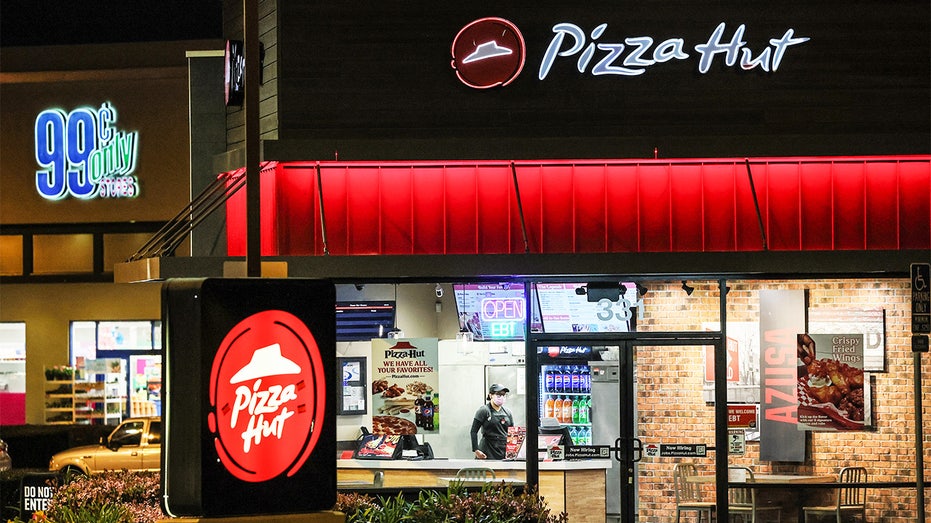
The football-themed marketing push comes at a pivotal time for Pizza Hut. (Robert Gauthier/Los Angeles Times via Getty Images / Getty Images)
“Under LongRange and Yum China, Pizza Hut will be well positioned for future growth with ownership that brings deep expertise in the restaurant industry,” Yum! CEO Chris Turner said.
“Pizza Hut was built by the passion and dedication of our team members, employees and franchisees, and we’re excited for the next chapter.”
| Ticker | Security | Last | Change | Change % |
|---|---|---|---|---|
| YUM | YUM! BRANDS INC. | 152.33 | +6.40 | +4.39% |
The sale follows a prolonged period of pressure on Pizza Hut’s U.S. business. FOX Business reported in June, citing Reuters, that Pizza Hut generated about 12% of Yum!’s revenue in 2025 and had posted declining U.S. comparable sales for 10 consecutive quarters.
Yum! had been evaluating strategic alternatives for Pizza Hut, including a potential sale, as the chain worked to reverse its sales slump.

Pizza Hut says it will go by “Hut” for the next 25 weeks, coinciding with the 2026 NFL season.
LongRange emerged as a potential buyer after Apollo Global Management and Sycamore Partners were also reported to have explored bids for Pizza Hut.
Yum! said earlier this month that the sale remained on track to close in August.
CLICK HERE TO GET FOX BUSINESS ON THE GO
The “Hut” branding, however, isn’t permanent. After its 25-week football promotion ends, Pizza Hut is expected to return to the name consumers have known for decades.
FOX Business’ Bradford Betz contributed to this report.

Nearly six months after US President Donald Trump vowed a swift victory over Iran, the conflict appears to be at a standstill, with prospects of a military victory or negotiated settlement growing dimmer.
To break the deadlock, Trump has vowed an “economic D-Day” under which any country that does business with Iran would face “tremendous” economic consequences.
Iran, however, has long faced sanctions and has so far shown a willingness to endure pain and a capacity to adapt to immense economic and military pressure as the conflict drags on.
The key question for the US then becomes, will further sanctions work where other strategies have failed?
The exact mechanics of the new US economic pressure campaign remain unclear, with Treasury Secretary Scott Bessent promising to reveal them in a news conference on 24 August.
But in an interview with CNBC, Bessent made clear that the US is willing to take action against any country – friend or foe – that it believes is extending a lifeline to Iran.
“You are either with us or against us,” he said. “If you insist on doing business with [Iran], either transferring money, buying their oil or doing seaborne sea transfers, then the US treasury and the US government… will put its full might and force toward enforcing against you.”
Vice-President JD Vance has described the sanctions as a “new phase” of the conflict in which economic pressure is the “most effective” tool available to the US.
“They’re going to try to apply economic pressure to us, but what has been true over the last couple of weeks is that they felt a lot more pressure than we have,” Vance said on the Clay Travis and Buck Sexton show.
“We’re going to keep that going because we think that’s the best way to ultimately achieve the final objective,” he added.
Iran has faced significant US sanctions since nearly the beginning of the Islamic Republic in 1979.
The economic pressure campaign intensified after the first Trump administration withdrew from the Joint Comprehensive Plan of Action (JCPOA), a 2015 pact between world powers and Iran to curb its nuclear programme.
And in the current conflict, the US government has already announced Operation Economic Fury, a two-pronged US economic campaign combining US treasury-co-ordinated sanctions against regime financial flows and a naval blockade against Iranian ports.
Imran Bayoumi, a geostrategy expert with the Atlantic Council in Washington DC and former policy adviser to the defence department, told the BBC the latest announcement was likely the result of mounting frustration that other options have not delivered the results Trump wants.
“This is really a recognition that the US is almost stuck in this war,” he said. “It’s another try at economic pressure.”
“This is just another tool that the US is using,” Bayoumi added. “We’ve not seen a clear strategy laid out by the administration with either military or economic tools. The question of what the US is trying to achieve is still unanswered.”
Michael Parker, an eight-year veteran of the Office of Foreign Assets Control (OFAC) and expert on economic sanctions, said the new strategy will likely represent an effort to “expand the economic blast radius” of sanctions by targeting third countries that still deal with Iran, but have economies that depend on the US dollar.
“Thus far, the US has largely used the threat of these secondary sanctions against foreign financial institutions to encourage compliance with sanctions policy,” he said.
“But this is a lever that is sort of unexplored insofar as targeting anything touching the US dollar that is also touching Iran,” Parker added.
As an example, Parker pointed to foreign financial institutions that help Iran evade sanctions, or directs money towards Iranian coffers.
How Iran would respond to these moves remains unclear, but sanctions experts say that Iran has so far proved adept at using irregular channels to circumvent sanctions – such as “shadow” vessels transporting oil or new commercial fronts unlisted by US sanctions.
“You keep seeing new names popping up, because Iran is adapting really quickly,” said Mohammed Hammouda, an export control and sanctions manager at the London Stock Exchange. “Whatever sanctions one does, they find a new road [around it].”
These Iranian counter-moves, he added, often leave those charged with enforcing compliance playing a game of catch-up.
“Sanctions are all on paper, but the hard work is behind the scenes,” Hammouda added. “There are teams worldwide trying to impose sanctions and identify those parties involved, which is why Iran has to try to adapt.”
How effective these sanctions are will largely be determined by how the countries that are ultimately targeted – which could include US allies like Turkey and Iraq, as well as China – react.
“Some of this is out of Iran’s hands,” Parker said. “Iran’s ability to evade or avoid sanctions is, in large part, contingent on other countries and financial institution’s willingness to give them [Iran] access to the formal banking system.”
Parker believes that the sanctions are “only as powerful” as the willingness of targeted countries to comply with American foreign policy objectives, or face potentially painful sanctions on trade involving the US dollar.
Some experts question whether that willingness currently exists.
“I can’t really see China agreeing to that, for example,” Bayoumi said. “These states have all been able to navigate their own interests with the Trump administration.”
“The underlying point is that this is just another tool,” he added. “But the broader question of strategy remains. Absent that, I’m not sure this is going to change anything long term.”

Redevelopment of Albany’s historic pilot station precinct has begun, with the $8.3-million project to breathe new life into the 173-year-old site.

International sales no longer belong only to large companies with overseas offices and dedicated regional teams. Smaller manufacturers, exporters, e-commerce businesses and professional services firms can now speak directly with prospects across multiple markets, often using the same messaging apps their customers already use every day.
WhatsApp is one of those channels, but using it for business becomes harder as enquiry volumes increase. Conversations become scattered across different sales representatives, follow-ups are easy to miss and managers have limited visibility into who is speaking to which customer. A WhatsApp CRM adds more structure by connecting conversations with customer records, ownership, follow-up activity and team workflows.
For growing businesses, that shift matters. WhatsApp can remain a convenient communication channel while becoming part of a more organised sales process.
WhatsApp Often Becomes a Sales Channel Before Businesses Plan for It
Many companies do not deliberately decide to build a WhatsApp sales operation.
It simply happens.
An overseas buyer asks for a catalogue and wants to continue the conversation on WhatsApp. A distributor sends a message after meeting the company at a trade show. A prospect asks for a quotation. A salesperson follows up after an enquiry from the website.
Over time, more customer communication moves into WhatsApp because it is fast and familiar.
The problem is that the process often grows without any structure around it.
One salesperson has customer conversations on one account. Another salesperson uses a different account. Important information may remain inside chat histories, spreadsheets or personal notes.
This can work when there are only a few enquiries.
It becomes much more difficult when the business has multiple representatives, hundreds of leads and customers spread across several countries.
The Real Problem Is Not Messaging, It Is Follow-Up
Most sales opportunities are not won in the first conversation.
A buyer may ask for information today, request pricing next week and need another follow-up a month later.
B2B sales cycles can be even longer.
A manufacturer might speak with a potential distributor several times before sending samples. A procurement team may need internal approval before responding to a quotation. An overseas customer may disappear for several weeks before returning with a revised requirement.
WhatsApp makes these conversations easy to start.
It does not automatically create a reliable follow-up process.
Without a CRM structure, salespeople may depend on memory, starred messages, spreadsheets or personal reminders.
That creates predictable problems:
- promising leads are forgotten;
- several employees contact the same buyer;
- there is no clear customer owner;
- managers cannot see which enquiries are still active;
- follow-ups depend too heavily on individual habits;
- customer context becomes difficult to transfer between employees.
A CRM helps turn the conversation into a process rather than leaving it as another unread message in an inbox.
International Sales Add Another Layer of Complexity
Domestic sales teams may already struggle with fragmented conversations.
International teams have additional challenges.
Different Time Zones
A customer in Europe may send a message while a salesperson in Asia is offline.
If the team relies completely on manual responses, leads can wait hours before receiving even a basic acknowledgement.
Automated replies and scheduled follow-ups can help maintain communication outside normal working hours while leaving important conversations for a salesperson to continue later.
Different Languages
A salesperson may be experienced at selling a product but less confident communicating in the buyer’s language.
Copying every message into a separate translation tool adds friction and increases the possibility of losing context.
Real-time translation inside the sales workflow can make everyday conversations easier, particularly when teams handle enquiries from several markets.
It does not eliminate the need to review sensitive or highly technical wording, but it can make routine communication much faster.
Multiple WhatsApp Accounts
International teams frequently operate more than one WhatsApp account.
There may be separate numbers for different countries, sales representatives, brands or departments.
Without central management, employees spend time switching accounts and customer information remains fragmented.
A multi-account CRM approach can give managers and team members a clearer view of conversations and ownership without forcing every customer relationship into an isolated inbox.
Customer Information Should Belong to the Business
There is another issue that growing businesses sometimes discover too late.
Customer relationships often become closely tied to individual salespeople.
A representative may have months or even years of WhatsApp conversations with buyers. They know previous quotations, product preferences, objections and follow-up history.
When that employee changes roles or leaves the company, transferring the relationship can be difficult.
The new account owner may receive a phone number and customer name but little context about what happened before.
Centralising customer records and conversation history reduces that dependency on individuals.
For management, this is not only about efficiency.
It is also about protecting a business asset.
Customer relationships developed through company time, marketing and sales activity should remain accessible to the organisation even when employees change.
AI Is Most Useful When It Removes Repetitive Sales Work
AI is becoming part of many CRM systems, but its value depends on what it actually removes from the salesperson’s workload.
The strongest use cases are usually repetitive tasks.
A salesperson may answer the same questions about product availability, shipping, minimum order quantities or company information dozens of times.
They may also spend time:
- writing similar follow-up messages;
- checking which leads need another response;
- translating routine conversations;
- searching previous chats for customer context;
- answering basic questions outside working hours.
AI-assisted replies, knowledge-based chatbots and automated follow-up can reduce some of this work.
The objective should not be to remove salespeople from the conversation.
It should be to let them spend more time on the conversations where judgement, negotiation and relationship building actually matter.
Better Visibility Helps Sales Managers Too
WhatsApp can feel highly productive from the salesperson’s perspective while remaining almost invisible to management.
A manager may know that the team is busy but still struggle to answer basic questions:
Which leads are active?
Who owns each customer?
Which prospects are waiting for a quotation?
How many enquiries have not been followed up?
What happens when a salesperson goes on leave?
Which customer conversations are generating progress?
Once WhatsApp activity is connected to customer records, assignments and follow-up information, managers have a clearer view of the sales process.
This does not mean monitoring every message.
It means having enough visibility to manage workload, identify missed opportunities and ensure customers are not forgotten.
The CRM Should Match How the Business Actually Sells
A company does not necessarily need to replace its entire technology stack simply because WhatsApp has become important.
The right approach depends on how sales already work.
For some businesses, WhatsApp is only one of several communication channels connected to a larger CRM.
For others, particularly exporters and international B2B teams, WhatsApp is where most customer conversations actually happen.
In that situation, using a WhatsApp CRM for international sales such as WADesk can make more sense than building a complicated process around separate messaging, translation, lead tracking and follow-up tools.
WADesk brings customer conversations, multiple WhatsApp accounts, lead management, AI assistance, real-time translation and team collaboration into the same workspace. It also supports workflows for identifying potential overseas buyers and managing them through subsequent WhatsApp communication.
The important point is not how many features a platform offers.
It is whether those features remove friction from the way the sales team already works.
When Does a Business Need More Than WhatsApp Business?
Not every company using WhatsApp needs a CRM.
A small business with one account, one salesperson and a manageable number of customer conversations may be perfectly comfortable with WhatsApp Business.
The need for additional structure usually becomes clear through operational symptoms.
For example, the business may be ready for a CRM when:
- several employees are handling WhatsApp enquiries;
- multiple accounts need to be managed;
- leads regularly require several follow-ups;
- managers cannot easily see customer ownership;
- staff are maintaining separate spreadsheets alongside WhatsApp;
- customers communicate in several languages;
- conversation history is difficult to transfer between employees;
- missed or duplicate responses are becoming common.
At that stage, the challenge is no longer simply sending messages.
It is managing customer relationships at scale.
Growing Internationally Without Adding Unnecessary Complexity
Small and medium-sized businesses have a particular challenge when expanding overseas.
They need more process, but they rarely want more administration.
Adding a new system only makes sense if it removes more work than it creates.
That is why WhatsApp CRM is becoming relevant to growing international businesses. It adds structure around a communication channel employees and customers are already using rather than forcing both sides into an entirely new way of working.
The sales team can continue speaking with buyers through WhatsApp.
The difference is what happens behind those conversations.
Leads can have owners. Follow-ups can be tracked. Customer history can remain with the company. Managers can gain visibility. Routine tasks can be automated. Language barriers can become easier to manage.
Final Thoughts
WhatsApp has made international customer communication faster, but faster messaging does not automatically create a better sales process.
As enquiry volumes, team sizes and overseas markets grow, businesses need a clearer way to organise the customer relationships behind those conversations.
A WhatsApp CRM can provide that structure without removing the convenience that made WhatsApp useful in the first place.
For growing exporters, manufacturers and other international businesses, the opportunity is straightforward: keep the conversation simple for the customer, while making the process behind it much easier for the sales team to manage.

SEC Regulation Crypto vs CLARITY Act: which framework wins

The New Exercise Trend for People Who Hate Going to the Gym

Arthur Okonkwo Joins Charlton Athletic on Loan from Wrexham





-

 Fashion6 days ago
Weekend Open Thread: Ann Taylor
-
 Tech7 days ago
11 Ways to Rank Your Videos
-

 Sports6 days ago
Birmingham 2026: Day 6 Timetable for Irish Athletes
-
 NewsBeat6 days ago
Myanmar says over 300,000 Rohingya refugees verified for repatriation as exodus enters ninth year
-

 Politics6 days ago
SEQ Code: The Three Letter Boarding Pass Code That Could Give You The Worst Seat
-

 Tech3 days ago
Qwen3.8-27B runs frontier-class coding agents and reasoning locally, no cloud API required
-

 Business3 days ago
SMA Solar Technology AG (SMTGY) Q2 2026 Earnings Call Transcript
-

 Crypto World6 days ago
Pi Network Protocol 27 endgame: last upgrade before what?
-

 Crypto World3 days ago
OCC Greenlights Trump Family Crypto Firm for Trust Charter
-
 Tech6 days ago
Every fusion startup that has raised over $100M
-
 Entertainment6 days ago
Marvel Studios Reveals New X-Men Cast Including Adam Driver and Sadie Sink
-

 Business7 days ago
15 Ways to Make Money From Your Phone (2026 Guide)
-
 Entertainment7 days ago
10 Netflix Shows That Quietly Became Modern Classics
-

 Crypto World7 days ago
Robinhood Chain Approaches $1B TVL as Uniswap Integration Boosts Liquidity
-

 Fashion6 days ago
Silver bangles for women – Newbridge Silverware
-

 Fashion6 days ago
Weekly News Update, 8.14.26 – Corporette.com
-

 News Videos22 hours ago
Don’t Leave Your Financial Future To Chance | August 19, 2026
-

 Business6 days ago
Facebook Down Now? Users Report Login And Loading Problems As Outage Trackers Monitor Ongoing Issues
-
 Business6 days ago
Monarch Mutual Fund set to enter MF space with maiden overnight fund; files draft with Sebi
-

 Fashion6 days ago
Cart Confidential Vol. 44 – Julia Berolzheimer
You must be logged in to post a comment Login