



Connect with us

Business

How Taylor Farms became integral to America’s food supply system

Published

on

How Taylor Farms became integral to America's food supply system
How Taylor Farms became so important to the U.S. food supply

The cyclospora outbreak that has sickened thousands of people across the U.S. has brought fresh scrutiny of the integral role Taylor Farms and other massive suppliers play in the country’s food supply.

The company, which the Food and Drug Administration has linked to the parasite’s spread, is one of the world’s largest producers of fresh-cut vegetables and salads, supplying some of the biggest grocery chains and restaurant companies in the U.S. Its products are sold at retailers including Walmart, Kroger, Whole Foods and Target, and its restaurant customers include McDonald’s, Taco Bell and Chipotle. Taylor Farms says 40% of salad kits sold at grocery stores come from the company, giving it a massive role in supplying a convenient and cheap vegetable option for many shoppers.

The company, founded in 1995, has grown through a combination of scale and acquisitions, building an operation that spans much of the food supply chain. Taylor Farms works with hundreds of family farms for its produce and handles processing, packaging and distribution itself.

That reach has made the company an increasingly important link between farms and some of America’s biggest food companies, and heightens the risk of food safety problems spreading. Taylor Farms’ scale has put the company under a brighter spotlight as the FDA investigates the cyclospora outbreak that the agency has linked to iceberg lettuce processed at Taylor Farms’ facility in central Mexico, some of which was served at Taco Bell restaurants.

Advertisement

Taylor Farms declined CNBC’s invitation for an interview but sent comments defending the steps it has taken to respond to the outbreak and keep its produce safe.

“We are confident in our food and food safety systems and will continue to be transparent as more information becomes available,” a spokesperson for Taylor Fresh Foods, the corporate name for Taylor Farms, told CNBC.

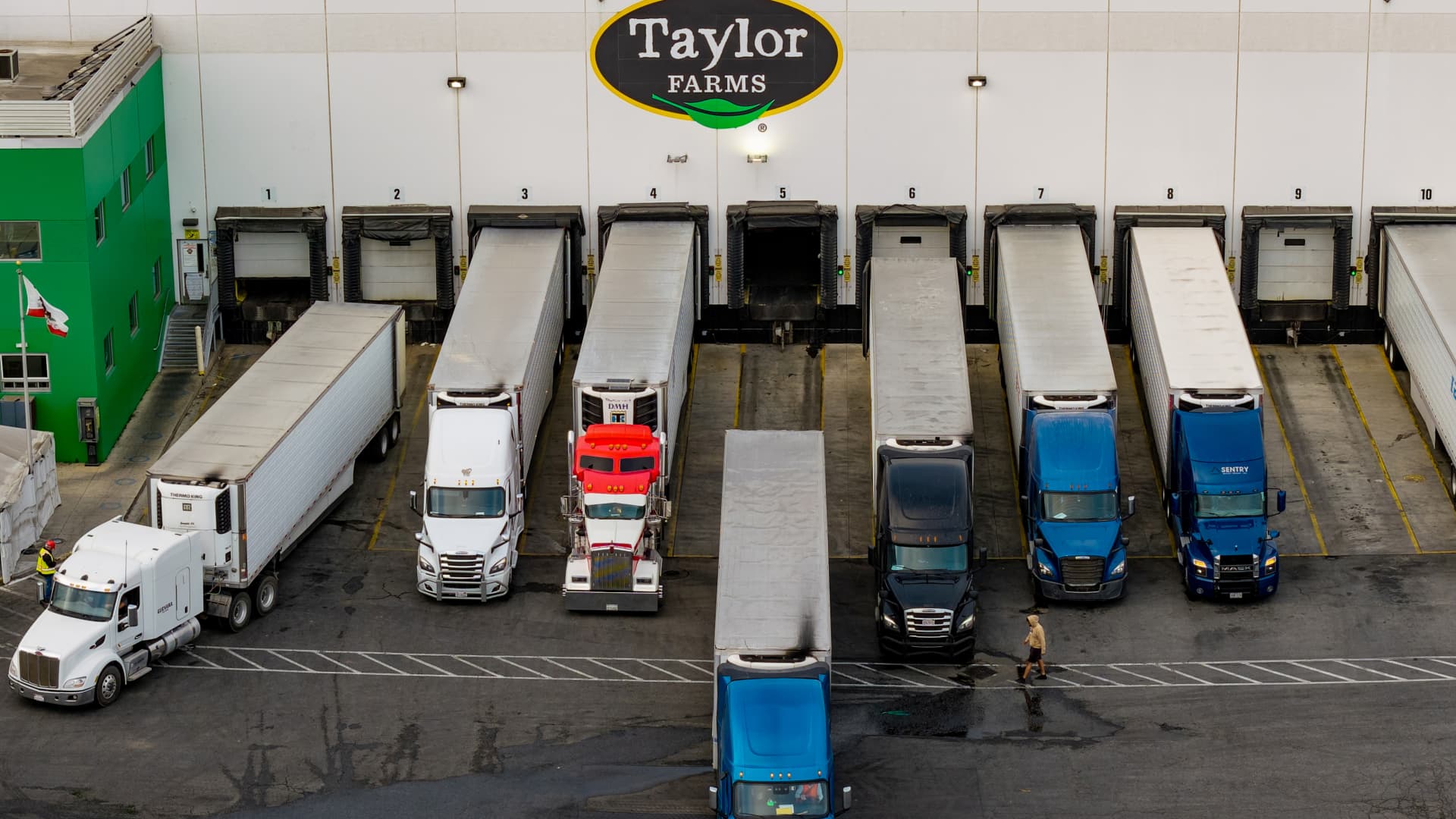
Tractor trailers at a Taylor Farms facility in Salinas, California, Aug. 10, 2026.

Josh Edelson | Bloomberg | Getty Images

Advertisement

Taylor Farms said in an August post on its website that it spends more than $200 million a year on food safety. The company added in a statement to CNBC that safety is its “biggest area of funding by several orders of magnitude.”

Taylor Farms has also voluntarily suspended iceberg lettuce sourcing and production from central Mexico and commissioned independent experts to conduct a review of food safety practices at its facility there. The FDA has not reported a positive product sample for cyclospora, because it can take weeks for symptoms to show and lettuce has a short shelf life, so it is difficult to test the right crop.

The breadth of the outbreak, which has led Walmart to recall bagged salads and Taco Bell to pull lettuce at some restaurants, underscores how integral Taylor Farms has made itself to the U.S. food system, and why broader industry consolidation risks worsening foodborne illness outbreaks.

Why Taylor Farms’ scale is important

A forklift transports crates of produce at a Taylor Farms facility in Salinas, California, Aug. 10, 2026.

Josh Edelson | Bloomberg | Getty Images

The company has also become more important by getting bigger. Taylor Farms has expanded its infrastructure through a string of acquisitions and investments, including its purchases of Earthbound Farm in 2019 and agricultural robotics company Farmwise in 2025.

The benefit of that consolidation has been reliable supply, standardized products and potentially lower labor costs, said Zagor.

Advertisement

But there is another side.

“The consolidation has camouflaged sources,” Zagor said. “It’s all put in one big pot. And if that pot has now gone bad, that affects the entire downstream logistic food chain.”

Zagor called it a “culinary national nightmare” when a company that distributes food to so many other businesses finds itself at the center of a foodborne illness outbreak.

It’s not the first time Taylor Farms has been tied to an outbreak.

Advertisement

Food safety lawyer Bill Marler compiled a list of outbreaks linked to Taylor Farms and whether they led to product recalls. Among them is a 2009 salmonella outbreak linked to shredded lettuce, along with a 2024 E. coli outbreak tied to slivered onions served at McDonald’s.

His law firm, Marler Clark, has filed five complaints based on the current cyclospora outbreak so far in Ohio, Michigan and Kentucky, against four separate Taco Bell franchise operators and the restaurant chain itself, along with Taylor entities including four operators and one supplier.

Growth and regulation

A customer reaches for Taylor Farms bagged salads for sale at a grocery store in Hercules, California, July 17, 2026.

David Paul Morris | Bloomberg | Getty Images

Advertisement

Taylor Farms, along with other food service giants such as US Foods and Sysco, has become bigger and more vital in part by buying other companies.

Taylor Farms has completed more than a dozen acquisitions or investments since 2011. While the cyclospora outbreak — the largest in U.S. history — has brought fresh scrutiny of the effects of consolidation, it’s unclear how much skepticism there was of the deals when they happened.

CNBC asked the Justice Department and Federal Trade Commission whether either agency had reviewed or challenged Taylor Farms’ acquisitions and investments. The DOJ did not respond. The FTC said it could not provide additional details without knowing the purchase prices of the transactions, which determines if the agency even had the opportunity to review.

CNBC found no public evidence that the FTC has challenged a Taylor Farms acquisition. Those deals took place under multiple presidential administrations of both parties, and various FTC leaders.

Advertisement

Some experts also highlighted a separate issue in the U.S. food system: the strength of oversight and regulation of food safety as distributors get larger and more influential. As the cyclospora outbreak raged, various news reports highlighted that Taylor Fresh Foods made a $1 million donation to the pro-Trump super PAC MAGA Inc. last year, around the time the Trump administration delayed a rule related to food tracing requirements. The company has also spent millions on anti-regulatory lobbying.

“If what you want is light enforcement of anything that’s going to be expensive and cost you money, it’s very nice to have political power,” said Marion Nestle, professor emerita of nutrition, food studies and public health at New York University. “You can go to Congress and say, we don’t want to do that.”

Taylor Fresh Foods rejected suggestions that its political contributions have resulted in favorable regulatory treatment.

“Taylor Farms categorically rejects any suggestion that the company has attempted or received favorable regulatory treatment as a result of political contributions or any other improper influence,” a spokesperson said. “The allegations are false.”

Advertisement

Nestle worries whether regulators have enough power as a few big companies become increasingly vital parts of the food system.

“Companies want to produce food as cheaply as possible,” said Nestle.

“And that means you need oversight,” she added.

Choose CNBC as your preferred source on Google and never miss a moment from the most trusted name in business news.
Advertisement
Continue Reading
Click to comment

You must be logged in to post a comment Login

Leave a Reply

Business

Standard Nuclear: Worth Keeping An Eye On, But Not Going To Invest Yet

Published

on

Standard Nuclear: Worth Keeping An Eye On, But Not Going To Invest Yet

Standard Nuclear: Worth Keeping An Eye On, But Not Going To Invest Yet

Continue Reading

Business

Exclusive | Thinking Machines Lab Co-Founder Barret Zoph Joins Google

Published

on

Exclusive | Thinking Machines Lab Co-Founder Barret Zoph Joins Google

Barret Zoph, the Thinking Machines Lab co-founder who abruptly defected to OpenAI this year amid a dispute with Chief Executive Mira Murati, has changed employers again.

Zoph, who served as chief technology officer at the startup and led a push to sell artificial-intelligence products to businesses at OpenAI, is joining Alphabet’s GOOGL -0.39%decrease; down pointing triangle Google as a vice president of research, the company said.  

Copyright ©2026 Dow Jones & Company, Inc. All Rights Reserved. 87990cbe856818d5eddac44c7b1cdeb8

Continue Reading

Business

Thailand Update: Major Trends in Politics, Economy, Tourism, and Society

Published

on

Asia's Industrial Supercycle awakens

Overview

Thailand has been at the center of a wide range of global headlines recently, spanning energy policy, military diplomacy, economic indicators, security challenges, and cultural milestones. This summary highlights the most significant developments shaping the country’s trajectory across multiple sectors.

Energy Transition and Regional Cooperation

Thailand is accelerating its shift away from liquefied natural gas (LNG) toward renewable energy sources, a strategic pivot driven largely by geopolitical instability following the Iran conflict. According to Thailand to Shift From LNG Toward Renewables in Wake of Iran War, the country aims to reduce its vulnerability to volatile fossil fuel markets by diversifying its energy portfolio. This aligns with broader regional energy security efforts, including a landmark 35-year gas supply agreement between PTTEP and Petronas, which strengthens the Thailand-Malaysia energy partnership and ensures long-term supply stability for both nations.

Monetary Policy and Economic Indicators

The Bank of Thailand has held interest rates steady, reflecting a cautious approach amid mixed economic signals. Central Bank Governor commentary suggests officials are pushing back against market expectations for an extended pause in rate adjustments, signaling flexibility depending on incoming data. Meanwhile, Thailand’s exports surged 21.6% year-over-year in July, driven substantially by an AI-related electronics boom, according to Thailand July Exports Rise 21.6% Y/y on AI Electronics Boom. This export strength contrasts with slowing second-quarter GDP growth, which analysts attribute to weakening domestic consumption.

Foreign investment trends are mixed. While Thailand has secured over $30 billion in electronics investment commitments, demand for foreign-owned condominiums has dropped notably due to a pullback in Chinese buyers. The Economic and Environmental Cooperation Organization (EECO) has outlined four priorities to sustain investment momentum, emphasizing the need to derive greater value from capital inflows rather than simply attracting volume.

Advertisement

Military Diplomacy: USS Abraham Lincoln’s Port Call

A major diplomatic and military story involves the USS Abraham Lincoln docking in Thailand after an extraordinary 250-plus day deployment in the Middle East—one of the longest at-sea deployments in recent naval history. The port visit offers sailors their first extended rest-and-recreation opportunity in months before the carrier heads home, with the USS George Washington set to replace it in the region. This visit also carries symbolic weight for US-Thailand diplomatic relations, reinforced by cultural exchanges tied to the visit.

Security Concerns and Domestic Challenges

Thailand faces significant internal security pressures. The southern insurgency has reignited with renewed violence, including coordinated attacks that have wounded multiple people and left local villagers trapped in a persistent cycle of fear. Security forces have tightened measures in response, though the roots of the decades-long conflict remain unresolved.

Separately, the country continues to grapple with the aftermath of a tragic school shooting that claimed at least eight lives, including a 12-year-old victim who succumbed to injuries weeks after the initial attack. The incident, involving a teenage gunman who first killed his grandparents, has prompted national reflection on gun violence and school safety protocols.

In an unrelated but notable development, Thailand issued arrest warrants for 20 Israeli nationals amid a business crackdown on Koh Samui, following a zoo-related dispute that also resulted in a visa revocation—highlighting friction in an otherwise cooperative bilateral relationship.

Advertisement

Political Developments

On the political front, a new amnesty law took effect, though it notably excludes lese majeste offenses, reflecting the continued sensitivity around Thailand’s monarchy laws. Additionally, new deportation rules signed by Deputy PM Anutin are set to take effect August 28, signaling tightened immigration enforcement.

Sports and Regional Competition

Thailand’s football team fell short in the ASEAN Championship final, with Vietnam claiming the title 4-2 on aggregate despite a Thai comeback effort in the second leg. Coach Anthony Hudson maintained optimism about the team’s future prospects. In volleyball, Thailand delivered strong performances, defeating South Korea in the Asian Championship quarterfinals and advancing toward a semifinal clash with Japan.

Technology, Business, and Innovation

Thailand is positioning itself as a regional technology hub. The government has introduced a National AI Roadmap aimed at centering artificial intelligence in productivity gains across industries. Complementing this push, Siemens launched its Eigen Engineering Agent in Thailand, bringing purpose-built industrial AI tools to automation engineering, while ZTE and AIS unveiled “ZTE Day Thailand 2026” to advance intelligent network infrastructure.

China’s commercial space sector has also expanded its footprint through a new partnership deal, while workforce upskilling initiatives aim to prepare Thai talent for an increasingly tech-driven economy.

Advertisement

Culture and Tourism

On the cultural front, Thailand selected “9 Temples to Heaven” as its official Oscars submission for Best International Feature, drawing attention to the country’s growing film industry. Meanwhile, tourism industry observers note diverging travel preferences between Gen Z and Millennial travelers, and Thailand continues pursuing a larger share of the global $9.75 trillion wellness economy.

Source : Google News – Search

Continue Reading

Business

Energy Vault: Deeper Cash Burn And Rising Debt Dull Enthusiasm Around Revenue Surge (NYSE:NRGV)

Published

on

Energy Vault: Deeper Cash Burn And Rising Debt Dull Enthusiasm Around Revenue Surge (NYSE:NRGV)

This article was written by

The equity market is a powerful mechanism as daily fluctuations in price get aggregated to incredible wealth creation or destruction over the long term. Pacifica Yield aims to pursue long-term wealth creation with a focus on undervalued yet high-growth companies, high-dividend tickers, REITs, and green energy firms.

Analyst’s Disclosure: I/we have no stock, option or similar derivative position in any of the companies mentioned, and no plans to initiate any such positions within the next 72 hours. I wrote this article myself, and it expresses my own opinions. I am not receiving compensation for it (other than from Seeking Alpha). I have no business relationship with any company whose stock is mentioned in this article.

Seeking Alpha’s Disclosure: Past performance is no guarantee of future results. No recommendation or advice is being given as to whether any investment is suitable for a particular investor. Any views or opinions expressed above may not reflect those of Seeking Alpha as a whole. Seeking Alpha is not a licensed securities dealer, broker or US investment adviser or investment bank. Our analysts are third party authors that include both professional investors and individual investors who may not be licensed or certified by any institute or regulatory body.

Advertisement
Continue Reading

Business

Festival for entrepreneurs goes from strength to strength

Published

on

Business Live

Ideas Fest will again be staged in Hertfordshire next month

Ideas Fest.

Over the years, I have attended more business conferences than I care to remember. Many follow the same formula, with a windowless hotel function room, a succession of PowerPoint presentations, a buffet lunch, and people wearing name badges, all while trying to work out who might be useful to them.

Good conferences can inform, challenge and connect, but entrepreneurship is not a conventional activity, and entrepreneurs rarely flourish in conventional environments. That is why, five years ago, we created Ideas Fest, which will take place in September at the iconic Champneys Resort in Tring, Hertfordshire.

Advertisement
'Welsh rugby’s problem may not be the number of professional teams but a fragmented and poorly aligned operating model'

Wales misses out on billions in funding every year | Dylan Jones Evans

Inspired by our love of festivals such as Green Man, we set out to move away from the usual conference style and create an event in a field where founders could hear honest stories, make unexpected connections, test ideas, and spend time with people who understand the exhilaration and occasional loneliness of building a business.

This year, six thousand people will gather for two days of talks, conversations, workshops and informal meetings, and more than 500 speakers will participate across stages and tents covering start-up, growth, investment, leadership, and exits.

To keep the festival spirit alive, there will be food traders, bars, a wellness area, and music from Rick Parfitt Junior and the iconic DJ Fat Tony.

Alongside established entrepreneurs, there will be people at the beginning of their journey, investors, advisers and others who support growing firms. Yet the numbers matter less than the purpose, and in my experience working with entrepreneurs over the last thirty years, entrepreneurship is often presented as a largely technical process: write a business plan, identify a market, secure finance, and assemble a team.

Advertisement

Of course, all those things matter, but anyone who has built a company knows the real journey is far messier, as founders often face decisions with no textbook answer. They experience self-doubt, setbacks and periods when they must persuade others to believe in something that may exist only as a possibility.

Business support can help, but it cannot always provide the confidence that comes from meeting someone who has faced the same problem and found a way through it. That is where entrepreneurial communities matter, and at Ideas Fest, the most valuable conversation may happen on a stage, over coffee or while two founders walk between sessions.

Someone may meet their next customer, investor, mentor, or collaborator queuing for the toilet (yes, that did happen last year!) while others may hear the one piece of advice that stops them from giving up. In other words, this is not networking in its most transactional sense but about creating the conditions in which relationships develop naturally and useful collisions can occur.

There is also an important role for honesty, as too much of the narrative around entrepreneurship focuses on success, such as the funding round, the rapid growth, or the eventual sale and what is often omitted is the uncertainty behind those achievements.

Advertisement

Entrepreneurs benefit from hearing not only what worked but also what failed; not only how much money was raised but also how close a business came to running out of funds; and not only the successful exit but also the personal sacrifices made along the way. Those candid conversations across the stages at Ideas Fest make entrepreneurship more human and help founders understand that difficulty is not evidence that they do not belong.

Indeed, Ideas Fest is deliberately designed to encourage what we call “real talk”, and speakers are asked to share lessons rather than deliver polished corporate presentations. As a result, the best contributions are often those in which an entrepreneur explains a mistake they would never repeat or admits they did not always have the confidence others assumed they had.

The event also provides a platform for ambition from across the UK. Through our Start Up Awards and the Fast Growth Index, we encounter thousands of remarkable businesses each year. Many create jobs, develop new products, and transform their communities without receiving the attention they deserve, and bringing founders together from every part of the nation matters because ambition is contagious.

When an entrepreneur from Wales meets someone growing a company in Scotland, Northern Ireland, the Midlands, or the North of England, they often discover they share challenges and that their potential market is larger than they imagined.

Advertisement

This is particularly important for Wales, as we have no shortage of entrepreneurial talent, yet too many founders remain disconnected from the networks, finance and opportunities that could help them grow. If we want to build a more productive economy, we must help ambitious Welsh businesses build relationships beyond their immediate geography while maintaining strong roots in their communities.

Nor should events such as Ideas Fest be judged solely by what happens over two days, as their real value lies in what follows, such as the introduction that becomes an investment, the conversation that becomes a partnership, the idea that becomes a new product, or the renewed confidence that enables a founder to make one more attempt.

Economic development sometimes tends to assume that entrepreneurship can be manufactured through programmes and processes. Government has a crucial role in creating the right conditions, providing appropriate support, and removing barriers, but successful ecosystems are ultimately built around people, trust and relationships, and that is what Ideas Fest is trying to achieve.

It’s certainly a celebration of entrepreneurs, but it is also a practical two days designed to give founders access to knowledge, networks, inspiration, and, perhaps most importantly, one another.

Advertisement

Entrepreneurs build businesses, create employment, and bring new ideas into the economy, yet they also need somewhere to learn, connect, speak honestly, and feel part of something larger than the company they are building.

That is why we created Ideas Fest and why I believe its greatest contribution will not be measured by the size of its audience, but by the businesses, friendships and opportunities that emerge long after everyone has gone home.

Continue Reading

Business

Stifel raises Elastic stock price target to $107 on strong growth

Published

on


Stifel raises Elastic stock price target to $107 on strong growth

Continue Reading

Business

Bachan’s buoys Marzetti sales | Food Business News

Published

on

Bachan’s buoys Marzetti sales | Food Business News

WESTERVILLE, OHIO — The addition of the Bachan’s Japanese barbecue sauce brand helped drive sales to a fourth consecutive year of record highs at Marzetti Co. Texas Roadhouse dinner rolls also continued to build momentum, even while dealing with a tough year-over-year comparison to the previous year’s rollout.

For the 2026 fiscal year ended June 30, Marzetti posted net income of $191.61 million, equal to $6.986 per share on the common stock, up 14% from $167.35 million, or $6.08 per share, in fiscal 2025. The most recent year included a net income benefit of $16.6 million from restructuring, impairment and other charges related to the sale of the company’s property in Milpitas, Calif. Net sales in 2026 rose 1% to $1.93 billion from $1.91 billion a year ago, driven by a 2.4% gain in the Foodservice segment to $927.05 million, which helped offset a narrow decline in Retail sales, which fell to $1.002 billion from $1.003 billion.

David Ciesinski, president and chief executive officer of Marzetti Co., told analysts during an Aug. 25 conference call that the company expects stronger top-line growth for recently-acquired Bachan’s in the back half of fiscal 2027, driven by continued investments in marketing and advertising to build the brand’s awareness and trial. He said the company has two “exciting innovations” on tap.

“First is Bachan’s wing sauce, which will be produced at our own Horse Cave, Ky., facility,” Ciesinski said. “Crafted by the Bachan’s team in conjunction with our culinary team, the wing sauce features craveable tamari-based flavors that deliver rich, savory depth.

Advertisement
epub_Texas-Roadhouse-Lead_T.-Marzetti-Co._800x800_webp.jpg

In the course of last year, retail sales for Texas Roadhouse rolls grew to almost $60 million.

| Photo: T. Marzetti Co.

“The second is Bachan’s Japanese mayo that offers a smooth, silky umami flavor. We expect the addition of the Bachan’s business to our portfolio to be a key growth driver for Marzetti in fiscal ’27. And we’re also pleased to share that the integration of this business remains on track.”

He said the mayo, in particular, presents “a really big category expansion opportunity.”

In the case of Texas Roadhouse dinner rolls, Ciesinski said Marzetti is “exceedingly happy” with the performance of the product since its launch in 2024.

Advertisement

“In the course of the last year, it grew to almost $60 million in retail sales, was up 70%,” he said. “Velocities are two times the category average or thereabouts. We’re launching a second item into Walmart, and honestly, there’s more room just through better distribution on the core items for it to grow. So, if you go back 1.5 years ago, when we began to talk about that item, I estimated that it could be a $100 million in retail sales item. And I still believe that it most certainly has the potential to do that.”

Ciesinski said one of the reasons for optimism around additional growth for the Texas Roadhouse brand is household penetration. He said the brand only has about a 2.5% household penetration, which is a “really, really small” number. By comparison, he said the company’s Sister Schubert’s roll brand has household penetration of close to 10%.

“So, I think with good execution and good trial, that core has the potential to get there ($100 million in retail sales),” he said. “You add that new item, I think it should give us even more confidence that we ought to be able to get there.” 

Advertisement
Continue Reading

Business

Mike Ashley slams Andy Burnham’s ‘populist’ high street and warehouse tax plans

Published

on

Business Live

The billionaire Sports Direct and Frasers Group founder has written to the Prime Minister accusing him of failing to tackle the cost of living crisis

Frasers Group is led by Sports Direct CEO Mike Ashley

Frasers Group is led by Sports Direct CEO Mike Ashley (Image: PA)

Retail magnate Mike Ashley has lambasted Andy Burnham’s plans to breathe new life into Britain’s high streets, branding them “populist” and “too little too late”.

Advertisement

The billionaire founder of Sports Direct and Frasers Group has penned a letter to the Prime Minister, accusing him of failing to address the cost of living crisis with what he describes as “delusional” policies.

The factors driving the UK’s soaring cost of living “have not been assisted by recent government policies and are not going to be helped by your recent populist proposals,” he said, in a letter seen by City AM.

Ashley accused Burnham of chasing headlines rather than delivering meaningful solutions for hard-pressed households and businesses, taking particular aim at the Prime Minister’s “disastrous” stance on business rates.

Burnham has committed to reviewing the way business rates are calculated for pubs and hotels, and has previously backed a levy on warehouses to fund tax relief for high street retailers, as reported by City AM.

Advertisement

Retailers have long cautioned that a warehouse tax could drive up costs for consumers and Ashley, who leads the Derbyshire-based Frasers group, told Burnham the measure would be “delusional”.

“Rather than address the real underlying issues of how the country’s financial affairs are managed, and supporting growth and entrepreneurialism in business, it is easier for you to pick topics which provide good media soundbites and the old salve of yet more regulation – which is not what the country needs to become competitive,” he wrote. “Shortsighted or populist reactions to underlying business challenges are not the answer. You have the chance to make a difference or get it horribly wrong.”

The retail billionaire ridiculed Burnham’s commitment to deliver “everyday fixes” on the cost of living, which have included a £2 bus fare cap and the removal of VAT on household electricity bills.

“This is a certainly a time for pragmatism and brave solutions but applying that to the underlying issues – not jumping on “everyday fixes” or band wagons that only address part of the problem,” he wrote.

Advertisement

Ashley’s comments arrive as businesses increasingly push back against Burnham’s cost-of-living promises while their own overheads continue to climb.

On Monday, a coalition of prominent business figures including billionaire political donor John Caudwell and retail heavyweight Lord Stuart Rose condemned the “creep of taxes” affecting companies nationwide.

In an open letter, the City veterans called on the government to rule out new taxes on founders, including levies on dividends, capital gains and business assets.

On Wednesday, Burnham told the Financial Times that he will address the “challenging” cost of doing business as he seeks to dispel concerns that October’s Budget will usher in another punishing tax assault on British enterprises. In his letter to Burnham, Ashley also took aim at the Prime Minister’s commitment to tackle what he describes as “fake” discounts.

Advertisement

Aldi chief executive Giles Hurley has thrown his weight behind this initiative, accusing rival supermarkets of misleading customers with loyalty pricing schemes.

Ashley said: “The driving down of prices through discounting is what helps the consumer by giving them better value and helps with their cost of living. Driving down prices through discounting against an RRP can’t be what you really mean when you talk about “rip off Britain”.

Before expanding into luxury fashion through Frasers Group’s takeover of Harvey Nichols and building a stake in Hugo Boss, Ashley built his reputation by offering affordable sportswear at Sports Direct.

Advertisement
Continue Reading

Business

Yatharth Hospital shares jump 5% as Aster, Advent likely eye controlling stake

Published

on

Yatharth Hospital shares jump 5% as Aster, Advent likely eye controlling stake
Shares of Yatharth Hospital & Trauma Care Services jumped more than 5% amid buzz around Advent International and Blackstone-backed Aster DM Quality Care negotiating to acquire a controlling stake in the specialty hospital chain.

Yatharth Hospital shares surged to a fresh 52-week high of Rs 1,024.85 apiece on the NSE. India’s second-largest hospital chain is looking to consolidate amid a buyout spree by large private equity groups, people familiar with the matter told The Economic Times.

The existing promoters may retain a sliver of ownership, but final negotiations are still underway, the report said, adding that there is no guarantee that the talks will lead to a transaction. Yatharth, however, denied it is in any sale discussions.

Headquartered in Noida and Greater Noida, Yatharth has about nine hospitals with a total bed capacity of over 2,800. The company is targeting a total capacity of over 5,000 beds in the next three years through new facilities and expansion. Its footprint also covers Jhansi-Orchha in Madhya Pradesh and Faridabad in Haryana.

Advertisement

Advent has been a big backer of Indian pharma companies but has, so far, not made an investment in the hospitals sector other than a 2012 investment in Care Hospitals. Aster DM Quality Care, meanwhile, was formed by a mega merger of Moopen family-founded Aster DM Healthcare and Quality Care India, unifying four healthcare brands — Aster DM, CARE Hospitals, Evercare and KIMSHEALTH. It also saw two of the biggest PE groups, TPG and Blackstone, join forces to create the country’s second-largest healthcare chain.


Also read | Yatharth Hospitals draws interest from Aster, Advent as healthcare consolidation heats up

Yatharth Hospital share price

Yatharth Hospital shares jumped more than 18% in one week and 21% in one month, with the stock overall jumping around 50% in 2026 so far. The shares of the company have overall jumped 43% in three years.In the longer term, Yatharth Hospital shares have delivered multibagger returns of more than 167% in three years. The company currently has a market capitalisation of around Rs 9,676 crore.

For the first quarter ended June, Yatharth reported a 51% year-on-year increase in consolidated revenue to Rs 392.70 crore. Average revenue per occupied bed was at Rs 34,758, up 7% from a year ago. Whole-time director Yatharth Tyagi recently told analysts on an earnings call that the hospital chain grew at 37% in FY26 and is set to “easily surpass that growth” this year.

Also read | These 19 stocks turned into tenbaggers in 5 years: Peter Lynch’s rules to find the next

Advertisement

(Disclaimer: Recommendations, suggestions, views and opinions given by the experts are their own. These do not represent the views of The Economic Times)

Continue Reading

Business

Pragmatic markets North East-made semiconductors to Chinese

Published

on

Business Live

The innovative chip maker is looking to grow its global business

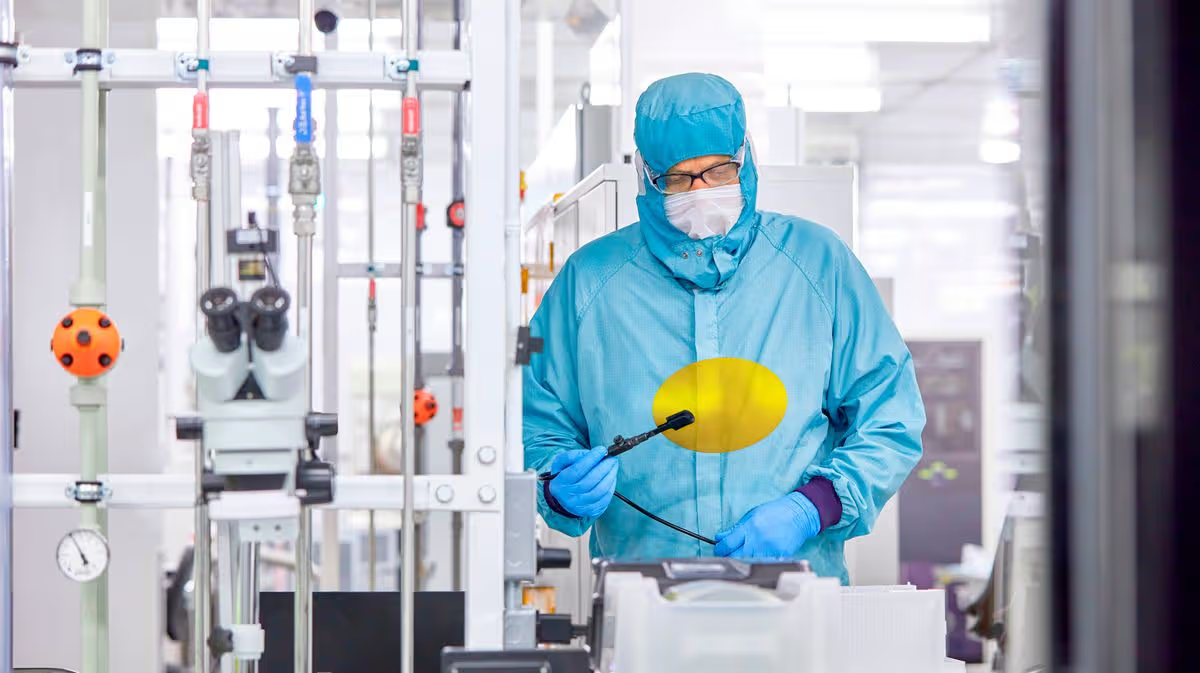
A worker dressed in full protective clothing in one of the clean rooms at Pragmatic Semiconductor's existing NETPark facility. He is holding one of the firm's flexible chips in a tongs.

A worker at Pragmatic Semiconductor’s existing NETPark facility.(Image: Supplied by Brands 2 Life PR)

North East-made microchips that are thinner than a human hair are being marketed in China, the company behind them has revealed.

Pragmatic Semiconductor, which opened its multi million-pound factory site in County Durham in 2024, has launched a new Chinese brand with which it hopes to attract customers in that country. The firm has been exhibiting at the International Internet of Things Exhibition (IOTE) in the country’s southern city of Shenzhen.

It says the launch of the new ‘Pragmatic 湃’ identity demonstrates the significance of the Chinese market – and signals its intention to serve regional customers there. China is considered one of the world’s largest semiconductor markets given its technology-driven strengths in areas such as artificial intelligence and electric vehicles.

Pragmatic’s pioneering flexible semiconductor technology is touted as holding major potential for a range of uses including in packaging, healthcare and consumer electronics, among other ideas. Its ultra-thin semiconductors are physically flexible and can be placed where other counterparts cannot.

Advertisement

The chips offer an alternative to silicon-based alternatives that are energy-intensive to make. And they can be embedded into almost anything, bringing connectivity and intelligence to everyday objects.

James Davey, senior vice president, sales, business development and product management at Pragmatic Semiconductor, said: “Connected products are a critical tool for brand trust, product authentication and protection, and consumer engagement. We are pleased to showcase our customer and partner innovations which demonstrate how flexible semiconductor technology can help brands expand market opportunities and connect the physical and digital worlds.

“With our award-winning NFC product portfolio, expanding partner ecosystem, and new Chinese brand, we are deepening our commitment to customers in China while continuing to scale our global business.”

Pragmatic’s push into China comes as the firm is searching for new equity funding, following its successful £179m series D raise. JP Morgan has been appointed to lead the effort which is intended to ramp up production in County Durham.

Advertisement

In the meantime, the firm has secured £36m of bridge financing from existing investors to keep working. Accounts published earlier this summer, and covering 2025, show Pragmatic saw revenues fall to £901,000, down from £1.69m the year before, and incurred operating losses of £65.1m, up from £55.8m.

Bosses flagged delays to the company’s plan but have pointed to the depth and complexity in their ambition to bring a new, disruptive technology to market. Meanwhile, at Pragmatic Park, a second high-volume production line has been installed to triple the site’s capacity.

Pragmatic’s time at the Shenzhen exhibition was boosted with an award win. It was handed the Radio Frequency Identification (RFID) Product Gold Prize at IOTE 2026’s Innovative Product Awards for its near-field communication product portfolio which includes Pragmatic’s FlexIC, flexible integrated circuit technology.

Advertisement
Continue Reading

Trending

Copyright © 2025