
Business
How the Four AI Chip Giants Really Compare in 2026 for Investors

Four of the world’s most important semiconductor companies, Nvidia, Samsung Electronics, SK Hynix and Taiwan Semiconductor Manufacturing Company, have each posted exceptional stock performance in 2026, fueled by surging demand tied to artificial intelligence infrastructure. Investors weighing which of the four to prioritize face a genuinely complex decision, since each company occupies a distinct position within the AI chip supply chain, carries a different valuation profile, and faces its own particular risks. This is not investment advice; it is a factual look at how the four companies compare, intended to help readers make their own informed decision.
Nvidia remains the dominant designer of graphics processing units used to train and run AI models, a position that has made it the most closely watched name in the sector. The company does not manufacture its own chips; as a fabless designer, it relies on TSMC to produce them. Nvidia has continued ramping production of its next-generation Vera Rubin AI platform and has announced collaborations with both TSMC on chip design and manufacturing and with SK Hynix on advanced AI memory. Analysts at Zacks Investment Research have noted that Nvidia faces increasing competition in AI accelerators and custom silicon, and its valuation reflects a premium tied to expectations of continued rapid growth, with analysts projecting a 52% jump in revenue and a 63% increase in earnings for the fiscal year that recently began. Nvidia’s stock has also shown more volatility than some of its peers this year, falling approximately 13.1% over one recent 30-day stretch even as the broader AI investment theme remained intact.
TSMC occupies a distinct and, according to several analysts, uniquely defensive position within the sector. As the world’s leading contract chip manufacturer, TSMC holds more than 60% of the global foundry market and leads in advanced process technology at 3-nanometer scale and below. Rather than depending on any single customer, TSMC manufactures chips for Nvidia, Apple, Broadcom, AMD, Qualcomm and numerous other companies, giving it a business model some analysts describe as more diversified and defensive than either a pure chip designer or a pure memory producer. TSMC has projected more than 30% revenue growth in 2026, with high-performance computing chips accounting for 61% of its first-quarter revenue. One analyst writing for 24/7 Wall St. argued that Taiwan Semiconductor “stands out as the best value because it’s got Nvidia’s business, custom silicon business, exposure to edge AI, physical AI, and, perhaps most importantly, it’s at the frontier of chip manufacturing,” while cautioning that a stumble at TSMC would ripple across the entire semiconductor sector given its central role in global chip production.
Samsung Electronics and SK Hynix, South Korea’s two dominant memory chip makers, have both posted extraordinary stock gains in 2026, driven primarily by their leadership in high-bandwidth memory, or HBM, chips essential to AI accelerators. SK Hynix shares have surged more than 200% year-to-date during some stretches in 2026, while Samsung has also posted triple-digit percentage gains over the same period, with both companies benefiting directly from what analysts have described as a memory chip “supercycle.” Memory prices were projected to rise a further 40% through the second quarter of 2026, according to Counterpoint Research. Ben Barringer, head of technology research at Quilter Cheviot, told CNBC that “the recent rally across the semiconductor space has been driven largely by the memory side of the market rather than logic chips,” underscoring how central Samsung and SK Hynix have become to this particular phase of the AI investment cycle.
Despite those dramatic gains, Samsung and SK Hynix have continued trading at notably lower valuations than either Nvidia or TSMC. Both companies carried forward price-to-earnings ratios below 6, compared with roughly 22 for Nvidia, even as Samsung and SK Hynix’s net profits were expected to grow by as much as 400% and nearly 300%, respectively, in 2026, far outpacing TSMC’s projected profit growth of around 50%. Christine Phillpotts, a portfolio manager for emerging market equities at Ariel Investments, told NAI 500 that “the ultimate point of debate is how quickly supply will increase to meet demand,” reflecting a broader market disagreement over whether the memory sector’s current strength represents a durable structural shift or a more traditional cyclical boom that could eventually reverse.
That valuation gap forms the core of the debate among analysts covering the sector. Some argue memory chip stocks deserve their lower valuations because memory earnings have historically proven more cyclical and volatile than logic chip businesses like Nvidia’s or TSMC’s. Others contend the current AI-driven demand cycle is fundamentally different from past memory cycles, arguing Samsung and SK Hynix’s low valuations relative to their earnings growth make them attractive on a pure value basis.
SK Hynix has also described its own strategic ambitions beyond simply supplying memory chips, stating on its website that it aims to evolve from a memory supplier into what it calls a “Full Stack AI Memory Creator,” positioning itself as a co-designer and ecosystem partner working directly alongside AI computing customers rather than purely as a component vendor.
Ultimately, each of the four companies offers a different risk and reward profile. Nvidia offers direct exposure to AI chip design leadership but carries a premium valuation and faces rising competition. TSMC offers diversified exposure across nearly every major AI chip designer with what several analysts consider a more defensive business model, albeit also at a valuation premium relative to memory peers. Samsung and SK Hynix offer direct exposure to the memory supercycle at considerably lower valuations, paired with the historically greater cyclicality that has characterized the memory chip business over past decades. Given these differing profiles, individual investors are encouraged to weigh their own risk tolerance, time horizon and portfolio diversification needs, and to consult a qualified financial advisor, rather than relying on any single comparison to determine which of these four companies best fits their specific investment goals.


March and April remain the months when many broadband and mobile contracts become more expensive. But while the increases are still happening, the way they are calculated has changed significantly.
Until recently, many of Britain’s largest telecoms providers linked annual increases to inflation, typically adding a further percentage on top. A contract might, for example, have increased each year by the Consumer Prices Index (CPI) plus 3.9%.
That made the eventual cost difficult to predict when customers signed up. Inflation would not be known until months or even years later, meaning someone entering an 18 or 24-month broadband contract could not know exactly what they would be paying towards the end of it.
Ofcom changed the rules from 17 January 2025. Providers can no longer include inflation-linked or percentage-based price rises in new contracts. Any increases written into a contract must instead be clearly stated in pounds and pence before the customer signs up, along with when they will take effect.
The annual price rise, however, has not disappeared.
Ofcom’s latest pricing analysis found that in-contract increases announced for fixed broadband customers in 2026 ranged from £2 to £4 per month.
That means a household paying £25 per month could see its broadband bill rise to £29 following a £4 increase. Over a full year, that is an additional £48.
The change has therefore made broadband price rises more predictable, but not necessarily insignificant.
It also creates an unusual effect for customers on cheaper broadband packages.
A fixed £3 monthly increase represents a 12% rise on a £25 tariff. The same £3 added to a £50 package represents a 6% increase.
In percentage terms, customers starting with some of the cheapest broadband deals can therefore experience the largest increases.
Tharindu Fernando, co-founder of Full Fibre Broadband Deals, which tracks pricing across the UK broadband market, says customers increasingly need to look beyond the headline price when assessing the cost of a new contract.
“A £3 monthly increase doesn’t sound particularly large when you’re signing up, but that’s another £36 a year. On a £25 broadband package, it represents a 12% increase,” Fernando says.
“The important number isn’t necessarily what the service costs in the first month. With 18 and 24-month contracts, it’s increasingly useful to look at what you’ll actually pay across the entire minimum term.”
The new system represents a fundamental change from the inflation-linked model.
Before the rules changed, a customer might have known the formula behind a future increase but not the actual amount. Under the new system, someone signing a contract should be able to see in advance what their monthly payment will become and when.
Ofcom introduced the rules after concluding that inflation-linked increases left consumers carrying financial risk they could neither predict nor easily understand.
The regulator has stopped short of controlling how large contractual increases can be. Providers remain free to set their prices, including scheduled increases, provided the amount and timing are clearly disclosed under the applicable rules.
There is also still a legacy of the old system.
Contracts signed before 17 January 2025 may contain inflation-linked or percentage-based increases. This meant some customers continued to face increases calculated under the previous model during 2026, while newer customers were already moving onto fixed pounds-and-pence increases.
The transition is gradually working its way through the market as older contracts expire.
The wider picture is also more complicated than annual increases alone suggest. Ofcom’s latest research found that prices for many faster broadband products have been falling in real terms, while customers who are out of contract can often make substantial savings by switching or agreeing a new deal.
Its 2026 analysis found that in-contract customers typically paid less than those who had fallen out of contract. For standalone broadband and common broadband bundles, average savings for customers who were in contract ranged from £7 to £9 per month.
That makes the annual spring increase only one part of what households actually pay.
A customer whose bill rises by £3 per month may still have a competitively priced contract. Someone whose monthly price has not recently increased could nevertheless be paying considerably more if their minimum term has ended and they have moved onto an out-of-contract rate.
For consumers, the new pricing rules at least make one part of the equation easier to understand.
The old question was how high inflation might be when the next annual increase arrived. Increasingly, the relevant numbers are already sitting in the contract.
As another March and April approach, Britain’s annual broadband price rise has not vanished. It has simply become easier to see coming.

Fastly CTO Artur Bergman sells $2.12m in company stock

London records the 9th-highest per-capita anti-ageing search intensity of any major UK city at 60.29 per 100,000 residents, while generating the highest absolute search volume in the country at 5,540 average monthly searches.
Cream and topical products account for 84.7% of London’s monthly anti-ageing searches, highlighting strong demand for targeted skincare.
Four individual search terms tie for the joint-highest volume in the city, each drawing 720 average monthly searches.
New research into Google search behaviour across 50 major UK cities, carried out by UK wellness brand Kollo Health, has identified London as the 9th-highest city in the country for per-capita anti-ageing search interest. With 60.29 searches per 100,000 residents, London outpaces 41 other cities analysed.
Despite that 9th-place ranking, London generates the highest absolute anti-ageing search volume of any city in the study at 5,540 average monthly searches, more than seven times the volume of the next-highest city, Birmingham, at 750. The gap reflects the effect of measuring per capita against London’s population of over 9.1 million: in raw terms its search volume dwarfs every other city, but once adjusted for population size, eight smaller cities record higher rates. The nearest city above London in the rankings is Birmingham at 8th with 62.53 per 100,000, just 3.7% higher than London’s rate.
Top 10 UK cities for anti-ageing search interest
| Rank | City | Avg Monthly Searches | Population (2026 Est.) | Searches per 100,000 |
|---|---|---|---|---|
| 1 | Plymouth | 230 | 274,104 | 83.91 |
| 2 | Newcastle upon Tyne | 260 | 328,349 | 79.18 |
| 3 | Brighton and Hove | 210 | 285,339 | 73.60 |
| 4 | Manchester | 430 | 605,521 | 71.01 |
| 5 | Kingston upon Hull | 190 | 278,303 | 68.27 |
| 6 | Bristol | 340 | 504,401 | 67.41 |
| 7 | Glasgow | 420 | 663,221 | 63.33 |
| 8 | Birmingham | 750 | 1,199,447 | 62.53 |
| 9 | London | 5,540 | 9,188,200 | 60.29 |
| 10 | Wolverhampton | 160 | 287,161 | 55.72 |
Scarlett Gray, Registered Dietitian at Kollo Health, said: “London’s sheer volume of anti-ageing searches is unmatched by any other UK city. While the per-capita rate places it 9th, the scale of interest across a population of over nine million residents is remarkable. The data suggests that anti-ageing skincare is a mainstream concern for Londoners, with a clear demand for targeted products such as creams and eye treatments.”
The figures are drawn from Google Keyword Planner search data, normalised against 2026 population estimates from World Population Review; the full dataset is available for review.
Florida Attorney General James Uthmeier joins ‘Varney & Co.’ to discuss the state’s lawsuit against TikTok, alleging the platform violated Florida’s child social media law and endangered minors.
Alabama teenagers using TikTok will soon face two-hour daily limits, overnight curfews and an end to the app’s customized “For You” page after the social media giant reached a $100 million settlement with the state.
TikTok reached the first-of-its-kind settlement just days before the lawsuit was scheduled to go to trial. Rather than imposing only financial penalties, the agreement requires the company to overhaul several of its core features for minors.
“TikTok has agreed to give parents real control over what their kids see and how much time they spend on the app,” Republican Attorney General Steve Marshall said in a statement. “We’ve said from day one that our number one goal was to stand up for Alabamians when they are being harmed, and today, we did exactly that.”

FLORIDA SUES NETFLIX, ALLEGES STREAMER TRACKED CHILDREN AFTER PROMISING FAMILIES PRIVACY
TikTok said the settlement reflects its ongoing efforts to improve safety features for teens.
“TikTok’s priority has always been fostering a safe and positive space where people can be creative, discover what they love, and connect with their community,” a TikTok USDS Joint Venture spokesperson said. “This builds on our commitment and core objective to continually enhance our robust safety tools to protect teens.”
Marshall filed the lawsuit against TikTok in April 2025, alleging the company intentionally designed the app to keep children scrolling while misleading parents about its safety features and the risks it posed to minors.
The lawsuit alleged TikTok’s recommendation algorithm exposed children to content involving self-harm, eating disorders, suicide, drugs and sexually explicit material, while overstating the effectiveness of tools such as Restricted Mode and age-verification features.
Within 45 days, TikTok must implement sweeping changes to how minors use the app. Among the most significant is disabling the personalized “For You” page for children. The algorithm-driven feed, which recommends videos based on a user’s viewing habits, is widely considered the centerpiece of TikTok’s engagement strategy.
The TikTok app logo is shown on an iPhone on Friday, Jan. 17, 2025, in Houston. (AP Photo/Ashley Landis / AP Newsroom)
The agreement also imposes two-hour daily limits, overnight curfews, mandatory “productive pauses” after 15 minutes of continuous use and then another pause at 60 and 90 minutes, bans cosmetic filters for children, strengthens age-verification measures and adds new safeguards limiting interactions between teen and adult accounts.
FEDERAL EMPLOYEES CAN DOWNLOAD TIKTOK ON GOVERNMENT DEVICES AFTER BYTEDANCE’S DIVESTITURE, DOJ SAYS
The changes are intended to curb addictive use among minors and strengthen protections for young users. If TikTok fails to comply with the settlement, the company could face an additional $300 million penalty.
The website for ByteDance Ltd.’s TikTok app is displayed on a smartphone in an arranged photograph in Beijing, China, on Wednesday, Sept. 2, 2020. (Photographer: Yan Cong/Bloomberg via Getty Images / Getty Images)
The settlement marks the latest setback for TikTok, which has faced bipartisan scrutiny in Washington for years. Although the social media platform avoided a nationwide U.S. ban earlier this year after its Chinese parent company agreed to divest control of its American operations, it continues to face lawsuits and ongoing questions over children’s safety and date privacy.
CLICK HERE TO DOWNLOAD THE FOX NEWS APP
In August, TikTok reached a $400 million settlement with the Justice Department over allegations that it violated children’s privacy laws and failed to adequately protect young users.
Fox News Digital reached out to TikTok for comment.

Cousins Maine Lobster co-founder Jim Tselikis discusses navigating inflation and higher food and fuel costs as the company surpasses $1B in systemwide sales. He also outlines the brand’s retail expansion and new product lineup.
A recall has been issued for raw milk cheese after more than a dozen people were sickened with E. coli across several states.
The recalled products include Sierra Nevada Graziers grass-fed raw milk cheeses: medium cheddar, sharp cheddar, jalapeño jack, and Monterey jack sold at retail in 8-oz or 16-oz packages.
A total of 13 people have been sickened so far, including eight hospitalizations. The last onset of symptoms was on Aug. 26.
MORE THAN 12,000 POUNDS OF BACON RECALLED AFTER USDA ISSUES HIGHEST-RISK ALERT

Recalled cheese packages are shown. (FDA / Unknown)
“The FDA and CDC, in collaboration with state and local partners, are investigating a multistate outbreak of E. coli O26:H11 infections linked to Sierra Nevada Graziers grass-fed raw milk cheese,” the U.S. Food and Drug Administration said in a release. “FDA’s investigation is ongoing.”
When public health officials interviewed nine of those sickened, they all said they had eaten Sierra Nevada Graziers grass-fed raw milk cheese within the last week.
FDA WIDENS CYCLOSPORA OUTBREAK INVESTIGATION TO SIX MORE STATES AS CONFIRMED CASES TOP 6,000
The Sierra Nevada Cheese Company, LCC voluntarily issued the recall and is working with the FDA.
Three people were sickened in California and Nevada and one in Oregon, Utah, Colorado, Michigan, Kentucky, Tennessee and Georgia.
CYCLOSPORA OUTBREAK: IS IT STILL SAFE TO EAT AT RESTAURANTS? HERE’S WHAT TO KNOW
“Do not eat, sell, or serve recalled Sierra Nevada Graziers grass-fed raw milk cheeses,” the FDA said.
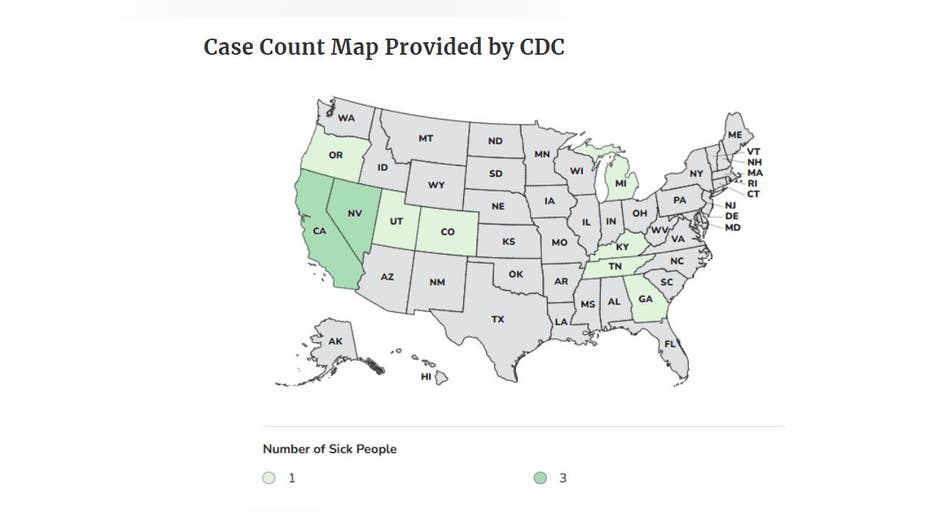
An E. coli case map. (FDA / Unknown)
It added, “This product has a long shelf life. Check your refrigerators and freezers for the recalled raw milk cheeses and throw them away. If you refrigerated or froze cheese without the original packaging and can’t tell if it’s part of the recall, throw it away.”
WHITE HOUSE ADDRESSES GROWING PARASITE OUTBREAK AFTER MORE THAN 400 AMERICANS SICKENED
The FDA is still investigating the source of the contamination, and to see if there are any other affected products.
Consumers who purchased the cheese should not only throw it away or return it for a refund, but also carefully sanitize any surfaces or containers the cheese touched.
MYSTERY PARASITE LEAVES AMERICANS BATTLING ‘EXPLOSIVE’ ILLNESS AS CDC INVESTIGATES

Number of Gram-negative Escherichia coli bacteria of the strain O157:H7, revealed in the 6836x magnified scanning electron microscopic (SEM) image, 2006. Image courtesy Centers for Disease Control (CDC) / National Escherichia, Shigella, Vibrio Refere (Smith Collection/Gado/Getty Images / Getty Images)
E. coli symptoms can start as late as nine days after eating the contaminated food and include severe stomach cramps, diarrhea, fever, and nausea.
CLICK HERE TO DOWNLOAD THE FOX NEWS APP
In severe cases, it can cause life-threatening conditions like chronic kidney disease, kidney failure and high blood pressure.

Are investors expecting too many hikes from the ECB?

Iran insists on diplomacy after Trump rejects Hormuz peace plan


Stone Fox Capital is an RIA from Oklahoma. Mark Holder is a CPA with degrees in Accounting and Finance. He is also Series 65 licensed and has 30 years of investing experience, including 15 years as a portfolio manager. Mark leads the investing group Out Fox The Street where he shares stock picks and deep research to help readers uncover potential multibaggers while managing portfolio risk via diversification. Features include various model portfolios, stock picks with identifiable catalysts, daily updates, real-time alerts, and access to community chat and direct chat with Mark for questions. Learn more.
Analyst’s Disclosure: I/we have no stock, option or similar derivative position in any of the companies mentioned, and no plans to initiate any such positions within the next 72 hours. I wrote this article myself, and it expresses my own opinions. I am not receiving compensation for it (other than from Seeking Alpha). I have no business relationship with any company whose stock is mentioned in this article.
The information contained herein is for informational purposes only. Nothing in this article should be taken as a solicitation to purchase or sell securities. Before buying or selling any stock, you should do your own research and reach your own conclusion or consult a financial advisor. Investing includes risks, including loss of principal.
Seeking Alpha’s Disclosure: Past performance is no guarantee of future results. No recommendation or advice is being given as to whether any investment is suitable for a particular investor. Any views or opinions expressed above may not reflect those of Seeking Alpha as a whole. Seeking Alpha is not a licensed securities dealer, broker or US investment adviser or investment bank. Our analysts are third party authors that include both professional investors and individual investors who may not be licensed or certified by any institute or regulatory body.
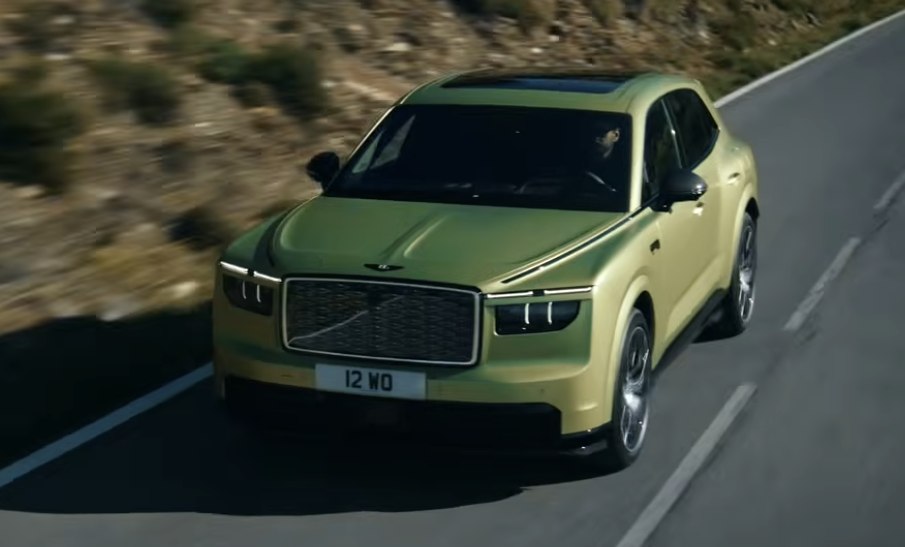
Bentley has unveiled the Torcal, its first fully electric model and the first entirely new Bentley in a decade, and early impressions from journalists who have seen and driven the car suggest the British luxury automaker has produced a genuinely compelling entry into the electric SUV market rather than a compromised transitional model.
The Torcal is built on the Premium Platform Electric architecture shared across the Volkswagen Group, the same underlying platform used by the Porsche Cayenne Electric. According to Bentley, the SUV is available in two trims: a standard Torcal producing up to 821 brake horsepower and 1,194 newton-meters of torque, and the more powerful Torcal S, which delivers up to 876 brake horsepower, or 888 metric horsepower, and 1,350 newton-meters, or 996 pound-feet, of torque, making it the most powerful production Bentley ever built. Bentley says the standard Torcal accelerates from zero to 60 miles per hour in 3.4 seconds, while the Torcal S completes the same sprint in as little as 2.8 to 2.9 seconds, figures the company describes, with characteristic understatement, as “sufficient.”
Power comes from a 113-kilowatt-hour battery pack, of which 108 kilowatt-hours are usable, feeding dual electric motors mounted on each axle for standard all-wheel drive. Bentley says the standard Torcal delivers 375 miles of range on the WLTP testing cycle, a figure expected to translate to somewhat lower results, likely north of 300 miles, under the stricter EPA testing standard used in the United States. The Torcal’s 800-volt electrical architecture supports DC fast charging at up to 400 kilowatts, allowing the battery to charge from 10% to 80% in approximately 16 minutes.
Reviewers who have seen the Torcal in person have generally praised its design as a successful modern interpretation of Bentley’s traditional styling language. Motor1’s assessment described the car as adapting Bentley’s classic, squared-off grille into a pattern of light-up crystal diamonds, clear-centered on the standard model and black-filled on the S trim, giving the front end an upright, aggressive character distinct from the more rounded, aerodynamically driven designs common among competing electric SUVs. The outlet called the Torcal “one of the best-looking EVs I’ve seen,” while noting the influence of the shared Cayenne platform remains visible in the vehicle’s wheelbase and roofline when viewed in profile.
Top Gear’s review offered a similarly favorable take on the design, while noting the illuminated grille, built using 76 hand-applied LED diamonds according to Bentley, makes the car strikingly visible on the road, particularly at night. The outlet described Bentley’s overall approach as designing the Torcal to “blend seamlessly into its existing lineup,” an EV built to avoid drawing attention to its electric drivetrain specifically, in contrast with more overtly futuristic electric SUV designs from rival luxury brands.
The interior has drawn particularly strong praise across multiple reviews. Edmunds described the Torcal’s cabin as “one of Bentley’s best ever,” highlighting new design touches including multilayer pressed wood trim, wool upholstery options, exposed aluminum, and real metal buttons with knurled texturing. The review also praised Bentley’s approach to digital interface design, noting that starting the vehicle triggers a video sequence in the gauge cluster designed to resemble light shining through crystal, an attempt to give the digital experience what the reviewer described as an analog feel consistent with Bentley’s traditional craftsmanship.
The Autopian’s review focused heavily on the Torcal’s dynamic capabilities, noting the vehicle’s substantial braking hardware, with standard iron discs measuring 16.5 inches in diameter at the front and 14.56 inches at the rear, expandable to 17.2 inches and 16.1 inches, respectively, with the optional carbon ceramic brake package. The outlet positioned the Torcal favorably against other ultra-luxury electric SUVs currently on the market, contrasting it with Mercedes-Benz’s electric G-Class, criticized for its limited 239 miles of range at a comparable price point, and the Cadillac Celestiq, whose broader market positioning the reviewer described as still unclear.
Bentley has also emphasized battery longevity as a specific design priority for the Torcal, given the brand’s positioning of its vehicles as long-term heirlooms rather than short-ownership-cycle products. According to Top Gear’s reporting, the Torcal’s nickel-manganese-cobalt-aluminum battery chemistry is designed to retain 90% of its original capacity after 100,000 miles of driving, a durability target Bentley has specifically highlighted given its cars’ traditional role as vehicles intended to be passed down across generations.
Pricing for the Torcal starts at approximately $200,000 in the United States, according to Edmunds, positioning it as a new, more accessible entry point into the Bentley lineup below the existing Bentayga SUV, despite carrying nothing resembling entry-level features or materials. In the United Kingdom, Autocar reported the Torcal starting at £173,000, positioning it as a direct electric rival to high-end Range Rover models. The vehicle arrives roughly a year later than Bentley had originally planned, reflecting a broader revision to the company’s electrification strategy, and represents a new, fourth model line for the brand rather than a direct electric replacement for any existing Bentley model.
With reviewers consistently praising the Torcal’s design, interior craftsmanship and performance credentials, Bentley’s first fully electric model appears, based on early impressions, to have avoided the pitfalls that have affected some other ultra-luxury electric SUV launches from rival automakers, positioning the Torcal as a genuine, credible entry into the growing high-end electric SUV segment rather than a compromised first attempt at electrification.


Seeking Alpha’s transcripts team is responsible for the development of all of our transcript-related projects. We currently publish thousands of quarterly earnings calls per quarter on our site and are continuing to grow and expand our coverage. The purpose of this profile is to allow us to share with our readers new transcript-related developments. Thanks, SA Transcripts Team

How Powerful Of A Power Bank Do You Need To Safely Charge A Laptop?

Orange Order successfully challenge injuction banning Drumcree parade

The April Broadband Price Rise Isn’t Dead. It Just Looks Different





-

 Crypto World4 days ago
Goldman Sachs and Deutsche Bank Agree: The S&P 500 Rally Isn't Over
-

 Fashion1 day ago
Weekend Open Thread: J.McLaughlin – Corporette.com
-

 Tech6 days ago
Researchers escape OpenAI Codex sandbox to run commands on host
-

 Fashion3 days ago
8 iPhone Accessories That Add Personality
-

 Crypto World6 days ago
Who Needs CLARITY Anyway? ARB Could See 70X Increase: Hodler’s Digest
-

 Entertainment4 days ago
These 17 Fall Amazon Dresses Seriously Look Like Anthropologie
-

 Business6 days ago
Analog Devices (ADI) Bets $1.35 Billion on Chips that Let Machines Think for Themselves
-

 Crypto World6 days ago
Coinbase, Robinhood, Circle Seen as Tokenized-Stock Winners
-

 Crypto World4 days ago
This Bearish Netflix Stock Trade Can Cash In On Video Streaming Giant’s Woes
-

 Crypto World5 days ago
Trump-Xi Polymarket Odds for Handshake Hit 50%
-

 Tech6 days ago
Google’s $899 Googlebook is a bet that you’ll buy a new laptop for Gemini
-

 Crypto World3 days ago
Crude Oil Prices Pressured by Diplomatic Hopes in the Middle East
-
 Crypto World3 days ago
Bitcoin price tests $83,600 Supertrend support after $87K rejection
-
 Business4 days ago
Oil Price Today (September 23): Crude oil below $100 on hopes of US-Iran talks. What did Trump say?
-

 Crypto World3 days ago
Bitcoin Threatens Sub-$84,000 Breakdown as Long Liquidations Spike
-
 Crypto World5 days ago
Meta Jumps 11% As Muse Shines and Investors Show an Appetite for Advancing AI
-
 Crypto World4 days ago
Did Jim Cramer Just Give GameStop Stock the Kiss of Death When He Said the Turnaround Is Working?
-
 Crypto World6 days ago
Bitcoin price holds above $81K as key catalysts line up
-
 Crypto World6 days ago
ARB Price Signals Spur Speculation of 70x Upside in Hodler Digest
-
 Crypto World5 days ago
Trump, Xi Meet on S&P 500's Best Day Since Early August: Will Markets Stay Bullish?
You must be logged in to post a comment Login