WEST MONROE, La. — Sadie Robertson Huff, the former “Duck Dynasty” star turned author and speaker, has opened up about a terrifying choking incident involving her 8-month-old daughter, Kit Carroway Huff, that left the infant briefly without breath and required immediate CPR.
In a vulnerable Instagram post shared Saturday, April 11, 2026, Robertson recounted how the near-tragedy unfolded this week while she prepared dinner at home. Kit was sitting in her high chair eating a snack when she suddenly began to choke. Within seconds, the situation escalated dramatically as the baby stopped breathing.
“My mom pulled her from the high chair and placed my girl into my arms just as she stopped breathing,” Robertson wrote. “Everyone went into action and into prayer. Mom called 911, I started CPR, and everyone began to pray out loud and moved the other kids downstairs.”
Robertson, 28, credited a combination of prior preparation and faith for the outcome. She had previously watched instructional videos on infant choking response and CPR, skills that kicked in instinctively during the crisis. “I can only explain it now like my body just knew what to do. I felt God’s Spirit guiding me, partnering with me in what I had learned and seen,” she said. “I remember saying ‘What do I do?’ and then immediately started doing it and declaring life.”
Advertisement
Sadie Robertson Huff
After following proper baby choking protocols and performing CPR, Kit miraculously coughed and began breathing again just as paramedics arrived. Robertson rode in the ambulance with her daughter to the hospital, where Kit spent one night for observation before being released fully recovered and healthy.
The mother of three — who shares daughters Honey James, 4, Haven Belle, 2, and now Kit with husband Christian Huff — described riding waves of anxiety from the trauma while feeling immense gratitude for what she called a miracle and “God’s undeniable hand on this situation.” She had stepped back from social media recently to focus on her mental health but felt compelled to share the story to raise awareness and encourage other parents.
“I’m currently walking through the waves of anxiety from the trauma of the situation, and the immense gratitude for the miracle of Kit’s full recovery,” Robertson posted. She emphasized that while faith sustained the family, practical knowledge proved lifesaving. “We can’t live in a state of fear… we have to trust God in all of it. And also, preparation and knowledge in the spiritual and physical sense can be a gift that you give yourself and your family!”
Robertson’s mother, Korie Robertson, echoed the sentiment in her own social media post, urging followers around children to learn choking response techniques. “We also want to be prepared to do what we can if a moment like this arises and are so thankful that Sadie had watched videos and was able to do what needed to be done,” Korie wrote. “God carried us through this, and Sadie wanted to share with the hope that this could help someone else!”
The incident highlights the critical importance of infant first aid training. Choking remains a leading cause of injury and death in young children, with the American Red Cross and American Heart Association recommending that parents and caregivers complete certified CPR and choking relief courses. For infants under 1 year old, the protocol involves back blows and chest thrusts rather than abdominal thrusts used on older children or adults. Robertson’s quick application of these techniques, combined with immediate emergency response, proved decisive.
Advertisement
Medical experts note that seconds count in airway obstructions. Even brief oxygen deprivation can lead to serious complications, making rapid intervention essential. In Kit’s case, the family’s coordinated response — CPR from Sadie, the 911 call from her mother, and collective prayer — created the conditions for a positive outcome. Paramedics arrived to find the baby already breathing, allowing focus on stabilization and transport.
The Robertson family, known for their strong Christian faith through the long-running “Duck Dynasty” reality series and subsequent media ventures, leaned heavily on prayer during the emergency. Family members prayed aloud as the crisis unfolded, a detail Robertson highlighted as integral to the moment. “Everyone went into action and into prayer,” she repeated in her account.
Robertson has built a public platform around faith, family and encouragement since rising to fame as a teenager on A&E’s “Duck Dynasty,” which followed her family’s duck-call manufacturing business and outdoors lifestyle. After the show ended, she launched the “Whoa That’s Good” podcast, authored books including “Live Original” and “Live Fearless,” and spoken at conferences about mental health, anxiety and trusting God amid life’s challenges.
Her openness about mental health struggles, including anxiety, made the post particularly resonant. Robertson acknowledged processing trauma while celebrating the recovery, encouraging followers not to let fear dominate but to balance it with preparation and trust. Many parents responded with stories of their own close calls, gratitude for her transparency and commitments to refresh their own first aid knowledge.
Advertisement
Christian Huff, Sadie’s husband since 2019, has been by her side throughout. The couple welcomed Kit in August 2025, completing their trio of daughters. Friends and extended family, including grandparents Phil and Miss Kay Robertson, expressed relief and reinforced messages of preparedness and faith.
Safety organizations used the moment to reiterate advice: Keep small objects, hard foods and hazards away from infants; never leave young children unattended while eating; learn age-appropriate choking relief and CPR; and ensure home emergency numbers are accessible. Devices like the LifeVac have gained popularity as supplemental tools, though proper technique remains foundational.
Robertson’s story arrives at a time when many families juggle busy schedules and mealtimes. Dinner prep moments, like the one that turned frightening for the Huffs, are common across households. Her willingness to share raw details — the panic, the instinctual action, the spiritual overlay — has sparked widespread conversations about blending practical skills with spiritual reliance.
As Kit continues to thrive at home, Robertson hopes her experience serves as both testimony and warning. “All of us are in God’s hands, our days are His,” the family has affirmed. Yet they stress the value of being equipped for emergencies that prayer alone may not instantly resolve.
Advertisement
The post has circulated widely on social media, drawing support from fellow celebrities, parenting influencers and everyday moms. Many praised Robertson for turning a private nightmare into a public service announcement on child safety. Hospitals and community centers reported renewed interest in CPR classes following similar high-profile stories.
For the Robertson-Huff family, the incident has deepened their appreciation for life’s fragility and the power of preparedness. Sadie continues focusing on recovery from the emotional aftermath while cherishing moments with her healthy baby girl. Kit, now approaching 9 months, remains a bundle of joy, oblivious to the drama that briefly halted her breathing but ultimately strengthened her family’s bonds and message.
Parents nationwide are taking note. Pediatricians recommend reviewing choking prevention and response at well-child visits, especially as babies transition to solid foods. Robertson’s account serves as a timely reminder that knowledge, quick thinking and community — both earthly and divine — can make all the difference in life’s most frightening seconds.
British businesses are in danger of being left stranded in the middle of the pack on artificial intelligence, with a new PwC study revealing a significant gap between UK firms and the world’s top AI adopters in both spending and returns.
The consultancy’s global survey found that while leading companies worldwide are investing an average of five per cent of revenue in AI and reaping returns of 15 per cent, their British counterparts are committing just two per cent and generating returns of ten per cent. It is a gap that should alarm boardrooms across the country, particularly among small and medium-sized enterprises already grappling with tight margins and limited budgets for technology transformation.
Perhaps more troubling is the innovation shortfall the figures suggest. UK businesses derived only 27 per cent of their revenue from products that did not exist three years ago, compared with 43 per cent among global leaders. For SMEs, which have historically relied on agility and fresh thinking to compete against larger rivals, that disparity ought to prompt some uncomfortable questions about whether enough is being done to turn AI capability into genuinely new commercial offerings.
The research points to familiar obstacles. Outdated IT systems and rigid internal processes continue to hold companies back, with only 27 per cent of UK businesses having redesigned their workflows to properly integrate AI rather than simply grafting it on to what already exists. The same proportion had modernised legacy technology to better accommodate the tools.
There is also a question of ambition. Nearly half of the UK businesses surveyed said efficiency and productivity were their primary motivation for experimenting with AI, while just 26 per cent cited revenue generation. It is a mindset that Leigh Bates, PwC UK’s global risk AI leader, believes is limiting the country’s potential.
Advertisement
Bates described the findings as a wake-up call, arguing that too many firms remain trapped between piloting AI projects and scaling them effectively. The businesses seeing the greatest returns globally, he said, are not merely doing more of the same but fundamentally reinventing how they operate.
Overall, the UK ranked 11th out of 19 countries in PwC’s assessment, behind China at the top of the table, as well as France, Germany and Saudi Arabia. The United States, notably, fared little better at 13th. PwC defined global leaders as companies in the top 20 per cent of AI-driven performance.
For Britain’s SME community, the message is clear enough. The window to move from cautious experimentation to meaningful adoption is narrowing, and those that continue to treat AI as little more than a cost-cutting exercise risk discovering that their competitors, at home and abroad, have already moved on.
Amy Ingham
Amy is a newly qualified journalist specialising in business journalism at Business Matters with responsibility for news content for what is now the UK’s largest print and online source of current business news.
Daniel is an avid and active professional investor.
He runs Crude Value Insights, a value-oriented newsletter aimed at analyzing the cash flows and assessing the value of companies in the oil and gas space. His primary focus is on finding businesses that are trading at a significant discount to their intrinsic value by employing a combination of Benjamin Graham’s investment philosophy and a contrarian approach to the market and the securities therein. Learn more.
Analyst’s Disclosure: I/we have no stock, option or similar derivative position in any of the companies mentioned, and no plans to initiate any such positions within the next 72 hours. I wrote this article myself, and it expresses my own opinions. I am not receiving compensation for it (other than from Seeking Alpha). I have no business relationship with any company whose stock is mentioned in this article.
Seeking Alpha’s Disclosure: Past performance is no guarantee of future results. No recommendation or advice is being given as to whether any investment is suitable for a particular investor. Any views or opinions expressed above may not reflect those of Seeking Alpha as a whole. Seeking Alpha is not a licensed securities dealer, broker or US investment adviser or investment bank. Our analysts are third party authors that include both professional investors and individual investors who may not be licensed or certified by any institute or regulatory body.
The Alternative Investment Market firm has acquired technology from Swedish firm Beep Insights AB
11:58, 13 Apr 2026Updated 11:59, 13 Apr 2026
Penarth headquartered global diagnostics firm, EKF Diagnostics, has acquired technology that tracks in real time glucose and lactate aimed at improving sport training performances.
The Alternative Investment Market listed firm has struck a deal with Sweden-based Beep Insights AB for its Beep Insights technology. The IOS and android software application combines data from sports performance wearables connected via Bluetooth with real-time glucose and lactate tracking to give personalised metrics to improve sport’s performance training.
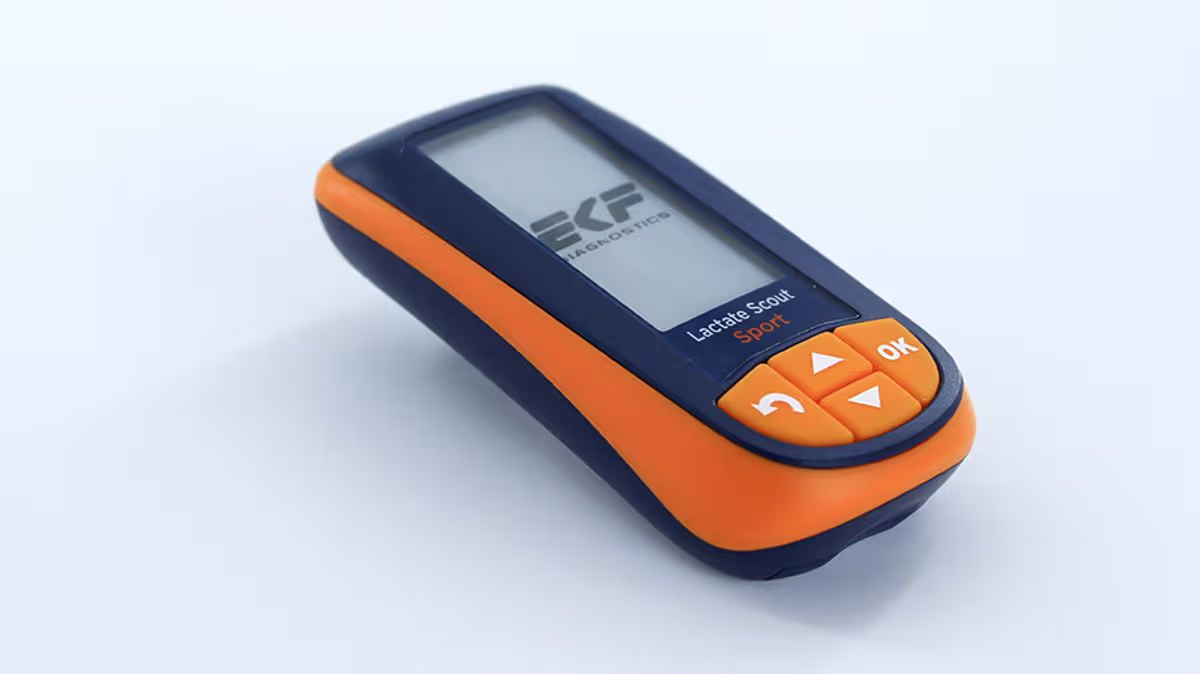
The deal bolsters EKF’s sports performance product range, specifically its lactate scout sport, which is already compatible with the Beep Insights application – a hand-held lactate analyser.
EKF has been working with Peter Alex, chief executive of Beep Insights, and his team to integrate the Beep Insights tech from their software application to better determine lactate threshold in a more accessible way and improve sports training outcomes.
Following the acquisition, the value of which has no been disclosed, Mr Alex will join the EKF team and will look into developing the use of AI within performance training and how this can be integrated into the technology
Gavin Jones, chief executive of EKF said: “Whilst working with Beep Insights we have been highly impressed with how well their data handling application seamlessly connects with our handheld Lactate Scout Sport device, enabling, fast and accurate lactate threshold testing for sports performance athletes at all levels.
Advertisement
“The acquisition of this technology is an exciting step forward for EKF’s Sports Performance division as we look to enable athletes of all abilities access to data to drive improved training outcomes.”
Brokers Singer Capital Markets said of the deal: “Whilst we do not expect any material impact on financials in the short-term, we view this as opening an additional incremental growth driver and a positive signal of intent from management. The shares remain highly attractive with strong cash generation and a robust balance sheet.”
The broker has maintained a share price outlook of 35p.
For its 2025 financial year EKF posted revenues of £51.6m, up from £50.2m a year earlier. Its pre-tax profit of £7.1m was up from £6.3m in 2024.
Advertisement
Mr Jones said: “The 2025 results establish a strong foundation for the five-year strategic Development plan, providing EKF a positive base from which to push further into new markets with a simplified product offering and greater commercial focus on the areas of strategic importance.
“The trajectory for EKF has been clearly mapped to deliver further improvements in margin, revenue and Ebitda. Operational cash generation remains at a high level, and this shall be utilised to thoughtfully invest in those areas that will further build on the requirements of the strategy, and deliver long term shareholder value.
“We remain committed to establishing EKF as a true leader in Hemoglobin point-of-care testing and life sciences, further developing the business through organic growth with a strong focus on profitability improvement and sustainable investment.”
Virgin StartUp has launched applications for the second round of Momentum, its free eight-week accelerator programme built specifically to help dyslexic entrepreneurs grow their businesses.
Momentum 2.0, which runs from 26 May to 14 July 2026, returns after what Virgin StartUp described as the most applied-for programme in its history. The inaugural cohort supported 30 founders last year, with nine in ten participants saying they came to view their dyslexic thinking as a strength by the time they finished. The programme is backed by Virgin Unite and run in collaboration with Made By Dyslexia, the global charity founded by Kate Griggs.
The accelerator is aimed at early-stage founders and offers a combination of tailored workshops, one-to-one mentoring and practical resources designed around the way dyslexic thinkers naturally operate. Virgin StartUp has also introduced a dedicated “Dyslexic Thinking” space within its online community for business founders, extending the programme’s reach beyond the cohort itself.
The commercial case for backing dyslexic entrepreneurs is well documented. Analysis from Made By Dyslexia suggests that dyslexic business owners contribute at least £4.6 billion to UK GDP annually and support more than 60,000 jobs. The charity estimates that one in three entrepreneurs is dyslexic, a statistic that underlines how closely entrepreneurial instinct tracks with the pattern recognition, creative problem-solving and big-picture thinking commonly associated with dyslexia.
Elle Upshall, scale up lead at Virgin StartUp, said the response to the first cohort had exceeded expectations and that the programme had demonstrated what happens when business support is designed around different ways of thinking rather than in spite of them.
Advertisement
Among the alumni of the first Momentum cohort is Alex Molokwu, founder of Loujo, an initiative that uses educational songs to help dyslexic children with reading and writing. Molokwu credited his mentor with helping him turn instinctive thinking into structured strategy. Aylin Abdullah, founder of Fractionals Match, an AI-powered marketplace for scaling businesses, said the programme gave her the space to articulate and lean into how she thinks, rather than treating it as something to work around.
Griggs, herself a dyslexic social entrepreneur, framed the initiative in broader economic terms, arguing that the UK has never needed dyslexic thinking more if it wants to unlock growth and innovation.
Momentum sits within a wider push across the Virgin Group to champion neurodivergent talent, inspired in large part by Richard Branson’s own experience with dyslexia. The ambition extends beyond the cohort: by helping dyslexic founders scale, the programme aims to drive job creation and inspire the next generation of entrepreneurs.
Applications for Momentum 2.0 close on 8 May 2026. Full details are available at virginstartup.org/momentum.
CANBERRA, Australia — The federal government on Monday rolled out a $20 million national advertising campaign urging Australians to reduce fuel consumption and adopt more efficient driving habits as global oil supply disruptions from the Iran conflict continue to push prices higher. Titled “Every Little Bit Helps,” the multi-channel blitz aims to stretch limited supplies for essential services such as trucking, farming and emergency response amid ongoing volatility in the Strait of Hormuz.
Oil Prices Plunge Below $95 as US-Iran Ceasefire Sparks Relief Rally in Volatile Energy Markets (Petrol Price)
Infrastructure Minister Catherine King said the campaign forms part of the government’s four-stage National Fuel Security Plan, announced after a national cabinet meeting in late March. It encourages motorists to drive less where possible, switch to public transport or active travel, maintain proper tyre pressure, remove unnecessary roof racks and avoid aggressive acceleration. The ads will appear on television, online platforms, radio and outdoor billboards over the coming weeks.
The initiative comes as Brent crude hovers near or above $100 per barrel following President Donald Trump’s announcement of a U.S. naval blockade in the Strait of Hormuz on Sunday. The narrow waterway, which normally carries about one-fifth of global oil supplies, has seen severely restricted traffic since Iran limited movements in early March in response to U.S. and Israeli strikes. Even after a fragile ceasefire took effect around April 8, full restoration of flows could take months due to damaged infrastructure and lingering tensions.
Prime Minister Anthony Albanese defended the spending, saying the campaign provides practical advice to households facing higher petrol and diesel prices. “We’re not lecturing people — we’re giving them simple steps that can make a real difference in stretching supplies,” Albanese told reporters ahead of a four-day trip to Asia to secure additional fuel imports. He noted the government had already halved fuel excise until the end of June and paused some road user charges for trucks to ease cost-of-living pressures.
Opposition politicians and some motorists quickly criticized the $20 million outlay as wasteful taxpayer-funded propaganda. Coalition senators accused the Albanese government of treating Australians like children while failing to address root causes of the supply crunch. Social media reactions ranged from mockery — with users joking about “inflating your tyres to save the economy” — to anger over the perceived lack of tangible relief at the pump. One viral post questioned why the money wasn’t used to subsidize fuel directly or accelerate domestic refining capacity.
Advertisement
Transport industry groups offered mixed responses. The Australian Trucking Association welcomed efforts to preserve diesel for freight but warned that reduced consumer driving alone would not solve shortages affecting supply chains. Farmers in regional areas expressed frustration, noting that many have no viable alternative to personal vehicles for essential travel. Urban commuters in Sydney, Melbourne and Brisbane, where public transport options exist, may find the advice more practical, though rising fares have drawn their own complaints.
The campaign highlights specific behaviours backed by government research. Maintaining correct tyre pressure can improve fuel efficiency by up to 3%, while removing excess weight and avoiding idling are among low-cost measures promoted. The government also encourages combining trips, carpooling and using apps to find the cheapest fuel. Officials estimate that widespread adoption could save millions of litres annually, helping redirect supplies to critical sectors.
This is not the first time Australia has turned to public appeals during energy crunches. Similar conservation messages appeared during past global oil shocks, though the current situation — triggered by geopolitical conflict rather than purely market forces — has created unique challenges. Panic buying in early March exacerbated local shortages, prompting temporary measures such as relaxed fuel quality standards to release nearly 100 million extra litres per month.
Economists warn that sustained high fuel prices will feed into broader inflation, particularly through higher transport and grocery costs. Diesel, vital for agriculture and freight, has seen particularly sharp increases, threatening to push up food prices in coming months. The Reserve Bank of Australia is closely monitoring the situation as it weighs future interest rate decisions.
Advertisement
The government’s four-stage National Fuel Security Plan includes preparation, keeping Australia moving, securing supplies and long-term resilience. Stage two focuses on demand management and public communication — the role the new campaign is designed to fill. Albanese’s upcoming trip to key Asian partners aims to diversify import sources and fast-track alternative shipping routes bypassing disrupted Gulf flows.
Critics argue the $20 million could have been better spent on expanding fuel reserves, incentivizing electric vehicle uptake or investing in domestic refining upgrades. Some regional MPs called for targeted support for rural communities where alternatives to driving are limited. Consumer advocates questioned the effectiveness of advertising when many households are already cutting back due to price pain at the bowser.
Supporters counter that clear public messaging can shift behaviours at scale and build community resilience during crises. Similar conservation campaigns in other countries during past energy shortages have shown modest but measurable reductions in demand. The government insists the spend represents value by empowering individuals to contribute to national efforts.
As the campaign launches nationwide, motorists will encounter the “Every Little Bit Helps” slogan across media. Early feedback suggests a divide between urban residents open to the advice and regional drivers feeling unfairly targeted. Fuel retailers report continued high demand despite the appeals, with some stations implementing informal rationing or extended hours to manage queues.
Advertisement
The broader context remains fluid. While the U.S.-Iran ceasefire provided temporary market relief, Trump’s blockade announcement has reignited volatility. Full normalization of Hormuz traffic, if it occurs, could still take months, keeping global prices elevated and forcing Australia — a net fuel importer despite its resource wealth — to navigate tight supplies.
For ordinary Australians, the campaign arrives amid cost-of-living strains already stretched by housing, groceries and energy bills. Whether practical tips on tyre pressure and smoother driving will resonate or simply fuel resentment remains to be seen. The government hopes the message lands as helpful guidance rather than finger-wagging.
As Monday’s trading on the ASX showed mixed energy sector responses to oil movements, households face the daily reality of higher pump prices. The $20 million campaign represents one tool in a broader toolkit that includes diplomatic efforts, tax relief and supply diversification. Its success will ultimately be measured not in advertising reach but in whether collective small actions help ease pressure on Australia’s fuel security during an uncertain period.
In the end, officials say every litre saved today helps keep essential services running tomorrow. Whether the public embraces the call to “use less where possible” will test both individual habits and the government’s ability to communicate effectively in a time of global energy strain.




















































You must be logged in to post a comment Login