
Business
India’s power market entering a storage-led transformation phase: Apoorva Bahadur


In an interview with ET Now, Apoorva Bahadur, Senior VP, IIFL Capital highlighted how India’s power demand has rebounded sharply after a brief slowdown over the past two years, driven by rising appliance usage, climate volatility, and structural economic growth.
“The power demand definitely has increased quite significantly and this comes after a lull of almost two odd years,” Bahadur noted, pointing out that FY26 is seeing a sharp reversal after subdued demand conditions in FY25.
Renewables Meet Their Limit in the Evening Peak
India’s installed renewable base—led by nearly 150 GW of solar capacity—is now capable of meeting daytime demand comfortably. In fact, during recent peak load conditions of around 256 GW, the grid did not face shortages during the day.
However, the evening hours remain the critical bottleneck.

“The challenge lies in the evening bit wherein the solar does not generate anything, so the contribution of solar goes down to zero,” Bahadur explained.
This mismatch between daytime surplus and evening shortage is now defining the urgency for energy storage systems, particularly Battery Energy Storage Systems (BESS) and pumped hydro projects.Storage Becomes the Critical Missing Link
With gas-based plants facing fuel constraints, hydro output uncertain due to weaker monsoon expectations, and coal plants carrying most of the load, the system is becoming increasingly dependent on storage technologies to balance demand.
“We will also have to add a lot of batteries and pump storage to meet the gap,” Bahadur said, adding that while progress has been made, scaling remains a challenge.
Recent capacity additions have come from players like Adani Green and ACME, while NTPC has also commissioned pumped storage assets. However, the pace is still insufficient to match the speed of demand growth.
“Quite likely that this year if the summer demand continues to outperform, we might see peak shortages like we saw two years back or maybe more than that as well,” he warned.
Storage Arbitrage: The Emerging Profit Pool
A key structural shift is also emerging in pricing dynamics. Daytime electricity prices in India’s merchant market are increasingly falling—sometimes below ₹1 per unit—due to excess solar supply.
This creates what experts describe as a “time-shift arbitrage opportunity,” where electricity stored during low-price hours is sold during high-demand evening peaks.
“Any player who has merchant storage capacity, specifically batteries or pump storage, should corner a large portion of the profit pool,” Bahadur said.
Coal and gas assets with merchant exposure may also benefit, but rising fuel costs are expected to compress margins, especially for gas-based generation.
Power Prices Likely to Trend Higher—For Now
On electricity tariffs, the outlook appears inflationary in the near term due to heavy infrastructure investment across generation, transmission, and distribution.
“Generally there will be an inflationary trend in electricity prices,” Bahadur said, citing large-scale government capex in grids and distribution upgrades, including nearly ₹9 trillion earmarked for transmission expansion up to 2032.
However, this trajectory may eventually reverse.
“Once we cross a certain threshold in terms of renewable plus storage capacity addition, the view will change and it becomes deflationary,” he added, pointing to the near-zero marginal cost of renewable generation.
BESS Competition Raises Concerns on Returns
A growing concern in the sector is aggressive bidding in Battery Energy Storage System (BESS) projects, which are increasingly bundled with renewable contracts.
Bahadur noted that early-stage optimism in emerging technologies often leads to overly competitive bidding cycles.
“We have seen similar story play out in solar as well when we started this journey in 2014-15 onwards,” he said.
He cautioned that battery economics are still heavily influenced by global supply chains, particularly China, where lithium pricing and policy shifts can directly impact project viability.
“Batteries are commodities so pricing is largely decided by China which has the entire upstream industry,” he said, adding that recent cost pressures could strain returns on aggressively bid projects.
Over time, he expects the market to stabilize, with returns likely converging to more sustainable levels, similar to solar projects where equity IRRs have ranged between 11% and 17% depending on competition.
The Road Ahead
India’s power transition is now clearly entering a storage-led phase. While renewable capacity continues to expand rapidly, the real competition is shifting toward who can effectively store and deploy electricity across time. In this evolving landscape, storage assets are no longer supporting infrastructure—they are becoming the core profit centre of the energy system.


A “For Lease” sign in the Financial District of San Francisco, California, US, on Wednesday, May 3, 2023.
Jason Henry | Bloomberg | Getty Images
A version of this article first appeared in the CNBC Property Play newsletter with Diana Olick. Property Play covers new and evolving opportunities for the real estate investor, from individuals to venture capitalists, private equity funds, family offices, institutional investors and large public companies. Sign up to receive future editions, straight to your inbox.
Despite the war with Iran and continued economic uncertainty in the U.S., demand for office space is recovering at a strong clip.
In the first quarter of this year, new in-person and virtual office tours reached their highest level since the pandemic began, as measured by the VTS Office Demand Index. The index is a future indicator of lease signings about a year or more out.
The index rose 18% from the fourth quarter 2025 and 13% from the same quarter one year ago.
“Although tested against a turbulent backdrop, demand for office space has seen an exceptional start to the year,” Nick Romito, CEO of commercial real estate software company VTS, said in a release. “What perhaps is most notable about this quarter’s positive performance is that it was led not just by tech’s sustained AI boom – but also by finance and legal companies entering the market as well.”
The surge in demand is curious, given that office-using employment is still down 2% from 2022, according to the Bureau of Labor Statistics. Usually, that would result in less office demand, but the drop in employment could also be giving employers more leverage to get workers back into the office.
Nationally, for all buildings, the office vacancy rate fell 14 basis points to 22.2% in the first quarter of this year from the previous quarter and is down 30 basis points from the last peak in Q2 2025, according to a report from JLL, a commercial real estate services and investment management company. Vacancy remains hyper-concentrated predominantly in larger-scale, aging buildings with financially constrained owners, with 10% of office buildings comprising more than 60% of total national vacancy.
As with everything in real estate, the office recovery is local. San Francisco and New York City are leading office demand, as AI tech employment rises quickly in the former and diversity of employment fuels the latter. Los Angeles also saw double-digit increases in demand on a quarterly basis, fueled by significant growth in the creative industry, according to VTS.
Cities seeing weaker demand include Boston, which was the worst-performing market in the report. Life science offices have taken a hit in that city, due to significant government funding cuts.
In addition, demand is contracting in Seattle, Washington, D.C., and Chicago, as they are not seeing strong employment growth.
“The AI boom continues to be a dominant headline for office, and markets that lack a major tech presence, or are without a primary growth lever in another industry, are seeing declines in demand,” Ryan Masiello, chief strategy officer of VTS, said in a release. “LA’s positive performance this time around was a new bright spot – and it remains to be seen if Los Angeles can sustain growth in the near term.”

White House senior counselor for trade and manufacturing Peter Navarro discusses Iran oil tensions, inflation data confusion and rising meat prices on ‘Mornings with Maria.’
The United Arab Emirates said Tuesday it is pulling out of OPEC and OPEC+, a move that could reshape production strategy as global oil markets face supply constraints and rising demand expectations.
The departure frees the UAE from group production quotas, giving it greater flexibility to increase output and expand its role across crude, petrochemicals and natural gas markets. Officials signaled the shift is aimed at positioning the country for long-term global energy demand growth.
UAE Energy Minister Suhail al-Mazrouei told Reuters the decision followed a “careful look” at national energy strategy and was a “sovereign national decision” grounded in long-term economic priorities. He said operating outside the group will allow the UAE to better meet future global demand.
“Being a country with no obligation under the group will give us flexibility,” al-Mazrouei said, adding the move comes at a time when global consumers require stable supply and strategic reserves are being drawn down.
GORDON CHANG: US SHOULD EXPAND SANCTIONS ON CHINA-LINKED NETWORKS TO HIT IRAN OIL REVENUE

An oil pump jack pumps oil in a field near Calgary, Alberta, Canada on July 21, 2014. (Reuters/Todd Korol / Reuters)
The timing also reflects ongoing constraints on global oil flows, particularly through the Strait of Hormuz — a key chokepoint between Iran and Oman that typically carries about one-fifth of the world’s oil and liquefied natural gas shipments. Disruptions and security threats in the region have tightened supply routes and added volatility to energy markets.

A meeting at the headquarters of the Organization of the Petroleum Exporting Countries (OPEC) with OPEC members and non-OPEC members in Vienna, Austria on December 7, 2018. (JOE KLAMAR / AFP / Getty Images)
Al-Mazrouei said the UAE did not directly consult with other producers, including Saudi Arabia, before making the decision. He added the country believes the move can be made without significantly disrupting markets given existing supply constraints.
The exit raises questions about coordination among OPEC+ producers, which have historically relied on production limits to manage global supply and influence prices. The UAE has been a longtime member of the group.
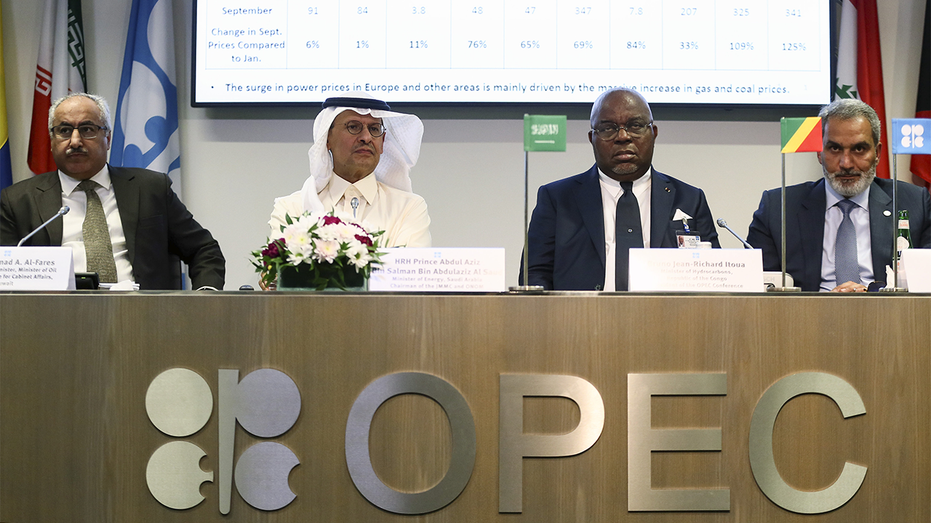
Secretary-General of OPEC Haitham al-Ghais (R) and Saudi Arabia’s Minister of Energy Prince Abdulaziz bin Salman Al-Saud (2nd L) hold a press conference after the 33rd OPEC (Organisation of the Petroleum Exporting Countries) and non-OPEC ministerial (Askin Kiyagan/Anadolu Agency via Getty Images / Getty Images)
UAE officials have expressed frustration with regional allies over their response to recent security threats. Anwar Gargash, diplomatic adviser to the UAE president, said Gulf Cooperation Council countries provided logistical support but fell short politically and militarily.
CLICK HERE TO GET FOX BUSINESS ON THE GO
“The Gulf Cooperation Council countries supported each other logistically, but politically and militarily, I think their position has been the weakest historically,” Gargash said at a forum on Monday. “I expect this weak stance from the Arab League and I am not surprised by it, but I haven’t expected it from the (Gulf) Cooperation Council and I am surprised by it.”
The UAE’s departure will be effective May 1.
Reuters contributed to this report.


Company celebrates opening of new line in Chicago area.

Xerox launches AI-powered IT management platform for mid-market
EVelution Energy signs $850 million cobalt supply deal with Japan’s Mitsui
Business
(VIDEO) Tom Cruise Steals Spotlight at CinemaCon with First ‘Digger’ Footage, Hails 2026 as Big Year

LAS VEGAS — Tom Cruise delivered one of the standout moments of CinemaCon 2026 on April 14, presenting the first teaser footage from his highly anticipated new film “Digger” and declaring 2026 a promising year for cinema during a high-energy appearance that reminded Hollywood of his enduring star power.

AFP
The 63-year-old actor, joined onstage by director Alejandro G. Iñárritu, shared glimpses of the Warner Bros. comedy described as “a comedy of catastrophic proportions.” Cruise, clearly energized, told the audience of theater owners that the industry has gotten off to a strong start and expressed excitement for the films still to come.
“Digger,” set for theatrical release on October 2, 2026, marks Cruise’s first project under his new multi-year deal with Warner Bros. Discovery. The film, shot over six months in the United Kingdom, features Cruise as a powerful figure on a frantic mission to prove he is humanity’s savior before a disaster of his own making destroys everything. The ensemble cast includes Jesse Plemons, John Goodman, Riz Ahmed, Sophie Wilde and Emma D’Arcy.
Cruise’s red-carpet appearance at the Dolby Colosseum in Caesars Palace drew cheers as he posed with industry figures including J.J. Abrams, Patton Oswalt and Alejandro González Iñárritu. Photos of the star smiling broadly circulated quickly online, with many noting his youthful energy and enthusiasm. He narrowly avoided an awkward encounter with ex-wife Nicole Kidman, who also attended the convention.
The “Digger” presentation highlighted Cruise’s ongoing commitment to big-screen theatrical experiences. Following the blockbuster success of recent “Mission: Impossible” entries, the actor continues pushing for original, event-style movies rather than streaming-first releases. Insiders say the Warner Bros. partnership gives him significant creative control and resources to deliver large-scale spectacles.
Cruise also addressed the audience about the broader state of the industry. “I had a lot of fun at CinemaCon seeing so many friends,” he posted afterward. “The year has already gotten off to a great start for cinema, and I’m looking forward to all the films still to come in the year ahead from countless hardworking and talented artists!”
Beyond “Digger,” Cruise has several major projects on the horizon. Paramount confirmed at CinemaCon that development is officially underway for “Top Gun 3,” with Cruise reprising his iconic role as Pete “Maverick” Mitchell. The sequel comes after the massive success of “Top Gun: Maverick” in 2022, which grossed nearly $1.5 billion worldwide.
Talks continue for other potential sequels, including “Edge of Tomorrow 2” with Emily Blunt and a possible follow-up to “Days of Thunder.” Cruise’s post-“Mission: Impossible – The Final Reckoning” (2025) slate shows a strategic mix of high-stakes action and more character-driven work with acclaimed directors.
The actor’s personal life also remains a point of public interest. Reports suggest Cruise has made reconnecting with daughter Suri, now 20 and attending Carnegie Mellon University under the name Suri Noelle, a priority in 2026. Sources close to the family describe ongoing efforts to rebuild their relationship after years of estrangement following his 2012 divorce from Katie Holmes.
Despite the personal headlines, Cruise’s focus appears firmly on work. His dedication to practical stunts and theatrical releases has earned him respect across Hollywood generations. At CinemaCon, theater owners gave him enthusiastic applause, viewing him as one of the few remaining stars capable of driving audiences back to cinemas.
Industry analysts see 2026 as a pivotal year for Cruise. With “Digger” positioned as a potential awards contender and box-office performer, followed by the “Top Gun” sequel, he could deliver multiple hits in a single calendar year. His ability to blend commercial appeal with artistic credibility under directors like Iñárritu positions him uniquely in today’s fragmented entertainment landscape.
Cruise’s influence extends beyond acting. His advocacy for practical effects and large-format exhibition continues shaping studio decisions. Warner Bros. executives praised his hands-on approach during production of “Digger,” noting his energy on set and commitment to storytelling.
As footage from the “Digger” teaser spreads online, anticipation builds for the October release. Early descriptions paint the film as a bold departure — a dark comedy with high-stakes elements that play to Cruise’s strengths while allowing Iñárritu’s signature intensity.
For fans, Cruise’s CinemaCon appearance offered reassurance that one of Hollywood’s most bankable and dedicated stars remains at the top of his game. Whether dangling from airplanes or delivering dramatic monologues, Tom Cruise continues proving that movie stars can still anchor major theatrical events in an era dominated by franchises and streaming.
With multiple projects advancing and a clear passion for the big screen, 2026 looks set to be another landmark year in Cruise’s remarkable career. As he told the CinemaCon crowd, the future of cinema remains bright — and he intends to play a starring role in it.

Corning GLW -4.48%decrease; red down pointing triangle posted higher first-quarter profit and core results, lifted by surging demand for its optical fiber products used in artificial intelligence data centers and continued growth in its new solar business.
The specialty materials and glass-technology company more-than-doubled net income to $371 million, or 43 cents a share, compared with $157 million, or 18 cents a share, in the same quarter a year ago.
Copyright ©2026 Dow Jones & Company, Inc. All Rights Reserved. 87990cbe856818d5eddac44c7b1cdeb8

British founders are being urged to think twice before accepting cheques from investors lured by tax breaks, after fresh analysis revealed that companies relying on the Enterprise Investment Scheme (EIS) and the Seed Enterprise Investment Scheme (SEIS) are overwhelmingly failing to scale.
Antler, the Singapore-headquartered early-stage venture capital firm, has crunched the numbers on more than 40,000 UK funding rounds over the past decade and concluded that the schemes, long held up by successive chancellors as the jewels in the crown of British start-up finance, are doing the opposite of what was intended.
Just 12 per cent of all UK companies raise follow-on capital after their initial round, according to Antler’s research. For those backed exclusively by EIS or SEIS money, the picture is bleaker still: a mere 3.7 per cent ever go on to secure further investment.
Adam French, partner at Antler and a familiar face on the British venture scene, did not mince his words. The schemes, he argued, prioritise “quantity over quality” and fail to provide founders with the strategic backing they need to grow into the kind of businesses that genuinely move the dial.
“If you were an investor in an SEIS fund, you’re primarily excited about the fact that you’re going to get 30 to 50 per cent of your investment back as a tax benefit in your tax return, and you don’t care as much about the outcome of the business that you’re investing in,” Mr French said.
The contrast with conventionally backed start-ups is stark. Where a company secured at least one institutional co-investor or an active angel in its opening round, the proportion going on to raise more capital leapt to 25.7 per cent, almost seven times the rate seen by the tax-relief-only cohort.
“The only way to do a good job in venture capital is to find the companies that go on to be outliers, and the tax-incentivised funds don’t have that mandate,” Mr French added. “They’re not looking to take insane amounts of risk because that’s ultimately what you have to do in venture to make a lot of money.”
The SEIS was introduced in 2012 by then-chancellor George Osborne to turbocharge the flow of capital into Britain’s fledgling start-ups, building on the older EIS, which dates back to 1994. Both offer generous reliefs designed to compensate investors for the considerable risk of backing unproven businesses.
Under current rules, investors can deploy up to £1 million per tax year, rising to £2 million for so-called knowledge-intensive companies that pour resources into research and development. Hold the shares for at least two years and any losses can be offset against income tax, an arrangement that, in effect, allows the Treasury to underwrite a significant chunk of the downside.
For more than a decade the schemes have channelled billions of pounds into the British innovation economy, and they have plenty of defenders in Whitehall and the City. But Antler’s findings will reignite a long-simmering debate about whether tax-led investment is genuinely building the next generation of British scale-ups, or merely creating a cottage industry of tax-efficient portfolios that quietly run aground.
Antler’s analysis did find that companies raising $1 million or more in their opening round were more likely to attract further backing, suggesting that cheque size remains a meaningful signal. But Mr French was emphatic that the calibre of the investor on the cap table mattered more than the headline figure.
His message to founders is blunt. “My advice to founders is to make sure you’re very selective about who you’re taking money from,” he said. “Don’t go for the first capital that lands on your table, make sure you go for the right capital.”
For Britain’s army of seed-stage entrepreneurs, the warning lands at a delicate moment. With venture funding still well below the highs of 2021 and the cost of capital biting across the board, the temptation to grab whatever money is on offer has rarely been greater. Antler’s data suggests that succumbing to that temptation may be the surest route to a dead end.

Amy Ingham
Amy is a newly qualified journalist specialising in business journalism at Business Matters with responsibility for news content for what is now the UK’s largest print and online source of current business news.


Protein production rising to meet consumer demand.
Cloudbreak Discovery to issue 364.8 million shares on Wednesday

IPL 2026: Vaibhav Sooryavanshi wins heart with humble gesture for young fan – Watch | Cricket News

Towson Apple Store employee union strikes back, allege unfair treatment after closure

6 Money Mistakes to Avoid Before You Sleep | Smart Financial Habits#shorts#youtubeshorts

Manchester United reach agreement with Casemiro over contract clause amid transfer speculation

US brings back mandatory military draft registration

Steven Gerrard disagrees with Gary Neville over ‘shock’ Chelsea and Arsenal claim | Football


-

 Fashion4 days ago
Weekend Open Thread – Corporette.com
-

 Tech20 hours ago
Register Renaming | Hackaday
-
 Crypto World3 days ago
Hyperliquid $HYPE Rally Builds Momentum as AI Sector Enters Prove-It Phase
-

 Politics6 days ago
Making troops accountable for war crimes threatens US alliance, ex-SAS colonel warns
-

 Politics6 days ago
Disabled people challenge government SEND proposals over segregation concerns
-

 Business5 days ago
Patterson-UTI Energy, Inc. (PTEN) Q1 2026 Earnings Call Transcript
-

 Business6 days ago
Rolls-Royce Voted UK’s Most Iconic Trade Mark as IPO Register Hits 150
-
 Crypto World7 days ago
Five Value Stocks with Recovery Potential in 2026: PayPal (PYPL), Nike (NKE), and More
-
 Sports2 days ago
IPL 2026: Ruturaj Gaikwad registers slowest fifty of the season, enters all-time unwanted list | Cricket News
-

 Politics16 hours ago
Drax board avoid their own AGM, accused of greenwashing & environmental racism
-

 Crypto World7 days ago
New York sues Coinbase, Gemini over prediction market offerings
-

 Politics6 days ago
Starmer handler McSweeney to be dragged from shadows by Foreign Affairs Committee
-

 Politics6 days ago
Zack Polanski responds to home secretary’s taser threat
-
Politics6 days ago
Wings Over Scotland | How To Get Away With Crimes
-
 Business6 days ago
HCL Tech share price tank over 9% after weak Q4. JPMorgan, HSBC & 3 others cut target price
-
 Crypto World7 days ago
Crypto’s great hope in Senate’s Clarity Act still has a path to survive tight calendar
-

 Politics6 days ago
‘Iran is still a nuclear threat’
-

 Fashion7 days ago
Kilkenny Design New Beauty Arrivals for Spring 2026
-
 Sports5 days ago
Tim Bradley names the current best in the world: “Better than Inoue and Usyk”
-

 NewsBeat2 days ago
LK Bennett closes all stores after entering administration
You must be logged in to post a comment Login