
Business
Indigenous business register backed by Ken Wyatt, Gerry Matera shut down


Yes. Corporate subscriptions are available for teams and organisations, with discounted rates as user numbers increase. Pricing starts from $1,625 + GST per user.
Get in touch
to discuss the right option for your organisation.
Business News subscriptions are used by executives, investors, consultants and professionals who need to stay informed and make better decisions about the WA market. When you subscribe you’ll get
- Unlimited access to WA’s most trusted business journalism
- Data & Insights — detailed profiles of WA companies, people, projects and deals
- MyBN — a personalised feed based on the companies, people and sectors you follow
- Special publications and industry reports
- Daily and weekly email newsletters
Data & Insights is a research tool built specifically for the WA market. It draws on more than 30 years of Business News reporting, updated regularly to reflect what’s happening now. Use it to:
- Look up detailed profiles of WA companies, including financials, directors and ownership
- Find decision-makers and track their career movements
- Research live and completed projects across WA industries
- Monitor deals, appointments and market activity
- Access industry rankings and league tables
Data & Insights is updated daily by our dedicated research team, which uses the latest announcements, ASX filings and editorial coverage to keep our person, company, list and project records up to date.
Business News welcome all opportunities to make our dataset accurate, complete and current, so if you have an update request, please email the team at
general@businessnews.com.au, and we’d be happy to assist.
MyBN
is part of every subscription. It’s your personalised view of Business News. You can follow the companies, people, sectors and projects that matter to you, and get a news feed and alerts tailored to your interests. You can save articles to read later and retain only what you need.
Only subscribers have full access to all content on the Business News website.
If staying informed about the WA economy is part of your job, and/or you’re looking for networking opportunities in WA, Business News is built for you.
Business News subscribers are:
- Executives and directors tracking competitors, clients and market movements
- Investors and advisers researching companies, deals and industry trends
- Consultants and professionals staying across sectors relevant to their clients
- Business owners looking for leads, context and market intelligence
Most Business News publications cover national or global markets. Business News is focused entirely on Western Australia, which means the journalism, the data and the intelligence are all built around WA companies, people and projects — not adapted from a national feed. Data & Insights, included with every subscription, combines more than 30 years of WA-specific editorial research with live business data. There’s no comparable product for the WA market.
The Morning Digest Email provides a comprehensive wrap of the major headlines, relevant to WA business, and includes with a snapshot of the overnight news covering oil, gold and ASX-listed companies.
The Afternoon Wrap Email focuses on the news covered by our team of journalists during the course of the working day, including exclusive stories and analysis, all of which relates to WA business and the local economy.
The BN Weekender Email contains a wrap of the Business News from the week that was, highlighting the top stories in each area of WA business.
Sign up for free.
We’re happy to help.
Get in touch
and our team will come back to you.


Shake Shack: The Activist Catalyst Adds To This Turnaround Story

Adding a new customer is a routine business decision for trucking companies — one that may also introduce changes in how the operation is structured.
There may be changes in the type of cargo carried, locations served, route types, mileage, and contractual insurance requirements. Even when fleet size remains unchanged, those changes may affect how coverage placement reflects the operation.
Reviewing whether existing coverage reflects current operations may be a useful step.
How a New Customer May Change Trucking Operations
Adding a new customer does not automatically trigger coverage changes. What matters is what changes in the operation as a result of that relationship.
If the new customer uses similar cargo, equipment, and routes, operational changes may be minimal. When a new customer introduces new states, different cargo types, or specialized equipment, there may be coverage considerations worth reviewing.
Relevant operational factors include:
- Type of freight
- Operating territory
- Expected mileage
- Equipment requirements
- Loading and unloading facilities
- Contractual insurance requirements
These factors help describe how a new customer relationship connects to the broader trucking operation.
Changes in Routes and Coverage Considerations
Adding a new customer may extend the operating territory.
Routes may appear in states or regions outside the company’s primary operating area. Operating in unfamiliar traffic and road conditions may introduce different exposure patterns.
While this does not point to any specific coverage outcome, operating territory is a relevant factor in the information used for coverage placement — and a change in territory may be worth reviewing in that context.
How Different Cargo May Affect Coverage Considerations
A new customer may bring a different type of cargo.
Motor truck cargo insurance addresses damage to freight in the motor carrier’s care, subject to the terms and limitations of the applicable policy.
A transition to higher-value, temperature-sensitive, or specialized cargo may be worth reviewing against existing cargo coverage terms. Refrigerated cargo, for example, introduces operational factors — temperature monitoring, reefer equipment maintenance, and breakdown exposure — that differ from standard dry freight operations.
How Equipment Requirements May Connect to Coverage
A customer may require specialized equipment — refrigerated trailers, flatbeds, or other configurations.
Physical damage coverage protects against damage to insured vehicles from accident, fire, theft, vandalism, and similar causes. Adding or changing equipment may be worth reviewing against existing physical damage coverage.
Where specialized equipment is used under a trailer interchange agreement, Trailer Interchange coverage may be relevant depending on the terms of that agreement.
For transportation businesses navigating those shifts, working with an independent agency specializing in commercial trucking insurance (such as GIA Group, LLC) may help identify how new routes, cargo types, equipment, and contractual requirements factor into coverage placement, and connect the operation to insurance carriers specialized in commercial trucking.
Why Contractual Requirements Are Worth Comparing Against Current Coverage
Customer contracts may include a range of insurance requirements:
- Liability limits
- Cargo limits
- Certificates of insurance
- Additional insured status
- Specific endorsements
Existing coverage does not automatically satisfy all contractual requirements. Comparing those requirements against current coverage before starting operations may help identify potential gaps.
Why Adding a Customer Does Not Automatically Mean Premium Changes
Adding a new customer does not automatically produce a specific premium change.
Premiums are influenced by many factors — vehicles, mileage, operating territory, cargo, claims history, and drivers among them. A new account may shift some of those factors, but the overall effect depends on the full operational picture and market conditions at the time of review.
When Customer Changes May Warrant a Coverage Review
A coverage review may be useful when a new customer introduces material operational changes such as:
- Entering a new operating region
- Significantly increasing mileage
- Carrying a different type of cargo
- Adding specialized equipment
- Introducing new contractual insurance requirements
- Changing loading and unloading arrangements
Reviewing these changes alongside existing coverage information may help clarify whether coverage continues to reflect current operations.
Why Keeping Coverage Information Current Matters
Trucking operations may evolve as customer relationships develop. Routes, cargo requirements, equipment, and mileage may all shift during the policy period.
Maintaining current operational records may support a clearer picture of how coverage aligns with actual business activity.
Conclusion
A new customer may mean more than additional freight — it may also bring different cargo types, extended routes, increased mileage, specialized equipment requirements, and new contractual obligations.
Reviewing those changes alongside existing commercial trucking coverage may help clarify whether coverage continues to reflect how the operation actually functions.

Silver consolidates at $66.40 in breakout coil: Live levels
Business
HEG shares rally 5% after receiving Rs 217.56 crore order from Indus Towers for lithium-ion battery banks

According to the filing with the exchange, the company said that Replus Engitech Private, a subsidiary of the company, has been awarded by a domestic entity for supply of Lithium-Ion battery banks. The broad consideration or size of the order(s)/contract(s) which is Rs 217.56 crore is inclusive of GST.
The order(s)/contract(s) are to be executed on or before March 31, 2027, or such extended date as may be mutually agreed upon by the parties.
Also Read | HEG demerger to take effect on September 1; record date fixed for September 7
The company also mentioned that the transaction does not fall under related party transactions and no promoter/ promoter group/group companies have any interest in the entity that awarded the order(s)/contract(s).

REPLUS Engitech Private Limited, a subsidiary of Bhilwara Energy Limited, is a fast-growing, technology-driven manufacturer at the forefront of India’s Battery Energy Storage System (BESS) and Electric Vehicle (EV) markets, according to the company’s website.
The company said it specialises in advanced lithium-ion technology and delivers secure, intelligent and reliable energy storage solutions, backed by in-house expertise in battery management systems (BMS) and energy management systems (EMS). Its offerings include AI-enabled battery pack manufacturing for stationary storage across residential, commercial, industrial and transmission and distribution (T&D) applications, as well as telecom, hybrid systems and e-mobility applications, including 2W, 3W, LCVs and AGVs.
HEG demerger
Earlier this month, the company announced its demerger into two separately listed entities focused on graphite electrodes and advanced materials.
The graphite electrodes business will move to HEG Graphite, which is proposed to be later renamed to HEG and run as a pure-play graphite electrodes company. The existing listed company will retain the advanced materials, battery energy solutions and green power businesses. It is proposed to be renamed HEG Advanced Materials after the demerger.
As part of the demerger, HEG shareholders will receive one share with a face value of Rs 2 each in the company being spun off for every share they hold in the existing HEG. This means the demerger ratio has been fixed at 1:1.
As part of the same scheme, Bhilwara Energy will be amalgamated into HEG. Under the arrangement, HEG will issue eight equity shares with a face value of Rs 2 each for every seven equity shares with a face value of Rs 10 each held in Bhilwara Energy. It is important to note that Bhilwara Energy is an unlisted company.
Also Read | Did HEG shares really crash 64% in one day? Here’s how the demerger math works
HEG share price movement
HEG’s share price has declined 65% over the past month and 60.27% so far this calendar year. The stock has fallen 52.43% over the past year, while its three-year and five-year declines stand at 28% and 42.24%, respectively.
Disclaimer: The views/recommendations mentioned in this article, wherever applicable, are those of the respective SEBI-registered Research Analyst/brokerage and have been reproduced/reported with due attribution. They should not be construed as the views or recommendations of The Economic Times Digital or the journalist. Readers are advised to consider the original research report and make their investment decisions based on their own assessment. Brokerage disclaimers here
Business
OFSS shares tumble 7%; Wipro, Coforge, Infosys shares down up to 2%. Why are IT stocks under pressure today?

OFSS shares plunged to Rs 11,061 apiece, on track to record the sharpest single-day fall since late July. It is currently the top loser on the Nifty IT index, which is down over half a %.
Why OFSS shares are falling today?
This came after the Financial Times reported that around $18 billion in loans tied to an Oracle-leased data centre in New Mexico has come under pressure, with loans quoted at 89 to 91 cents on the dollar by syndicate banks including Santander and Jefferies.
This came amid ongoing concerns regarding the escalating local opposition to the 1,400-acre “Project Jupiter” campus in Dona Ana County over fears it would impact water supply and air quality could derail Oracle’s massive AI infrastructure build-out, the FT report said. OFSS is the Indian subsidiary of Oracle.
Also read | Oracle’s $18 billion data center debt under pressure: FT
Trump extends $100K H-1B visa fee
Meanwhile, other IT stocks came under pressure after US President Donald Trump extended the $100,000 (around Rs 83 lakh) fee on employers for bringing in foreign workers on H-1B visas by another year. Trump, in a presidential proclamation issued on Friday, said the 2025 decision to impose the fee led to a 92% decrease in H-1B registrations by large IT outsourcing firms.
“An extension of the 2025 Proclamation will continue to protect the economic and national security interests of the United States, improve labour market access for American workers and graduates, and ensure that employers recruit only the most highly-skilled and essential alien workers when needed in line with the original intent of the program,” Trump said. Indians remain the single largest beneficiary group of the US H-1B visa program.IT stocks have seen sharp upswings and downswings this year. Earlier this month, Indian IT stocks sharply rallied after OpenAI and Anthropic leaders called for a slowdown in AI development to manage risks and protect humanity, boosting sentiment for the tech stocks on Dalal Street. HSBC earlier this year said India can serve as an “anti-AI” diversifier as sharp swings in technology-exposed markets encourage foreign investors to broaden their portfolios. “Any narrative around regulatory restrictions on the use of AI may actually have a positive influence on Indian IT stocks,” Bloomberg quoted Deven Choksey, managing director at investment advisory firm DRChoksey FinServ. “When the narrative shifts from unchecked development to regulated and responsible use of AI, short-covering backed by fresh buying in frontline IT stocks is quite possible,” he added.
Goldman Sachs on Indian IT stocks
Goldman Sachs however issued a cautious note, stating that IT services demand remains weak despite broadly robust tech spending, ET Now reported. It added that AI-led deflation has become more broad-based and could continue for another one to two years.
IT services firms can help clients customise AI solutions, while specific jobs may not require frontier models, Goldman Sachs was quoted as saying by ET Now. It added that GCCs continue to grow faster than IT services companies, bringing more work in-house. It noted that competition remained elevated across both new deals and renewals.
Disclaimer: This article has been written by Debaroti Adhikary, who is not a SEBI-registered Research Analyst or an Investment Adviser. Debaroti Adhikary and his/her ‘relative(s)’ (as defined under Section 2(77) of the Companies Act, 2013) do not hold any financial interest in the companies mentioned in this article as of the date of publication. The views/recommendations mentioned in this article, wherever applicable, are those of the respective SEBI-registered Research Analyst/brokerage and have been reproduced/reported with due attribution. They should not be construed as the views or recommendations of The Economic Times Digital or the journalist. Readers are advised to consider the original research report and make their investment decisions based on their own assessment. Brokerage disclaimers here.

For a business waiting 30, 60 or more days for customers to pay, that distinction matters. Previous missed payments or a difficult trading period may still be reviewed, but providers can also look at the strength of the business, its debtor book and the likelihood that outstanding invoices will be paid.
First identify where the cash flow gap comes from
Not every invoice-related cash-flow problem calls for the same type of finance. A business waiting for customers to settle completed work faces a different problem from one that needs to pay a supplier before receiving money from its own customers.
Before choosing invoice factoring or another invoice-based funding route, a business should identify which side of the payment cycle is creating the pressure. Factoring releases cash against unpaid customer invoices, while supplier invoice funding addresses bills the business itself needs to pay before enough customer cash has arrived.
Making that distinction first prevents a business from assessing a finance product that does not match the underlying problem.
Poor credit does not tell the whole story
Invoice factoring companies set their own eligibility criteria, so a weak credit history does not produce the same outcome in every application. Providers still carry out checks, but invoice finance also involves assessing the underlying business and the invoices being funded.
The quality of the debtor book matters because the facility depends on customers paying valid invoices. A business with established B2B customers, accurate records and customers that usually pay on time presents a different case from one dealing with disputed invoices or recurring late payments.
Recent accounts and trading information can also help explain an older credit problem. A missed payment during a temporary disruption may be viewed differently from continuing difficulty meeting current commitments.
None of this guarantees approval. It simply means the business credit history is one part of a wider assessment.
The invoices themselves need to stand up to scrutiny
Factoring works around money already owed to the business, so providers need confidence that those receivables are genuine and likely to be paid.
Accurate invoices, clear payment terms and an organised sales ledger make the position easier to assess. Providers may also look at how concentrated the debtor book is. Heavy dependence on one customer creates a different risk from a ledger spread across several established businesses.
Payment disputes matter as well. An invoice that is technically outstanding but subject to a disagreement over delivery or service quality is not equivalent to an undisputed invoice simply waiting for its payment date.
For the business owner, this means poor credit should not be considered in isolation. The condition of the receivables matters because those invoices sit at the centre of the facility.
Check whether factoring solves the actual problem
Access to funding is only one part of the decision. Factoring changes when the business receives cash and, in many arrangements, who manages collection from customers. It also comes with fees and contractual responsibilities.
A company with healthy sales but long customer payment terms or recurring late payments may have a clear reason to examine business invoice finance. A business that is consistently unprofitable has a different problem. Receiving cash earlier does not correct weak margins or operating costs that remain above income.
The same applies when poor credit reflects an issue that is still continuing. If current commitments already exceed what normal trading can support, another funding arrangement may shift the timing of the pressure without removing it.
Poor business credit does not automatically rule out invoice factoring, but approval and terms depend on the wider financial picture. The quality of the debtor book, current trading position, cost of the facility and reason for the cash-flow gap all matter when deciding whether factoring is a workable fit.
Business
US Fed, BoE step up scrutiny of bank exposure to trading firms after Jane Street loss, FT reports

US Fed, BoE step up scrutiny of bank exposure to trading firms after Jane Street loss, FT reports

Chevron: The Bull Case Goes Beyond $100 Oil

Kemi Badenoch has pledged that a Conservative government would restore VAT-free shopping for overseas visitors, bringing back the 20 per cent refund scheme that was scrapped in 2021. The Conservatives cited research estimating the move could attract up to 2.35 million additional visitors and generate £4.1bn in extra spending.
Under the plan, a Conservative government would restore VAT refunds for eligible visitors from outside the EU. The party said that if the evidence confirmed the scheme paid its way, it would extend refunds to visitors from the EU by the end of the next Parliament.
The 2021 decision
Refunds for international shoppers were available under the VAT Retail Export Scheme, which the previous Conservative government abolished from January 2021 alongside tax-free airside shopping. According to the Office for Budget Responsibility, the government said at the time the change was made to align with World Trade Organisation rules. An updated OBR estimate put the Exchequer savings from abolition at about £539m by 2025-26.
The figures cited by the Conservatives come from the Centre for Economics and Business Research (CEBR). The party said the policy would benefit shops, hotels, restaurants, transport and the wider tourism industry, and stop spending flowing to rival European destinations.
“I am tired of the doom and gloom that says Britain has to accept decline, tax people more and expect less,” Mrs Badenoch told the Daily Mail.
“We should be ambitious about what this country can do. We have iconic retailers, inventive designers, brilliant manufacturers and some of the best places in the world to eat, sleep and visit.
“Five years of sending shoppers to Paris or Milan is more than enough and I thank the Daily Mail for its important campaign to scrap the hated tourist tax.”
She added: “This policy has been terrible for tourism and terrible for the High Street. Britain should be a magnet for tourists who want to spend, not a country that tells them to take their money elsewhere.”
Mrs Badenoch accused Andy Burnham, who became prime minister in July, of accepting continuing decline under Labour. The pledge comes ahead of Chancellor John Healey’s Budget on 28 October. The Conservative leader has also said she would scrap stamp duty and reverse changes to inheritance tax on farms, and is exploring ways to abolish inheritance tax.
Business reaction
According to the Daily Mail, businesses backing its campaign include Giorgio Armani, Pernod Ricard and the owner of the Westfield shopping centres, which argue that the cost of refunds is outweighed by the benefits of encouraging more visitors. The retail sector has made the case before, with Mulberry urging Mr Burnham to restore VAT-free shopping shortly after he took office.
The bosses of Fortnum & Mason, Paul Smith and the parent company of Claridge’s hotel described Mrs Badenoch’s plans as “pro-growth” and “pro-jobs”, the paper reported.
Sir Rocco Forte, chairman of Rocco Forte Hotels, said: “This is a policy that has been crying out to be reversed. Britain is the only major shopping destination in Europe that denies international visitors a tax refund.”
Helen Dickinson, chief executive of the British Retail Consortium, said of a tax-free shopping scheme: “Done properly, it would boost economic growth and deliver a net benefit to the Exchequer.”
Lord Khan, the Labour Mayor of London, has also called on the government to restore tax-free shopping, describing the decision to scrap it as “a huge mistake”.
Labour response
A Labour spokesman said: “The Tories have pulled off a spectacular U-turn. If they think it’s such a great idea, they should explain why they scrapped it and how they’d pay for bringing it back.”
The Conservatives contrasted the pledge with the government’s plans for a levy on overnight stays. Ministers confirmed this month that England’s mayors will get powers to charge a tourist tax on overnight accommodation, set as a percentage of room costs.
The Tories said the levy would add to the price of family holidays and drive people to holiday overseas rather than in the UK.

Amy Ingham
Amy Ingham is a reporter at Business Matters, covering UK business news with a focus on breaking news, business policy, late payments and insolvency. She joined the magazine in 2026 after completing the NCTJ Diploma in Journalism at Harlow College’s journalism school. Her recent reporting includes British Steel’s nationalisation and its impact on SME suppliers, the decline in late payments by large firms, and Insolvency Service director disqualifications. Reach her at aingham@cbmeg.co.uk.

Bitcoin climbs toward $82k as tokenized-stock move boosts crypto sentiment

GMB’s Richard Arnold confirms wedding to rarely-seen partner as co-stars rush to support

Shake Shack: The Activist Catalyst Adds To This Turnaround Story

ZetaChain Holders Approve L1 Shutdown Plan, Solana Migration




-

 Fashion3 days ago
Weekend Open Thread: Talbots – Corporette.com
-

 Tech9 hours ago
Researchers escape OpenAI Codex sandbox to run commands on host
-

 Crypto World2 days ago
Circle launches Arc Studio AI agent for building onchain apps
-

 Crypto World6 days ago
Revolut Attackers Warn of Ongoing Daily Customer Data Leaks
-
 NewsBeat2 days ago
Trump says US has reached an agreement to take permanent control of Greenland’s security
-

 Crypto World6 days ago
Kraken Lets xStocks Holders Earn Yield Through DeFi
-

 Crypto World5 days ago
Robinhood engineers charged over $50K crypto scheme
-

 Crypto World5 days ago
What Is the Status of the U.S.-Iran Peace Talks? Here's What Both Sides Are Saying
-

 Crypto World2 days ago
Bitcoin price breaks channel as RSI climbs to 63
-

 Crypto World4 days ago
US Charges Robinhood Engineers Over Crypto Listing Trades
-

 Crypto World7 days ago
Elon Musk Drops a Bombshell: Grok 5 Could Be the AGI Breakthrough
-
Business7 days ago
SK Hynix ADRs Fall More Than 6% as Memory Rally Breaks on Fears of Slower AI Spending
-
 NewsBeat7 days ago
‘Sick conspiracy’: Trump says only guardrails AI needs is ‘a strong and smart (High IQ!) president’ in all-caps rant
-
 Crypto World6 days ago
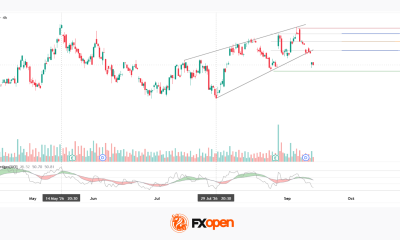
NVIDIA Analysis: Attempted Rising Wedge Breakout Amid Pressure on the AI Sector
-

 Tech5 days ago
Webb’s IC 348 Mosaic Includes Two-Jupiter Dwarfs, Twin Jets, and a Nursery Still Making Worlds
-
Crypto World6 days ago
Can Circle’s Arc Repeat Robinhood Chain’s Meme Coin Boom?
-

 Crypto World3 days ago
Silver prices recover quickly, hitting weekly high today
-

 Crypto World6 days ago
DOJ Seeks to Seize $61M in Iran Oil Funds From Binance Accounts It Vouched For
-

 Crypto World2 days ago
World Money launches in 150+ countries with Stripe
-
 NewsBeat2 days ago
US was ‘on brink of war’ with China over false AI report of nukes moving in Middle East
You must be logged in to post a comment Login