

Business
Innovate UK awards Agentic AI Pioneers Prize to leading UK startups


Innovate UK has unveiled the winners of its inaugural Agentic AI Pioneers Prize, marking a major step in the government’s ambition to position Britain as a global leader in next-generation artificial intelligence.
The competition, delivered in partnership with the Department for Science, Innovation and Technology, attracted more than 200 applications from across the UK’s high-growth sectors, highlighting the depth of innovation in areas such as advanced manufacturing, healthcare and the creative industries.
Designed to accelerate the commercialisation of “agentic AI”, systems capable of acting autonomously, collaborating with humans and managing complex workflows, the prize aims to support companies developing real-world applications of the technology.
The top award of £500,000 was granted to Danu Insights for its “Agentic Digital Twin Builder for the Life Sciences” platform.
The technology enables researchers to simulate biological systems and identify the most promising experimental pathways, helping to address growing complexity in drug discovery and biomanufacturing. By integrating modelling, validation and experiment planning into a single system, the platform is designed to reduce costs and accelerate the development of new therapies.
The judges highlighted its potential to deliver faster, more efficient and more sustainable innovation across the life sciences sector.
Two additional awards of £250,000 were presented to companies operating in advanced manufacturing and the creative industries.
In manufacturing, Singular Machine was recognised for CoEngen, a multi-agent engineering platform that coordinates design processes across disciplines using shared data models. The system allows engineers to optimise complex systems more quickly while maintaining traceability and safety standards.
In the creative sector, Tellme was awarded for a solution that delivers real-time, personalised museum experiences via smartphones. The platform enables visitors to interact with exhibits dynamically, receiving tailored information without the need for additional hardware, potentially transforming how audiences engage with cultural spaces.
Agentic AI represents a shift beyond traditional automation, focusing on systems that can take initiative, adapt to changing conditions and collaborate with human users. Applications range from industrial design and regulatory compliance to clinical decision-making and immersive digital experiences.
The competition demonstrated how these capabilities are already being applied to solve practical challenges, rather than remaining confined to theoretical research.
Sara El-Hanfy, head of AI and machine learning at Innovate UK, said the prize is intended to help promising companies move from early-stage innovation to scalable deployment.
“Our ambition is to support the companies set to shape the future of agentic AI and unlock its potential to drive growth across key sectors,” she said.
The initiative forms part of a broader strategy to position the UK at the forefront of AI development, particularly in areas where advanced technologies can deliver economic and societal impact.
By targeting sectors such as manufacturing, healthcare and creative industries, the programme aligns with the government’s industrial strategy priorities, focusing on areas where the UK has both strong research capabilities and commercial potential.
As AI continues to evolve, the emphasis is shifting from experimentation to implementation, with businesses seeking technologies that can deliver measurable productivity gains and competitive advantage.
The Agentic AI Pioneers Prize highlights how UK startups are beginning to translate cutting-edge research into practical solutions, with the potential to reshape industries and drive economic growth.
For Innovate UK, the challenge now is to ensure these early successes translate into scalable businesses capable of competing globally, reinforcing the UK’s position in the rapidly intensifying race for AI leadership.

Amy Ingham
Amy is a newly qualified journalist specialising in business journalism at Business Matters with responsibility for news content for what is now the UK’s largest print and online source of current business news.

Business
SBI sheds over $11 billion in market value in 2 sessions on margin squeeze, disappointing earnings

Shares of India’s largest lender by customers dropped 4.5% to a year-to-date low of 973.60 rupees on Monday, extending Friday’s near-7% post-results fall.
The selloff brought the stock down more than 10% in two sessions, wiping out $11.3 billion.
NSE data showed the heaviest fresh call writing on SBI’s 1,000 strike on Monday, signalling that investors expect any near-term rebound in the stock’s price to likely be capped at that level.
About 95 million shares changed hands over the two sessions, almost five-fold the 30‑day average of 18.7 million.

Analysts said the lender’s fourth-quarter earnings miss reinforced concerns that Indian banks are entering a tougher profitability cycle, with rising funding costs beginning to erode lending margins.
SBI on Friday reported a narrower net interest margin of 2.8% for the quarter, compared with 2.98% in the previous three-month period, and also missed analysts’ profit estimate.”NIM compression is becoming more visible as funding costs reprice faster,” JP Morgan said on Monday, adding that earnings momentum could moderate in the coming quarters.
“Core earnings were underwhelming, with incremental margins tightening,” Bernstein said, cautioning that upside catalysts may be limited without a stabilisation in margins.
SBI’s asset quality remained a key positive, with bad loans and credit costs staying benign, brokerages said, but warned it may not fully offset pressure on net interest income from margin compression.
Nonetheless, analysts retained a constructive long‑term view, citing the bank’s strong balance sheet, scale and market leadership.
The two-session selloff erased SBI’s year-to-date gains, leaving the stock down 0.8% in 2026, though it still outperformed the benchmark Nifty 50’s 8.8% drop.

Former White House ‘AI czar’ David Sacks discusses President Donald Trump’s upcoming China trip, where he is expected to talk about AI with Chinese President Xi Jinping on ‘The Claman Countdown.’
Former White House AI czar David Sacks predicted potential outcomes of President Donald Trump’s meeting with Chinese President Xi Jinping as the two leaders prepare to discuss artificial intelligence.
Sacks assessed the state of the intensifying AI arms race on “The Claman Countdown” Monday as China and the U.S. emerge as fierce competitors on the global stage.
“I do think that there are things that may be in our common interest, and it’s worthwhile to explore having those conversations,” he said.
“The fact is we have to still protect from against each other. So I think it’s going to be a little bit limited in terms of what we can achieve there.”
BEIJING IS QUIETLY DICTATING THE TRADE WAR’S NEXT MOVES AS TRUMP AND XI PREPARE TO MEET

US President Donald Trump and China’s President Xi Jinping (ANDREW CABALLERO-REYNOLDS/AFP / Getty Images)
Sacks’ comments follow the release of Anthropic’s Mythos, a model that has raised widespread worry over its capability to identify decades-old security vulnerabilities.
Sacks said the U.S. and China could potentially reach an agreement on new cyber standards during this week’s meeting, noting that neither country wants “rogue actors” to use AI models for dangerous purposes.
He also warned that the U.S. must take proactive defensive measures to ensure new AI models do not exploit existing vulnerabilities.
WHITE HOUSE MEETS AI FIRM ANTHROPIC AMID POLITICAL TENSIONS, PENTAGON DISPUTE
“We need to take steps now to harden our systems and scan our code bases to find latent vulnerabilities and patch them,” the former ‘AI czar’ said.
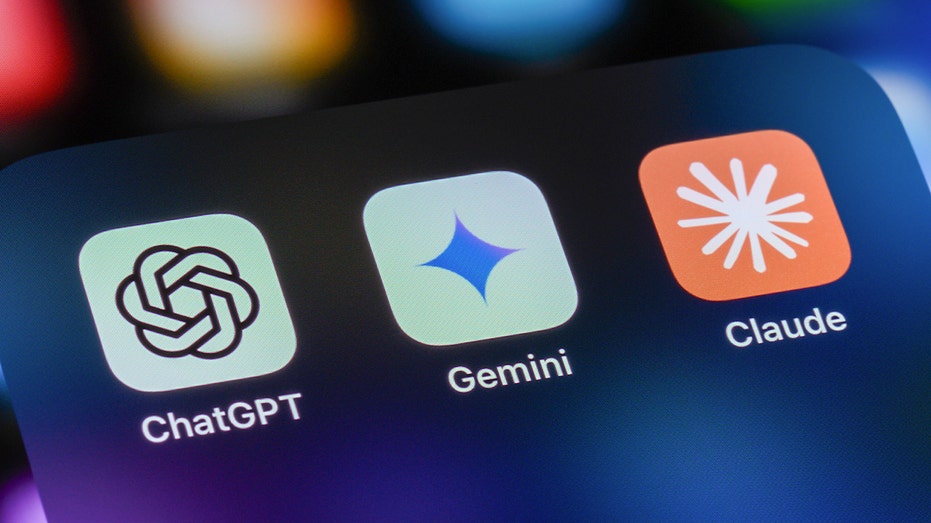
AI assistant apps on a smartphone — OpenAI ChatGPT, Google Gemini, and Anthropic Claude. (Getty Images / Getty Images)
Sacks also downplayed concerns about AI, arguing there is no need for strong federal regulation of the technology, while cautioning that China’s advancing cyber capabilities remain a serious concern.
“There’s been this debate about whether we needed an FDA for AI. That would be solving a problem I don’t think we have,” he told FOX Business.
“The real issue is not what the American labs do. It’s the fact that Chinese models and other models that other actors could train are gonna have advanced cyber capabilities within the next six months or so.”
Sacks cited previous success in AI discussions with China, including a late 2024 summit between former President Joe Biden and Jinping, where both countries agreed to keep AI away from nuclear weapons systems.

U.S. President Joe Biden escorts Chinese President Xi Jinping to his car to bid farewell after their talks in the Filoli Estate in the U.S. state of California, Nov. 15, 2023. (Photo by Li Xueren/Xinhua via Getty Images / Getty Images)
GET FOX BUSINESS ON THE GO BY CLICKING HERE
The former ‘AI czar’ said that while the U.S. and China remain locked in a highly competitive race for AI dominance, dialogue about the technology is a step in the right direction.
“I think the point here is for the two sides to start talking, to establish an initial dialogue and just to see how the Chinese are thinking about this,” Sacks said.

The US Supreme Court in Washington, DC, US, on Monday, April 20, 2026.
Graeme Sloan | Bloomberg | Getty Images
The U.S. Supreme Court cleared the way on Monday for Alabama Republicans to pursue a congressional voting map more favorable to their party ahead of November’s midterm elections, the latest fallout from the court’s seismic voting rights ruling.
The justices lifted a lower court’s decision that had blocked state Republicans’ preferred map as racially discriminatory and for illegally diluting the voting power of Black Alabamians.
The politically conservative Southern state is expected to seek to revert to this previous map, which would drop the number of districts where Black voters comprise a majority, or near-majority, from two to one out of the state’s seven U.S. House districts. Use of the previous map could be beneficial to Republicans.
The order was powered by the nine-member court’s conservative majority. The three liberal justices dissented and suggested that the lower court could reapply its judicial block to the Alabama Republicans’ preferred map.
President Donald Trump‘s fellow Republicans are fighting to maintain their control of the House, as well as the Senate, in the midterm elections.
Alabama is among a group of Republican-led states that has sought to eliminate majority-Black congressional districts and boost their party’s chances ahead of the elections following the Supreme Court’s ruling undercutting a key provision of the Voting Rights Act. Black voters tend to support Democratic candidates.
In its landmark April 29 ruling, the court, in a 6-3 ruling powered by its conservative members, struck down an electoral map that had given Louisiana a second Black-majority U.S. congressional district. The redrawn map, the majority ruled, had relied too heavily on race in violation of the constitutional equal protection principle.
Following the Supreme Court’s decision, Alabama immediately filed emergency motions asking the justices to allow it to revert to an older map with only a single majority-Black district.
Alabama, where Black voters make up a quarter of the electorate, had been ordered by a lower court to use a map that includes two majority-Black districts out of seven. Both are held by Black Democrats.
The lower court decided that a prior map had intentionally discriminated against Black voters and unlawfully diluted their voting power.
Alabama officials had argued in Supreme Court filings that Alabama’s court-ordered map shared the same constitutional defects as Louisiana’s.
In a dissent, liberal Justice Sonia Sotomayor emphasized that the lower court’s ruling concerning Alabama’s map was more expansive than the case involving Louisiana and included a finding of unconstitutional discrimination by intentionally diluting the votes of Black voters in Alabama.
The majority’s decision to set aside the lower court’s ruling is therefore “inappropriate and will cause only confusion as Alabamians begin to vote in the elections scheduled for next week,” Sotomayor wrote in a dissent that was joined by her two fellow liberal justices.
She said the lower court “remains free on remand to decide for itself whether Callais has any bearing on its Fourteenth Amendment analysis or if its prior reasoning is unaffected by that decision,” referring to the court’s April 29 decision, called Louisiana v. Callais.
In 2023, the court had upheld the lower court’s decision that the state’s Republican-drawn electoral map diluted Black voters’ power, violating the Voting Rights Act. That 5-4 ruling was authored by Chief Justice John Roberts, and he was joined by fellow conservative Justice Brett Kavanaugh and the court’s three liberal justices.
In a process called redistricting, the boundaries of legislative districts across the United States are reconfigured to reflect population changes as measured by the national census conducted every 10 years. Redistricting typically has been carried out by state legislatures once per decade.
Republicans and Democrats have been waging a multistate redistricting fight ignited last year when Trump initiated an unprecedented mid-decade effort to redraw maps in Republican-led states, starting with Texas.

Check out what’s clicking on FoxBusiness.com.
Passengers aboard Disney Cruise Line’s Disney Adventure say their four-night Singapore sailing was canceled after boarding due to technical issues, leaving families waiting hours for answers before being sent to hotels late at night.
Guests had already embarked on the May 7 voyage when the ship’s captain reportedly told them there were technical issues and that they would “set sail soon,” according to a passenger who documented the situation on Reddit.
By around 2 p.m. local time the following day, the captain announced the sailing would be canceled entirely.
“It’s really disappointing especially if vacationing with kids,” the user wrote.
DISNEY LAUNCHES NEWEST CRUISE SHIP AMID MASSIVE SEAFARING EXPANSION

The cruise ship “Disney Adventure”, built in the Wismar shipyard, is moored in the port of Mukran on the island of Rügen, while bathers and a windsurfer are in the water in the foreground. After around seven years of construction, one of the world’s (Photo by Stefan Sauer/picture alliance via Getty Images / Getty Images)
The passenger said guests waited hours for official instructions after the announcement, with only a handful of crew members assisting guests.
They said they did not receive hotel details until 12:10 a.m. and did not expect to reach their hotel until well after 1:30 a.m.
A letter to guests, later obtained and published by Disney Cruise Line Blog, said the sailing could not proceed as planned and apologized for the disruption.
DISNEY UNVEILS NEW SHOW IN PARK UNDERGOING MASSIVE TRANSFORMATION

Captain Mickey, Captain Minnie, Susan Egan, Josh D’Amaro and Joe Schott during the Disney Destiny christening in Fort Lauderdale, Florida on Nov. 10, 2025. (Pilar Arias/Fox News Digital / Fox News)
“We are truly sorry to let you know that we are unable to proceed with your Disney Adventure experience from May 7-11, 2026 as planned,” the company wrote, adding that “your safety and comfort as our guests are always our highest priority.”
The cruise line said affected guests would receive a full refund, 50% off a future cruise and a complimentary hotel stay, along with coverage for potential flight change fees and up to $500 per stateroom for incidental expenses.
However, the passenger raised concerns about the compensation, noting that the 50% future cruise discount requires booking by July 31, 2026, and sailing by May 31, 2027.
DISNEY ANNOUNCES MAJOR PLANS TO COMMEMORATE AMERICA’S 250TH ANNIVERSARY
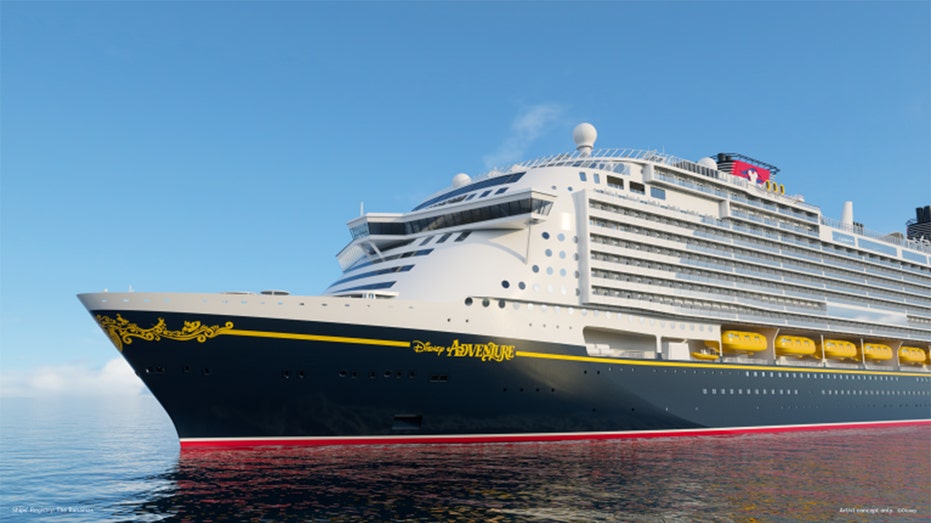
Disney Adventure should have capacity for about 6,700 guests and 2,500 crew members, Disney Cruise Line said. (Disney)
The user also questioned whether accommodations were consistent across guests, claiming that some passengers with back-to-back bookings received multiple complimentary nights while others were provided just one.
“We reached our hotel at around 2:00 a.m. and we have to check out at 12 noon… that isn’t even a full night,” the user wrote.
Additional complaints included a reported S$200 (about $150 USD) food and beverage credit, which the passenger said barely covered meals for one person — let alone a family of four.
The user said some travelers had flown in from countries including India, Australia and Canada specifically for the cruise, describing it as “one of the worst” experiences they’ve had with Disney.
“The Disney Adventure departed as scheduled on its next sailing after the mechanical issue was resolved,” a Disney spokesperson told FOX Business. “We completely understand this was an unfortunate situation for our guests and worked with them directly to support their travel needs, help make their trip home as smooth as possible and invite them back to a future sailing.”
CLICK HERE TO READ MORE ON FOX BUSINESS
The Disney Adventure is part of Disney Cruise Line’s major expansion plans, with the company aiming to grow its fleet to 13 ships by 2031. The vessel, which is home ported in Singapore, marks Disney’s first permanent cruise deployment in Asia.
FOX Business previously reported that Disney Cruise Line has been aggressively expanding its global cruise footprint, with Disney Experiences Chairman Josh D’Amaro saying the company is focused on bringing Disney cruises “to new guests on new shores.”


Andrew Archambault named president and chief operating officer.

NEW YORK — The NFL will unveil its highly anticipated 2026 regular-season schedule on Thursday, May 14, powered for the first time by Amazon Web Services artificial intelligence and advanced analytics, promising fans deeper insights, personalized viewing options and a more data-driven approach to one of the league’s biggest annual events.
The schedule release, traditionally one of the most exciting days on the NFL calendar, will be broadcast live across NFL Network, ESPN, and the league’s digital platforms beginning at 8 p.m. ET. This marks the first year the NFL has partnered with AWS to use machine learning models for schedule optimization, aiming to balance competitive fairness, travel demands, and broadcast appeal.
AWS technology transforms schedule creation
For the first time, AWS’s cloud infrastructure and AI tools played a central role in generating thousands of potential schedules before finalizing the version that best satisfied multiple constraints. The technology helped minimize back-to-back road games, optimize travel distances, and ensure key rivalries received optimal national television slots.
NFL Commissioner Roger Goodell highlighted the partnership during a recent media availability. “AWS has helped us create the fairest and most fan-friendly schedule we’ve ever produced,” he said. “This technology allows us to analyze millions of variables in real time — something that was impossible just a few years ago.”
What fans can expect on May 14
The 2026 schedule release will follow the familiar format fans love while incorporating new digital features. The NFL app and NFL+ will offer interactive tools allowing users to filter games by team, division, prime-time slots, and international matchups. Personalized “My Schedule” features will let fans generate custom calendars with alerts for their favorite teams.
Key highlights expected to dominate discussion include:
- The traditional Thanksgiving Day tripleheader
- Potential Christmas Day games
- International games in London, Munich, and possibly São Paulo
- Prime-time matchups featuring high-profile rivalries and high-scoring offenses
The defending champion Oklahoma City Thunder — wait, no, the NFL champion from the previous season will open the season on Thursday Night Football in a traditional kickoff game.
Major storylines heading into 2026
The schedule release will shine a spotlight on several compelling narratives:
- Aaron Rodgers’ future: Depending on his status with the Pittsburgh Steelers or a potential new team, his games will carry major intrigue.
- Rookie quarterbacks: The 2026 draft class, headlined by top prospects, will make their regular-season debuts under the national spotlight.
- Super Bowl rematch potential: Teams from the previous Super Bowl will likely face each other again.
- Expanded international presence: With growing global interest, more games outside the U.S. are anticipated.
Impact on teams and players
For the 32 NFL clubs, the schedule release marks the true beginning of preparations for the 2026 campaign. Teams will immediately begin analyzing opponents, travel schedules, and bye weeks to adjust training camp and preseason plans.
Players have mixed feelings about the May release date. While it provides clarity for family planning and training, many veterans note the increasing physical and mental demands of the modern NFL calendar. The AWS-powered optimization aims to reduce excessive travel fatigue, particularly for West Coast teams making multiple cross-country trips.
Broadcast and streaming implications
The 2026 season will feature expanded streaming options. Amazon Prime Video will once again handle exclusive Thursday Night Football games, while Netflix and YouTube continue growing their NFL presence. The schedule release will reveal which matchups receive the biggest national windows across ABC, ESPN, NBC, CBS, Fox, and streaming platforms.
Fan engagement and viewing parties
NFL fans are already planning watch parties and social media events for the May 14 release. Fantasy football leagues typically see a surge in activity immediately following the schedule drop as managers begin early draft research. Bars and restaurants across the country are expected to draw large crowds for the primetime reveal.
Historical context
The NFL has released its schedule in May since 2005 (with occasional exceptions). Last year’s release generated record digital engagement, with over 65 million unique users accessing NFL platforms within 24 hours. The league expects even higher numbers in 2026 thanks to improved technology and global interest.
What analysts are watching for
League insiders and betting markets are particularly interested in:
- Strength of schedule rankings for playoff contenders
- Primetime game distribution
- Bye week clustering
- Potential for flexible scheduling in the final weeks
Early projections suggest the Kansas City Chiefs, Detroit Lions, and Philadelphia Eagles could face particularly challenging slates, while certain rebuilding teams may benefit from more favorable matchups.
The road to Super Bowl LXI
The 2026 schedule will culminate in Super Bowl LXI on February 8, 2027, at Levi’s Stadium in Santa Clara, California. The release of the 17-game regular season roadmap is the first major step on that journey for all 32 teams.
As excitement builds toward Thursday’s reveal, the partnership with AWS signals the NFL’s continued embrace of technology to enhance both the on-field product and the fan experience. For millions of football fans counting down the days until September, May 14 cannot come soon enough.
The 2026 NFL schedule promises new rivalries, historic matchups, and another unforgettable season — and it all begins with the highly anticipated release this Thursday.

America turns 250 this year. Laird & Co., a family-run distillery in Colts Neck, N.J., can beat that—easily.
The roots of the business go all the way back to 1698, when founder William Laird began making and selling spirits; it became a formal business entity in 1780, in the midst of the Revolution. George Washington, according to family lore, enjoyed its signature Laird’s Applejack brandy.
Today, the company has expanded and diversified, and become the leading seller of American apple brandy in the U.S. and abroad. But it still makes its signature product with the same recipe, using the same methods. And it is still run by Lairds.
On some level, the arc of the Lairds’ business mirrors the arc of the country: from a colonial, farm-based economy to a national market stitched together by rail, through the shock of Prohibition and the mobilization of war, and into a modern era of reinvention and consolidation. The specifics change—laws, technologies, tastes—but the underlying challenge remains the same: how to survive in a country that is constantly remaking itself.
Copyright ©2026 Dow Jones & Company, Inc. All Rights Reserved. 87990cbe856818d5eddac44c7b1cdeb8
Business
US Stock Market Today | Dow Jones | Nasdaq Live: S&P 500 inches to higher close, AI fervor edges out Iran impasse

Tehran also demanded compensation for war damage, emphasised its sovereignty over the Strait of Hormuz, and called on the United States to end its naval blockade, guarantee no further attacks, lift sanctions and remove a ban on Iranian oil sales.
Within hours, Trump dismissed Tehran’s offer in a social media post.
“I don’t like it — TOTALLY UNACCEPTABLE,” Trump wrote on Truth Social, without giving further detail. The U.S. had proposed an end to fighting before starting talks on more contentious issues, including Iran’s nuclear programme.
Tehran responded on Monday by defending its stance.
“Our demand is legitimate: demanding an end to the war, lifting the (U.S.) blockade and piracy, and releasing Iranian assets that have been unjustly frozen in banks due to U.S. pressure,” Foreign Ministry spokesperson Esmaeil Baghaei said.
Business
Navitas Semiconductor Stock Explodes 25% on Surging AI Data Center Demand and Strong Q1 Results
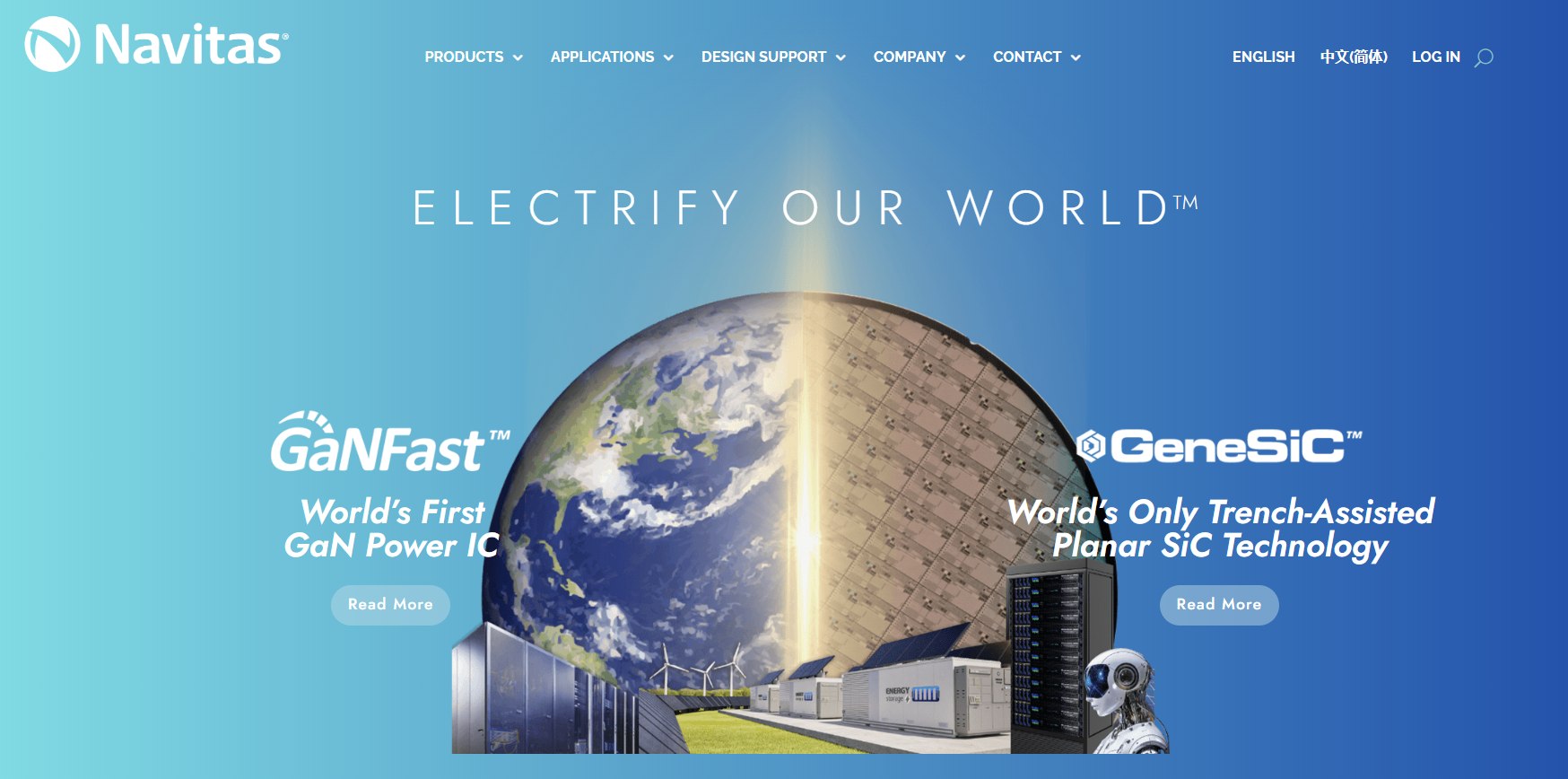
NEW YORK — Navitas Semiconductor Corporation (NASDAQ: NVTS) shares skyrocketed more than 25% in morning trading Monday, reaching $22.79 as investors poured into the gallium nitride and silicon carbide power chip specialist amid booming demand for high-efficiency solutions in artificial intelligence data centers.

The semiconductor company, which specializes in next-generation GaNFast and GeneSiC power semiconductors, has emerged as one of the clearest pure-play beneficiaries of the AI infrastructure buildout. Monday’s surge pushed the stock well above recent trading ranges on heavy volume, reflecting renewed enthusiasm for companies enabling faster, cooler and more efficient power conversion in hyperscale data centers.
Q1 results fuel optimism
Navitas reported first-quarter 2026 results on May 5 that showed sequential revenue growth of 18% to $8.59 million, beating analyst expectations. The company highlighted a meaningful shift toward high-power markets, including AI data centers, grid infrastructure, and industrial electrification. Gross margins also expanded as the product mix improved.
CEO Chris Allexandre emphasized the company’s successful pivot away from lower-margin mobile markets toward higher-value AI and energy applications. Navitas guided for Q2 revenue between $10.0 million and $10.5 million, with continued margin expansion driven by its growing design-win pipeline now exceeding $2.4 billion.
AI power revolution drives momentum
The core catalyst for Navitas has been its leadership in gallium nitride (GaN) and silicon carbide (SiC) technologies. These materials allow for significantly more efficient power conversion than traditional silicon, reducing energy loss and heat generation — critical advantages as AI training clusters consume enormous amounts of electricity.
At NVIDIA’s GTC 2026 conference in March, Navitas showcased an innovative 800V-to-6V GaNFast power delivery board designed specifically for NVIDIA’s MGX platform. The demonstration underscored Navitas’ growing integration into next-generation AI infrastructure, sparking investor excitement about multi-year design wins with major hyperscalers.
Analysts note that AI data centers require unprecedented levels of power density and efficiency. Navitas’ solutions address exactly these challenges, positioning the company at the intersection of two of the most powerful secular trends in technology: artificial intelligence and energy efficiency.
Short squeeze and technical breakout
Monday’s explosive move also carried elements of a short squeeze. Navitas had been heavily shorted earlier in the year by investors skeptical of its transition strategy. As positive momentum built on strong guidance and product momentum, shorts were forced to cover, accelerating the upward spiral.
Technically, the stock has broken out of a multi-month consolidation pattern on significantly elevated volume, with analysts raising price targets in recent weeks. Some bullish voices now see potential for $30+ if execution continues and AI spending remains robust.
Company transformation story
Navitas has undergone a significant strategic shift over the past 18 months. Once heavily focused on consumer mobile charging, the company has successfully repositioned itself toward high-power applications. This “Navitas 2.0” strategy appears to be paying off as revenue from AI and industrial markets grows rapidly.
Recent governance enhancements, including the appointment of experienced independent directors, have also helped boost investor confidence. The company maintains a strong balance sheet and continues investing in R&D to maintain its technology edge.
Risks and valuation debate
Despite the enthusiasm, some analysts caution that the stock’s rapid rise leaves it vulnerable to pullbacks. Memory and power semiconductor stocks are historically cyclical, and any slowdown in AI capital expenditure could pressure results. At current levels, Navitas trades at premium multiples that assume continued hyper-growth.
However, many growth investors argue the valuation is justified given the massive addressable market and Navitas’ early-mover advantage in GaN and SiC for AI. The company’s expanding design-win pipeline provides some visibility into future revenue.
Broader semiconductor AI theme
Navitas’ surge fits into a larger narrative of AI infrastructure winners. Companies enabling efficient power delivery are increasingly seen as critical picks-and-shovels plays in the AI gold rush. Navitas joins peers benefiting from hyperscaler spending on data center expansion and next-generation computing.
What investors should watch
Going forward, key catalysts for Navitas include:
- Q2 earnings in early August
- Progress on major design wins converting to revenue
- Updates from hyperscaler customers
- Potential new product announcements at industry events
Monday’s dramatic move highlights how quickly sentiment can shift in the semiconductor sector when a company demonstrates clear momentum in a high-growth area like AI power electronics.
As trading continues, Navitas Semiconductor stands out as one of the most compelling — and volatile — stories in the 2026 semiconductor landscape. Whether the rally sustains depends on continued execution, but for now, investors are rewarding the company’s successful pivot to the heart of the AI revolution.

NEW YORK — Shares of Innodata Inc. (NASDAQ: INOD) exploded higher Monday, rising more than 25% in morning trading to $106.72 as investors continued to pile into the AI data engineering and generative AI services company following its blockbuster first-quarter results and sharply raised 2026 outlook.

The surge extends the extraordinary momentum the stock has seen since its earnings release on May 7, when it more than doubled in a single session. Monday’s move pushed Innodata’s year-to-date gains well over 300%, turning the once-obscure data services firm into one of the hottest AI-related plays on Wall Street.
Record Q1 results ignite rally
Innodata reported first-quarter revenue of $90.1 million, a 54% increase from the prior year and well ahead of consensus estimates. Adjusted EBITDA soared to $25.0 million, crushing expectations by 139%, while adjusted gross margin expanded to 47%. Net income nearly doubled to $14.9 million, or $0.42 per diluted share.
CEO Jack Abuhoff highlighted strong execution across the company’s AI-focused businesses, particularly in data annotation, model training support, and evaluation services for large language models. The results reflect accelerating demand from Big Tech clients building next-generation AI systems.
Major Big Tech engagement disclosed
Perhaps most exciting for investors was the announcement of new engagements with an unnamed leading Big Tech company expected to generate approximately $51 million in revenue this year alone. Management noted this customer went from zero contribution last year to potentially the company’s second-largest client in 2026.
Innodata also introduced a new Evaluation and Observability Platform for agentic AI systems, further expanding its offerings in the rapidly growing space of autonomous AI agents.
Guidance raised significantly
Buoyed by strong visibility, Innodata raised its full-year 2026 revenue growth guidance to approximately 40% or more, up from the previous target of 35% or more. The upbeat outlook reinforced investor conviction that the company is well-positioned in the AI value chain.
Why the market is excited
Innodata provides essential data engineering services that power generative AI development, including high-quality training data, annotation, model evaluation, and synthetic data generation. As hyperscalers and AI leaders race to scale their models, demand for these specialized services has surged.
The company’s pivot toward higher-value AI solutions has dramatically improved margins and revenue visibility. Analysts see Innodata as a “picks and shovels” play in the AI gold rush — essential infrastructure that benefits regardless of which large language model ultimately dominates.
Short squeeze adds fuel
Heavy short interest earlier in the year created conditions for a classic short squeeze. As positive news flowed and the stock broke key technical levels, shorts were forced to cover, accelerating the upward move. Trading volume on Friday and Monday has been exceptionally heavy.
Valuation and risks remain
Despite the euphoria, some caution is warranted. At current levels, Innodata trades at premium multiples that assume continued hyper-growth. The stock remains volatile, and any slowdown in AI spending or delays in major contracts could trigger a sharp pullback.
However, many growth investors argue the valuation is justified given the massive addressable market and Innodata’s expanding pipeline. The company’s recent performance suggests it is successfully executing its transformation into a high-growth AI services leader.
Broader AI data services theme
Innodata’s surge fits into a larger wave of enthusiasm for companies enabling AI development. As model training and deployment scale dramatically, specialized data services have become critical bottlenecks. Innodata joins a select group of public companies directly monetizing this trend.
What’s next for Innodata
Investors will watch closely for Q2 results in early August and any updates on the major Big Tech engagements. Continued execution on margins and new customer wins could support further upside, while any signs of slowing AI investment would likely pressure the stock.
Monday’s dramatic move underscores how quickly sentiment can shift in the AI sector when a company delivers tangible results. For Innodata, the combination of record earnings, raised guidance, and major new contracts has transformed it from a niche player into one of 2026’s standout AI stories.
As trading continues, all eyes remain on whether this momentum can be sustained or if profit-taking will eventually cool the red-hot rally. For now, investors are rewarding Innodata’s successful bet on the generative AI revolution.

Pendidikan Financial Masalah di Indonesia

Mohamed Belloumi: Hull City winger makes up for slow introduction with match-winning impact
SBI sheds over $11 billion in market value in 2 sessions on margin squeeze, disappointing earnings

Manchester United reach agreement with Casemiro over contract clause amid transfer speculation

US brings back mandatory military draft registration

Steven Gerrard disagrees with Gary Neville over ‘shock’ Chelsea and Arsenal claim | Football


-
 Crypto World4 days ago
HarrisX Poll Found 52% of Registered Voters Support the CLARITY Act
-

 Fashion3 days ago
Weekend Open Thread: Marianne Dress
-

 Crypto World5 days ago
Upbit adds B3 Korean won pair as Base token gains Korea access
-
 NewsBeat5 days ago
NCP car park operator enters administration putting 340 UK sites at risk of closure
-

 Tech2 days ago
Auto Enthusiast Carves Functional Two-Stroke Engine from Solid Metal
-

 Politics3 days ago
Politics Home Article | Starmer Enters The Danger Zone
-
 Business2 days ago
Ignore market noise, India’s long-term story intact, say D-Street bulls Ramesh Damani and Sunil Singhania
-

 Crypto World6 days ago
UAE Free Zone Deploys Blockchain IDs to Verify Registered Firms
-

 Politics49 minutes ago
What to expect when you’re expecting a budget
-

 Tech17 hours ago
GM Agrees To Pay $12.75 Million To Settle California Lawsuit Over Misuse Of Customers’ Driving Data
-

 Fashion6 hours ago
Coffee Break: Travel Steam Iron
-

 Fashion21 hours ago
What to Know Before Buying a Curling Wand or Curling Iron
-

 Crypto World5 days ago
BlackRock CEO Larry Fink Discusses a New Asset Class
-

 Crypto World5 days ago
Robinhood says Wall Street is building onchain
-

 Entertainment5 days ago
Sarah Paulson Called Out For Met Gala ‘Hypocrisy’
-

 Tech6 days ago
Apple and Samsung are dominating smartphone sales so thoroughly that only one other company makes the top 10
-
Entertainment7 days ago
Serena Williams hits Met Gala in metallic dress after GLP-1 reveal
-

 Tech6 days ago
I tested the Xiaomi 17 Ultra’s camera and I don’t think I’ll ever go back to an iPhone
-
 Sports6 days ago
NBA playoff winners and losers: Austin Reaves is not loving Lakers vs. Thunder matchup, but Chet Holmgren is
-

 Fashion5 days ago
The Best Work Pants for Women in 2026
You must be logged in to post a comment Login