

Business
Iran Tensions Trigger Major Selloff in Thai Bonds


Thailand is experiencing its most significant foreign capital flight in years, with bond outflows exceeding $1 billion in March 2026, marking the largest selloff since 2022. This mass exit is driven by escalating geopolitical tensions in the Middle East, which have prompted global investors to retreat from emerging markets in favor of safer assets.
The resulting surge in oil prices has intensified concerns regarding inflation and widening current-account deficits, leading to substantial losses for international investors in both Thai bonds and equities.
Key Points
- Global funds offloaded more than $1 billion in Thai bonds in March, putting the market on track for its largest foreign selloff in four years.
- On a single Friday, overseas investors withdrew $1.2 billion from the bond market and an additional $1.2 billion from Thai equities.
- The retreat is primarily attributed to regional instability in the Middle East, which has caused money managers to de-risk their portfolios.
- Rising oil prices are a major concern for the Thai economy, as they threaten to drive up inflation and negatively impact the national current-account balance.
- Thai bonds have delivered an 8.5% loss to dollar-based investors on a hedged basis this month, while the domestic stock market has declined by over 8%.
Overseas investors withdrew a total of $1.2 billion from Thai bonds on Friday, March 20, 2026. This sell-off was the largest single-day withdrawal from the market since March 2022.
According to data from the Thai Bond Market Association, this significant exit is part of a broader trend where global funds dumped over $1 billion in Thai debt throughout March. The withdrawal coincides with escalating Middle East tensions, which have fanned inflation worries and pushed investors toward safe-haven assets. Beyond the bond market, overseas investors also offloaded $1.2 billion in Thai equities on the same day, marking the largest stock sell-off in two years.
The Bank of Thailand and market strategists note that these capital outflows are pressuring the Thai baht, which tested a nine-month low recently. Analysts suggest that the combination of high oil prices and widening current-account deficits has made emerging markets like Thailand less attractive to global money managers. While some officials remain confident in domestic stability, the Social Security Fund recently breached its risk limits for the first time in two years due to this market volatility.
What is the percentage loss for dollar-based Thai bond investors?
Thai bonds have delivered an 8.5% loss to dollar-based investors on a hedged basis in March 2026. This performance ranks among the worst in the region as global funds exit emerging markets due to escalating Middle East tensions.
The baht has faced significant downward pressure, testing a nine-month low of 33 per US dollar as investors shift toward safe-haven assets. Analysts at K-Research suggest the currency could weaken further to 33.50 per dollar this week due to rising US bond yields and geopolitical instability. Meanwhile, the Social Security Fund reported breaching its 8% value-at-risk threshold for the first time in two years following the market turmoil.
Middle East tensions have triggered a significant “risk-off” sentiment across global emerging markets, leading to substantial capital outflows as investors favor the US dollar and other safe-haven assets. This shift has particularly impacted Asian equities, which have seen a reversal of the “Sell America, Buy Asia” strategy due to the region’s heavy reliance on energy imports through the Strait of Hormuz.
Economists warn that a prolonged conflict could result in stagflation, a condition of high inflation and stagnant growth driven by surging oil and gas prices. Emerging economies like Thailand and India are especially vulnerable to cost-push inflation and trade deficits as the cost of importing crude oil, which has topped $100 a barrel, significantly increases production and logistics expenses.
Other People are Reading


Operator
Good day, everyone. Welcome to the TELUS 2026 Q1 Earnings Conference Call. I would like to introduce your speaker, Ian McMillan. Please go ahead.
Ian McMillan
Director of Investor Relations
Thank you, Karl, and hello, everyone. Thank you for joining us today. Our first quarter 2026 news release, annual MD&A and financial statements and detailed supplemental investor information were posted on our website earlier this morning.
On our call, we’ll begin with remarks by Darren and Doug. For the Q&A portion, we will be joined by Zainul, Navin and Tobias.
Briefly, prepared remarks, slides and answers to questions contain forward-looking statements. Actual results could vary from these statements. The assumptions on which they are based and the material risks that could cause them to differ are outlined in our public filings with securities commissions in Canada and the United States, including our Q1 2026 and 2025 annual MD&A.
And with that, over to you, Darren.
Darren Entwistle
President, CEO & Director
Thank you, Ian. Hello, everyone. In the first quarter of 2026, our team’s unwavering commitment to operational excellence and cost efficiency has once again empowered TELUS to deliver industry-leading customer growth, stable profitability and industry-best free cash flow growth of 19% on a

Beverage chain Dutch Bros posted first-quarter results after the market closed on Wednesday that were stronger than Wall Street expected, and raised its outlook for the full year. Still, shares fell on Thursday as consumers worried about whether growth could be sustained amid a weaker consumer environment and intense competition.
Business
Samsung Messages App to Be Discontinued in July 2026 as Company Pushes Google Messages Transition

NEW YORK — Samsung has officially confirmed it will discontinue its long-standing Samsung Messages application in July 2026 for users in the United States, urging Galaxy phone owners to switch to Google Messages as the default SMS, MMS and RCS platform to ensure continued functionality and access to modern features.

The end-of-service announcement, posted on Samsung’s U.S. support website, marks the final step in a years-long shift away from the company’s proprietary messaging app. Samsung began making Google Messages the default on new flagship devices in 2024 and stopped pre-installing Samsung Messages on many models. Now, the app itself will cease to function entirely for affected users starting in July.
“The Samsung Messages application will be discontinued in July 2026,” the notice states. “Upgrade to Google Messages as your default messaging app today to maintain a consistent messaging experience on Android.” The change applies to devices running Android 12 and newer in the U.S. market. Older devices and users outside the United States appear unaffected for now.
Why Samsung Is Making the Change
The move aligns Samsung more closely with Google’s broader Android ecosystem and the push toward Rich Communication Services (RCS) as the standard for modern texting. Google Messages offers enhanced features including end-to-end encryption (rolling out), better spam protection, AI-powered replies via Gemini, and seamless cross-device syncing. Samsung’s decision streamlines support and accelerates RCS adoption across its massive Galaxy user base.
Industry analysts view the discontinuation as a logical evolution. Samsung has been gradually de-emphasizing its own app for years, and the July 2026 cutoff gives users ample time to migrate. Devices running Android 11 or older will not be impacted by the shutdown.
What Users Need to Do Before July
Samsung recommends taking these steps as soon as possible:
- Set Google Messages as the default messaging app in phone settings.
- Back up chat history in Samsung Messages before the cutoff (export options are available in the app).
- Ensure Google Messages is updated via the Play Store for the latest RCS and security features.
- Test sending and receiving messages after the switch to confirm everything works smoothly.
After July, Samsung Messages will no longer send or receive texts (except possibly emergency services in some cases), and the app will be removed from the Galaxy Store. New Galaxy S26 series devices and future models will not even offer Samsung Messages as a downloadable option.
User Reactions and Concerns
The announcement has sparked mixed feelings across Samsung communities. Many users welcome the change, citing Google Messages’ superior features and cleaner interface. Others express nostalgia for Samsung’s customizable themes, edge lighting integration and familiar layout that some preferred over Google’s design.
On Reddit and Samsung forums, long-time users are sharing tips for smooth migration and backing up years of conversation history. Scammers have already begun exploiting the news with fake “Samsung Messages shutdown” phishing attempts, prompting warnings from security experts to only download Google Messages from the official Play Store.
Broader Implications for Android Messaging
Samsung’s decision accelerates the industry shift toward a unified messaging standard. With Apple also adopting RCS (with encryption in testing), cross-platform texting between Android and iPhone users is expected to improve significantly in the coming years. Google’s control over the default messaging experience on most Android devices strengthens its position in the mobile ecosystem.
For carriers, the move simplifies RCS rollout and reduces fragmentation. Users should see better message delivery, typing indicators, high-resolution media sharing and read receipts when communicating with other RCS-enabled devices.
How to Make the Switch Smoothly
Experts recommend the following transition checklist:
- Open Samsung Messages and export or back up important conversations.
- Download and set Google Messages as default.
- Re-register with your carrier for RCS if prompted.
- Review Google Messages settings for spam protection and customization.
- Test group chats, media sharing and international messaging.
Most users report the switch takes only minutes and preserves the majority of functionality, with added benefits from Google’s ecosystem.
What Happens After July 2026
Post-discontinuation, Samsung Messages will stop working entirely for U.S. users on supported devices. No new updates or security patches will be provided. Google Messages will handle all SMS, MMS and RCS traffic going forward, with Samsung focusing engineering resources on deeper integration rather than maintaining a parallel app.
The change is currently limited to the U.S. market, though international users may see similar transitions in the future. Samsung has not announced global rollout details.
Looking Ahead
Samsung’s discontinuation of its Messages app represents a pragmatic acknowledgment that Google’s platform has become the de facto standard for Android messaging. For millions of Galaxy users, July 2026 marks the end of an era but also the beginning of a more unified, feature-rich texting experience.
As the deadline approaches, Samsung is expected to issue more detailed guides and in-app notifications. Users who act early can avoid last-minute disruptions and take full advantage of Google Messages’ modern capabilities. The transition ultimately aims to deliver a better, more consistent experience across the Android ecosystem.
Q1: 2026-05-05 Earnings Summary
EPS of $0.91 beats by $0.19
| Revenue of $1.40B (113.61% Y/Y) beats by $76.10M

Seeking Alpha’s transcripts team is responsible for the development of all of our transcript-related projects. We currently publish thousands of quarterly earnings calls per quarter on our site and are continuing to grow and expand our coverage. The purpose of this profile is to allow us to share with our readers new transcript-related developments. Thanks, SA Transcripts Team

SALT LAKE CITY — A major cyberattack on the Canvas learning management system has disrupted education for millions of students and teachers across thousands of schools and universities, exposing sensitive data and forcing emergency contingency plans during critical end-of-semester periods. Instructure, the company behind Canvas, confirmed the breach on Thursday and is working with law enforcement. Here are 10 essential things everyone needs to know about the incident.

1. The attack was claimed by the hacking group ShinyHunters. The notorious group posted a ransom demand and claimed to have accessed data from more than 8,800 institutions and 275 million records. They defaced login pages with ransom notes and threatened to leak student information if payment is not made by May 12.
2. The breach involved unauthorized access to personal and academic data. Exposed information reportedly includes names, email addresses, student ID numbers, course records, private messages and possibly grades. While Instructure says highly sensitive financial data appears unaffected, the volume of personal information at risk is enormous.
3. Canvas serves millions of users daily across K-12 and higher education. The platform powers course management for over 8,000 institutions worldwide. During the outage, students could not submit assignments, access materials or communicate with instructors, particularly affecting those in final exam periods.
4. The attack caused widespread but not total system failure. While the main website showed partial functionality, the mobile app and certain backend services were heavily impacted. Many districts activated backup systems such as Google Classroom or email-based alternatives to minimize disruption.
5. Timing could not have been worse for academic calendars. The incident hit during peak finals and grading season for many schools. Universities and high schools scrambled to extend deadlines, shift to paper submissions or use alternative platforms, adding stress to already pressured students and faculty.
6. Instructure responded by taking systems offline proactively. The company said it detected suspicious activity and isolated affected portions of the platform. It is cooperating with cybersecurity experts and federal authorities, including the FBI, to investigate the full scope of the breach.
7. This is not the first major incident for education technology platforms. Canvas and other LMS providers have faced previous ransomware attempts and data leaks. The sector’s rapid shift to digital learning during the pandemic expanded the attack surface without proportional security investment at many institutions.
8. Students and parents should monitor for identity theft risks. Experts advise affected individuals to watch credit reports, enable two-factor authentication everywhere and be wary of phishing emails pretending to be from schools or Canvas support. Free credit monitoring may be offered to impacted users.
9. The financial and reputational cost to Instructure could be significant. Beyond any ransom payment (which the company has not confirmed pursuing), the breach may trigger lawsuits, regulatory fines and loss of institutional trust. Shares of Instructure’s parent entity faced selling pressure following the news.
10. The incident highlights urgent need for better ed-tech security standards. Education leaders are calling for stronger federal guidelines on data protection for learning platforms. Many schools are now reviewing vendor contracts and developing more robust backup systems to reduce reliance on single providers.
Background and Technical Details
The attack appears to have begun with exploitation of a vulnerability that allowed initial access, followed by privilege escalation. ShinyHunters posted screenshots of internal dashboards and sample data as proof. Instructure emphasized that core student safety systems and emergency communications were not compromised.
Impact on Different Education Levels
Higher education institutions faced the heaviest disruption, with final papers, exams and grade submissions affected. K-12 districts reported similar issues but were often quicker to pivot to alternative tools due to existing hybrid learning infrastructure. Some states activated statewide emergency learning continuity plans.
Long-Term Implications
The breach could accelerate a shift toward decentralized or open-source learning platforms and greater investment in cybersecurity training for school IT staff. Privacy advocates are pushing for stricter data minimization policies so that not every piece of student information is stored in one central system.
For now, students and educators are advised to remain patient as systems are gradually restored with enhanced security measures. Instructure has promised transparent updates and support for affected institutions. The education community is watching closely to see how quickly trust can be rebuilt after this significant incident.

Check out what’s clicking on FoxBusiness.com.
Tesla is recalling Cybertrucks over concerns their wheel studs could separate, potentially causing wheels to fall off, according to the National Highway Traffic Safety Administration (NHTSA).
According to the report, the recall affects Cybertrucks with the base 18-inch steel wheels that were sold between 2024 and 2026. Only 173 vehicles were recalled in total.
The issue stems from the brake rotors, with the report stating that more severe road conditions “may strain” the stud holes in the wheel rotor, causing cracks to form. If the cracks persist and worsen, it may result in the wheel detaching entirely.
Tesla said the issue traces back to pre-production testing in 2025, which identified that the geometry of the wheel hub and bearing could contribute to rotor cracking. Although early testing found no loss of vehicle function or control, engineers determined that continued use under strain could eventually lead to separation of the wheel stud from the hub.
TESLA RECALLS MORE THAN 218K VEHICLES OVER REARVIEW IMAGE ISSUE THAT POSES CRASH RISK

A fleet of Tesla Cybertrucks sits outside the Starbase Build Site at SpaceX’s South Texas testing facility on Feb. 6, 2026. (Reginald Mathalone/NurPhoto via Getty Images / Getty Images)
The company said planned durability improvements to the brake rotors were not incorporated when production began on Aug. 28, 2025, due to a change management error.
Tesla later identified a single real-world case in October 2025 in which a customer reported braking vibrations, and cracked brake rotors were found during a service inspection. The rotors were replaced, and the company said no crashes, injuries or fatalities have been linked to the issue.
The report warns that early signs a vehicle may be affected include vibrations or unusual noises from the wheels while driving.
As of April 14, Tesla had identified three warranty claims that may be related to the condition and said it initiated the recall out of an abundance of caution.
FORD RECALLS OVER 179,000 BRONCO AND RANGER VEHICLES OVER SEAT DEFECT

A Tesla Cybertruck is displayed at a Tesla dealership on December 20, 2024, in Corte Madera, California (Justin Sullivan/Getty Images / Getty Images)
All Tesla stores and service centers were notified of the recall on April 20, with notification letters set to be sent to owners on June 20.
A representative for Tesla did not immediately respond to FOX Business’ request for comment.
| Ticker | Security | Last | Change | Change % |
|---|---|---|---|---|
| TSLA | TESLA INC. | 428.35 | +16.56 | +4.02% |
GET FOX BUSINESS ON THE GO BY CLICKING HERE
The recall comes days after Tesla announced a separate recall of more than 218,000 vehicles over a rearview camera issue that could delay image display and increase crash risk, according to NHTSA.
FOX Business’ Landon Mion contributed to this report.
NEW YORK — Exxon Mobil Corp. (NYSE: XOM) stands as a compelling buy for long-term, income-focused investors in 2026, with Wall Street analysts issuing a consensus “Moderate Buy” rating amid resilient cash flows, a robust dividend and disciplined capital allocation despite volatile oil prices and the energy transition. The integrated oil major continues to deliver strong shareholder returns through dividends and buybacks while positioning itself for growth in low-carbon solutions and advantaged assets.
Shares have traded in the $148–$155 range in early May, reflecting solid year-to-date performance supported by a reliable 2.5–2.6% dividend yield and 43 consecutive years of dividend growth. Analysts covering the stock maintain an average 12-month price target of approximately $161–$165, implying 5–10% upside, with optimistic targets reaching $185–$195. Of roughly 20–42 analysts, the consensus leans toward Buy or Moderate Buy, with limited Sell ratings.
ExxonMobil reported first-quarter 2026 earnings on May 1 that beat expectations despite year-over-year declines tied to timing effects and lower commodity prices. Adjusted earnings reached $1.16 per share against consensus estimates around $1.00–$1.07, while revenue came in at roughly $83–$85 billion. The company highlighted record production in Guyana, strong Permian performance and structural cost savings as key drivers of underlying resilience.
Strong Cash Generation and Shareholder Returns
ExxonMobil generated substantial cash flow from operations in the first quarter, enabling $9.2 billion in shareholder distributions — including $4.3 billion in dividends and $4.9 billion in share repurchases. The company maintains a rock-solid balance sheet with low debt ratios and continues its $20 billion annual buyback program. These returns provide a compelling total return profile even in a lower oil price environment.
Management reiterated confidence in its advantaged assets, including the Golden Pass LNG project expected to contribute high-margin revenue later in 2026. Permian production growth remains on track toward 1.8 million oil-equivalent barrels per day, while international operations in Guyana deliver industry-leading returns.
Analyst Views and Valuation
Wall Street’s moderate optimism reflects ExxonMobil’s defensive qualities in the energy sector. The stock trades at a reasonable multiple to cash flow and book value for an integrated major, with a forward price-to-earnings ratio that appears attractive relative to historical averages and peers when factoring in its dividend reliability. Analysts highlight the company’s ability to generate free cash flow across a wide range of oil prices.
Risks include sustained lower oil prices due to geopolitical developments or slower global demand, potential regulatory pressures on fossil fuels and execution challenges in large projects. However, ExxonMobil’s diversified upstream, downstream and chemical segments provide meaningful buffers.
Why Buy Exxon Mobil in 2026
For conservative investors seeking income and relative stability, ExxonMobil offers a time-tested combination of scale, operational excellence and capital discipline. The stock suits retirement portfolios, dividend growth strategies and those wanting energy exposure without excessive volatility. Its proven ability to weather commodity cycles and return capital consistently makes it a core holding for many institutional investors.
Those already holding shares have little reason to sell given the attractive yield and long-term upside from strategic investments. New buyers may find current levels reasonable for accumulating a high-quality energy name with a fortress balance sheet. Dollar-cost averaging on dips can further enhance returns.
Long-Term Outlook
Looking further into 2026 and beyond, ExxonMobil is well-positioned to benefit from global energy demand while advancing lower-emission initiatives. The company continues investing in carbon capture, hydrogen and other technologies that could provide future growth avenues. Shareholder distributions are expected to remain robust, supporting total returns even if oil prices moderate.
As markets navigate geopolitical risks, energy security concerns and the energy transition, ExxonMobil’s integrated model and financial strength provide resilience. While not a high-growth tech play, the stock delivers dependable income and modest appreciation potential backed by tangible assets and proven management execution.
For investors comfortable with the energy sector’s inherent volatility, Exxon Mobil remains a high-quality choice in 2026. Its combination of dividend reliability, operational scale and strategic positioning supports a constructive outlook for long-term holders seeking both income and capital preservation in an uncertain macroeconomic environment.
Henry Sykes
Good afternoon, and welcome to the 2026 Annual Meeting of Shareholders of Pembina Pipeline Corporation. My name is Henry Sykes. I’m Chair of Pembina’s Board of Directors. And in accordance with our bylaws, I’ll preside over this meeting as Chair.
Before we proceed with the balance of the meeting, I’d like to start with the land acknowledgment, recognizing that we have people joining us today from numerous locations. As Pembina continues to build strong relationships and partnerships with indigenous communities, land acknowledgments are one way for us to communicate our respect for the land that we all share.
Pembina acknowledges our traditional hosts and thanks them for their graciousness in welcoming us to carry out work on their traditional territories. Pembina plays a role in the economic reconciliation with indigenous peoples’ and their respective communities where our operations take place. We acknowledge the future generations and the collective responsibility we all have to these lands. Indigenous peoples are the traditional stewards of the lands and waters where each of us work and choose to live.
We further acknowledge that the indigenous peoples have inhabited these lands and waters since time immemorial. The indigenous peoples territory, culture, truth, traditions, teachings and languages are sacred, and we’re thankful to be here today as guests.
Now this meeting is being held as a virtual-only meeting this year. Pembina has been and remains committed to maintaining and upholding shareholders’ rights, including in respect of our virtual shareholder meetings. Accordingly, we’ve ensured that this virtual meeting offers shareholders the opportunity to participate, submit questions and vote at the meeting.
Following the formal portion of this meeting, we’ll have

Cantaloupe completes merger with 365 Retail Markets, delists from Nasdaq
Operator
Good day, ladies and gentlemen, and welcome to the Cavvy Energy Annual General Meeting and Q1 2026 Financial Results Conference Call. Please be advised that today’s proceedings are being recorded.
[Operator Instructions]
I would now like to turn the meeting over to Mr. Dallas McConnell, Vice President, Corporate Finance. Please go ahead, Mr. McConnell.
Dallas McConnell
Vice President of Corporate Finance
Thank you, Didi. Hello, and welcome to the Annual General Meeting of Shareholders of Cavvy Energy Limited. My name is Dallas McConnell. I am Cavvy’s VP of Corporate Finance, and I will be the moderator for today’s meeting. I would now like to take this opportunity to review the logistics for today’s meeting.
In addition to the in-person portion of this meeting at Norton Rose Fulbright, this meeting is being streamed by live audio webcast and telephone. Participants attending via the webcast or telephone may listen to the meeting and ask questions but will not be able to vote on items of business. Only registered shareholders of record as of March 24, 2026, and duly appointed proxy holders present in person at this meeting are entitled to vote on items of business. The procedure for voting and asking questions will be addressed at the outset of the meeting.
Please note that today’s meeting is being recorded. If you participate in the meeting and disclose personal information, you will be deemed to consent to the recording, transfer and use of your personal information. If you disclose personal information of
![Cardi B - Money [Official Music Video]](https://wordupnews.com/wp-content/uploads/2026/02/1770603085_hqdefault-80x80.jpg)
Cardi B – Money [Official Music Video]
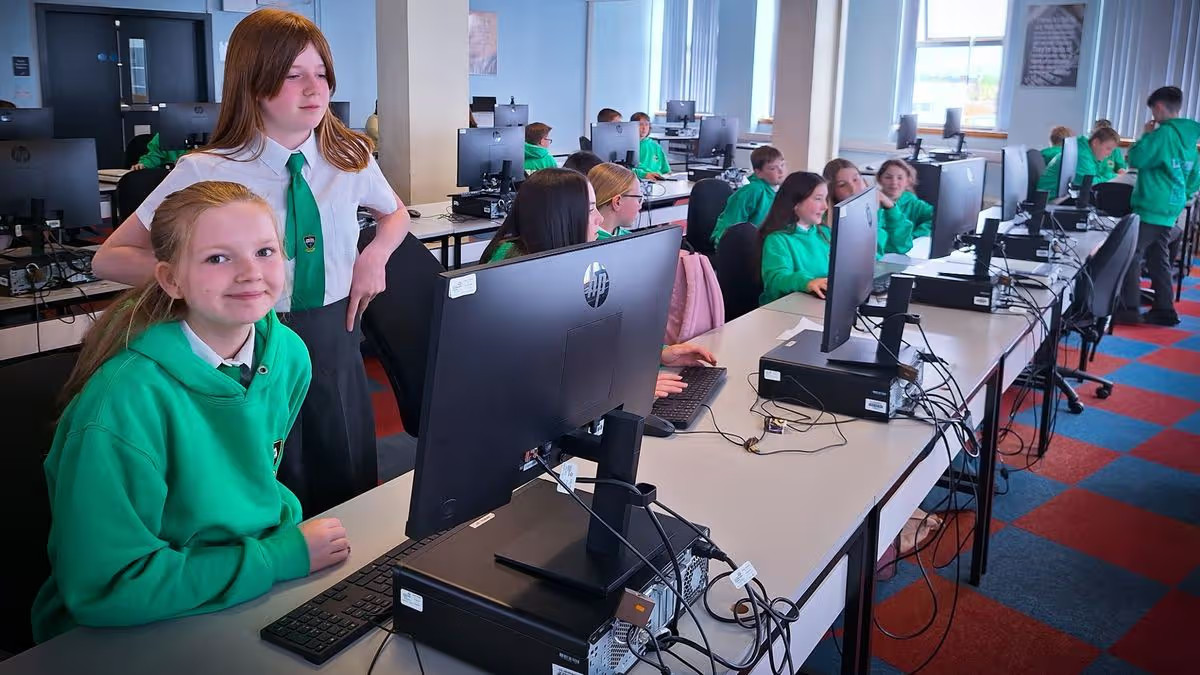
Coatbridge school pupils take part in coding challenge in taste of university life

TELUS Corporation (T:CA) Q1 2026 Earnings Call Transcript

Manchester United reach agreement with Casemiro over contract clause amid transfer speculation

US brings back mandatory military draft registration

Steven Gerrard disagrees with Gary Neville over ‘shock’ Chelsea and Arsenal claim | Football


-
 Crypto World14 hours ago
HarrisX Poll Found 52% of Registered Voters Support the CLARITY Act
-

 NewsBeat5 days ago
Channel 5 – All Creatures Great and Small series 7 new post
-

 Crypto World2 days ago
Upbit adds B3 Korean won pair as Base token gains Korea access
-

 Tech4 days ago
Image AI models now drive app growth, beating chatbot upgrades
-
 NewsBeat2 days ago
NCP car park operator enters administration putting 340 UK sites at risk of closure
-

 Sports7 days ago
Cavaliers vs. Raptors Game 6 live score, updates, highlights from 2026 NBA playoffs first-round series
-

 Entertainment7 days ago
Young and the Restless Next Week: Cane Arrested & Matt’s Deadly New Scheme!
-
Entertainment6 days ago
New Netflix Movies in May 2026 — My Top 3 Picks to Stream
-

 Sports6 days ago
Five killed in Texas plane crash identified as Amarillo pickleball players
-

 Entertainment6 days ago
Melissa Joan Hart and More Stars Attend 2026 Kentucky Derby
-
 Sports7 days ago
David Benavidez responds to team Canelo saying the fight will never happen
-
 Sports7 days ago
IPL 2026: ‘Love you darling’- Hardik Pandya’s reaction to MS Dhoni steals the show |Watch | Cricket News
-
Entertainment6 days ago
Anna Nicole Smith’s Daughter Attends 2026 Kentucky Derby
-

 Crypto World6 days ago
Bitcoin mining equities rise in 2026 as BTC lags behind
-
 Crypto World6 days ago
Pi Network Mandates Protocol 23 Upgrade for All Mainnet Nodes Before May 15 Deadline
-

 Business6 days ago
Luka Doncic Injury Update: Doncic’s Hamstring Recovery Slows Lakers’ Hopes Against Thunder: Can He Run Yet?
-

 Business7 days ago
Can Victor Wembanyama Bring the NBA Ring to Spurs in 2026? Historic Playoff Run Fuels Title Dreams
-
Entertainment6 days ago
Venus Williams’ Best Met Gala Looks Over the Years
-

 Sports6 days ago
Is Man United v Liverpool on TV? Channel, streaming and how to watch Premier League fixture
-

 Business6 days ago
Kuwait International Airport Resumes Operations After Closure as Regional Tensions Ease in 2026
You must be logged in to post a comment Login