

Crypto World
Trump’s 10% Intel (INTC) Stake Gains $47 Billion After Apple Chip Deal

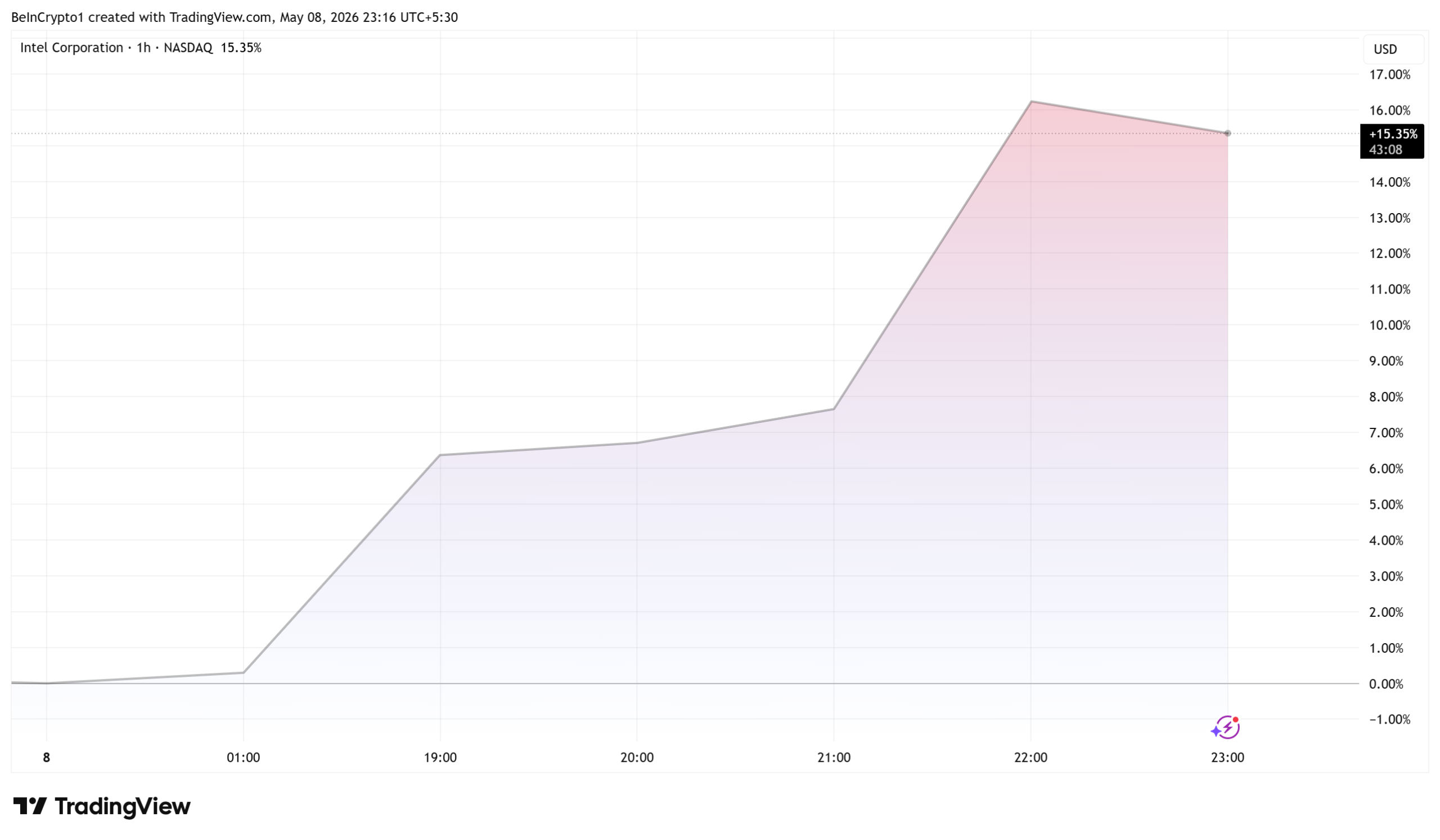
Intel (INTC) shares hit a record on May 8 after a preliminary deal to manufacture silicon for Apple. The rally lifted the Trump-era U.S. government Intel stake from $8.9 billion to $56.5 billion.
Washington paid $8.9 billion for the 9.9% position eight months ago. The Treasury now sits on roughly $47.6 billion in unrealized gains, according to The Kobeissi Letter. Intel shares climbed about 18% intraday to around $129, an all-time high.
How the Trump-era Intel stake was built
In August 2025, the Trump administration converted unpaid federal funding into 433.3 million Intel shares at $20.47 each.
The deal repurposed $5.7 billion in CHIPS and Science Act grants. It also drew $3.2 billion from the Defense Department’s Secure Enclave program.
President Trump publicly claimed credit for the move, telling supporters the country now owned 10% of Intel.
“The United States paid nothing for these Shares, and the Shares are now valued at approximately $11 Billion Dollars. This is a great Deal for America and, also, a great Deal for INTEL,” Trump wrote on Truth Social at the time.
The position is held by the U.S. Treasury as a passive investor, with no board seats. The structure tied the stake to a broader chip tariff agenda.
Following news that Apple and Intel had reached an agreement for the semiconductors and chip builder to make chips in Apple devices, INTC stock jumped 15%, pushing Trump’s investment to a valuation of $56.5 billion.

“That’s a gain of +$47.6 BILLION in less than 8 months. Truly unprecedented,” analysts at the Kobeissi Letter commented.
Why the Apple deal matters for Intel
The Wall Street Journal first reported the deal, the first time Apple has agreed to use Intel for production silicon. Apple has historically depended on Taiwan Semiconductor Manufacturing Company for its custom chips.
Commerce Secretary Howard Lutnick had met repeatedly with CEO Tim Cook to push the partnership forward.
Intel’s foundry business has spent more than a year searching for an anchor customer. Microsoft signed on for the 18A process earlier this year.
April 2026 was Intel’s strongest month on record with a 114% gain. The Apple deal adds another major customer to a foundry roadmap once viewed as struggling. It feeds the broader push to onshore semiconductor manufacturing.
The $47.6 billion gain remains on paper. Any sale will hinge on market conditions. It also depends on political appetite for booking a profit on what was framed as industrial policy.
The equity-for-grants formula has drawn Senate scrutiny over Trump policy windfalls.
Subscribe to our YouTube channel to watch leaders and journalists provide expert insights
The post Trump’s 10% Intel (INTC) Stake Gains $47 Billion After Apple Chip Deal appeared first on BeInCrypto.


Regulatory and enforcement developments shape ongoing crypto litigation and compliance landscape
In a sequence of legal and regulatory actions that underscore the industry’s ongoing scrutiny, high-profile crypto executives and local governments are navigating tightened oversight and courtroom outcomes. Former Celsius CEO Alex Mashinsky recently moved to represent himself in court after his counsel withdrew, while Celsius and FTX continue to illustrate the sector’s broader structural vulnerabilities. Separately, Washington state and Iowa advanced distinct regulatory efforts to curb crypto kiosk activity, signaling a growing emphasis on consumer protection and regulatory compliance at state and municipal levels. In New York, prosecutors pursue asset forfeiture linked to Sam Bankman-Fried, highlighting ongoing asset-recovery efforts in the wake of high-profile crypto failures.
These developments occur against the backdrop of bankruptcy proceedings and sweeping enforcement initiatives that have reshaped governance, licensing, and risk assessment for lenders, exchanges, and other crypto-enabled entities. The evolving regulatory posture—at federal, state, and local levels—continues to influence licensing, AML/KYC practices, and the management of consumer-facing crypto services.
Key takeaways
- Alex Mashinsky has chosen to proceed pro se as he faces prison time already imposed for fraud and price manipulation at Celsius Network.
- Roni Cohen-Pavon, Celsius’ former chief revenue officer, is slated for sentencing on May 13, with prosecutors having signaled potential leniency due to substantial assistance.
- Municipal and state regulators are tightening controls on crypto kiosks and ATMs, with Spokane Valley banning virtual currency kiosks/ATMs and Iowa adding rigorous oversight to formalize penalties for noncompliance.
- In New York, prosecutors seek to forfeit $10 million in cash tied to Sam Bankman-Fried, reflecting ongoing asset-recovery efforts as part of the broader FTX-related prosecutions.
Mashinsky’s pro se stance and sentencing backdrop
Legal filings indicate that, after a recent change in defense representation, Alex Mashinsky intends to proceed without counsel in the ongoing case surrounding his role at Celsius. The development comes as Mashinsky was previously sentenced to 12 years in prison for involvement in fraud and price manipulation at the Celsius lending platform. The decision to represent himself introduces a new dynamic into a case that has already drawn increased regulatory and judicial attention within the crypto finance sector.
The Celsius proceedings remain part of a broader wave of enforcement actions that have implicated multiple executives and entities tied to lender operations during the market downturn of 2022. The outcome of Mashinsky’s self-representation and any potential post-sentencing motions will be of interest to practitioners assessing how courts handle self-representation in complex, high-stakes financial wrongdoing cases within the crypto domain.
Subsequent sentencing considerations for Celsius leadership
Beyond Mashinsky, the legal process continues for Roni Cohen-Pavon, Celsius’ former chief revenue officer. Cohen-Pavon pleaded guilty in September 2023 and is set for sentencing on May 13. In a recent filing, U.S. prosecutors recommended that the judge consider Cohen-Pavon’s “substantial assistance” to the government at sentencing, a move that can carry mitigating weight in the final judgment. The recommendation, reported by prosecutors on May 4, signals a potential leniency trajectory, though the ultimate sentence will reflect a court assessment of the defendant’s conduct and cooperation.
The Celsius case is set against a broader context in which two major crypto platforms—Celsius and FTX—filed for bankruptcy in 2022 amid a sector-wide downturn. The distress experienced by these platforms has elevated attention on governance, risk controls, consumer protection, and the adequacy of disclosures in crypto-lending and related financial services.
Local and state regulatory actions on crypto kiosks and ATMs
Regulatory focus at the municipal and state levels has intensified as regulators seek to curb crypto-related scams and protect consumers. In Spokane Valley, Washington, the city council voted unanimously to adopt an ordinance prohibiting virtual currency kiosks and ATMs. The measure imposes a civil penalty of $250 for noncompliance and authorizes officials to revoke business licenses of operators found in violation. Entities hosting kiosks and ATMs face a 30-day compliance window, reflecting a rapid regulatory response to perceived consumer harms associated with crypto access points.
The Spokane Valley action aligns with a broader trend of local authorities scrutinizing crypto storefronts and services as scams affecting residents persist. The move potentially constrains the footprint of crypto kiosks in jurisdictions where consumer protection and enforcement resources are prioritized.
Meanwhile, Iowa’s regulatory posture expanded with the introduction of SF2296, which adds crypto kiosks to the state’s financial regulatory framework. The measure empowers state authorities to impose civil penalties and pursue injunctions against operators that fail to comply with the new regulatory regime, representing a meaningful expansion of oversight for crypto kiosks within the state. The public-facing communications from the Iowa Attorney General’s Office highlight the intent to establish robust oversight to deter scams and safeguard residents’ interests as these technologies permeate everyday financial interactions.
These actions illustrate a shift toward formalizing the oversight of crypto-enabled access points at multiple levels of government, with potential implications for operators, banks seeking to integrate crypto services, and investors monitoring compliance risk. For entities with cross-border or cross-jurisdictional activity, aligning with varying local requirements has grown increasingly complex and costly.
Asset forfeiture emphasis in the Bankman-Fried case
In a separate enforcement development, prosecutors in the Southern District of New York filed a motion to forfeit $10 million in cash linked to Sam Bankman-Fried. The funds were located in a Fiduciary Trust Company account and described by U.S. Attorney Jay Clayton as representing “the return of the investment made by [Bankman-Fried] in Semafor.” The filing underscores continued asset-recovery efforts following Bankman-Fried’s conviction and 25-year sentence for his role in defrauding FTX users and investors.
Bankman-Fried was ordered to forfeit more than $11 billion as part of the criminal judgment, a figure that remains unpaid as he pursues appeal proceedings. The forfeit action demonstrates the ongoing focus on disgorgement and asset recovery in high-profile crypto prosecutions, highlighting the cross-cutting implications for how proceeds of wrongdoing are identified, traced, and recovered, including assets held abroad or in complex custody arrangements.
These forfeiture matters illuminate the broader regime under which prosecutors seek to recoup proceeds linked to significant crypto-related fraud, and they intersect with regulatory expectations around transparency, financial misconduct, and the enforcement toolkit available to government authorities pursuing restitution and deterrence.
Closing perspective
The convergence of courtroom developments, state and municipal regulation, and high-profile asset-recovery actions confirms that enforcement and compliance considerations remain central to the crypto industry’s trajectory. The coming months will be critical for assessing how self-representation in complex cases influences sentencing, how leniency guidelines interact with substantial assistance in criminal matters, and how regulators reconcile consumer protection with the growth of crypto kiosks and other on-ramps. Observers should monitor ongoing court filings, regulatory rulemaking, and legislative activity that could recalibrate licensing, oversight, and enforcement across jurisdictions.
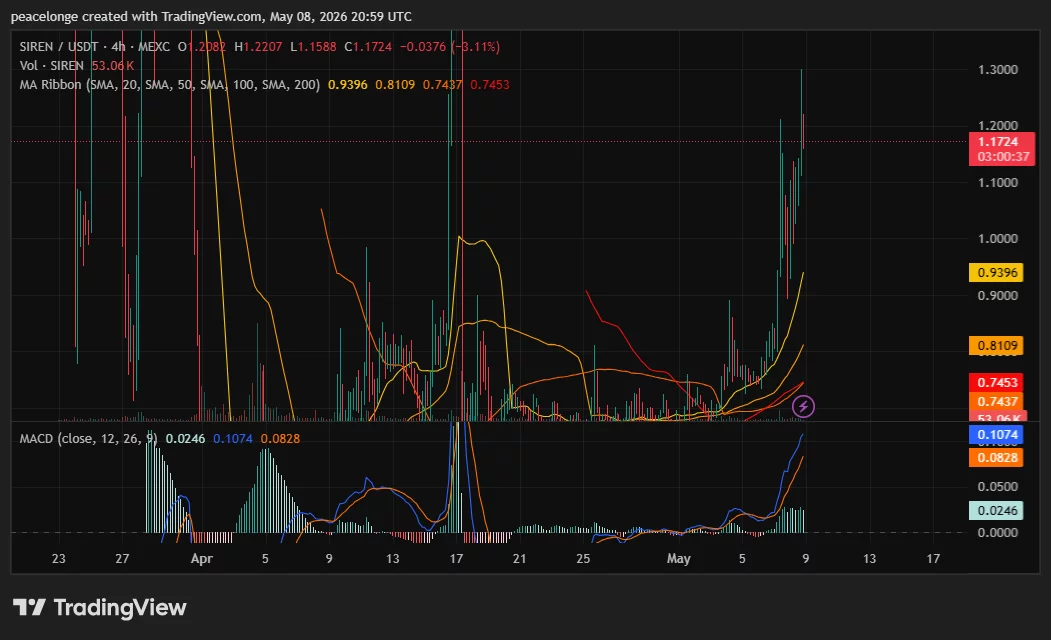
SIREN price surged 22% on Binance perpetuals on May 8, hitting $1.2965 before a sharp 4H reversal warned of seller resistance.
Summary
- SIREN’s Binance perpetual contract rose 22.82% on May 8, touching a session high of $1.2965 on volume of 139.23M tokens.
- The 4H spot chart on MEXC printed a long upper wick at $1.2207 and reversed 3.11%, signaling sellers stepped in at resistance.
- The daily MA ribbon has fully flipped bullish with all four SMAs stacked below price, but the MACD on the 4H is issuing the first caution flag of the latest rally.
SIREN price posted a 22% gain on Binance perpetuals on May 8 before a 4H reversal flagged seller resistance. The BNB Chain AI-meme token reached a daily high of $1.2965 on the Binance perpetual market on volume of 139.23 million tokens, the highest reading since the April peak, before pulling back to close the session near $1.1626 on the daily candle.
The daily timeframe tells a straightforwardly bullish story. All four moving averages in the MA ribbon — the 20, 50, 100, and 200 SMA — are stacked below price and fanning outward, the classic arrangement of a trend that has regained structure after a correction.
The MACD on the daily chart is crossing positive for the first time since the April peak, with the histogram ticking into green territory and the blue signal line lifting off the zero line.
Where the conflict is
The 4H spot chart on MEXC tells a different story in the short term. Price opened at $1.2089, spiked to a high of $1.2207, and reversed to $1.1724 by the time of the most recent close, a 3.11% intraday loss.
The resulting candle has a clearly defined upper wick at the $1.22 level, indicating sellers absorbed the buying pressure that drove the initial spike.
The 4H MACD is rising, with values at 0.0246 on the histogram and 0.1074 on the signal line, but the current red candle introduces the first distribution signal since the May rally began. Volume on the 4H was 53.06K, materially lighter than the spike candles that drove price from the $0.74 MA cluster to above $1.20 in the days prior.
As crypto.news documented, SIREN has a pattern of sharp intraday reversals following rapid moves higher. The token hit an all-time high of approximately $3.61 on March 22, then plunged more than 70% within 48 hours as wallet concentration concerns triggered selling pressure.
The current move is the second major recovery attempt from that collapse, with the token having based in the $0.68 to $0.80 range through most of late April before breaking out again in early May.
Supply and structure context
SIREN is a BNB Chain token that markets itself as an AI-meme hybrid, with a roadmap promising a DEX and an AI trading agent, both currently listed as coming soon on its website.
As crypto.news reported, on-chain researchers have flagged supply concentration concerns throughout the token’s history, with estimates ranging from 48% to 88% of supply controlled by a small cluster of wallets. That overhang has been a recurring driver of the token’s violent downside episodes.
The broader BNB Chain environment remains supportive for AI-themed tokens. BNB Chain surpassed 150,000 autonomous AI agent deployments in April 2026, growing 43,750% since January and establishing itself as the dominant chain for on-chain AI activity. SIREN’s AI narrative sits inside that tailwind, though its promised products remain undelivered.
The immediate technical question is whether $1.22 holds as the first meaningful resistance level on the 4H or whether buyers can reclaim it on the next session to set up a continuation toward the next visible supply zone near $1.30.
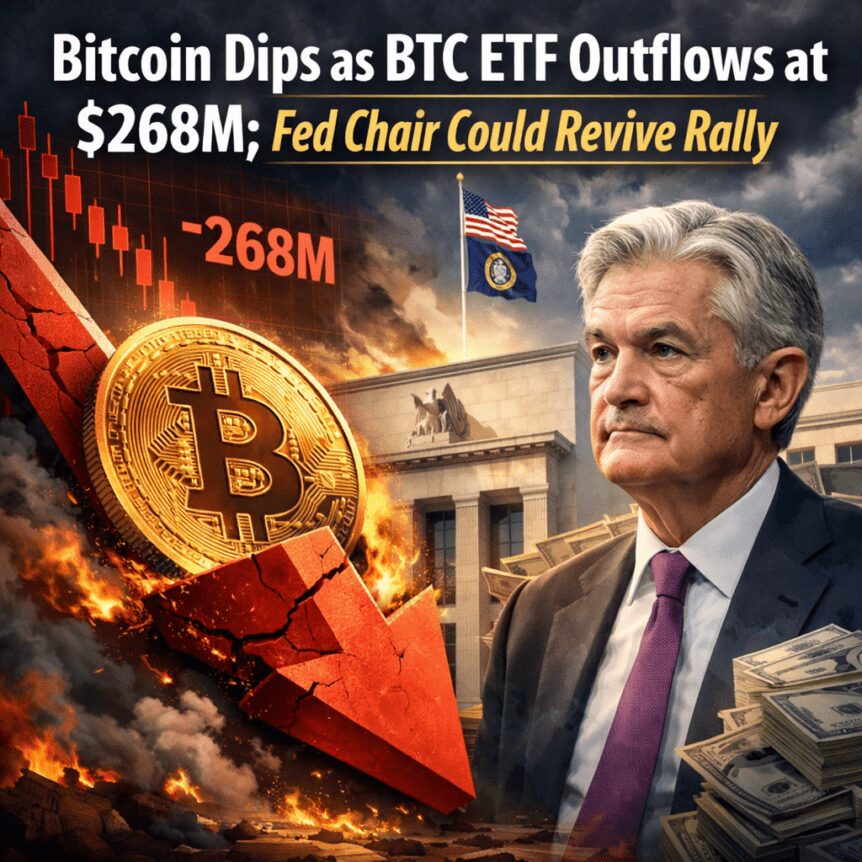
Bitcoin hovered around $80,000 on Friday after a failed push through $82,500, as traders reconciled a mix of ETF flows, leveraged futures activity, and a broader macro backdrop. US-listed spot Bitcoin ETFs posted $268 million in net outflows on Thursday, snapping a four-day streak of inflows, while $270 million of leveraged bullish Bitcoin futures positions were liquidated within 24 hours. The price action comes as equities held firm— the S&P 500 reached a fresh high—without a clear broad derisking signal across traditional markets, and the Russell 2000 remained close to its own peak.
Key takeaways
- ETF dynamics and macro tone: Spot Bitcoin ETF outflows cooled the recent positive flow stretch, suggesting a potential shift in near-term momentum even as macro conditions remain generally supportive for scarce assets.
- Retail demand under pressure: The latest quarterly results from Coinbase and Robinhood point to softer retail engagement, with Coinbase reporting a 31% revenue drop year over year and Robinhood’s crypto revenue down 47% in the same period, tempering optimism about a sustained rally driven by everyday users.
- Trader positioning diverges by venue: Top traders on Binance have pared long BTC exposure to the lowest levels in over a month, while OKX’s whales and market-makers briefly tilted bullish as BTC breached $80,000, only to trim those bets again as the week progressed.
- Dollar weakness and reserve speculation: A softer U.S. dollar over the past couple of months lends support to non-dollar assets, including Bitcoin, especially if inflation dynamics keep real yields unattractive in Treasuries.
- Policy chatter and what to watch next: Market minds are eyeing potential shifts in U.S. policy and the possibility of a Bitcoin-related reserve strategy; discussions around a future Strategic Bitcoin Reserve and influential voices in the Fed space have kept BTC on investors’ radar.
Macro backdrop and ETF flows shape the short-term path
Bitcoin’s oscillation around the $80,000 level underscores a market wrestling with mixed signals. On the one hand, a weaker U.S. dollar over the past two months and elevated oil prices have historically tended to tilt appetite toward scarce assets, including Bitcoin, as investors look for diversification away from U.S. Treasuries. On the other hand, the week’s ETF flow data painted a more cautious picture. SoSoValue tracked $268 million in net outflows from US-listed spot BTC ETFs on Thursday, ending a four-day streak of inflows and prompting renewed questions about the durability of Bitcoin’s recent strength.
Beyond ETF specifics, equities showed strength. The S&P 500 hit a record high, while the Russell 2000 remained within a short distance of its own peak, indicating that the move was not accompanied by a broad de-risking shift across risk assets. In this environment, Bitcoin’s fate has increasingly hinged on macro undercurrents as much as trader positioning in crypto venues.
Retail engagement waning as institutional and whale flows diverge
The health of the ongoing rally in Bitcoin has long depended on demand from retail buyers, but the latest data from major on-ramps paints a more nuanced picture. Coinbase reported a 31% revenue decline year over year for the quarter, while Robinhood’s crypto-driven revenue fell by 47% over the same period, suggesting that the much-anticipated broad retail revival is taking longer than some anticipated.
Trading dynamics at crypto venues further illustrate divergent sentiment. At Binance, the most active traders trimmed their long BTC positions to the lowest levels seen in more than four weeks, signaling risk-off leanings among market participants who were previously more aggressively bullish. Conversely, at OKX, whales and market-makers added bullish exposure as Bitcoin briefly climbed above $80,000 on Tuesday. Those bullish bets were subsequently scaled back on Friday, narrowing the top-trader long-to-short ratio to about 0.27—well below the roughly 1.20 seen only ten days earlier. This split highlights how different segments of the market—retail, institutions, and large holders—are reading the price action and risk differently as the macro environment evolves.
Dollar dynamics, strategic reserves, and policy chatter
Two macro threads keep Bitcoin in focus: a softer dollar and the prospect of a strategic Bitcoin reserve. The dollar’s weakness has reduced a core incentive to hold U.S. Treasuries, particularly in a world of elevated energy prices, which can bolster non-dollar assets in investor portfolios. In tandem, the debt backdrop in the United States fuels speculation about scarce-asset strategies that could include accumulating BTC as a reserve or strategic balance tool in the future.
Further fueling that narrative are ongoing policy discussions around Bitcoin holdings and potential shifts in leadership. Market chatter has circulated around Kevin Warsh, a former Federal Reserve governor who has been cited in media discussions as a contender for chair and who has publicly signaled favorable views toward crypto assets in the past. Warsh’s reported crypto and digital-asset holdings, along with his broader policy stance, have kept traders closely watching for signals that a more pro-Bitcoin stance could emerge at the central bank level should he rise to the top post.
The broader reserve conversation includes references to possible budget-neutral strategies for acquiring Bitcoin, a concept discussed by US Treasury-related voices in the past. While these ideas remain speculative, they reflect a growing dialogue about how a potential BTC reserve could fit into a diversified macro toolkit, particularly if the dollar remains under pressure and inflation dynamics stay elevated.
Additionally, market watchers noted that a shift toward a BTC reserve by the United States remains a long-term possibility rather than an imminent move. Still, the emergence of such discourse underpins a persistent theme: Bitcoin is increasingly viewed not just as a speculative asset but as a potential strategic edge in a diversified policy toolkit.
On liquid markets, data from Polymarket suggested that odds of the U.S. introducing any amount of Bitcoin into its official reserves by 2027 still sit in the longer-shot area. Even so, the mere presence of such bets signals a growing conversation about the role Bitcoin could play in national-level balance sheets should macro conditions warrant a shift in strategy.
Crucially, the recent ETF outflows do not, in and of themselves, indicate an imminent bear market. Rather, they reflect shifting sentiment and the evolving balance between institutional dynamics, retail demand, and macro risk appetite. Investors will want to monitor how this balance evolves as the next set of macro data and policy signals come into focus, particularly any concrete moves around a strategic BTC reserve or changes in Fed leadership that could tilt the incentives for Bitcoin adoption and holdings.
Related: Bitcoin bulls target $115K by December—Does data back the expectation?
Looking ahead, watchers will be watching for real-world developments that could recalibrate the market’s risk-reward calculus. A move by public institutions to incorporate Bitcoin into a strategic reserve would represent a watershed shift in the asset’s market structure, while a continued drift in the dollar and debt dynamics will keep BTC in the crosshairs of macro traders. Until then, BTC remains at a hinge point where macro resilience, evolving policy discourse, and shifting trader positioning will collectively shape the path forward.
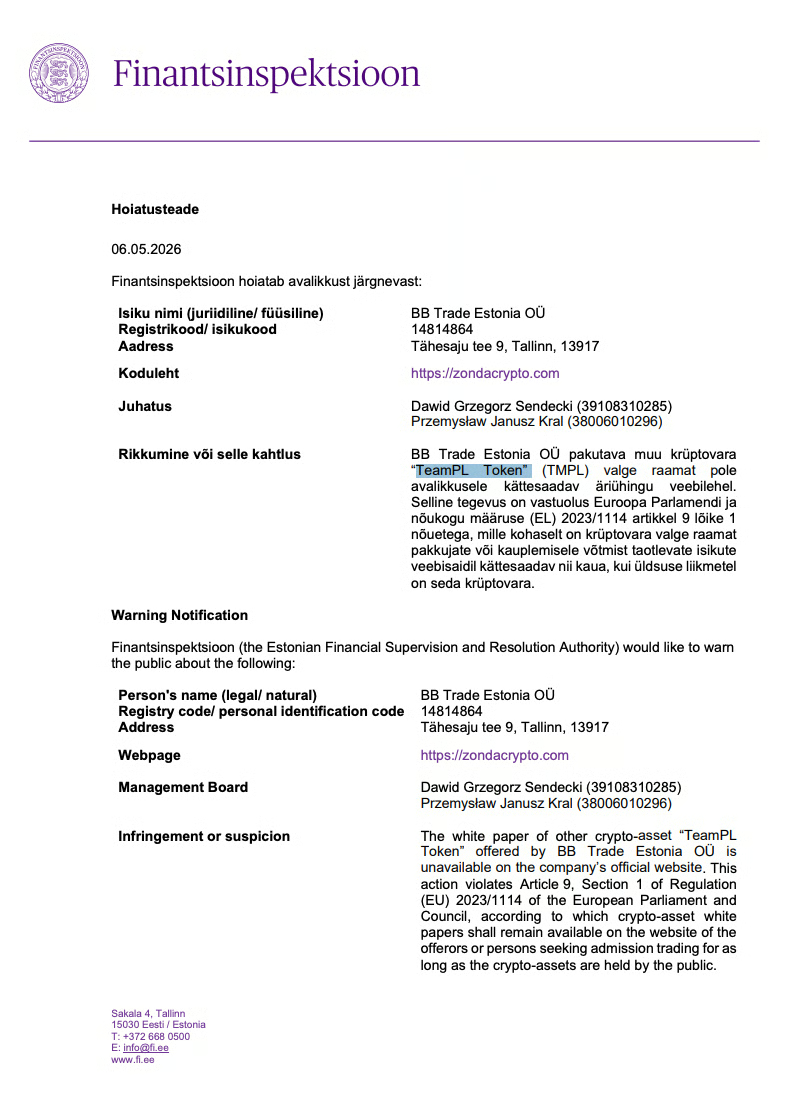
Estonia’s Financial Supervision and Resolution Authority (FSA), the country’s financial regulator, issued an investor warning for BB Trade Estonia OÜ, the company that operates the Zondacrypto digital asset exchange.
The FSA said the company did not have a white paper listed on its website for the “TeamPL” crypto token listed on the crypto exchange, a violation of the European Union’s Markets in Crypto-Assets (MiCA) regulatory framework. According to the FSA:
“This action violates Article 9, Section 1 of [MiCA], according to which crypto-asset white papers shall remain available on the website of the offerors or persons seeking admission trading for as long as the crypto-assets are held by the public.”

The investor warning for Zondacrypto and its parent company. Source: Estonia FSA
Cointelegraph reached out to Zondacrypto but did not receive a response by the time of publication.
The investor warning follows news of withdrawal issues at the Zondacrypto exchange and an investigation into the company by Polish law enforcement officials.
Related: Europe’s MiCA regime puts smaller crypto firms under pressure
Zondacrypto faces investigation following withdrawal and access issues
In April, Zonda CEO Przemysław Kral said the exchange did not have access to a cold wallet containing about 4,500 Bitcoin (BTC), valued at about $360 million at the time of writing.
Kral claimed that the wallet’s private keys were never handed over by Sylwester Suszek, the founder and former CEO of Zondacrypto, who has been missing since 2022. He also denied rumors that the exchange is insolvent, adding that it would meet all customer obligations.

Kral’s last post on the X social media platform was published on April 16, 2026. Source: Przemysław Kral
Polish investigators initiated a probe into the company in April, following reports from users of withdrawal issues and the inability to access funds.
Since that time, Kral has gone silent on social media, with no new posts since April 16. Local media outlets reported that he flew to Israel, where he is a citizen, amid the probe by Polish law enforcement.
In February, he told Cointelegraph that the company is based outside of Poland because the country has not brought its crypto regulations in line with the EU’s MiCA framework.
“Although we are a company with Polish roots and the largest player in the crypto industry on the Polish market, we have been operating outside Poland for years,” he said.
Magazine: Guide to the top and emerging global crypto hubs: Mid-2026

TLDR:
- Stellar now hosts over $2 billion in tokenized assets from major institutional players across the network.
- Franklin Templeton and Circle are among the firms actively deploying capital and infrastructure on Stellar.
- XLM is trading at $0.1600, testing critical trendline support at $0.1590 after pulling back from $0.1850.
- A hold above $0.1590 keeps recovery toward $0.1700 to $0.1750 in play for XLM bulls watching the chart.
Stellar is drawing major tokenization players as XLM adoption quietly grows across institutional finance. The network, long associated with cross-border payments, is now hosting billions in real-world asset activity.
Data from on-chain sources shows established financial names actively building on the blockchain. The scale of capital already settled on Stellar points to a deeper trend that many retail observers have yet to fully recognize.
Major Financial Names Are Building Tokenized Assets on Stellar
Stellar draws major tokenization players at a pace that is hard to ignore when the numbers are laid out. X Finance Bull posted data showing Spiko has deployed $776.8 million on the network.
Franklin Templeton follows with $657.9 million, while Bitbond accounts for $463.1 million. Circle sits at $270.1 million, and Ondo has committed $124.0 million to the chain.
These figures represent capital decisions, not experimental pilots. Firms of this caliber operate under strict compliance and fiduciary frameworks. Their presence on Stellar carries weight beyond the dollar amounts alone.
When Franklin Templeton, a firm managing trillions globally, chooses a blockchain for tokenized fund infrastructure, that choice goes through multiple layers of due diligence.
The same applies to Circle, which operates at the center of regulated stablecoin issuance. Their activity on Stellar reflects a deliberate infrastructure decision.
Combined, these players represent over $2 billion in tokenized value already running on the network. That volume positions Stellar as a live settlement layer for real-world assets, not a future possibility.
XLM Price Tests Key Support While Adoption Narrative Builds
As Stellar draws major tokenization players, XLM’s price is navigating a technical reset after a recent rally. The token climbed to $0.1850 before pulling back to the current level of $0.1600.
Binance Killers flagged on their platform that the 8-hour chart shows price sitting at a confluence of horizontal support and an ascending trendline near $0.1590.
That zone is now the key level traders are monitoring. A hold above $0.1590 keeps the recovery scenario toward $0.1700 and $0.1750 in play. The trendline support adds a structural argument for bulls at this range.
On the other hand, a close below $0.1590 would shift attention to the $0.1510 to $0.1550 band. That lower range would then serve as the next area where buying interest may re-enter. The setup is clean and defined, which makes it easier for traders to manage positions around current prices.
What makes this technical moment more compelling is the backdrop. Price consolidation during a period of growing institutional activity on the network tends to attract informed buyers.
The combination of a tested support zone and an expanding adoption story gives XLM a dual narrative that goes beyond short-term chart movements.



LayerZero Labs acknowledged a Lazarus Group attack on internal RPCs and a multisig signer’s unauthorized personal trade, impacting 0.36% of assets on the protocol.

In early 2026, as the United States Senate weighs a comprehensive digital asset market structure bill, leading crypto exchanges pressed lawmakers to remove a provision that could hamper token listings. Politico reported that Coinbase, Kraken and Gemini asked lawmakers to excise language requiring trading platforms to offer only assets that are “not readily susceptible to manipulation.” The appeal underscores how industry stakeholders may influence drafting that governs listing standards, exchange compliance, and market integrity.
The reported intervention followed the US Senate Agriculture Committee’s January vote to advance its version of the bill, signaling that industry input is shaping legislative text even as committees refine policy details. Separately, Coinbase Chief Policy Officer Faryar Shirzad said on social channels that the issue was “old news” and had already been included in the committee’s markup, highlighting the persistent tensions around tokenized equities and other complex instruments.
Under the market-structure framework, known as the CLARITY Act after its partisan maneuvering, the Commodity Futures Trading Commission would gain enhanced authority to oversee digital assets. In March, both the CFTC and the Securities and Exchange Commission announced intentions to coordinate oversight of the crypto markets, denoting a pragmatic approach to regulation in the absence of a comprehensive congressional accord. This coordination would influence licensing, enforcement, and cross-agency policy harmonization as firms navigate a bifurcated regulatory landscape.
Industry and policymakers have also been exploring a path forward on related questions, including stablecoins. Reports of a compromise between crypto and banking representatives on stablecoin yield circulated last week, with some lawmakers signaling a push for ethics language addressing conflicts of interest as the bill advances through the banking committee. Meanwhile, observers have widely anticipated a markup in the banking committee in the near term, with projections that the legislation could reach floor consideration before the Senate recess in August. White House crypto adviser Patrick Witt indicated the administration’s objective of shepherding House passage around early July, contingent on a vote in the Senate in June.
For market participants, these developments carry significant regulatory and compliance implications. The proposed standard that assets be “not readily susceptible to manipulation” would tighten the criteria for listing, potentially constraining smaller or newer tokens and altering traditional exchange onboarding practices. The tension between investor protection and market access remains central to the debate, with industry voices warning that overly aggressive constraints could impair liquidity or hinder innovation, particularly in tokenized assets and new digital-asset classes.
Key takeaways
- Major exchanges reportedly urged lawmakers to remove a clause linking listing eligibility to manipulation-resistance, a change that could affect the breadth of tokens that exchanges feel comfortable listing.
- The CLARITY Act, passed by the House in July 2025, would expand CFTC authority over digital assets and push for closer regulatory coordination with the SEC.
- Regulators signaled ongoing coordination between the CFTC and SEC to supervise the crypto markets, a development with material implications for licensing, enforcement, and cross-border compliance.
- The Banking Committee appears poised to markup the bill soon, with some observers predicting passage before the August recess and a White House timeline targeting early July for House approval after a Senate vote.
- Industry–regulator dialogue on stablecoins and yields signals attention to risk frameworks, fiduciary standards, and potential conflicts of interest in governance and custody arrangements.
Policy architecture and oversight shifts under CLARITY Act
The proposed market-structure framework would reallocate regulatory authority toward the CFTC, enlarging its remit over digital assets that operate outside traditional securities or commodities regimes. In parallel, the agreement among regulators to coordinate oversight reflects a move away from siloed supervision toward a layered, cross-agency approach. For market infrastructure providers—exchanges, liquidity venues and token issuers—this coordination could shape requirements for registration, surveillance, AML/KYC controls, and ongoing reporting obligations.
From a compliance standpoint, the shift amplifies the importance of accurate asset classification, as enforcement actions could hinge on whether a given token falls within a commodity, a security, or a digital asset category with bespoke regulatory rules. Firms may need to align programmatic controls—transaction monitoring, risk assessments, and governance frameworks—with expectations that both the CFTC and SEC will monitor market integrity, disclosure, and conflict-of-interest risks. The prospect of tighter, harmonized oversight also raises questions about licensing pathways for new products and the pace at which firms must adapt their compliance tooling to accommodate dual- or cross-registrations.
Industry leverage, listing dynamics, and token risk
The contested provision on manipulation risk reveals a core tension in contemporary market structure debates: balancing investor protection with practical liquidity and innovation. If the requirement to list only manipulation-resistant assets remains in flux or is softened, exchanges could maintain a broader token catalog, including smaller-cap tokens that typically face higher liquidity and surveillance costs. Conversely, stricter standards could narrow the universe of admissible assets, affecting portfolio construction for institutional traders, market-making desks, and fund liquidity programs.
Beyond listing mechanics, the episode underscores how public policy within a highly technical sector depends on input from market participants. Coinbase’s public commentary around the bill’s wording signals that industry players are monitoring both text changes and the process by which committee marks shape final policy. For participants, this means heightened sensitivity to legislative text and the timing of committee actions, with compliance teams tracking changes that affect onboarding, risk categorization, and disclosure obligations tied to asset classes and product design.
Regulatory coordination, enforcement, and licensing implications
With the CFTC and SEC signaling coordinated oversight, firms face an enhanced expectation of consistent implementation across agencies. This alignment bears directly on licensing regimes, registration expectations, and ongoing compliance monitoring. Institutions may need to revisit risk governance frameworks to reflect potential shifts in enforcement priorities, particularly around asset classification, listing standards, and disclosures related to custody and settlement risk. In addition, the broader regulatory stance on stablecoins—an area under intense congressional and executive scrutiny—could influence banking relationships, as regulators assess reserves, liquidity management, and customer protections in stablecoin programs.
Cross-border considerations remain salient. The United States’ regulatory posture often interacts with international frameworks, including MiCA in the European Union and various national regimes. Institutions operating globally must map how U.S. rules interface with overseas jurisdictions, ensuring that policy alignment, risk controls, and reporting obligations satisfy multiple legal regimes while maintaining consistency in risk signaling and governance practices.
Timeline, negotiations, and governance signals
Market participants have tracked a signal-rich window as negotiations proceed. Reports of a compromise on stablecoin yields indicate ongoing sector-into-policy dialogue, with the aim of advancing the bill through the banking committee. While some lawmakers advocate adding ethics language to address conflicts of interest, others anticipate a relatively rapid passage timeline, potentially before the August recess. A White House adviser’s comments regarding a July 4 target for House passage, after a Senate vote in June, illustrate the administration’s eagerness to see a coordinated framework come into effect within a defined cycle. For compliance and risk teams, this translates into windows of opportunity for policy finalization and corresponding readiness testing across internal control systems and audit programs.
Closing perspective
As the United States contemplates a broader framework for digital-asset market structure, the interplay between legislative text, industry engagement, and regulator coordination will shape the pace and scope of enforcement, licensing, and risk management. Institutions should monitor committee marks, enforcement signals, and cross-agency guidance to calibrate listing policies, product design, and compliance programs for the evolving regulatory landscape.
Key takeaways:
- A weakening US dollar and higher government debt favor scarce assets, even as spot Bitcoin ETF outflows and low retail demand spark some concern.
- Traders expect Kevin Warsh to become Fed Chair, which could benefit Bitcoin.
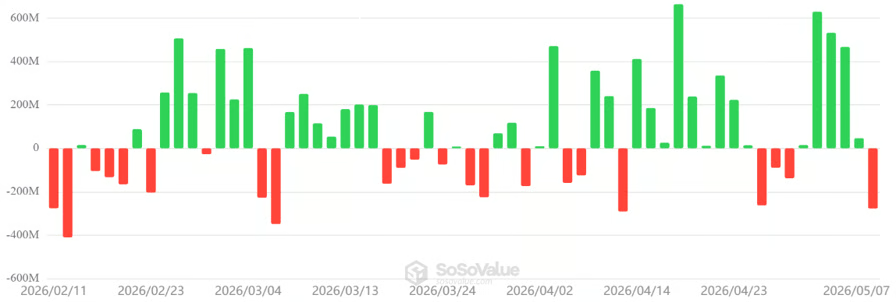
Bitcoin (BTC) stagnated near $80,000 on Friday following a rejection at $82,500. Traders grew anxious after US-listed spot Bitcoin exchange-traded funds (ETFs) posted $268 million in net outflows on Thursday.
Meanwhile, $270 million in leveraged bullish Bitcoin futures positions were liquidated within 24 hours, forcing investors to evaluate whether a sustained bear market is finally taking hold.

Bitcoin US-listed spot ETFs daily net flows, USD. Source: SoSoValue
The reversal in Bitcoin spot ETF flows on Thursday broke a four-day positive streak. This shift is particularly notable because the S&P 500 Index surged to an all-time high on Friday. There is no evidence of a broad derisking trend across traditional markets, as the US small-cap Russell 2000 Index remains within 2% of its own record peak.
Are Bitcoin retail traders jumping ship?
Underwhelming earnings reports from Coinbase and Robinhood indicated a sharp drop in retail engagement, sparking concerns about Bitcoin’s bull run sustainability. Coinbase recorded a 31% revenue decline compared to the first quarter of 2025, while crypto-related revenue on Robinhood plummeted by 47% over the same period.

Exchanges’ top traders Bitcoin long-to-short ratio. Source: CoinGlass
Top traders at Binance have slashed their Bitcoin longs to the lowest levels in over four weeks. In contrast, whales and market makers at OKX added bullish exposure as the Bitcoin price broke above $80,000 on Tuesday, but they subsequently reduced those positions on Friday.
Overall, the 0.27 long-to-short ratio among top traders at OKX remains a far cry from the 1.20 mark seen just ten days prior.
Weaker US dollar and odds of Strategic Bitcoin Reserves
While Bitcoin derivatives show moderate bearishness, two distinct factors support a sustained bull run. The US dollar has weakened against other major fiat currencies over the past two months. Whether intended by the US administration or not, this move reduces incentives to hold US Treasuries, especially given the current high oil prices.

Brent crude oil, USD (left) vs. US dollar strength index (right). Source: TradingView
The growing US government debt creates an environment favoring scarce assets. Even if the stock market and gold remain the primary options for most investors, Bitcoin tends to benefit from a weaker US dollar.
Regardless of the macroeconomic environment, expectations are rising that the US Strategic Bitcoin Reserve could start adding BTC, and Kevin Warsh is expected to replace Fed Chair Jerome Powell in the near term. Warsh recently reported significant holdings in cryptocurrency assets and companies and has previously expressed pro-Bitcoin views.
Related: Bitcoin bulls target $115K by December–Does data back the expectation?

Odds of the US adding any amount of Bitcoin to its reserves by 2027. Source: Polymarket
While still considered a long shot, the path to budget-neutral strategies for acquiring Bitcoin has been cited by US Treasury Secretary Scott Bessent in the past. Consequently, potential outflows from fixed-income investments due to a weaker US dollar and higher inflation increase the odds of sustained bullish momentum in Bitcoin.
The recent outflows from spot Bitcoin ETFs do not necessarily indicate that a bear market is underway, even if top traders’ current positioning signals a lack of confidence in a short-term rally.


Google Chrome has been silently installing a 4GB AI model called Gemini Nano on users’ devices without consent, a researcher found.
Summary
- Researcher Alexander Hanff documented Chrome secretly downloading a 4GB AI model called Gemini Nano to eligible devices without user notification or consent.
- The model reinstalls itself automatically if users delete it, and Chrome does not offer an opt-out prompt during installation.
- Hanff argues the practice likely violates the EU’s ePrivacy Directive and GDPR, raising legal questions that have not yet been tested in court.
Google Chrome is silently installing a 4GB AI model on users’ devices without consent, a researcher found. Privacy researcher and computer scientist Alexander Hanff documented the installation after discovering that a Chrome profile he created for automated privacy audits had accumulated 4GB of model files called weights.bin inside a folder named OptGuideOnDeviceModel, despite receiving zero human input at any point.
The model is Google’s Gemini Nano, a lightweight on-device large language model. Hanff’s evidence chain shows Chrome downloading the 4GB file in 14 minutes and 28 seconds on April 24, 2026, without a consent prompt, without a settings notification, and without a checkbox.
The file reinstalls automatically when restarted after deletion, according to multiple independent reports across Windows, macOS, and Linux.
What Chrome does with the model
Chrome 147 displays an “AI Mode” pill in the address bar, which users might reasonably assume routes queries to the local on-device model. According to Hanff’s investigation, that assumption is wrong.
The AI Mode pill is a cloud-backed Search Generative Experience that sends every query to Google’s servers. The on-device Gemini Nano powers right-click menu features that most users never access.
Snopes verified the claim as mostly true, finding the weights.bin file on the devices of three of six staffers checked, spanning both macOS and Windows machines. Google told Snopes it began rolling out an opt-out option in Chrome settings in February 2026, though this setting was not available to all users.
As crypto.news reported, unsolicited data collection and silent software behavior from major tech platforms have become a growing concern in 2026, with CZ and others warning that transparency failures across digital systems are eroding user trust at scale.
Legal and environmental risks
Hanff argues the practice likely violates the EU’s ePrivacy Directive, which governs storage of data on user devices, and GDPR transparency requirements.
Those claims have not been tested in court. He also calculated that at Chrome’s approximately one-billion-device scale, distributing the 4GB file generates between 6,000 and 60,000 tonnes of CO2-equivalent emissions.
The Malwarebytes security blog noted that a similar pattern emerged weeks earlier when Hanff documented Anthropic’s Claude Desktop silently installing browser integration files across multiple Chromium browsers without meaningful user disclosure, also arguing those installs likely violated EU law.
As crypto.news tracked, AI-driven security and privacy risks are accelerating in 2026, with CertiK warning that AI tools are making attacks faster and harder to detect across the digital ecosystem.
Crypto World
Consensys’ Bill Hughes to Senate: Pass the CLARITY Act Now or Lose the Crypto Market for Years
TLDR:
- U.S. users drove over $1 trillion in crypto volume in early 2025, yet offshore exchanges captured most of the trading activity.
- Binance held 38% of global spot market share while Coinbase, the top U.S. platform, sat below 7% of worldwide volume.
- Sanctioned actors from Russia, Iran, and North Korea have exploited offshore venues to move funds beyond U.S. regulatory reach.
- A HarrisX poll shows 52% of voters support the CLARITY Act, with majorities of both Republicans and Democrats backing the bill.
The CLARITY Act stands at the center of a growing debate over America’s role in the global crypto economy. The United States processes the largest cryptocurrency volume on the planet, yet offshore exchanges continue to dominate global trading.
Consensys’ Bill Hughes argues the Senate must act before the window closes. Without a clear legal framework, America risks losing both economic ground and national security leverage to foreign competitors operating beyond U.S. regulatory reach.
Foreign Exchanges Are Winning the Market America Built
The U.S. accounted for over $2.4 trillion in fiat-to-crypto volume between July 2024 and June 2025. American users alone moved more than $1 trillion in crypto transactions in the first seven months of 2025. Yet the bulk of that trading activity is flowing to exchanges based in the Cayman Islands and the Seychelles.
Binance, the largest offshore venue, controlled roughly 38% of all centralized spot market share in late 2025. Coinbase, the top U.S.-regulated exchange, sat below 7% of global spot volume over the same period.
Hughes noted that the gap “reflects a regulatory environment that made it easier to build a digital asset business abroad than at home.”
The derivatives market tells an even sharper story. Four offshore platforms—Binance, OKX, Bybit, and Bitget—together held roughly 62% of $86 trillion in 2025 perpetuals volume.
Not one U.S.-regulated platform appeared among them, leaving American regulators, courts, and tax collection with limited reach over a market U.S. users are actively driving.
The Competitiveness Gap Is Also a National Security Gap
Hughes argues that offshore dominance does more than hurt American business — it weakens U.S. law enforcement reach.
Sanctioned actors tied to Russia, Iran, North Korea, and Venezuela have routed stablecoins through offshore venues to move value outside conventional financial controls. That reality, he contends, makes the CLARITY Act a national security matter as much as an economic one.
The bill establishes a federal registration framework covering digital commodity exchanges, brokers, dealers, and certain intermediaries.
Treasury and FinCEN would gain broader visibility across the digital asset ecosystem through expanded Bank Secrecy Act and sanctions compliance requirements.
The legislation also introduces enhanced Section 311 authority, new transaction monitoring requirements, and targeted anti-fraud rules for digital asset kiosks.
Hughes described the cumulative effect as “a significantly more robust U.S. regulatory perimeter around the digital asset venues and intermediaries used by illicit actors.”
For major U.S. financial institutions exploring blockchain infrastructure, the bill would also provide the legal foundation that prudential regulators and fiduciary duties currently require before meaningful investment can follow.
Good Policy and Good Politics With a Closing Window
Hughes has been direct in framing the stakes: “CLARITY is not just good policy, it’s good politics. It ensures a market that works for Americans and the U.S. dollar, provides law enforcement with durable tools against illicit finance, and allows American institutions to modernize the rails on which finance runs.” That argument is finding broad support beyond the industry.
A HarrisX poll from May 2026 found that 52% of registered voters support the bill, with only 11% opposed. Majorities of both Republicans, at 58%, and Democrats, at 55%, back the legislation.
Senator Lummis has warned that failure to pass it this year could push progress back “until at least 2030,” with the August recess and midterm calendar rapidly narrowing the available time.
The bill passed the House in July 2025 with a bipartisan vote of 294 to 134. Meanwhile, the EU under MiCA, the UK, Singapore, and Dubai are all advancing competing frameworks.
U.S. blockchain job postings rose 26% year-over-year in 2025, with developers earning an average of $146,250 annually.
Hughes concluded that the durability of America’s position depends on “Congress turning the Executive Branch’s reset into permanent law” — and the Senate has only weeks left to do it.

#rich #finance #facts #savings

Mum of toddler in coma after horror birthday cake accident issues heart-warming update

Markets Weekly Outlook: Is The 'Risk-On' Rally Sustainable With Rates And Energy Elevated?

Manchester United reach agreement with Casemiro over contract clause amid transfer speculation

US brings back mandatory military draft registration

Steven Gerrard disagrees with Gary Neville over ‘shock’ Chelsea and Arsenal claim | Football


-
 Crypto World16 hours ago
HarrisX Poll Found 52% of Registered Voters Support the CLARITY Act
-

 NewsBeat5 days ago
Channel 5 – All Creatures Great and Small series 7 new post
-

 Crypto World2 days ago
Upbit adds B3 Korean won pair as Base token gains Korea access
-

 Tech4 days ago
Image AI models now drive app growth, beating chatbot upgrades
-
 NewsBeat2 days ago
NCP car park operator enters administration putting 340 UK sites at risk of closure
-

 Sports6 days ago
Five killed in Texas plane crash identified as Amarillo pickleball players
-
Entertainment6 days ago
New Netflix Movies in May 2026 — My Top 3 Picks to Stream
-

 Fashion8 hours ago
Weekend Open Thread: Marianne Dress
-

 Entertainment6 days ago
Melissa Joan Hart and More Stars Attend 2026 Kentucky Derby
-
Crypto World6 days ago
Pi Network Mandates Protocol 23 Upgrade for All Mainnet Nodes Before May 15 Deadline
-
Entertainment6 days ago
Anna Nicole Smith’s Daughter Attends 2026 Kentucky Derby
-

 Crypto World6 days ago
Bitcoin mining equities rise in 2026 as BTC lags behind
-

 Business6 days ago
Luka Doncic Injury Update: Doncic’s Hamstring Recovery Slows Lakers’ Hopes Against Thunder: Can He Run Yet?
-
Entertainment6 days ago
Venus Williams’ Best Met Gala Looks Over the Years
-
 Entertainment6 days ago
Netflix’s 10-Part Miniseries Based on a True Story Is a Perfect Weekend Binge
-

 Sports6 days ago
Is Man United v Liverpool on TV? Channel, streaming and how to watch Premier League fixture
-

 Business6 days ago
Kuwait International Airport Resumes Operations After Closure as Regional Tensions Ease in 2026
-
 Entertainment6 days ago
After 2 Years, This Taylor Sheridan Neo-Western Doesn’t Have a Single Bad Episode
-
Entertainment6 days ago
“Storage Wars” star Darrell Sheets' ex-wife breaks silence on his death
-
Crypto World6 days ago
Q1 2026 Tech Layoffs AI Wave Hits 81,747 as Firms Shift to AI Infrastructure
You must be logged in to post a comment Login