Anthropic’s popular Claude AI chatbot experienced a global outage on March 2, 2026, leaving thousands of users unable to access the service for several hours as the company attributed the disruption to unprecedented demand following recent explosive growth in usage.
Is Claude Still Down? Anthropic’s Claude AI Chatbot Hit by Widespread Outage Amid Surge in Demand
The incident, which began early Monday morning U.S. time, affected consumer-facing platforms including claude.ai, the Claude mobile apps, Claude Code (the AI-powered coding assistant) and Claude Opus 4.6, the company’s latest flagship large language model. Business integrations via the Claude API remained operational throughout, allowing enterprises to continue using the technology without interruption.
Anthropic first acknowledged the problem on its official status page at 11:49 UTC (6:49 a.m. ET), posting that it was “currently investigating” elevated errors across multiple services. Subsequent updates detailed issues tied to login and logout pathways on claude.ai, with some API methods failing and users encountering HTTP 500 internal server errors, 529 service unavailable codes, timeouts and messages such as “Claude will return soon” or “That’s not working right now. You can try again later.”
Service-monitoring platform Downdetector recorded a sharp spike in reports, peaking at nearly 2,000 user complaints around 6:40 a.m. ET. Complaints originated from regions worldwide, including the United States, Europe, India and Africa, indicating a broad rather than localized failure.
In statements provided to media outlets including Mashable, Bloomberg and The Hill, Anthropic emphasized that the outage stemmed from “unprecedented demand” observed over the preceding week. The company had seen Claude climb to the top of app store rankings in multiple categories shortly before the incident, reflecting rapid adoption amid growing interest in its safety-focused AI capabilities.
Advertisement
“We’re grateful to our users while the team works to match the incredible demand we’ve seen for Claude in recent days,” Anthropic said in a direct statement shared with reporters around 11 a.m. ET. The company confirmed resolution shortly thereafter, declaring all consumer-facing services “back up and running” by late morning Pacific time after deploying fixes and monitoring recovery.
The disruption lasted approximately two to three hours for most users, though intermittent issues persisted in some cases as systems stabilized. Anthropic’s status page transitioned from “Investigating” to “Identified” and “Fix Implemented” phases before marking the primary incident resolved, with follow-up monitoring for related components.
Industry observers noted the outage highlights the challenges facing fast-growing AI providers. Claude’s rise has positioned it as a strong competitor to models from OpenAI and Google, particularly among users valuing its constitutional AI approach that prioritizes helpfulness without excessive caution or bias. Recent benchmarks showed Claude Opus 4.6 outperforming rivals in certain reasoning and coding tasks, fueling the surge that strained infrastructure.
“This is the classic ‘success tax’ in AI services,” said one analyst familiar with cloud scaling for large language models. “When a model suddenly tops charts and sees viral adoption, even robust systems can buckle under traffic spikes that exceed provisioning forecasts.”
Advertisement
Unlike previous outages at rival platforms, Anthropic’s consumer services bore the brunt while the enterprise API stayed online — a deliberate architectural choice that shielded paying business customers from impact. Developers integrating Claude into workflows reported no downtime on that front, underscoring the company’s focus on reliability for high-stakes applications.
User reactions on social media and forums like Reddit ranged from frustration to understanding, with many expressing sympathy for the team handling the influx. Some speculated the timing coincided with backlash against competitors, including OpenAI’s reported partnerships, prompting a temporary shift of users to Claude.
Anthropic has not disclosed specific technical root causes beyond authentication and API method failures, nor provided details on capacity expansions underway. The company has invested heavily in infrastructure since its founding, partnering with major cloud providers and securing billions in funding to scale compute resources.
As of March 4, 2026, Anthropic’s status page showed no active major incidents related to the March 2 event, though a separate unresolved issue with usage reporting lingered under monitoring following a fix deployment. Downdetector indicated normal activity levels, with no elevated reports in the preceding 24 hours.
Advertisement
The episode serves as a reminder of the fragility in the booming generative AI sector, where demand can outpace even the most prepared operators. For Anthropic, the outage arrived at a pivotal moment of market momentum, testing its ability to convert viral interest into sustained reliability.
Users affected by the brief downtime were advised to refresh sessions or check status.claude.com for real-time updates in future incidents. Anthropic pledged continued improvements to handle growing traffic, signaling confidence that such disruptions would remain rare as scaling efforts advance.
With Claude now restored and demand showing no signs of abating, the company appears poised to capitalize on its position while addressing the infrastructure lessons from this high-visibility hiccup.
The delay in the decision is preventing major expansion on the site
Trevor Bevins, Local Democracy Reporter
07:43, 15 Apr 2026
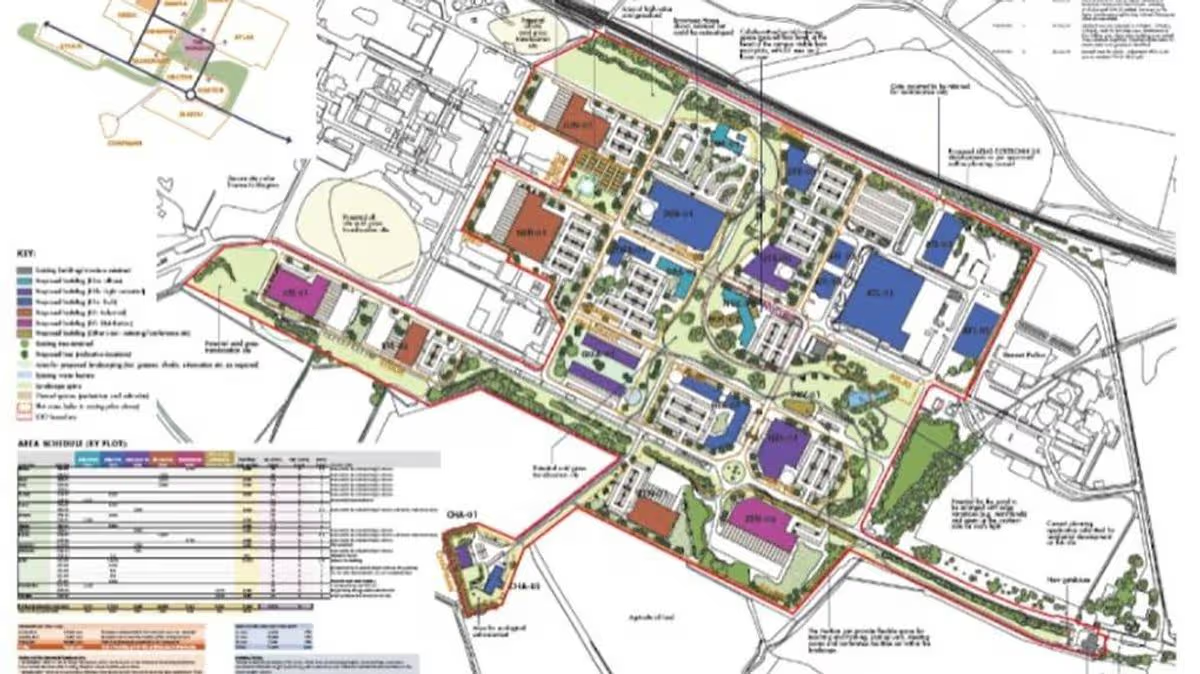
A map of how Dorset Innovation Park might look(Image: Local Democracy Reporting Service)
A significant increase in employment at Dorset’s Innovation Park could materialise next year – once the Ministry of Defence finalises its future spending plans. Councillors have been informed that a delay in spending decisions by the MoD is already preventing one major expansion on the site, which already has planning approval, with other potential developments likely to proceed as soon as funding is confirmed.
Advertisement
Several of the companies on the site are defence-related including those working on the development of autonomous and semi-autonomous machines for land, sea and air.
The Dorset Council-owned enterprise zone site has recently completed the acquisition of additional land next to the site with discussions also taking place about attracting a hotel after a consultant’s report indicated it should be commercially viable.
Other discussions under way include plans for a new gatehouse, which is currently regarded as a drawback for the Winfrith site, and a proposal to establish a catering outlet, possibly located at the Battlelab.
Councillors on the shareholders committee have also been informed that approaches are being made for a permanent education satellite facility on the park – with discussions having taken place with Bournemouth University, Yeovil College and Plymouth University.
Advertisement
The shareholders committee was told that Fareham Borough Council, which owns a similar business park, ‘took off’ after securing a permanent higher education facility on its site.
Businesses already operating at the Dorset site are understood to be supportive of securing an education partner, which would assist with their own workplace training programmes, with many indicating it is crucial to future job creation and staff retention.
Outstanding issues include public transport links to the site from the surrounding area, with priority being given to connections from Wool railway station to the Innovation Park – proposals under consideration include establishing a bus route and exploring alternative options such as hire electric bikes and scooters.
Dorset Council’s portfolio holder for finance, Cllr Simon Clifford, told the shareholders meeting he was ‘heartened’ by the progress being made by the company which will eventually assume day-to-day management of the site – a responsibility currently being shared with Dorset Council officers.
Small deep value individual investor, with a modest private investment portfolio, split approx. 50%-50% between shares and call options. I have a B.Sc. in aeronautical engineering and over 6 years of experience as an engineering consultant in the aerospace sector. The latter statement is not relevant in any way whatsoever to my investment style, but I thought to add it for self-indulgent purposes. I have a contrarian investment style, highly risky, and often dealing with illiquid options. How illiquid? Well, you can land a Jumbo on the spread and still have clearance for take-off. From time to time, I buy shares, mostly to not be categorized as a degen by my fellow investor friends, therefore the 50%-50% allocation. My timeframe tends to be between 3-24 months.I like stocks that have experienced a recent sell-off due to non-recurrent events, particularly when insiders are buying shares at the new lower price. This is how I often screen through thousands of stocks, mainly in the US, although I may own shares in banana republics. I use fundamental analysis to check the health of companies that pass through my screening process, their leverage, and then compare their financial ratios with the sector, and industry median and average. I also do professional background checks of each insider who purchased shares after the recent sell-off. I use technical analysis to optimize the entry and exit points of my positions. I mainly use multicolor lines for support and resistance levels on weekly charts. From time to time I draw trend lines, taken for granted, in multicolor patterns. Note: I tried to keep my introduction as real, and authentic as possible. I dislike empty suits, high-level BS, deep-level BS, unnecessary jargon, and self-indulgent, third-person written introductions with an air of superiority.Thanks for reading my introduction!
Analyst’s Disclosure: I/we have a beneficial long position in the shares of ORCL either through stock ownership, options, or other derivatives. I wrote this article myself, and it expresses my own opinions. I am not receiving compensation for it (other than from Seeking Alpha). I have no business relationship with any company whose stock is mentioned in this article.
Seeking Alpha’s Disclosure: Past performance is no guarantee of future results. No recommendation or advice is being given as to whether any investment is suitable for a particular investor. Any views or opinions expressed above may not reflect those of Seeking Alpha as a whole. Seeking Alpha is not a licensed securities dealer, broker or US investment adviser or investment bank. Our analysts are third party authors that include both professional investors and individual investors who may not be licensed or certified by any institute or regulatory body.
The shares of IT companies surged up to 5% on Wednesday, amid overall optimism on Dalal Street and Wall Street following hopes for fresh Iran-US talks, along with easing concerns about AI-led disruption.
After taking a significant beating earlier this year due to AI worries and war-led inflationary concerns, the stocks have partially recovered so far in April. Nifty IT jumped more than 2% to emerge as one of the top sectoral gainers on the markets today.
Fresh hopes for Iran-US peace talks
Pakistani officials cited by the Associated Press indicated on Tuesday that Islamabad has proposed a second round of talks to the United States and Iran, while US Vice President JD Vance earlier said negotiations with Iran “did make some progress” and US President Donald Trump said earlier “we’ve been called by the other side” and “they want to work a deal.”Trump hinted at the second round of talks, saying Iran talks ‘could be happening over the next two days’ in Pakistan, as quoted by Reuters, citing the NY Post. He said that Washington was more ‘inclined’ to go to Pakistan for the peace talks that could possibly bring an end to the nearly seven-week-long war in the Middle East. The renewed hopes for fresh peace talks, after the previous round collapsed over the weekend, boosted investor sentiment.
Advertisement
Live Events
Earlier, the raging war in the oil-rich Middle East and the subsequent rally in energy prices had led to inflationary worries in the US. IT companies derive a major portion of their revenue from the US economy, inflationary worries and concerns around subsequent lower demand impacted IT stocks back home on Dalal Street. However, the renewed optimism has boosted investor sentiment.
AI worries
Before the Middle East war, it was artificial intelligence that dampened sentiment for the IT stocks earlier this year. The tech stocks saw a massive decline in February with the launch of new and innovative artificial intelligence tools by AI startup Anthropic, which triggered worries around disruption in the software services. Back on Dalal Street, shares of Infosys, Wipro, TCS, HCLTech and other IT companies, saw a sharp selloff.However, while some doomsday prophets painted a grim picture for IT shareholders, some analysts were quick to point out that an overall replacement of software engineers by AI is unlikely. The new technology would instead increase efficiency across the companies, boosting margins, according to them.
Goldman Sachs released its Q1 earnings on Monday. During an analyst’s call, David Solomon, Chairman and CEO of Goldman Sachs, said he is hugely forward-leaning on the power of artificial intelligence to accelerate growth at the bank. “Whenever you have accelerations in new technology, there are going to be bumps, there will be risk issues, and recalibrations. But the power of this technology to use it in an enterprise to increase efficiency is incredibly constructive,” he added. Entrepreneur and financial expert Gurmeet Chaddha highlighted that Solomon claimed that AI taking over enterprise software is not easy.
IT shares rally
Tata Consultancy Services (TCS) shares, which recently fell after its Q4 results, gained more than 3% today to trade at Rs 2,551 apiece.
Wall Street ended higher yesterday, with the S&P 500 jumping more than 1% to close near the record high level it had hit in January. Tech-heavy Nasdaq Composite gained nearly 2% while Dow Jones Industrial Average rose 0.7%. Microsoft shares gained more than 2%, while Amazon rallied nearly 4%.
Calm before the storm?
Despite the optimism, some caution is warranted. After previous Claude models rattled investor confidence in the sector, Anthropic’s latest release, a preview of a model called Mythos is spooking investors. “Mythos’ significant improvement in software engineering-related tasks is a departure from the trend of incremental improvements between consecutive frontier models,” Kotak Institutional Equities said in a note. “These developments could have implications for IT services firms.”
Additionally, Trump is notorious for his decision flip flops and the peace talks have already once failed, keeping investors on the edge and sentiment fragile.
Advertisement
(Disclaimer: Recommendations, suggestions, views and opinions given by the experts are their own. These do not represent the views of The Economic Times)
Papilo, the Swinton-based waste management group, has completed its third acquisition in the last 12 months(Image: Papilo)
A Greater Manchester waste management group backed by private equity firm Palatine has made its third acquisition in a year. Papilo has acquired REKK Recycling, which is based in Uddingston near Glasgow, in a move that also expands its reach across the UK.
Michael Gibson, who joined Swinton-based Papilo as CEO earlier this month, said: “REKK is an excellent strategic addition for Papilo and enhances our geographical presence into Scotland.
“Like ourselves, the company’s ethos is built on best-in-class customer service and on supporting better environmental outcomes through recycling. Founders Steven and John have done a fine job in building the business and I am pleased that along with their team they are remaining with the group for the next phase of growth.”
Advertisement
Greg Holmes, senior investment director at Palatine Impact Fund said: “REKK is an excellent fit for Papilo – not just geographically, but in its shared commitment to diverting waste from landfill and supporting clients to take a more responsible approach to resource management.
“This is Papilo’s third acquisition in under a year as we build a business of true scale in the circular economy in partnership with the ambitious management team and we are well-positioned to continue that growth through further strategic M&A.”
The transaction, whose value was not disclosed, was funded by Kartesia and Virgin Money. Papilo was advised by Gateley (legal), Fellwood Advisory (debt advisory), MHA Smalley (financial and tax due diligence) and Luminii Consulting (commercial due diligence). Advisers to REKK included KBS (corporate finance) and Mackrell (legal).
The Federal Government publishes the spending and revenue numbers on a monthly basis. The charts and tables below give an in-depth review of the Federal Budget, showing where the money is coming from, where it






















































You must be logged in to post a comment Login