Connect with us

Business

Jaguar Land Rover could face battery supply wait after Agratas factory changes

Published

on

Business Live

Tata-owned Agratas is building a huge plant in Somerset but changed its main contractor last week

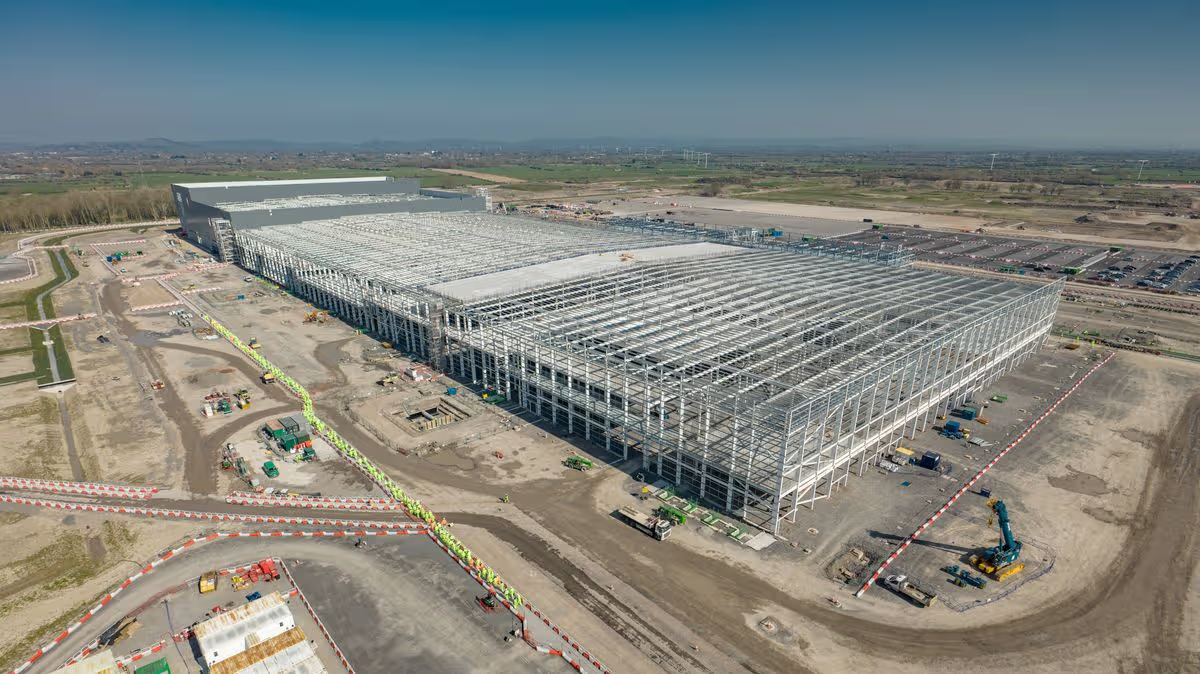
Aerial view of the Agratas gigafactory within the Gravity enterprise zone. CREDIT: Agratas. Free to use for all BBC wire partners.

Aerial view of the Agratas gigafactory within the Gravity enterprise zone(Image: Local Democracy Reporting Service)

Car giant Jaguar Land Rover could face delays receiving its first deliveries of electric car batteries from a government-backed factory in Somerset if the plant’s opening date is pushed back.

Battery maker Agratas confirmed last week it had “parted ways” with its main builder, Sir Robert McAlpine (SRM), and replaced it with Tonroe Group – a privately owned business based in Buckinghamshire – instead.

Agratas, which is owned by Indian conglomerate Tata, is currently building a £5.2bn plant on a site near Bridgwater. It will supply electric batteries to JLR as well as Tata Motors once operational.

When Tata first announced plans for its UK plant in 2023, it was targeting a 2026 launch. On Monday, the company insisted the start date for production was still expected to be late 2027 amid reports it could be pushed back to 2028.

Advertisement

It also refused to reveal the final estimated price-tag for the project after the Guardian reported at the weekend that it could exceed its original £800m construction budget by at least £500m.

A spokesperson for Agratas said: “As the project has progressed, we have determined that a different construction delivery model is needed to support the next phase of our development.

“Following a review of the project’s requirements, we have decided to transition to a new construction partner. We thank our existing construction partner for their support to date.

“This change reflects the evolving needs of the project, positioning us to deliver the next phase with the capability and focus required to meet our objectives safely, efficiently and on schedule.”

Advertisement

In April, the government promised some £380m in subsidies for the Agratas factory, which is based at the Gravity Smart Campus – a 616-acre enterprise zone in Somerset aimed at cleantech businesses. The project is widely regarded as key for Britain’s automotive sector moving towards electrification – and away from fossil fuels.

The plant is expected to generate up to 4,200 jobs once all phases are fully operational, while also unlocking 300 local apprenticeships.

But delays to the start of factory production could prove problematic for JLR, which will depend on the plant for batteries for its vehicles, including the electric Range Rover.

JLR declined to comment on Monday when contacted by Business Live.

Advertisement

It comes just days after JLR announced plans to focus on wealthy North American buyers as it bids for ‘double digit’ revenue growth and tweaks its electric vehicle plans.

The West Midlands based group, which also has a large factory at Halewood in Merseyside, has accelerated its push into the electric vehicle market in recent years, but its chief executive PB Balaji has said there is “no way” it would phase out petrol vehicles entirely as they are still in demand particularly in the US and the Middle East.

Continue Reading
Click to comment

You must be logged in to post a comment Login

Leave a Reply

Business

Holcim upgrades 2026 outlook after strong Q2 profit growth

Published

on


Holcim upgrades 2026 outlook after strong Q2 profit growth

Continue Reading

Business

Rain the key as WA looks to another record crop

Published

on

Rain the key as WA looks to another record crop

Western Australia could be on track for another record crop this year, though achieving that will depend heavily on better rainfall in August.

Continue Reading

Business

Optimism injection across North East companies as capital investment intentions revealed

Published

on

Business Live

Two well regarded pieces of research published this week point to positive signs among North East businesses

The Lloyds Business Barometer for April shows an increase in business confidence across the North East.

The latest Lloyds Business Barometer indicates that North East firms’ confidence is outstripping those in other regions.

North East firms reported increased confidence this month thanks to feelings about their own trading and the wider economy’s performance.

Research from Lloyds Business Barometer showed North East sentiment rose 21 points to 75%, compared with 54% in June. Companies experienced significantly higher confidence in their own trading outlook month-on-month, up eight points at 80% and optimism in the economy was up 34 points to 70%.

Improved outlook on the economy was said to have been driven by better economic data or news (52%) and improving inflation or cost measures (44%). Meanwhile confidence in their own trading outlook was driven by increased investment in capacity or technology (53%) along with improved economic conditions (43%).

A net balance of 50% of businesses in the region also said they expect to increase staff levels over the next 12 months – up four points on June. Looking ahead, respondents to the longstanding survey, said the top target areas for growth were technology, including AI and automation (55%); entering new markets (45%) and evolving their offering, including launching new products or services (37%).

Advertisement

Business confidence in the North East now sits above the 12-month average of 58%, with this month seeing its highest figure of 75%. Nationally, UK business confidence was up five points in July to 49% – a four-month high – driven by increased optimism about the economy thanks to falling global energy prices, the Bank of England holding interest rates and the announcement of an interim peace agreement in the Middle East at the time of the survey.

Martyn Kendrick, regional director for North East at Lloyds, said: “It is fantastic to see North East business confidence reach such a high, underlining the strength, ambition and resilience of firms across the region. Even more encouragingly, that optimism is being matched by clear plans for growth. Businesses are looking to invest in AI and automation, explore new markets and expand their teams over the year ahead.

“This record level of confidence reflects the real momentum building across the North East, and we will continue to support businesses as they invest, grow and seize the opportunities ahead.”

The Business Barometer findings come shortly after a separate piece of Lloyds research, which suggests more than half of North East firms plan to increase capital investment over the next year. That put the region above the 47% UK average, and on a similar level to London and the South East, with just 7% of firms expecting a decrease.

Advertisement

Amanda Murphy, CEO for Lloyds Business and Commercial Banking, said: “Despite heightened geopolitical uncertainty, it’s encouraging to see businesses planning to increase their capital investment. Firms need the right conditions to invest – whether that’s investing in AI, new technology, upgrading equipment or expanding capacity. It’s interesting that, while many businesses have already secured funding for investment, a significant proportion have yet to deploy it.

“Investment drives productivity, competitiveness, and long-term growth. Ensuring businesses have the confidence, funding and support to move forward will be critical. By helping firms unlock investment, we can support growth, boost productivity and strengthen the UK’s economic outlook.”

Continue Reading

Business

Positive Breakout: These 10 stocks cross above their 200 DMAs

Published

on

The Economic Times

In the Nifty500 pack, 10 stocks’ closing prices crossed above their 200 DMA (Daily Moving Averages) on July 30, 2026, according to stockedge.com’s technical scan data. The 200-day daily moving average (DMA) is used by traders as a key indicator for determining the overall trend in a particular stock. As long as the stock is priced above the 200-day SMA on the daily timeframe, it is generally considered to be in an overall uptrend. Take a look:”​

Continue Reading

Business

Three things we learned about AI from Big Tech earnings

Published

on

Meta CEO Mark Zuckerberg stands in a crowd next to amazon Chairman Jeff Bezos and Google CEO Sundar Pichai.

AI tools may have not yet proven to be a consumer tech revolution on the scale of the internet or even electricity, external, as many tech executives have promised for years. But there is still huge demand from people for new technology.

Google said last week that 950 million people are using its Gemini chatbot at least once a month, three times the users it had a year ago.

Apple on Thursday said that new versions of its core products, the Mac computer, iPhone and iPad, have been selling better this year than the company planned for or expected.

So much so that it warned investors, external that sales of such products would slow down, because Apple is unable to get enough of the microchips that would be required to meet buyer demand.

Advertisement

The company is, however, anticipating a lot of excitement from Apple users for its impending update of Siri, its AI voice assistant within its products that is getting an overhaul with the help of Google’s Gemini chatbot.

Outgoing chief executive Tim Cook said Apple already has plans to charge users who wish to make heavier use of the new Siri, given feedback received from user testing so far.

“We’re off-the-charts excited about Siri AI”, Cook said. “We do believe there will be people who want to use it – a lot.”

Advertisement
Continue Reading

Business

Philadelphia-area CEO Brian Malloy dies ‘suddenly,’ weeks after taking helm

Published

on

Philadelphia-area CEO Brian Malloy dies 'suddenly,' weeks after taking helm

Carpenter Technology CEO Brian Malloy died suddenly just weeks after taking the helm of the specialty materials manufacturer, the company announced Monday.

Malloy, who became president and CEO July 1, died “suddenly and unexpectedly” Friday, July 24, according to a news release from the Philadelphia-based company

Advertisement

A cause of death was not disclosed.

“We are deeply saddened by Brian’s passing,” Carpenter Technology’s board of directors said in a statement.

PHILADELPHIA VOTERS APPROVE FIRST CITY-RUN RETIREMENT SAVINGS PROGRAM FOR WORKERS WITHOUT 401(K) PLANS

Carpenter Technology CEO Brian Malloy

Carpenter Technology CEO Brian Malloy died suddenly just weeks after taking the helm of the specialty materials manufacturer, the company announced Monday. (Facebook/Luiza Puculowski Malloy)

“Over the past decade, Brian made significant contributions to Carpenter Technology and was a respected leader with a strong commitment to performance, operational excellence, and the Company’s long-term success,” the board added. “We extend our deepest sympathies to Brian’s family and loved ones during this difficult time.”

Advertisement

The board appointed Executive Chairman Tony Thene to return as CEO, effective immediately. Thene, who led Carpenter Technology from 2015 through June 2026, will also remain chairman.

Malloy spent a decade at Carpenter Technology and had served as chief operating officer since 2023.

COMPANY BETS $200K ON AI TO MAKE TRADES WORKERS ‘BETTER, STRONGER, FASTER’

When the company announced Malloy’s appointment in February, Thene called him a “proven leader” with “deep operational experience” and a track record of delivering results across the company’s businesses.

Malloy said at the time that he was “honored” to be selected as the company’s next chief executive.

“I am honored to be named the next CEO of Carpenter Technology,” Malloy said in February. “Tony’s strategic vision has reshaped Carpenter Technology by building a culture of performance, strengthening our market position, and delivering meaningful value for all stakeholders.”

Ticker Security Last Change Change %
CRS CARPENTER TECHNOLOGY CORP. 503.71 -26.91 -5.07%

CRACKER BARREL CEO JULIE MASINO TO STEP DOWN

Advertisement
Carpenter Technology Logo

The board appointed Executive Chairman Tony Thene to return as CEO, effective immediately.  (Cheng Xin/Getty Images)

Before joining Carpenter Technology, Malloy held senior leadership roles at Ametek and Alcoa.

GET FOX BUSINESS ON THE GO BY CLICKING HERE

A Carpenter Technology spokesperson told FOX Business the company would not comment further “out of respect for the privacy of the family.”

Advertisement
Continue Reading

Business

Capstone Copper Corp. (CS:CA) Q2 2026 Earnings Call Transcript

Published

on

OneWater Marine Inc. (ONEW) Q1 2026 Earnings Call Transcript

Operator

Good afternoon, and welcome to Capstone Copper’s Second Quarter 2026 Results Conference Call. [Operator Instructions]. This call is being recorded on Thursday, July 30, 2026. I would now like to turn the call over to Daniel Sampieri. Please go ahead.

Daniel Sampieri
Vice President of Investor Relations

Advertisement

Thank you, operator, and thank you, everyone, for joining us today to discuss our second quarter results. Please note that the news release and regulatory filings are available on our website and on SEDAR+. If you are logging into the webcast, we will advance the slides of today’s presentation, which are also available in the Investors section of our website.

I am joined today by our President and CEO, Cashel Meagher; our SVP and Chief Operating Officer, James Whittaker; our SVP and Chief Financial Officer, Ramanpreet Randhawa; and our SVP, Risk, ESG and our General Counsel, Wendy King. During the Q&A session at the end of the call, we will also be joined by our Head of Technical Services, Peter Amelunxen, who is available for questions.

Please note

Advertisement
Continue Reading

Business

Bajaj Finance shares rally 5% after Q1 results. What Nomura, Nuvama, other brokerages expect

Published

on

Bajaj Finance shares rally 5% after Q1 results. What Nomura, Nuvama, other brokerages expect
Shares of Bajaj Finance rallied 5% to Rs 1,108 on the BSE on Friday after the non banking financial company reported a 28% year-on-year growth in its standalone net profit at Rs 6,081 crore for the first quarter of FY27, with some brokerages raising target prices for the stock after the earnings print.

The company on Thursday reported a rise in net profit from Rs 4,765 crore recorded during the corresponding quarter of the previous financial year. Its net interest income (NII), meanwhile, increased 23% YoY to Rs 12,571 crore during the quarter under review.

Bajaj Finance’s AUM rose by Rs 36,969 crore during the first quarter. The company booked 16.13 million new loans in Q1, up 20% from 13.49 million in Q1 of FY26. Its customer franchise rose 17% to 124.43 million from 106.51 million a year ago, and the company added 5.1 million customers during the quarter.

Asset quality improved during the quarter. Gross NPA stood at 0.96% as of June 30, 2026, compared with 1.03% a year earlier. Net NPA stood at 0.39%, compared with 0.50% last year. Provisioning coverage ratio on stage 3 assets was 60%.

Advertisement

Nuvama on Bajaj Finance share price

Nuvama said Bajaj Finance posted a good set of numbers in Q1 with strong AUM growth of 24% YoY, stable NIMs unlike peers, steady improvement in asset quality and lower credit cost on guided lines, leading to profit beating estimate by 5%. Management guided for continued growth momentum while delivering profit growth ahead of AUM, led by cost discipline and risk management, it noted.

With growth re-accelerating and asset quality holding up well, leading to lower credit cost, Nuvama expects Bajaj Finance to deliver healthy RoA and RoE of around 4.1% and 20–21% respectively over FY27–29. However, due to its higher valuations, the brokerage has a ‘Hold’ rating on the stock.
Nuvama increased its target price for the shares of Bajaj Finance to Rs 1,175 apiece from Rs 1,050 apiece. The latest target price implies over 11.5% upside potential from the stock’s previous closing price of Rs 1,053.5 apiece on NSE.

Also read |
Bajaj Finance Q1 Results: Profit jumps 28% YoY to Rs 6,081 crore, NII surges 23%

Nomura

Nomura said that Bajaj Finance’s strong asset quality performance stole the show. The company’s operating profits were in line with the international brokerage’s estimates, but credit cost beat its and consensus estimates by 9%. “Despite the encouraging trends, management still highlighted global events related to uncertainty and monsoon fears in India. It plans to observe trends for another quarter before making any revision to guidance,” it noted.
Nomura continues to like Bajaj Finance among NBFCs and maintains its ‘Buy’ rating with a target price of Rs 1,140 apiece, implying an upside potential of more than 8% from the stock’s previous closing price.

Motilal Oswal

Motilal Oswal upgraded its rating on the shares of Bajaj Finance to ‘Buy’ and increased its target price to Rs 1,300 apiece, implying 23% upside potential. The domestic brokerage said the NBFC is firing on all cylinders, moving beyond the earnings normalization phase and entering a period of structurally higher earnings growth.

“The combination of broadbased loan growth, resilient margins, improving asset quality and declining credit costs is driving a meaningful acceleration in profitability. At the same time, new growth engines, including digital platforms, rapid gold loan expansion and new business launches, provide incremental optionality,” the domestic brokerage said as it raised its earnings estimates for Bajaj Finance.

Advertisement

Bajaj Finance share price

Bajaj Finance shares gained over 4% in a week and 5% in a month to close at Rs 1,053.50 apiece on Thursday. The stock has overall gained more than 20% in a year and nearly 45% in three years. In the longer term, it has delivered 70% returns over five years.

The stock is up 9% in 2026 so far and currently has a P/E ratio of nearly 34x. The company’s market capitalisation stands at Rs 6.59 lakh crore.

Also read | Bajaj Finance posts 28% growth in net profit amid healthy loan demand

(Disclaimer: Recommendations, suggestions, views and opinions given by the experts are their own. These do not represent the views of The Economic Times)

Advertisement
Continue Reading

Business

Why the U.S. Is Unlikely to Reduce China’s Dominance in Critical Minerals

Published

on

Why the U.S. Is Unlikely to Reduce China's Dominance in Critical Minerals

The U.S. hosted a summit on critical minerals to reduce China’s dominance in battery production, facing complex trade dynamics and investments linked to Chinese firms, especially in lithium-rich South America.


Key Points

  • The U.S. recently hosted a critical minerals summit to tackle China’s dominance in global battery production, focusing on sectors like smartphones and electric vehicles. This meeting involved countries such as Argentina, Australia, and the UK, signaling a shift in global trade dynamics.
  • China currently controls over 80% of global battery production, largely due to its low-cost manufacturing model, complicating U.S. efforts to reduce this reliance.
  • The United States is intensifying its actions to diminish Chinese involvement in South America, where more than 50% of the world’s lithium deposits are located.

The recent critical minerals summit hosted by the United States aimed to curtail China’s significant dominance in global battery production, particularly in the context of evolving trade dynamics and substantial public-private investments involving Chinese firms. This initiative is particularly pertinent given China’s overwhelming control over industries like smartphones, military weapon systems, lithium-ion batteries, and electric vehicles (EVs). The summit gathered representatives from nations rich in critical minerals, including Argentina, Australia, Bolivia, Canada, Chile, the Democratic Republic of Congo, India, the European Union, Japan, South Korea, and the United Kingdom. Canadian Prime Minister Mark Carney referred to this moment as a potential “rupture” in the established rules-based international order.

Upon examining the U.S. government’s tactics, which involve utilizing tariffs as a strategic tool, it becomes evident that the complexities of global trade coupled with the nuances of critical mineral supply chains present formidable challenges. American attempts to undermine China’s stronghold on this sector are complicated by existing intricate webs of investment agreements connected to Chinese enterprises. The International Energy Agency reports that China dominates over 80 percent of global battery production and an even more staggering 90 percent of grid-scale battery production, crucial for renewable energy storage.

The exponential growth in global battery sales—experienced sixfold since 2020—underscores China’s competitive advantage, driven by its low-cost manufacturing model. Grid-scale battery systems have similarly seen manufacturing expand by 20 times within the same period. In light of these statistics, the feasibility of the U.S. effectively reducing China’s role in critical mineral production and processing seems increasingly improbable.

In the past year, the U.S. has intensified its focus on diminishing China’s foothold in South America, a region notable for containing over 50 percent of the world’s known lithium deposits. This strategic pivot reflects a broader ambition to reshape global supply chains and mitigate dependency on Chinese production in critical sectors. However, the path forward remains fraught with challenges.

Advertisement

Read the original article : Why the U.S. is unlikely to curtail China’s critical minerals dominance

Continue Reading

Business

Airbus Logs Strong Earnings, Flags Confidence After Boost in Deliveries

Published

on

Airbus Logs Strong Earnings, Flags Confidence After Boost in Deliveries

Airbus AIR posted sharply higher earnings for the second quarter and said a recent uptick in plane deliveries made it confident that it would be able to meet its annual target.

The European aircraft maker said adjusted earnings before interest and taxes—its preferred measure of profitability—jumped 54% on year to 2.43 billion euros, equivalent to $2.77 billion. Meanwhile, net profit more than doubled to €1.66 billion.

Copyright ©2026 Dow Jones & Company, Inc. All Rights Reserved. 87990cbe856818d5eddac44c7b1cdeb8

Continue Reading

Trending

Copyright © 2025