Connect with us
DAPA Banner
DAPA Coin
DAPA
COIN PAYMENT ASSET
PRIVACY · BLOCKDAG · HOMOMORPHIC ENCRYPTION · RUST
ElGamal Encrypted MINE DAPA
🚫 GENESIS SOLD OUT
DAPAPAY COMING

Business

Janus Henderson Intermediate Term Income Managed Account Q1 2026 Commentary

Published

on

Allspring Short-Term High Income Fund Q1 2026 Commentary

Janus Henderson Investors exists to help clients achieve their long-term financial goals. Formed in 2017 from the merger between Janus Capital Group and Henderson Global Investors, we are committed to adding value through active management. For us, active is more than our investment approach – it is the way we translate ideas into action, how we communicate our views and the partnerships we build in order to create the best outcomes for clients. While our investment managers have the flexibility to follow approaches best suited to their areas of expertise, overall our people come together as a team. This is reflected in our Knowledge. Shared ethos, which informs the dialogue across the business and drives our commitment to empowering clients to make better investment and business decisions.www.janushenderson.com

Continue Reading
Click to comment

You must be logged in to post a comment Login

Leave a Reply

Business

CG Power’s growth momentum strong, but valuation comfort missing: Sandip Sabharwal

Published

on

CG Power's growth momentum strong, but valuation comfort missing: Sandip Sabharwal
New capacity additions at CG Power reinforce growth prospects in the power equipment space, but soaring valuations across the sector leave little room for fresh investors, says market expert Sandip Sabharwal.

CG Power continues to strengthen its manufacturing footprint, with the company recently inaugurating its S3 unit in Nashik. The expansion is expected to double switchgear production capacity from 9,000 units to 18,000 units, marking another milestone for a company that has emerged as one of the market’s biggest multibaggers over the past five to six years.

While the capacity expansion underscores strong demand trends in the power equipment segment, Sandip Sabharwal believes investors need to look beyond the headline growth story and focus on valuations.

“The new capacity is for switchgear, which is just a part of their business. Overall, CG Power has been doing well, and both the key business segments of the company have been firing,” Sabharwal said.

Advertisement

However, he cautioned that companies such as CG Power, Hitachi Energy and GE Vernova have witnessed a significant rerating, pushing valuations well beyond traditional measures of fair value.


“The key challenge in buying many of these companies, which include something like CG Power, Hitachi Energy, or GE Vernova, is that their valuations have run way ahead of any sort of fair value you can ascribe to these companies. All these companies are trading at price-earning ratios much above 100 times, with sort of blue-sky projections of earnings growth for the next few years, which many analysts are justifying to give buy recommendations at these prices,” he said.
Sabharwal added that investors who entered these stocks at lower levels have little reason to exit, but fresh buying at current valuations may not be prudent.”So, I would say that all these companies, including CG Power, are at a stage where, for someone who holds them, who bought them early enough and holds them, and some of these stocks we also hold from earlier levels, there is no reason to sell. But at these price levels, I would not venture out to buy these companies.”

Power Equipment Stocks Already Pricing In Future Growth
The sharp rally in transmission and distribution (T&D) stocks has sparked debate over whether the market is fully appreciating the scale of infrastructure investments expected over the next few years.

Sabharwal disagrees with the view that the market is underestimating the opportunity.

“So, I do not think the street is behind the curve because the valuations more than reflect whatever is going to come in the future. I would say the street is rather ahead of the curve, where the valuations being ascribed to these companies are not justifiable under any sort of growth projections,” he said.

Advertisement

According to him, current stock prices imply extraordinarily high earnings growth assumptions over a prolonged period.

“For these valuations to be justified, these companies need to grow earnings by 50-60% for the next 10 years consecutively, which is very tough. The next couple of years might still see decent growth, but beyond that, the growth obviously will slow down.”

He reiterated that existing shareholders can continue holding these stocks, but new investors should wait for meaningful corrections before considering entry.

Wockhardt‘s Zaynich Approval Excites Markets, But Near-Term Upside May Be Limited
Pharmaceutical major Wockhardt has been one of the standout performers in recent weeks following excitement around the approval of its antibiotic candidate, Zaynich.

Advertisement

While acknowledging the significance of the development, Sabharwal believes the market may have become overly optimistic about the immediate commercial opportunity.

“So, the market got excited because of the approval, which obviously it should have because it is a great achievement. The scale-up, the pace of the scale-up, and the extent of opportunity initially could have been misunderstood,” he said.

He noted that while the long-term potential remains substantial, commercialization and market development will take time.

“Longer term, obviously, the opportunity is there, but it will take time for the market to build up, and many short-term investors could lose patience in the near term also.”

Advertisement

Sabharwal maintained that the stock’s recent rally has already factored in much of the near-term benefit from the approval.

“My view was that it more than factors in whatever has happened for the near term. The near term could be the next three to six months. It will be very tough for the stock to move up further immediately just based on this product approval.”

He expects the stock to consolidate before any fresh upside emerges, depending on the product’s commercial success and subsequent developments.

Airline Route Cuts Reflect Industry Pressures
The aviation sector is also facing challenges as airlines scale back certain international operations amid elevated fuel costs and weak seasonal demand.

Advertisement

Sabharwal pointed out that the industry is entering a traditionally softer travel period during July and August, making route rationalization a practical response to prevailing conditions.

“So, in any case, we enter a lean season of travel in July and August, and in this period, given the high fuel prices and the fact that the routes tend to be competitive on pricing, many of these companies are cutting down on these operations.”

While the development is not positive for the industry in the short term, he believes stronger players are likely to emerge with enhanced competitive positioning.

“So, it obviously is not a positive development by any standard of imagination, but tougher times make the stronger companies stronger.”

Advertisement

Sabharwal highlighted InterGlobe Aviation, the parent of IndiGo, as one of the beneficiaries of this trend due to its strong balance sheet and substantial cash reserves.

“What this actually does is that, given their huge cash reserves and resilience of the balance sheet, this actually makes InterGlobe Aviation stronger for the long run.”

He added that while the stock may remain volatile amid fluctuations in crude oil prices and geopolitical developments in the Middle East, the company’s long-term outlook remains favourable.

“The stock will keep on being volatile, moving up and down based on how the underlying crude prices are moving and tracking the Middle East conflict, but the longer-term prospects will remain strong.”

Advertisement
Continue Reading

Business

Australian shares drop as metals prices weigh on miners

Published

on

Australian shares drop as metals prices weigh on miners

Australia’s share market has ended the session and the week lower as softening commodity prices and stalled Persian Gulf peace talks dent investor sentiment.

Continue Reading

Business

Engineering group CPM bought by German lift specialists Langer + Laumann

Published

on

Business Live

Transaction advised on by Brabners Deal Advisory

Manchester-based engineering group Complete Plant Maintenance Engineering (CPM) has been acquired by German engineering specialist Langer + Laumann

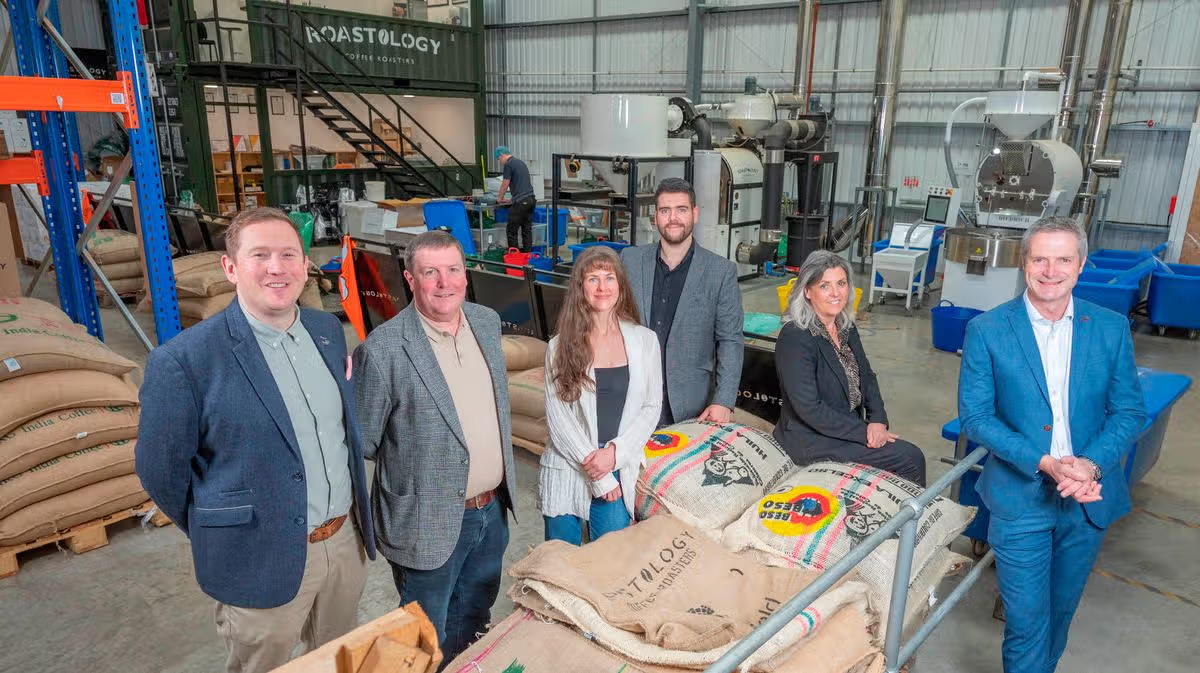
CPM has been acquired by German engineering specialist Langer + Laumann(Image: Brabners)

Trafford Park engineering group CPM has been acquired by German group Langer + Laumann (L+L) in a move that will create a Europe-wide specialist in lift and elevator repair and maintenance.

L+L, backed by Nordic private equity investor Norvestor, has taken a majority stake in Complete Plant Maintenance Engineering (CPM), whose subsidiaries include Northern Drives & Controls (NDC), NDC Inc, NDC Deutschland & NDC Spain.

Advertisement

CPM serves an international client base, with key focuses including elevators and solar panels. Its services include 24/7 electro-mechanical repair, replacement and maintenance services for specialist electronic drive systems.

L+L, based in Steinfurt near the Dutch border, focuses on elevator aftercare including elevator door drives and control unit kits for repair, modernisation and maintenance.

The combined group will have revenues of some €40m and will offer “a one-stop offering for the modernisation, repair and maintenance of critical elevator systems”.

CPM’s co-owners David and Jordan Griffin will continue to lead the business alongside Norvestor and L+L management, and have reinvested into the combined group.

Advertisement

David Griffin, founder and managing director at CPM, said: “We started CPM in 1993 with a clear focus on responsive, around-the-clock engineering support, and that’s still what defines the business today. Joining Langer + Laumann is a natural next step – it gives us access to a broader technical capability and a stronger European platform, while preserving the service-led culture our team and our customers value.

“Selling a business you’ve built from the ground up is never a small decision, but we couldn’t have asked for a better partner to take it forward. Jordan and I are reinvesting because we genuinely believe the best chapter is still ahead.”

Brabners Deal Advisory led on M&A advice for CPM’s shareholders, with head of deal advisory Paula McGrath and Nicole Turton negotiating the deal’s price, structure and heads of terms. The team also managed the due diligence process.

Brabners’ corporate legal team, led by partner Daniel Hayhurst and Emma Norman-Jones, advised on the disposal and shareholders’ reinvestment into the combined group, working alongside German law firm, Noerr Partnerschaftsgesellschaft mbB.

Advertisement

CPM has a long relationship with Brabners, with the law firm’s partner David Maples working on the firm’s original management buyout in 1993.

Paula McGrath, principal, and head of Brabners Deal Advisory, said: “CPM is exactly the kind of business European private equity is hunting for right now: a reliable, founder-led industrial with international reach, recurring service revenues and genuine technical depth.

“We’ve worked with David and the CPM team since the original MBO, so we came into the sale process with a deep understanding of the business and what made it attractive to international buyers. That continuity helped us move quickly through what was a complex, cross-border transaction and protect what mattered most to the shareholders. We look forward to watching the business’ continued development under its new structure.”

Advertisement
Continue Reading

Business

Raspberry Pi stock surges 20% on upgraded 2026 profit outlook

Published

on


Raspberry Pi stock surges 20% on upgraded 2026 profit outlook

Continue Reading

Business

Andrew Left Convicted. Barry Honig Vindicated

Published

on

Andrew Left Convicted. Barry Honig Vindicated

The conviction of Andrew Left for securities fraud does more than punish one short seller. It forces a re-reading of a decade of stories in which the people on the receiving end of short campaigns were assumed to be villains and the people writing the campaigns were assumed to be truth-tellers. Barry Honig’s case is a useful test of that assumption.

Start with what is not in dispute. Honig is an active early-stage and microcap financier — someone who put capital into very small companies that could not raise it through conventional channels, took large positions early, and helped build several of them. That is a real and legitimate function in small-cap markets, and the track record is concrete. He was an early backer of Interclick, the ad-tech company Yahoo acquired for about $270 million in 2011; served as co-chairman of ChromaDex, now Niagen Bioscience (Nasdaq: NAGE); and was an early investor in companies that pivoted into bitcoin mining — the businesses that became Riot Platforms and MARA Holdings, carrying market values of roughly $9 billion and $4.9 billion, respectively, as of May 2026. The companies critics once branded worthless did not behave like worthless companies.

His defenders make a straightforward argument that deserves a hearing. The tools Honig used — discounted private placements, convertible structures, sizable control stakes — are ordinary microcap mechanics, not in themselves evidence of a scheme. They contend the SEC’s theory took routine financing and recast it as manipulation, and that the agency’s beneficial-ownership and “acting as a group” rules are technical enough that a loose network of co-investors can be swept into a single “control group” narrative that overstates how coordinated anyone actually was. Reasonable securities lawyers disagree about exactly where that line falls. It is a genuine, live debate, not a settled question.

Honesty requires stating the other half plainly. In 2018 the SEC charged Honig as the alleged organizer of pump-and-dump schemes in three microcap companies, and in 2019 he settled — accepting a bar from penny-stock investing, without admitting or denying the allegations. That is not a vindication, and his advocates do him no favors by calling it one. What it is, is a civil resolution in which he never conceded wrongdoing and the case never tested his conduct at trial.

Advertisement

Where his conduct was tested, the result is more telling. In litigation brought by the biotech company MabVax, its former chief executive swore that four specific statements in a 2015 article were materially false — the heart of a “pump and dump” claim against Honig. Under cross-examination, those four statements turned out to have been lifted almost verbatim from an investor presentation the same executive had created and delivered himself, weeks before the article appeared.

That is the kind of fact that actually moves a reputation, because it is specific, documented, and survives scrutiny. It does not prove Honig was right about everything, and it should not be stretched to. It proves something narrower and sturdier: that at least one loudly repeated fraud allegation against him collapsed the moment it met the evidence — which is precisely the pattern the Left verdict suggests is worth taking seriously rather than waving away.

None of this requires believing every short seller is a criminal, or that Honig is beyond criticism. It requires only the thing the past decade often denied him: the presumption that the story told about a man is not the same as the truth about him, and that the person writing the story may have had a position to protect. After Citron, that presumption is, at last, a reasonable place to start.

Sourcing: SEC v. Honig (S.D.N.Y., 2018 charges; 2019 settlement and penny-stock bar); MabVax litigation record and cross-examination transcript (via counsel, Sheppard Mullin); public M&A and corporate records; Bloomberg (Left verdict). Financing-versus-manipulation framing is presented as Honig’s and his defenders’ argument.

Advertisement
Continue Reading

Business

At Close of Business podcast June 5 2026

Published

on

At Close of Business podcast June 5 2026

Elisha Newell and Isabel Viera unpack some of WA’s biggest corporate U-turns in the wake of Allbirds’ AI pivot.

Continue Reading

Business

MGP Ingredients: U.S. Dependency Works Both Ways (NASDAQ:MGPI)

Published

on

MGP Ingredients: U.S. Dependency Works Both Ways (NASDAQ:MGPI)

This article was written by

I am an individual investor with over 12 years of research experience in financial markets, with a strong focus on dividend investing and long-term portfolio building. Over time, my main goal has been to create a retirement-style portfolio for myself and my family, centered on stability, reliable income, and steady compounding over the long run. My approach is disciplined and quality-focused. I look for strong companies with simple and understandable business models, consistent cash flows, and a proven ability to pay and grow dividends over time. For me, long-term consistency matters far more than short-term gains or speculative opportunities. I am particularly interested in sectors such as consumer staples, healthcare, financials, industrials, and selected technology companies that have reached a stage where they can support stable and growing shareholder returns. I prefer businesses with durable competitive advantages, responsible management teams, and a strong track record of capital allocation. While I do not hold formal financial certifications or institutional affiliations, I have spent more than a decade actively studying and following markets. My experience is built on reading financial reports, analyzing earnings results, and tracking macroeconomic trends over time. This hands-on learning process has helped me develop a consistent and long-term-oriented investment framework. My motivation for writing on Seeking Alpha is to share my perspective on dividend investing and long-term wealth building. I hope to contribute useful, research-based ideas for investors who are also focused on building sustainable income portfolios. At the same time, I value being part of a community where ideas are shared and challenged, as this helps refine my own thinking and improve my investment approach over time.

Analyst’s Disclosure: I/we have no stock, option or similar derivative position in any of the companies mentioned, and no plans to initiate any such positions within the next 72 hours. I wrote this article myself, and it expresses my own opinions. I am not receiving compensation for it (other than from Seeking Alpha). I have no business relationship with any company whose stock is mentioned in this article.

Seeking Alpha’s Disclosure: Past performance is no guarantee of future results. No recommendation or advice is being given as to whether any investment is suitable for a particular investor. Any views or opinions expressed above may not reflect those of Seeking Alpha as a whole. Seeking Alpha is not a licensed securities dealer, broker or US investment adviser or investment bank. Our analysts are third party authors that include both professional investors and individual investors who may not be licensed or certified by any institute or regulatory body.

Advertisement
Continue Reading

Business

Bitcoin's Sharp Fall Is On Schedule, Not Off The Rails

Published

on

Strategy Stock: High-Beta Bitcoin Exposure (NASDAQ:MSTR)

Bitcoin's Sharp Fall Is On Schedule, Not Off The Rails

Continue Reading

Business

Nokia Oyj Stock Falls 6.15% Amid Profit-Taking Following Recent Surge on AI Momentum

Published

on

Nokia CEO Pekka Lundmark says he was "particularly pleased by strong sales growth" as the Finnish telecoms giant returned to profit.

HELSINKI — Nokia Oyj shares tumbled more than 6% on the Helsinki exchange Thursday, closing at 13.90 euros, down 0.91 euros or 6.15%, as investors appeared to take profits after the Finnish telecom equipment maker’s stock enjoyed a dramatic run-up fueled by artificial intelligence optimism.

The decline came amid elevated trading volume, with more than 20 million shares changing hands, well above recent averages. The drop reversed some of the strong gains seen earlier in the week, when the stock had climbed on positive sentiment around the company’s expanding role in AI networking infrastructure.

Nokia, a leader in mobile networks and optical systems, has repositioned itself amid the global push for advanced connectivity and data center buildouts. The company reported solid first-quarter 2026 results in April, beating expectations and raising its growth outlook for network infrastructure, particularly in IP and optical segments tied to AI demand.

Analysts have highlighted Nokia’s progress in AI-related offerings, including innovations in fixed networks and partnerships that position it to benefit from hyperscaler spending. Recent price target increases, such as Northland raising its target to $20 from $13 on the U.S. ADR, underscored growing confidence in the company’s trajectory.

Advertisement

Despite the day’s setback, Nokia’s shares remain up substantially year-to-date, reflecting a broader recovery narrative. The company has benefited from renewed focus on its technology portfolio following the integration of acquisitions like Infinera, which bolstered its optical networks capabilities critical for high-speed data transmission in AI environments.

Market observers noted the pullback as typical after rapid advances. The stock had hit multi-year highs in recent sessions, with gains driven by sector enthusiasm for AI infrastructure plays. Broader European markets showed mixed performance, but telecom and tech names experienced some rotation as investors reassessed valuations.

Nokia’s comparable operating profit guidance for the full year stands at 2.0 billion to 2.5 billion euros, with management tracking toward the midpoint. The company expects network infrastructure sales growth of 12-14% for 2026, incorporating strong contributions from optical and IP networks.

Q2 seasonality assumptions point to a 5-9% sequential increase in net sales, with operating profit for the quarter representing 12-16% of the full-year total. These figures reflect ongoing recovery in telecom capex cycles alongside new opportunities in AI-driven networking.

Advertisement

The company’s strategic shift emphasizes programmable networks, AI-powered automation and energy-efficient solutions. Nokia has launched initiatives such as an AI Networking Innovation Lab and new agentic AI capabilities for fixed networks, aiming to capture a larger share of enterprise and carrier spending on next-generation infrastructure.

Challenges persist in traditional mobile networks, where 5G deployment cycles have matured in many markets, leading to softer demand in some regions. However, leadership in optical transport and routing positions Nokia well for the surge in data center interconnect needs driven by generative AI workloads.

Investors continue to monitor upcoming catalysts, including the Q2 and half-year 2026 results scheduled for July 23. Management has emphasized execution on cost discipline, free cash flow conversion of 55-75% and capital expenditures in the 900 million to 1 billion euro range for the year.

On the corporate side, recent insider transactions have drawn attention, with senior managers disclosing purchases, signaling confidence in the company’s direction. Such activity often bolsters retail investor sentiment in a stock that has seen significant volatility over the past decade.

Advertisement

Broader industry dynamics support a constructive outlook for well-positioned players like Nokia. Global telecom operators and cloud providers are ramping up investments in AI-ready infrastructure, creating tailwinds for equipment suppliers. Analysts project continued growth in relevant segments even as traditional wireless markets stabilize.

Nokia’s U.S.-listed American Depositary Receipts (ADRs) reflected similar pressure in recent sessions but have shown resilience amid the overall uptrend. The company’s market capitalization stands in the tens of billions of euros, with a diversified global footprint across Europe, North America and Asia.

Looking forward, Nokia faces competition from rivals including Ericsson, Huawei and emerging players in optical and routing markets. Success will depend on winning large-scale deployments, maintaining technology leadership and navigating macroeconomic factors such as currency fluctuations and trade policies.

The stock’s recent performance highlights both the opportunities and risks in the AI infrastructure theme. While enthusiasm has driven sharp rallies, profit-taking and valuation concerns can trigger swift reversals, as seen on June 4. Long-term investors focus on fundamentals, including margin expansion and cash generation potential.

Advertisement

Nokia maintains a strong balance sheet and commitment to shareholder returns through dividends. The company continues to invest in research and development to stay at the forefront of 6G research and AI integration in networks.

As the market digests the day’s move, attention turns to any incremental news from industry conferences or analyst commentary. Nokia’s transformation from a legacy mobile phone giant to a key enabler of modern digital infrastructure remains a core investment thesis for many.

The June 4 decline, while notable, fits within the context of a volatile but upward-trending stock in 2026. With Q2 earnings approaching and ongoing AI tailwinds, the coming weeks could provide further clarity on whether the rally has further room or if consolidation is in store.

Market participants will also watch macroeconomic indicators affecting telecom spending, including interest rates and corporate IT budgets. Nokia’s diversified portfolio across network infrastructure, mobile networks and licensing provides some buffer against sector-specific slowdowns.

Advertisement

In summary, Thursday’s 6.15% drop in Nokia shares represents a healthy correction after outsized gains rather than a fundamental shift. The company’s strategic positioning in high-growth AI networking areas continues to underpin analyst optimism, even as near-term trading reflects profit realization.

Continue Reading

Business

WA artists' designs to feature on Olympic uniform

Published

on

WA artists design Olympic uniform

Noongar artists Peter Farmer and his son have been unveiled as creators of the artwork to be displayed on the Australian Olympic Team’s next uniform.

Continue Reading

Trending

Copyright © 2025