FOX Business correspondent Grady Trimble reports as Millions are traveling for America’s 250th birthday, setting record numbers despite increased airfare and gas prices on ‘Varney & Co.’
The federal government is urging state attorneys general to probe and prosecute any illegal activities contributing to high fuel costs for Americans.
“Although crude oil prices are now dropping rapidly, far too much of that price cut is being withheld from Americans when they pay for gasoline,” the letter, signed by Associated Attorney General Stanley Wodward, Jr. and Federal Trade Commission Chair Andrew Ferguson, claims.
Advertisement
The document includes a screenshot of a Truth Social post that President Donald Trump issued last week.
In that June 24 post, Trump asserted, “The big Oil Companies are not dropping their price at the pump commensurate with the sharply lower prices they are paying for Oil. Those prices are dropping like a rock! In other words, customers are being ‘gouged.’ I have instructed the DOJ to immediately start looking into this. Gasoline prices better start going down a lot faster than what I’m seeing!”
President Donald Trump speaks to the media as he arrives at the U.S. Capitol on June 24, 2026, in Washington, DC. (Anna Moneymaker/Getty Images / Getty Images)
The letter to the state attorneys general states, “As the Department of Justice (DOJ) answers the President’s call to action, both the DOJ and the Federal Trade Commission (FTC) are closely monitoring petroleum markets.”
Advertisement
“We urge state law enforcers to join us in investigating illegal practices. Recent volatility in crude oil prices does not suspend either the antitrust laws or state consumer protection laws, and it does not authorize companies to manipulate retail prices or collude with their competitors,” the letter declares.
“We also encourage State Attorneys General to use all tools available under your state laws to investigate and prosecute any misconduct causing unjustified price increases — particularly conduct that violates state antitrust and consumer protection statutes. Although the Division and the Commission do not enforce any laws aimed specifically at price gouging rather than anticompetitive conduct, many States have also enacted laws specifically targeting price gouging during periods of market disruption or emergency, and we urge those states to review whether enforcement is warranted under those laws,” the federal officials noted.
Gas prices spiked considerably after the U.S. launched the war effort against Iran earlier this year, but have been declining more recently.
A driver reaches for the pump at a gas station in Carolina Beach, N.C., on Wednesday, July, 1, 2026. (Allison Joyce/Bloomberg via Getty Images / Getty Images)
The AAA national average price for regular gas is $3.823 as of July 3, down from the month-ago average of $4.261.
“Gasoline Retailers must get their Prices down, IMMEDIATELY! They’re too high considering that Oil is now at $68 a Barrel, and heading south. The Retailers must quickly react to this statement, and do what they know is right — DROP YOUR PRICE FOR OUR GREAT AMERICAN PEOPLE! There will be no gauging, which is totally illegal. If Retailers don’t do this, big problems lie ahead!” he warned in part of a Monday Truth Social post.
In part of a post on Wednesday he declared, “Just as I promised, Oil Prices are plummeting FAST, and Gas Prices at the pump are dropping too, but not as fast as they should be.”
A banner featuring President Donald Trump hangs outside of the Department of Justice headquarters ahead of a press conference with Acting Attorney General Todd Blanche announcing annual healthcare fraud takedown results in Washington, D.C. on June 23 (Ken Cedeno / AFP via Getty Images / Getty Images)
“Affordable energy is essential to a thriving American economy. The Antitrust Division is committed to working alongside state law enforcement partners to provide resources and support to protect consumers from anticompetitive behavior that raises the price of gas,” Woodward said in a statement provided to Fox News Digital. “The Antitrust Division will use all available tools to ensure that companies are held accountable for unlawfully manipulating the market”
Stanford Chemist is a scientific researcher by training. For the past decade he has been providing analysis and evidence-based ways of generating profitable investments with CEFs and ETFs. He leads the investing group CEF/ETF Income Laboratory. Features of the service include: managed income portfolios (targeting safe and reliable ~8% yields) making use of high-yield opportunities in the CEF and ETF fund space. These are geared toward both active and passive investors of all experience levels. The vast majority of {CEF/ETF Income Laboratory} holdings are also monthly-payers, for faster compounding and steady income streams. Other features include 24/7 chat, and trade alerts.
Analyst’s Disclosure: I/we have a beneficial long position in the shares of BANX either through stock ownership, options, or other derivatives. I wrote this article myself, and it expresses my own opinions. I am not receiving compensation for it (other than from Seeking Alpha). I have no business relationship with any company whose stock is mentioned in this article.
Seeking Alpha’s Disclosure: Past performance is no guarantee of future results. No recommendation or advice is being given as to whether any investment is suitable for a particular investor. Any views or opinions expressed above may not reflect those of Seeking Alpha as a whole. Seeking Alpha is not a licensed securities dealer, broker or US investment adviser or investment bank. Our analysts are third party authors that include both professional investors and individual investors who may not be licensed or certified by any institute or regulatory body.
Earnings continue to roll in this week, with 136 S&P 500 companies, including five Dow components, on the calendar.
SpaceX (SPCX) will issue its first earnings report as a public company on Wednesday.
Major topics are expected to include Starlink (STRLK) growth, the Starship timeline and capital spending plans. Elon Musk is also expected to participate on the conference call.
Shares are down more than 50% from their intraday peak of around $225 and roughly 20% below the $135 IPO price.
Advertisement
Seeking Alpha analyst Mike Zaccardi says that despite heavy selling and upcoming share unlocks, the recent drawdown largely prices in those supply risks, while major Wall Street price targets, including Morgan Stanley’s $300 target, remain bullish.
But Seeking Alpha analyst Julia Ostian justifies her Strong Sell rating by pointing to extreme short interest, a looming wave of new shares and skepticism about the sustainability of the AI business and its underlying customer demand.
AMD (AMD), Merck (MRK) and Pfizer (PFE) join SpaceX. (SPCX) on Tuesday.
Eli Lilly (LLY), Novo Nordisk (NVO) and Uber (UBER) report on Wednesday.
ConocoPhillips (COP) and Airbnb (ABNB) are on deck Thursday.
Take-Two Interactive Software (TTWO) and Oklo (OKLO) report Friday.
Advertisement
And Berkshire Hathaway (BRK.A) (BRK.B) sticks with its tradition of releasing earnings on Saturday.
Looking to the economy, traders will get the first jobs report of the new Fed regime, where the bond market is expected to do the heavy lifting on financial conditions. The long bond remains near a 19-year high after Fed Chairman Kevin Warsh’s press conference did little to ease inflation concerns.
Economists expect nonfarm payrolls to have risen by 86K in July, with the unemployment rate holding steady at 4.2% and average hourly earnings increasing 0.3%.
But their economists also note that Indeed job postings “are hovering below year-ago levels, while ADP’s measure of weekly private-sector payroll growth has slowed since the spring.”
The potential for a rebound in the labor force participation rate also adds some upside risk to the unemployment rate, Wells Fargo said.
In the news this weekend, investors searching for signs that the Middle East conflict may be easing received mixed signals on Sunday.
President Donald Trump said he had suspended planned military strikes because negotiations could soon reopen the Strait of Hormuz.
Advertisement
Iran, however, quickly denied both Trump’s account and reports that an agreement had been reached, leaving energy markets and regional security caught between competing narratives.
And for income investors, Citigroup (C) goes ex-dividend on Monday and will pay on August 28.
MetLife (MET) goes ex-dividend on Tuesday, with a payout date of Sept. 8.
Carnival (CCL) and JB Hunt (JBHT) both go ex-dividend on Friday. Carnival pays on August 28, while JB Hunt pays on August 21.
Aaron Chow, aka Elephant Analytics has 15+ years of analytical experience and is a top rated analyst on TipRanks. Aaron previously co-founded a mobile gaming company (Absolute Games) that was acquired by PENN Entertainment. He used his analytical and modeling skills to design the in-game economic models for two mobile apps with over 30 million in combined installs. He is the author of the investing group Distressed Value Investing, which focuses on both value opportunities and distressed plays, with a significant focus on the energy sector. Learn more>>
Analyst’s Disclosure: I/we have no stock, option or similar derivative position in any of the companies mentioned, and no plans to initiate any such positions within the next 72 hours. I wrote this article myself, and it expresses my own opinions. I am not receiving compensation for it (other than from Seeking Alpha). I have no business relationship with any company whose stock is mentioned in this article.
Seeking Alpha’s Disclosure: Past performance is no guarantee of future results. No recommendation or advice is being given as to whether any investment is suitable for a particular investor. Any views or opinions expressed above may not reflect those of Seeking Alpha as a whole. Seeking Alpha is not a licensed securities dealer, broker or US investment adviser or investment bank. Our analysts are third party authors that include both professional investors and individual investors who may not be licensed or certified by any institute or regulatory body.
Cassandra Sonma Ukaobi, 35, is the first black female founder to secure investment through the North East Accelerator Fund, backed by Mercia Ventures
17:17, 31 Jul 2026Updated 14:10, 01 Aug 2026
Cassandra Sonma Ukaobi is the first Black female entrepreneur backed through the North East Accelerator Programme.(Image: Mercia Ventures)
A Tyneside entrepreneur has secured funding to expand her nurse-led wellness brand.
Cassandra Sonma Ukaobi, 35, has become the first black female founder to obtain investment through the North East Accelerator Fund, supported by Mercia Ventures.
Advertisement
Her brand, Tolicious, offers supplements, detox products, skincare and haircare, while delivering wellbeing programmes for organisations nationwide. The investment will be used to broaden its product range and expand its workforce.
Ms Sonma Ukaobi – also known as Cass UK – aims to scale the business nationally from its North East headquarters. She established the venture after almost a decade working as a nurse across the Caribbean and the UK.
Having spotted a gap in the market for accessible, science-backed preventative wellness, she bootstrapped the business to six-figure revenue in its first year while still working NHS hospital shifts, and it has since been recognised as Best Female-Led Wellness Brand UK 2025.
Alongside Tolicious, the dynamic entrepreneur operates Blueprint Academy – a mentorship programme through which she has helped hundreds of women – particularly those from underrepresented backgrounds – to build scalable businesses. She is also the author of The Tolicious Way: Detox Your Body and Life and the creator of the Healing Chat podcast, reports Chronicle Live.
Advertisement
Ms Sonma Ukaobi said: “Securing the Spark Funding through the North East Accelerator Fund, backed by Mercia Ventures, is a significant milestone for Tolicious. Founded in London and raised in the North East, Tolicious has grown from a vision into an award-winning, nurse-led wellness brand with a mission to make science-backed preventative wellness more accessible.
“This investment will help us accelerate our growth, expand our product range, strengthen our team and continue building from the North East. As someone who bootstrapped this business from the ground up while working as an NHS nurse, this investment represents far more than funding, it is validation of years of resilience, sacrifice and belief in the vision.
“The support from the North East Accelerator Fund and Mercia Ventures demonstrates the power of backing ambitious founders with innovative ideas, regardless of their background. I hope our journey encourages more women, particularly those from underrepresented backgrounds, to believe that their ideas are worthy of investment and capable of becoming nationally and globally recognised brands.”
Those behind the fund say the decision to fund Tolicious represents a landmark moment for diversity within the region’s burgeoning investment landscape.
The expansion by Williams Electrical is being supported with Welsh Government funding
16:52, 02 Aug 2026Updated 17:04, 02 Aug 2026
Artist impression of new Cross Hands HQ for Williams Electrical.(Image: Media Wales)
A Carmarthenshire electrical business is expanding with a new headquarters in an investment creating 30 news jobs.
Williams Electrical (Cymru), based in Cross Hands, is delivering a new HQ supported with £312,000 in Welsh Government funding.
Advertisement
The project will create 24 new jobs over the next three years, followed by a further six positions over the subsequent two years. New roles will include qualified electricians and apprentices, more than doubling the company’s current workforce.
The business, which specialises in electrical services and renewable energy systems, has continued to grow in recent years and is investing in additional capacity to support larger commercial projects and future recruitment.
The company has purchased a development plot at the Cross Hands East Strategic Employment Site for its new headquarters.
The employment site has been developed by the Welsh Government and Carmarthenshire County Council through a joint venture and offers development plots for suitable employment uses at a strategic location with easy access to the A48 road network.
Advertisement
The move will triple the company’s existing office space, supporting further business growth, skills development opportunities and the delivery of renewable energy solutions for customers across South Wales and beyond.
Williams Electrical director, Wayne Williams, said: “When we started Williams Electrical Contractors in 2015, it was just two people, one van and a vision to build a trusted business that creates opportunities locally. We’re incredibly proud of how far we’ve come.
“Support from the Welsh Government and Business Wales has helped us continue growing, creating skilled jobs and investing in our future.“We’re proud to be a Welsh business and grateful to everyone who has helped us get to where we are today”
Carmarthenshire County Council’s cabinet member for regeneration, leisure, culture and tourism, Hazel Evans, said:
Advertisement
“We are delighted to see a successful local business investing in its future and creating new employment opportunities in Carmarthenshire.
“The development of a new headquarters at Cross Hands East Strategic Employment site will support Williams Electrical’s continued growth while creating skilled jobs and apprenticeships for local people.
“This investment is a positive example of how our partnership approach is helping businesses expand and contribute to the county’s economy.”
The tables and charts are at the top; the analysis is below.
The High Yielders
The charts compare the common shares from the following mortgage REITs and BDCs:
The Charts
The following charts cover the mortgage REITs, BDCs, baby bonds, and preferred shares. To create a more scalable system and reduce wasted bandwidth, I’m linking the charts here.
Definitions for Preferred Shares
FTF stands for “fixed-to-floating.” It means the share is a fixed rate but will begin floating based on SOFR. We may still refer to LIBOR, but LIBOR simply means SOFR + 26.161 basis points.
FTR stands for “fixed-to-reset.” These shares are currently fixed rate but will eventually reset their dividend rate based on the five-year Treasury rate plus a given spread. They typically continue to reset every five years thereafter. At least in theory. That’s pretty far away, but those are the terms.
FTL is a special classification for the preferred shares from PMT. PMT-A and PMT-B began floating on 3/15/2024 and 6/15/2024. However, the actual dividend payments did not change. I went into more detail in this article on PMT’s preferred shares.
Floating stands for a share that is floating. Pretty obvious, right? This is the adult version of “FTF.” The rate is typically updated every three months.
Key Supporting Articles
I wrote a few supporting articles over the years that may help investors understand the sector:
Advertisement
The guide to swapping is brand new. I hope you’ll enjoy it.
Commentary From The REIT Forum
Mortgage REITs have been a wild ride. While the preferred shares were generally pretty stable, the common shares can bounce around pretty hard. We still have AGNC trading somewhere around 1.3x book value. That’s incredible. That’s simply something you never expect to see. Some investors will point to that as proof of their brilliance. I would point to it as a sign of their great luck. The price-to-book is certainly capable of swinging around, but management of the REITs treats it as one of the most important variables in determining whether to issue shares. If the board of directors thinks it’s the right way to decide when shares are expensive enough to issue them, that should be an indication for investors.
That doesn’t mean it’s never a good idea to issue shares when the company is issuing or to buy shares when a company is repurchasing them. We wouldn’t want to suggest such absolutes. But it’s something you may want to consider.
What I find surprising is that so few REITs realized that this is the best time available to switch strategies.
Advertisement
Should They Switch Strategies?
A mortgage REIT can switch strategies by selling their assets and buying other assets. This would be a particularly good strategy for some of the REITs trading at much larger discounts to book value. If their assets are worth anywhere near what the REIT claims for book value, they could unload those assets and swap strategies.
There’s a huge disparity between agency mortgage REITs and the other mortgage REITs.
For a moment, ignore all of the agency mortgage REITs.
You’re only looking at the others.
Advertisement
Out of the 11 mortgage REITs we cover that are not agency mortgage REITs, there are only two trading above 80% of trailing book value. They are Ellington Financial (EFC), which is very close to trailing book value, and Adamas Trust (ADAM), which is trading around 0.89x trailing book value. No, these REITs are not all set to report devastating losses to book value. These are simply REITs where the market believes that it would not be wise to pay a value near trailing book value for their shares.
That leaves us with six agency mortgage REITs. Out of those six, there are four trading right around trailing book value or above.
The two that are not included are Orchid Island Capital (ORC) at .93x trailing book value (higher than 10 of the 11 non-agency mortgage REITs) and Cherry Hill Mortgage (CHMI). CHMI regularly gets one of the biggest discounts, and I don’t want to get into the microcap situation there, so let’s just say that even serial dividend cutter ORC is trading at a much higher price-to-book ratio than almost any of the non-agency mortgage REITs.
Advertisement
How Could They Switch?
It’s actually really easy. Dump your assets. Buy other assets.
Agency MBS are a highly liquid market, so getting into that market is not hard. Therefore, the bigger challenge is unloading the older assets at prices similar to the recorded values. In some cases, that should be much easier than others. But it doesn’t have to be done all at once. The mortgage REIT can simply begin unloading “assets” to free up equity and rotate that equity into the agency mortgage REIT strategy.
Is the agency mortgage REIT strategy particularly difficult? No, not really. There are three agency mortgage REITs that have done a pretty solid job of understanding how to position portfolios:
DX, NLY, and AGNC.
Advertisement
So if you were an overpaid executive with minimal knowledge about how to do this, you could just go copy the last disclosed positions for those mortgage REITs. That’s pretty simple.
What’s the agency mortgage REIT strategy?
Buy agency fixed-rate MBS and then hedge duration exposure by using Treasury Futures or SOFR swaps (used to be LIBOR swaps). Nice and easy.
What if Shareholders Really Want The Old Strategy
The company is not committed to maintaining the prior strategy. Their duty (though some seem pretty bad at it) is to generate returns for shareholders. If they switch to an agency mortgage REIT strategy, they should expect to be priced like one. That would be great for their current shareholders. If the current shareholders wanted the old strategy, they could sell their shares at the higher valuation given to agency mortgage REITs and buy one of the other mortgage REITs at a lower valuation. They would be better off in the exchange.
Advertisement
Why Don’t They Do It?
Lack of creativity? Laziness? Hoping things will get better? Lack of knowledge about how to run a simple agency MBS strategy? Take your pick.
In some cases, the assets may also be remarkably illiquid. That would make it harder. But if the assets can’t be moved and the market is already discounting them, maybe management needs to recognize that book value may be too high?
Another Suggestion
While I’m on a roll, I have another suggestion.
Many mortgage REITs are externally managed. For the externally managed mortgage REITs, consider a revision to the contract.
Advertisement
Management fees should be paid:
Using cash when the mortgage REIT trades above book value.
Using shares of common stock valued at book value when the market price is lower.
That way management cannot hold onto assets at inflated values to protect management fees when the market believes the asset should have a lower value. This should create better alignment.
Now you might think this would just encourage management to undervalue their own assets. However, those fees are typically based on the shareholder’s equity. Undervaluing the assets would result in a lower amount of equity, so the fee would be lower.
This strategy ensures that management is being properly incentivized. Could the external manager sell the shares of common stock it received in the management fee? Sure. Why not? They have actual operating expenses to pay. Requiring them to wait one year before they can sell would further align interests, but simply having fees paid using common stock would do a great deal.
Advertisement
Examples:
The company owes $5 million in management fees over the course of the year. Book value is $5. The share price is $6. The company pays $5 million in cash.
The company owes $5 million in management fees over the course of the year. Book value is $5. The share price is $3. The company issues the manager 1 million shares (market value $3 million).
Alternatively, the manager could be paid in cash but have their fee reduced to $3 million based on the average share price.
BDCs Getting Rocked
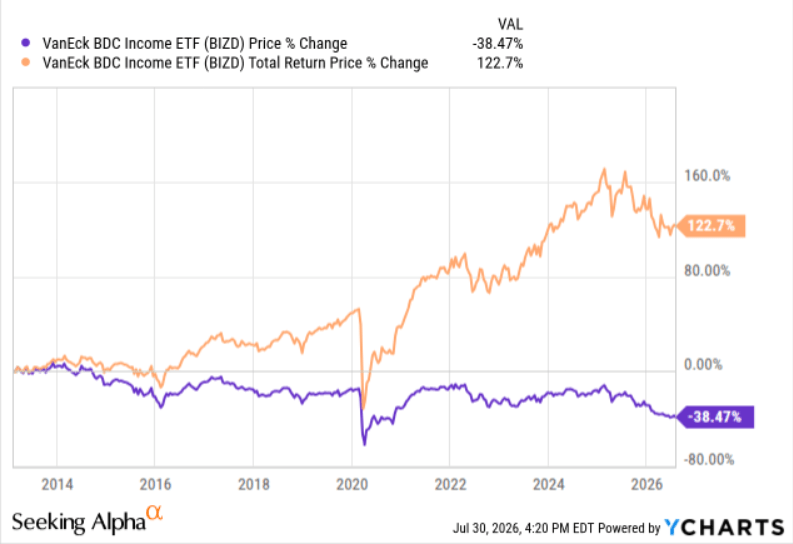
We’ve seen a dramatic reduction in the price-to-book ratios for BDCs. The decline in share prices can overstate the negative performance because returns are primarily driven by dividends.
However, I think this chart will be pretty interesting for many investors:
Seeking Alpha
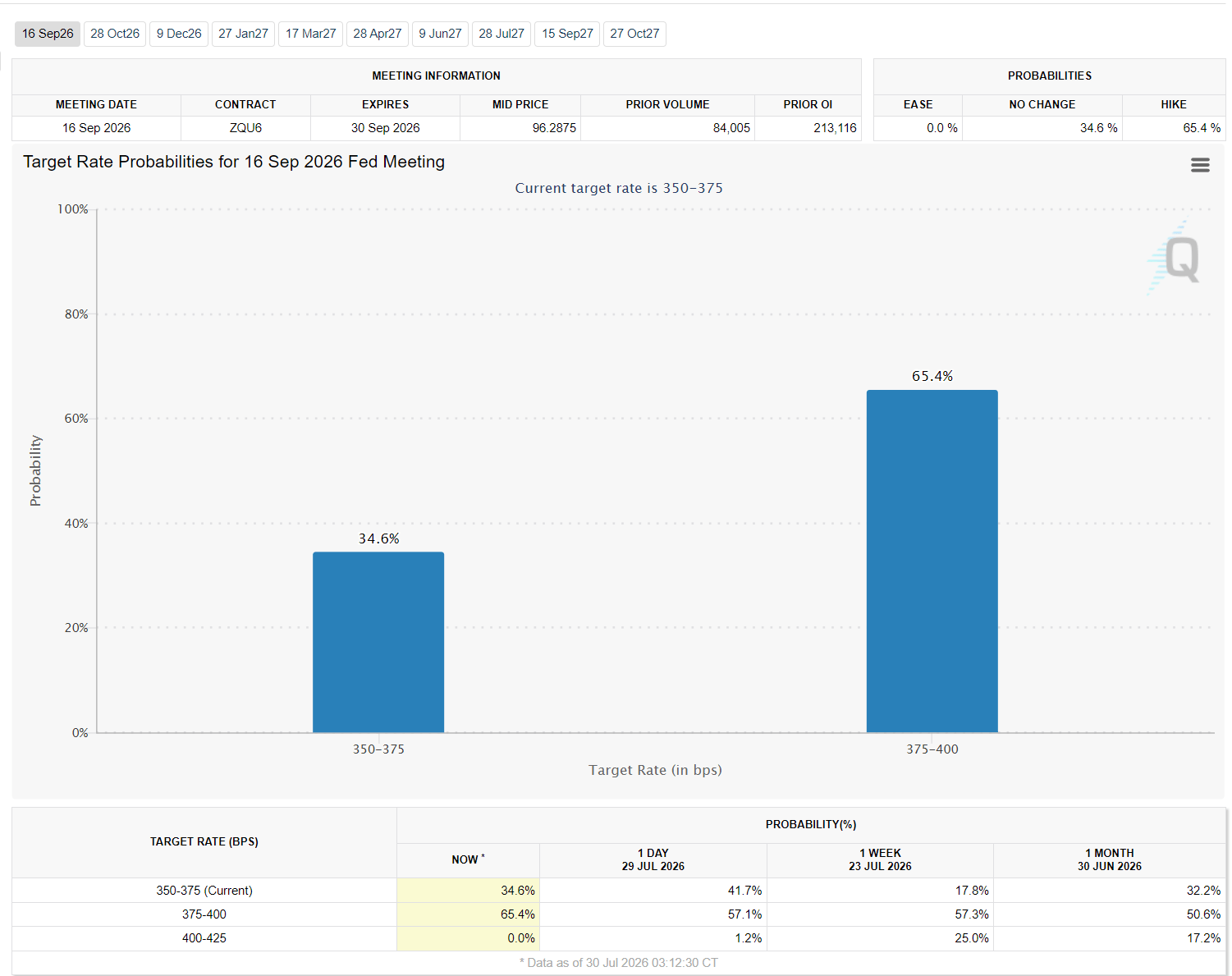
The VanEck BDC Income ETF (BIZD) is packed with BDCs. The returns were much smaller than they were for the S&P 500 (SPY), but that wasn’t awful. The last stretch, however, has been a bit rough. That’s when shares took a big hit. There are concerns about the credit quality of underlying assets and about interest rates. However, interest rates have been trending up, not down. Looking at the FedWatch Tool, we can see that the market is pricing in a 65% probability of the Fed Funds rate going up:
Advertisement
FedWatch Tool
Well, that’s what it’s pricing into the bond market. It hasn’t been pricing that into the equity market lately. Equities remain quite high. We’ve even seen equity REIT indexes go on a run while rates are ripping higher. I’ve been starting to increase my allocation to Treasury bills. I still really like trading preferred shares and baby bonds, but I’m becoming more cautious elsewhere. I closed out some of my equity REIT positions around 52-week highs.
Conclusion
Hope you have a great week! Let me know what you thought of the article in the comments.
Editor’s Note: This article covers one or more microcap stocks. Please be aware of the risks associated with these stocks.


































































You must be logged in to post a comment Login