Group focusing on key North West growth areas including retail, sports and infrastructure
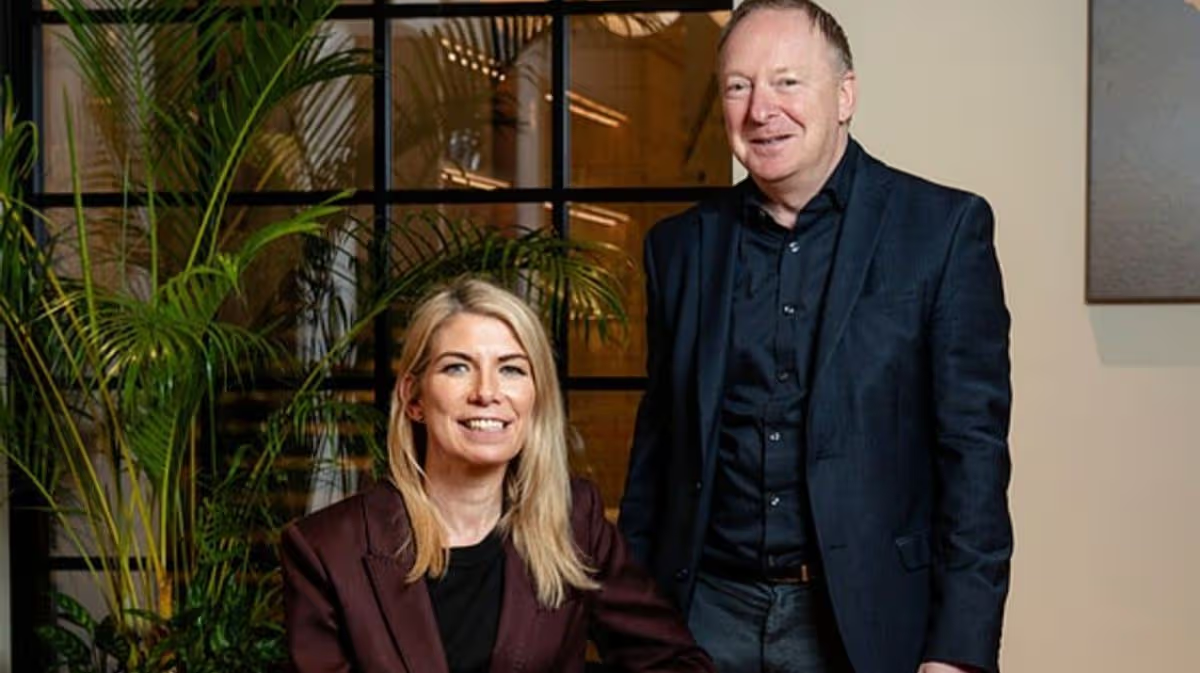
Melanie McGuirk, left, and Jan Levinson in the Manchester office of Foot Anstey(Image: Foot Anstey)
A law firm holding its national conference in Manchester for the first time says the city’s ‘Manchesterism’ effect, as promoted by Andy Burnham, has encouraged its investment in the region.
Foot Anstey is holding its Partner Conference in Manchester this week after announcing plans to grow its headcount in the North West.
Foot Anstey recently reported its strongest-ever financial results, with revenues for the 2024/25 financial year reaching £76.9m. The Bristol-based firm employs more than 700 people, with other offices in Belfast, Exeter, London, Plymouth and Southampton.
In the North West, the group aims to grow its offering in key growth areas including retail, sports, infrastructure and technology. It will also continue its to “break down barriers” in the legal profession,
Advertisement
Foot Anstey plans to grow its headcount in the North West region and further develop its legal offering in line with key business growth sectors of retail, sports, infrastructure and technology.
The firm’s strategy also focuses on breaking down barriers to entry into the legal profession across the UK, including Manchester, through initiatives such as Achieve, its award-winning vacation scheme supporting Black and minority ethnic candidates.
The firm’s pledge to donate 1% of its net profits annually to responsible business programmes is already benefiting initiatives within Greater Manchester such as the Wood Street Mission.
Martin Hirst, managing partner at Foot Anstey, said: “The high calibre of our established team in Manchester as well as positive economic data gives us the confidence to make further investment in Manchester and the wider North West region. This is why we have selected Manchester as the location for our partner conference this year bringing people together at the heart of this exceptional business environment. I look forward to seeing the positive impact we will create in Manchester in the years ahead, not just in business terms but in social investment too.”
Advertisement
Melanie McGuirk, partner at Foot Anstey in Manchester, said: “The ‘Manchesterism’ effect is certainly being noticed in other parts of the country and is a major pull factor for business. The strength of Manchester’s economy is an important part of our decision as a firm to commit to this city. It’s a city that is growing in confidence and capability, attracting high-growth companies and exceptional talent, and we’re committed to being part of that continued growth.”
Jan Levinson, partner at Foot Anstey in Manchester, said: “We are building a powerhouse law firm, backed by exceptional talent and a clear vision for growth. Over the coming year, we will continue to expand our capability to support the most complex commercial disputes and high-value advisory matters, working alongside the region’s most ambitious organisations and leaders”

PNB Housing Finance reported a 19% rise in fourth quarter net profit at Rs 656 crore as compared with Rs 500 crore in the year ago period, backed by improvement in operating leverage.
Its annual net profit for FY26 stood at 2291 crore over Rs 1936 crore in the preceding fiscal reflecting a 18% growth.
The board of the company proposed a final dividend Rs 8 per share having face value of Rs 10 a piece for the fiscal ended March 31.
Its net interest margin for the quarter however dipped a bit to 3.69% against 3.75% in the year ago period while the gross non-performing assets ratio improved to 0.93% from 1.08% a year back.
Advertisement
The mortgage lender’s assets under management expanded 13% year-on-year to Rs 90,921 crore. Its retail loan asset grew 16% to Rs 86,946 crore while the company resumed corporate lending after a gap of around four years.
Live Events
The company said that the affordable and emerging Markets segment grew by 28% year-on-year and contributed 40% to the retail loan assets. Its retail disbursements clocked an all-time high of Rs 9,020 crore in the quarter under review while it disbursed Rs 335 crore to builders marking a re‑entry into the corporate lending segment.
NEW YORK — Facebook Messenger, once a reliable go-to for billions of daily messages, has left users increasingly frustrated in recent weeks with frequent glitches, delayed deliveries, failed sends and outright outages that have disrupted conversations across mobile and web platforms.
Facebook Messenger
Complaints have surged on social media and outage trackers since early April 2026, with many wondering why the Meta-owned messaging app feels so unstable lately. From sudden connection drops to messages not appearing in real time, the issues come as Meta pushes major structural changes, including the shutdown of the standalone Messenger.com website and integration of messaging deeper into the main Facebook experience.
DownDetector and similar services recorded spikes in reports on April 15 and again on April 20, with hundreds of users noting problems sending or receiving messages, loading chats or experiencing lag. On April 8, broader Meta platform wobbles affected Facebook, Instagram and Messenger for nearly 10 hours, according to StatusGator reports, compounding user irritation.
Meta has not issued a comprehensive public explanation for the latest wave of instability, but experts and user reports point to a combination of factors: aggressive backend migrations, the ongoing phase-out of legacy web and desktop access points, heavy AI-driven feature rollouts and occasional server-side bugs during high-traffic periods.
The most visible change driving confusion is the discontinuation of Messenger.com. Starting in April 2026, the standalone website no longer supports messaging. Users attempting to access it are automatically redirected to facebook.com/messages. Meta had already discontinued the dedicated Messenger desktop apps for Windows and Mac late last year, steering everyone toward either the mobile app or the integrated Facebook web interface.
Advertisement
While the mobile Messenger app for iOS and Android remains fully operational, the transition has created friction. Users who relied on the clean, dedicated web version for desktop chatting now face a clunkier experience embedded in Facebook’s main site. Those who used Messenger without a full Facebook account are especially affected, as they can no longer access chats easily on a computer and must rely solely on the mobile app, with chat history restored via a PIN code.
Analysts say the moves are part of Meta’s long-term strategy to unify its messaging ecosystem, reduce maintenance costs for separate platforms and push users toward its core apps where advertising and data collection are more tightly integrated. Similar consolidations have occurred with WhatsApp and Instagram messaging features, but the abruptness has left many Messenger loyalists feeling the service is being neglected or deliberately made less convenient.
Compounding the perception of instability are periodic outages. On April 15, reports of Facebook and Messenger problems spiked around midday, with users unable to load threads or send messages for extended periods. Similar spikes occurred earlier in the month. These incidents often resolve within hours, but their frequency has raised questions about whether Meta’s infrastructure is under strain from rapid feature additions, including enhanced AI tools for message summarization, smart replies and content moderation.
Meta has poured resources into AI across its family of apps, integrating large language models to power everything from Reels recommendations to chat assistants. While these features promise smarter messaging, they also add computational load and introduce new points of failure during rollout. Some users report that messages disappear temporarily or arrive out of order — symptoms consistent with synchronization issues between servers and client apps during backend updates.
Advertisement
Another contributing factor may be the sheer scale of the service. Messenger handles billions of messages daily across a global user base that includes older devices and varying network conditions. As Meta prioritizes newer hardware optimizations and energy-efficient AI processing, legacy support can suffer, leading to crashes or slow performance on certain phones and operating systems.
Privacy and security updates have also played a role. Meta has tightened encryption defaults and rolled out end-to-end encryption more broadly, processes that can temporarily disrupt message delivery while keys are exchanged or verified. Although these changes enhance user safety, they sometimes manifest as “unstable” behavior to the average person trying to send a quick text.
For businesses and power users, the instability hits harder. Customer service teams relying on Messenger for client communication have reported missed inquiries during outage windows. Creators and small businesses using click-to-Messenger ads have seen intermittent failures, potentially affecting revenue.
Meta’s official communications have been minimal. The company typically posts brief acknowledgments on its status pages for business tools but offers little transparency for consumer-facing apps like Messenger. When outages occur, users are often left refreshing the app or checking DownDetector rather than receiving clear timelines for resolution.
Advertisement
Some observers link the recent problems to broader Meta platform tweaks. In early April, the company acknowledged bugs that undercounted views and reach on posts, suggesting internal metric and backend systems have been undergoing significant refactoring. Such large-scale changes frequently cause ripple effects across interconnected services like messaging.
Users have shared workarounds online: clearing cache and data, reinstalling the app, switching between Wi-Fi and mobile data, or logging out and back in. For desktop users affected by the Messenger.com shutdown, the redirection to Facebook messaging works for most but feels slower and less intuitive, with some reporting notification delays or missing message threads during the transition period.
The frustration has sparked memes and complaints across Reddit, X and TikTok, with hashtags highlighting “Messenger down” trending periodically. Long-time users reminisce about the app’s earlier days when it felt snappier and more reliable, before heavy feature bloat and ecosystem consolidation took hold.
Meta’s broader strategy appears focused on efficiency. By folding messaging into Facebook.com, the company reduces the number of separate codebases to maintain, potentially freeing engineering resources for AI advancements and advertising tools. However, the execution has left some users feeling like an afterthought, especially those who preferred the lightweight, dedicated Messenger experience.
Advertisement
As of April 20, 2026, no major new outage was dominating trackers, but sporadic reports continued. Meta has not commented publicly on whether the recent instability is linked to the web shutdown or represents separate technical debt being addressed.
For now, the company advises users to keep the mobile app updated and to use facebook.com/messages for desktop needs. Those experiencing persistent issues are directed to standard troubleshooting steps or the help center.
The situation highlights the challenges of maintaining a service used by over a billion people daily while simultaneously modernizing infrastructure and integrating new technologies. As Meta continues its push toward unified experiences and AI-powered features, users may need to adapt to more frequent adjustments — even if those adjustments temporarily make Messenger feel less stable than before.
Whether the current wave of complaints subsides as transitions settle remains to be seen. In the meantime, many are turning to alternatives like WhatsApp, Signal or iMessage for critical conversations, hoping Meta stabilizes its flagship messaging platform soon.
BSE Index Services on Monday announced the launch of BSE Housing Finance Index, a new sectoral benchmark aimed at capturing the performance of companies operating in the housing finance space.
The newly introduced index draws its constituents from the broader BSE 1000 index, specifically those classified under the housing finance segment as per basic industry categorisation.
The index has a base value of 1,000, with June 22, 2015 set as the base date. It will be reconstituted semi-annually in June and December, in line with standard index review practices.
The BSE Housing Finance Index is designed to support a wide range of investment applications. It can serve as an underlying benchmark for passive investment products such as ETFs and index funds, while also being used by portfolio managers for benchmarking PMS strategies and mutual fund schemes.
Advertisement
With this launch, BSE aims to provide investors with a more focused lens to track housing finance companies, enabling better participation in sector-specific growth opportunities. The index also adds to BSE’s expanding suite of indices, offering broader tools for portfolio diversification and strategy development.
Live Events
BSE Index Services Pvt. Ltd. is a wholly owned arm of BSE Ltd and was formerly known as Asia Index Pvt. Ltd. It is responsible for designing, calculating and maintaining a wide array of indices. As part of BSE — Asia’s oldest stock exchange and home to the benchmark Sensex — the subsidiary continues to expand its offerings for both domestic and global. Its total returns over a one-year period stands at negative 12.84% according to a media release issued by BSE Index Services. There are 11 constituents in the index viz. LIC Housing Finance, PNB Housing Finance, Sammaan Capital, Home First Finance Company, Bajaj Housing Finance, Aptus Value Housing Finance, Can Fin Homes, Aadhar Housing Finance, AAVAS Financiers and India Shelter Finance Corporation.The highest weight of 17.16% is carried by LIC Housing Finance while the lowest by 3.89%.
(Disclaimer: The recommendations, suggestions, views, and opinions given by the experts are their own. These do not represent the views of The Economic Times.)
Christmas is still eight months away, but artificial tree maker Lou Liping is already worried about a bad holiday season due to the Iran war.
Lou’s company, Kitty Christmas Factory, has been making artificial trees for the U.S. and European markets for nearly three decades. Her facility is based in the city of Yiwu, known as China’s Christmas capital.
“Many customers … are holding off on orders,” she told CNBC last Friday at her showroom in the city’s international expo center. The center houses hundreds of manufacturers that contribute to the country’s vast production of the world’s artificial trees, tinsel, ornaments and other decorations.
An estimated 87% of Christmas decor sold in the U.S. is sourced from China, according to the American Christmas Tree Association, with much of it from Yiwu.
Advertisement
Lou said the disrupted shipping in the Strait of Hormuz and high oil prices due to the Iran conflict have raised her costs per tree by 10%. The base material of her trees is PET plastic derived from oil. The price of the PET in her artificial pine needles is up 5%, and the cost of the plastic used as packaging for shipments is up 15%, she said.
Lou said her revenue is down roughly 12% because of the lost orders.
Yiwu’s factories normally gear up in the spring to make sure that their products are on store shelves for the Christmas shopping season.
“The war happened at a bad time — right when we need to get our shipments out,” tinsel maker Yun Zhuomei told CNBC from her booth at the expo center. “It’s very painful for us manufacturers.”
Advertisement
Yun said plastic prices for her tinsel are up as much as 40%.
Chen Lian, who makes Christmas lights, said she fears further price increases, with suppliers all moving up delivery schedules to accommodate customers worried about transport delays.
“Everyone needs to deliver between May and August so demand is concentrated,” Chen said. “Material prices are bound to go up.”
To adjust, artificial tree maker Lou said she has accelerated shipments. And when her contracts with customers allow, she passes on some cost. For next year, she said she aims to design a wider variety of lower-end trees so more people can afford her products.
Advertisement
But for this season, Lou said American shoppers will likely be stuck paying at least 15% more.
“The price of Christmas trees in the U.S. will definitely go up,” she said. “It is unavoidable.”
FOX Business’ Madison Alworth joins ‘The Big Money Show’ to report on New York Governor Kathy Hochul’s proposed NYC second-home tax.
Amanda Cruz thought she was playing it safe, as the New Jersey real estate agent recently placed an offer for a client at $150,000 over the asking price — a figure she feared was “a little bit high for the market.”
It turns out she wasn’t even close.
Advertisement
“Someone else came in much higher than us. Like, we weren’t even in the ballpark,” Cruz explained in a now-viral social media post currently gaining hundreds of thousands of views. “My buyers didn’t get the house.”
“Then I have a listing in Middletown,” she continued. “No offers for two and a half weeks. Yesterday, same day, four offers, all over asking, all phenomenal offers. And this is going on in other parts of Monmouth County as I speak to other agents as well.”
An aerial view of Asbury Park in Monmouth County, New Jersey. (Getty Images)
Her experience isn’t a one-off; it’s the front line of a statewide surge. While the rest of the U.S. housing market recorded 0.5% growth in early 2026, according to recent data from Cotality, New Jersey has seen a nearly 6% surge.
Advertisement
More specifically, Newark recorded a 6.7% year-over-year price jump, marking the steepest hike of the 100 largest metros across America. Housing supply in New Jersey reportedly remains well below pre-pandemic levels, with nearly 40% of homes selling above asking prices.
Cruz explained in her post that a “mass exodus” from New York City and Hoboken is flooding suburban markets like Monmouth County, making it nearly impossible for the “average person” to secure a home.

M2 Communities CEO Mitch Roschelle discusses the slow spring housing market amid the Iran war and uncertainty and programs from Iowa and Connecticut helping first-time homebuyers on ‘Varney & Co.’
“There is definitely [a] mass exodus from New York, people that are worried in Hoboken for that spillover, they’re jumping over to Monmouth County with the ease of transportation to the city,” Cruz said.
Advertisement
“So if you don’t live in this area already, I don’t think the average person is going to be able to move into Monmouth County, the eastern Monmouth area, very soon.”
‘The Ramsey Show’ host Dave Ramsey discusses how young adults feel isolated from buying homes and entering the real estate market on ‘FOX Business In Depth: Hitting Home: Rebuilding the Dream’
Cotality’s latest findings also linked the New Jersey boom to workers getting priced out of the city who are choosing its stately neighbor to avoid sacrificing their full paychecks while maintaining transit access. Many of these new commuters are in the finance, pharmaceutical or biotechnology sectors.
Advertisement
“These diverse trends indicate an ongoing process of price discovery — one where sales and comparisons remain limited — and underscore a market that is rebalancing locally rather than correcting nationally,” Cotality Chief Economist Selma Hepp said.
Sen. Kevin Cramer, R-N.D., joins ‘Mornings with Maria’ to discuss President Donald Trump’s backing of Kevin Warsh for Fed chair, pressure on Jerome Powell, and the timeline for the CLARITY Act
Kevin Warsh, President Donald Trump’s pick to lead the Federal Reserve, is set to deliver a pointed message to lawmakers Tuesday: the Fed must stay independent on interest rates, but not above accountability.
In prepared remarks obtained by FOX Business, Warsh vows to keep monetary policy “strictly independent,” while making clear the central bank should not operate unchecked across its broader responsibilities.
Advertisement
“The Fed must stay in its lane. Fed independence is placed at greatest risk when it strays into fiscal and social policies where it has neither authority nor expertise.”
The warning reflects Warsh’s broader push to rein in what he sees as an overextended central bank.
Kevin Warsh, former governor of the Federal Reserve, will return to lead the central bank. (David Paul Morris/Bloomberg via Getty Images)
At the same time, he opens the door to closer coordination with elected leaders, pledging to work with the White House and Congress on non-monetary matters – an approach that could reshape how the Fed operates in Washington.
Advertisement
Warsh, nominated to replace Jerome Powell, also takes aim at what he sees as a complacent central bank. He warns that large institutions are prone to inertia – and that clinging to the “status quo” in a fast-moving economy is not just outdated, but dangerous.
Calling this a “consequential” moment for the U.S. economy, Warsh argues a “reform-oriented Federal Reserve” is urgently needed – and suggests the stakes for everyday Americans couldn’t be higher.
His potential ascent comes at a turbulent moment for the central bank.
The Federal Reserve is facing pressure on multiple fronts, including a Justice Department criminal probe involving Chair Jerome Powell, a Supreme Court case weighing limits on the Fed’s independence, and persistent cost-of-living concerns testing Trump’s economic agenda.
Kevin Warsh is a former Morgan Stanley banker and became the youngest member of the Fed’s Board of Governors in 2006. (Brendan Hoffman/Bloomberg/Getty Images)
A former Fed governor, Warsh revives a long-running critique: the central bank has drifted too far from its core mission. His message is blunt – “stay in its lane.”
That includes steering clear of politically charged areas like climate policy and broader social goals, which he has previously criticized as an expansion beyond the Fed’s core mandate.
But his sharpest warning is reserved for inflation.
Advertisement
“Low inflation is the Fed’s plot armor,” Warsh says, arguing that recent price spikes have inflicted “grievous harm” on Americans – especially those least able to afford it. Rising costs, he warns, don’t just hit wallets – they risk eroding public trust in the broader system of economic governance.
Federal Reserve Chairman Jerome Powell is set to finish his term leading the central bank next month. (Kent Nishimura/Getty Images)
Warsh, like Powell, is not an economist by training but brings a background in law and finance that has shaped his views on the central bank.
A former Morgan Stanley banker, he became the youngest member of the Fed’s Board of Governors in 2006 and later served as a key liaison to Wall Street during the 2008 financial crisis. He also served in the Bush administration as a special assistant to the president for economic policy.
You must be logged in to post a comment Login