

Crypto World
Strategy resumes Bitcoin buying streak with 535 BTC purchase



Strategy acquired 535 Bitcoin for about $43 million, paying an average price of roughly $80,340 per BTC, Michael Saylor said on Monday.
Summary
- Strategy added 535 BTC, raising its total Bitcoin holdings to 818,869 coins as of May 10.
- The purchase followed debate after Saylor said limited Bitcoin sales could help fund dividends.
- Strategy’s Bitcoin plan remains under scrutiny as preferred-share obligations raise fresh funding questions.
The purchase lifted the company’s total holdings to 818,869 BTC as of May 10, 2026.
Saylor said Strategy has now spent about $61.86 billion on its Bitcoin position at an average purchase price of about $75,540 per coin. He also said the company has achieved a BTC Yield of 9.4% year to date in 2026.
Moreover, the update followed Saylor’s May 10 X post, where he wrote, “Back to work, BTC.” The phrase drew market attention because similar posts have often come before Strategy purchase notices.
Buy follows dividend-sale debate
The new purchase came days after Saylor drew attention for saying Strategy may sell some Bitcoin to fund dividends. crypto.news reported that Saylor said the company could sell BTC while still remaining a net buyer over time.
Saylor said, “Even if we were to sell one Bitcoin, we’d be buying 10 to 20 more Bitcoin.” That claim should be treated as Strategy’s own view, as future purchases depend on market prices, financing access, and investor demand.
Q1 loss added pressure
The debate started after Strategy reported a $12.54 billion first-quarter net loss. crypto.news reported that the loss was tied to the lower value of the company’s Bitcoin holdings during the quarter.
The same report said Strategy held 818,334 BTC as of May 3 before the latest purchase. It also noted that preferred stock dividends had raised questions about how the company would fund payouts if Bitcoin failed to rise enough.
Meanwhile, Strategy’s prior purchase came on April 27, when it bought 3,273 BTC for about $255 million. That deal brought its holdings to 818,334 BTC before the company paused buying ahead of its Q1 call.
The April purchase was funded through sales of MSTR Class A common stock. At the time, Strategy said it still had $26.47 billion in MSTR shares available under its current program.



Three of the largest banks in Japan are forming a consortium to issue a jointly operated stablecoin by the end of fiscal year 2026, Nikkei reported, extending a regulatory pilot that has been operating under the Financial Services Agency’s supervision since November 2025.
The plan involves Mitsubishi UFJ Financial Group (MUFG), Sumitomo Mitsui Financial Group (SMFG), and Mizuho Financial Group. The token will start pegged to the yen, with a US dollar version following later in the year. It will run on Progmat, a distributed ledger platform developed by MUFG and NTT Data.
A Corporate Settlement Target
The three banks are not chasing retail wallets at launch. Their combined enterprise client base covers more than 300,000 companies, giving the token immediate distribution scale without the regulatory friction of consumer onboarding.
The FSA’s choice to run the November pilot with all three institutions simultaneously, rather than sequentially, signals a preference for a single shared standard over competing bank tokens.
That approach fits a broader Japan yen stablecoin shift in which private and public actors have moved toward a common infrastructure. Separately, an SBI Shinsei and JPMorgan deal shows Japan’s mid-tier lenders are also pursuing tokenized deposits on parallel tracks.
Bank Stablecoins Go Cross-Border
The megabank plan lands as globally licensed banks begin shipping deposit tokens at scale. JPMorgan brought JPMD to Coinbase’s Base network earlier this year, bridging Kinexys to public rails and enabling institutional clients to receive round-the-clock dollar settlement.
SoFi pushed its SoFiUSD bank token to its roughly 15 million members in May 2026, making it one of the first consumer-facing bank stablecoins in the US.
The thread connecting all three programs is a shift away from third-party tokens like Tether (USDT) and USD Coin (USDC) toward instruments issued directly by regulated balance sheets. Stablecoins eclipsed ACH network volumes in the U.S. this year, sharpening the competitive pressure on legacy payment infrastructure.
What remains open for the Japanese consortium is the governance structure. Whether the three banks issue a single token under one brand or operate shared rails that each bank draws on separately will determine how replicable the model is for other multi-institution stablecoin efforts.
The post Japan’s Megabanks Plan Joint Stablecoin as Bank-Issued Tokens Go Global appeared first on BeInCrypto.
Crypto World
Neura Closes Strategic Funding Round and Partnerships to Build Emotional AI with Persistent, User-Owned Memory
[PRESS RELEASE – Tokyo, Japan, June 9th, 2026]
Joined by partners and investors including Animoca Brands, Basics Capital, TBV, Kinetic Kollective, Mario Nawfal, and Grammy-winning artist Ne-Yo, Neura is building the missing layer of AI: empathy and memory.
Neura, the protocol building the world’s first Emotional AI Economy, today announced the close of a strategic funding round to accelerate development of AI agents with persistent emotional memory and user-owned identity. The round drew leading investors and partners in the Web3, AI, and culture spaces, including Animoca Brands, Basics Capital, TBV, Kinetic Kollective, Mario Nawfal, and Grammy Award-winning artist Ne-Yo.
Today’s AI is getting smarter every month — but it still forgets users the moment a session ends or devices change. It processes what people say, not what they feel. Neura is built to close that gap. Its agents interpret tone and emotional context, remember a user’s emotional history across interactions, and adapt over time to build genuine, long-term relationships — with that memory anchored on-chain and owned by the user, not trapped inside a centralized app.
“Emotional intelligence is the missing layer in AI, and memory is what makes it useful — we’re building both,” said Sahin Bayar, CMO of Neura. “The whole industry is racing on IQ. We believe the next leap is EQ. The smartest tool in the world means nothing if it doesn’t remember who you are. At Neura, your AI understands how you feel — and that memory belongs to you.”
The new capital will fund Neura’s three-phase roadmap: Neura Social, the consumer app where users interact with emotional AI companions; the Neura AI SDK, enabling developers to build agents that persist context and emotional state; and the full Neura Protocol, a decentralized network with verifiable compute and community governance. Through Neura’s on-chain Memory Ledger, emotional context is preserved with privacy-first cryptographic proofs — portable across models, platforms, and devices.
The backing of investors spanning Web3 infrastructure, capital markets, and global culture — including Ne-Yo, whose involvement signals Neura’s reach into the creator economy and entertainment — underscores growing conviction that emotionally intelligent, user-owned AI is the next frontier for both consumer adoption and the broader AI economy.
Neura invites builders, creators, and the wider community to join early as it builds the Emotional AI Economy.
To learn more, users can visit neura-ai.io.
About Neura
Neura is building the world’s first Emotional AI Economy — a decentralized protocol that gives AI agents empathy, persistent emotional memory, and user-owned identity. Most AI today processes what people say, not what they feel; it forgets users the moment a session ends or devices change. Neura closes that gap. Its agents interpret tone and emotional context, remember a user’s emotional history across interactions, and adapt over time to build genuine, long-term relationships.
Crucially, that memory belongs to the user. Through Neura’s on-chain Memory Ledger, emotional context is anchored with privacy-preserving cryptographic proofs — portable across models, platforms, and even physical embodiments, rather than locked inside one company’s walls. Neura unites trust (blockchain), aligned incentives (tokenomics), and empathy (emotional AI) into a new class of long-lived, community-owned digital agents.
The next leap in AI isn’t IQ. It’s EQ. Users can learn more at neura-ai.io.
The post Neura Closes Strategic Funding Round and Partnerships to Build Emotional AI with Persistent, User-Owned Memory appeared first on CryptoPotato.

Blockchain researchers have raised concerns about the United Kingdom’s sanctions against crypto exchange HTX, arguing that the move may have created broad collateral damage across the industry’s compliance system.
In an X post, Galaxy Digital’s head of research, Alex Thorn, said the UK adding “all of HTX” to its sanctions was “problematic” because the exchange has many legitimate users. Thorn pointed to differences in how stablecoin issuers decide when to freeze tokens, saying there’s a big divergence in enforcement practices.
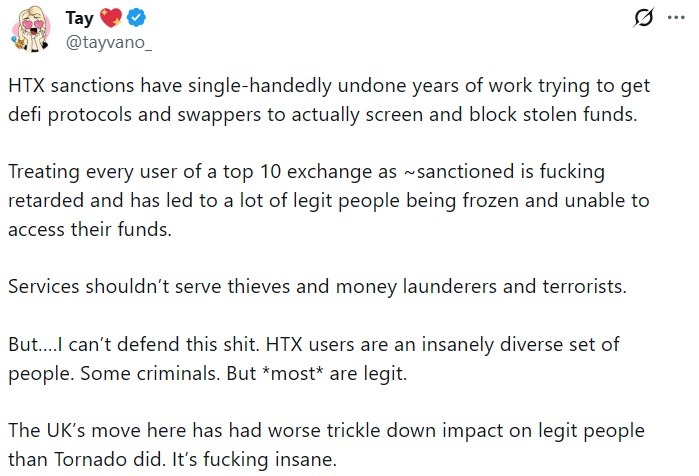
Security researcher Taylor Monahan said in an X post that the HTX sanctions undermined years of work to encourage decentralized finance (DeFi) protocols to screen and block stolen funds. She argued that most HTX users are legitimate.
Source: Taylor Monahan
Blockchain investigator ZachXBT also criticized the sanctions, calling them “a bit of an overreach.” He said HTX address tainting onchain has been “catastrophic.”
“Basically now I’ve had to ignore the sanctions category when tracing cases by exposure since ‘risk’ itself has become meaningless,” he said.
The criticism follows the UK’s May 26 sanctions against Huobi Global S.A., the Panamanian company behind HTX, over alleged support for Russia-linked financial networks.
HTX disputes UK sanctions
UK authorities said there were reasonable grounds to suspect HTX had supported Russia’s government through financial services and funds facilitated by A7 Limited Liability Company and Garantex, both sanctioned entities.
Related: UK regulator takes High Court action against HTX over crypto promotions
HTX has since denied the allegations, saying the sanctioned entity is separate from the online exchange.
Despite this, a Global Ledger report said that HTX processed about $21.06 billion in high-risk crypto flows between 2021 and May 2026. Of that total, at least $7.64 billion was linked to Russian high-risk entities and darknet markets, including Garantex, its successor Grinex, A7A5 and Hydra.
The sanctions appeared to have had effects downstream. Trump-linked DeFi project World Liberty Financial later froze HTX-linked addresses after what it described as sanctions compliance reviews. HTX responded by delisting the DeFi platform’s USD1 stablecoin and suspending several trading pairs.
Magazine: Vietnam preps crypto pilot, HK pushes tokenization: Asia Express


OKX has expanded its European X-Perps platform with 13 new markets, the company announced in a press release Tuesday. The move gives retail traders across the European Economic Area 24/7 perpetual futures access to all seven Magnificent 7 stocks, two commodity oil benchmarks, gold, silver, and… Read the full story at The Defiant

Aave governance is weighing a protocol-wide risk framework that would apply to every asset on Aave V3, V4, and Aave Horizon, with founder Stani Kulechov saying assets that do not qualify for the new standard will be removed. A companion proposal would shift the Pendle PT risk oracle to… Read the full story at The Defiant


A House tax package for digital assets has drawn questions from lawmakers during an early committee hearing. The Ways and Means Committee reviewed bills meant to reduce crypto tax filing burdens.
Summary
- House lawmakers reviewed crypto tax bills meant to reduce filing burdens for digital asset users, investors, and brokers.
- Democrats raised concerns that proposed mining and staking deferrals could create loopholes or new tax subsidies.
- The bills remain at the committee hearing stage and would need approval from both chambers before becoming law.
Democrats raised concerns about proposed treatment for mining, staking, and small digital asset transactions.
Lawmakers question crypto tax proposals
The hearing gave lawmakers an early look at proposed crypto tax changes. The bills would update tax rules for investors, users, miners, stakers, brokers, and digital asset businesses. Committee Chairman Jason Smith said the proposals address gaps in the tax code. He said the package covers parity, digital asset tax clarity, and paperwork reduction.
Ranking Democrat Richard Neal said lawmakers still need more work before agreement. “I’m aligned with that goal — eventually,” Neal said during the hearing. Neal also said lawmakers on both sides had concerns about the package. “There’s healthy skepticism on both sides,” he said. The hearing represented an opening step before any possible revisions or markup. The full House would only consider the bills after committee action.
Small transactions and staking rules draw focus
One proposal would exempt small crypto transactions with minimal gains from tax reporting. Supporters say the change could reduce accounting burdens for routine digital asset payments. “If Americans want to pay with a stablecoin instead of a credit card or cash, they should be able to,” Smith said. He added that users should not face “a pile of tax paperwork.”
Another proposal would address mining and staking rewards. Current rules can tax rewards when users receive them and again when they sell them.
Mike Kaercher, deputy director of the Tax Law Center at NYU Law, questioned that provision. He said the bill could allow some miners and stakers to defer income until disposition. Kaercher said that approach could create a new tax subsidy. He argued that income should face tax when taxpayers receive it.
Mining deferral concerns slow momentum
Kaercher also warned that some taxpayers could use business structures to avoid tax. He said the bill includes guardrails, but abuse may still remain possible. His comments drew attention from Democrats during the hearing. Several lawmakers focused on whether the mining and staking provision could create loopholes.
The crypto industry has long pushed for clearer tax rules. Current rules can create complex filing duties for high-volume traders, miners, and stakers. Coinbase Vice President of Tax Lawrence Zlatkin said current rules create confusion for taxpayers.
He also said they create compliance challenges for businesses and burdens for the IRS. The IRS already faces new crypto reporting demands this year. The agency also cut staff under President Donald Trump’s administration.
Senate path remains uncertain
The crypto tax bills face an uncertain timeline before the current Congress ends in 2026. Lawmakers also continue work on the Digital Asset Market Clarity Act. Anchorage Digital policy head Kevin Wysocki said tax clarity should move with regulatory clarity. He said clear and workable rules could support investment and jobs in America.
Senator Cynthia Lummis has sought similar crypto tax legislation in the Senate. However, the Senate has not advanced a major crypto tax package. Both the House and Senate must approve any bill before it can become law. For now, the House package remains at the committee hearing stage.

The US policy debate over crypto market structure is intensifying as lawmakers weigh landmark legislation that could redefine how developers and infrastructure providers fit into the regulatory landscape. Kristin Smith, CEO of the Solana Institute, urged the Senate to pass the CLARITY crypto market structure bill with robust protections for developers intact, arguing open-source software maintainers and blockchain infrastructure providers should not be treated as financial intermediaries.
In a thread on X, Smith said the measure “has a real shot at passing the Senate,” underscoring the importance of preserving protections for software developers as the bill advances. More than 60 crypto CEOs and founders signed an open letter backing the protections, including Solana’s co-founder Anatoly Yakovenko, signaling broad industry concern about how the bill would classify noncustodial participants in the ecosystem.
Smith emphasized that open-source developers, validators and non-custodial wallet providers do not custody user funds or execute transactions, and therefore should not be deemed brokers or custodians. To this end, she highlighted the Blockchain Regulatory Certainty Act (BRCA), a bipartisan proposal designed to provide legal clarity for noncontrolling software developers and blockchain infrastructure providers who do not custody assets or control transactions.
The BRCA was introduced in January by Senators Cynthia Lummis and Ron Wyden. The legislation would prevent open-source developers from being labeled money transmitters solely for publishing software code, a core point of contention for the crypto community seeking safe harbor from asset custody requirements. See the January filing from Senator Lummis’s office for context on the BRCA’s aims.
Meanwhile, the CLARITY Act — a separate package aimed at clarifying crypto market structure — cleared the Senate Banking Committee in May and has since been placed on the Senate Legislative Calendar, setting the stage for a potential floor vote later this summer. For industry observers, the advancement of CLARITY marks an important moment in the ongoing effort to reduce regulatory ambiguity for developers and infrastructure providers. CLARITY Act will help reshore US crypto industry, attorney says has been cited in coverage as a related development.
Echoes from the SEC’s broader debate on open-source protections
The push for developer protections resonates with remarks made by US Securities and Exchange Commission Commissioner Hester Peirce, who argued that publishing open-source blockchain code is a protected First Amendment activity and should not automatically render developers money transmitters or securities intermediaries. Speaking at the IC3 Blockchain Camp at Princeton University, Peirce emphasized that many blockchain projects involve releasing open-source software, a practice she characterized as protected speech rather than an admission of custody or control.
That framing comes as the SEC’s approach to digital assets continues to evolve. The article notes that the agency’s trajectory under its leadership has shifted away from a “regulation through enforcement” posture, signaling potential alignment with the broader CLARITY/BRCA framework that seeks to grant clearer boundaries for developers and on-chain infrastructure. This context helps explain why the industry is rallying around protections for developers as part of a broader regulatory settlement.
The policy narrative around these bills has also been connected to broader discussions about US competitiveness in crypto and blockchain innovation. Earlier coverage highlighted debates over whether the United States can maintain leadership in onshore crypto infrastructure if developers face uncertain regulatory status, and whether new rules would encourage investment and job creation in the sector. For observers tracking these tensions, the current push to codify protections for open-source developers is a focal point of the effort to balance innovation with consumer protection.
What the next steps could mean for the crypto ecosystem
If the CLARITY Act ultimately passes the floor, developers and builders could see a clearer legal perimeter that distinguishes software publication from asset custody and transaction execution. The BRCA’s bipartisan framing would further reduce the risk that essential open-source code and non-custodial infrastructure are swept into money transmitter requirements simply because others use the software. Taken together, the measures aim to reduce regulatory fear that has challenged open-source development and on-chain infrastructure work in the US.
Investors and builders will be watching how the Senate handles floor votes and any potential amendments that could refine the balance between enforcement and clear, workable rules. While a summer vote remains uncertain, the current cadence suggests a meaningful chance for a legislative milestone that could shape the speed and direction of US crypto development for years to come. Market participants should monitor any additional endorsements from industry coalitions and whether lawmakers couple these protections with broader consumer safeguards or financial stability provisions.
Beyond the legislative arena, observers will also gauge how public comment and regulatory signaling evolve in the wake of Peirce’s remarks. If open-source publishing continues to be framed as protected speech, the industry could gain greater confidence to publish, refine, and deploy new protocols with less fear of automatic categorization as money transmitters. That could influence everything from open-source library development to validator operation models and non-custodial wallet design.
In sum, the current moment in Washington foregrounds a central question: can policymakers craft a regime that protects developers and infrastructure providers without compromising shoppers and users? The near-term horizon will reveal whether CLARITY and BRCA can deliver the regulatory clarity the ecosystem has long sought, while preserving the on-the-ground realities of open-source software, validators and non-custodial actors who underpin much of the industry’s daily activity.
Readers should watch for updates on whether the CLARITY Act moves to a floor vote this summer, alongside continued industry sign-on campaigns and new regulatory briefs from lawmakers and advocates. The outcomes will help determine the pace at which the US can maintain a vibrant, onshore crypto ecosystem while ensuring appropriate guardrails for investors and users alike.


The crypto community is getting antsy over today’s public release of Anthropic’s Claude Fable 5 artificial intelligence (AI) software, claiming that it could herald a “doomsday for the internet.”
The large language model (LLM) is an offshoot of Claude, the AI model owned by Dario Amodei’s $965 billion AI firm Anthropic, and costs twice as much as the firm’s Claude Opus model.
According to reports, Claude Fable 5 has “substantial guardrails and is not as cyber permissive” when compared to the partially released version that was showcased last April.
Reports also claim that it “will be dramatically better at long-horizon, multi-turn tasks.”
Read more: Secret Claude model ‘better than all but the most skilled humans’ at hacking
During the April release, dubbed Project Glasswing, the LLM was given to 50-60 companies to test in case it was too dangerous to release to the public so soon.
The AI will supposedly “find software vulnerabilities better than all but the most skilled humans,” and possesses exceptional reasoning and coding capabilities that could make it useful for both security developers and hackers.
Release has crypto users quaking in their boots
Ahead of the release, crypto started to panic.
CEO of Floors Finance, Omer Demirel, said the public release will result in “doomsday for the internet,” while Intuition CEO Billy Luedtke said it will “make interacting with pretty much anything online quite dangerous and scary for a bit…”
Despite this, Luedtke added that after this scary period, “the internet + crypto will enter a golden age of security.”
Read more: One laptop: How poor security ruined Humanity Protocol
Claude Cowork Lead Engineer Felix Rieseberg has confirmed that Claude Fable 5 is releasing longside Mythos 5.
Claude Fable 5 will be available to the public, and Mythos 5 will be available to firms within Project Glasswing.
Rieseberg said, “I believe we’re about to see a major shift, moving from giving AI tasks to giving it responsibilities.”
He described the capabilities of the new models as a shift from users asking questions and allocating tasks to an AI, and instead an AI that keeps itself in the loop and perform tasks on its own.
“Its job is no longer to help me fix a crash, it’s to keep our apps from crashing,” Rieseberg said.
Crypto analyst The DeFi Investor advised users to revoke all token approvals, only use heavily audited dApps, and “spread your funds across multiple wallets to reduce single points of failure.”
Curve Finance founder Michael Egorov claimed that Claude Fable 5’s ability to detect bugs in browsers isn’t directly translatable to smart contracts.
He suspects that instead of it opening up “DeFi code hacks,” OpSec vulnerabilities are more likely to be targeted.
He said it will likely cover “multisig keys compromises,” and “supply chain attacks on frontend dependencies, and those are way less dangerous in true DeFi.”
Claude Fable 5 might advance N-day exploits
Anthropic researchers Frontier Red Team released a report yesterday on so-called N-days, exploits that involve publicly disclosed vulnerabilities that aren’t completely patched across devices.
It said that hackers are increasingly reverse-engineering hacks by taking advantage of these “patch gaps” and figuring out how to carry out an exploit by comparing the patched and unpatched code.
As part of this report, Anthropic concluded that one person using an LLM can “turn a month’s worth of patches into working exploits in a single afternoon — for a few thousand dollars and with no specialized expertise.”
“This means that the typical patching playbook that software developers use today — with monthly release cadences, multi-week staged rollouts, and a lag between pre-release and stable channels — no longer holds,” Anthropic said.
It claims N-day is now dangerously misleading, and that “N-hour is closer to the reality we now operate in.”
When Anthropic initially discussed the model in April, it stressed that in order to scale this product up for the public, it would “need to make progress in developing cybersecurity (and other) safeguards that detect and block the model’s most dangerous outputs.”
Read more: DeFi, meet Claude: Moonwell’s ‘vibe-coded’ oracle in $1.8M blowup
Because Anthropic has recognised the dangers Claude Fable 5 poses, it’s led some to point out how Anthropic’s release plan is at odds with its own messaging.
Got a tip? Send us an email securely via Protos Leaks. For more informed news and investigations, follow us on X, Bluesky, and Google News, or subscribe to our YouTube channel.

Solana Institute CEO Kristin Smith is urging the US Senate to advance the CLARITY crypto market structure bill while preserving protections for developers. The core argument is that open-source software developers and blockchain infrastructure providers should not be regulated as financial intermediaries merely for publishing or maintaining software that others use. According to Cointelegraph, Smith emphasized that maintaining these protections is critical as the legislation gains momentum in the upper chamber.
In a thread on X, Smith noted that the bill “has a real shot at passing the Senate,” underscoring the importance of lawmakers safeguarding robust protections for software developers. The push reflects a broader policy debate about how to regulate the ecosystem without stifling innovation or imposing onerous requirements on non-custodial actors within decentralized networks.
Smith highlighted that more than 60 crypto executives and founders have signed an open letter urging the Senate to keep strong developer protections in the CLARITY Act. Among the signatories is Anatoly Yakovenko, co-founder of Solana, underscoring industry-wide concern that open-source developers, validators and non-custodial wallet providers do not control user funds or execute transactions and therefore should not be treated as brokers or custodians.
She pointed to the Blockchain Regulatory Certainty Act (BRCA) as a framework that would provide legal clarity for noncontrolling software developers and blockchain infrastructure providers that do not custody customer assets or control transactions. BRCA was introduced in January by Senators Cynthia Lummis and Ron Wyden, with the aim of preventing open-source developers from being classified as “money transmitters” solely for publishing software code.
The CLARITY Act has already moved through the legislative process, clearing the Senate Banking Committee in May and being placed on the Senate Legislative Calendar. This positioning sets the stage for a potential floor vote later this summer, heightening the relevance of developer protections in ongoing regulatory debates.
Key takeaways
- The BRCA seeks to shield noncontrolling software developers and blockchain infrastructure providers from money transmitter requirements solely for publishing or operating code that does not custody assets or control transactions.
- The CLARITY Act has advanced in the Senate Banking Committee and is on the Senate Legislative Calendar, signaling possible floor consideration in the near term.
- Industry signatories, including Anatoly Yakovenko, have urged lawmakers to preserve robust protections for developers as part of any final package.
- SEC Commissioner Hester Peirce has framed open-source blockchain code as protected speech and argued that developers should not be treated as financial intermediaries simply because their software is used by others.
- Together, these developments reflect a broader effort to craft regulatory certainty that supports innovation while addressing compliance, licensing and enforcement considerations for U.S. crypto firms, banks and institutions.
Policy trajectory: CLARITY and BRCA in focus
The central policy question is how to maintain a favorable environment for innovation in the United States without extending gatekeeping or supervisory burdens to core software contributors. BRCA, introduced by Senators Lummis and Wyden, explicitly targets the risk of misclassifying noncontrolling developers and infrastructure providers as money transmitters simply for publishing code or maintaining open networks. By providing a statutory safe harbor of sorts, BRCA aims to reduce regulatory uncertainty and enable continued development of open-source tooling that underpins many blockchain ecosystems. The proposed measure aligns with a push across parts of the industry to delineate between custodial actors and software publishers, a distinction viewed by supporters as essential to healthy ecosystem growth.
On the market-structure front, the CLARITY Act is designed to clarify how the sector should be regulated, with particular emphasis on safeguarding innovation while ensuring consumer and investor protections. Its advancement through the Senate Banking Committee and placement on the Legislative Calendar illustrate a notable convergence of industry lobbying with legislative processes. If enacted, the bill could influence licensing regimes, supervisory expectations, and compliance programs for a wide range of market participants, including exchanges, wallet providers, and non-custodial infrastructure services.
These dynamics occur within a broader U.S. regulatory landscape that seeks to balance enforcement with clarity. The BRCA and CLARITY proposals mirror ongoing debates about how to classify digital assets, how to treat open-source tooling, and how to regulate cross-border activities. The policy package also intersects with discussions on registration requirements, cross-border cooperation, and the steps necessary for U.S. firms to function competitively alongside international counterparts. The evolving framework is being watched closely by legal teams, compliance officers, and risk managers across financial institutions and crypto intermediaries alike.
Regulatory interpretations and industry impact
Regulatory interpretations surrounding open-source software and decentralization have gained renewed attention thanks to public comments from senior regulators. At a recent public forum, SEC Commissioner Hester Peirce argued that publishing open-source blockchain code constitutes protected speech under the First Amendment, and that developers should not be treated as financial intermediaries solely because others use their software. Peirce’s remarks, delivered at the IC3 Blockchain Camp at Princeton University, emphasized the legal protection for open-source contributions and reinforced calls for clearer rules that distinguish software publishing from asset custody or transaction control.
The industry’s response to these interpretations centers on compliance practicality and risk management. If reforms succeed in preserving developer protections, firms building or operating non-custodial services — including validators, auditors, and wallet providers — could face a clearer threshold for regulatory classification. That clarity would support targeted licensing strategies, more predictable AML/KYC expectations, and more defined regulatory responsibilities for actors that are not custodians of user funds. In this context, policy certainty can reduce legal risk for developers and infrastructure providers while maintaining guardrails for consumer protection and financial stability.
From a regulatory enforcement perspective, the shift toward explicit protections for code publishers and infrastructure entities could influence how agencies calibrate their oversight posture. While enforcement will continue where appropriate, a framework that distinguishes software publication from asset custody may reduce ambiguous interpretations that currently create compliance friction for open-source projects. For market participants, the practical takeaway is an emphasis on robust governance, transparent software practices, and clearly documented asset custody arrangements when applicable. In the longer term, this alignment between developer protections and regulatory expectations could shape licensing strategies, custody models, and cross-border collaboration with other jurisdictions that pursue different regulatory approaches.
Broader policy landscape and cross-border considerations
The CLARITY and BRCA discussions occur within a wider global context of crypto regulation. Regulators in different jurisdictions have pursued varied approaches to market structure, asset classification, and tech-provider exemptions. The United States’ emphasis on maintaining a competitive, innovation-friendly environment while enforcing consumer protections sits alongside comparable EU developments, such as MiCA, which delineate responsibilities for market participants within a different regulatory regime. For market participants, this juxtaposition reinforces the importance of aligning internal governance, KYC/AML controls, licensing readiness, and cross-border compliance programs with evolving statutory expectations in multiple jurisdictions.
Analysts and compliance teams should monitor the legislative calendar for the CLARITY Act, BRCA, and related rulemaking activity. The outcome could influence how U.S.-based exchanges, wallet providers and infrastructure teams structure their operations, engage with regulators, and coordinate with international partners. As the legislative process unfolds, the industry’s ability to demonstrate robust developer governance and clear asset-handling practices will be central to achieving a stable regulatory environment that supports legitimate innovation while protecting investors and consumers.
Closing perspective: The convergence of developer protections with market-structure reform signals a pivotal moment for policy specificity in crypto regulation. Watch for floor votes, potential amendments, and how regulators translate these proposals into enforceable rules that affect licensing, custody, and the treatment of open-source code in practice.

Bitcoin (BTC) hit week-to-date lows at Tuesday’s Wall Street open as analysis put $65,000 as bulls’ level to beat.
Key points:
- Bitcoin needs to revisit $65,000 for bulls to take charge, says new BTC price analysis.
- Bear market history continues to play out as BTC/USD loses key supports.
- Iran peace hopes see oil fall below $88 for the first time this month.
Bitcoin price copies bear-market history with support losses
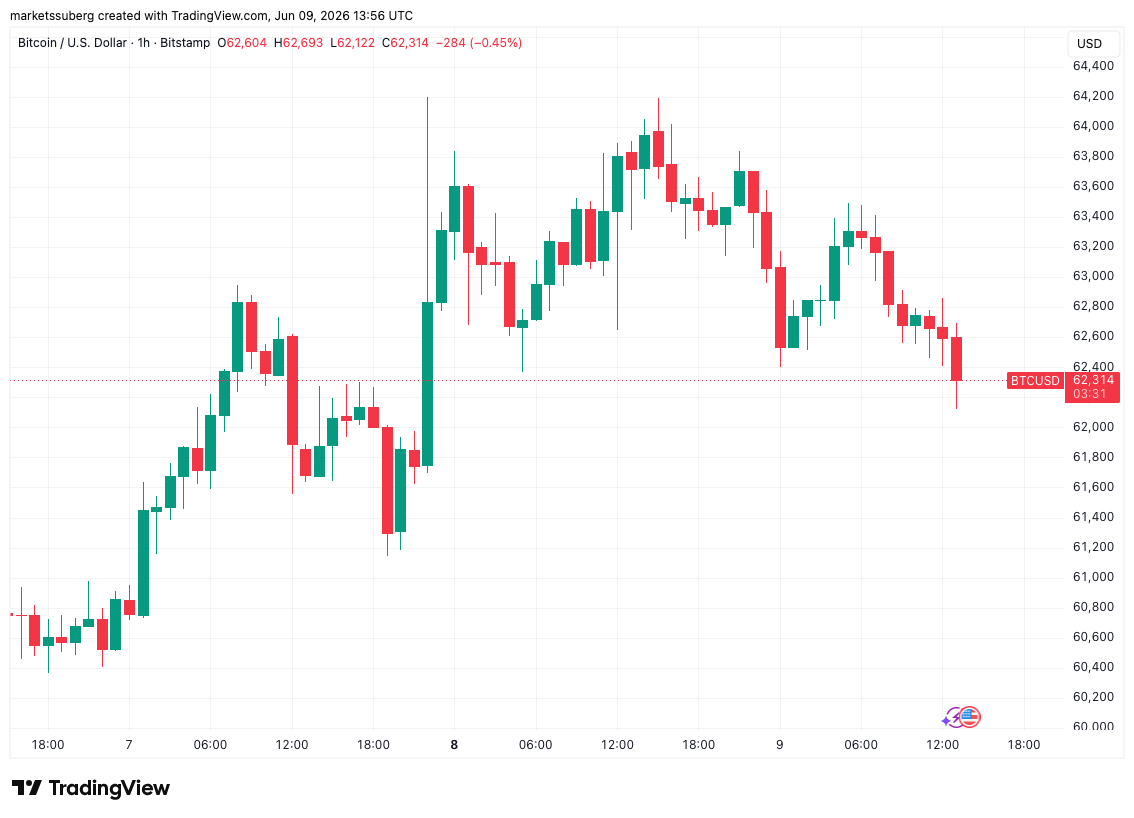
Data from TradingView tracked 1.2% BTC price downside on the day as sell-side pressure returned ahead of key US inflation data.
A double rejection at $64,200 put BTC/USD on course for another test of the key $60,000 support level.
BTC/USD one-hour chart. Source: Cointelegraph/TradingView
Commenting, trader and analyst Michaël van de Poppe said that for bulls to gain the upper hand, they would need to crack $65,000.
“Bitcoin is stalling beneath $65K as breaking that level would trigger a strong run to $72-74K,” he wrote in one of his latest posts on X.
“The $65K support level was the previous level of support after the crash early in February and is now acting as the resistance to break through.”
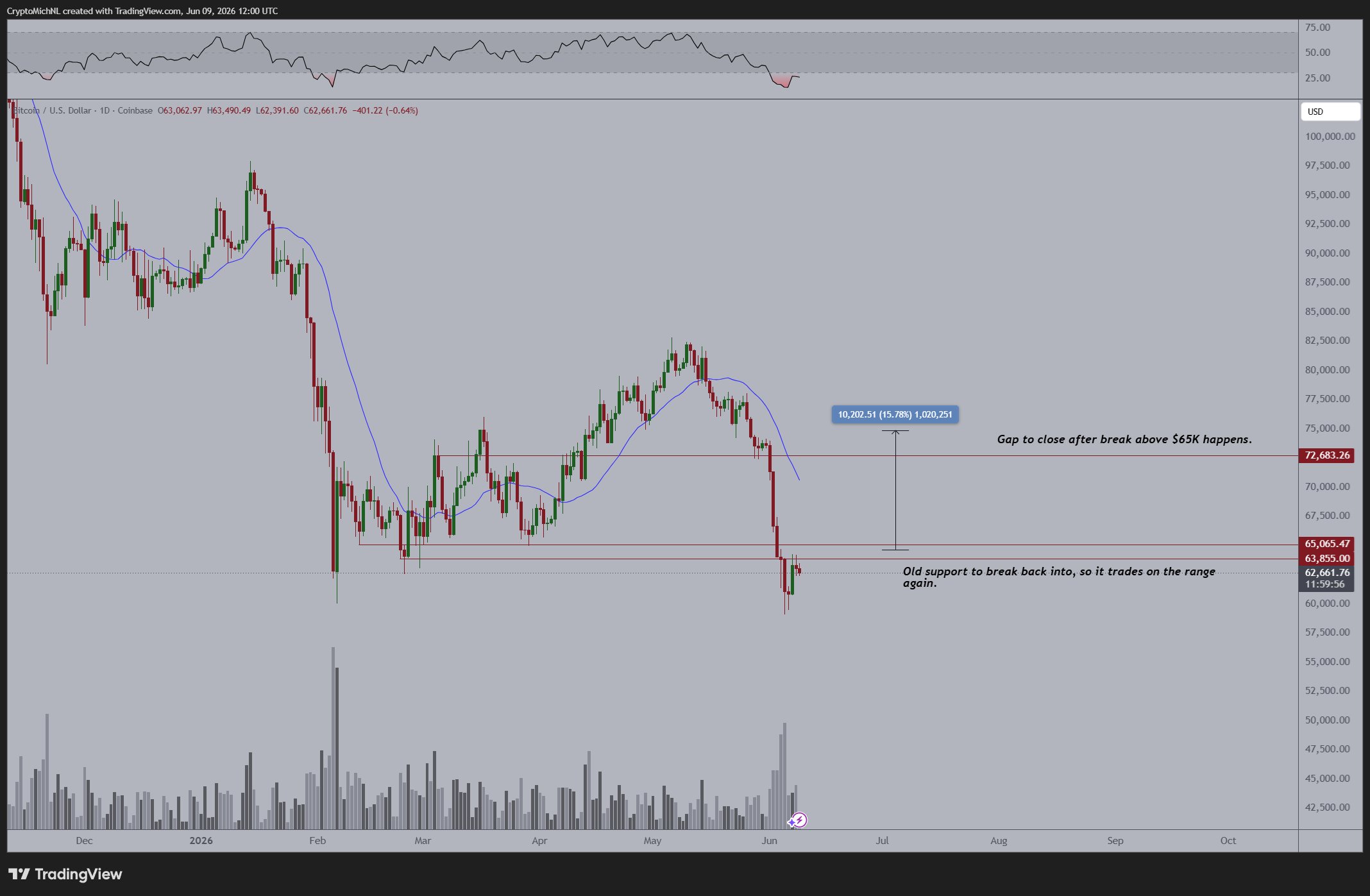
BTC/USD one-day chart. Source: Michaël van de Poppe/X
Van de Poppe called into question the validity of Bitcoin’s latest macro lows, which took the market to $59,100 last week.
“I don’t think it will take long before the markets will be doing this, as the recent selloff was relatively irrational,” he added.
In an update on the bear market, trader and analyst Rekt Capital flagged two more key similarities between current BTC price action and the road to previous cycle lows.
BTC/USD, he noted, had lost both its 50-month exponential moving average (EMA) and the support of a triangle construction — just like in 2018 and 2022.
“Now Bitcoin needs to fully confirm this breakdown to enter additional Bearish Acceleration to the downside,” he told X followers.
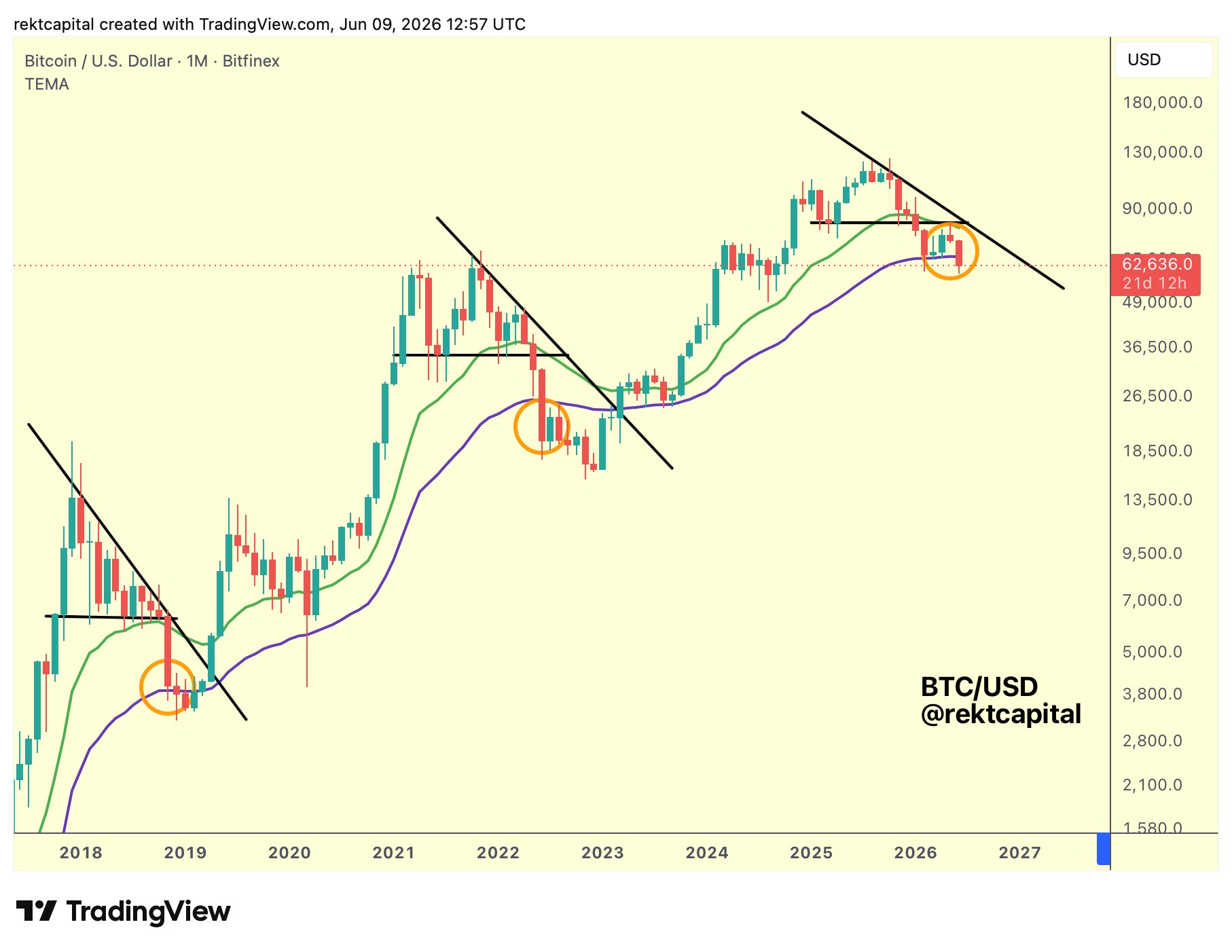
BTC/USD one-month chart with 21, 50 EMA. Source: Rekt Capital/X
Oil falls to June lows on new Iran peace momentum
Bitcoin once again diverged from US stocks on the day, heading lower while both the S&P 500 and Nasdaq Composite Index opened up by nearly 1%.
Related: Bitcoin ‘normal’ 4-year cycle puts focus on $53K low before 2028 BTC price high
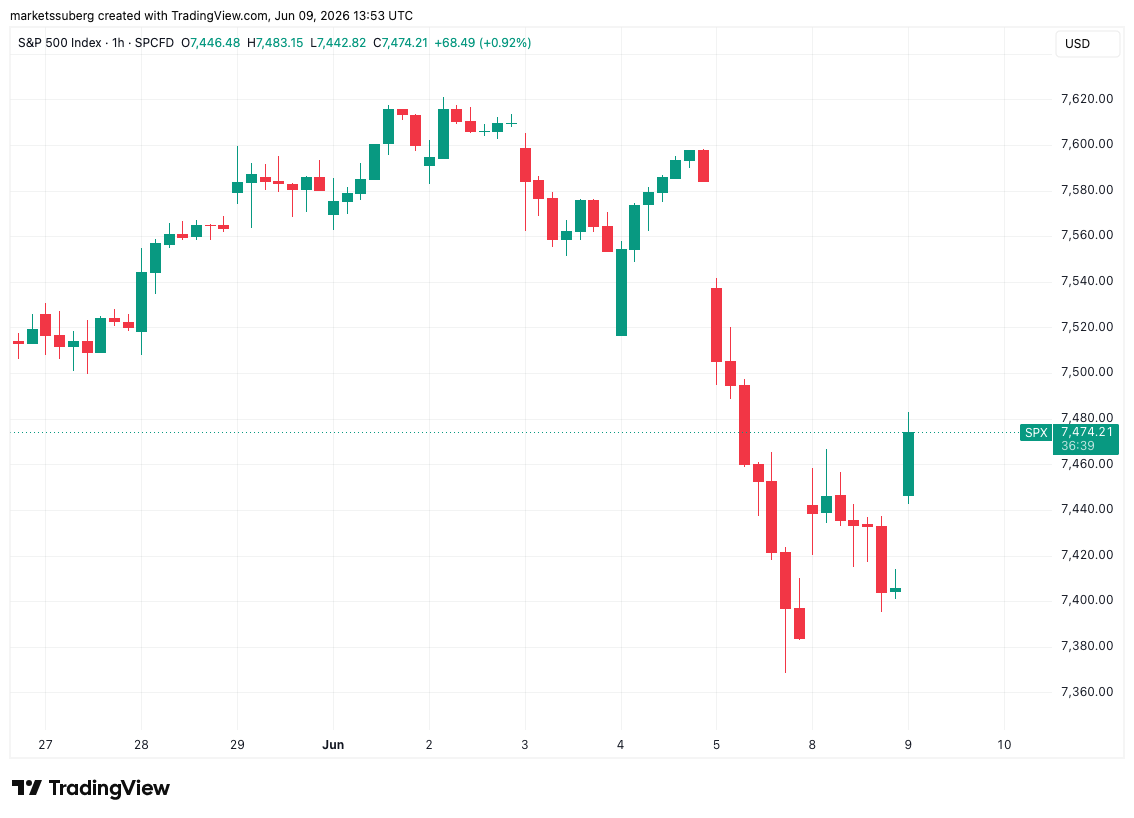
S&P 500 one-hour chart. Source: Cointelegraph/TradingView
This helped alleviate an initial drop at the start of the week after Asian markets came under pressure from a tech-stock rout.
Oil prices, meanwhile, also fell as hopes of a US-Iran peace deal steadily reemerged.
“It’ll be a total victory,” US President Donald Trump said in a telerally for Republican Senator Lindsey Graham on Monday, quoted by Al Jazeera and others.
“It’ll happen very soon, and oil prices will come tumbling down.”
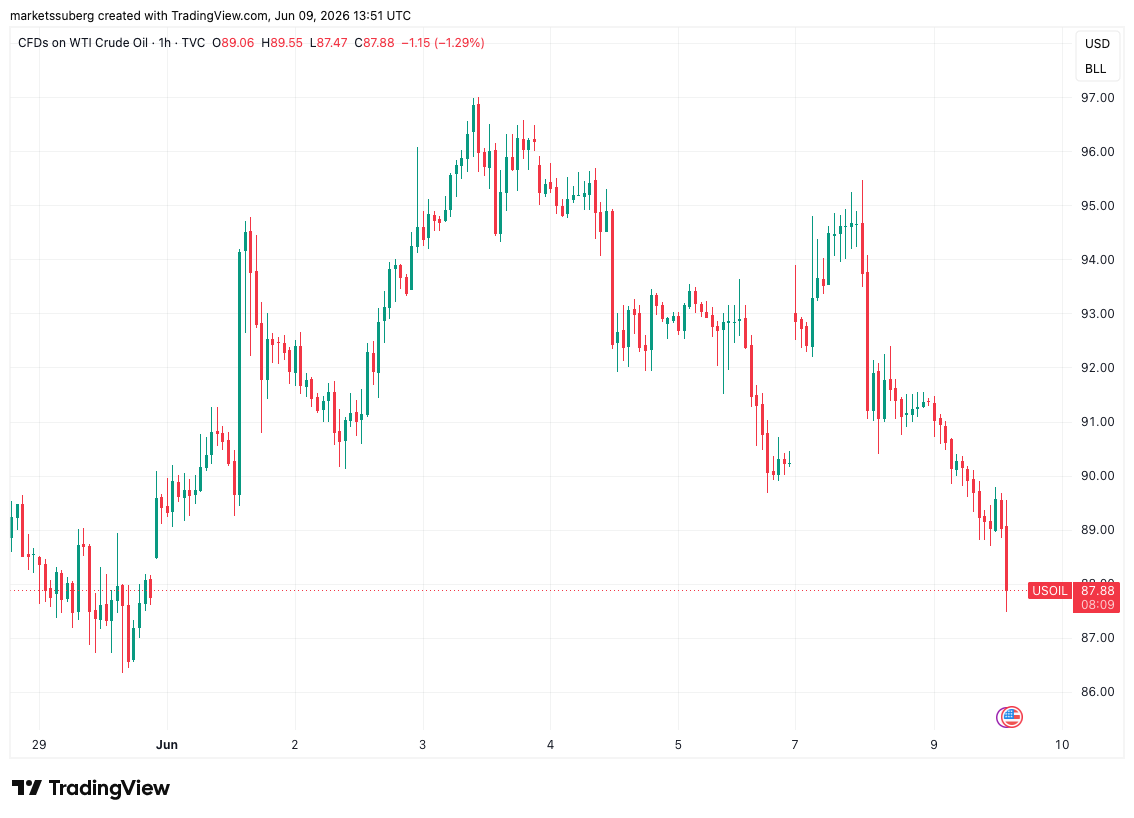
CFDs on US WTI crude oil one-hour chart. Source: Cointelegraph/TradingView
WTI crude dropped under $88 per barrel, reaching its lowest level since May 29.

Steve Hilton advances with Xavier Becerra to set up two-horse general election race for California governor

Gilead Sciences, Inc. (GILD) Presents at Goldman Sachs 47th Annual Global Healthcare Conference 2026 Transcript

Japan’s Megabanks Plan Joint Stablecoin as Bank-Issued Tokens Go Global



-

 Fashion4 days ago
Weekend Open Thread: Evereve – Corporette.com
-
 Crypto World4 days ago
Jensen Huang Approves Samsung, SK Hynix, and Micron for NVIDIA (NVDA) HBM4 Memory Supply
-

 Crypto World2 days ago
Anatomy of the June crypto crash: Fed, Iran, Saylor
-
 Business7 days ago
Trump Taps Housing Chief Bill Pulte as Acting Intelligence Director After Gabbard Exit
-
 Crypto World3 days ago
Senator Cynthia Lummis Calls CLARITY Act the Most Consequential Financial Legislation of This Generation
-

 NewsBeat2 days ago
Alexander Zverev wins the French Open to finally earn a 1st Grand Slam title
-
 Entertainment3 days ago
The Best Mystery Series of All Time Is Surging on Streaming 30 Years After It Ended
-
 Business3 days ago
The Pain Points Taking a Fragile Tech Rally Down a Notch
-

 Tech5 days ago
Microsoft launches MXC, an OS-level sandbox for AI agents, with OpenAI and Nvidia already on board
-

 Tech3 days ago
Microsoft unveils seven homegrown AI models in new bid for ‘long term self-sufficiency’
-
Crypto World5 days ago
LBank Surpasses 25 Million Users Worldwide as AFA Partnership Continues to Drive Global Growth
-

 Tech4 days ago
Suspicious Polyfill login prompts pop up on Toshiba, Muji websites
-

 Crypto World2 days ago
Trump’s AI Ownership Plan Could Benefit Anthropic at OpenAI’s Expense
-
 Sports8 hours ago
Bangladesh beat Australia after 20 years in ODIs, register only their second win over six-time world champions | Cricket News
-

 Business5 days ago
(VIDEO) Justin Bieber Delivers Surprise Happy Birthday Serenade to Diners at Los Angeles Mexican Restaurant
-

 Tech5 days ago
RCS Messages Between iPhone and Android Get End-to-End Encryption With iOS 26.5
-

 Tech4 days ago
Meta steals a tactic from Tesla and builds data centers in tents
-
 Crypto World2 days ago
Eli Lilly (LLY) Stock Surges 4% Following Breakthrough Sleep Apnea Trial Results
-

 Tech4 days ago
Hackers now exploit SolarWinds Serv-U flaw to crash servers
-
Business7 days ago
Asia stocks rise past US-Iran jitters; Nikkei hits record high on stimulus cheer
You must be logged in to post a comment Login