

Business
Mahjong tournaments are drawing Gen Z away from screens for community


FOX Business’ Lydia Hu reports on the surprising resurgence of the 200-year-old tile-based game, Mahjong, finding Gen Z embracing the classic activity.
Mahjong, a centuries-old tile game with deep roots in Chinese culture, is finding a new audience as younger Americans swap nights out and endless scrolling for face-to-face competition. Across the country, clubs, social groups and tournaments are drawing newcomers who see the game as more than just a hobby. It has become a way to build friendships and disconnect from screens.

Mahjong, a centuries-old tile game, is seeing a surge in popularity among Gen Z players looking for screen-free social activities. (RAWFILE REDUX 2 / Getty Images)
FOX Business’ Lydia Hu joined FOX Business’ Cheryl Casone on “Mornings with Maria” to explore why the game’s popularity is surging, speaking with players at a mahjong tournament about what is driving the growing interest among Gen Z.
While colorful modern mahjong sets have helped attract attention on social media, many players said the game’s biggest appeal is the community that forms around the table. One player described the atmosphere by saying, “One of the things I love about this community is we are celebratorily competitive… When someone wins a big hand, everyone will kind of cheer.”
MikeRoweWorks Foundation CEO Mike Rowe joins ‘Varney & Co.’ to discuss the growing trend of Gen Z pursuing trade-based careers and why the U.S. urgently needs more skilled labor to support the economy.
Others said the combination of strategy, luck and genuine human interaction keeps them coming back.
GEN Z BREAKS ULTIMATE TABOO BY POSTING SALARIES ONLINE
“People are really looking for in-person connections and just activities that also don’t involve drinking or eating or being on your phone,” another player said.
The Wall Street Journal Free Expression associate editor Mary Julia Koch joins ‘Varney & Co.’ to discuss the rise of Gen Z’s ‘loud budgeting’ trend, why young Americans are drinking less and how AI fears are shaping financial habits.
The game’s welcoming nature is also helping fuel its rapid growth. New players are joining experienced competitors, with one tournament participant saying, “I just won my first hand after learning the rules yesterday, so I’m feeling pretty good.”
GEN Z SHOPPERS HELPING REVIVE AMERICA’S MALLS WITH PUSH FOR IN-PERSON EXPERIENCES
Hu also shared the story behind her father’s vintage mahjong set, which he brought with him when he immigrated from Taiwan decades ago. The family heirloom became a conversation starter at the tournament, highlighting how a traditional game continues to connect generations while creating new friendships.

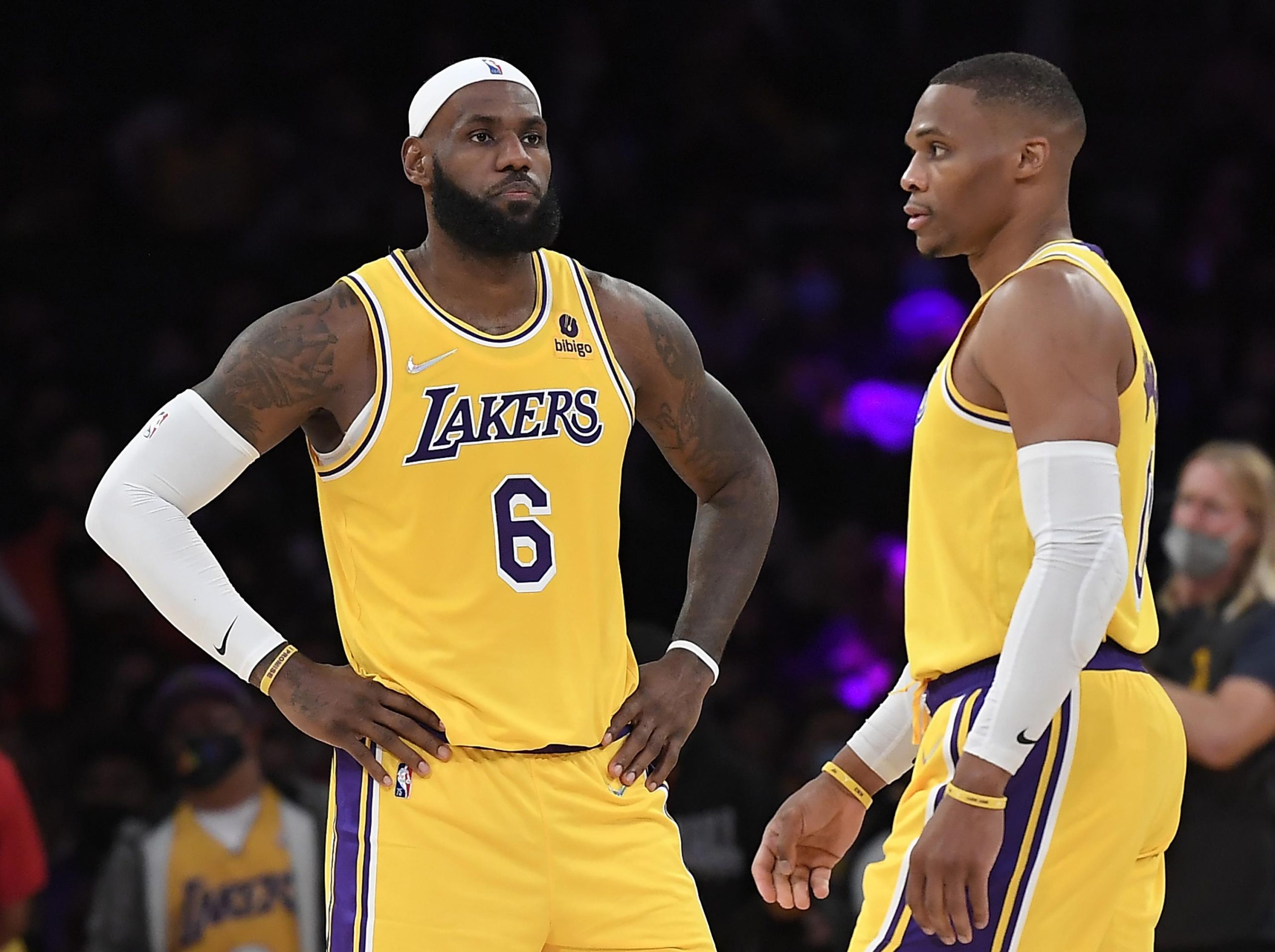
LeBron James signaled this week that his decision on where he will play for the 2026-27 NBA season is close at hand, telling reporters he does not intend to keep the league waiting much longer as free agency stretches into its third week.
“I won’t hold you guys up too much longer,” James said Thursday, offering the clearest public hint yet that a resolution to one of the most closely watched storylines of the NBA offseason could arrive within days. James informed the Los Angeles Lakers earlier this month that he intends to leave the franchise after eight seasons, ending his second stint with the team and setting off a wave of recruiting efforts from franchises across the league.
Five teams have emerged as the clear finalists in the pursuit: the Cleveland Cavaliers, Miami Heat, Golden State Warriors, Philadelphia 76ers and Minnesota Timberwolves. ESPN’s Shams Charania reported that the formal pitching process from all interested teams has now wrapped, with franchises submitting their proposals to James’s agent, Rich Paul, for the 41-year-old star to make his final call. “The voice notes have all been listened to, the rosters are set, the decks are all laid out,” Charania said. “We’ll see when he’s ready to make his decision.”
The pitching process itself has offered clues about how seriously different organizations are treating the pursuit. According to Charania, several teams had their owner, team president or general manager personally record voice memos for Paul to relay to James, rather than leaving the recruiting to coaches or players alone. The Philadelphia 76ers appeared to lean into that approach visibly, with Bob Myers, president of Harris Blitzer Sports & Entertainment, the ownership group behind the Sixers, appearing directly on Paul’s “Game Over” podcast, which he co-hosts with Max Kellerman.
Not every recruiting pitch has gone smoothly. Indiana Pacers star Tyrese Haliburton revealed this week that he made his own attempt to lure James to Indiana before James had even informed the Lakers of his departure, only for the effort to fall flat almost immediately. According to ESPN’s Dave McMenamin, Haliburton said James responded to his recruiting pitch with nothing more than a laughing emoji, effectively ending any serious consideration of the Pacers as a landing spot.
James has continued to offer glimpses into his decision-making process through informal public interactions. Responding to a question from an 11-year-old fan about his free agency, James gave one of his longer public answers on the subject to date. “This is the third time in my career I’ve been a free agent,” James said. “It’s a big decision, not only for myself, but my family as well. This is the last part of my career and where I want to spend the last few years, or last year, or last two years of my NBA career.” He added that he intends to bring the full breadth of his experience to whichever franchise he ultimately joins, saying, “I’m a natural-born leader. I’m going to try to fit into whatever team I go to but also give them all the tools and knowledge I’ve been able to grasp over the last 23 years.”
Speculation surrounding the Warriors in particular has generated its share of unconfirmed signals in recent days. Golden State head coach Steve Kerr playfully told fans stopped at a red light, “We got him,” when asked about the team’s chances of signing James, a remark widely regarded as lighthearted rather than a genuine confirmation. Around the same time, a “Pardon the Interruption” podcast episode was briefly and mistakenly published under the title “Steph Curry Behind LeBron’s Stunning Decision?” before being pulled, fueling further speculation online even though neither Kerr nor the ESPN program is believed to have advance knowledge of James’s actual decision.
James’s unusually long free agency has been shaped in part by his changed financial leverage compared with previous offseasons. Unlike his prior free agency decisions, when James commanded a maximum contract that forced teams to plan their entire roster construction around his signing, James is now expected to sign for a portion of the midlevel exception or possibly even a minimum contract, giving him more flexibility to take his time without holding up other teams’ offseason plans as significantly as in years past. Rather than anchoring a long-term rebuild, James is instead selecting a roster he believes gives him the best chance at a deep playoff run in what could be his final one or two NBA seasons.
James’s decision carries significant ripple effects across the rest of the league. NBA reporter Evan Sidery noted that several top remaining free agents have delayed their own decisions until after James makes his choice, given how his signing could reshape the remaining cap space and roster needs of the teams still in the running. Players including Draymond Green and James Harden have already opted out of their existing contracts in recent weeks, moves that have granted their respective teams additional financial flexibility as they continue pursuing James alongside other offseason priorities.
Historically, James has favored made-for-television announcements when revealing major career decisions, from his 2010 televised special declaring he would join the Miami Heat, to a first-person essay in Sports Illustrated announcing his return to Cleveland in 2014, to a more understated social media post in 2018 confirming his move to the Lakers. With James scheduled to host a live episode of his “Mind the Game” podcast at Fanatics Fest in New York alongside special co-host Tyrese Haliburton, some NBA insiders have speculated that the podcast setting could once again serve as the venue for James to reveal his decision directly to fans, continuing his pattern of controlling the narrative around his own career moves rather than allowing the news to break through a reporter’s social media post.
For now, the five finalist franchises remain in a holding pattern, having completed their formal pitches and left the final decision in James’s hands. With his own comments suggesting an announcement could come soon, the NBA world appears to be entering the final stretch of what has become one of the longest and most closely tracked free agency sagas of James’s storied 23-year career.

Soccer-Spain’s World Cup winner Capdevila seeks Trump’s help after US entry denial


Seeking Alpha’s transcripts team is responsible for the development of all of our transcript-related projects. We currently publish thousands of quarterly earnings calls per quarter on our site and are continuing to grow and expand our coverage. The purpose of this profile is to allow us to share with our readers new transcript-related developments. Thanks, SA Transcripts Team

The most widely-followed gauge of market fear and uncertainty was rising on Friday as investors carried on ditching chip makers and other AI stocks.
The Cboe Volatility Index, or VIX, climbed 1.6 points to more than 18 in early trading. Any reading of above 20 tends to signal heightened volatility.
The VIX was moving higher as futures tracking the tech-heavy Nasdaq 100 slumped 1.6%.
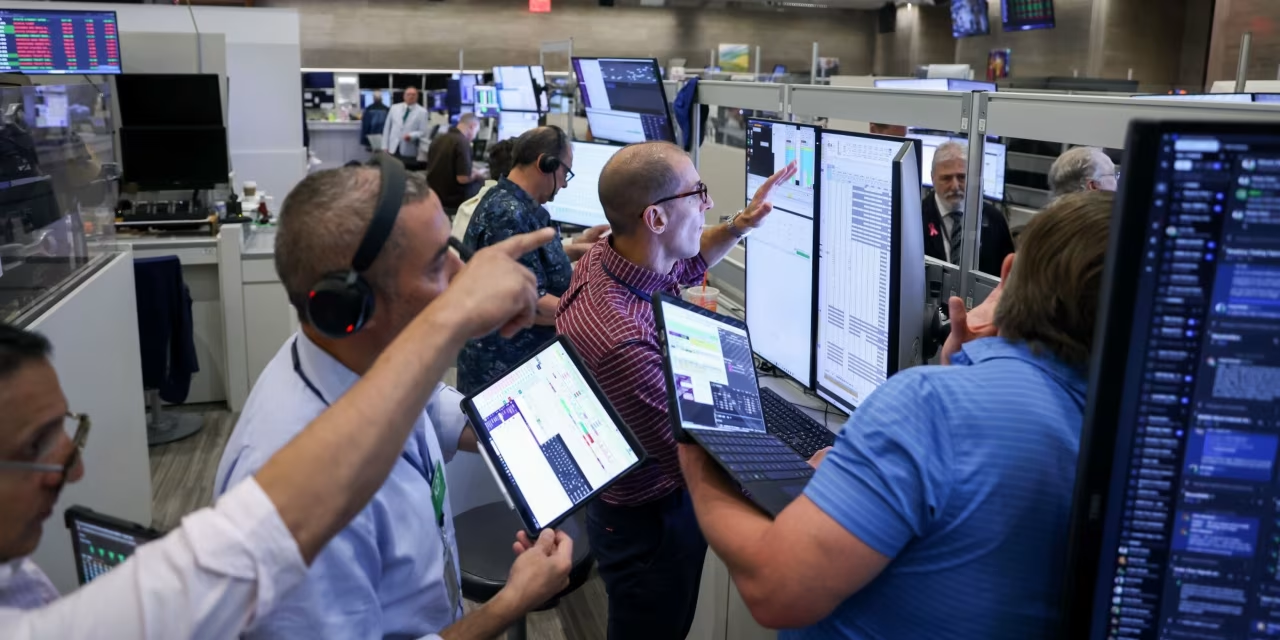

Thursday got ugly for tech stocks, especially for chip makers, and Friday could be about as bad based on Nasdaq futures, which are off again. Investors are finding refuge in dowdier sectors such as consumer staples. An ETF tracking those stocks rose Thursday and is pointing up again premarket.
📈 Follow our live markets data and coverage.
Copyright ©2026 Dow Jones & Company, Inc. All Rights Reserved. 87990cbe856818d5eddac44c7b1cdeb8

My Top 5 Dividend Picks For July

In his classic book, “Why You Win or Lose: The Psychology of Speculation”, Kelly argued that successful investing isn’t about predicting the future better than everyone else—it’s about understanding crowd psychology and resisting the emotional impulses that lead to poor decisions.
Why contrarian investing works
Kelly believed markets are driven as much by human behaviour as by business fundamentals. Investors who simply follow popular opinion often end up buying near market tops and selling close to bottoms.
“If everybody tried to buy when prices are low, then bargains would never exist,” Kelly observed, explaining that opportunities arise only because most people fail to recognise them. According to him, the majority loses because it behaves in the most natural—and emotionally driven—way.
Human psychology matters more than economics
One of Kelly’s central ideas was that investors lose money less because of economic conditions and more because of psychological biases.
He believed investors often sell their best-performing stocks too early while stubbornly holding on to losing investments, hoping they’ll recover. Pride, fear and wishful thinking frequently overpower rational analysis, leading to costly mistakes.
The typical investor’s cycle
Kelly described a familiar pattern of investor behaviour:

- Investors buy cautiously at the beginning of a rally.
- As prices keep rising, confidence turns into overconfidence.
- Greed encourages them to hold on even as valuations become excessive.
- Every decline is dismissed as a buying opportunity.
- Only after widespread pessimism sets in do they finally sell—often near the market bottom.
The four enemies of investment success
Kelly identified four psychological traits that repeatedly derail investors.
Vanity: Investors hate admitting mistakes. Rather than booking losses, they continue holding losing stocks while quickly selling profitable ones to protect their ego.Greed: Greed destroys patience. Investors chase expensive stocks during euphoric markets instead of waiting for attractive valuations.
The will to believe: Hope often pushes investors into speculative bets, convincing them that risky stocks will somehow deliver extraordinary returns despite weak fundamentals.
Blind logic: Kelly argued that what feels logical in markets is often wrong. Buying after strong rallies and selling after prolonged declines may appear sensible because recent trends seem likely to continue, but history shows that such behaviour frequently results in buying high and selling low.
Why patience beats excitement
Kelly advised investors to avoid buying stocks simply because they’ve fallen sharply. Instead, he recommended waiting until a stock demonstrates that selling pressure has truly exhausted itself.
He also warned against assuming that a stock is cheap merely because it trades below its previous highs. A lower price alone doesn’t necessarily make a stock a bargain.
Not everyone is suited for the stock market
Kelly believed successful investing requires emotional flexibility and discipline. Investors who become emotionally attached to their opinions or refuse to adapt to changing market conditions often struggle.
He also cautioned against expecting quick riches without preparation, arguing that the stock market rewards patience, study and temperament far more than luck.
The bottom line
Fred Kelly’s investing philosophy remains remarkably relevant even decades later. In an era dominated by social media trends, momentum investing and fear of missing out, his advice serves as a reminder that the biggest edge in investing often comes not from superior information, but from superior behaviour.
His message was to understand the crowd, learn from its mistakes and avoid following it blindly. Long-term investment success belongs not to those who react emotionally, but to those who remain patient, disciplined and willing to think independently.
(Disclaimer: Recommendations, suggestions, views and opinions given by the experts are their own. These do not represent the views of The Economic Times)


My interest in financial markets was born out of a love for companys, productive companies, and free market capitalism. The first book i read that shaped my investment perspective was Benjamin Grahams The Intelligent Investor. I enjoyed Prof. Grahams aproach to valuations grounded in strong fundamentals and assets. After finishing The Intelligent Investor i was able to read Security Analysis the 2nd 1940 edition by Benjamin Graham, which completely changed my analysis style and shifted me to the Heavy Industrial Sector, the steelmaking sector in particular. I also read Austrian Economic theory from Murray Rothbard: MNan Economy and State with Power and Market, Americas Great Depression, Ethics of Liberty’s, The Panic of 1819, A history of Money and Banking in the United States and Conceived in Liberty volumes I-V. Understanding Austrian theory, especially the Austrian Theory of the Business cycle helped me be aware in my investment analysis about the effects of credit expansion and contraction in industrial firms. Also i have read The Making Shaping and Treating of Steel, the Carnagie Steel 1920 edition, to be able to understand the operational and tehnical aspects of Blast Furnace steelmaking. I want to write for Seeking Alpha to be able to share with as many people sound investment theory and Austrian Economics principle to help them make informed decisions.
Analyst’s Disclosure: I/we have no stock, option or similar derivative position in any of the companies mentioned, and no plans to initiate any such positions within the next 72 hours. I wrote this article myself, and it expresses my own opinions. I am not receiving compensation for it (other than from Seeking Alpha). I have no business relationship with any company whose stock is mentioned in this article.
Seeking Alpha’s Disclosure: Past performance is no guarantee of future results. No recommendation or advice is being given as to whether any investment is suitable for a particular investor. Any views or opinions expressed above may not reflect those of Seeking Alpha as a whole. Seeking Alpha is not a licensed securities dealer, broker or US investment adviser or investment bank. Our analysts are third party authors that include both professional investors and individual investors who may not be licensed or certified by any institute or regulatory body.
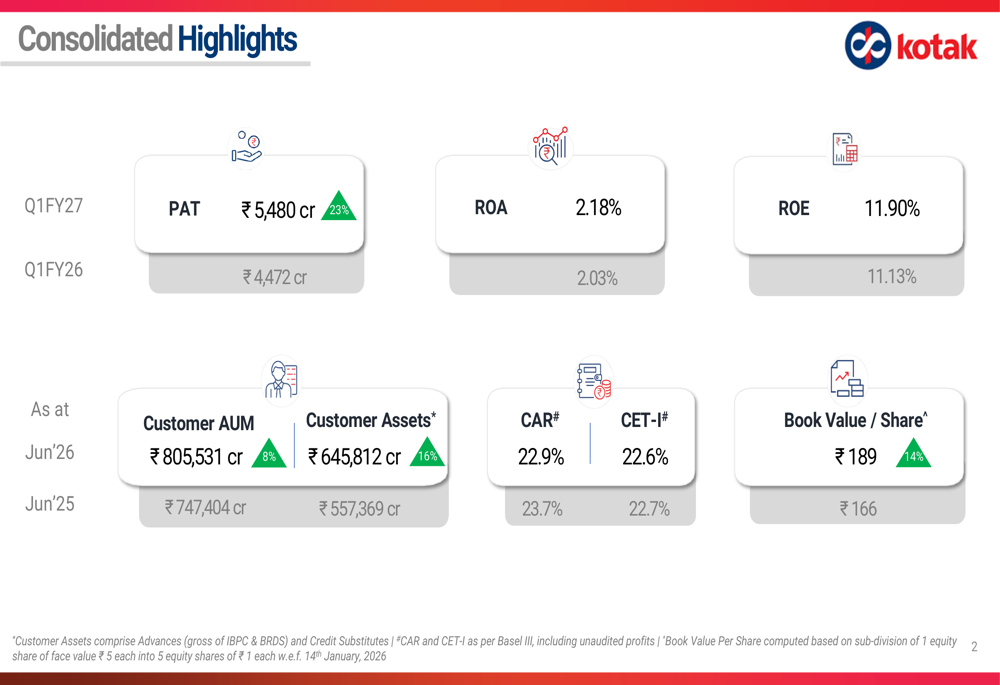
Kotak Q1FY27 presentation: 23% profit growth, asset quality improves

The bank’s net interest income, the difference between interest earned and interest expenses, rose more than 10% YoY to Rs 3,486 crore in Q1 FY27 from Rs 3,166 crore in Q1 FY26.
IDBI Bank’s asset quality slightly worsened since the March quarter, although it improved on a YoY basis. The lender’s net NPA ratio stood at 0.16%, as against 0.15% in Q4 FY26 and 0.21% in Q1 FY26.
Provisions and contingencies stood at a negative Rs 637 crore, as against a negative Rs 179 crore in the year-ago period. Capital adequacy ratio, meanwhile, increased to 26.92% during the quarter under review, while return on assets stood at 1.89%.
Also read | HDFC Bank Q1 Results: Net profit rises 5% YoY to Rs 19,060 crore, NII up 7%
IDBI Bank’s total deposits grew 10% YoY to Rs 3.26 lakh crore, while net advances rose 22% YoY to Rs 2.59 lakh crore. Credit deposit ratio stood at 79.5%, marking an improvement by 810 bps YoY and 644 bps QoQ. Net interest margin (NIM) stood at 3.61%. The lender’s total balance sheet increased 10% YoY to Rs 4.44 lakh crore.
The company’s current account savings account ratio stood at 43.64%, marking a 99 bps fall since June last year. CASA, meanwhile, grew 7% YoY to Rs 1.42 lakh crore in Q1 FY27.
IDBI Bank share price
IDBI Bank shares gained around 2% to close at Rs 87 apiece on Friday. The shares of the company gained around 5% in one week, but have fallen around 4% in one month. Overall, the stock is down more than 16% in 2026 so far.
Also read | Yes Bank Q1 Results: Net profit surges 34% YoY to Rs 1,071 crore; NII advances 18%
Over a longer term, IDBI Bank shares have delivered a negative return of 13% over one year, but positive returns of 50% in three years and 130% in five years. The company has a market capitalisation of nearly Rs 93,546 crore.
(Disclaimer: Recommendations, suggestions, views and opinions given by the experts are their own. These do not represent the views of The Economic Times)

Do patients who suffer heart attack have more micro and nanoplastic in their blood? New study assessed

‘Won’t Hold You Guys Up Much Longer’ as Decision Nears Five Suitors

10 Video Games With the Best Character Development


-
 NewsBeat2 days ago
London Mayor Sadiq Khan handed a peerage by Keir Starmer alongside 15 other Labour figures… just days before the PM leaves No10
-

 Fashion18 hours ago
Weekend Open Thread – Corporette.com
-

 Crypto World2 days ago
CFTC blocks Kalshi from unwinding Michigan trades after court order
-

 Politics3 days ago
Young campaigners urge incoming PM to act on outdoor junk food ads
-

 Business2 days ago
Nvidia Stock Slips After Big Tuesday Rally as Huang Confirms Vera Rubin Chip Is Now in Production Today
-

 Politics2 hours ago
The House | The City of London can help the new chancellor deliver growth in every postcode
-
 Entertainment3 days ago
Disney’s Most Ambitious Failed Star Wars Attraction Is Coming to SDCC
-

 Crypto World14 hours ago
Ripple wins EU-wide access as ESMA adds it to MiCA register
-

 Tech4 days ago
Get Your ESP32 Sunny Side Up With This Solar Dev Board
-

 Crypto World2 days ago
Injective Submits SEC Transfer-Agent Registration to Onchain Ownership Records
-

 News Videos4 days ago
XRP BOMBSHELL… XRP OMBOARDED FOR TRANSACTIONS!!!
-

 Business2 days ago
Palantir Shares Rise After Expanded Nvidia Partnership and Fresh Analyst Upgrades Ahead of Earnings Day
-

 NewsBeat1 day ago
Registration is now open for March for Men with Kev 2026
-

 Tech4 days ago
Dark Secrets Emerge When Jailbreaking LLMs
-
 Sports3 days ago
New Cornerback Enters Vikings Trade Rumor Mill
-

 News Videos1 day ago
Money | Class 12 Economics | CBSE Board Exam 2026-27
-

 Business1 day ago
Banco Bilbao Vizcaya Argentaria, S.A. (BBVA) Discusses Global Macro Environment and Economic Outlook for Core Markets Transcript
-

 NewsBeat7 hours ago
Durham County Council to send out electoral registration emails
-
 Tech5 days ago
Cloudflare Precursor Watches Your Mouse and Keyboard To Decide If You Are Human
-
 Crypto World2 days ago
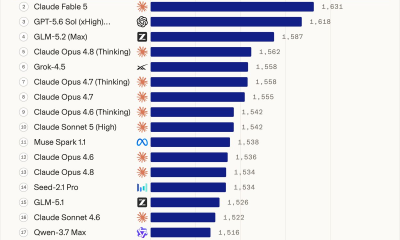
Claude Fable 5 Slips to Second in AI Coding Leaderboard
You must be logged in to post a comment Login