Indian markets are navigating through a period of heightened uncertainty, with global cues signaling a weak start to the week. Tariff concerns, particularly related to the US, continue to weigh on investor sentiment.
Amnish Aggarwal from Prabhudas Lilladher, noted the volatility in trade relations with the US. “The situation of your trade parameters with the US remains very volatile. Now, we have got some interim arrangement, but as we have seen over the last one year, nothing can be said with certainty because this is not only the India problem, this is a bit of a geopolitical problem as far as your tariffs are concerned. At this point, I would be very cautious on how the deal with the US will pan out. Something like, if we do not lose from the situation we are in, that should be satisfactory for the country. I would be more gung-ho on some of the other deals we have done, which includes the EU, where we are getting much better terms of trade. Based on the tariff policies of the US and other geopolitical factors, I believe that overall market volatility will continue in the near term.”
On the impact of artificial intelligence on IT services, Aggarwal highlighted the uncertainty surrounding business models and profitability. “It is very uncertain because it is not the beginning of AI or the transformation, it is not the end of it, but it has just started getting noticed and having some impact. We are not in a stage where growth rates of companies have started plummeting or there is margin pressure. So, this is a big reset. I do not think it is going to get settled in a quarter or two. One needs to wait and watch how deep and big the impact could be. The market actually hates uncertainty. I do not see any big green shoots for IT in the near term, and that is why we have been underweight on IT services for at least a couple of years.”
Turning to financial services, Aggarwal discussed the value unlock potential in digital lending platforms. “One needs to look at it from three angles. It aims at utilizing the cash flows the company is throwing, and because you are into telecom, we have got the digital platform and tech stack already there. They are extending it to make it bigger than today. The bigger issue is how your screening process is and how you control lending, collections, and delinquencies. Given the money they are allocating and the reach through their mobile network, they have a fair chance to scale it up. As far as value unlocking is concerned, it is too premature to presume. But for a company throwing in so much cash, it is a good extension and usage of cash. This is not going to be the first initiative, as other segments like data centers will also play a major role over time. The impact on financials and value unlocking will take a long period.”
Advertisement
On IDFC First Bank, which recently saw a 16% hit to its stock, Aggarwal emphasized perspective over panic. “We do not have a formal rating on the stock, but the hit of 590 crores is not that big relative to the balance sheet. However, it raises questions on the process and systems prevalent in the organization, which they need to address. Usually, there is initial panic, but if they manage the situation well and the deposit franchise is intact, things should recover over time.”
Live Events
In the auto sector, Aggarwal observed a mixed but generally positive momentum. “The auto sector changed gears immediately post-GST. The past three to four months have been fairly robust. Two-wheelers were already doing okay, but for PVs, the major push came later. Logically, the momentum should continue, but last month Maruti showed flattish volumes for small cars, while M&M did well in SUVs. Entry-level cars might show some fatigue, but two-wheelers and commercial vehicles continue to do well. The farm sector has been strong, though El Nino may impact the upcoming monsoon and tractor demand. Overall, selectivity is key in the auto space.” Aggarwal also shared his view on metals. “In the ferrous space, demand is good, and profitability is likely to improve in Q4. From current levels, incremental returns are possible. For non-ferrous, like aluminium, we have already seen the best, with companies like Hindustan Zinc moving up on price action. Ferrous remains the space where we are still positive.”
An automotive startup founded by a knighted billionaire, U.K. chemical mogul and minority owner of one of the world’s most prominent soccer clubs wants to rekindle the rugged SUV market.
Advertisement
The company — Ineos Automotive — has produced more than 35,000 off-road SUVs and pickups since starting in 2022, with ambitious growth plans that include potentially expanding vehicle production to the U.S. and a target this year to achieve breakeven, executives exclusively told CNBC.
“We’re running it for success. We’re running it for profitability,” Ineos CEO Lynn Calder told CNBC in an interview. “We’re just doing it really efficiently, and I think that that will allow us to, with not very much more sales, actually, to make it to breakeven.”
Ineos on Monday is set to announce a record number of orders for its flagship, gas- and diesel-powered Grenadier 4×4 vehicles during the first quarter, setting it up for a “great start” to the year, Calder said.
The company’s plans this year include growing sales in the U.S. — its largest market — by roughly 30% to 35% year over year, while further expanding awareness and sales globally after supply chain disruptions, tariffs and other issues affected its business last year.
Advertisement
Ineos Automotive CEO Lynn Calder
Courtesy Ineos Automotive
That’s easier said than done, with increasing competitiveness in the global automotive industry, which is capital intensive. Most automotive startups, particularly all-electric vehicle companies, have gone bankrupt after burning through billions of dollars in capital.
“We’ve been quietly getting on, building a company, getting things right, learning as a new startup … to get to the stage where we’re ready to grow. And that’s kind of where we are now,” Ineos Automotive Chief Commercial Officer Mike Whittington said during a separate interview.
Advertisement
U.S. production, expansion
The carmaker, a subsidiary of multinational conglomerate and one of the world’s largest chemical producers, Ineos Group, is currently selling vehicles in 50 global markets across North America, Europe, Africa, the Middle East, Southeast Asia, China and Australia.
But its greatest focus right now is on the U.S., which accounts for roughly 60% of its sales, Whittington said.
The American market is crucial to the company achieving sales of 200,000 to 250,000 units by the early 2030s, at the latest, Calder told CNBC. She said that would include production at its current plant —a former Mercedes-Benz facility in France — as well as potentially adding a factory in the U.S.
“With our models having a huge appeal to the U.S. market, we should make it there, and that would make the most sense to us,” she said. “So, absolutely, we are fully looking at options for producing in the U.S.”
Advertisement
Ineos Grenadier Quartermaster pickup truck
Courtesy Ineos Automotive
She said that could mean starting limited assembly in the U.S. in the coming years to help avoid tariffs, including a 25% “chicken tax” on light trucks imported to America that was enacted in 1964 as a response to a European levy on poultry to assist in protecting domestic manufacturing.
Ineos declined to disclose its current financials, but Calder confirmed the company has spent roughly $2 billion since its formation in 2017. That’s a relatively low amount given the company’s plant, production and retailer network, especially when compared with other recent automotive startups such as EV makers Rivian Automotive and Lucid Group.
Advertisement
“I love cars, but I’m not here as the ‘car gal.’ I’m here as someone that runs a business,” said Calder, who started leading the company after spending most of her career in Ineos’ petrochemicals and energy sectors. “And that’s kind of what I’ve just been describing. We need a scale, and that’s what we’re working toward.”
A billionaire, a pub and adventure
Ineos’ flagship vehicle is the $71,000 Grenadier, named after a well-known London pub that U.K. billionaire and company founder Sir James Ratcliffe was at when he initially came up with the idea.
The chemical mogul, who has a net worth of more than $18 billion, according to Forbes, decided to pursue the vehicle while at the Grenadier pub, as he felt there was a need for such a vehicle after the cancellation of the quintessentially rugged Land Rover Defender, he has said.
Ineos Automotive founder and British billionaire Sir James Ratcliffe with the automaker’s planned Fusilier SUV in 2024.
Advertisement
Courtesy Ineos Automotive
“We set out with a vision to build the world’s best utilitarian 4×4, and we have done just that,” Ratcliffe, a self-described adventurer and car enthusiast, has stated.
Ratcliffe is chairman and majority owner of chemical giant Ineos Group as well as minority owner of the British soccer club Manchester United. He had three nonnegotiables behind the Grenadier: functional design, serious durability and extreme off-road capability. It has a design that mixes elements of Mercedes-Benz’s prominent G-Class, or “G-Wagon,” SUV and a military Humvee, or Hummer.
The Grenadier is available in SUV, pickup truck and commercial models, powered by a gas-powered BMW 3.0-liter inline-six for the U.S. Other parts come from suppliers such as Bosch, Brembo and Recaro, with engineering development assistance from Magna.
Advertisement
Ineos Grenadier interior
Courtesy Ineos Automotive
The pickup truck model, called Quartermaster, starts at $84,400. A limited-edition, tailored model of the Grenadier SUV, called Detour, can cost around $157,000.
The company’s next vehicle is expected to be a smaller model called the Fusilier, which was anticipated to be an all-electric vehicle before Ineos paused development of that in 2024 to consider hybrid options for the vehicle as well.
Advertisement
Calder said Ineos aims to partner with other companies for future models rather than building from scratch like it did with the Grenadier. She said the Fusilier is expected in the next two to three years, followed by a much quicker product cadence after that.
“We’re just a bit of a renegade British brand with a rebellious car that gives people the chance to have an extremely fun, adventurous life,” Calder said. “I’m extremely optimistic about 2026 as being really sort of the next, pivotal milestone year in our growth.”
Sequoia Capital partner Konstantine Buhler discusses Waymo and the companies showcased at the HumanX conference on ‘The Claman Countdown.’
YouTube Premium subscribers should expect to see higher monthly prices, marking the first increase since 2023.
The streaming platform said the price changes will help it “maintain features our members value most: ad-free viewing, background play, and a massive library of 300M+ tracks on YouTube Music.”
Advertisement
“We continue to offer several plans, ensuring subscribers can choose the option that works best for them,” the company said.
YouTube Premium is raising prices for multiple plans. (Anna Barclay/Getty Images)
YouTube Premium offers ad-free viewing, background listening, offline video downloads and full access to YouTube Music Premium.
Under the new pricing, YouTube Premium will cost $15.99 per month, up $2 from $13.99. YouTube Music Premium will rise to $11.99, up $1 from $10.99, while the YouTube Premium Lite plan will increase to $8.99 per month from $7.99.
Under the new pricing, YouTube Premium will cost $15.99 per month, up $2 from $13.99. (Idrees Abbas/SOPA Images/LightRocket via Getty Images)
The family plan, which allows up to six people in the same household to share access, will increase to $26.99 per month, up from $22.99. Student plans will also rise to $8.99 per month, an increase from $7.99.
The latest price increases come as streaming companies continue to adjust subscription costs across the industry. Netflix recently raised the price of its ad-supported tier by $1 to $8.99, while Spotify increased its monthly plan in January from $11.99 to $12.99.
Jo Bamford, heir to the JCB fortune, says move might be needed to preserve jobs
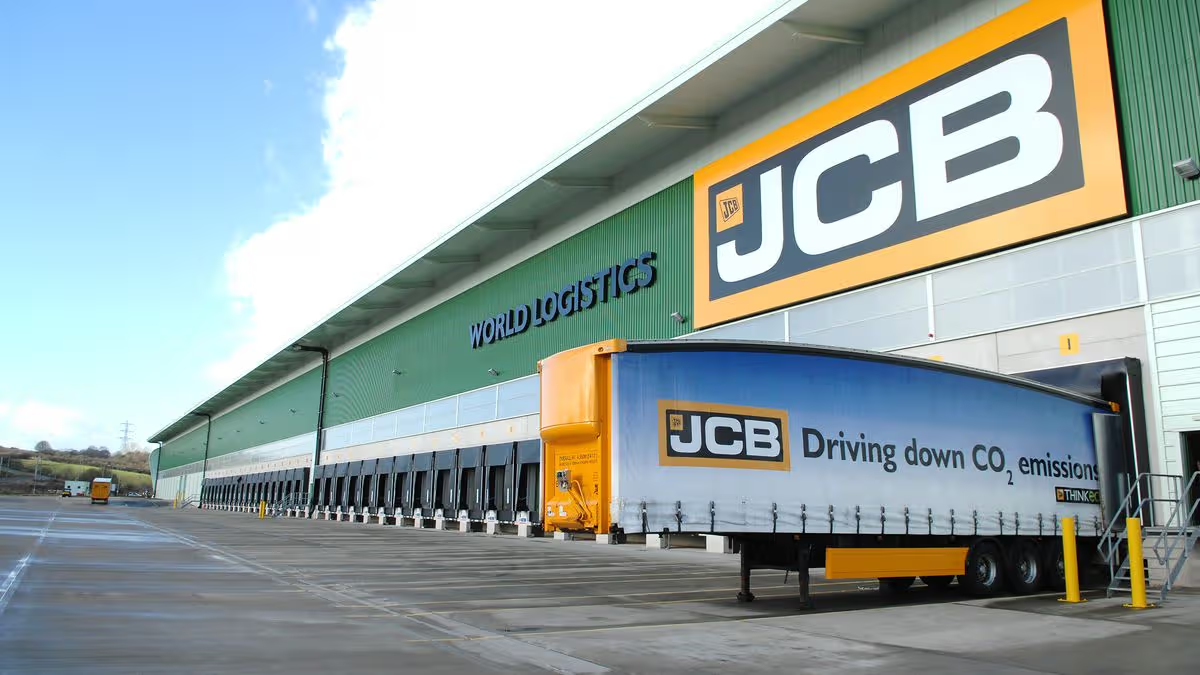
JCB’s World Logistics Centre in Newcastle-under-Lyme(Image: JCB)
The heir to the billion-pound JCB fortune has warmed that the government’s inheritance tax clampdown on family businesses could drive his father’s vast commercial empire out of the country.
Jo Bamford, whose billionaire father Anthony owns the excavation equipment manufacturer, warned he may be compelled to relocate abroad in order to protect jobs across the family’s portfolio of companies and prevent businesses from being broken up and sold.
“The family tax… is a real problem,” he told City AM in an interview, adding: “It could quite easily become an American business. I love being in Britain. I love being here. I love our factories here. But I would say to a political party of any stripe, look, there’s only so much you can ultimately do.”
The government has pressed ahead with proposals to impose inheritance tax on family-owned enterprises for the first time in decades, as part of a sweeping crackdown on wealth. The measure, first unveiled at Labour’s inaugural Budget, has sparked a chorus of warnings from business owners that the death duty will compel long-established firms to be sold off or dismantled to meet their tax obligations.
Advertisement
Both farms and family-run businesses had previously enjoyed a longstanding exemption from the unpopular levy, allowing them to be handed down without restriction. However, they were drawn into its scope amid concerns the arrangement was being exploited as a loophole by the super-wealthy. Under the changes, which came into force last week, all shareholdings in a family business worth more than £2.5m will be subject to a reduced inheritance tax rate of 20 per cent, as reported by City AM.
Billionaire engineering mogul James Dyson and hotel magnate Sir Rocco Forte have both cautioned that unless the levy is reversed, their heirs will likely be forced to sell off portions of their businesses to meet the costs. Meanwhile, drinks tycoon Steve Perez, founder of VK-maker Global Brands, warned that his company has scrapped investment plans for a new plant and hotel in a bid to reduce his family’s exposure to the tax.
At BusinessLive, we reported this week that JW Lees brewery boss William Lees-Jones also feared the impact of inheritance tax on family firms, calling the recent change an “act of self harm” that will stop family firms growing and creating jobs.
Bamford, whose family owns boutique food and drinks retailer Daylesford, the eponymous luxury soap brand, and JCB, told City AM that he and his sister were born in the US in the 1970s following a government drive to nationalise its business.
Advertisement
The manufacturing heir, whose father donated millions to the Conservative Party and is now one of Nigel Farage’s most prominent corporate backers, said: “When you’re hunting down family businesses or farms or any those two things, it is quite contentious, but you want people to hold on to these things long term.
“You want us, as a family, to invest here in Britain. You know, we have businesses everywhere around the world. We have them in India and China and Brazil. I’m here because I’m British and I’m here and I employ people in Britain because I like British people, and I like being in my part of the community.”
Serial entrepreneur Bamford maintains a position on the JCB board but has carved out a career in the clean energy sector, establishing hydrogen fuel company Ryze Power and chairing the board of environmentally-friendly bus manufacturer Wrightbus.
WINONA, Minn. — Shares of Fastenal Co. tumbled more than 6% Monday to $45.77 after the industrial distributor posted first-quarter results that largely met Wall Street expectations but failed to excite investors amid concerns over margin trends, pricing contributions and a cautious outlook in a mixed manufacturing environment.
Fastenal Stock Plunges 7% to $45.77 After Q1 Earnings Despite 12.4% Sales Jump and In-Line Results
The company, a leading supplier of fasteners, tools and industrial supplies, reported net sales of $2.2017 billion for the quarter ended March 31, up 12.4% from $1.9594 billion a year earlier. Daily sales rose 12.4% on the same number of business days, driven by market share gains, improved customer contract signings and broad-based demand across core end markets including manufacturing and construction.
Earnings per share came in at $0.30, matching analyst consensus estimates exactly and up from $0.26 in the prior-year period. Net income climbed 13.8% to $339.8 million. Operating income reached $447.6 million, yielding an operating margin of 20.3%, a 20-basis-point improvement year-over-year.
Despite the solid top-line growth and slight margin expansion, shares opened sharply lower and remained under pressure throughout the session. Some analysts and investors appeared disappointed that a portion of the sales increase — about 350 basis points — stemmed from pricing actions rather than pure volume growth, which rose an estimated 5.9%. Foreign exchange contributed a modest 60-basis-point tailwind.
Fastenal’s results reflect resilience in U.S. industrial activity even as broader economic signals remain mixed. Management highlighted continued strength in vending and other on-site customer solutions, which help lock in long-term relationships and improve supply chain efficiency for buyers.
Advertisement
“We delivered strong double-digit daily sales growth in the first quarter, reflecting share gains and broad-based demand,” said Fastenal CEO Dan Florness in prepared remarks accompanying the release. The company noted slight improvement in industrial production indices during the period.
Operating cash flow surged 44.3% to $378.4 million, representing 111.4% of net income and underscoring strong working capital management, including inventory optimization. The company returned $295.7 million to shareholders through $275.6 million in dividends and $20.1 million in share repurchases during the quarter.
Fastenal maintained a fortress-like balance sheet with total debt of just $125 million and significant cash generation capacity. For the full year 2026, the company guided for capital expenditures net of proceeds between $310 million and $330 million, up from $230.6 million in 2025. The increase supports replacement of the Atlanta hub facility, network efficiency upgrades, higher trucking investments and delayed IT projects now rolling into 2026.
The effective tax rate for the quarter stood at 24.2%, with management projecting an ongoing rate around 24.6% absent discrete items.
Advertisement
Analysts had entered the report expecting revenue near $2.19 billion and EPS of $0.30. The slight revenue beat of about $12 million provided little catalyst as the market appeared to price in higher expectations for volume-driven growth and sustained margin improvement.
The stock’s decline comes after a period of relative strength, with shares having traded near 52-week highs around $50.63 earlier in 2026. Monday’s drop pushed the market capitalization to roughly $52-53 billion, with a forward price-to-earnings multiple still elevated given the company’s consistent execution.
Fastenal’s business model — centered on thousands of branches, vending machines and sophisticated supply chain services — has long been viewed as defensive in industrial cycles. The company has expanded its addressable market through e-commerce, direct imports and value-added services that go beyond basic product distribution.
Yet investors remain sensitive to any signs of softening in manufacturing. While Q1 showed improvement, forward-looking commentary on the earnings call focused on steady but not explosive demand, with some end markets still navigating inventory adjustments and tariff-related uncertainties.
Advertisement
Pricing contributed meaningfully to the sales increase, a factor that may prove less sustainable if raw material costs stabilize or competitive pressures intensify. Gross margins held steady as the company balanced cost management with selective price adjustments.
The industrial distributor has benefited from onshoring trends and companies seeking more reliable domestic supply chains. Fastenal’s ability to deliver products quickly through its extensive network has been a competitive advantage, particularly for maintenance, repair and operations spending.
Broader sector dynamics include potential impacts from trade policies, infrastructure spending and capital investment cycles in heavy industry. Fastenal serves a diverse customer base spanning small machine shops to large manufacturers, giving it a real-time pulse on economic activity.
Wall Street’s consensus rating remains a cautious Hold, with an average 12-month price target around $48-49, implying modest upside from current levels. Some firms have highlighted the stock’s premium valuation relative to peers, while others cite Fastenal’s superior return on capital and consistent cash returns as justification for a higher multiple.
Advertisement
The company has increased its dividend for decades, making it a favorite among income-oriented investors. The quarterly payout remains reliable, with the most recent declaration underscoring management’s confidence in long-term cash generation.
Looking ahead, investors will monitor monthly sales updates for signs of sustained momentum. Fastenal typically provides preliminary daily sales figures early in the following month, offering frequent transparency into trends.
Risks include cyclical exposure to manufacturing slowdowns, commodity price volatility affecting both costs and pricing power, and potential margin compression if pricing tailwinds fade. Competition from other distributors and direct manufacturers also remains a factor, though Fastenal’s scale and service model provide differentiation.
The stock carries a beta below 1.0, reflecting its relative stability, though earnings reactions can still produce sharp moves when growth or margin narratives shift.
Advertisement
Fastenal’s long-term track record of profitable growth, high returns and shareholder-friendly capital allocation has built a loyal following. Monday’s sell-off appears more a case of “sell the news” after in-line results rather than fundamental disappointment.
With U.S. manufacturing showing pockets of strength and the company continuing to gain share through technology-enabled services, Fastenal remains well-positioned for the remainder of 2026. Whether the market rewards the execution or continues to demand faster volume acceleration will shape the stock’s trajectory in coming months.
As of mid-April 2026, the industrial bellwether trades at levels that some value investors may view as more attractive following the post-earnings pullback, while growth-oriented holders await clearer signals of accelerating end-market demand.
The earnings call, held Monday morning, provided additional color on regional trends, category performance and strategic initiatives around digital tools and supply chain optimization. Management emphasized disciplined execution amid an environment that remains constructive but not euphoric.
Advertisement
Fastenal’s ability to compound earnings through cycles has been a hallmark of its business. The Q1 print, while not a blowout, demonstrated that the company continues to navigate macro crosscurrents effectively while investing for future efficiency gains.
For a stock often described as a proxy for U.S. industrial health, Monday’s reaction underscores how even solid results can disappoint when expectations have been elevated by prior momentum. The coming weeks of monthly sales data will likely set the tone for investor sentiment heading into the second quarter.
Bill Sweeney, AARP’s senior vice president for government affairs, urges eligible families to consider opening the new “Trump Accounts,” a savings program aimed at helping children start building wealth early.
With an eye on the next generation, a new Trump Accounts proposal aims to turn tax season into more than a yearly chore – recasting it as a first step toward building lasting wealth.
Tucked inside President Donald Trump’s sweeping One Big Beautiful Bill Act, the plan would create government-backed investment accounts for children, designed to grow over time.
Advertisement
The accounts would function much like traditional long-term investment vehicles, but with rules tailored to protect young savers.
Available only to those under 18, they would be funded through federal seed money, private contributions from families and, in some cases, supplemental deposits from employers or nonprofit organizations.
Trump Accounts are tucked inside President Donald Trump’s sweeping One Big Beautiful Bill Act. (Tim Clayton/Corbis/Getty Images)
To kick-start the nest egg, the federal government will deposit an initial $1,000 into each new account.
Advertisement
“If the government is going to give you $1,000, you should definitely take it,” Bill Sweeney, AARP’s senior vice president of government affairs, told Fox News Digital.
“This is a great opportunity, from our perspective at AARP, for grandparents to help make sure that their grandkids are set on a good financial path and put a little bit of extra money away for their future,” he added.
Sweeney said anyone can apply for the accounts for a child born between 2025 and 2028.
“It’s a simple one-page form included with your tax return to open the account,” he added.
A blank 1040 tax return form from the IRS. (iStock)
Supporters say the accounts are designed to harness the power of long-term investing to build wealth early.
“One of the most important parts of wealth creation is what we in finance call compound interest,” said Michael Faulkender, co-chair of the America First Policy Institute’s Center for American Prosperity.
“If you put money into an account and leave it untouched, that initial investment – and the interest it earns – can grow into a significant amount over time.”
ESPOO, Finland — Nokia Oyj shares skyrocketed nearly 9% Monday in Helsinki trading to €8.74 as investors piled into the Finnish telecom equipment maker ahead of its first-quarter earnings, following a bullish upgrade from Bank of America that highlighted strong growth potential in optical networks fueled by exploding AI data traffic and hyperscaler spending.
Nokia Lehtikuva / Heikki Saukkomaa
The surge marked one of Nokia’s strongest single-day gains in recent months and pushed the stock to levels not consistently seen since 2011, continuing a remarkable recovery that has seen shares more than double from lows in 2025. Trading volume spiked as optimism spread that Nokia is well-positioned to capitalize on the infrastructure demands of artificial intelligence, 5G-Advanced and eventual 6G deployments.
Bank of America upgraded Nokia to a Buy rating from Neutral, citing accelerating demand for high-capacity optical and IP networking gear as cloud providers and telecom operators build out AI-ready infrastructure. The firm raised its price target significantly, reflecting confidence that Nokia’s technology portfolio — particularly in optical transport and routing — can capture a larger share of the multi-billion-dollar wave of spending driven by generative AI workloads.
Nokia has aggressively positioned itself in the AI infrastructure narrative. Its solutions for high-speed, low-latency optical networks are increasingly critical for moving massive datasets between data centers and supporting the training and inference of large language models. Executives have emphasized “AI-native” networks that integrate intelligence directly into the infrastructure, a theme that resonated with investors after recent demonstrations at industry events including Mobile World Congress.
The upgrade comes at a pivotal moment. Nokia’s first-quarter 2026 interim report is scheduled for release on April 23, with analysts expecting updates on order intake, margin trends and progress in its restructured business segments. The company shifted to a new reporting structure at the start of 2026, providing more granular visibility into areas such as Network Infrastructure, which includes optical and IP routing — segments now seen as primary growth engines amid AI tailwinds.
Advertisement
Nokia has faced challenges in recent years, including intense competition from Ericsson and Huawei, margin pressure in mobile networks and a multi-year cost-cutting program that included significant job reductions. The company has been trimming its global workforce, aiming to reduce annual costs substantially while refocusing on higher-margin software, enterprise and optical businesses.
Despite those headwinds, recent momentum has been building. Nokia secured key 5G contracts, including a multi-year deal with Virgin Media O2 in the U.K. for AirScale radio access network equipment featuring Massive MIMO and AI-enabled capabilities. Partnerships and product launches in private wireless, enterprise solutions and defense-related technologies have also broadened its revenue base.
The stock’s rally reflects a broader re-rating of telecom equipment suppliers as AI spending shifts from pure hyperscaler GPU clusters to the underlying networking fabric that connects them. Optical networking, in particular, has become a hot area as data center interconnect demands soar. Nokia’s technology in coherent optics and high-capacity routing positions it to benefit alongside peers, though analysts note execution and competitive dynamics will determine market share gains.
Chief Executive Justin Hotard, who took the helm in 2025, has emphasized operational discipline, innovation in AI-driven networks and selective growth in attractive segments. The company continues to invest in research and development through Nokia Bell Labs, with recent emphasis on AI integration across its portfolio.
Advertisement
Monday’s sharp move also coincided with generally positive sentiment in European tech stocks and easing geopolitical concerns that had weighed on risk assets earlier in the month. Nokia’s dual listing in Helsinki and as an American Depositary Receipt on the New York Stock Exchange (NOK) saw sympathetic buying interest in U.S. trading hours.
Valuation metrics have expanded with the rally. While still viewed as reasonable by some compared with historical averages, the stock trades at a premium to recent troughs, prompting debate over whether the current enthusiasm is sustainable or risks a pullback if upcoming earnings disappoint. Analysts’ consensus price targets have risen but remain mixed, with some calling for further upside while others caution about near-term margin visibility.
Nokia’s dividend policy remains shareholder-friendly. The board has proposed flexible distributions up to €0.14 per share in installments rather than a single payout, providing flexibility amid ongoing restructuring. The Annual General Meeting held earlier in April approved board changes, including the planned succession of Board Chair Sari Baldauf by Timo Ihamuotila.
Longer-term opportunities include the transition toward 6G, where Nokia aims to play a leading role through standards development and early technology trials. The company’s strong patent portfolio in wireless technologies continues to generate licensing revenue, offering a relatively stable income stream.
Advertisement
Challenges persist. Mobile networks margins have been under pressure, and large-scale 5G deployments in some markets have slowed. Geopolitical tensions, supply chain issues and currency fluctuations also affect results, given Nokia’s global footprint.
For investors, Nokia represents a play on both traditional telecom infrastructure renewal and the newer AI networking boom. The stock’s volatility reflects shifting narratives — from a legacy handset maker to a diversified networking and technology leader — with AI providing fresh optimism after years of stagnation.
As the April 23 earnings approach, focus will center on order backlog trends, particularly in optical and enterprise segments, cost-saving progress and any updated full-year guidance. Positive surprises on AI-related demand could fuel further gains, while any softness in core mobile infrastructure might temper enthusiasm.
Monday’s 8.74% jump underscored how quickly sentiment can shift in the sector when analyst upgrades align with macro tailwinds and thematic interest in AI infrastructure. Nokia, once considered a fading giant, is once again drawing attention as a potential beneficiary of the massive capital expenditure cycle unfolding in data centers and carrier networks worldwide.
Advertisement
Whether this momentum sustains through earnings season will depend on concrete evidence that the optical and AI narratives are translating into revenue acceleration and margin expansion. For now, investors appear willing to give Nokia the benefit of the doubt as it navigates its transformation in an increasingly AI-driven telecom landscape.
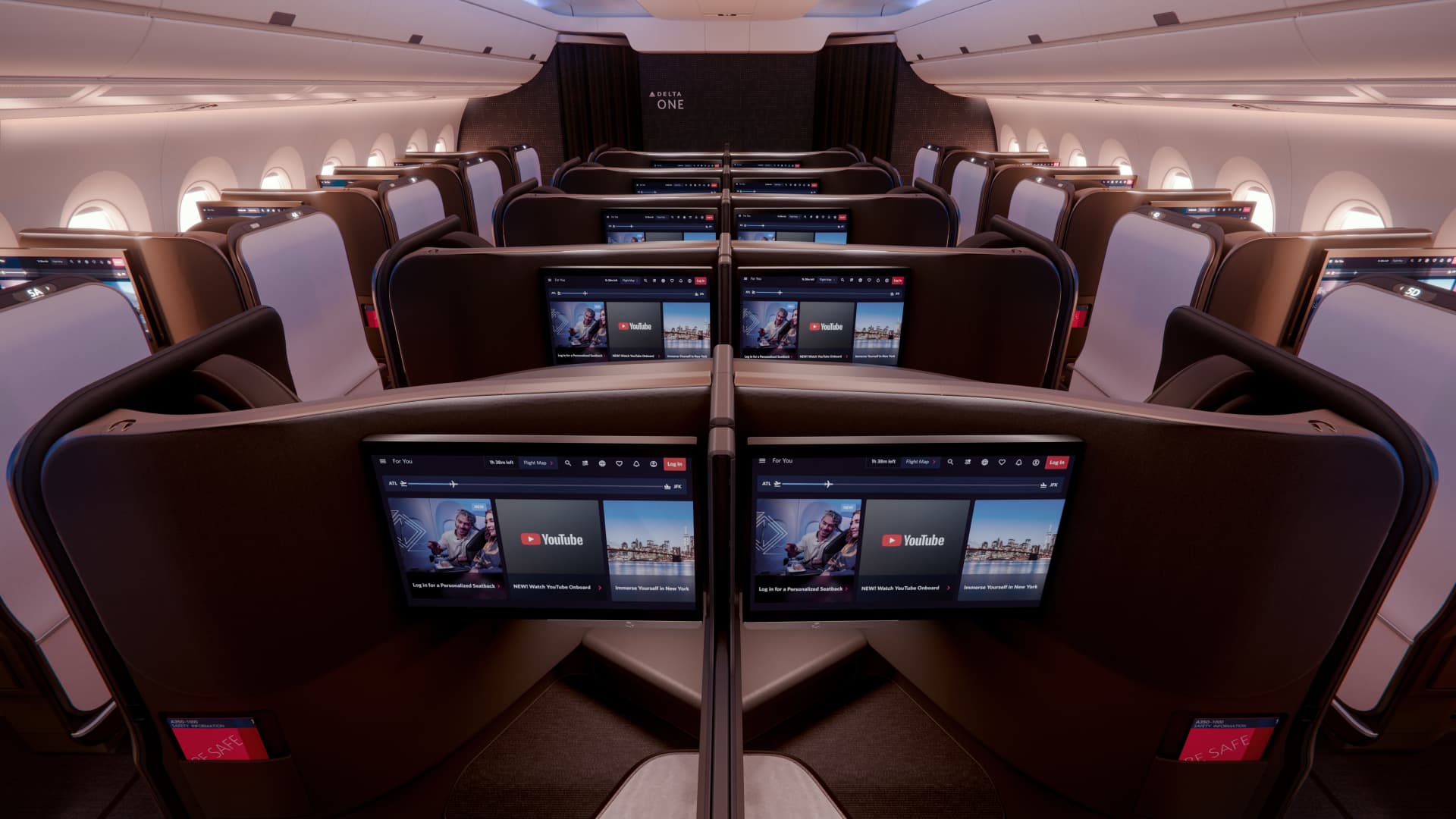
Delta A350 fleet renderings with the next-generation Delta One suite cabin.
Courtesy: Delta
Delta Air Lines on Monday unveiled an updated Delta One suite for some of its longest-haul planes, marking its first refresh of the top-tier seat in a decade as airline competition for well-heeled travelers ramps up.
Advertisement
The new suites, which Delta said will debut on its Airbus A350-1000 aircraft in 2027, will include beds that are three inches longer than the older suites and a new pillow-top cushion. The new design will give travelers more leg and knee room, said Mauricio Parise, Delta’s vice president of brand experience.
“Most customers are side sleepers,” and the new designs could accommodate them, he said.
Delta had customers test the new suites out for “hours” at the company’s headquarters, Parise said.
Delta A350 fleet renderings with the next-generation Delta One suite cabin.
Advertisement
Courtesy: Delta
The airline’s Delta One business class cabin debuted nearly a decade ago on the A350s, featuring lie-flat beds, doors and a “do not disturb” button.
“We were a first mover, [and] started flying with doors in 2017,” Parise said. “There is an element of improvement.”
The A350-1000s, which are dedicated to long-haul flights, will have 50 of the suites.
Advertisement
The changes come as industry profit leader Delta and other airlines are refreshing their cabins, adding more expensive — and profitable — premium seats as wealthier customers continue to drive results.
The company said that premium ticket revenue, from first class and other more expensive options compared with coach, was up 14% in the first quarter over last year. Main cabin revenue, meanwhile, increased for the first time since late 2024.
Delta’s rival, United Airlines, showed off its new long-haul Polaris suite at the carrier’s hangar at Los Angeles International Airport last month, along with a slew of other products aimed at giving travelers more chances to pay up for additional space, ranging from a three-seat coach row that converts into a bed to both lie-flat and premium economy seats on narrow-body Airbus jets.
Nemes Laszl | Science Photo Library | Getty Images
Revolution Medicines‘ drug for pancreatic cancer succeeded in a highly anticipated Phase 3 trial, almost doubling the typical length of survival and slashing the risk of death by 60% versus chemotherapy, the company said Monday.
Advertisement
RevMed said its daily pill, daraxonrasib, met all primary and secondary endpoints in a trial of people whose cancer had already progressed on another treatment. People who took daraxonrasib typically lived for 13.2 months versus 6.7 months for people who took chemotherapy, an increase of 6.5 months, RevMed said in a press release.
“These are dramatic, practice-changing outcomes, and our focus now is moving quickly to bring this potential new treatment option to patients who urgently need new treatment,” RevMed CEO Mark Goldsmith said in an interview.
Goldsmith called the results “unprecedented,” saying no drug has shown an overall survival benefit greater than one year in a Phase 3 trial for pancreatic cancer. The company plans to soon seek Food and Drug Administration approval using a Commissioner’s National Priority Voucher, which grants a review within a matter of months.
RevMed’s pill could bring a new option for people with pancreatic cancer, an aggressive disease that has the lowest five-year survival rate of any major cancer, at 13%. Daraxonrasib broadly targets RAS mutations, which drive tumor growth and are found in about 90% of pancreatic cancer cases.
Advertisement
“These results usher in a new era of RAS-targeted medicines for pancreatic cancer, which has been exclusively treated with cytotoxic intravenous chemotherapy,” Goldsmith said.
The company’s shares jumped more than 30% following release of the results Monday.
RevMed said the drug showed a manageable safety profile and that no new concerns were observed. The drug can produce rash, a side effect highlighted last week by former Republican Sen. Ben Sasse, who shared his experience taking the drug in an interview with The New York Times. Goldsmith said the company can’t comment on any individual patient, but that a rash is a known side effect and one that’s generally manageable.
The company will seek approval for second-line treatment, or in patients whose cancer has already spread while taking another drug. It’s conducting a Phase 3 trial for newly diagnosed patients.
Seeking Alpha’s transcripts team is responsible for the development of all of our transcript-related projects. We currently publish thousands of quarterly earnings calls per quarter on our site and are continuing to grow and expand our coverage. The purpose of this profile is to allow us to share with our readers new transcript-related developments. Thanks, SA Transcripts Team






















































You must be logged in to post a comment Login