
Business
Memory panic amid TurboQuant is a buying opportunity in these stocks: BofA




Adding cryptocurrency payments to your website sounds like a developer’s job. You’d need API integration, webhook configuration, security implementation, etc., which is considered technical.
Many business owners don’t have that expertise. They end up either hiring developers or putting crypto payments on the back burner.
CoinRemitter eliminates that barrier. This crypto payment gateway offers plugins, invoices, and widgets. These features don’t require any technical skills to accept crypto payments. This crypto payment gateway helps you accept Bitcoin, Ethereum, USDT, etc., without coding.
Crypto Payment Plugins for Instant Integration
CoinRemitter’s ready-made Crypto plugins eliminate the need for technically complex integration into websites built on WordPress, OpenCart, PrestaShop, Laravel, etc. You can install them like an extension, connect your wallet, and accept payment in crypto. The setup takes about 12 minutes on average.
On the other hand, custom crypto API integration may stretch into days depending on your platform. With plugins, your store gets crypto payment functionality without you touching a single configuration file.
Professional Invoices for Service-Based Businesses
Not every business runs an online store; some prefer requesting payments via invoices. Traditional invoicing platforms charge fees and take days to settle. Plus, international clients face wire transfer costs that eat into your agreed rate.
The invoice system from this crypto payment processor lets you create and send payment requests in cryptocurrency for free. You enter the amount, select the crypto, and share the invoice link. Clients pay directly. No account creation required on their end. Settlement happens in a few minutes instead of 3-5 business days. That’s the difference between waiting for a wire transfer and having funds available by the end of the day.
For service businesses, this means faster cash flow. You don’t chase payments across time zones. And you’re not losing 3-4% to international transaction fees.
Crypto Payment Widgets: Four Solutions, Zero Code
Some businesses need even simpler solutions. Building a full checkout system for such businesses may not be worth it. This process can also be time-consuming.
This cryptocurrency payment gateway offers four widget options that solve different payment scenarios to address this issue. Each one generates code or a URL that you can copy and paste into your website. That’s it.
Pricing Widget
The Pricing Widget displays subscription tiers or pricing plans with built-in payment functionality. SaaS companies love this one. You set up your plan names, prices, and descriptions in the visual editor. The widget handles the rest, displaying options, collecting payments, and tracking conversions.
No CSS knowledge needed. The preview shows exactly how it’ll look on your site before you publish.
Presale Widget
Crypto projects launching tokens need a way to collect payments during ICOs. The Presale Widget creates a complete token sale interface. You can set up to four distribution rounds with different prices, increase pricing after a certain time period, and offer bonus tokens for larger purchases.
This feature also supports multiple currencies. So, you can add multiple crypto options during the presale period. This will help you distribute tokens to a wider audience.
Payment Button
Simple needs call for simple solutions. The Payment Button Widget gives you exactly what it sounds like. It gives a customizable button that triggers a crypto payment. Configure the amount, choose your cryptocurrency, customize the appearance, and embed the generated code.
Donation pages use this extensively. So do freelancers collecting fixed-fee payments. The button is responsive and adapts to mobile screens automatically.
Payment Page
The Payment Page Widget helps you create a web page with a shareable URL. You can create and customize the page, set pricing, get the URL, and share it anywhere to request payments.
This feature is ideal for social media creators, consultants, and other businesses who take bookings via email. Anyone who wants to accept payment in crypto without a website can find this feature helpful. It allows you to track analytics, set expiration dates, and display goal progress for fundraising campaigns.
Why These Tools Matter for Non-Technical Businesses
Developers often charge $50-150 per hour. Custom crypto payment integration can require anywhere from 10-40 hours, depending on complexity. That’s$500-$6,000 in development costs before you process your first payment.
CoinRemitter’s user-friendly solutions cost $0 upfront. You pay only 0.23% processing fees per transaction. Development costs are eliminated entirely.
Here’s what you get without writing code:
- Zero Developer Dependency: Set up payments yourself. Change configurations anytime. No waiting for developer availability.
- Instant Updates: In widgets, you can easily make customizations, including pricing, payment options, widget appearance, etc., through the dashboard.
- Lower Launch Costs: No upfront investment in custom development. Your savings start day one.
- Faster Time to Market: Go from “I want to accept crypto” to processing payments in under an hour. Some businesses launch the same day they sign up.
- Full Control: Access your payment data, statistics, and configurations from anywhere. No middleman required.
Conclusion
Accepting cryptocurrency shouldn’t require technical expertise. Yet many payment gateways assume you have developers on staff. This cryptocurrency payment gateway flips that assumption. Plugins, invoices, and widgets put crypto payment acceptance in your hands regardless of your technical background.
You get the same features businesses pay thousands to develop, multi-currency support, instant notifications, and settlement tracking, without hiring anyone. The platform handles complexity. You handle your business.
Ready to accept crypto payments without writing code? Create your free CoinRemitter account and choose your integration method. No KYC required.

WASHINGTON — As U.S. Sen. Marsha Blackburn (R-Tenn.) ramps up her campaign for Tennessee governor in 2026, the 73-year-old lawmaker continues to captivate attention with a career that blends small-business grit, entertainment industry roots and staunch conservative advocacy. The first woman elected to represent Tennessee in the Senate, Blackburn has emerged as a leading voice on issues ranging from protecting women’s sports to rural health care and artificial intelligence policy.

Here are five fun and fascinating facts about the Mississippi-born senator that highlight her journey from 4-H scholarship recipient to one of the most influential figures in Volunteer State politics.
1. She Paid Her Way Through College Selling Books Door-to-Door
Long before she entered politics, a young Marsha Wedgeworth (her maiden name) demonstrated remarkable entrepreneurial spirit. At Mississippi State University, where she earned a bachelor’s degree in home economics in 1973, Blackburn worked as a sales representative for the Southwestern Company. She became one of the first female sales associates in the South for the book-selling firm and later helped organize an all-female sales division.
Blackburn often credits this experience with teaching her resilience, persuasion skills and the value of hard work. She received a 4-H scholarship that helped fund her education, tying her early achievements to rural roots and community involvement. Those door-to-door sales lessons would later inform her reputation as a skilled grassroots campaigner, particularly during her successful fight against a proposed state income tax while serving in the Tennessee Senate in the late 1990s and early 2000s.
2. Her First Big Government Role Involved Tennessee’s Music and Film Scene
Blackburn’s entry into public service had a distinctly creative flavor. In 1995, she served as executive director of the Tennessee Film, Entertainment, and Music Commission. The position allowed her to promote Nashville’s booming entertainment industry, forging connections with musicians, filmmakers and creative professionals.
This early role reflects a lesser-known side of the conservative senator: her longtime support for the arts and entertainment sectors. As a lawmaker, she has backed legislation such as the Ask Musicians for Music Act and the Help Independent Tracks Succeed Act, aimed at protecting artists and independent creators in the digital age. Her appreciation for Tennessee’s music heritage — from country to rock — adds a layer of cultural affinity to her political persona in a state where entertainment is big business.
3. She Is a Bestselling Author and Children’s Book Collaborator
Blackburn has leveraged her communication skills beyond the Senate floor by becoming a published author. Her books include “Life Equity: Realize Your True Value and Pursue Your Passions at Any Stage in Life” (2008) and “The Mind of a Conservative Woman: Seeking the Best for Family and Country” (2020). The latter outlines her philosophy on family, freedom and conservative principles.
In a more lighthearted turn, she co-authored the children’s book “Camilla Can Vote” (2020) with her daughter, Mary Morgan Ketchel. The book aims to inspire young readers — especially girls — about civic participation and the importance of voting. This family collaboration underscores Blackburn’s emphasis on passing down values of engagement and empowerment to the next generation. She and her husband, Chuck Blackburn, whom she married in 1974, also have a son, Chad, and two grandsons, making her a proud mother and grandmother who frequently references family in her public remarks.
4. She Defeated a Proposed State Income Tax Through Grassroots Organizing
One of Blackburn’s most celebrated early political victories came during her time in the Tennessee State Senate (1998-2002). She played a leading role in a statewide grassroots campaign that successfully defeated a proposed state income tax. The effort mobilized thousands of Tennesseans and cemented her image as an anti-tax champion and effective organizer.
The campaign showcased her ability to connect with everyday citizens, a skill she has carried into her congressional and Senate careers. Supporters often point to this episode as evidence of her commitment to limited government and fiscal responsibility — themes that remain central to her platform as she seeks the governorship in 2026.
5. She Has Championed Causes From Rural Hospitals to Women’s Sports
Blackburn’s legislative work frequently highlights practical, constituent-focused issues. In March 2026, she joined Sen. Mark Warner (D-Va.) in introducing the bipartisan Save Struggling Hospitals Act to support rural hospitals facing financial strain. She has also introduced measures to expand mental health care access for veterans through community partnerships and pushed for stronger consumer protections in data security and product safety.
On the cultural front, Blackburn has been vocal in recent weeks about protecting women’s sports, joining Republican colleagues in pressing for policies to keep biological males out of female athletic competitions. She has described the issue as a defense of Title IX opportunities for girls and women.
As she eyes the Tennessee governor’s race — where recent polls show her commanding a strong lead in the Republican primary — Blackburn continues to blend her personal story with policy priorities. Born in Laurel, Mississippi, on June 6, 1952, she moved to Tennessee and built a life in Brentwood, a Nashville suburb. Her net worth, according to financial disclosures, places her in the upper-middle range for lawmakers, reflecting a career that includes running her own marketing and event management company before entering full-time politics.
Blackburn’s path from sales manager and small business owner to U.S. senator and gubernatorial contender illustrates a classic American narrative of ambition and persistence. She first won election to the U.S. House in 2002, representing Tennessee’s 7th Congressional District for eight terms before successfully running for Senate in 2018. She cruised to reelection in 2024 and now positions herself as a candidate who can make Tennessee a national model for conservative governance.
Critics and supporters alike note her sharp debating style and frequent media appearances. She has authored opinion pieces, appeared on national television and used social media effectively to communicate directly with constituents. Her office highlights a leadership philosophy rooted in private-sector experience, family values and a belief in empowering individuals rather than expanding government.
As the 2026 gubernatorial race heats up, with Blackburn emerging as a frontrunner, these five facts offer a glimpse into the woman behind the headlines. From her youthful days selling books to her current efforts shaping policy on rural health, veterans’ care and cultural issues, Marsha Blackburn’s story reflects both personal drive and deep ties to Tennessee’s identity.
Voters and political observers will watch closely as she campaigns on themes of prosperity, opportunity and conservative principles. Whether discussing entertainment industry support, family empowerment or economic freedom, Blackburn consistently draws on experiences that span decades of public and private service.
For those following Tennessee politics, the senator’s blend of grit, policy focus and personal touch continues to define her appeal. As she pursues the state’s highest office, her journey from Mississippi roots and college sales jobs to the corridors of power remains one of the more compelling narratives in American politics today.

Why is SanDisk stock higher today?

Dr Edwin Masimba Moyo is an entrepreneur, author, and agricultural innovator known for shaping modern horticulture and food systems across Africa. Raised in Zambia and Zimbabwe, he built his career at the intersection of agriculture, trade, and global markets.
He first gained recognition as a pioneer of Zimbabwe’s blueberry industry. At a time when export horticulture was still developing, he led projects that supplied high-value crops such as blueberries, strawberries, and exotic vegetables to international retailers, including Tesco and Marks & Spencer. He also played a key role in opening access to the Chinese market for African-grown blueberries.
His career has not followed a straight path. After facing major setbacks, including the loss of land during political upheaval in Zimbabwe, Dr Moyo shifted his approach. He began working with small-scale farmers through contract farming, turning adversity into a scalable model for inclusive agriculture.
Today, he leads AgriConnectAfrica, a digital platform designed to link African farmers with global markets, finance, and infrastructure. The initiative aims to reach 50 million farmers over the next decade while building a broader ecosystem that includes research, food processing, and international distribution.
Alongside his business work, Dr Moyo is a published author of several books on agriculture, economics, and consumer behaviour. His latest work, The Mathematics of Food, explores the economic forces shaping global food systems.
His work reflects a long-term focus on value creation, innovation, and economic development across Africa.
Q&A Interview
Edwin Masimba Moyo: Building Systems, Not Just Businesses
Q: Let’s start at the beginning. What first drew you into agriculture and trade?
I grew up in both Zambia and Zimbabwe, where agriculture was always part of daily life. But I did not see it as a business at first. That changed when I realised the gap between what farmers produced and what global markets demanded. I became interested in how to bridge that gap, not just through farming, but through systems.
Q: You became known for pioneering the blueberry industry in Zimbabwe. How did that happen?
At the time, blueberries were not a common crop in Zimbabwe. I saw an opportunity in export markets, especially in the UK and later China. We built supply chains from the ground up. That included production, quality control, and logistics. It was not easy, but it showed that African agriculture could compete globally if structured properly.
Q: Your career has also included major setbacks. How did those experiences shape your approach?
One of the biggest challenges was losing land during political changes in Zimbabwe. It was a turning point. Instead of focusing on large-scale ownership, I shifted towards working with small-scale farmers. Contract farming allowed us to keep production going while involving more people. It changed my thinking from individual success to collective systems.
Q: How did that thinking lead to AgriConnectAfrica?
AgriConnectAfrica came from years of seeing the same problems. Farmers lacked access to markets, finance, and reliable partners. At the same time, buyers and investors struggled to find structured supply. The platform connects all these groups in one system. It is not just about selling crops. It is about building an ecosystem.
Q: What makes the platform different from other agricultural initiatives?
The structure is different. Farmers are not just users. Over time, they become partners. The platform also integrates banks, insurers, and logistics providers. We are working with universities as well, to support research and training. The goal is long-term sustainability, not short-term transactions.
Q: You have also spoken about research into indigenous plants and health. How does that fit into your work?
Agriculture and health are closely linked. We are researching indigenous antioxidant plants that may support early brain development. This work builds on what we learned from crops like blueberries, but goes further. It is about using local knowledge and science together to create new value.
Q: Your latest book, The Mathematics of Food, looks at food systems in a different way. What inspired it?
I wanted to show that food is not just about what we eat. It is also about economics. The book looks at waste, processing, and the long-term costs of unhealthy diets. By putting numbers to these issues, we can better understand the system and make more informed decisions.
Q: You have written several books. How does writing support your work as an entrepreneur?
Writing helps me organise ideas. It also allows me to share lessons from experience. Each book reflects a different stage of my journey, from agriculture to consumer behaviour to future thinking.
Q: What is your long-term vision for AgriConnectAfrica?
In the short term, it is about mobilising and training farmers. In the medium term, it is about building entrepreneurs and expanding markets. In the long term, it is about creating a strong African economy driven by its people, especially the youth.
Q: Finally, how do you define success at this stage of your career?
Success is not personal. It is about how many people you help become successful. If the system works for others, then it works.

Check out what’s clicking on FoxBusiness.com.
Since entering the national spotlight, former NFL MVP Cam Newton has been authentically and unapologetically himself.
Whether on the field, or now off of it in his new content-creating realm, Newton’s fans and followers have gravitated toward his genuine, no-filter takes on his hit shows “Funky Friday” and “4th & 1 with Cam Newton.” Now, with a new, key partnership with Offscript Worldwide, Newton’s reach to the masses will be far greater.
Iconic Sage Productions, the independent production powerhouse founded by Newton, joined Offscript, a creator-owned ecosystem that connects culture-shaping brands and platforms under one roof, including REVOLT, REVOLT Sports and 3BlackDot, among others. The major expansion was announced at the 2026 IAB NewFronts, as Offscript, which represents more than 130 creators and produces over 150 creator-led series that reach more than 250 million subscribers on YouTube alone.
CLICK HERE FOR MORE SPORTS COVERAGE ON FOXBUSINESS.COM
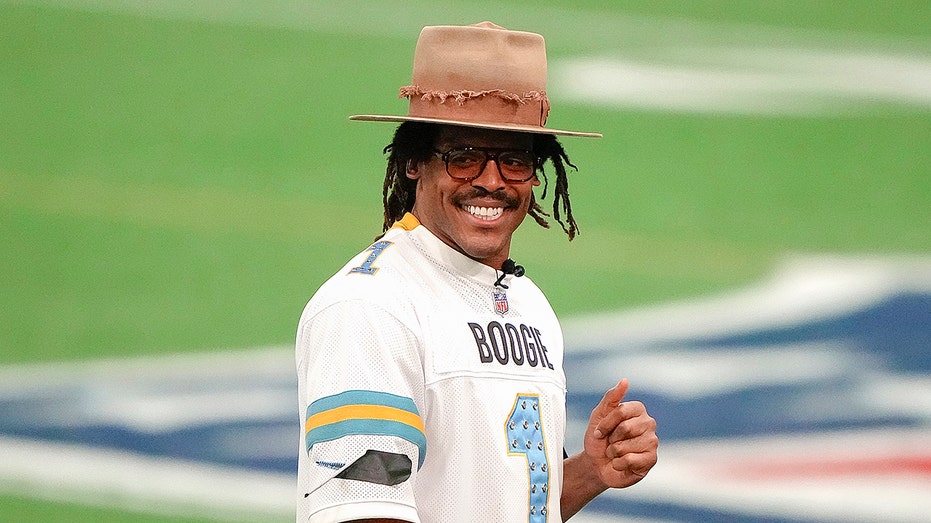
Cam Newton of team J Balvin looks on against team Druski during the Super Bowl LX Celebrity Flag football game on YouTube at Moscone Center South on Feb. 7, 2026 in San Francisco, California. (Thearon W. Henderson/Getty Images / Getty Images)
As part of the expansion, Newton’s Iconic Saga will integrate into Offscript’s creator-led ecosystem, which will ultimately amplify the reach of Newton’s signature storytelling.
“When you really think about Offscript, it’s like the ecosystem that bridges so many different facets of our lives, from sports, to culture, to lifestyle and so many different things,” Newton explained to Fox Business. “That transition for me wasn’t foreign. Instead of training to be the best football player, or the best athlete. Now, I’m just training to be the best content creator I can possibly be.
“I just always want to be a beacon of the person, in a lot of ways, figured it out as I went. I’m just so thrilled that Offscript gives me and Iconic Saga the opportunity to continue to believe in our vision, and we’re not able to do these things without great partners like this.”
TOM BRADY OPENS UP ABOUT HIS HEALTH AMID GLP-1 SURGE: WATER, MOVEMENT AND DISCIPLINE
Content creation is usually viewed as an independent art, but Newton knows that’s not the case, especially now with Offscript.
“It’s comparable to when I was playing football,” he said. “Even though I would probably make a play, and they’d always use the analogy, ‘Oh my God, he made an unbelievable play, that’s all him.’ Well, you still had offensive lineman, you had receivers blocking, you had coaches calling the play, you had general managers assessing the team.
“For us, that’s the same thing. We want to play to our strengths and partner in our weaknesses. That’s what Offscript gives us the opportunity to do – partner with their ecosystem to really bring ease to the business as we know it.”
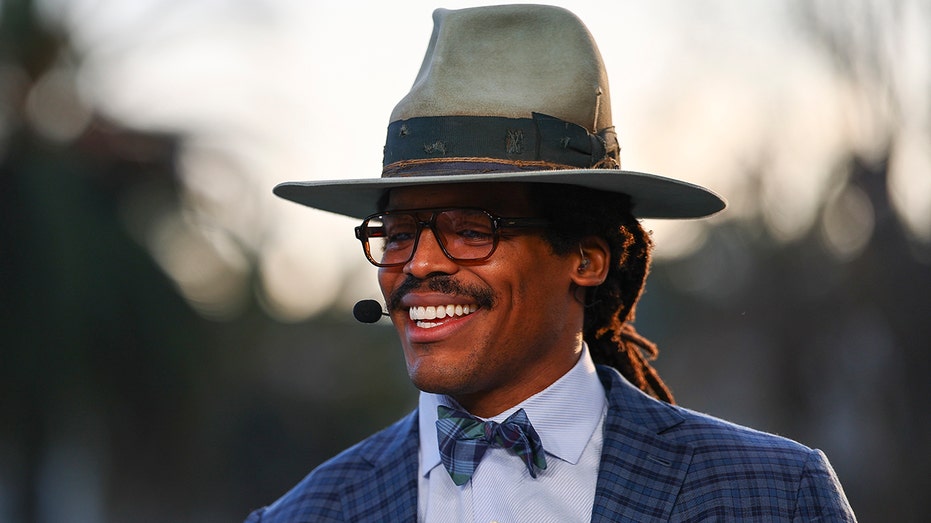
ESPN analyst Cam Newton is on the set of “First Take” on Feb. 6, 2026 in San Francisco, California. (Aaron M. Sprecher/Getty Images / Getty Images)
The content creation game is also about being authentic with your audience, which Newton said is “nothing new” from him. But he also recognizes how today’s consumers can “identify B.S.,” as he put it.
As Iconic Saga preaches authenticity, so does Offscript, which Newton gravitated toward with this partnership. It also helps that Offscript can bridge the gap with global brands to partner with Newton’s content in the future as well.
“These brands who align, you can also sell them the visual output that people look to your platform to see,” Newton said. “…The real game changer, so to speak, is when brands align with your message. Brands align with your audience. Brands align with your real value to capturing people’s attention. That’s where we’re at with Iconic Saga, no different than if it’s ‘Funky Friday’ or ‘4th & 1.’”
As this partnership kicks off, that message is going on tour as well, with the “4th & 1 College Tailgate Tour.” Iconic Saga is running the show, meaning Newton will be taking full ownership of the narrative, which means his unfiltered, authentic connection directly to the HBCU community.
“4th & 1” will be traveling to America’s HBCU campuses, where live recordings of the show will allow fans to experience, what Newton calls, “from the set to the yard.” Whether at home or in person, the tour, which is set to begin in Fall 2026, will shine a spotlight on the student-athletes, academic programs, and the unique game-day culture that defines an HBCU.

Cam Newton speaks on the “Funky Friday” panel during the 2025 Black Effect Podcast Festival at Pullman Yards on April 26, 2025 in Atlanta, Georgia. (Derek White/Getty Images / Getty Images)
GET FOX BUSINESS ON THE GO BY CLICKING HERE
This and much more is expected as Newton, Iconic Saga and Offscript embark on a partnership aimed at continuing to make an impact at the intersection of sports, culture, and lifestyle.
“We’ve always had interests outside the game,” Newton said. “Now, I can 100% dedicate my time, energy and effort not into just creating, but also aligning with incredible partners like Offscript, as well as beefing up my personnel within Iconic Saga to not just get any person, but the right person that can magnify the brand to be able to get the most out of ‘Funky Friday’ as well as ‘4th & 1.’”
Follow Fox News Digital’s sports coverage on X and subscribe to the Fox News Sports Huddle newsletter.

Woodside Energy and Chevron have both confirmed production impacts from Tropical Cyclone Narelle, with LNG and domestic gas supply interrupted.


The globally-inspired noodles are available at Canadian retailers.

Nobody tells you what the silence after a stem cell transplant feels like. The months before the transplant requires multiple medical visits together with important medical choices and intense physical activity. The procedure begins and you find yourself in a hospital room during a period of waiting. Your new cells need to complete the process of engraftment. Your body counts require a period of waiting until they increase. Your body needs to determine its upcoming actions.
Patients who undergo stem cell transplantation must face the most difficult process of both physical and emotional recovery. The treatment results in remarkable life changes for many patients who receive it. The guide will assist you in understanding the structure of your journey through the upcoming weeks and different stages until you reach the end.
The First Phase: Early Recovery in Hospital
You will stay at the hospital for two to four weeks after your transplant operation. The most important time occurs during this time frame. Your body experiences maximum infection risk because your immune system has been purposely weakened for stem cell transplant purposes. The medical staff will conduct daily blood count tests to track your progress until the new stem cells start their process of creating healthy blood cells. The whole procedure has this milestone as its most eagerly awaited point of progress. The transplant begins its successful operation when the counts start to rise.
The treatment will result in severe tiredness for you during the entire time because your body will reach its full state of exhaustion. Mucositis develops because of high-dose chemotherapy because it creates severe mouth and digestive system inflammation. The typical symptoms of the landscape include nausea and loss of appetite and weakness. Your current situation presents a difficult task which will end when you complete your daily progress to reach the next stage of your work.
“Recovery isn’t a straight line. It’s more like a tide some days the water comes in strong, and some days it pulls back. What matters is the overall direction.”
Going Home: The First 100 Days
The first three months after a stem cell transplant demonstrate the highest danger period because patients need to complete multiple outpatient medical visits during this time.
At Liv Hospital, post-transplant care needs to achieve the same degree of precision which the transplant operation requires. The follow-up team maintains continuous contact during this time period to track complications and modify medications while providing complete assistance to the patient throughout their journey back home. What does life look like during these 100 days? The situation becomes restricted but remains manageable through proper guidance. Most patients are advised to:
- Avoid entering public places which have many people and which include sick individuals
- They must adhere to food safety standards which prohibit the consumption of raw meat and unpasteurized items and unwashed produce
- They must take all prescribed drugs without fail which includes antifungals and antivirals and antibiotic prophylaxis
- The guidelines require individuals to use masks in specific locations which include indoor spaces and healthcare facilities
- Patients need to rest while they should also practice mild activities which they can handle because exercise helps their healing process
- Patients should attend all scheduled outpatient visits regardless of their current health status
Precautions exist to protect people, but they do not create prison-like conditions. The body requires this protection because the immune system needs time to develop its defenses and this period determines how well the body will perform in the future.
Graft-Versus-Host Disease: The Complication Worth Understanding
The medical field requires understanding graft-versus-host disease (GVHD) because it represents the primary concern for patients who undergo allogeneic transplant procedures which involve donor cell transplants to treat their medical conditions. The patient’s body becomes attacked by donor immune cells because they perceive the patient’s body tissues as foreign entities.
GVHD exists in two forms because it can develop during the first three months after transplant or it can start later and continue for several years. The condition can impact multiple body systems including the skin and liver and gut and eye and mouth and lung systems. The condition presents various degrees of intensity which range between minor and severe situations.
The patient needs to inform their medical team about these symptoms which include persistent skin rash or redness and yellowing of the skin or eyes and ongoing diarrhea or abdominal cramping and dry or painful eyes and difficulty swallowing and unexplained shortness of breath. GVHD treatment results better when doctors use early treatment methods for GVHD management. Certain blood cancers benefit from using GVHD because the immune system attacks both healthy tissues and remaining cancer cells.
The Recovery Timeline: What to Expect and When
Every patient recovers in a unique way, but most individuals follow a typical recovery pattern. The stages that people experience during stem cell recovery and their follow-up process enable people to create correct expectations while reducing their anxiety about uncertain outcomes.
Days 0–30: Engraftment Phase
The new stem cells establish themselves in bone marrow before they start producing blood cells. The patient needs daily monitoring because of their high infection risk and their experience of extreme fatigue. This period represents the highest level of medical activity.
Days 30–100: Early Recovery
The blood counts reach stable levels. The body starts to build its immune system through a gradual process. The patient needs to visit outpatient facilities for treatment. The patient shows improvement in energy but their ability to sustain energy throughout the day remains restricted. The medical staff currently observes the patient’s GVHD condition.
Months 3–6: Immune Rebuilding
The patient moves back to their daily life through a gradual process. Medical professionals will reduce the dosage of medications. The patient will start their new vaccination program according to established guidelines. Most patients who undergo this treatment period will experience significant progress toward their normal state.
Months 6–12: Continued Strengthening
The body’s immune system continues to develop better functions. Most limitations on activities have been removed. The person can now think about returning to work or school. The schedule for future medical check-ups has been extended to longer intervals between appointments.
Year 1 and Beyond: Long-Term Follow-Up
Patients now follow a routine that includes annual or bi-annual medical examinations. The ongoing medical treatment now concentrates on assessing treatment-related late effects which include organ function and bone health and secondary medical conditions.
Long-Term Follow-Up: Why It Never Really Ends
Patients exhibit difficulty in accepting their need for continuous follow-up care which extends indefinitely. Transplant patients require ongoing monitoring throughout their lives, even after they achieve successful transplant outcomes. The medical team displays their full operational capacity through this standard procedure which they conduct.
Patients who undergo high-dose chemotherapy and transplant procedures face enduring effects that impact their fertility abilities and bone density levels and thyroid and hormonal systems and heart condition and cognitive functions. Some effects of the treatment remain dormant until they emerge after several years. The procedure of routine monitoring enables identification and treatment of medical conditions before they progress into severe health issues.
People entering this period should take active steps to re-establish their connection with life. Transplant survivors achieve their complete rehabilitation when they resume work and travel and maintain their relationships with others. The follow-up phase focuses on constructing future goals which the patient will achieve after they complete their current illness period.
The Emotional Recovery Nobody Warns You About
People pay most of their attention to physical recovery because they underestimate the equal difficulty of emotional recovery. Transplant survivors experience three common emotions which include anxiety about relapses and difficulty adjusting to a changed body and survivor’s guilt and the strange grief of leaving active treatment behind.
The act of speaking about something is significant. The act of identifying your feelings to a therapist or support group or trusted friend or medical team represents a strength rather than a weakness. The most beneficial action you can take to improve your health for future years stands as your ability to maintain hydration throughout the day. Psychological support has become standard practice in post-transplant care at many transplant centres because of its proven benefits to patients.
People need their daily life activities to establish their recovery process beyond the restricted space of medical facilities. Your recovery process depends on your food intake and sleep patterns and physical activity and stress management and ability to engage with activities that bring you joy. For practical, warm, and genuinely useful guidance on building those habits back up, Live and Feel is a lifestyle and wellness resource designed to support exactly that kind of whole-life recovery — because healing fully means feeling well in every sense of the word.


The snacks are now USDA certified organic.

The 2027 Infiniti QX65.
Courtesy: Infiniti
Japanese brand Infiniti on Thursday unveiled a new midsize luxury SUV, called the QX65, as it tries to mount a comeback in the U.S.
The vehicle will have a 268-horsepower VC-Turbo engine with 286 foot-pounds of torque, as well as dual 12.3-inch displays.
The QX65 “accelerates INFINITI into its next era,” Eric Ledieu, vice president of Infiniti Americas, said in a press release.
Infiniti, Nissan’s premium brand, sold a record 153,000 vehicles in 2017 in the U.S., one of the world’s most important auto markets. Last year, it sold just a third of that, according to the company.
The 2027 Infiniti QX65.
Courtesy: Infiniti
After its record 2017, sales have declined nearly every year, according to a report from Haig Partners, a firm that facilitates dealer transactions. Infiniti sales fell 9% in 2025 over the previous year.
“Now down 65.6% from its peak, and with only two nameplates on dealer lots, INFINITI sits in a tough position,” the report said.
Contrast that with Lexus, the luxury brand from Nissan’s Japanese competitor, Toyota, which saw sales climb 7.1% in 2025, after an already record year in 2024, according to Haig Partners. Sales of Acura also rose slightly in the same period, at just under 1%.
Infiniti has been in a “product lull” for a while, said Stephanie Brinley, principal automotive analyst at S&P Global Mobility.
“They’ve changed, of course, a couple of times over the last few years,” she said. “And Nissan, the parent company, has had a lot on its plate. While the intent to support Infiniti is there, it has faltered a little bit.”
Right now, Infiniti has two 2026 models in the U.S. The QX65 will make a third, and it will be a midsize SUV — hitting one of biggest single segments in the U.S. With a starting price of $53,990, it’s less expensive than the average luxury midsize vehicle’s manufacturer’s suggested retail price of about $77,000, according to Cox Automotive.
The brand touted its American ambitions with the vehicle’s launch, choosing New York City’s Grand Central Terminal as the site to unveil the QX65 and, as it has in the past, enlisting NFL stars Rob Gronkowski and Julian Edelman as hosts for the event.
Brinley also said the QX65 draws on Infiniti’s old FX line of sport utility vehicles, which debuted in the U.S. in the early 2000s.
“[Those vehicles] were terrific,” she said. “They were super stylish, they were performance oriented, and still just really cool and really vibrant.”
Infiniti said it plans to release one vehicle annually over the next five years, as opposed to a more aggressive cadence.
“Hopefully they can … turn this into a turnaround,” Brinley said. “But it’s going to take some time.”
The QX65 is set to be manufactured in Smyrna, Tennessee, with vehicles arriving at retailers in early summer.
Correction: The headline on this story has been updated to reflect that Infiniti is releasing a new SUV in the U.S. A previous headline misspelled the brand’s name.

How Coinremitter Helps Businesses Accept Crypto Without Developer Support
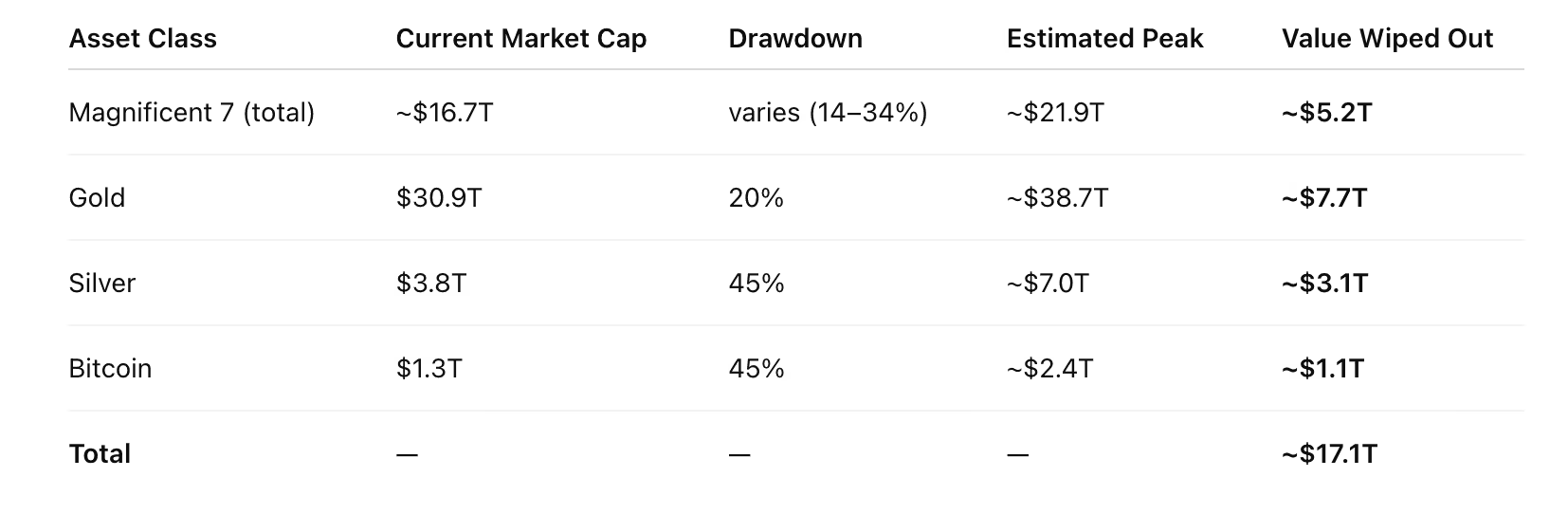
Bitcoin, Coinbase, Strategy, Gemini, Galaxy swept up in market rout

Anne Hathaway Gets Real About Body Insecurities Despite Ageless Appearance


-
 Crypto World7 days ago
NIO (NIO) Stock Plunges 6.5% as Shelf Registration Sparks Dilution Worries
-
 NewsBeat2 days ago
Manchester United reach agreement with Casemiro over contract clause amid transfer speculation
-

 Fashion7 days ago
Weekend Open Thread: Adidas – Corporette.com
-

 Politics7 days ago
Jenni Murray, Long-Serving Woman’s Hour Presenter, Dies Aged 75
-

 Crypto World6 days ago
Best Crypto to Buy Now: Strategy Just Spent $1.57 Billion on Bitcoin During Fear While Early Investors Quietly Enter Pepeto for 150x Potential
-

 Crypto World6 days ago
Bitcoin Price News: Bhutan Sells $72 Million in BTC Under Fiscal Pressure, but the Smart Money Entering Pepeto Sees What the Market Does Not
-

 News Videos2 days ago
Parliament publishes latest register of MPs’ financial interests
-

 Sports4 days ago
Remo Stars and Kano Pillars Strengthen Survival Hopes in NPFL
-

 Sports4 days ago
Gary Kirsten Accuses Pakistan Cricket Board Of ‘Interference’, Mohsin Naqvi Responds
-

 Business5 days ago
No Winner in March 21 Drawing as Prize Rolls to $133 Million for Next
-

 Tech5 days ago
Give Your Phone a Huge (and Free) Upgrade by Switching to Another Keyboard
-

 Sports7 days ago
2026 Kentucky Derby horses, odds, futures, preview, date: Expert who nailed 12 Derby-Oaks Doubles enters picks
-

 Tech5 days ago
AI enters the chat: New Seattle dating app relies on tech to facilitate meaningful human connections
-

 News Videos4 days ago
Ch 9 Financial Management Part 1 | Detailed One Shot | Class 12 Business Studies Boards 2026
-
Business7 days ago
Columbia Sportswear enters $500 million credit agreement with JPMorgan Chase
-

 Tech6 days ago
Today’s NYT Connections Hints, Answers for March 22 #1015
-

 Business19 hours ago
Instagram, YouTube Found Responsible for Teen’s Mental Health Struggle in Historic Ruling
-
 Crypto World7 days ago
Small-cap Russell 2000 enters correction territory
-

 Business5 days ago
Will Duke Basketball Win It All? Duke Basketball Enters Second Round as Third Favorite to Claim NCAA Title
-

 Sports4 days ago
2026 Kentucky Derby horses, odds, futures, preview, date: Expert who hit 12 Derby-Oaks Doubles enters picks
You must be logged in to post a comment Login