

Business
Micron Stock Plunges Nearly 10% as Global Memory Chip Selloff Deepens Amid CXMT Threat Worldwide


Micron Technology shares tumbled sharply Tuesday, falling 9.96% to $810.55, losing $89.65 as a deepening global selloff in memory chip stocks continued to hammer the sector amid growing concerns about Chinese competition and cooling AI infrastructure spending sentiment.
The decline extends a brutal stretch for Micron shares, which had already fallen more than 10% in the prior session, marking one of the steepest two-day drops the stock has experienced this year despite the company’s continued strong underlying financial performance.
A Broad Selloff Across the Memory Sector
Micron’s decline was far from an isolated event, with virtually every major memory chip manufacturer facing similar pressure Tuesday. Major global memory giants generally slumped in pre-market trading, including Western Digital, SanDisk, Seagate and SK Hynix, all of which recorded losses ranging from 4% to 6%, indicating that capital was fleeing the entire memory chip sector rather than reacting to any single company’s news.
The pressure originated overnight in Asian markets before spreading to U.S. trading. Japanese and South Korean stock markets suffered another heavy blow during the early Asian session, with Samsung falling more than 7% and SK Hynix dropping over 9%, while South Korea’s Kospi index fell sharply and triggered a trading halt as selling pressure intensified.
China’s Growing DRAM Ambitions Weigh on Sentiment
A central driver behind the selloff has been growing investor anxiety about how quickly Chinese memory manufacturers could scale up production and challenge established players like Micron. Micron shares slipped as new competition from CXMT heightened concerns over DRAM price pressure, following the Chinese chipmaker’s blockbuster Shanghai stock market debut a day earlier, in which shares closed up 466% from their offer price after the company raised approximately $8.6 billion in Asia’s largest initial public offering of 2026.
That IPO valued CXMT at close to $488 billion, providing the company with significant fresh capital for further expansion. Analysts say CXMT remains about one generation behind top memory makers, and continued U.S. export restrictions on cutting-edge manufacturing tools are expected to limit how quickly the company can catch up, particularly in high-bandwidth memory used for AI applications, even as it poses a more immediate threat in standard commodity DRAM.
Investors Reassessing the Durability of the AI Memory Boom
Beyond the direct competitive threat from China, Tuesday’s selloff also reflects a broader reassessment among investors of how sustainable the extraordinary rally in memory stocks has been this year. Micron remains one of the biggest beneficiaries of the AI memory boom, but recent price action suggests investors are reassessing how long strong high-bandwidth memory demand, pricing power and hyperscaler spending can sustain the sector’s rally.
Analysts have also pointed to reports of Chinese progress in deep ultraviolet lithography technology as adding to the uncertainty. Deutsche Bank strategist Jim Reid told the Financial Times that renewed worries over AI infrastructure spending and lower-cost Chinese competition triggered another wave of selling across global semiconductor stocks.
Record Quarterly Results Failed to Halt the Slide
Notably, Tuesday’s decline comes despite Micron having recently reported some of the strongest financial results in its history, underscoring how disconnected near-term stock price action has become from the company’s underlying business performance. Micron’s fiscal third-quarter revenue stood at $41.46 billion, with GAAP net income of $28.24 billion, while gross margin increased to 85%. Chief Executive Sanjay Mehrotra described the results as reflecting “the strategic value of memory in the AI era.”
A Company Executive’s Perspective on the Competitive Threat
Industry analysts covering Micron have suggested that the near-term stock reaction to CXMT’s rise may be overstating the actual competitive risk facing the company in the near term. For Micron shareholders, the scale-up of CXMT’s production is viewed by some analysts as more significant for its long-term implications than its initial valuation suggests, with Monday’s decline in shares anticipating a future increase in supply rather than signaling any immediate drop in current memory supply tightness.
Macroeconomic Pressures Add to the Selling
Beyond the chip-specific concerns, broader macroeconomic factors have also contributed to the pressure on high-valuation technology stocks like Micron in recent sessions. A stronger-than-expected inflation reading has reignited fears of a more restrictive monetary policy stance from the Federal Reserve, which disproportionately affects high-beta technology stocks. As yields on longer-dated bonds have moved higher, the present value of future cash flows for capital-intensive companies like Micron is being discounted more aggressively by investors.
A Valuation Under Scrutiny
Some market analysts have also pointed to Micron’s elevated valuation multiples as making the stock particularly vulnerable to this kind of sentiment-driven pullback. Micron trades at a price-to-earnings ratio around 27, which is considered rich compared with historical memory-sector cycles, reflecting how the market has been pricing the company as an AI infrastructure winner, with a price-to-sales ratio near 15. When AI enthusiasm cools, analysts note, that kind of premium multiple tends to be exactly what traders target first.
Wall Street Analysts Remain Broadly Bullish Despite the Selloff
Even amid the sharp pullback, several major Wall Street firms have maintained highly positive ratings and price targets on Micron stock in recent weeks. KeyBanc maintained an Overweight rating and raised its price target to $1,750 on July 14, while Cantor Fitzgerald raised its price target to $2,000 on June 29 after previously maintaining a $1,500 target in late June, both well above Micron’s current trading levels even after Tuesday’s decline.
A Pivotal Week Ahead for AI Spending Signals
Investors are looking to a series of upcoming events this week that could help clarify whether the current selloff reflects a temporary overreaction or a more durable shift in sentiment toward AI-related stocks. The Federal Reserve holds its policy meeting July 28-29, with a decision due Wednesday afternoon, while earnings from Microsoft, Meta, Amazon and Apple are also expected this week, with their capital expenditure plans likely to influence projections for AI-related memory demand going forward.
With Micron continuing to trade well above both its 100-day and 200-day moving averages despite the recent correction, some analysts maintain that the stock’s longer-term uptrend remains intact even amid the sharp near-term volatility. Whether Tuesday’s selloff proves to be a lasting reassessment of the AI memory trade or a temporary pullback within a longer bull run is likely to become clearer in the coming days, as this week’s Federal Reserve decision and major technology earnings reports offer further signals about the durability of AI-driven infrastructure spending heading into the second half of 2026.


TDAQ: The New Kid On The Nasdaq Block

Check out whats clicking on FoxBusiness.com.
Johnson & Johnson (J&J) on Monday said it reached a settlement that it would pay an estimated $5.5 billion to settle tens of thousands of lawsuits alleging its baby powder and talc products cause ovarian cancer, which could end years of litigation on the subject.
The company said the proposed settlement would cover about 76,000 claims – including those that have been consolidated in federal court in New Jersey and related cases in state court – to cover nearly all the outstanding claims against J&J.
J&J previously settled most of the cases alleging its talc contained asbestos and caused mesothelioma.
The deal was confirmed by plaintiffs’ law firms on Monday, saying it was a good resolution after a decade-long court battle. The deal has to be accepted by 95% of the ovarian cancer claimants in state or federal court before it becomes final.
JOHNSON & JOHNSON CEO CREDITS TRUMP TAX POLICY FOR $55B US INVESTMENT PUSH, INCLUDING $1B IN FLORIDA
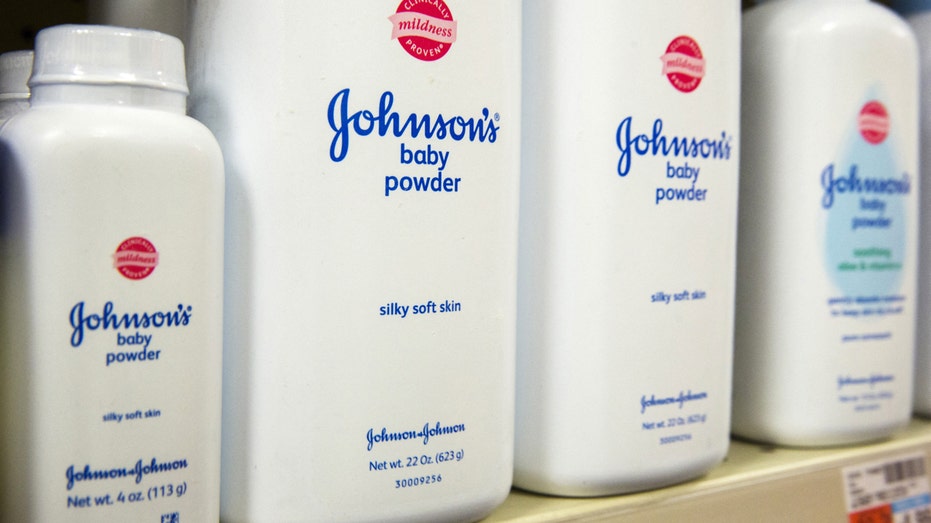
Johnson & Johnson announced a deal to settle talc powder lawsuits. (Lucas Jackson/Reuters)
J&J denied wrongdoing in its announcement of the settlement, saying that the plaintiffs weren’t able to prove their claims that the talc products caused cancer cases and that the settlement is a way of efficiently ending the litigation.
“While we are confident the company would ultimately have prevailed with further litigation, as it has in the vast majority of cases tried to date, this resolution allows the company to put this matter behind it and remain focused on its mission to develop medicines and devices that save lives,” said Erik Haas, worldwide VP of litigation at Johnson & Johnson.
The company expects to pay out $3 billion in 2027 and make further payments in 2028, though the deal could be worth more depending on how many people participate in the settlement.
JOHNSON & JOHNSON TO INVEST $1B IN PENNSYLVANIA MANUFACTURING FACILITY
| Ticker | Security | Last | Change | Change % |
|---|---|---|---|---|
| JNJ | JOHNSON & JOHNSON | 266.75 | +0.72 | +0.27% |
Chris Seeger, an attorney who represents about 2,500 clients with talc claims and helped negotiate the settlement, said J&J could ultimately pay $7 billion or more as the settlement doesn’t cap the total payout and rather assigns specific values to qualifying ovarian cancer claims.
Seeger told Reuters in an interview that the plaintiffs “got a fair settlement, and our clients are going to be happy with it.”
The settlement comes after J&J secured a series of courtroom victories, including in individual trials, moves to disqualify plaintiffs’ lawyers and rulings against experts used by plaintiffs. The company won a significant court victory last week when a federal judge cast doubt on individual plaintiffs’ ability to prove that talc specifically caused their ovarian cancer.
TEXAS AG SUES KENVUE, J&J OVER ‘DECEPTIVELY MARKETING’ TYLENOL TO PREGNANT WOMEN
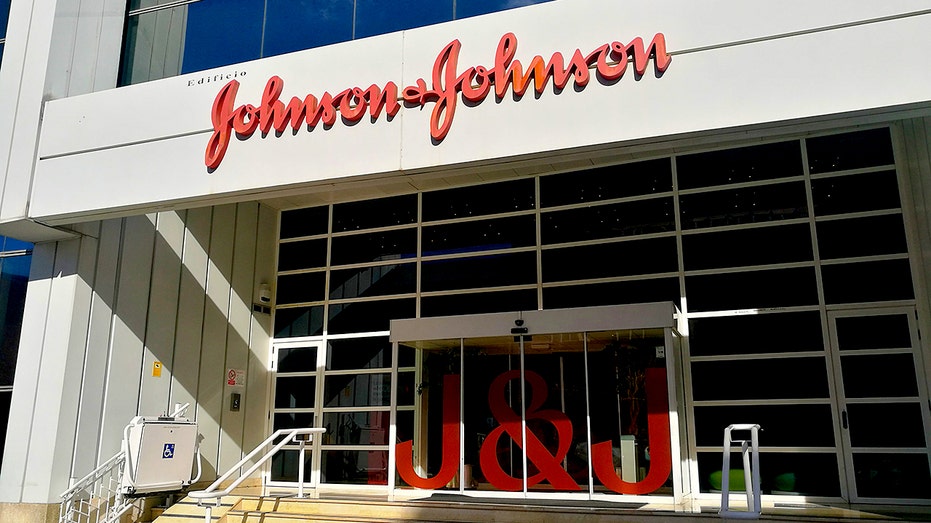
Johnson & Johnson has denied that its talc products caused cancer and said the settlement is a way to end the litigation. (Cristina Arias/Cover/Getty Images)
J&J has long denied that its talc products caused cancer, saying the products were safe and didn’t contain asbestos. It stopped selling talc-based baby powder in the U.S. in 2020 and switched to a cornstarch product.
The company attempted a legal strategy in which shell-company subsidiaries declared bankruptcy in an effort to settle the cases, though that proved unsuccessful.
It had a mixed record when talc cases went to trial, winning some outright and reducing verdicts on appeal, though it was hit with a multibillion-dollar verdict in a case brought by 22 women.
GET FOX BUSINESS ON THE GO BY CLICKING HERE
The new settlement only applies to existing claims and doesn’t address future lawsuits. The exclusion of future claims made more money available to current plaintiffs and also accelerated the payments so that all claims will be paid within 18 months instead of being spread out over more than a decade, Seeger said.
Reuters contributed to this report.
Aevex stock rises on $88.1M precision strike system orders


The base features dried rye sourdough to deliver flavor and aroma.

Rosecliff founder and managing partner Mike Murphy discusses the chip sell-off as he highlights the U.S. becoming less dependent on Taiwan for the technology.
Meta CEO Mark Zuckerberg wrote in a new op-ed published on Tuesday that the rise of artificial intelligence should be used to empower all people rather than being centralized and controlled by a few institutions.
Zuckerberg wrote in The Wall Street Journal that people will be able to use superintelligence beyond human capacities in the next few years to create and discover new things, as well as drive economic growth and create opportunities. He noted that contrasts with some of the rhetoric from AI developers, and argued that diffusing AI access and its power broadly will lead to a better outcome.
“It is surprising that the discourse from many of those who are developing artificial intelligence is so filled with doom. I don’t understand why anyone who believes that AI will eliminate most jobs and much of humanity’s relevance would rush to build that future,” he wrote.
“The notion that AI is so dangerous that the only safe path is an extreme concentration of power seems dangerous. Historically, hoping that an absolute power will benevolently provide for humanity if sufficiently enlightened hasn’t led to safe or positive outcomes,” Zuckerberg explained.
ZUCKERBERG SAYS AI SHOULD EMPOWER PEOPLE, NOT REPLACE THEM, IN NEW META VISION

Meta CEO Mark Zuckerbreg argued that AI should be diffused rather than concentrated in a few institutions. ( John Nacion/Variety via Getty Images)
Zuckerberg said that there have been many transformative advances in technology throughout history that have stoked fears it would leave people behind, and that ultimately people enjoyed more prosperity, health and freedom as those technologies progressed.
“Putting power in people’s hands to pursue their own aspirations is how humanity has made the most progress. Novel ideas and major steps forward rarely originate from established institutions alone,” he wrote.
Zuckerberg alluded to how massive technological developments for humanity like flight, electricity and personal computing were advanced by individuals without deep ties to institutions. He said that as “everyone gains more powerful tools, each person will become more capable of shaping the future, not less.”
AI INNOVATION IS OUTPACING GOVERNANCE, LEAVING COMPANIES EXPOSED, EQUALAI WARNS
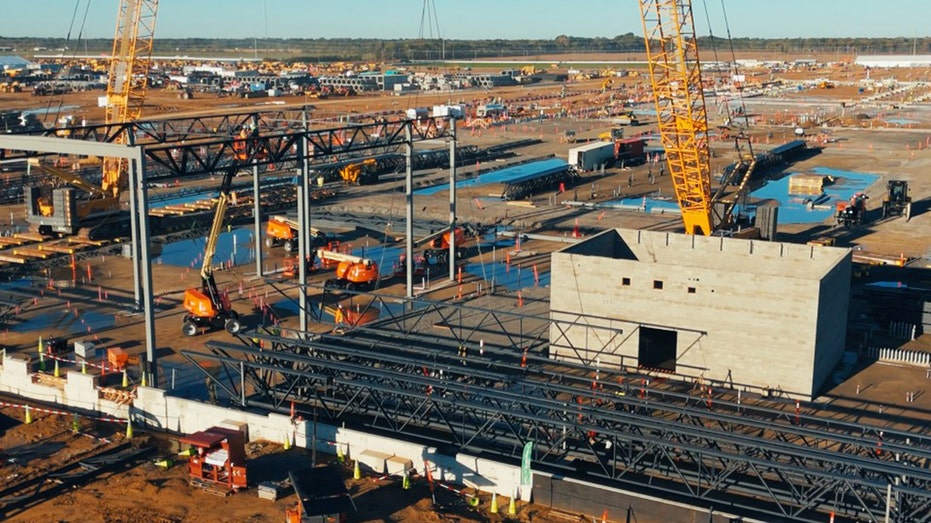
The rise of AI is leading to technological advances as well as investment in infrastructure, like new data centers. (Meta)
The Meta CEO acknowledged that there is a balance between the use of AI for automation and it being a tool that empowers innovation and enables people to expand skills and launch businesses, adding that if the balance leans toward automation it could have a negative impact on jobs and the economy.
“But if superintelligence is widely distributed, then I believe we will see more jobs in the future, not fewer. It will be significantly easier to start businesses without raising large amounts of capital.”
“I expect the economy will become more entrepreneurial with a greater number of people working at small businesses rather than larger companies,” he wrote.
PALANTIR CEO WARNS US AGAINST EUROPE’S AI REGULATION PATH, URGES TRUMP ADMIN TO NOT BAN OPEN MODELS

Zuckerberg said he thinks AI-powered superintelligence can bring about a positive future for humanity. (Reuters/Manuel Orbegozo)
Zuckerberg added that the development of superintelligence “will be the most profound technological advance we will see in our lifetimes.”
“Meta is committed to building with the principles of individual empowerment, invention and balance of power. The arc of human history has bent toward putting more power in people’s hands.”
“If these values lead the way, then I am optimistic that we can build a positive future for everyone,” he wrote.

eBay and some former executives have agreed to pay a couple $56m (£42m) after a campaign of harassment in retaliation for their online criticism of the firm.
In a statement on Tuesday, David and Ina Steiner, said they and eBay had reached a settlement stemming from the 2019 harassment they faced at the hands of several of the company’s executives, including eBay’s then chief executive.
The Steiners ran a website and newsletter EcommerceBytes that was at times critical of eBay.
A group of now former company executives ultimately pleaded guilty to sending the couple a costume mask covered in pigs blood, a book on surviving the death of a spouse, among other threatening actions.
Other actions, external perpetrated against the Steiners included eBay executives sending them a funeral wreath and harassing messages on Twitter (the social media platform now known as X). Some even paid visits to the couple’s Massachusetts home in a bid to install a tracking device on their car.
Seven former eBay executives pleaded guilty, external to the criminal charges between 2022 and 2024, according to the U.S. Department of Justice.
An FBI agent involved in the investigation said in 2024 that the former executives’ actions were an “unprecedented, relentless, and over-the-top harassment campaign”.
eBay was also criminally charged and entered into a deferred prosecution agreement with the DOJ and agreed to pay a fine of $3m.
While eBay is paying the couple the bulk of the settlement, including $6m to “various non-profit organizations”, Wenig is personally paying $1m toward the settlement.
Wenig left eBay in 2019. The same year, he had sent another eBay executive a text message regarding Ina Steiner which said: “Take her down.”
His contribution is set to go to an unnamed charity that is “dedicated to protecting First Amendment rights” and will be gifted in the name of Ina Steiner, according to the couple’s lawyers.
The First Amendment of the U.S. Constitution protects the right to freedom of speech.
Christopher Murphy of Scalli Murphy Law PC, which represented the Steiners in the case, said on Tuesday: “We believe this resolution sends a clear message that corporations and their executives cannot engage in this type of misconduct without facing significant consequences.”
eBay said: “What the Steiners were subjected to by former eBay employees in 2019 was wrong, reprehensible and should never have happened.”
The company condemned the former employees who ended up pleading guilty to criminal charges that led to the civil lawsuit, and admitted to an “unprofessional tone in internal communications”.
“This agreement is consistent with our commitment to fairly compensate the Steiners and fulfills our efforts to make things right,” eBay said on Tuesday.
Business
Kelly Ripa Sidelined by Painful Gum Graft Surgery, Husband Mark Consuelos Says She Can’t Talk This Week

Kelly Ripa’s painful dental surgery has sidelined the daytime TV staple, forcing the famously chatty host into an unusual recovery that has left her unable to speak, according to husband and co-host Mark Consuelos.
During Monday’s episode of “Live with Kelly and Mark,” Consuelos revealed that Ripa had undergone gum graft surgery, explaining the procedure to guest Nick Jonas while filling in for his wife on air.
Consuelos Breaks the News on Air
Consuelos delivered the update directly to viewers and their guest during the broadcast, making clear the procedure was more significant than it might sound. “Kelly sends her love,” Consuelos told Jonas. “Kelly had a little bit — well, it’s not a little — she had a gum graft surgery.”
Gum graft surgery typically helps correct thinning or receding gums, according to the Cleveland Clinic. Consuelos indicated the procedure wasn’t a sudden decision, revealing that Ripa’s dentist had actually recommended it years earlier.
According to Consuelos, Ripa had been advised to undergo the surgery long before she finally went through with it, and had even joked about the timeline when the recommendation was first made. “Her dentist said five years ago, ‘You can do it in about five years,’” Consuelos recalled. “And she joked, ‘I didn’t think I’d still be on the air in five years!’”
An Unusual Recovery for the Chatty Host
Perhaps the most notable detail Consuelos shared was that Ripa’s recovery process requires her to avoid talking altogether, a significant challenge for someone whose career centers on conversation. Jonas found the situation amusing given Ripa’s on-air persona. “Wow. That’s got to be the hardest thing she’s ever done,” Jonas joked.
Consuelos, describing his wife as “such a great conversationalist,” suggested he was having some difficulty ensuring she actually follows her doctor’s instructions during the recovery period. “I’m trying to keep her to follow the rules, follow the directions,” he said.
Keeping an Eye on the Healing Process
Beyond simply staying quiet, Consuelos also described the challenge of managing Ripa’s curiosity about her own healing progress at home, saying the hardest part of her recovery wasn’t the physical pain but keeping her from constantly checking on the surgical site. “Last night she was like, ‘Can you look?’ I’m like, ‘I’m not pulling your lip down,’” Consuelos said, describing how Ripa instead positioned herself so he could check without touching her lip directly. “So I’m down there like, ‘It looks great!’”
A Surgery Notable for How Much It Hurt
What made this particular procedure stand out, according to Consuelos, was how unusual it was for Ripa to acknowledge being in real pain, given her typical tolerance for discomfort at the dentist. “Yeah, it’s painful,” he told Jonas. “But she famously doesn’t feel pain. When she goes into the dentist, she doesn’t use the novocaine. But this one hurts, so I know it’s bad.”
A Tangent on Pain Tolerance
Ripa’s reputation for shrugging off pain led to a broader conversation between Consuelos and Jonas about pain tolerance more generally, with Jonas noting his own wife, singer and actress Danielle Jonas, shares a similar tendency to downplay discomfort. “I’ll be like, ‘Are you in pain?’ She’s like, ‘I’m fine!’ Come to find out her foot’s, like, falling off,” Jonas joked. Consuelos offered his own theory for the pattern, pointing to childbirth as a broader example. “Well, they do have kids. They deliver kids,” Consuelos added. “We’re not built for that.”
Ripa’s absence from the show is expected to extend beyond just a day or two as she completes her recovery. Ripa is not expected to return to “Live” for the next week, a representative for the show confirmed to People.
A Long-Running Partnership on Daytime TV
Ripa and Consuelos have co-hosted “Live with Kelly and Mark” together since 2023, continuing a franchise that has been a fixture of daytime television for decades under various co-host pairings. The married couple, who have been together for more than two decades, have built much of their on-air chemistry around exactly the kind of candid, personal banter that characterized Monday’s discussion of Ripa’s surgery and recovery.
Not the First Health Detail Ripa Has Shared Publicly
This isn’t the first time Ripa’s health and personal medical decisions have become a topic of public discussion on the show or in interviews. Ripa has previously spoken openly about other health and cosmetic choices in interviews, part of a broader pattern of candor that has become a hallmark of her on-air persona and contributed to her reputation as an unusually open daytime television personality.
With Ripa expected to remain off the air for roughly a week while she completes her recovery from the gum graft procedure, Consuelos is likely to continue hosting alongside guest co-hosts or additional appearances from friends of the show during her absence. Fans of the program can expect Ripa to return to her usual on-air banter once her doctor clears her to resume talking freely, with Monday’s segment offering a lighthearted, if unusually personal, glimpse into the couple’s home life during her recovery.

FBTC: Self-Custody Was The Pitch. Now There's A Backup Plan Nobody Explained
Business
Sanmina Stock Plunges 20% Despite Strong Earnings Beat as Revenue Guidance Disappoints Investors Today

Shares of Sanmina Corporation tumbled Tuesday morning, falling 20.50% to $166.15, wiping out $42.75 in value even after the electronics manufacturing company reported earnings that significantly beat Wall Street’s expectations for its fiscal third quarter.
The steep selloff highlights how sharply investor sentiment can turn on forward guidance, even when a company delivers a clear earnings beat on both the top and bottom lines.
A Clear Earnings Beat
Sanmina posted quarterly earnings results for its fiscal third quarter of 2026 on Monday, July 27, reporting earnings of $3.31 per share, beating estimates of $2.83 by 48 cents. Other analyst trackers put the size of the beat even larger, with the company topping consensus estimates of $2.77 by 54 cents per share, according to FiscalAI.
The company’s revenue performance was similarly strong relative to expectations. Sanmina reported revenue of $3.46 billion during the quarter, compared with analyst expectations of roughly $3.40 billion, representing year-on-year revenue growth of 69.7% and beating Wall Street’s estimates by 1.8%.
Impressive Underlying Growth Trends
Beyond simply beating estimates, Sanmina’s underlying earnings trajectory showed accelerating momentum heading into the report. In the quarter, Sanmina reported adjusted earnings per share of $3.31, up sharply from $1.53 in the same quarter a year earlier, with the company’s two-year annual earnings-per-share growth of 41.3% coming in higher than its five-year trend. Analysts noted that Sanmina’s optimistic earnings guidance for the next quarter also blew past expectations, and its adjusted operating income outperformed Wall Street’s estimates by a wide margin.
Where the Disappointment Came From
Despite those clear positives, one specific piece of forward-looking guidance appears to have driven Tuesday’s steep selloff. On the other hand, the company’s revenue guidance for the next quarter missed expectations, even as company management guided for a 64.6% year-on-year increase in sales for the coming quarter. Overall, analysts characterized the quarter as solid with some key areas of upside, but noted the market seemed to be hoping for even more, with the stock trading down 5.5% to $197.44 immediately after Monday’s report before extending losses further into Tuesday’s session.
Updated Full-Year Guidance
Alongside its third-quarter results, Sanmina also provided updated guidance for the current quarter and the full fiscal year. The company updated its fourth-quarter 2026 guidance to a range of $3.05 to $3.35 in earnings per share, and raised its full fiscal-year 2026 guidance to a range of $11.90 to $12.20 in earnings per share. Wall Street separately projected that Sanmina’s full-year earnings per share would grow 17.2%, from $10.52 to $12.33, over the next 12 months.
A Volatile Trading Session
Sanmina’s stock initially moved higher on Monday following the earnings release before reversing course as investors digested the guidance details more fully. SANM stock traded up 47 cents during midday trading on Monday, reaching $208.90, with a trading volume of roughly 1.2 million shares compared with its average volume of about 943,000 shares. That initial positive reaction gave way to the sharp decline that carried into Tuesday’s session, as investors focused increasingly on the revenue guidance shortfall rather than the substantial earnings beat.
A Pullback That Preceded the Earnings Report
Tuesday’s decline adds to a difficult recent stretch for Sanmina shares, which had already been retreating in the weeks leading up to the earnings report. Sanmina’s share price had pulled back over the past month, with a 30-day share price return down 16.4% heading into the report, even as the stock’s momentum over longer time horizons remained strong, highlighted by a year-to-date share price return of 26.7% and a five-year total shareholder return of more than four times the original investment.
Company Fundamentals and Valuation
Beyond the immediate earnings reaction, several other financial metrics offer context for how Sanmina’s business and valuation currently stand. The company reported a return on equity of 16.23% and a net margin of 2.29% for the quarter, along with a market capitalization of approximately $11.20 billion, a price-to-earnings ratio of 44.16, and a price-to-earnings-growth ratio of 0.80. The stock’s 52-week range spans from a low of $97.76 to a high of $288.68, reflecting substantial volatility even before Tuesday’s sharp move.
Insider Selling Activity
In the weeks leading up to the earnings report, several company insiders had also reduced their holdings in Sanmina stock, activity that some investors monitor closely for signals about management’s own confidence. Chief Financial Officer Jonathan P. Faust sold 10,076 shares of Sanmina stock on May 29, at an average price of $265.80, for a total transaction value of roughly $2.68 million, a sale that was executed under a pre-arranged Rule 10b5-1 trading plan and represented an 11.57% decrease in his overall ownership stake. Separately, Director David V. Hedley III sold 500 shares of the company’s stock on May 1 at an average price of $219.52.
Institutional Investor Activity
Ownership data also shows a broadly active institutional investor base around Sanmina’s stock heading into the earnings report, with positions moving in both directions across different funds. Roughly 245 institutional investors added shares of Sanmina stock to their portfolios in the most recent quarter tracked, while 208 institutional investors decreased their positions over the same period, reflecting a mixed but active level of engagement from large investors even before Tuesday’s sharp selloff.
With Sanmina’s updated full-year guidance now pointing toward continued earnings growth despite the revenue guidance shortfall that triggered Tuesday’s decline, investors will be watching closely in the coming quarters to see whether the company’s next-quarter sales materialize closer to its own more optimistic earnings outlook or continue to disappoint relative to Wall Street’s revenue expectations. Given how sharply the stock has moved on both the initial earnings beat and the subsequent guidance-driven selloff, Sanmina’s next several trading sessions are likely to remain closely watched as investors work to reconcile the company’s strong profitability trends with its more measured outlook for near-term sales growth.


I am a part-time investor interested in equities, ETFs, macro, and emerging markets.
Analyst’s Disclosure: I/we have no stock, option or similar derivative position in any of the companies mentioned, and no plans to initiate any such positions within the next 72 hours. I wrote this article myself, and it expresses my own opinions. I am not receiving compensation for it (other than from Seeking Alpha). I have no business relationship with any company whose stock is mentioned in this article.
Seeking Alpha’s Disclosure: Past performance is no guarantee of future results. No recommendation or advice is being given as to whether any investment is suitable for a particular investor. Any views or opinions expressed above may not reflect those of Seeking Alpha as a whole. Seeking Alpha is not a licensed securities dealer, broker or US investment adviser or investment bank. Our analysts are third party authors that include both professional investors and individual investors who may not be licensed or certified by any institute or regulatory body.

How much impact does the onboarding process have on job commitment?

Croda International issues results for half-year to June 30
3 Reasons Why Bitcoin Crashed to a 10-Day Low Today and What’s Next


-

 Fashion4 days ago
Weekend Open Thread: Brooks Brothers
-
 Business7 days ago
New Jersey voter registration controversy explained: How 6,600 noncitizens got on the rolls, and what happens next
-

 Tech2 days ago
Intel is reversing course and bringing hyper-threading back to its server chips
-
 Sports2 days ago
Commonwealth Games boxing: Jadumani Singh seals dominant 5-0 win over Pakistan’s Sumama Rehman to enter quarter-finals | Commonwealth Games News
-

 Crypto World6 days ago
Ethics, other provisions in crypto Clarity Act to be further discussed
-

 Politics1 day ago
Luke Littler dismantles Gerwyn Price to retain title in Blackpool
-

 Sports5 days ago
2026 3M Open leaderboard: Scottie Scheffler finds putter in Round 1, sits three back
-

 Fashion5 days ago
16 Dresses for the High Summer Event
-

 Politics13 hours ago
The Part of the Electric Transition Nobody Wants to Discuss
-

 News Videos2 days ago
BITCOIN JUST ENTERED THIS CRITICAL ZONE…
-

 News Videos5 days ago
The Peugeot Family: How 200 Years of an “Old Money” Dynasty Died in A Boardroom
-

 Politics2 days ago
Spain sweeps the board at 2026 World Cup with individual awards
-
 Entertainment4 days ago
A New Post-Apocalyptic Gundam Anime Series Blasts Into SDCC
-

 Crypto World3 days ago
Ripple bought a bank in pieces. The $4 billion audit
-

 Crypto World3 days ago
XRP Ledger adds $2.6B as RWA inflows rank second
-

 Crypto World5 days ago
Uniswap (UNI) pushes deeper into tokenized RWAs with permissioned trading pools
-

 Tech4 days ago
Anthropic launches Claude Opus 5, a cheaper AI model for coding, agents and enterprise workflows
-
 Entertainment3 hours ago
‘Stargate’ Creator’s New Sci-Fi Series Returns for Season 3 Tomorrow
-

 Entertainment3 days ago
Sara Gilson Killed By Husband After Viral “Pedophile” TikTok Video
-

 Crypto World7 days ago
Sablier Labs Enters Maintenance Mode, Halts Development
You must be logged in to post a comment Login