















The median Welsh built-up area has a population of only around 1,260.

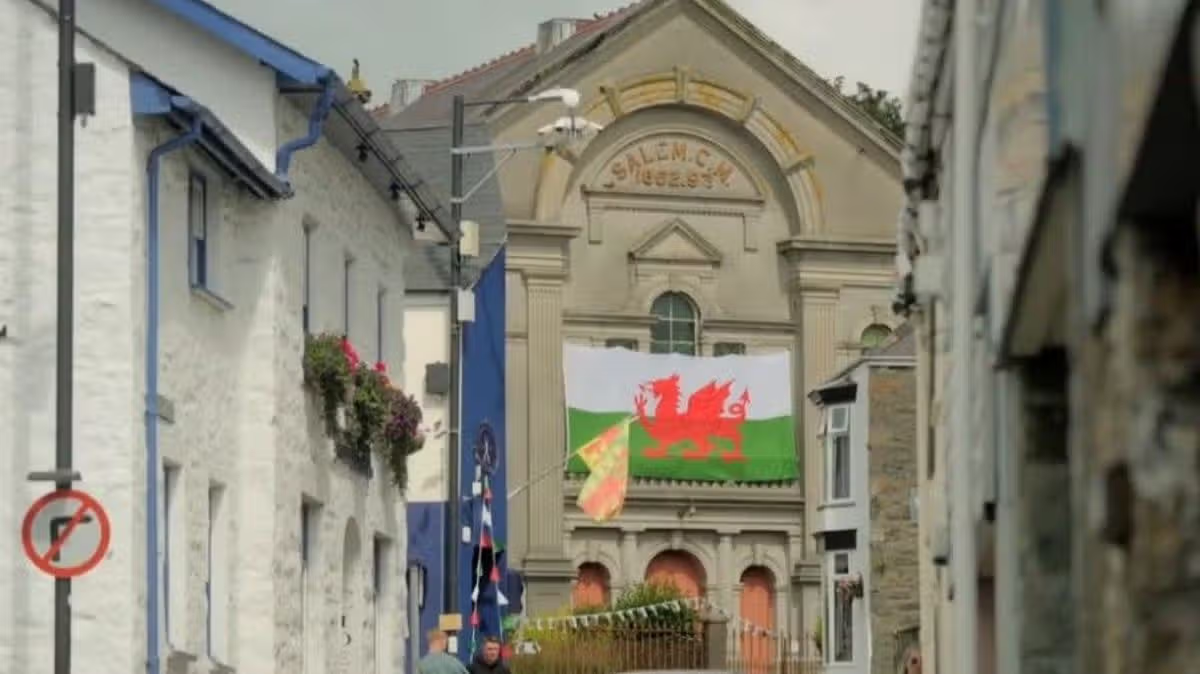
Pwllheli.(Image: Channel 4)
Every now and again, a statistic makes you see a familiar problem differently, and I had one of those moments earlier this month after reading an excellent American article entitled Most of America is a Small Town.
Its author had examined population data for nearly 20,000 incorporated places in the United States and discovered that the median community has just 1,153 residents.
Three-quarters have populations below 5,000, and almost half have fewer than 1,000; the argument wasn’t that America’s great cities don’t matter, but that much of the thinking around economic development was created for relatively large places when most communities are actually very small. As someone brought up in Pwllheli in North Wales, it resonated with me, especially given how the town has been neglected in recent years.
That got me wondering what the equivalent figure would be for Wales, and according to the Office for National Statistics, Wales has 579 built-up areas. These are useful because they represent actual settlements (the cities, towns and villages where people live) rather than artificial administrative boundaries and together they account for 88% of the Welsh population.
When those settlements are examined, the result is striking and the median Welsh built-up area has a population of only around 1,260. Some 252 have fewer than 1,000 residents and more than four out of five have fewer than 5,000. At the other end of the scale, only a handful of Welsh settlements have populations greater than 50,000. Cardiff, with 348,535 residents in the 2021 census, is in a completely different league from most of the country.
In other words, most of Wales really is a small town and that may sound like nothing more than an interesting statistical observation, but I think it raises an important question about how we have organised economic development.
For the last two decades, there has been a steady movement towards ever larger economic geographies, and we have city regions, growth deals, regional economic frameworks and, more recently, corporate joint committees. There are perfectly sensible reasons for this, as transport systems, labour markets, universities and major industrial clusters do not fit neatly within council boundaries.
If Wales wants to attract major international investment or develop industries such as compound semiconductors and renewable energy, then regional and national approaches are essential.
But in doing so, have we moved too far away from the places where economic activity actually happens? A business does not expand in an economic region but in a town. When a manufacturer runs out of factory space, it needs another building somewhere close enough to retain its workforce and if a company employing 50 people closes in a community of 5,000, that is a major economic shock regardless of how insignificant those jobs might appear within the larger region.
We spend money bringing empty buildings back into use, improving town centres and creating better public spaces, but those things are not the same as developing the local economy. Real economic development means knowing which businesses in a town are growing, which are thinking about expanding, which are struggling to recruit and which may be considering leaving.
Above all, it means regularly talking to the firms already employing people and this was one of the most persuasive arguments in the American article. For most small communities, the biggest economic-development victory will not be attracting a huge company from somewhere else. It will be helping an existing business employing 20 people become one employing 30 or preventing another established employer from leaving because it cannot find suitable premises.
That should resonate strongly in Wales as we have tens of thousands of small firms spread across the country, and while individually they may not generate ministerial visits or headline-grabbing announcements, collectively they form the foundation of local prosperity.
What would happen if every significant Welsh town had somebody whose responsibility was simply to know its economy properly? Not another bureaucracy and certainly not another strategy, and in smaller areas, several towns could share the resource. Their job would be to speak regularly to local employers, understand which businesses had growth potential, maintain a live picture of available property and land and connect companies with finance, colleges, universities and business support.
It is hardly revolutionary and indeed, that is perhaps the point. We have created an increasingly complicated economic-development system in Wales, but sometimes the most useful interventions are remarkably straightforward.
A local manufacturer tells somebody it needs six skilled workers so that person speaks to the college, a growing company says it will have to leave because there is nowhere to expand so somebody identifies a suitable building nearby, and a 65-year-old business owner admits they are thinking about closing so somebody starts a conversation about succession before the redundancy notices appear.
Nor would this require a huge new pot of money as Wales has £546.5m available through the Local Growth Fund over the next three years, including more than £156m for innovation and business competitiveness. A network of 50 town business growth managers would cost around £3m a year or less than 2% of the overall Fund and could cover roughly 125 of our larger towns.
For that relatively modest sum, virtually every significant Welsh community could have someone whose job was not to write another strategy, but to know its businesses, identify those capable of growth and help remove the obstacles holding them back.
Of course, Wales should be developing globally competitive industries, attracting investment and supporting businesses capable of rapid growth but that does not mean ignoring the economic geography of the country we actually have.
Most of Wales is a small town, andEvery now and again, a statistic makes you see a familiar problem differently, and I had one of those moments earlier this month after reading an excellent American article entitled Most of America is a Small Town.
Its author had examined population data for nearly 20,000 incorporated places in the United States and discovered that the median community has just 1,153 residents.
Three-quarters have populations below 5,000, and almost half have fewer than 1,000; the argument wasn’t that America’s great cities don’t matter, but that much of the thinking around economic development was created for relatively large places when most communities are actually very small. As someone brought up in Pwllheli in North Wales, it resonated with me, especially given how the town has been neglected in recent years.
That got me wondering what the equivalent figure would be for Wales, and according to the Office for National Statistics, Wales has 579 built-up areas. These are useful because they represent actual settlements (the cities, towns and villages where people live) rather than artificial administrative boundaries and together they account for 88% of the Welsh population.
When those settlements are examined, the result is striking and the median Welsh built-up area has a population of only around 1,260. Some 252 have fewer than 1,000 residents and more than four out of five have fewer than 5,000. At the other end of the scale, only a handful of Welsh settlements have populations greater than 50,000. Cardiff, with 348,535 residents in the 2021 census, is in a completely different league from most of the country.
In other words, most of Wales really is a small town and that may sound like nothing more than an interesting statistical observation, but I think it raises an important question about how we have organised economic development.
For the last two decades, there has been a steady movement towards ever larger economic geographies, and we have city regions, growth deals, regional economic frameworks and, more recently, corporate joint committees. There are perfectly sensible reasons for this, as transport systems, labour markets, universities and major industrial clusters do not fit neatly within council boundaries.
If Wales wants to attract major international investment or develop industries such as compound semiconductors and renewable energy, then regional and national approaches are essential.
But in doing so, have we moved too far away from the places where economic activity actually happens? A business does not expand in an economic region but in a town. When a manufacturer runs out of factory space, it needs another building somewhere close enough to retain its workforce and if a company employing 50 people closes in a community of 5,000, that is a major economic shock regardless of how insignificant those jobs might appear within the larger region.
We spend money bringing empty buildings back into use, improving town centres and creating better public spaces, but those things are not the same as developing the local economy. Real economic development means knowing which businesses in a town are growing, which are thinking about expanding, which are struggling to recruit and which may be considering leaving.
Above all, it means regularly talking to the firms already employing people and this was one of the most persuasive arguments in the American article. For most small communities, the biggest economic-development victory will not be attracting a huge company from somewhere else. It will be helping an existing business employing 20 people become one employing 30 or preventing another established employer from leaving because it cannot find suitable premises.
That should resonate strongly in Wales as we have tens of thousands of small firms spread across the country, and while individually they may not generate ministerial visits or headline-grabbing announcements, collectively they form the foundation of local prosperity.
What would happen if every significant Welsh town had somebody whose responsibility was simply to know its economy properly? Not another bureaucracy and certainly not another strategy, and in smaller areas, several towns could share the resource. Their job would be to speak regularly to local employers, understand which businesses had growth potential, maintain a live picture of available property and land and connect companies with finance, colleges, universities and business support.
It is hardly revolutionary and indeed, that is perhaps the point. We have created an increasingly complicated economic-development system in Wales, but sometimes the most useful interventions are remarkably straightforward. A local manufacturer tells somebody it needs six skilled workers so that person speaks to the college, a growing company says it will have to leave because there is nowhere to expand so somebody identifies a suitable building nearby, and a 65-year-old business owner admits they are thinking about closing so somebody starts a conversation about succession before the redundancy notices appear.
Nor would this require a huge new pot of money as Wales has £546.5m available through the Local Growth Fund over the next three years, including more than £156m for innovation and business competitiveness. A network of 50 town business growth managers would cost around £3m a year or less than 2% of the overall Fund and could cover roughly 125 of our larger towns.
For that relatively modest sum, virtually every significant Welsh community could have someone whose job was not to write another strategy, but to know its businesses, identify those capable of growth and help remove the obstacles holding them back.
Of course, Wales should be developing globally competitive industries, attracting investment and supporting businesses capable of rapid growth but that does not mean ignoring the economic geography of the country we actually have. Most of Wales is a small town, and it might be time we started developing our economy from the town upwards rather than always from the region downwards.












































You must be logged in to post a comment Login