






Connect with us
DAPA Banner
DAPA Coin
DAPA
COIN PAYMENT ASSET
PRIVACY · BLOCKDAG · HOMOMORPHIC ENCRYPTION · RUST
ElGamal Encrypted MINE DAPA
🚫 GENESIS SOLD OUT
DAPAPAY COMING

Business

MongoDB: Atlas And AI Keep The Growth Story Alive

Published

on

MongoDB: Atlas And AI Keep The Growth Story Alive
Continue Reading
Click to comment

You must be logged in to post a comment Login

Leave a Reply

Business

RFBL Flexi Pack fixes price band at Rs 47-50 for IPO, to hit markets on May 12

Published

on

RFBL Flexi Pack fixes price band at Rs 47-50 for IPO, to hit markets on May 12
Flexible packaging materials manufacturer RFBL Flexi Pack Ltd on Saturday announced a price band of Rs 47-50 per equity share for its initial public offering, which opens for subscription on May 12.

The Rs 35.32-crore IPO of the Gujarat-based manufacturer and trader of printed multilayer flexible packaging materials comprises a fresh issue of up to 70,65,000 equity shares of face value Rs 10 each, the company said in a statement.

The issue will open for subscription on Tuesday, May 12, 2026, and will close on Thursday, May 14, 2026, on the NSE SME platform. The anchor investor bidding will open on Monday, May 11, 2026.

RFBL Flexi Pack Ltd intends to utilise Rs 35 crore of the IPO proceeds for repayment/ prepayment, in full or part, of all or a portion of certain borrowings availed by the company, while the remaining funds will be used for general corporate purposes and issue expenses, according to the offer document.

Advertisement

The company is engaged in the manufacturing and trading of printed multilayer flexible packaging materials such as plastic film rolls and pouches used across diverse industries including food, pharmaceuticals, home care, and consumer products.


Grow House Wealth Management Pvt.Ltd. is the Book Running Lead Manager (BRLM) to the Issue, while Kfin Technologies Ltd is the Registrar to the Issue.

Continue Reading

Business

Traders looking for next leg in global stocks rally bet on Asia

Published

on

Traders looking for next leg in global stocks rally bet on Asia
As the focus moves away from the Iran war, investors and strategists alike are looking for the next leg up in equities. Many are turning to Asia.

Shares in South Korea and Taiwan have rallied the most in the world this month, with the surge in the Kospi index taking it up 78% for the year. The two markets have been key beneficiaries of the euphoria surrounding artificial intelligence, thanks to the growing dominance of giants Samsung Electronics Co., SK Hynix Inc. and Taiwan Semiconductor Manufacturing Co.

Equity-derivatives strategists are increasingly recommending trades to bet on more gains, just as traders chasing the rally push up the cost of options. The result: Implied volatility for stocks in Taiwan and Korea is rising along with those markets. It’s now hovering around peak levels versus the S&P 500 Index for both the Taiex and the Kospi 200 Index, with the Cboe Volatility Index sinking back below its one-year average.

“The strength of the move is producing extreme reversals from prior trends,” said Jun Gyun, a derivatives analyst at Samsung Securities Co., referring to the Korean market. That’s creating the “vol up, spot up” pattern, which could last for “some time, until a period of consolidation emerges,” he added.

Advertisement
814x-1 (2)ETMarkets.com

Korean shares have been so in demand that Interactive Brokers Group Inc. started giving US retail investors direct access to the market. Meanwhile, the assets under management for leveraged exchange-traded funds have surged to a peak, and they’re likely to grow further as authorities have approved the local listing of those for single stocks, according to a recent JPMorgan Chase & Co. report that said the products keep the risk of “flow-driven overshoots alive.”
Samsung Securities’ Jun sees long-gamma strategies tied to rising volatility as favourable for Korean equities in the near term. Looking out three months or longer, he says traders should consider building short-gamma exposure in anticipation of a volatility peak.
At Societe Generale SA, strategists noted that the 12‑month variance spread between the Kospi 200 and S&P 500 has reached extreme levels. Yet a meaningful reversal would need a “more benign” oil and geopolitical environment and a pause in the tech rally, conditions they don’t see happening in an “orderly manner” now, they wrote in a report where they said they don’t advise positioning for this scenario.

814x-1 (1)ETMarkets.com

Meanwhile, JPMorgan strategists recommended bullish structures on the iShares MSCI Emerging Markets ETF, expecting the equities to continue to outperform given the AI theme, a more supportive macro backdrop and strong fundamentals. Ahead of the upcoming summit between Presidents Donald Trump and Xi Jinping, where AI policies are poised to be key points, investors boosted bullish positioning in US-traded Chinese ETFs, buying call spreads on the iShares China Large-Cap ETF and calls on the KraneShares CSI China Internet ETF.

Separately, JPMorgan strategists led by Tony Lee advised call spreads on the Taiex or worst-of calls on the Taiwanese gauge, the Kospi 200 and Japan’s Nikkei-225 Stock Average to bet on the AI hardware rally.

814x-1ETMarkets.com

“US large-cap tech, Korean memory and component suppliers, and Taiwan’s semiconductor ecosystem are all showing the same pattern — earnings delivery remains strongest where exposure to AI hardware bottlenecks is highest,” the strategists wrote in a note. “Hardware remains the earnings backbone of the AI theme, and Taiwan remains its most efficient index level proxy.”

Continue Reading

Business

2026 market turmoil? These 10 classic investing rules still hold the key

Published

on

2026 market turmoil? These 10 classic investing rules still hold the key
In today’s financial landscape, investors are navigating a complex mix of rising geopolitical tensions, elevated crude oil prices, uncertain interest rate trajectories, and sharp swings in global equities. While markets may appear unpredictable, history suggests otherwise. Veteran market strategist Bob Farrell’s timeless investing rules offer a powerful framework for interpreting and navigating such phases.

Originally formulated decades ago, these rules remain strikingly relevant because they are rooted in human behavior, market cycles, and sentiment dynamics — all of which remain unchanged.

1. Markets Always Revert to the Mean

Farrell’s first rule emphasizes that markets eventually return to their long-term average.

Advertisement

In today’s context, several sectors—especially those linked to AI, defence, and select PSU themes—have seen sharp rallies. However, history suggests that overextended valuations tend to normalize, often catching late entrants off guard.

For Indian investors, this is a reminder:

Strong rallies are not permanent trends—they are phases.

2. Excesses Lead to Opposite Excesses

Markets behave like a pendulum—overshooting in both directions.
The recent surge in oil prices due to geopolitical tensions has led to panic in equity markets. But just as euphoria drives prices irrationally higher, fear can push them below fair value, creating opportunities.Smart investors recognize both extremes.

Advertisement

3. There Are No “New Eras”

Every cycle comes with a narrative—“this time is different.” Farrell strongly disagreed.

Whether it was the dot-com bubble, crypto mania, or today’s AI boom, speculative excesses never last forever. The current enthusiasm around new-age technologies may persist, but valuations will eventually align with fundamentals.

4. Sharp Rises Lead to Sharp Corrections

Markets don’t correct gently—they correct decisively.

Advertisement

The recent volatility seen in global and Indian markets—sharp intraday falls followed by quick recoveries—is a classic reflection of this rule. In such conditions, risk management becomes more important than return maximization.

5. The Crowd Gets It Wrong at Extremes

Retail investors tend to buy at market tops and sell at bottoms.

With social media, WhatsApp tips, and TV narratives influencing decisions, this behavior has only intensified. The surge in retail participation in India is positive—but it also increases the risk of herd-driven mistakes.

A contrarian mindset often delivers better long-term results.

Advertisement

6. Fear and Greed Drive Markets

Emotions overpower logic in investing.

Today’s market reflects both extremes:

Greed during sectoral rallies (PSUs, defence, railways earlier)
Fear during global uncertainty (oil shocks, war risks)

Advertisement

Successful investors are those who follow discipline over emotion.

7. Strong Markets Are Broad-Based

When only a few stocks drive the index, the market is weaker than it appears.

Currently, while headline indices may look stable, broader participation—especially in midcaps and small caps—has been uneven. This divergence signals fragility beneath the surface.

Advertisement

8. Bear Markets Have Phases

Bear markets don’t fall in a straight line—they evolve through stages.

Even in a correction, you’ll see:

Sharp declines
Temporary rallies
Gradual fundamental deterioration

Advertisement

This explains why markets often confuse investors before forming a clear trend.

9. Consensus Is Often Wrong

When everyone agrees on a market view, it’s usually priced in.

Today, debates around interest rate cuts, global slowdown, or continued bull markets are widespread. But markets tend to surprise the majority.

Advertisement

10. Bull Markets Feel Better Than Bear Markets

This may sound obvious—but it carries a deeper lesson.

Investors often underestimate risks during bull markets because rising prices create a false sense of security. The real test of discipline comes during downturns.

Timeless Wisdom for Modern Chaos

Despite algorithmic trading, AI-driven investing, and real-time data flows, markets are still governed by human psychology and cyclical behavior. That’s why Bob Farrell’s rules remain as relevant in 2026 as they were decades ago.

Advertisement

In the current environment:

  • Stay disciplined
  • Avoid chasing momentum blindly
  • Use corrections as opportunities
  • Focus on long-term fundamentals

Because in the end, while markets evolve, human behavior does not—and that’s where real investing wisdom lies.

Continue Reading

Business

Rajeev Thakkar and Sankaran Naren see value in IT despite AI disruption concerns

Published

on

Rajeev Thakkar and Sankaran Naren see value in IT despite AI disruption concerns
Concerns around artificial intelligence disrupting traditional technology services have kept investors cautious on Indian IT stocks over the past year. Weak discretionary spending, slower global demand and muted earnings growth have further weighed on sentiment. However, veteran fund managers Rajeev Thakkar of PPFAS Mutual Fund and Sankaran Naren of ICICI Prudential Mutual Fund believe parts of the sector are beginning to look attractive again.

Speaking at the Groww India Investor Festival 2026 in Mumbai during a session titled The Art of Not Losing Money, the two fund managers shared their views on the changing IT landscape and whether AI could fundamentally alter the future of Indian software services companies. Both fund managers said that they are finding opportunities in IT even as broader sentiment towards the sector remains cautious.

Also Read | Parag Parikh Flexi Cap Fund increases stake in ITC, TCS, HDFC Bank and 14 other stocks in April

Veteran fund manager Sankaran Naren described the current setup in the IT sector as a “contrarian valuation call”, though he acknowledged that the industry still faces genuine disruption risks from AI.

“It is a contrarian valuation call. But whether it is a value trap, that is not clear,” Naren said at the event.

Advertisement


According to him, markets have sharply de-rated IT companies because investors fear that AI could reduce demand for traditional coding and software services. However, he said it is still unclear whether the sector is facing a structural disruption or merely a cyclical slowdown linked to changing global spending priorities.
“We are grappling with whether this is a value trap because of disruption, or a cyclical slowdown because of what is happening with AI capex. We are still doing the work,” he added.Naren also pointed out that if AI-led disruption becomes severe enough, the impact may not remain restricted to IT services alone.

“If AI is truly disruptive, several sectors will get disrupted. But the market is selectively punishing IT,” he said, while noting that allocations to the sector among mutual funds remain relatively low.

Rajeev Thakkar, on the other hand, highlighted how Indian IT companies have repeatedly navigated major technological shifts over the last three decades.

“In the late 1990s, people thought these companies were only about Y2K. Then came the dotcom crash. Later during the SaaS wave, people questioned why clients would even need IT services companies,” he said.

According to Thakkar, the industry has historically adapted to disruptions rather than getting displaced by them.

Advertisement

“People are now saying this time it is different, that AI is replacing developer work and there may not be enough work to go around,” he said.

However, Thakkar argued that AI-driven productivity may ultimately expand demand rather than shrink it. Referring to the economic principle known as Jevons’ Paradox, he explained that lower costs often lead to higher overall consumption.

Also Read | New to mutual funds? Experts suggest using the 50-30-20 rule to build a smart investment strategy

“If 10 people can now do the work of 50, costs come down. But lower costs can also increase usage and demand,” he said.

Advertisement

He drew parallels with industries such as telecom and discount broking, where falling costs eventually expanded customer adoption and overall market size.

Despite their constructive stance, both fund managers maintained that their outlook remains dynamic and dependent on how the AI narrative evolves globally.

“As of now, that is the base case. But as Naren said, we will have to keep re-evaluating,” Thakkar added.

The broader discussion focused on risk management, capital preservation and disciplined investing, but the relatively optimistic view on IT stood out at a time when the sector remains largely out of favour among investors.

Advertisement

(Disclaimer: Recommendations, suggestions, views and opinions given by the experts are their own. These do not represent the views of The Economic Times)

If you have any mutual fund queries, message on ET Mutual Funds on Facebook/Twitter. We will get it answered by our panel of experts. Do share your questions on ETMFqueries@timesinternet.in along with your age, risk profile, and Twitter handle.

Add ET Logo as a Reliable and Trusted News Source

Continue Reading

Business

Qatar dispatches first LNG shipment via Strait of Hormuz since start of conflict

Published

on


Qatar dispatches first LNG shipment via Strait of Hormuz since start of conflict

Continue Reading

Business

Host Hotels & Resorts: Limited Upside At Current Levels (Rating Downgrade)

Published

on

Host Hotels & Resorts: Limited Upside At Current Levels (Rating Downgrade)

Host Hotels & Resorts: Limited Upside At Current Levels (Rating Downgrade)

Continue Reading

Business

Newcastle’s Black and White Engineering reports strong year of growth

Published

on

Business Live

The global data centre specialist says demand is expected to continue in its key market

Generator Studios, where Black and White Engineering has an office.(Image: Oak Engage)

Profits and staff numbers have both grown significantly at Tyneside-based Black and White Engineering, new accounts show.

The Newcastle firm, which has operations around the world, says the global data centre market – its key focus – is expanding at pace and with all signs pointing to more activity in the years to come. Black and White saw its turnover rise from £36m to £55.8m in the year to the end of October 2025, with operating profits soaring from £2.2m to £7.7m.

It follows significant expansion for the firm, which last year acquired Irish consulting engineering business Homan O’Brien, and upgraded offices in Dubai, London and Singapore, as well as opening an outpost in Frankfurt. That has meant Black and White’s workforce has grown by 51% to 236.

A breakdown of the year’s turnover shows most was derived from work in the UK and Europe. With more than 100 staff in the UAE, and a number of key portfolio projects in the Middle East, the firm said it had followed advice from the UAE government and was working from home with no issues reported as a result of the Iran conflict.

Advertisement

Writing in the accounts, director Steven Horn said the business is on track to meet long term goals and targets. He said: “We are making continued progress with our investments in people and infrastructure, continuing the enhancement of our systems and teams in IT, human resources and finance. The B&W expansion into new areas such as civil structural engineering, design management as well as a number of other specialist areas continues at pace and will continue in the years to come.

“Our current business performance year to date suggests we will continue to meet our global revenue targets and business initiatives .Global expansion continues with an office opened in Frankfurt in the year with Dubai, London and Singapore all moving to larger offices. B&W entered Ireland through the acquisition of Homan O’Brien, a highly regarded Dublin-based MEP consultant in March 2025.

“That business is now fully integrated, growing and focused on data centre projects and clients as part of the one global team. We continue to set up new business entities to meet our ability to trade in multiple countries across the globe, following key clients.”

Mr Horn added: “Our brand and technical offering continues to evolve and is very well received in the market place. This is the direct result of our people, our delivery model, quality of product and client-focused approach. Our aim is to be the datacentre consultant of choice for our clients and continue to win repeat business in addition to increasing our client base year-on-year.”
Advertisement
Continue Reading

Business

Blyth offshore wind training provider set to expand after funding

Published

on

Business Live

The Wind Academy’s director Geoff Briggs called it a “significant step forward” for his business

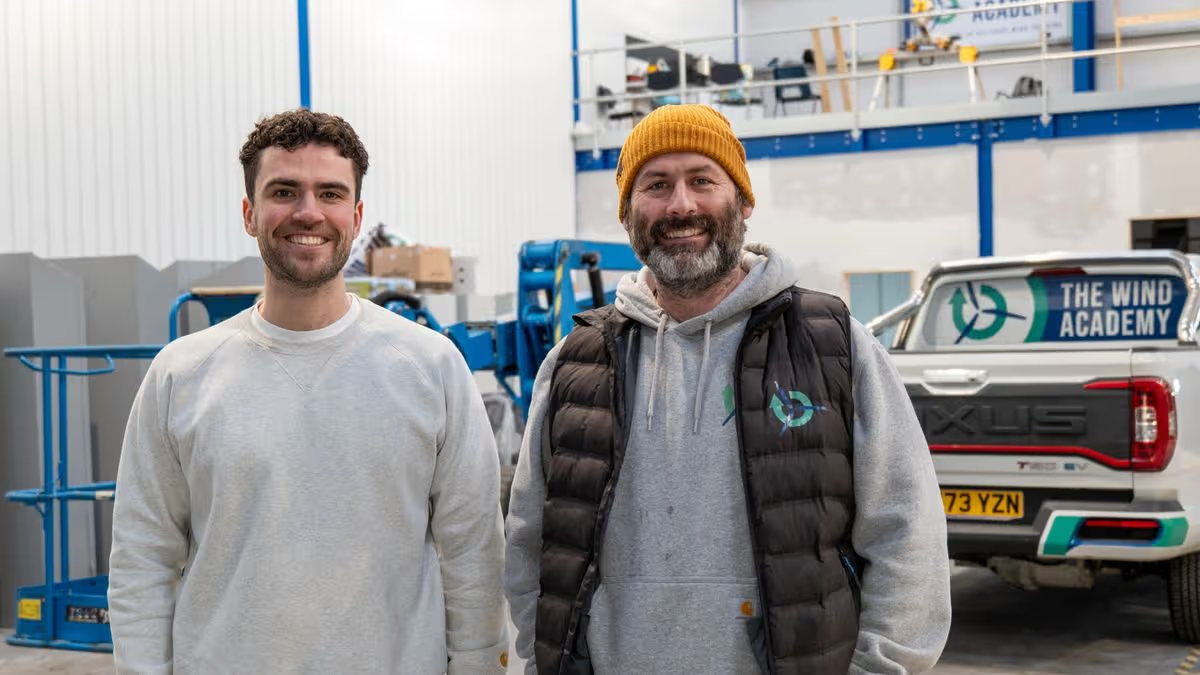
The Wind Academy is based in Blyth.

Olly Hassan (left) and Geoff Briggs of The Wind Academy.(Image: The Wind Academy)

A Blyth training provider to the growing offshore energy sector its plotting its own expansion after securing funding.

The Wind Academy, which specialises in vocational courses for renewables industry, is set to extend its facilities at the Port of Blyth following the injection of more than £42,000 from the Business Growth Fund. It will support training infrastructure for wind turbine technicians working on offshore and onshore developments.

The Academy’s growth ambition is led by director Geoff Briggs and business development manager, Olly Hassan, who are broadening its training capacity and industry partnerships.

Mr Briggs said: “This funding is a significant step forward for the Wind Academy. It allows us to invest directly in our training facilities and ensure we are delivering high-quality, industry-ready training for the offshore and onshore wind sectors.

Advertisement

“As demand for renewable energy skills continues to rise, this support helps us grow sustainably and create real opportunities for people in the region.”

The Business Growth Fund support was delivered through Business Northumberland. Coun Richard Wearmouth, cabinet member for regeneration at Northumberland County Council, said: “The Wind Academy is playing an important role in developing the skills needed for the future of renewable energy. This funding will help the business grow, invest in its facilities and continue supporting the region’s low-carbon economy.”

Jon Paul Heron, business advisor at UMi, who helped guide the process, added: “It’s been a pleasure supporting the Wind Academy on its growth journey. This investment will help strengthen its position as a key training provider for the wind sector and support long-term economic growth in Northumberland.”

The Wind Academy is based out of the Energy Central learning hub at the Port of Blyth, which has recently announced its own major expansion programme in a bid to capture more work in offshore wind. Bosses this week set out a £100m vision which includes reclaiming up to three hectares of land from the River Blyth estuary at the port’s Battleship Wharf terminal.

Advertisement

The additional space and facilities will be marketed at wind farm developers and operators amid an expected influx of North Sea energy projects. The North East is well placed to benefit from the Government’s next offshore lease auction that could take place in 2027 and could feature predominantly sites off the region’s coast.

That round could bring another 6GW of wind energy to the UK though it is unlikely that turbines will be in place and turning before the 2030s.

Continue Reading

Business

Cruise ship hit by hantavirus outbreak arrives in Tenerife

Published

on

Cruise ship hit by hantavirus outbreak arrives in Tenerife


Cruise ship hit by hantavirus outbreak arrives in Tenerife

Continue Reading

Business

Heard on the Street Recap

Published

on

Heard on the Street Recap

What Happened in Markets Today

The U.S. economy added 115,000 jobs in April, the Labor Department said, far exceeding expectations. The unemployment rate stayed unchanged at 4.3%. The jobs report puts the Federal Reserve’s focus squarely on inflation data when it comes to determining its next move on interest rates. Four months ago, a big question for the Fed was whether it needed to keep cutting rates to support what looked like a shaky labor market. But that question is now gone.

Intel shares rose 14% after The Wall Street Journal reported that the chip maker struck a preliminary deal to supply chips to Apple. It’s still unclear which Apple products Intel would make chips for. Intel reached a stock-market value of $628 billion, and its shares are up almost 500% in the past year. The news lifted other semiconductor stocks, including Micron, which gained 15%. The PHLX Semiconductor Index rose 5.5%. Apple’s stock climbed 2%.

Continue Reading

Trending

Copyright © 2025