

Business
Heard on the Street Recap


Five of the nation’s largest lenders—including JPMorgan Chase and Goldman Sachs—reported a 39% jump in combined earnings to over $49 billion, driven by surging Wall Street fees from a widespread “risk-on” environment, the recent SpaceX IPO, and the AI boom. Goldman shares soared over 9% on record profits, though Citigroup dropped 5% over concerns about elevated future expenses.

Business
RENK Group AG (RKGRY) Discusses Pre-Close Update and Strong Order Intake Driven by Defense Contracts Prepared Remarks Transcript

Operator
Welcome to the RENK Group AG pre-close call for H1 2026. Please note that this call will be recorded. I’d now like to turn the call over to Maximilian Konig, Senior Investor Relations Manager. Please go ahead.
Maximilian Konig
Thank you, operator. Good morning, everyone. Thank you for joining today’s pre-close call for the second quarter and first half of 2026. One organizational aspect upfront. In the next few minutes, I will walk you through a short set of key messages, giving a reminder of publicly disclosed information provided by us during the second quarter and potential implications on Q2 2026. After that, there will be no Q&A session. We will, of course, be happy to take all of your questions at our half year results call on August 6, where the full details will be published. Please bear in mind, our half year closing process is still ongoing. Everything I say today, therefore, reflects our current view. Final figures will be published on the mentioned H1 print on August 6.
Ladies and gentlemen, the key message is very clear. Our story is fully on track. H1 unfolds exactly as planned and always communicated and in full alignment with our full year 2026 guidance of more than EUR 1.5 billion revenues and an adjusted EBIT range of EUR 255 million to EUR 285 million. Rest assured that we continue to clearly target the upper half of that adjusted EBIT range.
Let me now start with order intake. Based on an unchanged strong market momentum with continued high demand for our products, order intake will again be one of the highlights of the quarter
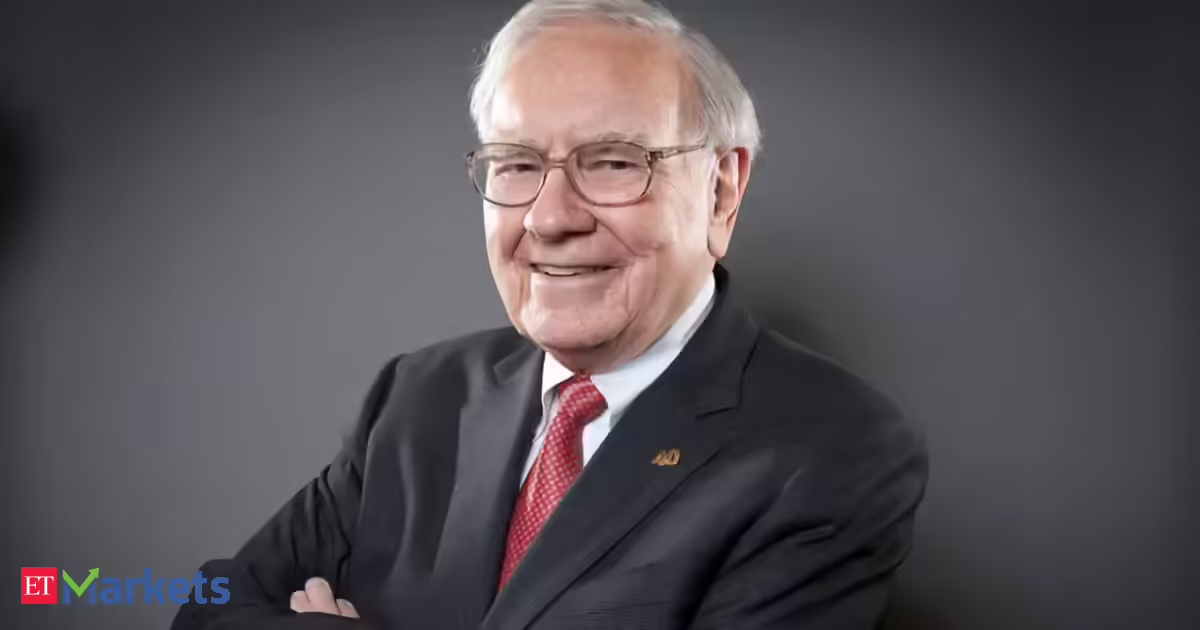
Buffett’s Berkshire Hathaway last month unveiled a large new stake in Alphabet, instantly propelling the Google parent into Berkshire Hathaway’s top 10 holdings. The move is widely seen as an endorsement of Alphabet’s heavy AI investments and the market’s view of the company as a frontrunner in the AI race.
The investment comes at a moment of transition for Berkshire. Buffett announced in May that he will step down as CEO at the end of this year, though he will retain his stock, handing the reins to vice chairman Greg Abel after decades at the helm of a company that began as a Nebraska textile mill and grew into one of the most influential conglomerates in American finance.
Burry doubles down on his skepticism
Michael Burry, however, is moving in the opposite direction. The investor who famously profited from betting against the U.S. housing market in 2008 has taken new short positions in Palantir and Nvidia, two of the highest-profile beneficiaries of the AI boom.He has been particularly critical of accounting practices across Big Tech, arguing that companies “have been systematically increasing the useful lives of chips and servers, for depreciation purposes, as they invest hundreds of billions of dollars in graphics chips with accelerating planned obsolescence.”

Burry is also in a period of transition. Scion Asset Management, his hedge fund, will close by year-end. In a recent investor letter, he wrote that his “estimation of value in securities is not now, and has not been for some time, in sync with the markets.” He has since launched a financial newsletter, Cassandra Unchained, where he continues to express skepticism about the AI boom.
A market split as AI hype peaks
Their opposing moves come as even industry leaders begin to acknowledge stretched expectations. Sam Altman, CEO of OpenAI, has voiced concerns about the pace and scale of speculative fervor surrounding artificial intelligence.
Still, capital continues to flood the sector, and the disagreement between two investors of such high reputation underscores the uncertainty in the market. Buffett turned Berkshire Hathaway into one of the most recognizable names in American investing, while Burry inspired Michael Lewis’s The Big Short and the film adaptation starring Christian Bale.Now, with both navigating turning points in their own careers, the divergence in their AI positions is emerging as one of the most closely watched splits in the market—one that could signal whether the boom is built on solid ground or heading toward another historic correction.
(Disclaimer: Recommendations, suggestions, views and opinions given by the experts are their own. These do not represent the views of The Economic Times)
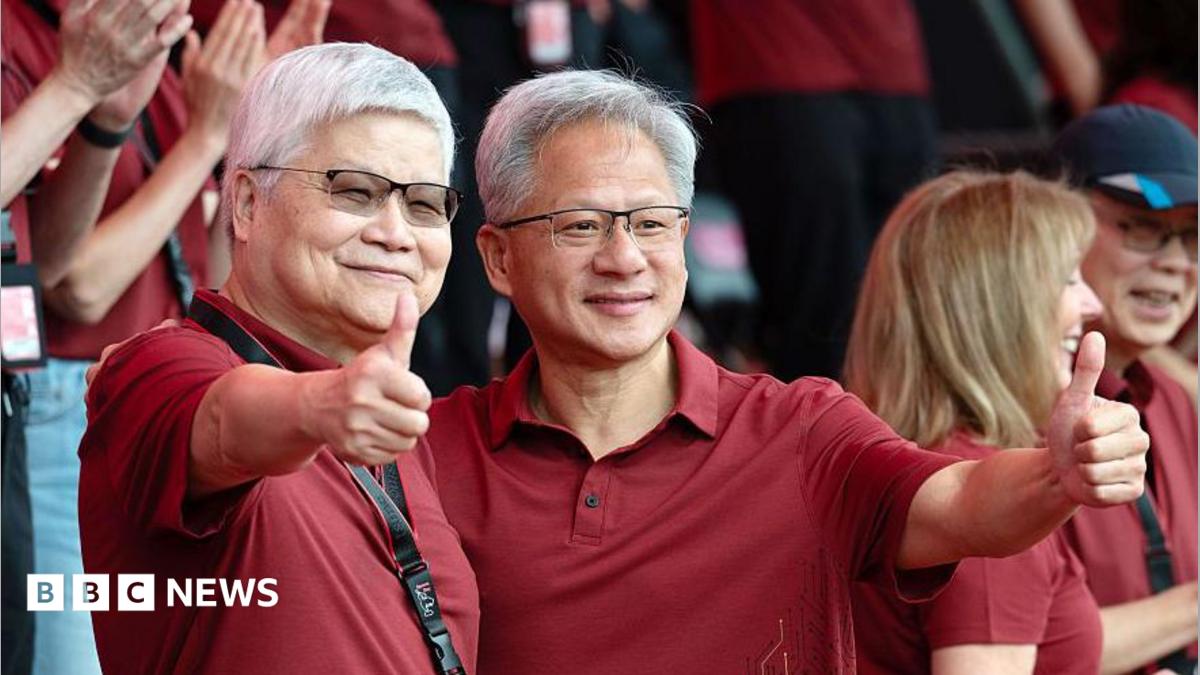
Wei did not give a timeline of when the new plants were likely to be built, saying only that it would depend on the “market situation”. The new plants would add to the eight already being built or planned.
“We believe this investment will help to further foster the development of the US semiconductor ecosystem, strengthen the supply chain, and support an increasing number of high-tech, high-paying jobs in the United States,” Wei said.
President Trump wants to boost US production of semiconductor chips, which are found in machines ranging from cars to smartphones, and has been a priority for the US since shortages during the Covid-19 pandemic exposed supply chain risks.
He has previously attributed a decision by TSMC last year to expand its investments in the US to his threats of tariffs on Taiwan and on the global semiconductor business.
In January this year, the US said it had agreed to cut tariffs on goods from Taiwan to 15% in exchange for hundreds of billions of dollars in investment aimed at boosting domestic production of semiconductors.
Welcoming the plans, Commerce Secretary Howard Lutnick said: “President Trump’s leadership is driving companies to invest in American manufacturing.
“TSMC’s announcement of an additional $100 billion investment following our historic deal on trade and investment with Taiwan will create tens of thousands of American jobs and bring advanced semiconductor manufacturing back to America.”
Additional reporting by Osmond Chia
FOX Business’ Edward Lawrence reports live from the Pennsylvania Defense & Innovation Summit, highlighting $10 billion in defense deals and 4,000 new jobs.
With the American merchant fleet down to fewer than 190 flagged vessels from a high of nearly 3,000 in the 1960s, a critical national security gap has left the U.S. heavily reliant on foreign shipbuilders.
To help reverse this decline, JPMorgan Chase announced Wednesday it is injecting $24 million into Philadelphia’s maritime sector to help secure the defense supply chain, building a new submarine assembly facility and training thousands of workers for critical defense roles.
“America can compete and lead in shipbuilding again—it starts with more skilled workers and secure supply chains. We need to train people for the jobs shipbuilders urgently need, connect them to good careers and strengthen the suppliers and partners that keep a shipyard running,” JPMorgan Chairman and CEO Jamie Dimon said in a press release.
“When we build the workforce and the supply chain together,” he added, “we create good careers for workers and a stronger, more resilient maritime industry that supports our national security and our economy.”
JAMIE DIMON SAYS HE UNDERSTANDS WHY PEOPLE HAVE GROWN ‘ANTI-RICH’
“America cannot restore its industrial strength or ensure peace through strength without investing in the workforce that powers it. Philadelphia has long been one of the great shipbuilding cities in the world, and today’s investment by JPMorgan Chase—the kind of investment we’re proud to feature at today’s Defense and Innovation Summit—recognizes that revitalizing this industry requires more than ships and shipyards,” Sen. Dave McCormick, R-Pa., also said.
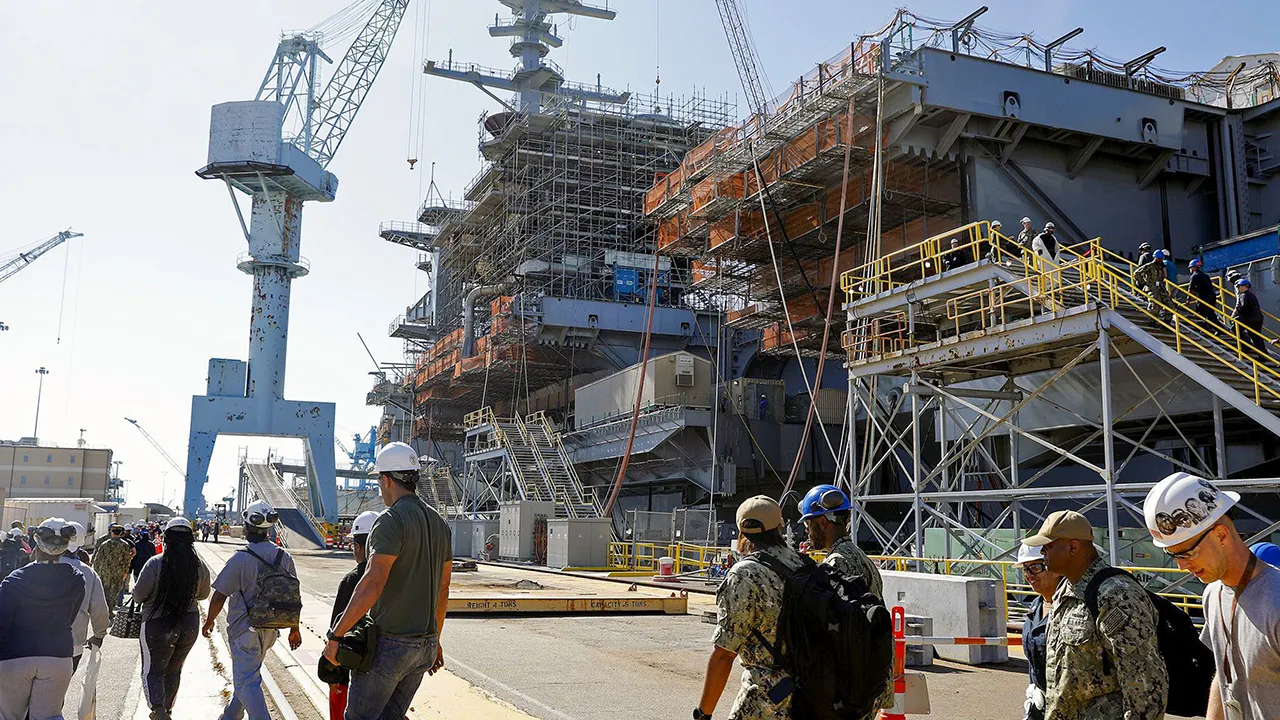
Shipbuilding workers and Navy sailors walk past the USS George Washington as it rests pier side. (Getty Images)
“It requires creating opportunity for people. By supporting workforce development and strengthening local communities, this commitment will help prepare the next generation of skilled workers who will build the ships that protect our country and reinforce Pennsylvania’s role as a cornerstone of America’s defense industrial base,” the senator continued.
The corporate commitment will use $18 million in commercial financing and capital investments, while the remaining $6 million will come from philanthropic contributions.
The project funds construction of a 95,000-square-foot submarine assembly plant, which will create 450 permanent jobs. Additionally, the program targets the Philadelphia Navy Yard — an industrial hub supporting 16,000 active positions across manufacturing and maritime sectors — to scale non-degree educational pathways.
JPMorgan Chase CEO Jamie Dimon joins ‘Mornings with Maria’ in a wide-ranging interview on AI risks, stablecoin regulation, housing affordability and his recent meeting with New York City Mayor Zohran Mamdani.
“Philadelphia is a place where targeted, coordinated investment can translate into real economic mobility,” JPMorgan’s Global Head of Corporate Responsibility and Chairman of the Mid-Atlantic Region Tim Berry said. “By strengthening workforce pathways, supplier readiness and access to capital, we can help more people connect to quality jobs and help local businesses participate in long-term growth.”
“When organizations like JPMorgan Chase invest in Philadelphia, they’re investing in our people,” Mayor Cherelle L. Parker said. “They’re helping create the kind of opportunities that let someone learn a new skill, earn a good paycheck and build a better life for themselves and their family. That’s exactly the future we’re creating in the Lower South and at the Navy Yard: more pathways to family-sustaining careers and more opportunities for Philadelphians to help build America’s future.”
GET FOX BUSINESS ON THE GO BY CLICKING HERE
Father Judge High School welding specialist Joe Williams discusses how his program helps students get jobs after they graduate and more on ‘Red, White & Blue Collar.’
The rest of the $24 million investment will go toward supporting local businesses and training workers for the shipyard. This includes a $5 million low-cost loan program to help small businesses create or retain 200 jobs and $1.5 million to help 100 local maritime suppliers upgrade their facilities.
Another $2 million will go toward training 300 Philadelphia residents for manufacturing jobs that do not require a college degree, alongside a $2.4 million grant to connect those workers with employers. The entire package is part of a 10-year, $1.5 trillion commitment by JPMorgan Chase to fund domestic industries that are vital to U.S. national security.
Business
(VIDEO) Warner Bros Delays ‘The Batman Part II’ to 2028 as J.J. Abrams’ ‘The Great Beyond’ Moves to Oct 2027
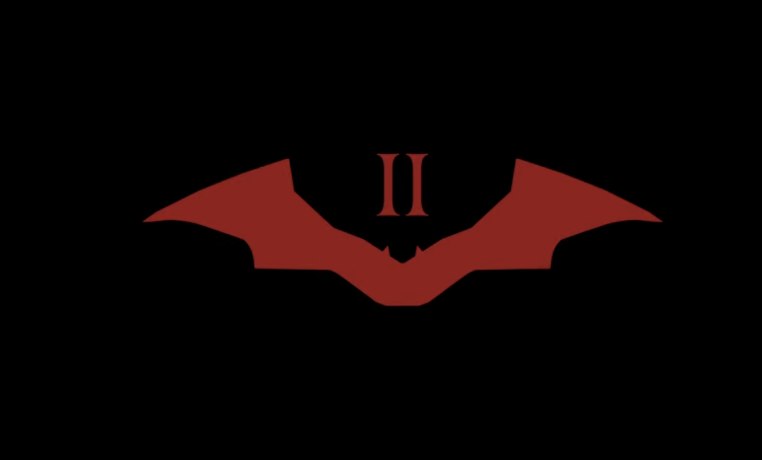
Warner Bros. reshuffled several major release dates on its 2027 and 2028 theatrical calendar this week, most notably pushing Matt Reeves’ “The Batman Part II” back to early 2028 to make room for J.J. Abrams‘ long-in-the-works sci-fi fantasy film “The Great Beyond.”
The studio confirmed that “The Great Beyond,” starring Glen Powell and Jenna Ortega, will no longer open on Nov. 13, 2027, as previously planned. Instead, the film is moving up to Oct. 1, 2027. That shift set off a chain reaction across the studio’s slate, sending “The Batman Part II,” which had occupied the Oct. 1 date, to Feb. 18, 2028.
The new date places the Robert Pattinson-led superhero sequel on the four-day Presidents Day holiday weekend, a slot that has previously hosted major comic book releases including “Black Panther,” “Ant-Man and the Wasp: Quantumania” and “Captain America: Brave New World.” Reeves announced the change on social media Wednesday morning. The film’s production start had already been delayed by five months earlier in its development, and the new release date gives the director additional time in post-production.
“The Batman Part II” will still receive Imax screenings on its new date. The film’s cast includes Pattinson returning as Batman, along with Andy Serkis as Alfred and Colin Farrell reprising his role as Penguin. New additions to the cast include Scarlett Johansson, Sebastian Stan, Jayme Lawson, Charles Dance, Gil Perez-Abraham and Sebastian Koch. The sequel will face competition on its new February 2028 weekend from an untitled Disney release and Sony’s original action sci-fi feature “Grandgear,” directed by Takashi Yamazaki, known for “Godzilla Minus One.”
Warner Bros. also moved two other titles on its calendar as part of the broader reshuffling. Sam Esmail’s thriller “Panic Carefully” and New Line’s horror sequel “Revenge of La Llorona” effectively swapped release dates. “Panic Carefully,” which had been scheduled for Feb. 26, 2027, will now open April 9, 2027, in Imax. “Revenge of La Llorona,” previously dated for April 9, 2027, moves up to Feb. 26, 2027.
“Panic Carefully” reunites Esmail, the creator of “Mr. Robot,” with “Homecoming” and “Leave the World Behind” star Julia Roberts. The cast also includes Eddie Redmayne, Brian Tyree Henry, Ben Chaplin, Aidan Gillen, Joe Alwyn, Naledi Murray and Elizabeth Olsen. On its new April date, the film will go up against Paramount Primal’s R-rated comedy “Boys for Life,” which was dated for the same weekend just a day before Warner Bros.’ announcement.
“Revenge of La Llorona,” meanwhile, will now compete against Paramount’s “K-Pop: The Debut” and Sony’s family drama “Live Like That” on its new February weekend. The film is directed by Santiago Menghini from a screenplay by Sean Tretta, and continues the story introduced in the 2019 horror film “The Curse of La Llorona.” Its cast includes Raymond Cruz, Monica Raymund, Martín Fajardo, Acston Luca Porto, Avie Porto, Edy Ganem and Jay Hernandez, with the sequel following a fractured family that must confront its past and enlist an estranged curandero grandfather to battle the vengeful spirit at the center of the franchise.
The reshuffling comes as “The Great Beyond” finalizes its production timeline. Early signs of the date change emerged when Amazon MGM Studios recently moved its action film “How to Rob a Bank” from Labor Day weekend to Nov. 13, effectively clearing the November date that “The Great Beyond” was vacating. The only wide release remaining on that November weekend is Paramount’s “Ebenezer: A Christmas Carol,” directed by Ti West and starring Johnny Depp.
According to reporting on the project, a recent test screening of “The Great Beyond” at a theater in Irvine, California, led Warner Bros. to commit to releasing the film in 70mm Imax prints, a format decision that factored into the scheduling shift. Abrams has been in the editing process on the film and was previously expected to complete post-production work in September. The new release date gives the director, best known for “Star Wars: The Force Awakens” and “Star Wars: The Rise of Skywalker,” additional time to finish the project, which he also wrote. The film was first teased publicly at CinemaCon in April.
“The Great Beyond” marks Abrams’ first original film in more than a decade and lands in a launch window that has historically been favorable for Warner Bros., having previously hosted hits including “Gravity,” “Joker,” “A Star Is Born,” “Dune,” “Argo” and “The Departed.” In addition to Powell and Ortega, the film also stars Emma Mackey, Sophie Okonedo, Merritt Wever and Samuel L. Jackson. As of this week, “The Great Beyond” remains the only major studio wide theatrical release scheduled for Oct. 1, 2027.
The scheduling changes arrive as Warner Bros.’ pending acquisition by Paramount remains tied up in ongoing antitrust litigation, including lawsuits brought by the attorneys general of California, New York and ten other states. The 103-year-old studio’s merger with Paramount had previously been expected to close by the fall of 2026, though that timeline remains uncertain given the continuing legal challenges. Notably, the date shuffle puts Warner Bros. in direct competition with Paramount, its potential parent company, on two of the newly adjusted dates, as Paramount already had films scheduled for both Feb. 26 and April 9, 2027.
The moves represent some of the more significant scheduling changes on Warner Bros.’ calendar this year, affecting four separate films across genres ranging from big-budget superhero filmmaking to original science fiction, prestige thriller and horror sequel territory. With “The Batman Part II” now more than a year and a half away from release, fans of the franchise will have an extended wait to see Pattinson’s return, while Abrams’ passion project moves into a release window the studio has historically used to launch some of its biggest awards-season and box office successes.

Why is Swedish Orphan Biovitrum stock rallying today?

The UK-India trade deal came into force this week carrying a £4.8bn-a-year prize. But for Sukhpal Ahluwalia, the entrepreneur who built Euro Car Parts from a single Wembley shop into a business he sold for £280m, the agreement itself is not the achievement. The achievement is what British businesses now build on top of it.
The Comprehensive Economic and Trade Agreement, signed last July, entered into force on 15 July after years of stop-start negotiation. It is one of the most significant trade agreements India has ever signed and the UK’s largest since Brexit, projected by the government to add £4.8bn a year to UK GDP and £25.5bn to annual bilateral trade in the long run.
Ahluwalia, who now chairs GSF Car Parts and property group Dominus, has spent decades building businesses across both markets. His conclusion is blunt: it is businesses, not agreements, that create long-term growth. Yet the capital flows, joint ventures and institutional links that two economies of this size should have still do not exist at anything like the scale they could.
Too often, he argues, the UK-India relationship has been viewed primarily through the lens of trade. The greater opportunity lies in creating a genuine two-way exchange of investment, talent and innovation.
For smaller firms, the gap between opportunity and uptake is stark. Just 17 per cent of UK small businesses currently export at all, and of those only 12 per cent sell into India, a shortfall that initiatives such as Great British Pitch India, which put more than 40 export-ready firms in front of Indian buyers last month, are designed to close.
Nor is the hard work over in Westminster. MPs on the Business and Trade Committee have already warned that billions in tariff savings could be put at risk by plans to cut almost 40 per cent of the trade staff tasked with helping businesses expand into India. Initial tariff savings for UK exporters are estimated at around £400m a year, rising to as much as £3.2bn annually within a decade, but only if firms are supported to navigate India’s administrative complexity.
The timing, Ahluwalia believes, could hardly be better. With the UK gearing up for a new Prime Minister, the incoming government arrives on a wave of momentum and has the chance to put UK-India relations at the centre of its growth agenda from day one, rather than letting the relationship drift down the list of priorities.
There is precedent for treating the agreement as a beginning rather than an end. Advisers noted during negotiations that external pressures helped focus minds on completing long-stalled post-Brexit deals, and the same urgency now needs to carry through into implementation.
Ahluwalia’s core lesson from decades straddling the two markets is a simple one. People, not policy, make growth happen. Governments can create the framework, but it is businesses, trust and long-term partnerships that turn trade agreements into lasting economic growth.
The deal is done. The biggest win is yet to come, and it will not be signed in a ceremony. It will be built, deal by deal and partnership by partnership, by the businesses willing to do the work.

Amy Ingham
Amy is a newly qualified journalist specialising in business journalism at Business Matters with responsibility for news content for what is now the UK’s largest print and online source of current business news.
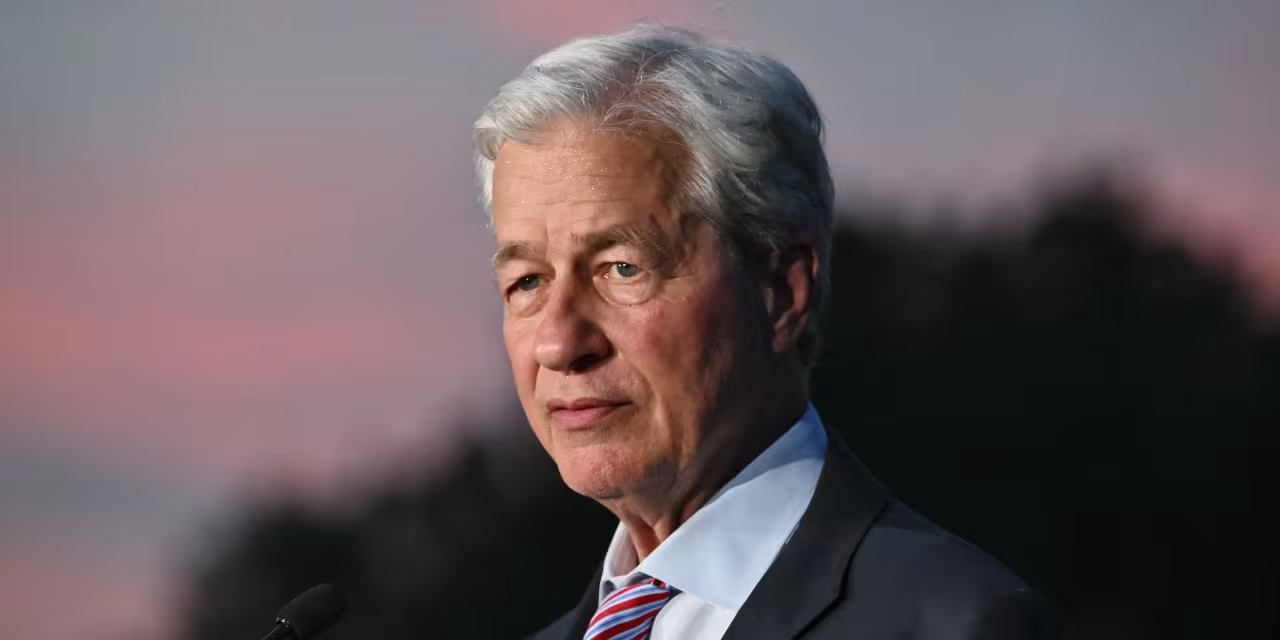
Many of the same factors have propelled big banks’ strong performance: a solid economic backdrop with low unemployment, corporate clients’ appetite for executing big deals, and lots of trading activity.
But after the four largest U.S. banks and Goldman Sachs reported second-quarter earnings results on Tuesday, some of their stocks traded in different directions.
Shares of JPMorgan Chase rose 2.5%, Goldman surged 9%, and Bank of America rose 1.8%—all to new record highs. Goldman was the best-performing stock in the Dow Jones Industrial Average on Tuesday. On the flip-side, Citigroup and Wells Fargo fell 5.3% and 2.8%, respectively.

The $145 million apartment development gained planning approval in 2022, following SKS Group’s purchase of the site in 2015.

The company reported a profit after tax of Rs 785 crore for Q1FY27, compared with Rs 568 crore in the corresponding quarter last year. Net interest income (NII) increased 20% year-on-year to Rs 2,509 crore from Rs 2,092 crore, while net total income rose 17% to Rs 3,185 crore from Rs 2,726 crore.
Pre-provisioning operating profit grew 25% year-on-year to Rs 1,752 crore from Rs 1,402 crore a year ago. Profit before tax climbed 44% to Rs 1,055 crore, compared with Rs 733 crore in the year-ago quarter.
The company’s assets under management (AUM) stood at Rs 1.22 lakh crore as of June 2026, up 11% from Rs 1.09 lakh crore a year earlier. Its gross loan book also expanded 11% year-on-year to Rs 1.21 lakh crore from Rs 1.09 lakh crore as of June 2025, reflecting steady growth in its lending business.
Also Read | Protection business boosts HDFC Life, ICICI Pru Life Q1 earnings
What are experts saying after HDB Financial Q1
Motilal Oswal has maintained a Neutral rating on HDB Financial Services with a target price of Rs 810, implying an upside potential of 8%. The brokerage said the company delivered a steady June quarter, with earnings coming in slightly ahead of its estimates.
Asset quality continued to improve despite the seasonally weaker first quarter, keeping credit costs broadly stable. It also highlighted an expansion in net interest margins (NIM), supported by better portfolio yields. While loan growth was marginally below expectations, the brokerage noted that the management remains confident of a meaningful acceleration in the coming quarters, aided by strategic initiatives undertaken over the past few quarters and continued improvement in asset quality.
Nomura has reiterated its Neutral rating on HDB Financial Services with a target price of Rs 790, indicating an upside potential of 5.1%. The brokerage noted that the management expects the cost of funds to remain rangebound through the second quarter of FY27, similar to its guidance in the previous quarter, although it remains cautious about the second half of the fiscal given the uncertain global environment. Nomura also said the healthy growth in the consumer finance portfolio has supported an expansion in yields, a trend it expects to continue through FY27.
Also Read | HDFC AMC Q1 Results: Net profit rises 12% to Rs 837 crore, revenue up 14%
The company delivered healthy growth across its key operating metrics during the quarter. Net interest income grew at a faster pace than the loan book, while pre-provisioning operating profit outpaced overall income growth. This helped profit before tax register a 44% year-on-year increase despite a slight rise in provisioning.
Investors are also likely to track the company’s asset quality trajectory following its market debut, as loan growth, margins, credit costs and the performance of stressed assets remain key factors in the valuation of lending businesses.
(Disclaimer: Recommendations, suggestions, views and opinions given by the experts are their own. These do not represent the views of The Economic Times)

RENK Group AG (RKGRY) Discusses Pre-Close Update and Strong Order Intake Driven by Defense Contracts Prepared Remarks Transcript

Ripple XRP ETF Inflows Near Zero as Institutional Demand and On-Chain Activity Fall Together

SHAXRIYOR – KEL MONEY


-

 Fashion7 days ago
Loro Piana Fall 2026 Enters Houston’s Art Scene
-

 Fashion5 days ago
Weekend Open Thread: Nutriplenish Leave-In Conditioner
-
 Sports7 days ago
2026 Genesis Scottish Open Thursday TV coverage: Round 1
-

 Sports6 days ago
Super Eagles star Moses Simon opens up on Liverpool transfer regret
-

 Tech7 days ago
Character.AI enters the microdrama arena with its own productions, but there’s a twist
-

 Politics23 hours ago
Young campaigners urge incoming PM to act on outdoor junk food ads
-

 News Videos2 days ago
XRP BOMBSHELL… XRP OMBOARDED FOR TRANSACTIONS!!!
-

 Tech2 days ago
Get Your ESP32 Sunny Side Up With This Solar Dev Board
-

 Tech2 days ago
Dark Secrets Emerge When Jailbreaking LLMs
-
 Sports13 hours ago
New Cornerback Enters Vikings Trade Rumor Mill
-
 Entertainment18 hours ago
Disney’s Most Ambitious Failed Star Wars Attraction Is Coming to SDCC
-

 Tech7 days ago
Level Infinite Launches Gangstar Mirage City in India with Pre-Registrations
-
 NewsBeat7 days ago
Major update after Huntingdon train attack as man enters plea
-

 News Videos3 days ago
how to make coin bank box with cardboard #scienceproject #money #diy #shorts
-
 Tech3 days ago
Cloudflare Precursor Watches Your Mouse and Keyboard To Decide If You Are Human
-
 Entertainment16 hours ago
Vicki Gunvalson Defends Discussing Heather Dubrow’s Money
-
Crypto World2 days ago
Ripple, Coinbase, Circle Join Linux x402 Foundation to Help Shape AI Payments
-

 NewsBeat13 hours ago
Watch: Is Donald Trump facing a popular backlash on immigration?
-
 Sports11 hours ago
Michigan officials not expected to discuss AD Warde Manuel at Thursday meeting
-
 NewsBeat13 hours ago
Firefighters issue update on Dovestone moorland blaze as fire enters fourth day
You must be logged in to post a comment Login