

Business
New York commuter rail strike ending after MTA, unions reach agreement


New York GOP gubernatorial candidate Bruce Blakeman criticizes Gov. Kathy Hochul for ‘bailing out’ Mayor Zohran Mamdani on ‘The Bottom Line.’
New York Gov. Kathy Hochul announced Monday that the Long Island Rail Road (LIRR) strike is set to end after the Metropolitan Transportation Authority (MTA) and union leaders reached an agreement.
In a post on X, Hochul said phased LIRR service is expected to resume Tuesday at noon, easing travel disruptions for hundreds of thousands of commuters across the New York region.
“Tonight, the [MTA] reached a fair deal with the five LIRR unions that delivers raises for workers while protecting riders and taxpayers,” Hochul wrote. “I’m pleased to announce that phased LIRR service will resume beginning tomorrow at noon.”
The breakthrough came after thousands of LIRR workers went on strike at midnight Saturday, effectively shutting down the nation’s busiest commuter railroad for the first time in more than three decades and threatening major economic disruption across the New York region ahead of Memorial Day.
GEN Z IS SINGLE-HANDEDLY BRINGING AMERICA’S SHOPPING MALLS BACK TO LIFE

Long Island Rail Road (LIRR) workers picket outside of Penn Station in New York, US, on Saturday, May 16, 2026. (Victor J. Blue/Bloomberg via Getty Images / Getty Images)
The strike halted service for roughly 300,000 daily riders after last-minute contract negotiations between the MTA and a coalition of five rail unions failed to produce a wage agreement.
The MTA confirmed Saturday that all LIRR service was suspended and warned there was “no substitute” for the railroad, urging commuters to work remotely if possible as officials braced for severe congestion and delays throughout the metropolitan region.
New York State Comptroller Thomas DiNapoli’s office estimated the strike could cost the regional economy up to $61 million per day in lost economic activity, as commuters scrambled for alternatives and businesses prepared for disruptions.
The labor action marked the first LIRR strike since 1994. Union leaders said workers involved in the coalition had gone more than three years without raises while negotiating a new labor agreement.
NYC REAL ESTATE TITAN COMPARES ‘TAX THE RICH’ SLOGAN TO ‘DISGUSTING RACIAL SLURS’ AMID MAMDANI CLASH
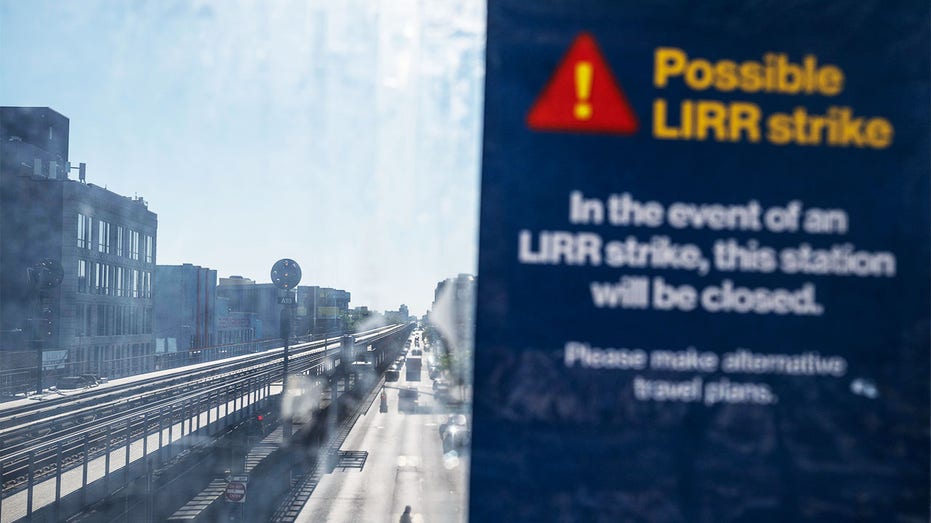
A sign displaying the suspension of Long Island Rail Road (LIRR) service due to a strike, at Nostrand Avenue station in the Brooklyn borough of New York, US, on Saturday, May 16, 2026. (Victor J. Blue/Bloomberg via Getty Images / Getty Images)
“This strike would not have happened if the MTA and LIRR offered our members the reasonable terms the government recommended multiple times. But management refused,” Mark Wallace, president of the Brotherhood of Locomotive Engineers and Trainmen and the Teamsters Rail Conference, said in a statement.
“We hope LIRR gets serious soon to avoid further unnecessary disruptions for hundreds of thousands of New Yorkers. They know where to find us when they’re ready: on the streets.”
MTA officials defended their bargaining position, arguing that excessive wage increases could ultimately drive up fares and strain the transit system’s finances.
MTA Chair and CEO Janno Lieber said the agency “cannot responsibly make a deal that implodes MTA’s budget” and warned taxpayers and riders could ultimately bear the cost of larger wage increases.

A commuter sits at the Long Island Rail Road (LIRR) station at Nostrand Avenue in the Brooklyn borough of New York, US, on Saturday, May 16, 2026. (Victor J. Blue/Bloomberg via Getty Images / Getty Images)
CLICK HERE TO GET FOX BUSINESS ON THE GO
Hochul had previously criticized the strike as “reckless,” warning it could hurt commuters, businesses and the broader regional economy.
President Donald Trump also weighed in on the dispute, blaming Hochul for allowing the strike to occur.
“If you can’t solve it, let me know, and I’ll show you how to properly get things done,” Trump wrote on Truth Social.


Gulf companies are set to reveal the unequal toll of Iran war

The S&P 500 has ended lower after US President Donald Trump said an interim deal aimed at ending the war with Iran was “over,” while Broadcom led gains among recently battered chip stocks.
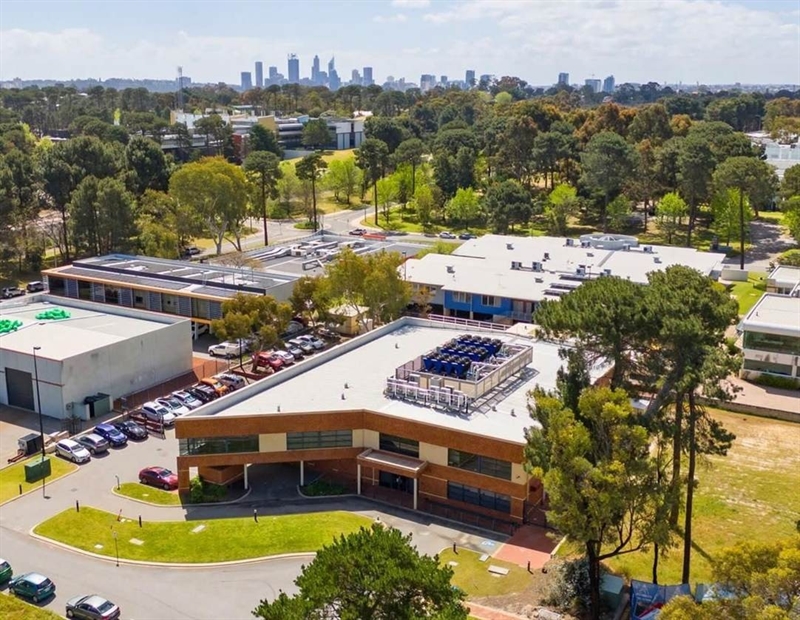
A data centre in Bentley’s Technology Park, which houses Vocus infrastructure, has sold to a private overseas buyer for some $13 million.

For years, Southeast Asia has been an afterthought in the global robotics conversation, dwarfed by American innovation and Chinese manufacturing scale.
Key takeaways
- Singapore is establishing itself as Southeast Asia’s robotics hub, anchored by dConstruct’s $125 million raise and state-backed programs like RoboNexus.
- The region’s edge lies in commercialization and deployment rather than pure research or manufacturing, with government-built testbeds attracting partners like Nvidia, OpenAI, Grab, and DHL.
- Deal flow across Neptune Robotics, BeeX, Augmentus, and Amity shows momentum, but the open question is whether these startups can scale globally and deliver real exits.
But a string of recent funding rounds and acquisitions suggests the region is quietly building its own niche, and Singapore is emerging as its unmistakable center of gravity, according to reporting from Jon Russell’s Asia Tech Review newsletter.
A Record-Setting Raise
The clearest signal came last week when Singapore-based dConstruct closed a $125 million funding round, one of the largest robotics investments Southeast Asia has ever seen, and an unusually large Series A for a company at that stage. The five-year-old startup builds 3D mapping technology designed to give robots, drones and vehicles better spatial navigation.
dConstruct’s success also serves as an early proof point for RoboNexus, the venture-building accelerator run under Singapore’s National Robotics Programme; the company emerged from the accelerator’s very first cohort. It isn’t the only graduate turning heads. Spinoff Robotics, which builds drone-based tools for cleaning and inspecting industrial infrastructure, was recently acquired by Nanoveu, an Australia-listed AI and automation firm. The deal’s financial terms weren’t disclosed, but the acquisition is described as a meaningful milestone both for the accelerator and for Singapore’s broader push to become a robotics hub.
A Strategy Built on Deployment, Not Invention
Rather than competing head-on with US research labs or Chinese manufacturing might, Singapore appears to be carving out an edge in commercialization, taking existing robotics research and pushing it into real-world use. That strategy crystallized in May, when the government unveiled a national AI strategy alongside a new Nvidia robotics lab, an OpenAI-run AI lab, and a dedicated testbed for companies developing robotics applications in delivery, cleaning, and related industries. Early partners in that testbed include Grab, DHL, and Chinese robotics maker Unitree.
That same deployment-first mindset runs through the rest of the region’s recent deal flow. Neptune Robotics raised $52 million for its ship-hull-cleaning robots and is pouring fresh investment into a Singapore manufacturing base. BeeX secured $7.7 million for underwater inspection drones. Augmentus raised $11 million to simplify how robots are programmed for tasks like surface finishing and welding. And in Thailand, hospitality-robotics firm Amity closed a $7 million round for its concierge robots.
The Open Question
Taken together, the deals paint a picture of a region finding commercial traction by turning laboratory-stage robotics into deployable products, with Singapore’s state-backed programs doing much of the heavy lifting. What remains unresolved, per the report, is whether these companies can eventually deliver meaningful exits and scale beyond Southeast Asia, rather than simply continuing to attract a steady stream of early-stage capital.
Other People are Reading

The state government has revealed the cost of the Perth Cultural Centre redevelopment has risen by $25 million, while the opening date has been pushed back again after years of delay.

Curtin University has partnered with Octave Intelligence in an initiative to tackle the skills shortage in the construction sector, becoming the first institution to sign up to the program.
The Bentley-based university will integrate Octave’s OnSite Visualize software, which allows students to work with the same professional tools used in the industry, into some construction and built environment units.
Octave NextGen Builders Program aims to give students practical, hands-on experience through the full process of infrastructure projects, from design and construction to operation.
Curtin University will be the US-based software company’s first partner in rolling out the program, according to Octaves Asia-Pacific (APAC) principal industry consultant Jeff Sharp.
“We’ve had a really good relationship with Curtin for a fair while now,” he said.
“They use some of our products already, and this was seen as an opportunity to really grow that relationship and have Curtin as the first partner.
“We see Curtin as the inaugural partner in this NextGen Builders program, but we’re currently talking with other universities through APAC, and we’re quite keen to grow this because we think it’s quite an important initiative.”
Curtin University construction Management course coordinator Vasilios Papastamoulis and Associate School of Design and the Built Environment head Jeremy Wu are co-leading the integration of the program over the next few years.
“This partnership equips our students with in-demand digital skills and real-world experience, while highlighting the vital role careers in construction and infrastructure play in shaping Australia’s future,” Dr Papastamoulis said.
“Students participating in the program will learn how to transform complex Building Information Modelling (BIM) data into construction-ready work packages.
“Using industry-standard software they will combine and review federated models to detect and resolve clashes, producing well-coordinated models that support improved project sequencing, coordination and efficiency.”
Octave APAC vice president Fabio Yada said the program responded to workforce shortages and the changing nature of modern infrastructure delivery.
“Critical industries are facing a dual challenge: a growing skills shortage and an ageing workforce, combined with the need to attract a new generation of digitally minded talent,” he said.
“The NextGen Builders Program is about making sure graduates are ready for the reality of modern projects, where decisions across design, construction and operations are increasingly interconnected, but also about demonstrating that careers in these industries are innovative, high-tech and genuinely exciting.”
Mr Sharp said the skill shortage issue was not only in construction but also affects the oil and gas and mining sector.
“What we’re seeing is young people coming in, replacing this generation with all this knowledge in their head who did things in an analog way,” he said.
“What we see this partnership is doing is training students to use digital tools, digital processes that they will see in the workplace, so they can come in more job ready with a better skill base.”
Business
Bonus issue alert! Last day to buy Goldiam International shares for 1:3 bonus reward. Do you own?

Only those shareholders who hold Goldiam International shares in their demat accounts as of Friday will be eligible to receive the bonus shares. Due to SEBI’s T+1 settlement norm, investors must purchase the company’s shares at least one trading day before the record date so they are credited to their demat accounts by that date and qualify for the corporate action. This effectively makes today the final day for investors to buy the shares to be eligible for the bonus issue.
All about Goldiam International’s bonus issue
While announcing its Q4 results back in May, Goldiam International said that its board of directors considered and approved a 1:3 bonus issue for shareholders. The company’s board approved the plan to issue one bonus share with a face value of Rs 2 each for every three shares of the same face value held in the company as on the record date.
Goldiam International will issue nearly 4 crore shares amounting to Rs 7.53 crore as part of the bonus issue, using its capital redemption reserves (CRR), securities premium account, free reserves, or retained earnings available as of March 31, 2026. On that date, the company’s CRR stood at Rs 5.67 crore, while the securities premium account balance stood at Rs 196 crore and free reserves at Rs 311 crore.
The bonus shares will be credited by July 25 this year. A bonus issue consists of free shares distributed by a company from its reserves and is often seen as a sign of strong financial health and growth prospects. While the issue of bonus shares increases the total number of outstanding shares, it does not change the company’s market capitalisation. However, it can improve liquidity and affordability, allowing more investors to add the company’s shares to their portfolios.
Notably, this is the first bonus issue announced by the diamond jewellery maker in around 21 years, according to data from Trendlyne.

Also read: Bonus issue alert! Goldiam International announces 1:3 bonus reward for shareholders. Check details
Goldiam share price
Goldiam shares tumbled more than 5% in one week but gained around 3% in one month to close at Rs 425.05 apiece on Wednesday. The stock is overall up around 17% in 2026 so far.
In the longer term, the shares of the diamond jewellery maker and exporter have delivered 22% returns over one year and a whopping 227% returns over three years. The company currently has a market capitalisation of nearly Rs 4,784 crore.
Goldiam Q4 results
Goldiam reported a consolidated net profit of Rs 37 crore for the January-March quarter of FY26. This marks a 61% year-on-year (YoY) increase from the Rs 23 crore net profit reported in the corresponding quarter of the previous financial year. The firm’s revenue from operations grew over 18% YoY to Rs 235 crore during the quarter under review.The company said it delivered a superior performance in FY26 despite US tariffs and volatile gold prices.
(Disclaimer: Recommendations, suggestions, views and opinions given by the experts are their own. These do not represent the views of The Economic Times)

SK Hynix US listing more than seven times oversubscribed, source says


I’m a full-time investor with a strong focus on the tech sector. I graduated with a Bachelor of Commerce Degree with Distinction, major in Finance. I’m also a proud lifetime member of the Beta Gamma Sigma International Business Honor Society. My core values are: Excellence, Integrity, Transparency, & Respect. I always, to the best of my ability, hold true to these values which I believe are key for long-term success. I would like to invite all of my readers to leave their constructive criticism and feedback in the comments section so that I can further enhance the quality of my work moving forward. Thank you and God Bless America!
Analyst’s Disclosure: I/we have no stock, option or similar derivative position in any of the companies mentioned, and no plans to initiate any such positions within the next 72 hours. I wrote this article myself, and it expresses my own opinions. I am not receiving compensation for it (other than from Seeking Alpha). I have no business relationship with any company whose stock is mentioned in this article.
Seeking Alpha’s Disclosure: Past performance is no guarantee of future results. No recommendation or advice is being given as to whether any investment is suitable for a particular investor. Any views or opinions expressed above may not reflect those of Seeking Alpha as a whole. Seeking Alpha is not a licensed securities dealer, broker or US investment adviser or investment bank. Our analysts are third party authors that include both professional investors and individual investors who may not be licensed or certified by any institute or regulatory body.

DreamWorks SKG co-founder Jeffrey Katzenberg and WndrCo general partner Justin Wexler join ‘The Claman Countdown’ to discuss the AI revolution, rising cybersecurity risks and the surge of young innovators reshaping Silicon Valley.
The artificial intelligence (AI) boom is causing a fierce bidding war for some luxury homes in the San Francisco Bay Area, with dozens of homes selling more than $1 million above asking price last month.
Mike Simonsen, chief economist at Compass International Holdings, noted in a post on X citing the firm’s analysis of MLS data, that there were 44 homes sold in San Francisco that closed at a price at least $1 million above the final asking price. It showed the 44 transactions from June totaled over $60 million in total sales.
The June total marked the continuation of a recent trend after April and May each had a little more than 30 sales that closed at least $1 million over the asking price and totaled over $40 million, while March had 20 such sales that totaled about $30 million.
By contrast, from February 2024 through February 2026, some months saw zero home sales that closed $1 million above the asking price, and no month saw more than nine such transactions, which illustrates the rapid intensification of bidding wars in the Bay Area luxury market.
CHATGPT BOOM FUELS A LUXURY HOUSING FRENZY IN BAY AREA

Dozens of San Francisco homes sold for more than $1 million over their final asking price, Simonsen said. (Tayfun Coskun/Anadolu via Getty Images)
Simonsen said in his post that the data was, “Absolutely BANANAS” and added that it “may be the most useful data in understanding the 2026 San Francisco housing market.”
Most of the homes sold at $1 million or more above their final asking price were sold in San Francisco’s 94114 zip code, which includes neighborhoods such as The Castro, Noe Valley and Dolores Heights.
San Francisco has long anchored the Bay Area’s tech economy, and Silicon Valley has surged amid the rapid rollout of AI software serving a wide range of consumer and business purposes. That has contributed to the uptick in demand for luxury homes in the city.
HOUSING AFFORDABILITY UNLIKELY TO RETURN TO MORE FAVORABLE LEVELS OF THE PAST, ECONOMIST SAYS

The AI boom has fueled a surge in demand for luxury homes in San Francisco. (Getty Images)
Joel Berner, senior economist at Realtor.com, told FOX Business that the overall housing market in San Francisco is a “seller’s market” with buyers “competing over a smaller pool of listings, and homes are selling 18% faster than they were last year at this time.”
Across the overall market, the median listing price has actually declined 4.9% from a year ago to $1.137 million, though Berner noted that’s likely due to smaller homes coming onto the market.
“The luxury tiers (95th and 99th price percentile) of the SF market are seeing stronger price growth than the median,” he added.
CALIFORNIA TECH LEADERS CHALLENGE PROGRESSIVE POLICIES AS BILLIONAIRES, BUSINESSES FLEE: REPORT

San Francisco’s housing market is constrained by scarce, expensive land and burdensome regulations. (Justin Sullivan/Getty Images)
“This kind of uptick in buyer activity is consistent with a cash infusion on the buyer side, which we know is occurring as part of the AI boom and the IPOs of several of these companies with presences in the Bay Area,” Berner explained.
“Buyers have more money in their pockets, but they’re chasing after the same pool of homes as before as supply has not yet had the chance to meet demand.”
He added that because San Francisco is a “notoriously tough place to build new homes, with pricey and scarce land and high regulatory burdens for builders,” it is “unlikely that a new wave of construction comes to balance the market, so expect seller’s market conditions to continue and prices to start rising significantly.”

Three heatwave cooling ‘hacks’ that may do more harm than good
Gulf companies are set to reveal the unequal toll of Iran war

XRP price eyes drop to $1 as it loses a key support

No Jackpot Winner as $257 Million Prize Rolls Over to $269 Million Monday Draw

Renter of Home in Anne Heche Crash Denies Settlement With Son

Weekend Open Thread: Staud – Corporette.com

E TU COSA FARESTI ?? #apple #iphone #finance #money #investment

BREAKING: IMF Just Dropped A Crypto Bomb!!! Russia Make Shocking Announcement! IRAN / US War Update!

Bajaj Finance Personal Loan 2026 | Bajaj Finserv Personal Loan Kise Le | Bajaj Finance Loan Kisele
-

 Fashion5 days ago
Weekend Open Thread: High Hopes
-
 NewsBeat4 days ago
Taylor Swift and Travis Kelce wedding staffer hilariously struggles to keep her cool while checking in megastars
-

 Fashion2 days ago
Open Thread: What Great Books Have You Read Recently?
-

 Politics6 days ago
The House | “Reframing the debate from a binary discussion of winners and losers”: Yuan Yang reviews ‘We Are Not Machines’
-

 Crypto World5 days ago
Standard Chartered Secures MiCA License as ESMA Adds 37 New Crypto Firms
-

 News Videos2 days ago
Whats Hidden Inside This Cash Register? #treasure #reselling #money
-
 Tech2 days ago
Anthropic’s new “J-lens” reveals a silent workspace inside Claude that mirrors a leading theory of consciousness
-

 Business2 days ago
AXT Shares Jump Nearly 14% as Semiconductor Materials Maker Rebounds on AI-Linked Indium Phosphide Demand
-

 Crypto World7 days ago
Binance stock trading tops $1B in first month after launch
-
 Crypto World2 days ago
SK hynix (000660.KS) Stock Dips as $28B Nasdaq ADR Offering Drives AI Memory Expansion
-

 Crypto World4 days ago
South Africa proposes crypto tax guidance under existing rules
-

 News Videos3 days ago
Best Time to Enter Small Caps Right Now? Another Bull Run? | Financially Free
-

 Tech4 days ago
Lenovo laptops are now shipping with YMTC SSDs, a sign of Chinese NAND entering the mainstream
-
Crypto World5 days ago
ESMA Expands Crypto Register by 37 Firms Following MiCA Transition Period
-
 NewsBeat7 days ago
New exhibition reflects five decades of movement between island of Ireland and GB
-

 Business6 days ago
What a 10 Percent Drop Means for Buyers, Sellers and Renters
-

 Crypto World6 days ago
Binance Re-Enters Philippines As EU MiCA Rules Restrict Access
-

 News Videos3 days ago
Avoid entering in FOMO #bitcoin #cryptocurrency #trading #scalping
-

 Sports1 day ago
Joshua Pacio ‘more complete’ ahead of ONE rematch vs Malachiev
-

 Crypto World6 days ago
Alibaba bans Claude Code over alleged backdoor security concerns
You must be logged in to post a comment Login