

Business
NICE Ltd Stock Bounces Nearly 5% Today After Hitting 52-Week Lows Amid AI Contact Center Disruption Fears


Shares of NICE Ltd. climbed Wednesday morning, recovering modestly from a 52-week low hit just two weeks ago as a broader rally in beaten-down enterprise software stocks lifted the Israeli AI contact center technology company alongside peers that have been battered by investor fears over generative AI disruption to their core business models.
Shares of the Ra’anana, Israel-based company were trading at $95.37 as of 10:34 a.m. EDT, up $4.52, or 4.98%, on the day. The advance offers some relief after a prolonged and painful selloff that has carried NICE shares from a 52-week high of $175, reached in late July 2025, down to a 52-week low of $83.10 hit on June 18, a decline of more than 52% that has made the company one of the hardest-hit names in the enterprise software sector during 2026.
Wednesday’s bounce comes on a day when the broader software category has stabilized following weeks of broad-based selling attributed to fears, sometimes described by analysts as the “SaaSpocalypse,” that generative AI tools from companies such as Anthropic, OpenAI and Google could fundamentally disrupt traditional enterprise software subscription business models. That dynamic has weighed heavily on NICE in particular because the company’s flagship CXone Mpower platform competes directly in the AI-powered contact center space, a category that some investors fear could be hollowed out by AI tools capable of performing customer service interactions autonomously without requiring a dedicated third-party software platform.
NICE has pushed back forcefully against that narrative through its annual NiCE World 2026 customer conference, held June 8 through 10 at Walt Disney World in Orlando, Florida, where the company rolled out a series of product announcements designed to position itself not as a victim of the agentic AI wave but as one of its primary beneficiaries. The company announced that agentic AI is now natively embedded at the core of its CXone Mpower platform, framing the shift as a fundamental transformation of customer experience from human-driven support to an integrated model combining AI agents, human workers and enterprise data in a single operating environment.
NiCE said it introduced the Workforce Empowerment Suite, giving enterprises one operating model to manage, govern and empower both human employees and AI agents at scale. The company also launched NiCE Labs, a dedicated AI innovation lab established to conduct advanced research, rigorous benchmarking and rapid prototyping at the leading edge of agentic customer experience technology.
The financial results presented at the same investor and analyst day showed revenue of $768.62 million for the first quarter of fiscal 2026, up 8% year-over-year and modestly above analyst estimates of $760.92 million. Adjusted earnings per share of $2.64 also beat consensus expectations of $2.52, representing a year-over-year increase of roughly 39% in net income. Despite those beats, the stock fell sharply following the event, with multiple analysts cutting their price targets in response to concerns about the pace of longer-term revenue growth in an increasingly competitive AI-native contact center market.
Wedbush lowered its price target on NICE to $100 from $120 and maintained a Neutral rating on the shares following the investor day. Morgan Stanley maintained an Overweight rating but lowered its price target to $130 from $148. Citi reduced its target to $100 from $119, and RBC Capital lowered its target to $130 from $150.
The broadly negative analyst price target revisions reflected a common concern: while NICE’s near-term financial performance has held up reasonably well, investors are increasingly questioning whether the company’s competitive position in the contact center software market is durable over a multi-year horizon given the pace of development of AI-native alternatives. NICE has traditionally relied on its CXone platform’s breadth of capabilities, including workforce optimization, quality management, compliance recording, analytics and interaction management, as a defensible moat against competitors. That argument is now being stress-tested in real time as both established cloud software companies and smaller AI-native startups attempt to replicate those capabilities using foundation models.
A separate challenge has emerged from NICE’s European presence. Reports have circulated that France’s domestic intelligence agency was transitioning off Palantir’s tools in favor of domestic alternatives, and more broadly, a wider shift in European government and enterprise procurement sentiment toward prioritizing domestically developed or European-domiciled software vendors has created uncertainty around renewal rates for NICE’s international public-sector customer base, even if the company has not publicly quantified the impact.
Despite those headwinds, NICE has continued executing on its commercial expansion strategy. NICE Actimize, the company’s financial crime and compliance division, signed a major contract with DNB Bank ASA, Norway’s largest financial services group, to deploy the NICE Actimize X-Sight Enterprise platform, consolidating DNB’s fraud detection and anti-money laundering systems onto a single cloud-native intelligence-driven platform. The win illustrates that NICE’s financial crime compliance business, which serves banks and financial institutions rather than consumer-facing contact centers, has continued to grow independently of the contact center narrative that has dominated the stock’s recent performance.
According to 16 analysts, approximately 93.75% maintain a Buy rating on NICE shares, with an average 12-month price target of $131.43, implying roughly 30% upside from recent trading levels. That disconnect between the overwhelmingly bullish analyst consensus and the stock’s 52% decline from its 52-week high reflects a broader investor skepticism about the durability of enterprise software business models in an AI-saturated environment that has not yet been resolved by any individual earnings report or product announcement.
NICE’s next earnings report is expected in early August, a date that will give investors their next opportunity to assess whether the company’s pivot toward agentic AI as a platform-level strategy is beginning to translate into new bookings, expanded customer commitments and improved revenue visibility, or whether the competitive pressures bearing down on the contact center software market are more structurally challenging than the company’s current financial results reflect. For now, Wednesday’s advance represents a stabilization trade rather than a conviction reversal, with the stock still far below where it traded just a year ago even after this morning’s nearly 5% bounce.



The non-alcoholic mixers are available in four flavors.


Each pint contains 30 grams of protein.

Form 4 First Solar Inc For: 1 July

Britain has cemented its position as Europe’s undisputed home for high-growth business, with a record 80 “unicorn” companies now valued at more than $1 billion apiece.
The country’s strength in building promising financial technology and artificial intelligence firms has helped it record the third-highest number of unicorns anywhere in the world. Only the United States and China are home to more private companies worth in excess of $1 billion, according to a new global ranking.
The UK now boasts a record 80 unicorns worth a combined £242.4 billion, overtaking India to take third place in the annual index produced by the Hurun Research Institute, the Shanghai-based firm behind the closely watched Global Unicorn Index.
With 23 new unicorns minted over the past 12 months, the research concluded that Britain had reinforced its “position as Europe’s undisputed start-up capital”, noting that it now has more unicorns than Germany, France, the Netherlands and Sweden combined.
The nation’s unicorn count has nearly doubled since 2016, and the “pipeline of new companies entering the billion-dollar club is the strongest it has ever been”, Hurun said. In total, the firm tracked 1,603 unicorns across 52 countries, with the combined value of the world’s unicorns rising 43 per cent to $8 trillion.
The number of unicorns a country produces is watched closely as a barometer of the health of an economy, its appetite for innovation and its ability to create companies with the potential to scale globally.
Britain’s continued strength comes against a backdrop of concern about the appeal of the London Stock Exchange as a home for the most promising businesses, as well as government efforts to nurture emerging domestic technology firms amid questions over the wisdom of relying on a handful of American giants for essential technology.
Ministers have already stepped in to keep home-grown talent listed in the UK, part of a wider push to strengthen the appeal of the London Stock Exchange after a run of de-listings and companies shifting their primary listings overseas. That includes fresh government backing for AI firms weighing a domestic float.
Revolut, the financial services group, remains the UK’s most valuable unicorn with a £57.8 billion valuation, having recently leapfrogged Barclays in value after an Nvidia-backed deal. It is followed by Nscale, the artificial intelligence data centre business, worth £11.6 billion at its last funding round, Hurun said.
Fintech companies account for a third of the UK’s unicorns and more than half of their total value. It is a sector in which fresh names keep emerging, from data platforms to challenger lenders, with recent arrivals such as 9fin reaching unicorn status with British Business Bank support.
Artificial intelligence, meanwhile, was the fastest-growing sector for UK unicorns, with nine such companies worth a combined £40.6 billion, quadrupling in value in a single year. Just ten of the UK’s 80 unicorns are developing physical products, with the rest building software or services.
Rupert Hoogewerf, chairman and chief researcher at Hurun Research Institute, said the UK had shown it was “the best gateway into European tech” for international investors.
Hurun’s broader global report identified a record 1,603 unicorns worldwide, with six of the world’s ten most valuable examples working on AI, an industry that also dominated the list of private companies posting the largest valuation increases.
“The concentration of economic power in a small number of AI companies is unprecedented,” the report said.
The enormous valuations attached to leading AI businesses have prompted concern about a bubble in public markets, and there are signs the boom is reshaping the venture market too. Analysts say the capital-raising environment has tilted towards founders working in AI, while remaining challenging for many entrepreneurs in other sectors.
AI is accounting for an unprecedented share of total deal value in European venture capital, and “non-traditional investors” such as corporations and hedge funds are joining funding rounds at record levels.
Other sectors producing UK unicorns include energy, with four such businesses, among them Octopus Energy, the UK’s largest energy supplier, and its spin-off Kraken Technologies, as well as life sciences, which accounts for eight unicorns.
Hurun’s analysis of the 136 founders behind the UK’s largest private technology companies underlined the industry’s continuing lack of diversity. More than one in four attended Oxford or Cambridge. Only eight are women, prompting Hurun to warn that “the UK is failing to capture the full potential of its female entrepreneurial talent.” More encouragingly, more than half of all the founders were born outside the UK.
The UK’s unicorns have an average valuation of £3.2 billion, Hurun said, and took an average of 3.6 years to reach the $1 billion mark.

Jamie Young
Jamie is Senior Reporter at Business Matters, bringing over a decade of experience in UK SME business reporting.
Jamie holds a degree in Business Administration and regularly participates in industry conferences and workshops.
When not reporting on the latest business developments, Jamie is passionate about mentoring up-and-coming journalists and entrepreneurs to inspire the next generation of business leaders.

.webp?t=1782921538)
Manufacturers are reviewing their portfolios to ensure alignment with current trends.

Oil prices rose sharply at the start of the Iran war. Traders slightly pared their rate-hike expectations as Warsh spoke, but they still expect at least one hike from the U.S. central bank this year, according to data compiled by LSEG. Shares of Meta Platforms rallied after Bloomberg News reported that it is building a cloud business to sell excess AI computing capacity.
“This does seem to be something that is likely to continue to help the stock,” said Tim Ghriskey, senior portfolio strategist at Ingalls & Snyder in New York. “It has underperformed the Mag 7 group” of other megacap stocks. Meta shares remain down for the year to date.
An index of semiconductors was off sharply.
Investors are keeping a close eye on talks between the U.S. and Iran and they remain cautious, especially with a long U.S. holiday weekend coming up, Ghriskey said.

According to preliminary data, the S&P 500 lost 14.34 points, or 0.19%, to end at 7,485.02 points, while the Nasdaq Composite lost 169.56 points, or 0.65%, to 26,044.16. The Dow Jones Industrial Average fell 3.62 points, or 0.01%, to 52,315.58.
The key monthly U.S. jobs report is due out on Thursday, while the market will be closed Friday ahead of the Fourth of July holiday. U.S. Vice President JD Vance said discussions between the U.S. and Iran were going well as they held indirect technical talks in Qatar about the Strait of Hormuz on Wednesday, adding Washington would not return to full combat unless necessary. The U.S. and Iran signed an interim accord last month. Investors are also digesting data from the Institute for Supply Management that showed U.S. manufacturing activity had slowed in June but was still solid.The day’s lackluster performance comes after a strong second quarter for the indexes. The S&P 500 and the Nasdaq Composite registered their biggest quarterly gains since 2020, while the Dow marked its best showing since 2022.
Among the day’s decliners, shares of Alcoa fell after Australia’s South32 agreed to sell most of its aluminium assets to Alcoa.

The index includes companies belonging to the REIT category as well as firms classified under the residential and commercial projects segment that derive meaningful exposure from commercial real estate assets and rental income.
The BSE REITs and Commercial Real Estate Index has a base value of 1,000, with September 2022 as the first value date. It will be reconstituted semi-annually in March and September.
Announcing the launch, Ashutosh Singh, MD & CEO of BSE Index Services, said the index is the first in the industry to provide focused exposure to India’s yield-generating real estate ecosystem, including office, retail and leasing-led business models.
He said the index combines listed REITs with companies having significant commercial real estate assets and rental income streams. It also incorporates a 20% cap on individual constituents to ensure diversification, making it suitable for creating investable products and targeted investment strategies.
According to BSE, the index can serve as the underlying benchmark for exchange-traded funds (ETFs) and index funds, while also being used for benchmarking portfolio management services (PMS), mutual fund schemes and institutional portfolios.
Also read: Only 1/5th the size of NSE? Why Jefferies predicts 27% upside for this near-monopoly stockThe launch expands BSE’s suite of thematic indices and comes amid growing investor interest in income-generating commercial real estate assets through listed REITs and related companies.
(Disclaimer: Recommendations, suggestions, views and opinions given by the experts are their own. These do not represent the views of The Economic Times)
The Halifax brand is being scrapped after 173 years, with all customer accounts to be rebranded to Lloyds.
Lloyds Banking Group, which has owned Halifax since 2009, confirmed the move after reports in May said it was considering phasing out Halifax as a standalone brand.
Lloyds said it remained committed to the town of Halifax and the wider Yorkshire and Humber region, where 3,000 staff are based at its Trinity Road office.
Halifax Labour MP Kate Dearden described the move as “bitterly disappointing” and said she had been in discussions with Lloyds to “ensure their commitment and continued investment in Halifax long into the future”.
Lloyds Banking Group’s chief executive of consumer relationships Jas Singh said very little would change for customers.
“As Halifax changes to Lloyds, our Halifax customers will keep everything they know and love today – the same fantastic app design, the same friendly faces in our branches – even the same sort code and account number,” he said.
No job cuts are being announced as part of the shake-up, and Halifax branches will either be rebranded to Lloyds or shifted to a nearby branch throughout 2027.
It is understood the decision was rooted in efforts to simplify the group’s portfolio, with the distinction between Halifax and Lloyds seen as becoming less prominent in recent years.

Jana Holdings Ltd (JHL) owns about 17% in Jana Small Finance Bank, which is publicly listed. The bank’s share price opened sharply lower Wednesday at Rs 445 against the previous close of Rs 469 but recovered immediately and closed barely changed at Rs 468.80.
The rating company said that JHL and Jana Capital Ltd (JCL) have repayments of around Rs 4200 crore in total due on June 30 as principal plus accrued interest.
Indian government bonds saw gains as anticipation of Bloomberg index inclusion and improved liquidity bolstered prices. Despite higher U.S. yields and rising oil due to geopolitical tensions, traders are optimistic. Foreign investors have significantly boosted purchases of Fully Accessible Route bonds, driven by expectations of their inclusion in global indices. Market sentiment hinges on monsoon progress and global stability for further rallies.
“While the entities had previously met debt repayments through refinancing, they were unable to do so on this occasion. Consequently, the tenure extension has been undertaken to avoid a potential default on the original due date, and has therefore been treated as a distressed debt exchange and a default by Ind-Ra,” the rating company said Wednesday.
Jana Capital is a core investment company, which promoted Jana Holdings as the non-operative holding company to hold the promoter stake in the small finance bank.
Both JCL and JHL are non-operating entities with no cash-flows of their own, and were to make payments towards the NCDs either by a stake sale of their operating banking entity or through refinancing.
Business
Strategy Inc Stock Jumps 7.82% Today After Launching Bitcoin Monetization Plan and $1B Repurchase Program
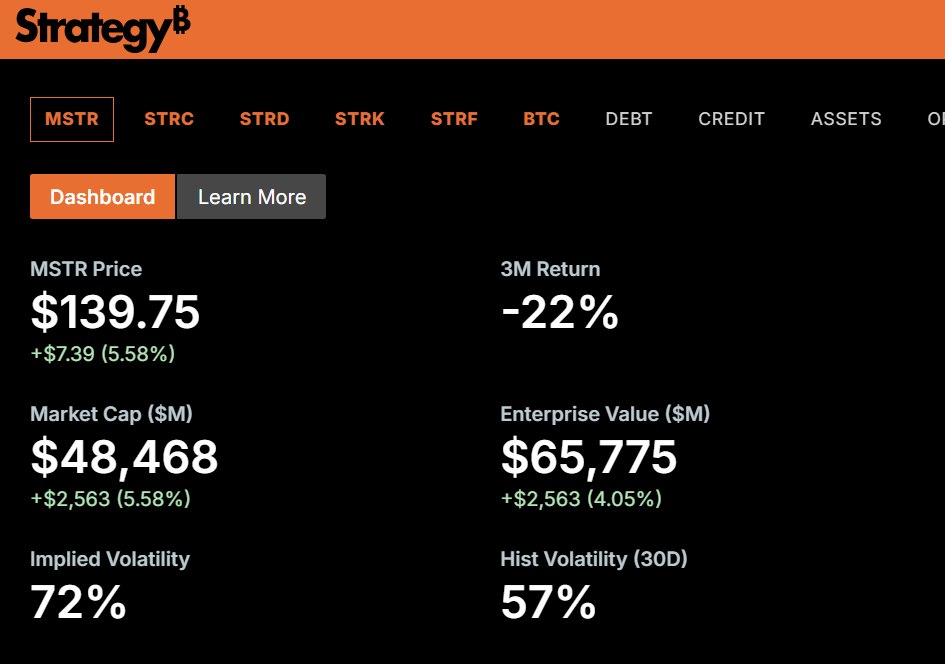
Strategy Inc., the bitcoin treasury company formerly known as MicroStrategy, climbed sharply Wednesday as investors responded to a sweeping overhaul of the company’s capital strategy that includes a program to sell bitcoin for the first time since 2022, a $1 billion repurchase authorization for its digital credit securities and a new framework designed to address mounting pressure on the company’s preferred stock financing model.
Shares of the Tysons Corner, Virginia-based company were trading at $93.73 as of 10:08 a.m. EDT, up $6.80, or 7.82%, on the day. The advance builds on a 4.67% jump Monday after the company announced the new corporate plan and represents a meaningful recovery from what has been one of the most difficult stretches in the company’s modern history, with the stock having fallen from a peak of $543 in late 2024 to a recent low near $85, a decline of roughly 83% from that all-time high.
Strategy’s board authorized a BTC Monetization Program under which the company may sell bitcoin from time to time for three primary purposes: to fund a U.S. dollar reserve, support share repurchases and bolster liquidity. The company also announced it has established a repurchase program for up to $1 billion aggregate purchase price of its outstanding Digital Credit Securities, including its preferred stock series.
Strategy adopted a Digital Credit Capital Framework designed to strengthen the company’s various series of preferred securities, enhance liquidity, preserve long-term Bitcoin exposure, and address the structural pressures that have mounted on its preferred stock financing model throughout 2026.
The moves represent a pivotal shift for a company that built its entire identity around an unwavering, one-directional accumulation of bitcoin. Co-founder Michael Saylor had spent years publicly refusing to entertain any scenario in which the company would sell any portion of its holdings, a position that became both a brand and a conviction central to the company’s appeal among retail investors and bitcoin enthusiasts. The decision to authorize bitcoin sales, even for limited and specific purposes, was initially received with a measure of disbelief among the company’s most devoted followers.
Strategy is “evolving from one-way capital” deployment, the company said in its announcement of the new framework. The company’s filings confirm it made no bitcoin purchases between June 22 and June 28, the first week without an acquisition in some time, as management prepared the new capital framework.
As of June 28, Strategy holds 847,363 bitcoin acquired for an aggregate purchase price of approximately $64.10 billion, making it the world’s largest corporate holder of the cryptocurrency by a considerable margin. At current bitcoin prices near $58,900, those holdings carry a market value of roughly $50 billion, representing an unrealized loss against the aggregate cost basis. The gap between purchase price and current market value has been a central driver of the company’s financial stress, as mark-to-market accounting rules require Strategy to record non-cash gains or losses on its bitcoin holdings each quarter, producing massive headline losses even when the company’s underlying software operations continue to generate revenue.
The preferred stock funding mechanism that had underpinned Strategy’s bitcoin accumulation strategy faces particular strain. Annual preferred dividend obligations have grown to roughly $1.2 billion, a fourfold increase since the start of 2026, while cash reserves have fallen 38% over the same period. Strategy held the STRC dividend rate at 11.50% for four consecutive months despite the stock’s sharp discount to par, disappointing investors who had anticipated a meaningful increase to at least 12% to 12.50% to reflect the effective market yield of approximately 15%.
Adding to the structural pressure, Strategy was removed from several major Russell Growth indices, including the Russell 1000, 3000 and Top 200 Growth benchmarks, effective June 29, reducing automatic demand from passive and index-tracking institutional investors. Insider selling of approximately $25.9 million worth of shares over the past three months has compounded the negative sentiment, alongside a broader episode of historically large bitcoin ETF outflows during June that CoinShares described as the worst week of redemptions the bitcoin ETF category had seen since the products launched, reflecting a significant wave of institutional profit-taking from bitcoin-linked assets broadly.
Despite the pressure, Wall Street’s major analyst voices have maintained generally constructive ratings on the stock. TD Cowen lowered its price target on Strategy to $260 from $400 and kept a Buy rating on the shares, calling the company’s Digital Credit Framework a “digital credit engine” and characterizing the bitcoin monetization program as a rounding error in the context of Strategy’s overall bitcoin holdings. Citi has similarly maintained a Buy rating with a $260 price target following the capital plan announcement. One analyst at a research firm covering the company estimated the stock could surge as much as 500% from recent levels to roughly $570 under a scenario in which bitcoin recovers and the new capital framework successfully stabilizes the preferred stock financing model.
Bitcoin itself was showing signs of recovery Wednesday, hovering near $58,900 after briefly testing $58,000 the previous week, a price level that had drawn what some market observers described as genuine buyer interest. Strategy’s fortunes remain inextricably linked to bitcoin’s direction, with each significant move in the cryptocurrency translating almost immediately into corresponding gains or losses in the company’s equity value. The stock’s beta of approximately 3.05 means it tends to move roughly three times as much as the broader market in either direction, a characteristic that has amplified both the extraordinary gains investors experienced between 2023 and late 2024 and the steep losses that followed.
Strategy’s next earnings report is scheduled for August 4, an event investors will watch closely for further detail on how the bitcoin monetization program is being implemented, how much of the $1 billion repurchase authorization has been deployed and whether the company’s preferred dividend obligations can be managed sustainably as the company navigates what its own leadership has acknowledged is a fundamentally different capital management environment from the one that drove its initial rise to prominence as the world’s most prominent corporate bitcoin holder.

A kiss for Kane! England’s saviour captain celebrates with his family as WAGs rush to congratulate Three Lions’ in wake of comeback against DR Congo

Owl’s Brew adds functional mixers

CZ shrugs off ETF exodus with $1 million Bitcoin call





-

 Fashion5 days ago
Weekend Open Thread: Staud – Corporette.com
-

 Politics6 days ago
The House | Manchesterism won’t survive the painful trade-offs unless it gets citizens on board
-

 Crypto World2 days ago
Strategy authorizes up to $1.25B in Bitcoin sales under new capital plan
-

 Politics6 days ago
Potential 2028er World Cup attendee leaderboard
-

 Business6 days ago
Asia stock markets slide as tech shares slump
-

 News Videos3 days ago
MAJOR BITCOIN & MARKET UPDATE!!!! (MUST WATCH ASAP!!!)
-

 Tech6 days ago
A Look At A Gaggle Of Transputer Boards
-
 Crypto World6 days ago
Dell (DELL) Shares Tumble Over 5% Following Analyst Downgrade to Hold
-

 Crypto World4 days ago
Coinbase, Circle Deepen Crypto Stock Losses Despite Resilient S&P 500
-

 Business2 days ago
Australia treasurer says alleged access of prime minister’s bank data ’incredibly concerning’
-

 Crypto World5 days ago
Kraken's xStocks Opens Bending Spoons IPO Registration to EEA Retail
-

 Sports5 days ago
FIH Pro League: India defeat Pakistan 7-1, register biggest win of campaign | Other Sports News
-
 Crypto World6 days ago
Bitcoin Sparks $600M Hourly Liquidations With $65,000 Set To Become Resistance
-

 Tech4 days ago
Bluekit phishing kit adopts browser-in-the-middle for login theft
-

 Tech4 days ago
Russian hackers now target Signal backup recovery keys
-
 Crypto World5 days ago
Hyperliquid Named on Singapore MAS Investor Alert Register
-

 Crypto World5 days ago
RTX holders must register wallets before token distribution begins
-

 Crypto World7 days ago
Ripple and SBI launch RLUSD in Japan after JFSA approval
-

 Tech2 days ago
Anonymous researcher drops 0-day ‘exploitarium’ repo
-
 Business2 days ago
The AI boom won’t burst all at once. It will pop in ‘rolling bubbles’: Macquarie
You must be logged in to post a comment Login