
Business
NXG: The Yield Is High, But The NAV Is Moving The Wrong Way



Business
Can John Ternus Fill Tim Cook’s Shoes As Apple’s New CEO? Analysts Weigh The Challenges Ahead In First Test

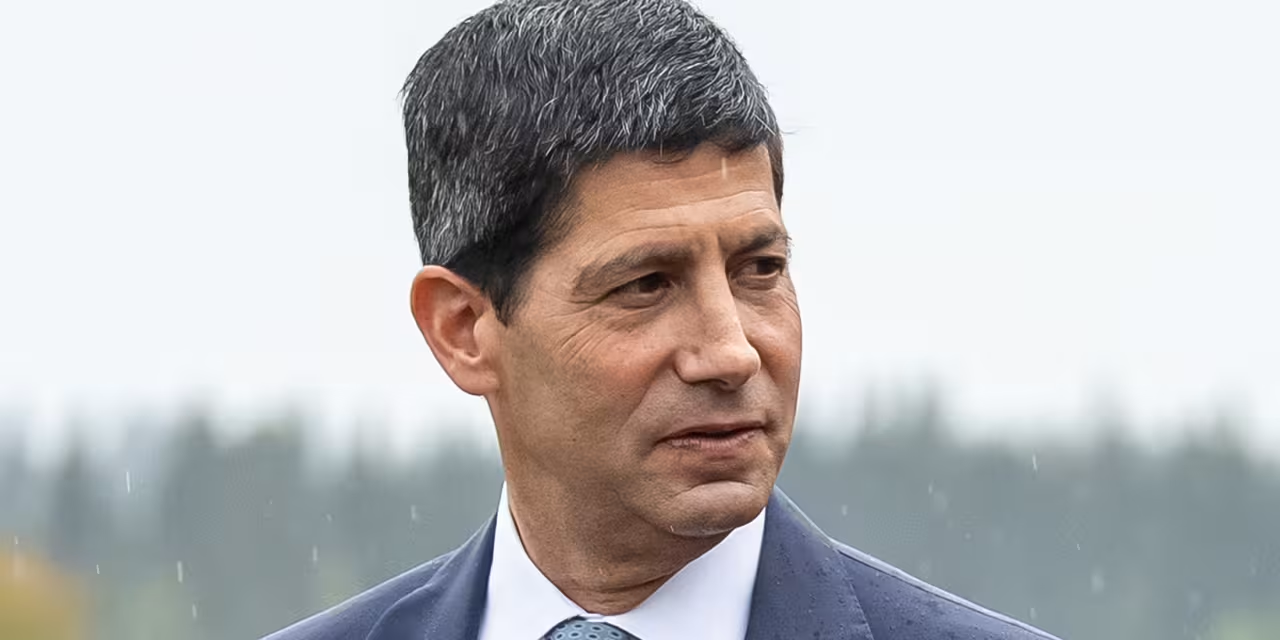
CUPERTINO, Calif. — John Ternus officially took over as Apple’s chief executive on Sept. 1, ending Tim Cook’s 15-year tenure atop the world’s most valuable technology company, and now faces an immediate test of his leadership just days into the job as Apple prepares to unveil its latest iPhone lineup, including the company’s first foldable device.
Ternus, 50, joined Apple’s product design team in 2001 and spent the past 25 years working almost exclusively in hardware engineering, rising to vice president of hardware engineering in 2013 before being promoted to senior vice president in 2021, the role from which he now moves into the CEO position. He was formally named to Apple’s board of directors effective Sept. 1, the same day the leadership transition took effect.
Cook, who succeeded Apple co-founder Steve Jobs in 2011, will remain with the company as executive chairman following the transition. Under his leadership, Apple’s market value grew from roughly $350 billion to as much as $4.6 trillion, driven largely by the enduring commercial success of the iPhone. Apple’s board announced the succession plan in April, with non-executive chairman Arthur Levinson praising Cook’s tenure while expressing confidence in his successor.
“Tim’s unprecedented and outstanding leadership has transformed Apple into the world’s best company,” Levinson said at the time. “We believe John is the best possible leader to succeed Tim and as he transitions to CEO we know his love of Apple, his leadership, deep technical knowledge, and relentless focus on creating great products will help lead Apple to an extraordinary future.”
Ternus inherits the company at what analysts describe as a genuinely pivotal moment, one shaped by mounting competitive pressure in artificial intelligence, ongoing questions about Apple’s manufacturing dependence on China, and a services division that, while still generating substantial revenue, recently missed Wall Street’s expectations.
Babak Hafezi, a professor of international business at American University, told Al Jazeera that Ternus’s background signals a deliberate strategic emphasis heading into the new era.
“The appointment of Ternus is Apple’s subtle way of doubling down on hardware innovation as a core strategy,” Hafezi said. “It doesn’t refute the Tim Cook era; it marks a new stage in Apple’s history by intertwining AI with hardware, rather than treating AI as a standalone product.”
Ternus faces his first major public test just over a week into the job, when Apple unveils its newest iPhone lineup on Sept. 9, an event expected to include the iPhone 18 Pro, iPhone 18 Pro Max and Apple’s first foldable device. Unlike in past years, when Cook typically led such presentations, Ternus is expected to take the stage himself to introduce Apple’s newest hardware, marking his public debut in the role in front of both the media and Apple’s global customer base.
Some industry watchers have drawn parallels between the pressure now facing Ternus and the skepticism Cook himself encountered when he first took over from Jobs in 2011, a moment when many analysts publicly questioned whether Apple could sustain its success without its co-founder at the helm. Tim Bajarin, a longtime technology analyst, framed the central question now facing Ternus in similarly high-stakes terms.
“The next question really is, what’s Ternus gonna do?” Bajarin said. “The fact that he is a product guy and has product ideas makes us hopeful that we may see even new breakthrough products.”
Jane Edison Stevenson, global vice chair of executive search firm Korn Ferry, said Apple’s decision to keep Cook closely involved as executive chairman reflects a deliberate effort to reassure investors and employees during the transition, though she cautioned that approach carries its own risks.
“They are looking to signal there’s continuity, that there’s a continued strategic continuum that’s being followed, and that there’s a bit of a failsafe,” Stevenson said. She added that an extended or loosely defined transition period “can make it more challenging for the new leader to take hold with the freedom to make independent decisions.”
Among the specific challenges Ternus inherits is Apple’s services business, which includes the App Store, Apple Music, iCloud and Apple Pay and has become an increasingly important growth driver under Cook. The unit generated $30.7 billion in revenue during its most recent quarter, up 12% year over year and a record for that period, but still came in below the $31.22 billion analysts had projected. Apple senior vice president Eddy Cue has previously acknowledged, in testimony during one of Google’s antitrust trials, that AI could eventually reshape consumer reliance on hardware like the iPhone altogether.
“You may not need an iPhone 10 years from now, as crazy as it sounds,” Cue said at the time, underscoring the scale of disruption Apple’s leadership believes artificial intelligence could bring to the company’s core business over the coming decade.
Despite the uncertainty surrounding the transition, some market analysts have pushed back against the idea that a change in CEO alone should trigger significant investor caution. CNBC’s Jim Cramer, discussing the leadership change during an August investor meeting, expressed continued confidence in Apple’s underlying business even while acknowledging his own personal attachment to Cook’s leadership.
“I think that’s wrong,” Cramer said, addressing speculation that Apple’s stock could face downgrades or a selloff tied to the transition. “Apple’s fundamentals are incredible, so we say stay the course.” Cramer added that his “fondness for Tim Cook is so great that it will be difficult for me to be as confident with a new CEO,” while stressing that he was not prejudging Ternus’s performance before giving him a chance to lead.
Cook is also expected to continue playing a behind-the-scenes role in maintaining Apple’s relationship with the Trump administration even after stepping back from day-to-day CEO responsibilities, a task some analysts view as an additional layer of institutional continuity supporting Ternus during his early tenure.
Whether Ternus can successfully build on Cook’s legacy while charting Apple’s own path through the current artificial intelligence race remains an open question that will likely take months or years, rather than a single product launch, to answer definitively. For now, the Sept. 9 event stands as Ternus’s first major public opportunity to demonstrate the kind of product-driven leadership his supporters within Apple and across the analyst community have said could define his tenure, even as broader structural questions about Apple’s AI strategy, manufacturing footprint and services growth continue to loom over the company’s next chapter.
Business
Pancreatic Cancer Drug Daraxonrasib Shows Early Promise Shrinking Tumors In Lung Cancer Trial

NEW YORK — A drug approved just last week to treat advanced pancreatic cancer is already showing early signs it could help patients battling the world’s deadliest cancer, with a new clinical trial finding the medication shrank tumors in more than 30% of lung cancer patients who received it.
The drug, daraxonrasib, sold under the brand name Rasonque, was developed by Revolution Medicines, a biotechnology company based in Redwood City, California. Results from the early-phase trial were published Wednesday in the New England Journal of Medicine, just one week after the U.S. Food and Drug Administration approved the drug for treating metastatic pancreatic adenocarcinoma in patients who had already received at least one prior systemic therapy.
In the trial, researchers gave 136 patients with non-small-cell lung cancer, the most common form of the disease, daily doses of daraxonrasib for three weeks at a time. Every patient enrolled had previously tried other cancer therapies with little to no success and carried mutations in RAS proteins, a family of genes known to drive tumor growth across multiple cancer types. The drug was found to be safe while reducing tumor burden in more than 30% of participants overall.
Results varied somewhat by dosage level. Among patients who received the lowest dose tested, 31% saw their tumors shrink. That figure rose to 34% among patients in the middle dosage group, and climbed further to 37% among those who received the highest dose studied.
Dr. Kathryn Arbour, a thoracic medical oncologist at Memorial Sloan Kettering Cancer Center who led the trial, described the significance of daraxonrasib’s broad activity against the many different forms RAS mutations can take within lung cancer patients.
“Daraxonrasib is the first time we’ve had a therapy that can target all the different KRAS mutations we find in lung cancer,” Arbour said.
RAS proteins, and the KRAS mutation specifically, have long been considered among the most difficult targets in cancer treatment. KRAS acts as a kind of molecular on-off switch regulating cell growth and division, and for decades scientists regarded the mutated protein as effectively “undruggable” because of the physical structure of the molecule, which made it extremely difficult to bind with conventional medications.
Daraxonrasib overcomes that challenge through a novel mechanism researchers describe as a “molecular glue.” Rather than attempting to bind directly to RAS, the drug first attaches to a common cellular protein called cyclophilin A. The resulting combined structure creates a surface capable of binding to both normal and mutated RAS molecules, blocking them from interacting with the other proteins they would typically need in order to drive continued tumor growth. Because this approach targets a broad range of RAS mutations rather than just one specific variant, daraxonrasib has shown activity against a wider array of patients and cancer types than earlier-generation RAS-targeted drugs, including rare mutation variants and cancers that have evolved to evade other treatments.
The drug’s pancreatic cancer approval came unusually quickly. The FDA granted daraxonrasib approval on Aug. 26, more than six months ahead of the regulatory decision date Revolution Medicines had originally anticipated. That accelerated timeline followed a “Breakthrough Therapy” designation the FDA granted the drug in June 2025, a status reserved for treatments addressing serious conditions that show preliminary evidence of substantial improvement over existing available therapies. The pancreatic cancer application was also reviewed under the FDA’s Commissioner’s National Priority Voucher Program, a mechanism designed to further expedite review of especially promising treatments.
The underlying pancreatic cancer data that supported the drug’s approval proved striking. In a late-stage clinical trial involving 500 patients with advanced pancreatic cancer, daraxonrasib nearly doubled median overall survival, extending it to more than 13 months, compared with a median survival of approximately 6.7 months among patients receiving standard chemotherapy. Results from that trial, first presented at the 2026 annual meeting of the American Society of Clinical Oncology, reportedly drew a 30-second standing ovation from attendees, according to Fred Hutchinson Cancer Center, before being published concurrently in the New England Journal of Medicine.
Lung cancer remains the leading cause of cancer death worldwide, making daraxonrasib’s newly reported activity against the disease particularly significant to oncologists tracking the drug’s broader potential beyond its initial approved use. Researchers at Memorial Sloan Kettering noted that Revolution Medicines has continued developing related compounds targeting the same cancer-driving mutations implicated in pancreatic, lung and colorectal cancers, reflecting a broader industry push to expand RAS-targeted therapies across multiple tumor types simultaneously.
Daraxonrasib is not the only RAS-targeted therapy to show promise across multiple cancer types in recent months. Researchers at Memorial Sloan Kettering have separately studied a related KRAS-degrading drug called setidegrasib, with results published in March 2026 also in the New England Journal of Medicine, showing promising activity in both pancreatic and lung cancer. Other researchers at the same institution have led trials of a separate KRAS-targeting drug, adagrasib, that resulted in the first FDA approval of a KRAS-directed therapy for colorectal cancer, underscoring the rapidly expanding landscape of treatments now targeting this once-considered-undruggable family of cancer-driving mutations.
Despite the encouraging early results in lung cancer, researchers cautioned that the current findings stem from a relatively small, early-phase trial rather than the kind of large, randomized late-stage study that would typically be required to support a formal regulatory approval for that specific use of the drug. Larger confirmatory studies are now underway to further validate daraxonrasib’s activity in lung cancer patients with RAS mutations, following a similar development pathway to the one that led to the drug’s recent pancreatic cancer approval.
For now, daraxonrasib’s approval remains limited specifically to metastatic pancreatic adenocarcinoma in patients who have already tried at least one prior systemic treatment. Whether the drug eventually receives a formal expanded approval covering lung cancer will depend on the results of those larger, ongoing trials, though the early data published this week has already generated significant interest among oncologists given the drug’s demonstrated ability to target a notably broad range of cancer-driving RAS mutations across different tumor types.

Bitcoin trades near $80,000 as corporate demand and US crypto policy stay in focus
Business
PR Expert Says Meghan Markle Has More To Gain From Kate Middleton Reconciliation Than Kate Amid Royal Return

LONDON — A prominent public relations expert says Meghan Markle stands to gain considerably more from a potential reconciliation with Kate Middleton than the Princess of Wales does, arguing that the two women’s vastly different public standing and future paths make any thaw between them significantly more valuable to the Duchess of Sussex.
PR expert Mark Borkowski, speaking to i News, said that regardless of what happens between the Sussexes and the rest of the royal family, Kate’s position remains secure given her status as the future queen consort. Borkowski’s comments come amid renewed speculation about the possibility of a thaw between the two sisters-in-law following Meghan and Prince Harry’s recent return to the United Kingdom with their two children.
The gap in public opinion between the two women remains substantial, according to a recent YouGov poll cited in the report. William and Kate currently hold the highest favorability ratings among members of the British royal family, with net approval scores of 60% and 61%, respectively. Harry and Meghan, by contrast, remain deeply unpopular with the British public, registering net favorability ratings of negative 25% and negative 43%, respectively.
According to Borkowski, that stark disparity in public perception is central to why a reconciliation would carry asymmetric value for the two women. He said Kate’s future within the royal family is already effectively guaranteed, regardless of whether any relationship with the Sussexes improves, since she remains on track to eventually become queen consort no matter the outcome.
Meghan’s situation, Borkowski argued, looks considerably different. He suggested that her broader personal ambition has always centered on making a meaningful impact, and that healing the rift with Kate could open doors currently closed to her. According to Borkowski, a reconciliation might allow Meghan to operate more freely across both the United Kingdom and the United States, a flexibility he noted Kate has never needed to consider given her fixed position within the royal institution.
Borkowski also raised the possibility that even informal acceptance back into royal circles, short of any formal return to official duties, could provide Meghan with a form of institutional credibility she currently lacks. He argued that this kind of acceptance could help her pursue the sort of influence and impact she has long sought, both in Britain and in the United States, opportunities he suggested a continued estrangement simply cannot provide.
“A reconciliation is worth more to Meghan,” Borkowski said, summarizing his view of how differently the two women’s public standing and future trajectories are shaped by the ongoing rift.
The timing of Borkowski’s comments adds another layer to the broader speculation surrounding the Sussexes’ return to Britain. According to the report, Harry has reportedly already been working quietly to rebuild his relationship with Kate specifically, even as tension is said to persist elsewhere within the broader royal family, particularly in his relationship with his brother, Prince William.
Borkowski’s analysis adds to a long and often contradictory stream of reporting and commentary surrounding the relationship between Meghan and Kate since the Sussexes stepped back from royal duties in 2020. Various royal commentators and outlets have offered competing characterizations of the relationship’s status over the years, ranging from claims that Kate had effectively “closed her mind” to reconciliation following the couple’s departure, to more recent suggestions that Kate has been actively seeking common ground with Meghan as part of a broader personal effort to find peace following her own cancer diagnosis and treatment.
One British journalist, Jennie Bond, previously told OK! Magazine that Kate had grown so hurt by Harry and Meghan’s actions after leaving the royal family that reconciliation seemed unlikely, describing how difficult it can be for someone from a close, united family, as she characterized Kate’s own upbringing, to fully understand how such an estrangement could occur. Other reporting has suggested a more hopeful trajectory, with some sources describing Kate as wanting the current year to represent a broader period of personal peace across multiple areas of her life, including her relationship with the Sussexes.
Royal commentator Hilary Fordwich has separately suggested that while Meghan has expressed genuine remorse over the state of the relationship and a desire for reconciliation, Kate may see limited benefit in repairing the bond given how far the relationship has deteriorated in the years since the Sussexes’ departure and their subsequent public criticisms of the royal family, including through their Oprah Winfrey interview, a Netflix docuseries and Harry’s memoir, “Spare.”
Neither Kensington Palace nor representatives for the Duke and Duchess of Sussex have publicly commented on Borkowski’s specific analysis or confirmed any active reconciliation discussions between Meghan and Kate. The palace has generally maintained a policy of not commenting publicly on the personal relationship dynamics between members of the royal family and the Sussexes since their 2020 departure from official duties.
Borkowski’s framing of the relationship in terms of asymmetric reputational stakes reflects a broader pattern within royal commentary, where PR and image-focused analysts have increasingly assessed the Sussexes’ various public moves, including interviews, media appearances and now their return to Britain, through the lens of strategic reputation management rather than purely personal or emotional considerations.
With Meghan and Harry now settled back in the United Kingdom alongside their children, Prince Archie and Princess Lilibet, speculation over the future of Meghan’s relationship with Kate is likely to continue in the coming months, particularly as the family navigates other significant developments, including Prince George’s recent start at Eton College and the broader question of how visible a role, if any, the Sussexes will play in British public life going forward. For now, Borkowski’s analysis adds a distinctly strategic dimension to that ongoing speculation, framing any eventual reconciliation less as a matter of personal forgiveness and more as a calculation over whose public image and future opportunities stand to benefit most from repairing one of the royal family’s most closely watched personal rifts.

Not long ago, hand-drafted drawings, paper schedules, verbal progress reports, and manual budget tracking methods were the accepted modes of operation in the construction industry.
Of course, these manual processes also created lags in data transfer and communication that could render blueprints, reports, and other information sources obsolete upon arrival.
Thankfully, the complexity of today’s construction industry has been accompanied by advanced construction software tools capable of harnessing the wealth of available cost, schedule, safety, and quality data each project reveals. The value of this data depends not only on its breadth and accuracy, but on whether teams receive it while they can still act upon it.
Construction Doesn’t Have a Data Shortage
As anyone who has visited a modern construction site can tell you, there is no shortage of data to be collected and reviewed. Technologies like IoT sensors, mobile software apps, and cloud-based BIM platforms make data on task completion, schedule adherence, safety incidents, and countless other metrics available to us.
Unfortunately, the collection of data doesn’t guarantee it will reach the right audience at the right time. Key decisions related to construction budget management, procurement, and resource allocation rely on data that is both accurate and timely. The best software tools connect the dots between data sources and stakeholders, ensuring financial, quality, safety, or logistical issues are prioritized and addressed proactively.
The Difference Between Reporting a Problem and Preventing One
In data-rich cloud computing and network security realms, visibility is assessed based on recognition time. In other words, no amount of data can keep powerful applications running smoothly and securely unless it is interpreted and acted upon quickly. This highlights the difference between reporting vs preventing problems that is fundamental in construction.
For example, subfloor changes to address safety concerns mid-project can be integrated seamlessly when information flows quickly. However, even a modest delay between project phases can cause a chain reaction, with wasted materials, schedule conflicts between impacted trades, and expedite fees creating an expensive and time-consuming mess.
Data Silos Can Hide the Real Project Story
Construction data silos were once the result of physical distances. Today, they are frequently caused by differing priorities and perspectives: While a project manager sees a task conforming to schedule, a procurement specialist only sees the markups, return fees, and delivery premiums required to keep pace. Additional sources of data silos in construction include:
- Disconnected software platforms
- Localized spreadsheets and trackers
- Confidentiality concerns between stakeholders
Eliminating these silos helps to enhance the flow and value of construction data, with connected information helping teams understand how changes or problems in one area can directly impact others.
Useful Data Should Trigger Decisions
Establishing robust links between construction data and the experts who need it is just the first step. Project managers, quantity surveyors, and cost accountants can become overwhelmed by growing lists of metrics and KPIs, regardless of their importance. The best construction budget management tools transform timely data into real-time highlights that identify exceptions and emerging problems. This allows decision-makers to narrow their focus and concentrate on key risks and opportunities, taking action before financial, schedule, or safety issues multiply.
From Data Collection to Project Visibility
The road to optimized visibility begins with commitments to collect available data in real-time, break down siloes that impede the flow of information, and develop tools and systems that convert raw data into timely alerts and updates. While technology is a common (and necessary) ingredient, additional steps that help to complete this transformation include:
- Reducing reliance on traditional, retrospective reporting processes
- Establishing clear ownership for data collection, review, and sharing activities
- Focused training to improve data literacy project-wide
Conclusion
The construction industry has never been short on data, but establishing the systems and protocols to ensure useful data is available when needed is a next-level challenge. These advanced capabilities drive design, procurement, and financial decisions that define project success, along with the safety, sustainability, and logistical features of an evolved jobsite.
As construction software tools improve to expand data collection, the dissemination of information to decision-makers is equally important. The best project data does more than explain what went wrong. It gives teams enough time to keep it from going wrong in the first place.

China Is Quietly Bracing for AI’s Social Costs

Ermenegildo Zegna: Core Margin Expansion And Better FCF Support A Buy (Rating Upgrade)
Business
Moscow has not ruled out trilateral meeting between presidents of Russia, US, China, TASS reports

Moscow has not ruled out trilateral meeting between presidents of Russia, US, China, TASS reports

OPEC+ set to keep oil output policy unchanged on Sunday, sources say
Skip the Rate Hike, Trim the Balance Sheet, Some Fed Watchers Urge

Can John Ternus Fill Tim Cook’s Shoes As Apple’s New CEO? Analysts Weigh The Challenges Ahead In First Test

Apple TV Officially Comes for Harlan Coben’s Crown With New Thriller This Month

Crypto Investors Need To Watch This IMMEDIATELY





-

 Fashion2 days ago
Weekend Open Thread: Beyond Yoga
-
 Crypto World2 days ago
Bitcoin price stalls near $82K as key resistance holds
-

 Politics2 days ago
Best Gaming Laptops, CPUs, TVs, And Keyboards To Upgrade Your Set Up For GTA VI
-

 Tech2 days ago
The Birds Outside, Drawn For You Automatically
-

 Crypto World2 days ago
IMF Says El Salvador’s Post-Review Bitcoin Purchases Used No Public Funds
-
 Crypto World2 days ago
U.S. added stronger than expected 162,000 jobs in August as labor market bounced back
-

 Sports2 days ago
Alexandre Pato consortium’s Northampton Town investment approved
-

 Sports2 days ago
Commanders’ Chig Okonkwo is a top breakout fantasy football candidate
-

 Sports2 days ago
Golden Eaglets Drawn in Group B for 2026 WAFU B U17 Championship
-
 Crypto World2 days ago
XRP price breaks falling channel as bulls target $1.53
-

 Politics2 days ago
A new European chapter for Gibraltar
-

 Politics2 days ago
How To Avoid Winter Colds: 4 Everyday Habits That Spread Germs, Says Pharmacist
-

 Politics2 days ago
The House | Bin the lectures, bring gossip and be ready to banter: how the new PM should prepare for his Trump encounter
-

 Crypto World2 days ago
From warning to listing: UK’s largest retail investment platform opens access to crypto ETNs
-

 Crypto World2 days ago
FinCEN flags $12.7B tied to Southeast Asia crypto investment scams
-

 Tech2 days ago
A Worthy Android Ereader, With Some Tradeoffs
-

 Crypto World2 days ago
Trezor Data Breach Impacts 67,000 More US Customers
-

 Tech2 days ago
How To Edit Claude’s Memory
-

 Politics2 days ago
33 Cosy Autumn Home Decor Ideas: Blankets, Pumpkin Decorations, And Candles
-

 Sports2 days ago
Seven wickets in 21 balls: Sri Lanka’s Chamari Athapaththu scripts history with record-breaking spell
You must be logged in to post a comment Login