Connect with us
DAPA Banner
DAPA Coin
DAPA
COIN PAYMENT ASSET
PRIVACY · BLOCKDAG · HOMOMORPHIC ENCRYPTION · RUST
ElGamal Encrypted MINE DAPA
🚫 GENESIS SOLD OUT
DAPAPAY COMING

Business

Oil Prices Slide Below $80 on Iran Supply Hopes as Bond Yields Ease Before Warsh Fed Debut

Published

on

Oil Prices Plunge Below $95 as US-Iran Ceasefire Sparks Relief

Crude oil prices fell sharply on Wednesday as optimism grew over potential Iranian supply returning to global markets following the US-Iran ceasefire agreement, pushing Brent crude below $80 a barrel and contributing to lower bond yields amid reduced geopolitical risks.

Brent futures dropped more than a third from recent peaks, reflecting expectations of resumed Iranian exports that could ease supply concerns and moderate inflationary pressures. The prospect of additional barrels entering the market added to relief over normalized shipping through the Strait of Hormuz, helping stabilize energy costs for importers worldwide.

Westpac economist Luka Belobrajdic noted the potential scale of Iranian exports. “Iran’s total exports could approach around the equivalent of 2% of global demand,” he said, though he cautioned that sanctions relief would not be immediate and would depend on the durability of peace.

The decline in oil prices also supported a drop in government bond yields. German 10-year yields, the euro zone benchmark, fell for a fifth consecutive day to their lowest since early April, last trading down 1.6 basis points at 2.91%. British yields declined sharply after May inflation held at a 13-month low of 2.8%, while U.S. Treasury yields steadied at 4.43%, down around 23 basis points from a May peak.

Advertisement

The moves came ahead of Kevin Warsh’s debut as Federal Reserve chair, with markets watching closely for signals on monetary policy direction. Traders are assessing how Warsh will balance dovish influences from the administration with market expectations of potential rate adjustments later this year.

Market Sentiment and Sector Reactions

European stock markets showed modest gains as lower energy costs supported manufacturing and consumer sectors. The pan-European STOXX 600 rose 0.1%, hovering near recent records, while Germany’s DAX benefited from relief in energy-sensitive industries. However, BMW shares fell 8% after the automaker slashed its 2026 outlook, citing challenges in China and broader geopolitical impacts.

U.S. stock futures pointed to a rebound in technology shares after recent selling pressure eased. Chipmaker-heavy markets in Asia showed mixed performance, with Tokyo and South Korea advancing modestly despite a negative lead from U.S. semiconductor stocks. Taiwan’s benchmark was capped by a decline in TSMC shares.

Advertisement

MSCI’s broadest index of Asia-Pacific shares outside Japan gained 0.4%, with AI-related gains in China offsetting weakness in consumer stocks following soft retail sales data.

The U.S. dollar remained relatively steady, with the euro firming slightly to around $1.16. The yen held near 160.2 against the dollar, supported by intervention risks despite a recent rate hike in Japan.

Gold prices bounced from support levels around $4,000 an ounce, last trading near $4,325, while Bitcoin stabilized above $64,000, recently changing hands just above $65,400.

Warsh’s Fed Debut in Focus

Advertisement

Attention now centers on Kevin Warsh’s first Federal Reserve policy meeting as chair. With no immediate rate change widely expected, focus will shift to his press conference comments, voting record and updated economic projections from committee members.

AFS Group research director Arne Petimezas outlined the cautious outlook. “I don’t have either cuts or hikes on my radar in the next 12 months,” he said. “If Warsh is going to hike, which is where I think the risks are, it will be more than just one hike.”

Sweden’s Riksbank kept rates unchanged but signaled a possible future hike, adding to the global central banking narrative of measured policy adjustments amid evolving inflation and growth dynamics.

Broader Economic Implications

Advertisement

The Iran ceasefire has provided meaningful relief to energy-importing economies, particularly in Europe, where stock markets have lagged U.S. indices this year. Deutsche Bank strategist Maximilian Uleer highlighted potential benefits. “Lower prices could lead to a recovery in manufacturing and consumer sentiment,” he wrote, shifting his preference toward European stocks over U.S. equities.

U.S. inflation reaching a three-year high in May has kept consumer stocks under pressure, but falling oil prices could ease some of those concerns by supporting household spending power and corporate margins.

Strategic oil reserves in the United States remain at their lowest levels since 1983 following the conflict’s impact on supply chains. While the ceasefire offers hope for normalization, full restoration of Iranian exports will take time and depend on diplomatic progress.

Commodity and Currency Dynamics

Advertisement

Oil’s decline reflects both immediate supply optimism and longer-term demand considerations. Analysts caution that any sanctions relief remains subject to verification and could face implementation delays. However, the mere prospect of additional barrels has shifted market sentiment toward greater supply availability.

Currency markets have remained relatively stable, with the dollar holding ground as investors await clearer signals from the Federal Reserve under Warsh’s leadership. The euro’s modest gains reflect improved risk sentiment in Europe, while the yen’s stability underscores ongoing intervention risks from Japanese authorities.

Gold’s recovery from recent lows demonstrates its continued role as a diversification asset, even as safe-haven demand moderates in a lower-risk environment. Bitcoin’s stabilization above key support levels indicates resilience in cryptocurrency markets amid traditional asset movements.

Outlook for Global Markets

Advertisement

As markets digest the latest geopolitical developments, focus shifts toward central bank communications and economic data releases. The Federal Reserve’s next steps under Warsh will be pivotal in setting the tone for global monetary policy, particularly as inflation trends and growth prospects evolve.

European central banks, including the Bank of England, face their own decisions amid cooling inflation pressures. Sweden’s Riksbank’s signal of potential hikes illustrates divergent paths among policymakers responding to local conditions.

Commodity markets will continue monitoring Iranian supply developments closely. Sustained lower oil prices could support global growth while challenging producers, creating varied impacts across regions and sectors.

Equity investors appear cautiously optimistic, with technology shares showing signs of stabilization after recent volatility. Broader indices remain near highs, reflecting confidence in corporate earnings resilience despite shifting macroeconomic conditions.

Advertisement

The coming days will bring further clarity on policy directions and economic indicators. For now, the combination of geopolitical relief and steady monetary policy expectations has created a relatively constructive environment for global markets, though uncertainties around implementation details and longer-term inflation trends warrant continued vigilance from investors.

Continue Reading
Click to comment

You must be logged in to post a comment Login

Leave a Reply

Business

10 Things to Know About Peter Fox, Former Executive Chairman of Linfox and Son of Billionaire Lindsay Fox

Published

on

10 Things to Know About Peter Fox, Former Executive Chairman

MELBOURNE — Peter Fox, the eldest son of Australian trucking magnate Lindsay Fox, has long been a central figure in one of the country’s largest privately owned logistics empires. As executive chairman of Linfox until his recent extended leave, Fox played a pivotal role in expanding the family business across the Asia-Pacific region while navigating the complexities of succession planning in a multibillion-dollar enterprise.

Linfox, founded by Lindsay Fox in 1956, has grown from a single truck operation into a major supply chain solutions provider with thousands of vehicles and operations spanning multiple countries. Peter Fox’s career within the company reflects both dedication to the family legacy and adaptation to modern logistics demands. Here are 10 essential facts about the executive who has helped shape Linfox’s trajectory for decades.

1. Eldest Son of Lindsay and Paula Fox

Peter Fox is the eldest of six children born to Lindsay and Paula Fox. His position as the firstborn has placed him at the forefront of family business responsibilities, with expectations to carry forward the values instilled by his parents. The Fox family has emphasized philanthropy and responsible stewardship of their resources, with Peter publicly reinforcing these principles in company statements.

Advertisement

2. Executive Chairman of Linfox Group Companies

Until taking extended leave in late 2025, Peter Fox served as Executive Chairman of Linfox Pty Ltd, Linfox Australia Pty Ltd, Linfox International Group Pty Ltd and Linfox Armaguard Pty Ltd. His appointment in 1993 marked the beginning of a long tenure guiding the company’s strategic direction, operational efficiency and expansion into new markets.

3. Early Career Path Before Joining Linfox

Before fully committing to the family business, Fox worked at Mayne Nickless as a trainee cadet. He then joined Linfox in Brisbane as a Trainee Supervisor, gaining hands-on experience in logistics operations. This practical foundation helped him understand the business from the ground up before assuming leadership roles.

Advertisement

4. Wide Range of Operational and Management Roles

Fox held diverse positions across Linfox businesses, progressing through operational and management roles. This broad exposure provided deep insight into supply chain challenges, customer needs and operational efficiencies. His experience informed strategic decisions as the company scaled from domestic trucking to international logistics solutions.

5. Education in Distribution Management

Fox earned a Certificate in Effective Distribution Management from UNSW Australian Graduate School of Management in 1983. This formal education complemented his practical experience, equipping him with analytical tools for managing complex logistics networks in a competitive industry.

Advertisement

6. Recent Extended Leave from Leadership

In December 2025, Peter Fox began an extended leave of absence from his executive chairman role, expected to last until April 2026. The sabbatical followed intense negotiations to stabilize Armaguard, Linfox’s cash-in-transit business. Non-family directors have stepped up during his absence, highlighting evolving succession planning within the family empire.

7. Commitment to Family Philanthropy

The Fox family, including Peter, has maintained a strong philanthropic ethos. Peter has spoken about giving being instilled from a young age. “Giving was instilled in us by our parents, Lindsay and Paula, from a young age, and it’s something that we intend to carry forward for generations to come,” he said in a Linfox statement. “As my father often says, ‘We’re a family that enjoys giving. You never get poor from giving.’”

Advertisement

8. Role in Linfox Succession Planning

Peter Fox’s temporary step back has brought family succession discussions into sharper focus. As Lindsay Fox approaches his late 80s, questions about leadership transition have intensified. Peter’s experience makes him a key figure in any long-term plan, though the family has increasingly involved non-family executives in governance roles.

9. Contribution to Linfox’s Asia-Pacific Expansion

Under Peter’s leadership, Linfox expanded significantly across the Asia-Pacific region, operating thousands of trucks and employing tens of thousands of people. The company’s growth from Australian roots to a regional powerhouse reflects strategic vision in supply chain solutions, including specialized services like Armaguard cash logistics.

Advertisement

10. Reputation for Discretion and Operational Focus

Colleagues and industry observers describe Fox as hardworking and independent, with a focus on operational excellence rather than public spotlight. His low-key approach has helped maintain Linfox’s private status while navigating competitive pressures in the logistics sector. Recent health or personal reasons for his leave remain private, consistent with his preference for discretion in family and business matters.

Linfox’s Enduring Success Under Family Leadership

Linfox’s transformation from a single-truck operation in 1956 to a major regional player demonstrates the Fox family’s long-term vision. Peter Fox’s contributions have been instrumental in professionalizing operations, adopting new technologies and expanding service offerings. The company’s continued private ownership allows flexibility in strategy while preserving core family values of hard work and community contribution.

Advertisement

The logistics industry faces ongoing challenges including supply chain disruptions, labor shortages and sustainability demands. Linfox’s leadership, with Peter Fox’s influence even during leave, has positioned the company to address these through innovation and strategic partnerships. Recent investments in electric vehicles and digital tracking systems reflect adaptation to modern expectations.

Succession and Future Direction

Peter Fox’s extended leave has prompted discussion about Linfox’s future leadership structure. Lindsay Fox’s children, including Peter, Andrew and David, have taken on various roles, with non-family executives providing additional expertise. The family’s approach balances legacy preservation with professional management, a model common among successful multigenerational businesses.

As Linfox navigates the next phase, Peter’s experience and institutional knowledge remain valuable assets. His temporary absence has allowed other leaders to demonstrate capability, potentially strengthening overall governance. The company’s commitment to responsible growth and philanthropy suggests continuity in core principles regardless of specific leadership arrangements.

Advertisement

Industry Recognition and Broader Impact

Linfox’s success under the Fox family has earned industry respect and community goodwill. Peter’s leadership contributed to operational excellence and strategic expansion while maintaining the company’s reputation for reliability in critical logistics services. The business’s scale supports thousands of jobs and contributes significantly to regional economies across the Asia-Pacific.

Peter Fox’s story reflects broader themes in Australian family business: balancing tradition with innovation, navigating succession challenges and using success for community benefit. His career demonstrates how hands-on experience and strategic thinking can sustain growth across generations.

For those following Australian business, Peter Fox represents a key figure in one of the nation’s most successful private enterprises. As Linfox continues evolving, his influence and the family’s vision will shape its path forward. The company’s ability to adapt while honoring its roots positions it well for future opportunities in a dynamic global logistics landscape.

Advertisement

Peter Fox’s contributions to Linfox, combined with the family’s philanthropic ethos, underscore the positive role family businesses can play in economic development and community support. As the company moves into its next chapter, the lessons from Peter’s tenure will likely inform continued success for generations to come.

Continue Reading

Business

Oil prices dip as traders weigh US-Iran deal, Trump’s fresh warning

Published

on


Oil prices dip as traders weigh US-Iran deal, Trump’s fresh warning

Continue Reading

Business

Oil slips again as US, Iran sign peace deal

Published

on

Oil slips again as US, Iran sign peace deal


Oil slips again as US, Iran sign peace deal

Continue Reading

Business

June’s 5 Dividend Growth Stocks With Yields Up To 6.47%

Published

on

June's 5 Dividend Growth Stocks With Yields Up To 6.47%

This article was written by

Cash Builder Opportunities (aka Nick Ackerman) is a former fiduciary and a registered financial advisor with 14 years of investing experience.He is the leader of the investing group Cash Builder Opportunities, where his specific focus is on closed-end funds, dividend growth stocks, and option writing as an attractive way to achieve income. He shares model portfolios and research to help investors make better decisions, via his Investing Group’s active chat room.

Analyst’s Disclosure: I/we have a beneficial long position in the shares of VICI, NNN, ADC, O, OKE, WEC, NEE, DTE either through stock ownership, options, or other derivatives. I wrote this article myself, and it expresses my own opinions. I am not receiving compensation for it (other than from Seeking Alpha). I have no business relationship with any company whose stock is mentioned in this article.

Seeking Alpha’s Disclosure: Past performance is no guarantee of future results. No recommendation or advice is being given as to whether any investment is suitable for a particular investor. Any views or opinions expressed above may not reflect those of Seeking Alpha as a whole. Seeking Alpha is not a licensed securities dealer, broker or US investment adviser or investment bank. Our analysts are third party authors that include both professional investors and individual investors who may not be licensed or certified by any institute or regulatory body.

Advertisement
Continue Reading

Business

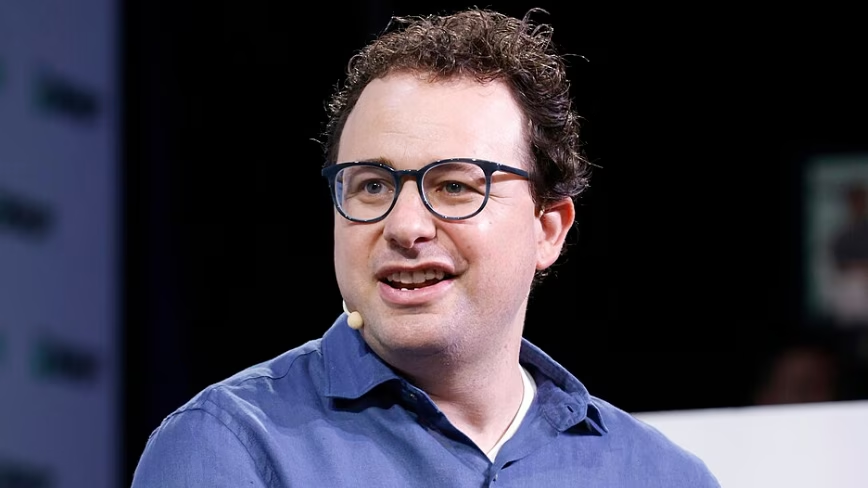
Google’s Gemini co-lead Noam Shazeer to join OpenAI

Published

on

Google’s Gemini co-lead Noam Shazeer to join OpenAI


Google’s Gemini co-lead Noam Shazeer to join OpenAI

Continue Reading

Business

RBI removes cap on NRI deposit rates until September

Published

on

RBI removes cap on NRI deposit rates until September
Kolkata: The Reserve Bank of India on Wednesday temporarily removed the interest rate ceiling on non-resident deposits allowing banks to go all-out in overseas fund mobilisation.

The central bank removed the cap on both fresh foreign currency non resident -bank (FCNR-B) deposits of three to five years and non-resident external accounts of three years and above, including the deposits that are renewed upon maturity. The direction comes into effect immediately and will remain valid till September 30, 2026.

“Banks facing challenges in building long term liabilities and maintaining liquidity buffers at threshold levels are likely to take advantage of the temporary removal of the FCNR-B rate ceiling. With the cap lifted until September end, some banks may even offer rates of up to 8% to attract long tenor, granular and sustainable deposits that are accretive to Liquidity Coverage Ratio,” Karur Vysya Bank treasury head Rama Chandra Reddy told ET.

“The move will also support banks in strengthening their asset liability management (ALM) profile,” he added.

Advertisement

Banks have already raise FCNR-B deposit rates by 250-450 basis points in the past few days following the regulator’s decision to bear the hedging on foreign currency-linked deposit mobilisation and swap the dollar with it at par, allowing hefty cost savings for banks. However, they could not raise the rates beyond 7.13% as there was a 350 basis point ceiling over the underlying alternate reference rate for dollars which was 3.63% applicable till end June.


“As the cap will no longer be there till September-end, banks may raise the FCNR-B rates further to 8% or beyond. Some banks may be ready to offer the same rates as local deposits as foreign currency deposits will be for long term while the maturity period for local deposits are typically one to two years,” a senior executive with a public sector bank said.
Prior to the RBI move to bear the hedging cost, banks were offering 3.5% to 4% for three to five years foreign currency non resident -bank (FCNR-B) deposits. The decision to remove the restriction on NRE deposits will allow banks to offer higher rates on overseas deposits than local deposits.”Both the regulatory measures will technically allow banks to raise interest rates on overseas deposits further. However, it will depend on the respective banks’ appetite,” a head of a Kerala-based lender said. Banks headquartered in the southern states are traditionally more active in tapping the Indian Diaspora to mobilise deposits.

Continue Reading

Business

Form 13D/A Stablecoin Development Corp For: 17 June

Published

on


Form 13D/A Stablecoin Development Corp For: 17 June

Continue Reading

Business

Royal Gold, Inc. (RGLD) Presents at Renmark Financial Communications Virtual Non-Deal Roadshow Series Transcript

Published

on

OneWater Marine Inc. (ONEW) Q1 2026 Earnings Call Transcript

Royal Gold, Inc. (RGLD) Renmark Financial Communications Virtual Non-Deal Roadshow Series June 17, 2026 2:00 PM EDT

Company Participants

Alistair Baker – Senior Vice President of Investor Relations & Business Development of Royal Gold Corp.

Conference Call Participants

Advertisement

Noella Alexander-Young

Presentation

Noella Alexander-Young

Advertisement

Hello, and good morning, everyone. Welcome to today’s virtual non-deal roadshow. My name is Noella Alexander-Young, virtual event moderator here at Renmark Financial Communications. On behalf of our team, we’d like to thank everyone in San Francisco and surrounding areas for joining us today for the presentation of Royal Gold trading on the NASDAQ under the ticker symbol RGLD. Presenting today is Alistair Baker, Senior Vice President of Investor Relations and Business Development.

The presentation will last approximately 25 minutes and will be followed by a Q&A session for which you can participate by using the chat box in the top right-hand corner of your screen. That being said, I will now hand it over to Alistair.

Alistair Baker
Senior Vice President of Investor Relations & Business Development of Royal Gold Corp.

Advertisement

Thanks very much, Noella. I appreciate the opportunity to present to you today. Had a very busy time at Royal Gold over the past year. And I think it’s still, we haven’t seen recognition in the market for a lot of what we’ve done. So I think it’s very timely to give you an update today.

So I will be making forward-looking statements during this presentation. There are risks and uncertainties that could cause actual results to differ materially from these statements. All of these risks and uncertainties are discussed in our most recent form 10-K filing with the SEC.

So during this presentation, I’m going to give you the investment thesis for Royal Gold. We are a high-margin business. We generate consistent cash flows from

Advertisement
Continue Reading

Business

Fidelity Freedom 2060 Fund Q1 2026 Commentary (FDKVX)

Published

on

Fidelity Freedom 2060 Fund Q1 2026 Commentary (FDKVX)

Fidelity’s mission is to strengthen the financial well-being of our customers and deliver better outcomes for the clients and businesses it serves. With assets under administration of $12.6 trillion, including discretionary assets of $4.9 trillion as of December 31, 2023, Fidelity focuses on meeting the unique needs of a broad and growing customer base. Privately held for 77 years, Fidelity employs more than 74,000 associates with its headquarters in Boston and a global presence spanning nine countries across North America, Europe, Asia and Australia. Note: This account is not managed or monitored by Fidelity, and any messages sent via Seeking Alpha will not receive a response. For inquiries or communication, please use Fidelity’s official channels.

Continue Reading

Business

Meta CTO Andrew Bosworth Says Employee Morale Near All-Time Low Amid Layoffs and AI Push

Published

on

A screen displays the logo and trading information for GameStop on the floor of the New York Stock Exchange (NYSE) in New York City, U.S., March 29, 2022.

Meta Platforms’ chief technology officer Andrew “Boz” Bosworth has acknowledged internally that employee morale at the social media giant is near an all-time low, citing the toll of recent mass layoffs, mandatory AI training assignments and broader organizational changes as key factors contributing to widespread dissatisfaction among staff.

Bosworth made the comments during an internal “Tuesdays with Boz” chat on June 2, according to multiple people familiar with the discussion. He described current morale as “maybe not the worst it’s ever been in 20 years here, but it’s probably up there. It’s definitely up there,” while referencing the Cambridge Analytica scandal as a previous low point. He then added that morale is “probably one of the worst it’s ever been.”

The remarks come at a challenging time for Meta, which has been navigating significant restructuring to offset massive investments in artificial intelligence while maintaining its core advertising business. The company laid off approximately 10% of its workforce in May, with additional employees reassigned to AI model training initiatives that some staff have described as mandatory and akin to being “drafted.”

Bosworth’s comments reflect growing internal unease as Meta balances aggressive AI development with efforts to stabilize its workforce. The company has faced criticism from employees over initiatives like tracking mouse movements and keystrokes to improve AI models, further contributing to tensions. Despite these challenges, Meta leadership has begun outlining steps to address morale concerns and rebuild company culture.

Advertisement

In a memo sent to staff on Monday, Bosworth emphasized the need for Meta to “be the best place for the best people to do their best work.” He expressed hope to “rekindle the best of the culture” that attracted employees initially. The memo committed to greater transparency from leadership and enhanced support for personal and career development.

Meta has also taken concrete actions to ease tensions. Employees reassigned to the AI task force will now be allowed to reapply for other internal roles if desired. The company is increasing budgets for travel, events and snacks to improve daily work experiences, according to reports.

Context of Recent Challenges

Meta’s difficulties stem from its ambitious pivot toward artificial intelligence. The company has poured billions into developing advanced AI models, requiring substantial computational resources and human oversight for training. This shift has necessitated workforce adjustments, including layoffs and reassignments that have disrupted team dynamics and career trajectories for many employees.

Advertisement

The May layoffs affected various departments as Meta sought to streamline operations and redirect resources toward AI priorities. For those remaining, mandatory participation in AI training tasks has added to workloads and created resentment among staff who joined the company for different roles. Some employees have privately compared the experience to being drafted into service, highlighting the cultural shift underway.

These changes occur against a backdrop of broader industry pressures. Tech companies across Silicon Valley have been recalibrating after years of rapid expansion during the pandemic, followed by cost-cutting measures as economic conditions evolved. Meta’s situation is particularly notable given its scale and the high visibility of its internal culture under CEO Mark Zuckerberg.

Bosworth’s Role and Leadership Perspective

As Meta’s longtime chief technology officer, Bosworth has been instrumental in shaping the company’s technical direction and fostering innovation. His internal communications, including the “Tuesdays with Boz” sessions, have traditionally served as forums for transparent dialogue with employees. The recent acknowledgment of morale issues represents a candid assessment from a senior leader, potentially aimed at addressing concerns before they escalate further.

Advertisement

Bosworth’s reference to Cambridge Analytica as a historical low point provides context for the current situation. That scandal, involving the misuse of user data for political targeting, severely damaged trust both externally and internally. The fact that he places recent morale challenges in a similar category underscores the seriousness with which Meta’s leadership views the issue.

The memo outlining steps to improve culture signals recognition that sustained low morale could impact innovation, retention and overall performance. By committing to transparency and development opportunities, Bosworth aims to rebuild confidence among employees who may feel uncertain about their roles in Meta’s AI-focused future.

Employee Reactions and Industry Trends

Reports from inside Meta indicate mixed responses to leadership’s acknowledgment. Some employees appreciate the candor and concrete actions like increased budgets for team-building activities. Others remain skeptical, viewing the measures as insufficient to address deeper concerns about job security and shifting priorities toward AI.

Advertisement

The situation at Meta mirrors challenges faced by other major tech companies. Layoffs, reassignments and cultural shifts have become common as firms adapt to artificial intelligence opportunities while managing costs. Employee morale has emerged as a key metric for success in the industry, with companies investing in retention strategies and transparent communication to maintain competitive edges in talent acquisition.

Industry analysts note that high-performing tech organizations increasingly recognize the connection between employee satisfaction and innovation output. Meta’s efforts to address morale could serve as a case study for peers navigating similar transitions.

Meta’s Strategic Direction and Future Outlook

Despite internal challenges, Meta continues pushing aggressively into artificial intelligence. The company has demonstrated commitment to developing competitive AI models, with significant investments in infrastructure and talent. Leadership views these changes as necessary for long-term positioning in a rapidly evolving technology landscape.

Advertisement

The focus on AI has already yielded advancements in content recommendation, advertising tools and user experiences across Meta’s platforms. However, balancing this innovation drive with employee well-being remains an ongoing priority as the company seeks to attract and retain top technical talent.

Meta’s stock performance and financial results have remained relatively strong, providing resources to address internal issues. The company’s ability to maintain business momentum while resolving cultural challenges will be critical for sustained success.

Broader Implications for Tech Industry

Meta’s experience highlights the human element of technological transformation. As artificial intelligence reshapes industries, companies must carefully manage workforce transitions to preserve institutional knowledge and maintain innovation capacity. Successful organizations will likely combine strategic investments with thoughtful change management.

Advertisement

For employees across the tech sector, Meta’s situation serves as a reminder of the importance of adaptability and continuous skill development. Those affected by reassignments or layoffs often find new opportunities, but the process can be disruptive and emotionally taxing.

As Meta implements its morale improvement initiatives, the coming months will reveal their effectiveness. Bosworth’s leadership in addressing these issues directly could strengthen internal culture and position the company for continued growth in the competitive AI era.

The acknowledgment of near all-time low morale represents a significant moment of transparency from Meta’s leadership. While challenges remain, the company’s willingness to confront issues openly and take corrective action demonstrates commitment to long-term organizational health. For a company that has weathered numerous controversies, this latest chapter underscores the ongoing evolution of its workplace culture amid ambitious technological goals.

Advertisement
Continue Reading

Trending

Copyright © 2025