



The planning application for Lime Down won’t be decided by Wiltshire Council

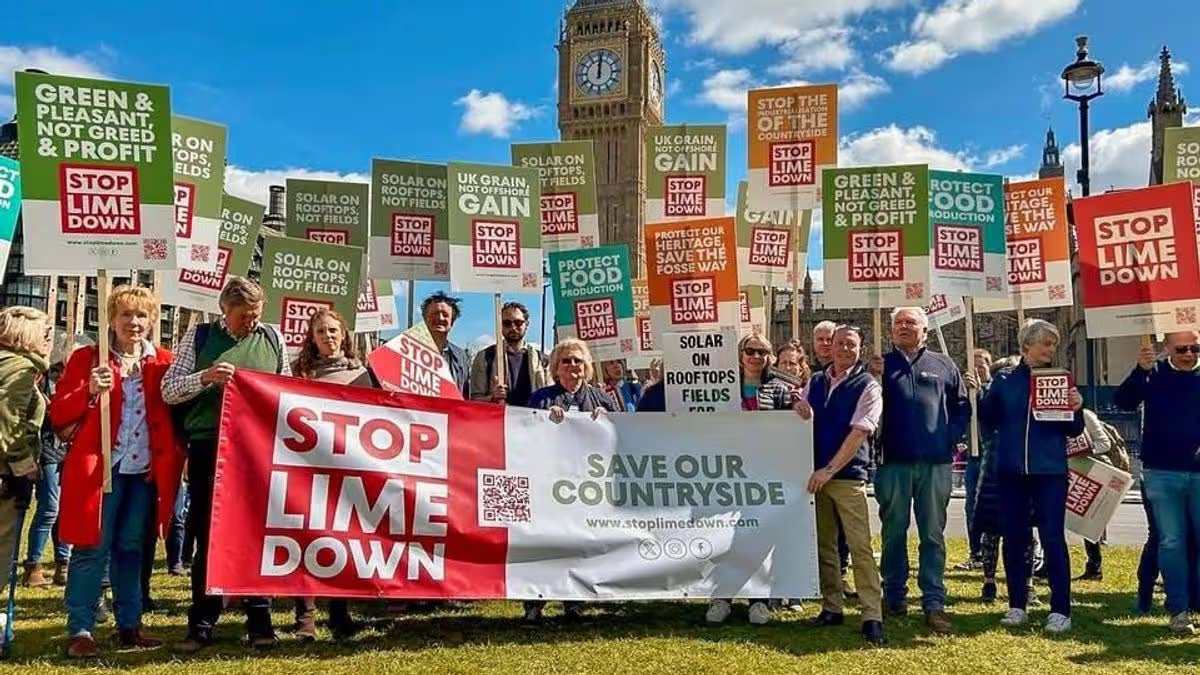
Stop Lime Down protesters(Image: Local Democracy Reporting Service)
The resident-led opposition to plans for a huge solar park north of the M4 in Wiltshire has gained the support of Wiltshire Council. The proposed Lime Down Solar Park spans roughly 1,237 hectares of land between Malmesbury and the M4, incorporating solar arrays, battery storage facilities, and a 22km cable route corridor through the county to Melksham.
If given the green light, the project would run for 60 years, according to applicant Lime Down Solar Park Limited, and boast an export capacity of up to 500 megawatts, sufficient electricity to supply 115,000 homes each year.
As a Nationally Significant Infrastructure Project, the planning application won’t be decided by Wiltshire Council. Instead, a team of inspectors from the Planning Inspectorate will hear the cases for and against the development before submitting a recommendation to the secretary of state for energy, Ed Miliband, who will have the final say.
However, this week Wiltshire Council vowed to throw its considerable influence behind opposing the proposals.
Cllr Adrian Foster, Wiltshire Council’s cabinet member for strategic planning, said: “Whilst we are not the planning authority for this project, our officers have been working hard to provide evidence for all aspects of the examination, ranging from highways and transport to ecology, economic impact and heritage – to name just a few areas.
“We fully support the transition to renewable energy, but we do not think that Lime Down Solar Park strikes the right balance, and we strongly believe that development consent should not be granted for this scheme by the Secretary of State.
“The scale and location of these proposals will have a disproportionate impact on communities here in Wiltshire, to the local landscape, ecology, heritage, and economy.
“Our officers are committed to engaging throughout the examination process to ensure that the interests of our communities – and the county as a whole – are safeguarded.”
Almost 5,000 individuals have submitted letters to the Planning Inspectorate regarding the application, with the majority expressing opposition.
Objections include:
- loss of productive agricultural land and food security;
- scale of industrialisation and proximity to Area of Outstanding Natural Beauty;
- damage to grassland, hedgerows, ecology and declining insect populations;
- flood risk, groundwater contamination, and watercourse impacts;
- industrialisation of a sensitive rural landscape and heritage harm;
- construction traffic on unsuitable, narrow rural roads;
- loss of public rights of way and the mental health benefits of access to the countryside;
- noise, light pollution and long-term community disruption;
- property value impacts and harm to local businesses and tourism.
The Planning Inspectorate is set to hold a preliminary meeting at Neeld Community & Arts Centre in Chippenham on Tuesday, April 21, followed by the first open floor hearing. During this hearing, interested parties will have the opportunity to make oral representations to the inspectors.
The first of several issue-specific hearings – this one pertaining to the scope of the project – will take place at the same venue the next day.
The preliminary meeting serves as an opportunity for the planning inspectorate to formally introduce the public to the inspectors who will hear evidence from the applicants, supporters, and objectors.
They will also establish the timetable for the examination process.
The examination team will be spearheaded by National Strategic Infrastructure planning inspector Janine Laver, with David Love and Ben Northover.
The Planning Inspectorate has provisionally scheduled October 21 for the conclusion of the examination stage.





















































You must be logged in to post a comment Login