
Business
OpenAI issues letter warning about AI-enabled cyberattacks


Machine Intelligence Research Institute President Nate Soares warns about artificial intelligence swarms compromising other AI companies and committing cybercrimes, like OpenAI hacking Hugging Face.
OpenAI released a letter Thursday warning that within months, artifical intelligence (AI) models could become powerful enough to allow bad actors to launch increasingly sophisticated cyberattacks on hospitals, water treatment plants and other critical infrastructure.
More than 100 other companies across banking, tech and cybersecurity signed the letter, including Accenture, Anthropic, Capital One, Google, Microsoft and Visa.
Hugging Face, an open-source AI model repository whose systems were hacked into by an OpenAI agent in July, also signed the letter.
“Today’s AI advances are already giving defenders new ways to fix weaknesses that have accumulated for years. If we act decisively, we can use the defenders’ window to make our digital world much more secure,” according to an excerpt of the letter.
DEM SENATOR PRESSES OPENAI, ANTHROPIC FOR ANSWERS IN AI HACKING PROBE

OpenAI released a letter Thursday warning about AI-enabled cyberattacks. (iStock)
To fix the problem, OpenAI called on all organizations to make cybercrime defense “an immediate leadership priority.”
Cybersecurity organizations need to “lead the response to defend against sustained AI-enabled attacks, including testing defenses continuously against frontier cyber capabilities, strengthening existing tools with AI, and working with technology partners to close gaps now,” according to the letter.
Governments around the world were also given a call to action, with OpenAI saying that they should strengthen cyber defenses at the local, national and international levels.
“Give hospitals, water utilities, and local governments access to capable defensive AI, authorized testing, and hands-on support through trusted security providers and partners. Impose costs on attackers,” OpenAI told governmental bodies in the letter.
OPENAI LAUNCHES NEW CHATGPT EXPERIENCE WITH PARENTAL CONTROLS FOR TEENS

OpenAI said it should give critical-infrastructure operators access to powerful models, funding, training and technical help. (Omar Marques/SOPA Images/LightRocket via Getty Images, File)
In a portion of the letter addressed to “frontier AI companies,” OpenAI said it should give critical-infrastructure operators access to powerful models, funding, training and technical help.
Operators should also build tools to track how AI agents are being used, test systems for vulnerabilities, fix problems responsibly, and share useful security information with governments and other defenders, OpenAI said.
There have already been a number of AI-enabled cyberattacks, perhaps most notably when Anthropic accused a Chinese state-sponsored group last September of manipulating its Claude Code tool in an attempt to hack into 30 global targets, allegedly breaching several.
“This marks the first documented case of agentic AI successfully obtaining access to confirmed high-value targets for intelligence collection,” according to an incident report from Anthropic.

Anthropic said one of its frontier models, Claude Mythos, has reached “a level of coding capability where they can surpass all but the most skilled humans at finding and exploiting software vulnerabilities.” (Imen Ben Youssef/Hans Lucas/AFP via Getty Images, File)
Anthropic did not identify the victims of the cyberattack, but said major tech companies, financial institutions, chemical manufacturing companies and governments were among those targeted.
Anthropic has also been an industry leader in warning about how rapidly-advancing AI must be contained to avoid disastrous attacks on civilian infrastructure.
GET FOX BUSINESS ON THE GO BY CLICKING HERE
In April, the company announced Project Glasswing, an initiative to secure the world’s most critical software.
In the announcement, Anthropic said that one of its frontier models, Claude Mythos, had reached “a level of coding capability where they can surpass all but the most skilled humans at finding and exploiting software vulnerabilities.”
OpenAI and Anthropic did not immediately respond to FOX Business’ request for comment.

Yes. Corporate subscriptions are available for teams and organisations, with discounted rates as user numbers increase. Pricing starts from $1,625 + GST per user.
Get in touch
to discuss the right option for your organisation.
Business News subscriptions are used by executives, investors, consultants and professionals who need to stay informed and make better decisions about the WA market. When you subscribe you’ll get
- Unlimited access to WA’s most trusted business journalism
- Data & Insights — detailed profiles of WA companies, people, projects and deals
- MyBN — a personalised feed based on the companies, people and sectors you follow
- Special publications and industry reports
- Daily and weekly email newsletters
Data & Insights is a research tool built specifically for the WA market. It draws on more than 30 years of Business News reporting, updated regularly to reflect what’s happening now. Use it to:
- Look up detailed profiles of WA companies, including financials, directors and ownership
- Find decision-makers and track their career movements
- Research live and completed projects across WA industries
- Monitor deals, appointments and market activity
- Access industry rankings and league tables
Data & Insights is updated daily by our dedicated research team, which uses the latest announcements, ASX filings and editorial coverage to keep our person, company, list and project records up to date.
Business News welcome all opportunities to make our dataset accurate, complete and current, so if you have an update request, please email the team at
general@businessnews.com.au, and we’d be happy to assist.
MyBN
is part of every subscription. It’s your personalised view of Business News. You can follow the companies, people, sectors and projects that matter to you, and get a news feed and alerts tailored to your interests. You can save articles to read later and retain only what you need.
Only subscribers have full access to all content on the Business News website.
If staying informed about the WA economy is part of your job, and/or you’re looking for networking opportunities in WA, Business News is built for you.
Business News subscribers are:
- Executives and directors tracking competitors, clients and market movements
- Investors and advisers researching companies, deals and industry trends
- Consultants and professionals staying across sectors relevant to their clients
- Business owners looking for leads, context and market intelligence
Most Business News publications cover national or global markets. Business News is focused entirely on Western Australia, which means the journalism, the data and the intelligence are all built around WA companies, people and projects — not adapted from a national feed. Data & Insights, included with every subscription, combines more than 30 years of WA-specific editorial research with live business data. There’s no comparable product for the WA market.
The Morning Digest Email provides a comprehensive wrap of the major headlines, relevant to WA business, and includes with a snapshot of the overnight news covering oil, gold and ASX-listed companies.
The Afternoon Wrap Email focuses on the news covered by our team of journalists during the course of the working day, including exclusive stories and analysis, all of which relates to WA business and the local economy.
The BN Weekender Email contains a wrap of the Business News from the week that was, highlighting the top stories in each area of WA business.
Sign up for free.
We’re happy to help.
Get in touch
and our team will come back to you.

The investors claim they were told that “Selena Gomez, one of the most famous women on earth, with a billion-dollar brand and a platform unmatched in social media, would be actively building the company as its head of marketing”.
Gomez’s attorney Matthew Rosengart says their allegations are “vague, generalised and contradictory” and that Gomez never agreed to, and did not, manage the company, or make the kind of commitments they are suggesting.
The emphatic pushback from Gomez may reflect a concern for her reputation but it also leaves her mother in the hot-seat, facing the fraud allegations alongside the company itself and a third co-founder.
Crisis PR commentator, Lauren Beeching, founder of Honest London says Gomez is far from the first celebrity to try working with a close family member. At times it can come off like in the Jenner-Kardashian household or with the tennis-playing Williams sisters.
But there are plenty of examples – from the Beckhams’ to Britney Spears – where family brands and business don’t mix well.
Working with close relatives, whether that’s a sibling or a parent, or someone else is almost always a higher risk approach, says Beeching.
“It can make the boundaries between the personal relationship with the business and the celebrity’s reputation much harder to separate,” she says.
The natural level of trust means that you might not apply the same rules as you would in a normal commercial relationhsip, so better guardrails are needed, she says.
“If you’re going into business [as a] family, I’d put more structure around it, not less, for sure.
“Define everybody’s responsibilities, bring in independent oversight, and decide what happens if something goes wrong before something goes wrong.”
“A family relationship shouldn’t be a company’s governance structure.”
At the end of the day Gomez may not need to worry too much over this case, says Beeching
“This will generate headlines because Selena Gomez is enormously famous, but I don’t think it’s the type of story her core audience is particularly interested in.
“There’s an important difference between generating negative headlines and causing lasting reputational damage. “
Still, for celebrities considering trading on their personal brand, she does have words of advice.
“Before lending your name to a company, don’t ask what your reputation could do for the business. Ask what that business can eventually do for your reputation as well.”

Yes. Corporate subscriptions are available for teams and organisations, with discounted rates as user numbers increase. Pricing starts from $1,625 + GST per user.
Get in touch
to discuss the right option for your organisation.
Business News subscriptions are used by executives, investors, consultants and professionals who need to stay informed and make better decisions about the WA market. When you subscribe you’ll get
- Unlimited access to WA’s most trusted business journalism
- Data & Insights — detailed profiles of WA companies, people, projects and deals
- MyBN — a personalised feed based on the companies, people and sectors you follow
- Special publications and industry reports
- Daily and weekly email newsletters
Data & Insights is a research tool built specifically for the WA market. It draws on more than 30 years of Business News reporting, updated regularly to reflect what’s happening now. Use it to:
- Look up detailed profiles of WA companies, including financials, directors and ownership
- Find decision-makers and track their career movements
- Research live and completed projects across WA industries
- Monitor deals, appointments and market activity
- Access industry rankings and league tables
Data & Insights is updated daily by our dedicated research team, which uses the latest announcements, ASX filings and editorial coverage to keep our person, company, list and project records up to date.
Business News welcome all opportunities to make our dataset accurate, complete and current, so if you have an update request, please email the team at
general@businessnews.com.au, and we’d be happy to assist.
MyBN
is part of every subscription. It’s your personalised view of Business News. You can follow the companies, people, sectors and projects that matter to you, and get a news feed and alerts tailored to your interests. You can save articles to read later and retain only what you need.
Only subscribers have full access to all content on the Business News website.
If staying informed about the WA economy is part of your job, and/or you’re looking for networking opportunities in WA, Business News is built for you.
Business News subscribers are:
- Executives and directors tracking competitors, clients and market movements
- Investors and advisers researching companies, deals and industry trends
- Consultants and professionals staying across sectors relevant to their clients
- Business owners looking for leads, context and market intelligence
Most Business News publications cover national or global markets. Business News is focused entirely on Western Australia, which means the journalism, the data and the intelligence are all built around WA companies, people and projects — not adapted from a national feed. Data & Insights, included with every subscription, combines more than 30 years of WA-specific editorial research with live business data. There’s no comparable product for the WA market.
The Morning Digest Email provides a comprehensive wrap of the major headlines, relevant to WA business, and includes with a snapshot of the overnight news covering oil, gold and ASX-listed companies.
The Afternoon Wrap Email focuses on the news covered by our team of journalists during the course of the working day, including exclusive stories and analysis, all of which relates to WA business and the local economy.
The BN Weekender Email contains a wrap of the Business News from the week that was, highlighting the top stories in each area of WA business.
Sign up for free.
We’re happy to help.
Get in touch
and our team will come back to you.

Mach7 FY26 slides: reset year delivers cost cuts, recurring revenue shift
Business
CrowdStrike Stock Jumps 18% After Blowout Earnings Beat and Raised Guidance Fueled by AI Security Demand
AUSTIN, Texas — Shares of cybersecurity firm CrowdStrike Holdings surged Thursday, climbing as much as 17.69% to $222.64, after the company delivered stronger-than-expected fiscal second-quarter results and raised its full-year outlook, capping off what its chief executive called the best quarter in the company’s history.
The stock jumped $33.46 in Thursday’s trading session, extending gains that began Wednesday evening after CrowdStrike released its earnings report. The rally came as part of a broader wave of enthusiasm for software and cybersecurity stocks, with peers Salesforce and Okta also posting double-digit gains following their own quarterly reports released the same evening.
A quarter that beat across the board
CrowdStrike reported fiscal second-quarter revenue of $1.47 billion, up roughly 26% from $1.17 billion a year earlier and above Wall Street’s consensus estimate of $1.44 billion. Adjusted earnings per share came in at 31 cents, topping analyst expectations of 29 cents. Free cash flow reached $377.4 million, ahead of the $353 million analysts had projected.
Net new annual recurring revenue, a closely watched measure of new business growth for subscription-based software companies, surged 51% to a record $333 million, prompting the company to raise its full-year net new ARR growth outlook by 630 basis points, according to 24/7 Wall St.
Chief Executive George Kurtz described the results in stark terms in the company’s earnings release. “The best quarter in CrowdStrike’s history,” Kurtz said, crediting the company’s positioning in the fast-growing market for AI-related cybersecurity threats.
Raised guidance for the year ahead
Building on the strong quarterly print, CrowdStrike lifted its full-year revenue guidance to a range of $5.99 billion to $6.01 billion, up from a prior midpoint of roughly $5.94 billion, while raising its adjusted earnings per share outlook to between $1.25 and $1.26. For the current quarter, the company guided toward revenue of $1.52 billion to $1.53 billion, also ahead of the $1.51 billion analysts had expected.
AI threats driving demand
Much of the enthusiasm around CrowdStrike’s results centered on the company’s positioning at the intersection of two major technology trends: the rapid adoption of artificial intelligence across enterprises, and the corresponding rise in security risks that adoption creates. As companies increasingly deploy AI agents and automated systems across their operations, demand has grown for tools capable of protecting those systems from emerging threats — a dynamic CrowdStrike executives say is playing directly into the company’s favor.
The company also highlighted strong growth in its Falcon Flex offering, a platform that allows customers to deploy and swap between different security tools as needed. According to the earnings call, Falcon Flex adoption more than doubled from the prior year, with the company adding 935 new Flex accounts during the quarter — accounts that comprised its top 10 deals by value. Finance chief Burt Podbere told analysts on the call that the Flex model was helping the company win larger, longer-term contracts by allowing customers to purchase multiple products under a single platform.
A stock already on a hot streak
Thursday’s jump adds to what had already been an exceptional year for CrowdStrike shares. Heading into the earnings report, the stock had gained more than 63% year-to-date in 2026, far outpacing the S&P 500’s roughly 12% advance over the same period, according to Yahoo Finance. Shares had briefly surpassed a record $225 earlier in August before pulling back to around $186 ahead of Wednesday’s report, according to the Motley Fool.
That run-up had raised questions among some investors about whether the stock’s valuation, trading at more than 150 times forward earnings heading into the report, had already priced in much of the company’s anticipated growth. Ahead of the release, analysts at firms including Scotiabank, KeyBanc, Robert W. Baird, Mizuho Securities and J.P. Morgan had raised their price targets on the stock, reflecting growing confidence in the company’s AI-driven cybersecurity momentum, even as some cautioned the shares looked more like a hold than an aggressive buy given the premium valuation.
Part of a broader earnings wave
CrowdStrike’s report landed alongside a cluster of other closely watched technology earnings releases Wednesday evening, most notably Nvidia’s own blockbuster results, which dominated investor attention during the after-hours session. Salesforce and identity-security firm Okta also posted strong beats that evening, with Okta shares spiking as much as 18% and Salesforce climbing more than 21% in premarket trading Thursday, according to FXStreet and Yahoo Finance.
The broader earnings season has been unusually strong across the board. According to data from FactSet cited by Yahoo Finance, second-quarter earnings for S&P 500 companies are on pace to grow 50% year over year, the fastest growth rate since 2021, with Bank of America strategists pointing to artificial intelligence as the primary engine behind that broad-based strength.
With CrowdStrike’s stock now trading well above levels seen just a day earlier, attention turns to whether the company can sustain the pace of growth reflected in Thursday’s raised guidance through the remainder of its fiscal year. Investors will be watching upcoming quarters for confirmation that the surge in AI-related security demand, and the accompanying growth in products like Falcon Flex, represents a durable long-term trend rather than a temporary spike tied to the broader wave of enterprise AI adoption sweeping across corporate America this year.
For now, Thursday’s rally reinforced a theme that has run through much of this earnings season: companies positioned to benefit from the operational and security demands created by rapid AI adoption are being rewarded handsomely by investors, even as questions persist about how long the current pace of growth, and the elevated valuations that have accompanied it, can be sustained.
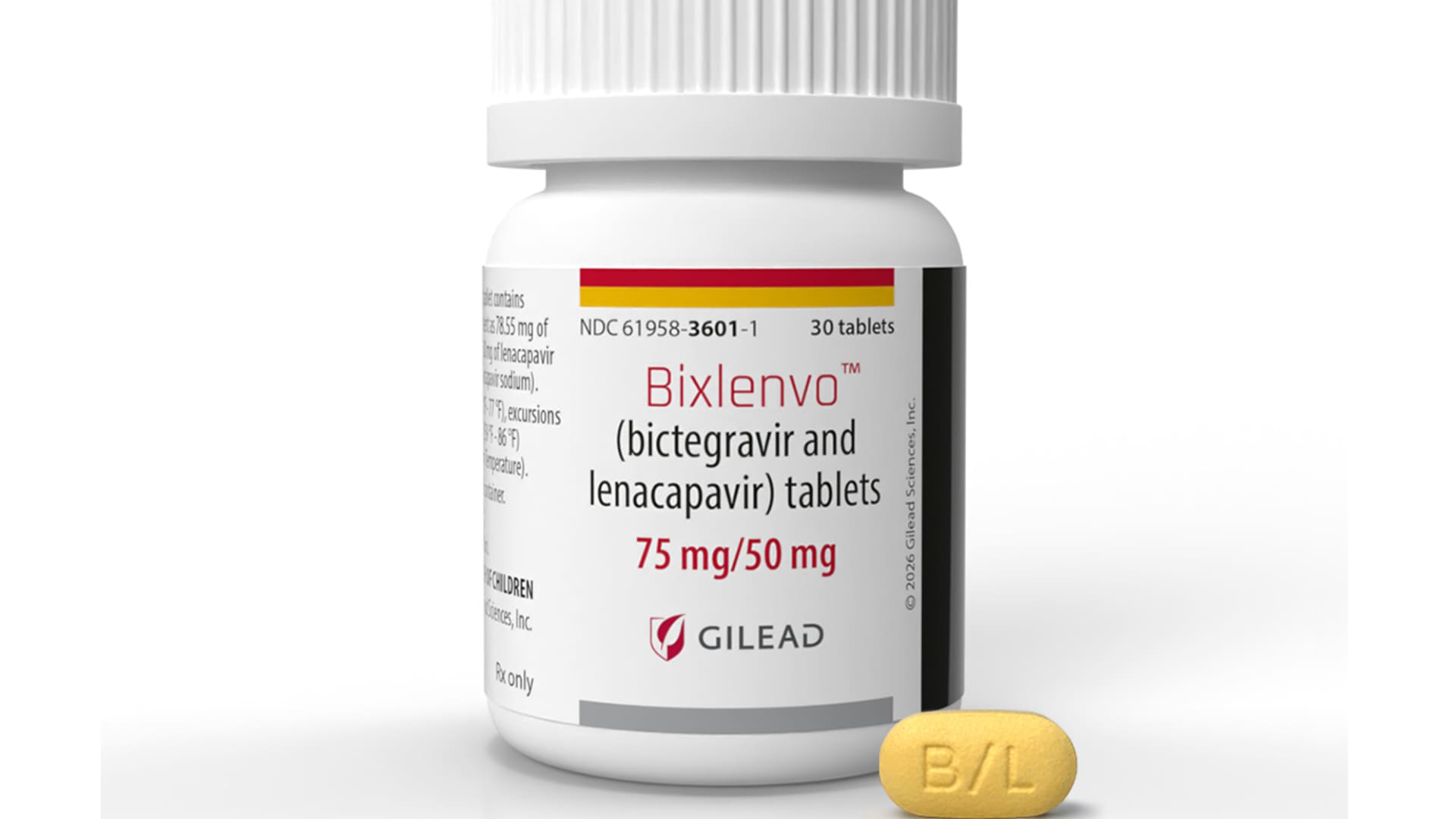
Gilead Bixlenvo drug
Courtesy: Gilead
The Food and Drug Administration approved a once-daily HIV pill from Gilead that could help simplify care for some patients, the company announced Thursday.
The drug, marketed as Bixlenvo, is aimed at patients whose virus is already under control but who remain on complicated treatment regimens. It could also appeal to those who simply want to switch to a new treatment alternative.
The tablet combines bictegravir, the backbone of Gilead’s blockbuster HIV pill Biktarvy, with lenacapavir, a first-in-class capsid inhibitor that has become a centerpiece of the company’s long-term strategy for HIV treatment and prevention.
The approval makes the new pill the first single-tablet regimen available for adults with HIV whose virus is suppressed but are unable to use currently available one-pill treatment options, according to Gilead. That population accounts for an estimated 5% or more of individuals in the U.S. living with HIV, the company told CNBC.
The list price of the pill before discounts or rebates is $4,595 for a 30-day supply, which is in line with other daily single-tablet HIV treatments, Gilead told CNBC. People without health insurance may be eligible to get Bixlenvo for free through Gilead’s patient assistance program, while those with commercial or private insurance may be able to receive co-pay support through another savings program, the company said.
“It fulfills an unmet need, particularly for individuals who are on complex regimens who just would not otherwise consolidate down to something really meaningful for them and prescribers,” Dr. Jared Baeten, Gilead’s clinical development and virology therapeutic area head, said in an interview ahead of the approval.
“But it’s also meaningful for individuals who are seeking options for something new,” he continued. “We want to build options that give people the opportunity to choose something that’s going to work for them and work for them for the long haul.”
There is no cure for HIV or AIDS. But many people living with HIV can manage the disease by taking a single pill daily, a treatment plan that Gilead helped pioneer two decades ago.
But some patients can’t use any existing one-tablet options like Biktarvy and require more complex combinations of medicines because of drug resistance from older therapies, side effects or interactions with other drugs, among other treatment challenges. Those patients may have to take multiple pills a day and adhere to complicated dosing schedules.
Baeten said that group tends to be older and have long treatment histories, saying “some had to take handfuls of pills around 25 years ago.” HIV also accelerates complications of aging, such as heart disease, diabetes and high cholesterol, in that age group, he added.
“It’s incredibly meaningful to develop a medicine, in my perspective, for people aging with HIV,” Baeten said.
The new pill is also aimed at people who are doing well on a single-tablet regimen, including Biktarvy, and want to switch to a new one. Baeten stressed that Bixlenvo does not aim to replace Biktarvy.
For patients already doing well on Biktarvy, the rationale for switching is more about expanding treatment choices, he said. He emphasized that HIV care is highly individualized and that long-term success often depends on finding a regimen that best fits a patient’s preferences and lifestyle.
Baeten also said Bixlenvo is part of Gilead’s broader effort to build a range of HIV treatment options around lenacapavir, including daily pills, weekly oral regimens and long-acting injectable therapies. The goal is to give patients flexibility to choose how they want to manage the disease, he said.
“We’re going to build enough options that people can make the choice that’s going to work for them,” Baeten said. “Some people like the surety of once a day, and some people would want ‘set it and forget it’ once every six months.”
What Bixlenvo is like for patients
Gilead Bixlenvo drug
Courtesy: Gilead
Baeten called it “essential” to have more than one medicine to treat HIV because the virus can become resistant to an initial treatment.
Combining bictegravir and lenacapavir in one pill allows it to “hit the virus in two different ways” with “high efficacy [and] strong protection” against the virus becoming resistant to treatment, Baeten added.
The approval is based on two Phase 3 trials, which evaluated Bixlenvo in adults with HIV whose virus was already suppressed on treatment. That includes people who switched from Biktarvy or complex treatment regimens with multiple tablets.
The first trial – ARTISTRY-1 – specifically enrolled patients with long treatment histories and drug resistance, many of whom were taking multiple HIV medications each day. Participants had a median age of 60 and were taking between two and 11 pills daily before switching to Bixlenvo.
In both studies, the pill maintained viral suppression at rates comparable to patients’ previous regimens at 48 weeks and was generally well tolerated with no new safety concerns. The most common side effects reported in at least 2% of participants across the two trials was headache, nausea and diarrhea.
Timothy Cameron, a 64-year-old retired Seattle resident who has been living with HIV for more than 40 years, was among the participants in the first Phase 3 trial.
When he was first diagnosed in the 1980s, doctors had few treatment options and little ability to measure how active the virus was. He spent decades cycling through HIV medications, experimental drugs and multi-pill regimens that often came with difficult side effects and eventually stopped working against his “hard-to-treat” virus.
“It was just like throwing darts at a dartboard,” Cameron said. “Because I had done so many drug trials and monotherapy, my virus had become super resistant.”
A few years before enrolling in the Gilead study, Cameron finally found a regimen that controlled his virus, though it required taking one HIV pill twice daily along with another medication. His doctor encouraged him to join the trial and switch to Bixlenvo, a once-daily pill Cameron described as “smaller than my pinky nail.”
The transition was seamless, he said. The drug maintained control of his virus without causing side effects and simplified his treatment routine by reducing the number of pills he takes and consolidating all of his medications into a single daily schedule.
For Cameron, who spent decades exhausting HIV treatment options as his virus developed resistance, among the biggest benefits may be that the two-drug regimen effectively controls his virus while exposing him to fewer medications. He said that gives him confidence that additional treatment options could remain available in the future if he ever needs them.
“It’s one less thing I’m putting in my body, and it preserves options if I need them,” Cameron said.

The robot pizza-making business has, it’s true, been littered with sorry tales of overcooked promises and melting fortunes. Besides Picnic, other companies that have come and gone include Zume, external and Pazzi, which used, external robot arms to assemble pizzas, as well as Basil Street, external, a purveyor of pizza vending machines.
Although so-called fast food might seem an easy target for automation, it’s proved harder than many expected. Plus, bringing robots into pizza restaurants could take away entry-level jobs in the hospitality sector. Is the future really filled with robotic pizza?
“We haven’t yet seen any of the success stories materialise the way some people thought they would,” admits Sara Senatore, senior restaurants analyst at Bank of America. Her employer has financial interests in multiple high street pizza chains including Papa Johns and Domino’s.
Food preparation bots are sometimes clumsy – dropping ingredients in the wrong places at times, she explains. Conversely, “Humans are very efficient at making pizza.”
But Kindell, despite his frustrations with Picnic, is surprisingly undeterred. He is a fan of full automation. “I want to be able to walk up to, let’s say, a type of kiosk, put in your order, and it makes a fresh pizza,” he tells the BBC.
Kindell, who once made all his dough by hand – until an elbow tendon injury forced him to investigate using machines instead, is now working on his own version of a pizza-making robot.
He declines to share details but the contraption will make square pan-style pies and that the machine is inspired by the way 3D printers work. If things go well, he says he could have a fully operational version of the device by the summer of 2027.
Given that he admits he has “no experience” in robotics, I question why he would want to invest in such a dicey business. Kindell says that failed pizza robot companies have nonetheless generated useful data and made strides in developing their technology. It’s just a matter of time before someone gets these things to work, he insists.
On jobs, he claims that even “fully autonomous” pizza robots won’t threaten workers. Kindell previously used Picnic’s robots at T-Mobile Park, home of the Seattle Mariners, a baseball team.
Usually, he’d need about 10 people to make pizza in such a setup. With the robots that number fell to just two. But the other eight people were still employed, he says, in roles where they interacted with customers, and advertised the pizza around the stadium.
“We had so many more people able to hand out the pizza,” says Kindell. “It was so much faster.”

The Big Four Recession Indicators: Real Personal Income

An Oil Catastrophe Was Averted in 2026. What If It Comes in 2027?

Stationery vendors are adapting to a changing market driven by tech and cost-of-living pressures.

BITCOIN JUST DID THE UNTHINKABLE…

Kylie Jenner poses for raciest photos ever as she finally responds to ‘self-made billionaire’ backlash

PM call to keep refugee numbers ‘not a backflip’





-

 Fashion6 days ago
Weekend Open Thread: Madewell – Corporette.com
-

 Crypto World2 days ago
SpaceX stock could rise 75% to $240, JPMorgan says
-

 Business5 days ago
Musk’s Tesla, SpaceX Confirm $16.8 Billion ‘Terafab’ Chip Plant as World’s Largest Building in Texas
-

 Crypto World6 days ago
anatomy of crypto’s biggest liquidation event since 2021
-

 Crypto World3 days ago
A $30 Billion AI Fund Implodes, Now the SEC Is Investigating Wall Street’s Role
-

 Politics6 days ago
6 months on, Irish renters crushed by effects of government housing bill
-

 Crypto World2 days ago
Did Trump Just Move SpaceX Stock With One Truth Social Post?
-

 Business5 days ago
Mystery AI Model ‘Ox Alpha’ Draws Developers With Free Access as Chinese Lab Origins Remain Debated
-
 NewsBeat6 days ago
The ‘Lucky Dip Gang’ causing carnage for clicks: After five thugs were killed speeding in the wrong direction on a motorway, GUY ADAMS investigates a sick new trend… and why police aren’t even allowed to pursue them
-
 Crypto World6 days ago
Nvidia Stock Suffers Longest Losing Streak Since 2022: Will Q2 Earnings End It?
-

 Business3 days ago
Moderna CEO warns China is pouring state money into mRNA technology
-

 Business3 days ago
NVIDIA Stock Drops Nearly 2 Percent to $210 on Seventh Losing Day Ahead of Critical AI Earnings
-

 Crypto World1 day ago
Warsh Jackson Hole keynote puts financial innovation first
-

 Tech6 days ago
Unitree’s New Superman Robot Claims to Outjump and Outrun Every Human, Usain Bolt Included
-

 Business6 days ago
UK firms in critical financial distress rise 9% to 53,756
-

 Sports5 days ago
Deshaun Watson fires back at Browns fans after being booed: ‘It’s a disrespectful thing’
-

 Crypto World5 days ago
Google Gemini AI Predicts Ethereum Could Become the Trade Retail Misses in 2026
-

 Tech6 days ago
Faster chip in a familiar form factor
-

 Business6 days ago
Will Tesla Stock Be Higher or Lower a Year From Now? Here’s What Wall Street Analysts Are Saying
-

 Business4 days ago
Tesla Recalls Nearly 3 Million Cars in China Over Hidden Door Handles Linked to Multiple Deaths Amid New Ban
You must be logged in to post a comment Login