
Business
Options market eyes 2022 playbook for Iran war risks

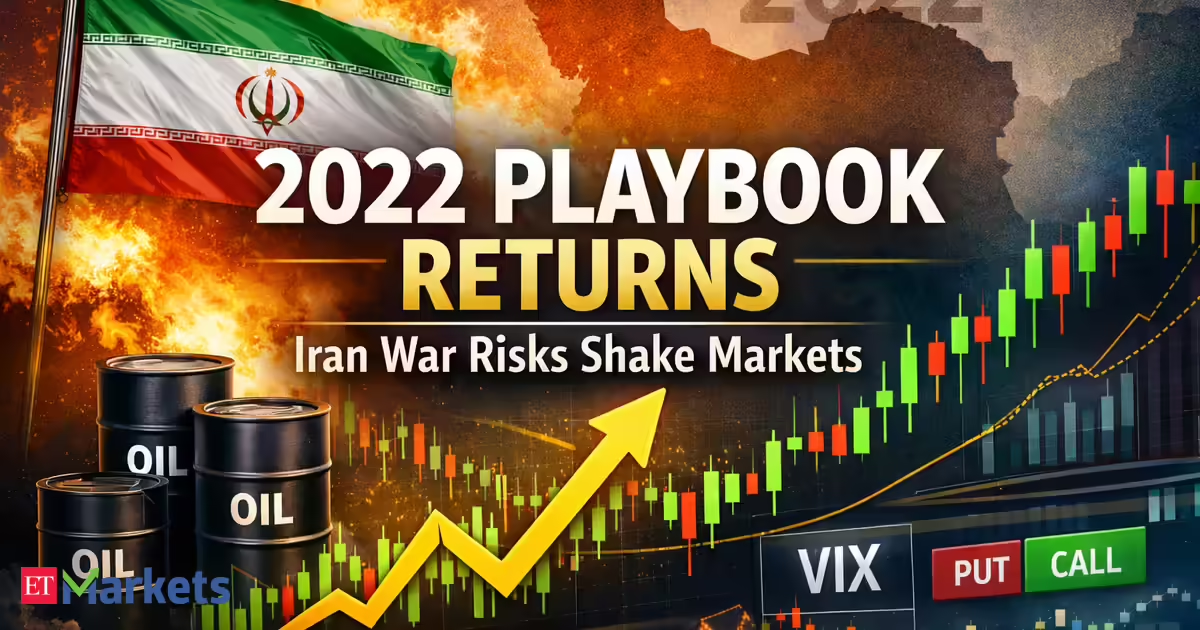
The key concern: an inflation shock that lifts correlations within stock indexes and spurs an extended period of higher volatility.
The spike in oil and natural gas is rippling through supply chains, threatening to raise prices not just for gasoline but for a wide range of goods and services. That’s shifted traders’ attention away from single stocks, as macroeconomic worries begin to outweigh more granular themes such as artificial intelligence. This, in turn, has narrowed the volatility premium for individual shares versus the wider S&P 500 Index and shrunk trading volumes.
 Bloomberg
While the VIX has been more sensitive to drops in the S&P 500, the overall realized moves at the index level have remained muted compared with past crises. The volatility gauge hasn’t closed above 30 points this year, after spending two weeks above that level during the tariff turmoil of last April.

In 2022, the VIX surpassed 30 points periodically following Russia’s invasion of Ukraine and averaged 25.64, more than 6 points above this year’s mean. The S&P 500 fell 19% that year as the Federal Reserve hiked rates multiple times.
“Investors are looking to the 2022 playbook for clues on how the current situation in Iran plays out for markets,” said UBS Group AG derivatives strategist Kieran Diamond. “The risk is an inflation shock, which could drive higher correlations within equity markets, and potentially switch the index volatility regime from fast VIX rises and reversals to one where the VIX floor rises and volatility is sustainably higher.”At the same time, the Cboe Skew Index of market stress has calmed in recent days, possibly because of the unwinding of hedges as investors became disillusioned with vanilla index puts, according to UBS strategists. The low level of realized volatility to the downside since the Middle East escalation may have also caused a general re-pricing of the skew curve.
BloombergWhile some discretionary traders have leaned into the short volatility trade via VIX put structures, the QIS space hasn’t seen a material shift in investor behavior, according to Michele Cancelli, global head of structuring for the multi-asset group at Citigroup Inc. and global head of QIS trading and structuring.
“Despite the elevated volatility risk premium in SPX, there’s little evidence of a rush into the short volatility trade,” he said. “We’re likely not far enough through the Iran-driven volatility window for investors to have conviction in monetizing it.”
Low realized volatility for the S&P 500 is at odds with the positioning of options dealers. Consensus has emerged among most derivatives strategists that dealers were short gamma heading into the quarterly expiry date. Realized volatility is notably higher intraday versus close-to-close, which may potentially be where dealer gamma is having the greater market impact.
Meanwhile, the broader market micro-structure does not appear to have changed all that much: There’s still significant call overwriting at the index level, as well as one-day-to-expiry condors being sold on an ongoing basis.
BloombergHowever, the bleeding out of index hedges — whether outright S&P 500 puts or trades like long VIX calls — doesn’t take away the risk-reward from such positions if the market does crack. Furthermore, some investors still see the value in leaning against popular trades such as volatility dispersion.
“We see better opportunities right now from being long index volatility and long intra-index correlation in terms of risk/reward,” said David Elms, head of diversified alternatives at Janus Henderson Group Plc. “Within that space, long correlation via reverse dispersion is interesting given the low levels of implied correlation and the floor to correlation being effectively zero.”
He noted that long convexity is also attractive given the carry cost is lower than historical norms, due to a flow imbalance.
BloombergAnother feature of markets has been intraday reversal, highlighting that while option dealers may be short gamma, they are not the key driver of prices in a macro headline-driven environment. The reversals on some level explain muted close-to-close realized volatility — suggesting a cohort of investors are still trading countertrend. On Thursday, the stock market was weak intraday but staged a big rebound into the close.
A flip of such price movement could see reversals giving way to genuine momentum, leading to an acceleration of stock gains as the end of the trading session nears.


Dollar jumps as failed US-Iran peace talks spark safe-haven push


Oil bounces back above $100 after US, Iran talks end in stalemate

Kornit Digital acquires PrintFactory to expand digital reach

US FTC in settlement talks with ad companies in boycott probe, WSJ reports


Hungary’s Orban concedes landmark defeat to centre-right opposition


US military says it will start blockade of all ships going to and from Iran on Monday

VanEck is a global asset management firm offering ETFs, mutual funds, private funds, model portfolios, institutional strategies, separately managed accounts, as well as UCITS funds. Since our founding in 1955, putting our clients’ interests first, in all market environments, has been at the heart of the firm’s mission. VanEck has a long history of looking beyond financial markets to spot trends that create meaningful investment opportunities. We were one of the first U.S. asset managers to give investors access to international markets, which set the tone for identifying asset classes and themes such as gold investing in 1968, emerging markets in 1993, and exchange traded funds in 2006 that later helped shape the investment industry. The firm oversees $161.7 billion in assets as of September 30, 2025. Disclosures: http://ow.ly/SZ9450N5qTJ.

Once inspired by Orban, Hungary’s Peter Magyar unseats him in landmark election
S&P 500: Distrust Direction (Technical Analysis)

VanEck is a global asset management firm offering ETFs, mutual funds, private funds, model portfolios, institutional strategies, separately managed accounts, as well as UCITS funds. Since our founding in 1955, putting our clients’ interests first, in all market environments, has been at the heart of the firm’s mission. VanEck has a long history of looking beyond financial markets to spot trends that create meaningful investment opportunities. We were one of the first U.S. asset managers to give investors access to international markets, which set the tone for identifying asset classes and themes such as gold investing in 1968, emerging markets in 1993, and exchange traded funds in 2006 that later helped shape the investment industry. The firm oversees $161.7 billion in assets as of September 30, 2025. Disclosures: http://ow.ly/SZ9450N5qTJ.

Ether Machine Merger Collapses as Dynamix Exits $50M SPAC Deal

This Forgotten 12-Part Sci-Fi Show Was ABC’s Wildest ‘Tron’ Knockoff

Bolton dad jailed after drug deal in Halliwell car park


-

 Business7 days ago
Three Gulf funds agree to back Paramount’s $81 billion takeover of Warner, WSJ reports
-

 Politics2 days ago
US brings back mandatory military draft registration
-

 Fashion2 days ago
Weekend Open Thread: Veronica Beard
-

 Tech5 days ago
How Long Can You Drive With Expired Registration? What Florida Law Says
-

 Politics8 hours ago
World Cup exit makes Italy enter crisis mode
-
 Sports2 days ago
Man United discover Nico Schlotterbeck transfer fee as defender reaches Dortmund agreement
-

 Fashion6 days ago
Massimo Dutti Offers Inspiration for Your Summer Mood Board
-

 Crypto World3 days ago
Canary Capital Files SEC Registration for PEPE ETF
-

 Fashion5 days ago
Let’s Discuss: DEI in 2026
-

 Business2 days ago
Tesla Model Y Tops China Auto Sales in March 2026 With 39,827 Registrations, Beating Cheaper EVs and Gas Cars
-

 Crypto World4 days ago
Bitcoin recovers as US and Iran Agree a Ceasefire Deal
-

 Politics3 days ago
Malcolm In The Middle OG Turned Down ‘Buckets Of Money’ To Appear In Reboot
-

 Business2 days ago
OpenAI Halts Stargate UK Data Centre Project Over Energy Costs and Copyright Row
-

 Business1 day ago
Ireland Fuel Protests Enter Day 5 as Blockades Spark Shortages and Government Prepares Support Package
-

 Tech7 days ago
Italian court says Netflix must refund customers up to $576 over price hikes
-

 Tech7 days ago
Haier is betting big that your next TV purchase will be one of these
-

 Tech7 days ago
Gamer Restores the Original PlayStation Portal From Two Decades Ago
-

 Tech7 days ago
The Xiaomi 17 Ultra has some impressive add-ons that make snapping photos really fun
-

 Tech7 days ago
Samsung just gave up on its own Messages app
-

 Politics3 days ago
LBC Presenter Mocks Trump Over Iran War Failures
You must be logged in to post a comment Login