

Business
Paras Defence, ideaForge, other defence stocks slide up to 5%. What’s triggering the selloff?

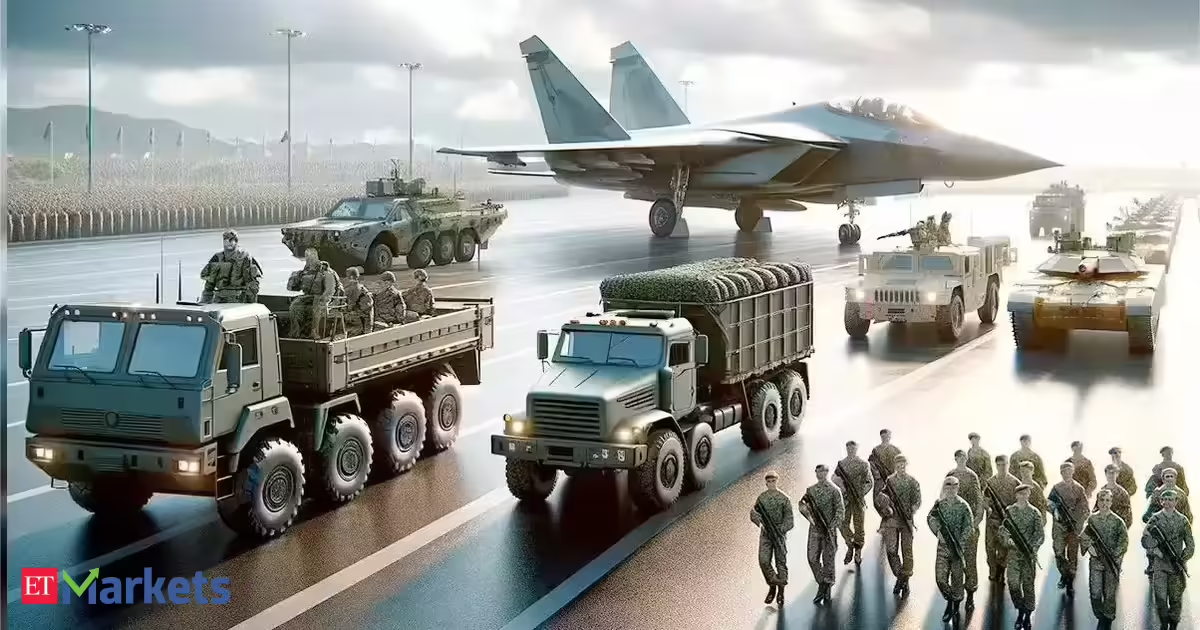
The rally on Monday came after the Defence Acquisition Council (DAC) approved capital acquisition proposals worth about Rs 52,000 crore. The approvals span a range of procurements aimed at enhancing the operational capabilities of the Army, Navy and Air Force, including air defence systems, anti-drone technologies, surveillance equipment and unmanned warfare platforms.
Among individual stocks, Data Patterns declined 5% to Rs 4,390, while Paras Defence fell nearly 5% to Rs 1,294 on the BSE. ideaForge also dropped 5% to Rs 812, while Bharat Dynamics slipped over 2% to Rs 1,375. Mazagon Dock and Cochin Shipyard were down as much as 3% during the session.
Also read: DAC clears Rs 52,000 crore defence acquisitions, boosts drone and air defence capabilities
DAC Approval
The latest approvals span several indigenous and advanced defence platforms across the three armed services, with a focus on improving preparedness against emerging aerial and mechanised threats.
For the Indian Army, the DAC cleared the procurement of the Anti-Unmanned Aerial Vehicles (UAV) Electronic Warfare System ‘AKASH TARANG’, Man Portable Anti-Tank Guided Missile (MPATGM) Systems, Medium Range Surface-to-Air Missile (MRSAM) Weapon System, Very Short Range Air Defence System (V-SHORADS), Active Protection System for Tanks and the Jet-Based Kamikaze Drone System.

For the Indian Navy, approvals were granted for the procurement of the Multi-Influence Ground Mine (MIGM), Naval Shipborne Unmanned Aerial System (NSUAS) and the establishment of a Land-Based Testing Facility (LBTF) for Electric Propulsion Systems.
For the Indian Air Force, the council approved the acquisition of a Fixed-Wing Based High Altitude Pseudo Satellite (FW-HAPS), along with other proposals. According to the ministry, the FW-HAPS platform will provide persistent intelligence, surveillance and reconnaissance (ISR), telecommunications, and remote sensing capabilities, strengthening the Air Force’s operational reach and endurance.
What are experts saying?
“This is likely to accelerate order inflows and execution for defence companies, as a larger share of procurement contracts can now be approved directly by the armed forces,” domestic brokerage Motilal Oswal said.
The brokerage has maintained its ‘Buy’ rating on HAL with a target price of Rs 5,500, implying an upside of 24% from current levels. It expects the company’s revenue to grow 9% year-on-year, supported by healthy execution of its opening order book. Investors will closely watch updates on deliveries of the Tejas Mk1A and HTT-40 aircraft, the partnership with GE for engine manufacturing and the working capital cycle.
Read more: Lessons from Op Sindoor: DAC nod to pseudo satellites, air defence systems, jet-based drones
Motilal Oswal has also reiterated its ‘Buy’ rating on Astra Microwave. The brokerage expects revenue to rise 13% year-on-year in the first quarter of FY27, with execution likely to gather pace on the back of an order book of around Rs 2,600 crore. Key monitorables include fresh ordering across larger platforms, margin sustainability and export opportunities.
For Bharat Electronics, the brokerage has retained its ‘Buy’ recommendation with a target price of Rs 510, suggesting a potential upside of 23% from current levels. It expects revenue to grow 16% year-on-year, driven by the execution of the company’s opening order book of about Rs 74,000 crore. Analysts will monitor updates on major orders, including QRSAM, Uttam radars, next-generation corvettes, P75I submarines and the progress of the AMCA programme.
(Disclaimer: Recommendations, suggestions, views and opinions given by the experts are their own. These do not represent the views of The Economic Times)



Decotion solutions are produced from monk fruit using a water-based decotion process.

The India business grew by more than 38%, while same-store sales rose around 28%, underscoring resilient consumer demand even during a period that traditionally sees a slowdown in wedding-related jewellery purchases in several parts of the country.
The company’s international business also delivered a strong performance, with revenue increasing about 35% year-on-year. The Middle East operations recorded around 30% growth despite geopolitical tensions affecting customer footfall during April. International markets contributed nearly 14% to consolidated revenue while digital-first jewellery platform Candere more than doubled its revenue, registering approximately 112% growth during the quarter.
A key highlight of the quarter was the sharp rise in the use of recycled gold. The company’s “Shine with India” gold recirculation campaign, launched in the second half of May, helped increase recycled gold’s share of revenue to more than 46% during the June quarter. In June alone, recycled gold accounted for over 55% of revenue, reflecting strong consumer participation in exchanging old jewellery.
The campaign comes at a time when India’s jewellery industry is increasingly looking to reduce dependence on imported bullion. With gold prices remaining elevated, consumers are increasingly opting to exchange idle jewellery for new purchases, boosting the availability of recycled gold. Industry executives say higher recycling not only reduces import dependence but also improves inventory management and working capital efficiency for organised jewellers.
During the quarter, Kalyan Jewellers opened 12 showrooms across India, while Candere added five new outlets. As of June 30, 2026, the group operated 524 stores globally, including 354 Kalyan showrooms in India, 38 in the Middle East, two in the US, one in the UK and 129 Candere outlets.
The company said the current quarter has begun on a positive note as it prepares for the festive and wedding season with new collections and further showroom expansion.


BettaF!sh grows Bayou Best Foods portfolio beyond plant-based shrimp.

A merger between Perth cyber safety software developer Qoria and Boston-based Aura Consolidated Group has received the green light from the Federal Court of Australia.


Midwest Dairy Accelerator helps scale emerging food, beverage brands using Midwest dairy in products.

The modern daily commute is facing a critical inflection point. For decades, the image of a successful professional was tied to a solitary drive in a personal vehicle—a symbol of independence and status.
Today, that same image represents an operational bottleneck, an environmental liability, and a primary source of workplace stress. As urban centers become increasingly congested and commercial real estate costs for corporate parking spaces skyrocket, organizations can no longer treat employee transportation as a secondary concern. The infrastructure of yesterday is simply incapable of supporting the workforce of tomorrow.
To bridge the gap between sustainability mandates and operational reality, forward-thinking enterprises are shifting away from passive transportation policies and turning toward Corporate Carpooling as a core mobility strategy. Scope 3 emissions—which encompass indirect emissions throughout a company’s value chain, including employee commuting—frequently represent a significant portion of a business’s total carbon footprint. By converting a disjointed grid of single-occupancy vehicles into a synchronized, efficient network, organizations can actively optimize the daily journey to the office, simultaneously delivering on ambitious Environmental, Social, and Governance (ESG) targets while reducing overhead costs.
1. The multi-layered benefits of shared mobility solutions
When looking closely at the mathematics of the daily commute, the inefficiencies are staggering. Millions of vehicles hit the asphalt every morning carrying only a single passenger: the driver. This systemic underutilization of assets accelerates the wear and tear on urban infrastructure, severely degrades local air quality, and forces companies to dedicate vast swathes of expensive real estate to multi-story concrete parking structures. By introducing shared mobility frameworks, businesses can immediately tap into a wealth of hidden operational advantages that directly impact the bottom line.
From a purely financial perspective, the traditional model of individual commuting creates immense hidden overhead. Companies operating in metropolitan areas face premium lease rates for parking blocks, money that could otherwise be allocated to core research and development or workspace innovation. When employees embrace a culture of shared transportation, the demand for physical parking bays drops dramatically. This spatial reclamation allows corporate facilities managers to downsize their real estate footprint or repurpose concrete parking zones into green communal spaces, collaborative outdoor lounges, or additional office infrastructure.
Beyond the physical asset optimization, the human element of shared mobility is equally compelling. The psychological toll of navigating gridlock traffic alone is well-documented, often leading to elevated cortisol levels and cognitive fatigue before an employee even clocks in. By distributing the driving responsibility among colleagues, professionals can transform dead travel time into an opportunity for relaxation, casual reading, or low-stakes collaboration. Furthermore, shared commutes naturally break down corporate silos, allowing team members from entirely different departments to converse, network, and build interpersonal trust outside the structured pressures of meeting rooms and digital dashboards.
2. Driving change: The Hybo Corporate Carpooling service
To bridge the gap between corporate intent and seamless execution, Hybo has integrated a sophisticated, automated carpooling engine directly into its comprehensive workspace management ecosystem. Organizing a successful, sustained carpooling network across a large enterprise requires aligning an immense number of fluid variables, including varying shift schedules, disparate residential neighborhoods, personal comfort preferences, and sudden changes in daily itineraries. Hybo eliminates the administrative friction that has traditionally plagued shared transit programs by embedding route optimization directly into the daily workflow.
The strength of Hybo’s service lies in its algorithmic simplicity for the end-user. Rather than requiring employees to navigate a secondary, disconnected transportation app, Hybo synchronizes transit coordination with desk and space bookings. When an employee schedules a day to work from the physical headquarters, the platform cross-references their residential zone and shift hours with data from nearby colleagues. The system then automatically proposes optimized pairings, mapping out the most efficient routes to ensure minimal detours and maximum punctuality.
To actively incentivize adoption, Hybo connects carpooling directly to parking asset allocation. Shared vehicles can be automatically granted priority access to prime, front-row corporate parking bays, complete with automated license plate recognition and integrated EV charging scheduling. Simultaneously, the platform acts as a critical telemetry tool for executive leadership. Every shared trip is tracked and converted into verifiable environmental data, calculating the exact metrics of carbon reduction and fuel saved[cite: 3]. These insights are automatically aggregated into visual compliance dashboards, providing corporate sustainability officers with audit-ready, empirical proof of Scope 3 emission reductions to substantiate their annual ESG disclosures.
3. The ecological and cultural return on investment
Implementing a smart, software-driven carpooling architecture yields dividends that ripple far beyond basic fuel savings. On a macro environmental scale, the collective reduction of hundreds of individual vehicles commuting to a single corporate hub creates a measurable decrease in local gridlock and urban greenhouse gas concentration. When an enterprise scales this behavior across thousands of employees globally, the environmental impact transitions from a symbolic gesture to a powerful, systemic force for ecological preservation, aligning perfectly with international net-zero benchmarks.
The Structural Impact: True sustainability is achieved when green practices are woven directly into the operational software of a business. By automating the shared commute, enterprises transform eco-friendly choices from an individual chore into the default, friction-free corporate standard.
Culturally, the shared journey acts as an organic catalyst for employee engagement and well-being. The modern workplace can occasionally feel fragmented, particularly within hybrid frameworks where teams rarely interact face-to-face across different organizational layers. The shared space of a carpool creates a unique social environment where horizontal communication happens naturally. Junior associates gain invaluable mentorship insights from senior managers, cross-departmental alignment improves organically, and the sense of isolation often exacerbated by remote work models is replaced by a tangible, supportive corporate community.

Despite speculation from many commentators about the looming crisis of AI-induced job losses, some evidence has suggested that these fears are partly unfounded.
Last week, Business Insider reported that job openings at tech companies in the United States have climbed nearly 14% so far this year, according to data provided by TrueUp.
In a recent interview with AI Expert and Tech entrepreneur Rotem Farkash, we got a better sense of the effect of AI on the jobs market and the wider economy. Farkash’s expertise stretches across the tech sector from cybersecurity to applied machine learning. Having previously founded two tech startups he is perfectly-placed to dissect the interplay of business and technology with the wider economy.
AI is the New Steam Engine
Farkash explained that the overall net long-term effect on the economy will be positive for both jobs and output, comparing the AI revolution with previous technological paradigm shifts.
‘In some ways AI is like every other vanguard industrial technology throughout history. We are living through another heightened era of what the Austrian economist Joseph Schumpeter called ‘creative destruction’. New sectors and jobs are being created and other sectors and jobs are experiencing a decline.’
‘In this sense, AI is like the steam engine or the railway or the computer’, Farkash continued. ‘It shrinks the demand for some sectors, but it also creates huge new ones while raising productivity in many kinds of tasks’.
AI will lead to genuine productivity gains
Some professionals have questioned whether AI would actually deliver meaningful improvements in productivity. When pressed on this, Farkash, who himself is an AI startup founder, was unequivocal.
‘AI will fundamentally transform human productivity,’ said Farkash, explaining that the technology’s ability to conduct data analysis, and execute coding, writing and visualisation tasks, are already quite impressive.
Take for example, the impact it could have on our health and sciences sector. Scientific researchers can now process data and source information that may have taken them weeks. A recent trial study for the British National Health Service found that an AI-powered administrative support could save an average of 43 minutes per staff member per day. This AI can speed up administrative tasks such as rota building, equipment and bed management and patient discharge processes. The result of this is lower waiting times and more focus by clinicians on patient care rather than bureaucracy.
Human skills are still unique
Farkash was at pains to explain that human ingenuity would always be valued in the jobs market. ‘There are obvious advantages that human intelligence maintains over AI. AI is not wholly reliable and can fail to contextualise information. As many others have pointed out, it also currently only operates on the existing archive of human intelligence. It is a high-speed imitator. Real lateral thinking is still a human asset. This applies just as much to scientists as it does for jobs that involve understanding cultural contexts like law, diplomacy or journalism’.
‘There is also the question of trust’, Farkash continued. ‘AI models are trained on certain information and behavioural programming, but this is not always transparent. Human beings are also arguably the sum of their educational influences and biases but are often more transparent. People often prefer humans because their biases are easier to understand. On some level you must have a human being to handle the client relations of any business. It is a cliché but so much of business is about relationships and AI won’t change that.’
Farkash explained that this is particularly true for white-collar service jobs such as lawyers, accountants and consultants, which have long been thought the most vulnerable to being replaced by AI.
‘Humans can be held accountable. You cannot sue or properly hold an AI model accountable. If there are issues with your accounting or legal advice, you can only sue an accountant or lawyer.’
The big picture is optimistic
In his concluding thoughts, Farkash emphasised the need for a balanced but ultimately optimistic perspective on the future for the overall economy.
‘I think AI is and will continue to lead to significant improvements in human productivity which will bring all kinds of benefits in the speed, cost and quality of goods and services.’
Regarding the jobs market, Farkash summarised: ‘It’s important to recognise that in the short and medium term, there will be disruption. Some industries will also experience a contraction and that is regrettably a side effect of technological innovation. On the macro-level however, there is a lot of reason to hope that there will be new demand for existing products and entire new sectors related to AI which will keep employment steady. I think it is important to take a balanced view of these things without losing sight of this optimism.’


New consumer needs drive innovation.
Business
Messi’s World Cup Penalty Conversion Rate Falls to 50% After Second Miss Against Egypt, Trailing Ronaldo


IBTimes US
ATLANTA — Lionel Messi’s missed penalty against Egypt on Tuesday has pushed his career World Cup penalty conversion rate down to 50 percent, widening the gap between the Argentine captain and longtime rival Cristiano Ronaldo, who has converted 80 percent of his own World Cup penalty attempts, excluding shootouts, according to data from MessivsRonaldo.app.
🚨 𝗗𝗜𝗗 𝗬𝗢𝗨 𝗞𝗡𝗢𝗪: Cristiano Ronaldo has scored 80% of the penalties he has taken at the World Cup.
Lionel Messi’s conversion rate is 50%. pic.twitter.com/WDaXnaqRmp
— The Touchline | 𝐓 (@TouchlineX) July 7, 2026
Tuesday’s miss, which came in the 20th minute of Argentina’s Round of 16 match at Mercedes-Benz Stadium, marked the second time this tournament Messi has failed to convert from the spot in regulation play, following a similar miss earlier in the group stage against Austria. That earlier miss had briefly denied Messi the chance to become the all-time leading scorer in men’s World Cup history, though he went on to score twice later in that match to secure the record regardless.
Ronaldo, by contrast, has built a reputation as a more consistent penalty taker across World Cup competition specifically, even though broader career statistics show a closer overall picture between the two players. According to career-wide figures compiled by MessivsRonaldo.app, Ronaldo has converted approximately 84 percent of his penalties across his entire career, compared to roughly 78 percent for Messi, a gap driven in part by Ronaldo having taken significantly more penalty attempts over a longer career.
The disparity narrows further when factoring in penalty shootouts specifically, where Messi has actually posted a slightly higher career success rate than Ronaldo, converting 11 of 13 shootout attempts compared to Ronaldo’s 12 of 14.
Despite Tuesday’s miss, Messi remains tied for the lead in this year’s tournament’s Golden Boot race with seven goals, level with Norway’s Erling Haaland and France’s Kylian Mbappe. Argentina’s Round of 16 match against Egypt continued Tuesday afternoon as both sides looked to advance toward a quarterfinal matchup against the winner of the Switzerland-Colombia tie later this week.
UBS managing director and senior portfolio manager Jason Katz joins ‘Varney & Co.’ to give his outlook on the markets in the second half of the year.
Toyota is investing $3.6 billion to expand its San Antonio, Texas, assembly plant, a move expected to create about 2,000 new jobs and bring Toyota Tacoma pickup production from Mexico to the Lone Star State.
The automaker announced Monday that it will build a second vehicle assembly line at its San Antonio campus, allowing the facility to assemble the Tacoma alongside the Tundra and Sequoia.
As part of the expansion, Tacoma production will gradually transition from Toyota’s Baja California plant in Mexico over the next four years, according to the company. Toyota will continue producing Tacoma pickups at its Guanajuato, Mexico, plant.
BMW NORTH AMERICA CEO TOUTS ‘LONG GAME’ IN US
The project will add about 2.5 million square feet to the manufacturing campus, effectively doubling the site’s size by 2030 and bringing Toyota’s total investment in the San Antonio operation to $8.3 billion since construction began in 2003. Toyota previously moved Tacoma production from San Antonio to its Guanajuato plant in 2020.
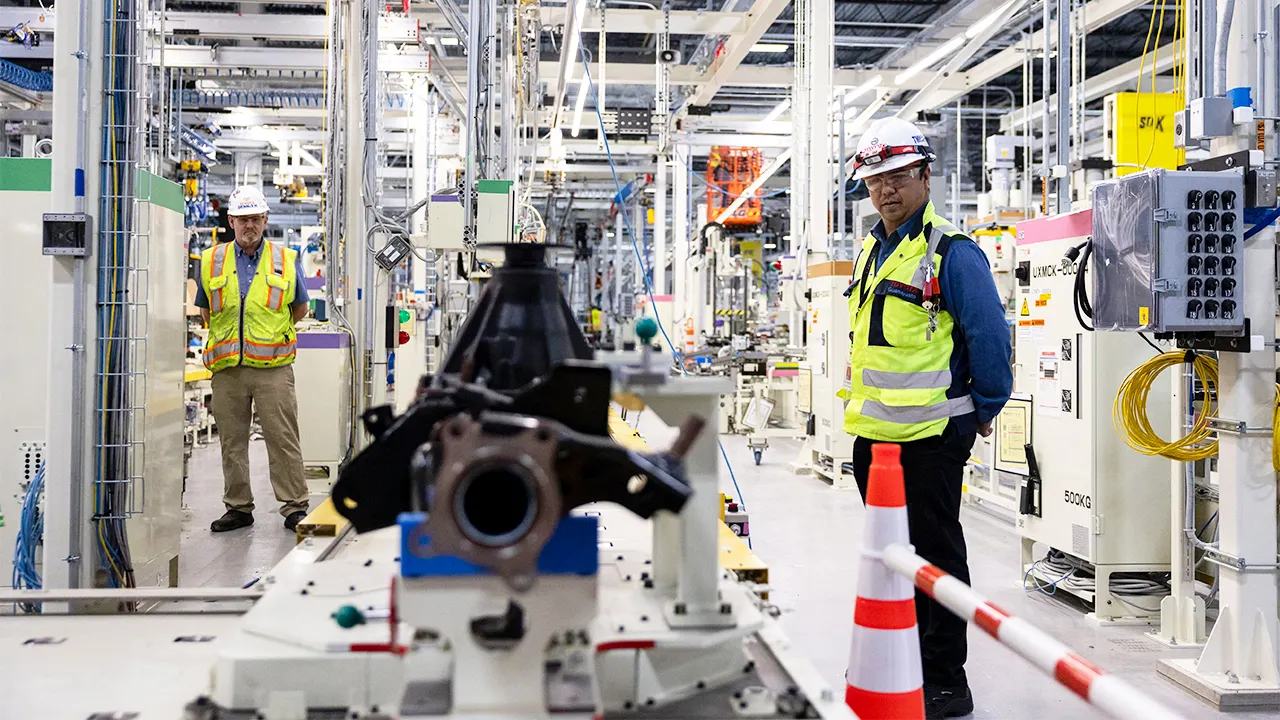
Workers stand by the assembly line at the new rear axle plant at Toyota Texas in San Antonio on March 2, 2026. (Katina Zentz/San Antonio Express-News via Getty Images)
Toyota said the investment reflects its confidence in North America’s workforce, innovation and long-term growth potential. The expanded facility will also incorporate advanced manufacturing technologies designed to increase production flexibility.
The announcement is another major manufacturing win for Texas, which has attracted billions of dollars in industrial investment in recent years as companies cite the state’s business-friendly policies, workforce and available land. Gov. Greg Abbott said the expansion, supported by the Texas Enterprise Fund and JETI program, will qualify for a $20 million state grant and other incentives and reinforces Texas’ position as a leading destination for advanced manufacturing.
FORD REHIRES EXPERIENCED ENGINEERS AFTER AI MISSES THE MARK
| Ticker | Security | Last | Change | Change % |
|---|---|---|---|---|
| TM | TOYOTA MOTOR CORP. | 179.80 | +5.21 | +2.98% |
Once completed, Toyota’s San Antonio workforce is expected to grow to approximately 6,000 employees, supported by 23 onsite suppliers. The plant produced more than 197,000 vehicles last year and remains the exclusive assembly site for the Tundra and Sequoia. Production at a new rear axle facility is also expected to begin later this year.
Toyota said it remains committed to manufacturing across the United States, Canada and Mexico while encouraging a swift resolution to issues surrounding the U.S.-Mexico-Canada Agreement to help keep North America’s auto industry globally competitive.
AVERAGE NEW CAR PAYMENT REACHES ALL-TIME HIGH AS AFFORDABILITY ISSUES PERSIST
The investment comes as President Donald Trump has pushed automakers to expand U.S. manufacturing while imposing tariffs on imported vehicles, auto parts, steel and aluminum as part of his broader trade agenda.

President Donald Trump weighed in on Toyota’s announcement Tuesday in a post on Truth Social. (Anna Moneymaker/Getty Images)
Trump has argued the tariffs will encourage companies to shift production to the United States, while automakers have warned the levies could increase costs and disrupt North America’s integrated supply chain.
CLICK HERE TO GET FOX BUSINESS ON THE GO
Trump weighed in on Toyota’s announcement Tuesday in a post on Truth Social, writing: “Toyota is moving from Mexico to the United States (Texas!). A really big deal. Tariffs at work!”

Osaka’s Wimbledon dreams ended by impressive Muchova as Gauff reaches semis

Layn Natural Ingredients expands monk fruit portfolio

Nigel Farage to Resign as MP in Crypto “Gift” Scandal


-

 Fashion4 days ago
Weekend Open Thread: High Hopes
-

 Fashion1 day ago
Open Thread: What Great Books Have You Read Recently?
-
 NewsBeat3 days ago
Taylor Swift and Travis Kelce wedding staffer hilariously struggles to keep her cool while checking in megastars
-

 Politics4 days ago
The House | “Reframing the debate from a binary discussion of winners and losers”: Yuan Yang reviews ‘We Are Not Machines’
-
 Crypto World6 days ago
Airdrop Registration Becomes Key Focus For Remittix As RTX Launch Updates Approach
-

 Crypto World4 days ago
Standard Chartered Secures MiCA License as ESMA Adds 37 New Crypto Firms
-

 Sports6 days ago
Broncos roster: OL Ben Powers (No. 74) entering final year of contract
-

 Business23 hours ago
AXT Shares Jump Nearly 14% as Semiconductor Materials Maker Rebounds on AI-Linked Indium Phosphide Demand
-

 Crypto World6 days ago
Binance stock trading tops $1B in first month after launch
-

 NewsBeat7 days ago
Presenter Caroline Flack’s brother Paul Flack dies aged 55
-

 Crypto World6 days ago
Alibaba-affiliate Ant Group enters the humanoid robot market with 12 deals
-
Crypto World23 hours ago
SK hynix (000660.KS) Stock Dips as $28B Nasdaq ADR Offering Drives AI Memory Expansion
-

 Crypto World2 days ago
South Africa proposes crypto tax guidance under existing rules
-

 News Videos1 day ago
Best Time to Enter Small Caps Right Now? Another Bull Run? | Financially Free
-

 Tech2 days ago
Lenovo laptops are now shipping with YMTC SSDs, a sign of Chinese NAND entering the mainstream
-

 Business6 days ago
Meta Platforms Stock Jumps 7% Today as Bloomberg Reports Company Plans to Enter the Cloud Business
-
 NewsBeat5 days ago
New exhibition reflects five decades of movement between island of Ireland and GB
-

 News Videos14 hours ago
Whats Hidden Inside This Cash Register? #treasure #reselling #money
-

 Business5 days ago
What a 10 Percent Drop Means for Buyers, Sellers and Renters
-

 Crypto World5 days ago
Binance Re-Enters Philippines As EU MiCA Rules Restrict Access
You must be logged in to post a comment Login