






Business
Six innovators join dairy accelerator program
Business
Ford recalls Mustang vehicles over windshield wiper, drivetrain defects
Check out what’s clicking on FoxBusiness.com.
Ford is recalling more than 110,000 vehicles in the U.S. across two separate safety campaigns after federal regulators identified defects involving windshield wipers and a rear drivetrain component that could increase crash risks.
According to the National Highway Traffic Safety Administration (NHTSA), the automaker is recalling 110,626 vehicles in two separate actions affecting certain Mustang, Mustang GTD and Mustang Mach-E models.
The larger recall affects 67,842 Mustang and Mustang GTD vehicles. NHTSA said that under certain cold-weather conditions, the windshield wipers may operate only at the high-speed setting, while the windshield washer system may not function properly. The agency said the reduced visibility could increase the risk of a crash.
FORD RECALLS 741,195 SUVS AND PICKUPS AFTER TRANSMISSION DEFECT RAISES ROLLAWAY RISK: NHTSA

A few brand-new Ford Mach-E Mustangs for sale at a dealership in Santa Clarita, California. (Getty Images)
In a separate recall, Ford is recalling 42,784 Mustang Mach-E vehicles because the rear differential pinion shaft may fracture.

Ford Motor Co. signage is displayed outside a dealership as the General Motors Co. headquarters building stands in the distance in Detroit, Michigan. (Jeff Kowalsky/Bloomberg via Getty Images )
THE $5 PLASTIC CLIP BEHIND MILLIONS OF FORD EXPLORER RECALLS: REPORT
According to NHTSA, the defect could result in a loss of drive power or unintended vehicle movement if the SUV is parked without the parking brake applied, increasing the risk of a crash.
Dealers will repair or replace the affected components free of charge.
FORD IN DEEP WATER AFTER SWEEPING RECALLS HIT EVERY MODEL SINCE 2020 – WITH ONE EXCEPTION
| Ticker | Security | Last | Change | Change % |
|---|---|---|---|---|
| F | FORD MOTOR CO. | 13.83 | +0.47 | +3.52% |
Ford shares were flat in early trading and are up more than 5% year to date.
CLICK HERE TO GET FOX BUSINESS ON THE GO
Reuters contributed to this report.
Business
One Brands debuts Reese’s layered protein bars

Made with chocolate-peanut butter combination Reese’s is known for.
Business
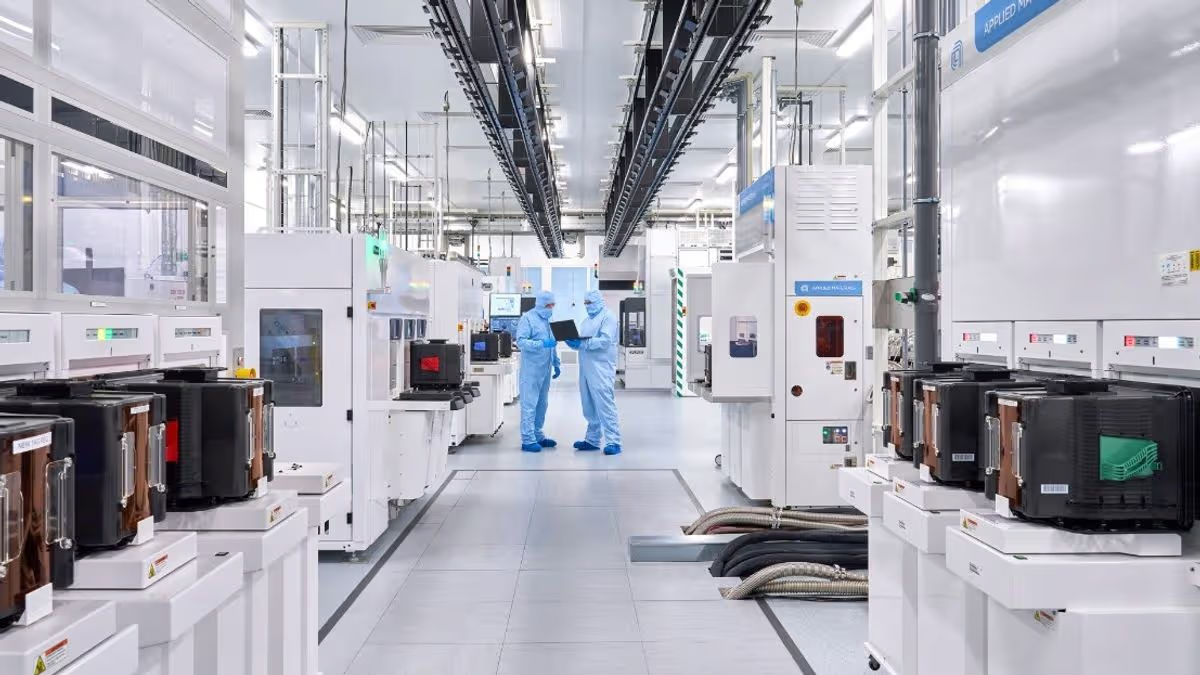
Micron, Intel shares crash up to 8% as Samsung fails to calm concerns over AI
The selloff hit several chip names. Intel fell 3.3%, while Marvell Technology dropped 4.5% amid broader weakness in the sector. The pressure came after a sharp fall in Asian chip stocks earlier in the day, led by Samsung Electronics and SK Hynix.
Samsung shares tumbled 6.9% in Seoul even after the company forecast a 19-fold jump in second-quarter operating profit. The numbers beat expectations and marked a major recovery for the South Korean chipmaker, but investors were not impressed. The stock had already more than doubled this year before Tuesday’s fall, leaving little room for even a strong earnings surprise.
The weakness spread across South Korea’s market. The KOSPI closed down 4.9% after falling as much as 8.2% intraday. Circuit breakers were triggered during the session as volatility in semiconductor stocks intensified. SK Hynix, another major AI memory winner, also fell sharply.
The selloff showed a shift in investor mood. For most of the year, chip stocks have been among the biggest winners of the AI trade, helped by expectations of strong demand for memory, data centre chips and AI infrastructure. But after a powerful rally, investors are now questioning how much of that growth is already priced in.
Micron has been one of the companies seen as a beneficiary of rising memory demand from AI servers. High-bandwidth memory and advanced DRAM have become important parts of the AI supply chain, with investors betting that demand from cloud companies and chip designers will support pricing and margins. Tuesday’s fall suggests that the market is becoming more selective, even for companies tied to AI infrastructure.
Sentiment was also hit by a Reuters report that Chinese startup DeepSeek is developing its own AI chip. The chip is aimed at inference tasks and could reduce DeepSeek’s reliance on Nvidia and Huawei chips, Reuters reported, citing sources. The project is still at an early stage but reflects a broader push by Chinese AI companies to build more of their own hardware as US export controls limit access to advanced chips.That news added to concerns that the AI hardware market may become more fragmented over time. While demand for AI chips remains strong, investors are watching whether large AI companies and startups begin shifting towards custom chips, which could change the demand outlook for established suppliers.
The immediate trigger for the weakness, however, was Samsung’s market reaction. The company’s forecast showed that earnings are recovering sharply as memory prices improve and AI demand supports advanced chips. But the fall in the stock after such a strong forecast suggested that investors had already built in much of the good news.
Chip stocks have seen similar bouts of volatility in recent weeks as investors weigh strong near-term earnings against high valuations. The sector has benefited from massive AI spending by technology companies, but questions remain over how quickly that spending will translate into profits across the broader AI ecosystem.
Business
Why More People Are Looking for a Meditation Center in Dubai to Restore Inner Balance
In a world that rarely slows down, finding moments of stillness has become more important than ever. Busy schedules, digital overload, work pressure, social demands, and constant mental stimulation can leave people feeling disconnected from themselves without even realizing it.
Many carry stress in their body, race through their days on autopilot, and struggle to fully switch off—even during rest. As a result, more individuals are searching for healthier ways to create calm, regain clarity, and reconnect with a deeper sense of balance. This is one of the reasons interest in a meditation center Dubai experience continues to grow.
Meditation is no longer viewed as something reserved only for spiritual retreats or people with years of practice. It has become a practical and powerful tool for modern well-being. Whether someone is trying to manage anxiety, reduce mental clutter, improve focus, sleep better, or simply feel more grounded, meditation offers a space to pause and reset. And when practiced in a supportive environment, it can become even more impactful.
Why Meditation Feels So Relevant Today
The pace of modern life often keeps the nervous system in a state of overactivity. Even when people are not physically busy, the mind can remain active—replaying conversations, worrying about the future, thinking about work, or jumping from one thought to another without rest. Over time, this mental noise can affect mood, concentration, energy levels, emotional resilience, and sleep quality.
Meditation offers a way to interrupt that pattern. It creates a moment where the mind does not need to chase, solve, perform, or react. Instead, it is invited to observe, breathe, and settle. This may sound simple, but in reality it can be deeply transformative. A regular meditation practice helps people build awareness of their thoughts rather than being controlled by them. It teaches stillness in the middle of chaos and creates a sense of inner space that many people don’t realize they’ve been missing.
This is why so many are now drawn to guided meditation experiences rather than trying to figure it out alone. A dedicated meditation space removes distractions and creates the right atmosphere for the mind and body to relax more naturally.
More Than Just Sitting Quietly
One of the biggest misconceptions about meditation is that it means forcing the mind to be empty. In reality, meditation is not about shutting thoughts off completely. It is about learning how to sit with the present moment without constantly being pulled away by stress, noise, and internal pressure. Some sessions focus on breath awareness, others on mindfulness, visualization, relaxation, emotional release, or guided inner reflection.
A calm environment can make this process much easier, especially for beginners. Rather than sitting at home with interruptions, phone notifications, or a racing mind, many people find that a guided session in a dedicated setting allows them to drop into the experience more deeply. A well-designed meditation center offers more than silence—it creates a sense of safety, grounding, and support that helps people settle inwards.
The Emotional and Mental Benefits of Meditation
Meditation has become increasingly popular because of how much it can support both mental and emotional well-being. People often begin meditating because they feel stressed, overwhelmed, or emotionally drained, but over time they discover that the benefits go much further. Meditation can support emotional regulation, improve self-awareness, reduce mental reactivity, and create a stronger sense of calm in daily life.
For some, it becomes a way to process emotions they’ve been carrying quietly for a long time. For others, it helps them sleep better, become more focused at work, or feel less consumed by worry and overthinking. It can also improve how people respond to difficult situations by creating a little more pause between what they feel and how they react.
In a city where daily life can move quickly and external demands are high, these benefits become especially valuable. A meditation practice is not about escaping reality—it’s about becoming more steady within it.
Why People Are Seeking Meditation in Dubai
Dubai is a city full of ambition, movement, and opportunity. It’s exciting, inspiring, and dynamic, but it can also be intense. Long workdays, fast routines, social expectations, and a constant drive to keep up can take a toll on the nervous system over time. Even people who appear successful and productive on the outside may still feel mentally overloaded, emotionally tired, or disconnected from themselves internally.
This is exactly why the search for a meditation center Dubai experience is becoming more common. People are not just looking for relaxation; they are looking for a reliable way to create peace within a fast-paced lifestyle. Meditation offers a way to reset from the inside out. It helps people step out of mental noise and reconnect with breath, presence, and stillness—things that often get lost in a busy routine.
For professionals, parents, creatives, entrepreneurs, and anyone carrying emotional or mental fatigue, meditation can become an anchor. It creates a pause in the middle of movement and gives the mind a place to rest.
A Supportive Space Makes a Difference
While meditation can absolutely be practiced anywhere, the environment matters—especially when someone is building the habit or wants a deeper experience. A dedicated meditation space helps signal to the body and mind that it is time to slow down. It offers intentional stillness in a world full of stimulation.
This kind of environment can also be especially helpful for people who feel they “can’t meditate.” Often, the issue isn’t that meditation isn’t for them—it’s that they’ve never had the right guidance or setting. When meditation is introduced in a welcoming and supportive way, it becomes much more accessible. It stops feeling like a task and starts feeling like a release.
Some people also benefit from combining meditation with other wellness practices such as breathwork, sound healing, energy work, or holistic therapies. Together, these practices create a fuller sense of restoration and help support emotional, physical, and energetic balance.
Meditation as a Long-Term Wellness Practice
One of the most powerful things about meditation is that its value grows over time. Even short, regular sessions can begin to shift how a person experiences daily life. Instead of constantly reacting to stress, they may start feeling more grounded. Instead of carrying tension all day, they may find it easier to release it. Instead of feeling scattered, they may experience more focus and emotional steadiness.
Meditation doesn’t need to be complicated to be meaningful. It simply needs consistency, intention, and a space that supports the experience. In that sense, visiting a meditation center is not just about taking a break—it’s about building a healthier relationship with the mind and creating room for calm in everyday life.
For anyone looking to experience the deeper benefits of meditation in a nurturing and holistic setting, Home of Wellness offers a thoughtful place to begin. With a focus on inner balance, emotional well-being, and restorative practices, it provides a peaceful environment for those exploring meditation as part of their wellness journey. For anyone searching for a more grounded and meaningful meditation center Dubai experience, Home of Wellness reflects the kind of calm, support, and intentional care that modern life truly needs.
Business
Midwesterners retire to Florida Gulf Coast, fueling Sarasota boom
Florida CFO Blaise Ingoglia addresses concerns that New Yorkers moving to the state will bring leftist ideology and business-unfriendly policies. He delivers a clear message to new residents.
A community on Florida’s Gulf Coast has seen a large influx of new residents from the Midwest who are driving the area’s rapid growth.
The population of Sarasota County, Florida, has grown 12.4% over the five years leading up to April 2025, according to Florida’s Bureau of Economic and Business Research (BEBR).
Midwesterners have flocked to the community for a permanent move as they approach or begin retirement, following the path taken by many of the region’s snowbirds who relocate to the warmer climate during cold Midwest winters.
“The surge of Midwesterners into Sarasota reflects a confluence of factors that have been building for decades, including the natural I-75 corridor, the Gulf’s calmer and more accessible beaches and a cultural tempo that feels closer to the Midwest than Miami’s intensity does,” Realtor.com senior economist Hannah Jones told FOX Business.
SILICON VALLEY ELITE SHIFT RECORD WEALTH TO BUILD FLORIDA’S NEW ‘TECH CAPITAL’

Sarasota County, Fla., has seen a large influx of new residents over the last decade, with many relocating from the Midwest. (iStock)
While the uptick in Midwesterners to the region began before the COVID-19 pandemic, the economic disruption caused by the pandemic helped accelerate the trend as remote work made it easier for those still in the workforce to relocate.
“What accelerated that long-standing pattern was the pandemic, which untethered buyers from their offices and gave them both the means and the motivation to make a move they might have otherwise saved for retirement,” Jones said.
Data from the Census Bureau showed that about 1,585 people from Michigan relocated to Sarasota County from 2018 to 2022, while other Midwestern states weren’t far behind. Illinois contributed 1,399 transplants, and Ohio added another 1,282.
HOUSING AFFORDABILITY UNLIKELY TO RETURN TO MORE AFFORDABLE LEVELS OF THE PAST, ECONOMIST SAYS

Sarasota remains in demand despite lower home prices in areas like Cape Coral and Tampa. (Octavio Jones/AFP via Getty Images)
Florida’s BEBR data showed a net influx of 72,493 residents to Sarasota from 2020 to 2025. IRS data showing county-to-county flows from 2022-23 showed about 5,300 Midwesterners relocated to the area and accounted for about 17.5% of incoming residents, making the region the second-largest source of new residents behind the Northeast.
The influx of new residents initially overwhelmed Sarasota’s housing market, and Jones noted that the “resulting demand wave hit Sarasota hard: Inventory cratered, prices spiked and the market briefly rewarded anyone willing to waive contingencies and close quickly.”

INCOME NEEDED TO AFFORD A MEDIAN-PRICED HOME HAS NEARLY DOUBLED SINCE 2020, REPORT FINDS

Florida’s population surge intensified during the COVID pandemic when its economy remained relatively open compared with other states. (Zak Bennnett/Bloomberg via Getty Images)
Over time, the market adjusted and home prices in the areas have stabilized such that Sarasota remains in demand despite having a higher median listing price of $487,000 in May 2026, compared with nearby cities like Tampa ($400,000) and Cape Coral ($399,000).
“The supply response came partly through new construction, but the condo market in particular outran the post-pandemic appetite, leaving that segment softer even as single-family inventory has since tightened back up,” Jones said.
GET FOX BUSINESS ON THE GO BY CLICKING HERE
“What Sarasota is navigating now is less a retreat than a recalibration. The underlying draw to Sarasota County hasn’t changed, but the market has shifted from one that penalized hesitation to one that rewards it.”
Business
Layn Natural Ingredients expands monk fruit portfolio

Decotion solutions are produced from monk fruit using a water-based decotion process.
Business
Kalyan Jewellers posts strong Q1 growth on robust demand
The India business grew by more than 38%, while same-store sales rose around 28%, underscoring resilient consumer demand even during a period that traditionally sees a slowdown in wedding-related jewellery purchases in several parts of the country.
The company’s international business also delivered a strong performance, with revenue increasing about 35% year-on-year. The Middle East operations recorded around 30% growth despite geopolitical tensions affecting customer footfall during April. International markets contributed nearly 14% to consolidated revenue while digital-first jewellery platform Candere more than doubled its revenue, registering approximately 112% growth during the quarter.
A key highlight of the quarter was the sharp rise in the use of recycled gold. The company’s “Shine with India” gold recirculation campaign, launched in the second half of May, helped increase recycled gold’s share of revenue to more than 46% during the June quarter. In June alone, recycled gold accounted for over 55% of revenue, reflecting strong consumer participation in exchanging old jewellery.

The campaign comes at a time when India’s jewellery industry is increasingly looking to reduce dependence on imported bullion. With gold prices remaining elevated, consumers are increasingly opting to exchange idle jewellery for new purchases, boosting the availability of recycled gold. Industry executives say higher recycling not only reduces import dependence but also improves inventory management and working capital efficiency for organised jewellers.
During the quarter, Kalyan Jewellers opened 12 showrooms across India, while Candere added five new outlets. As of June 30, 2026, the group operated 524 stores globally, including 354 Kalyan showrooms in India, 38 in the Middle East, two in the US, one in the UK and 129 Candere outlets.
The company said the current quarter has begun on a positive note as it prepares for the festive and wedding season with new collections and further showroom expansion.
Business
Bayou Best Foods reels in BettaF!sh

BettaF!sh grows Bayou Best Foods portfolio beyond plant-based shrimp.
Business
Court approves Qoria merger
A merger between Perth cyber safety software developer Qoria and Boston-based Aura Consolidated Group has received the green light from the Federal Court of Australia.
Business
Why Corporate Carpooling is the future of enterprise mobility
The modern daily commute is facing a critical inflection point. For decades, the image of a successful professional was tied to a solitary drive in a personal vehicle—a symbol of independence and status.
Today, that same image represents an operational bottleneck, an environmental liability, and a primary source of workplace stress. As urban centers become increasingly congested and commercial real estate costs for corporate parking spaces skyrocket, organizations can no longer treat employee transportation as a secondary concern. The infrastructure of yesterday is simply incapable of supporting the workforce of tomorrow.
To bridge the gap between sustainability mandates and operational reality, forward-thinking enterprises are shifting away from passive transportation policies and turning toward Corporate Carpooling as a core mobility strategy. Scope 3 emissions—which encompass indirect emissions throughout a company’s value chain, including employee commuting—frequently represent a significant portion of a business’s total carbon footprint. By converting a disjointed grid of single-occupancy vehicles into a synchronized, efficient network, organizations can actively optimize the daily journey to the office, simultaneously delivering on ambitious Environmental, Social, and Governance (ESG) targets while reducing overhead costs.
1. The multi-layered benefits of shared mobility solutions
When looking closely at the mathematics of the daily commute, the inefficiencies are staggering. Millions of vehicles hit the asphalt every morning carrying only a single passenger: the driver. This systemic underutilization of assets accelerates the wear and tear on urban infrastructure, severely degrades local air quality, and forces companies to dedicate vast swathes of expensive real estate to multi-story concrete parking structures. By introducing shared mobility frameworks, businesses can immediately tap into a wealth of hidden operational advantages that directly impact the bottom line.
From a purely financial perspective, the traditional model of individual commuting creates immense hidden overhead. Companies operating in metropolitan areas face premium lease rates for parking blocks, money that could otherwise be allocated to core research and development or workspace innovation. When employees embrace a culture of shared transportation, the demand for physical parking bays drops dramatically. This spatial reclamation allows corporate facilities managers to downsize their real estate footprint or repurpose concrete parking zones into green communal spaces, collaborative outdoor lounges, or additional office infrastructure.
Beyond the physical asset optimization, the human element of shared mobility is equally compelling. The psychological toll of navigating gridlock traffic alone is well-documented, often leading to elevated cortisol levels and cognitive fatigue before an employee even clocks in. By distributing the driving responsibility among colleagues, professionals can transform dead travel time into an opportunity for relaxation, casual reading, or low-stakes collaboration. Furthermore, shared commutes naturally break down corporate silos, allowing team members from entirely different departments to converse, network, and build interpersonal trust outside the structured pressures of meeting rooms and digital dashboards.
2. Driving change: The Hybo Corporate Carpooling service
To bridge the gap between corporate intent and seamless execution, Hybo has integrated a sophisticated, automated carpooling engine directly into its comprehensive workspace management ecosystem. Organizing a successful, sustained carpooling network across a large enterprise requires aligning an immense number of fluid variables, including varying shift schedules, disparate residential neighborhoods, personal comfort preferences, and sudden changes in daily itineraries. Hybo eliminates the administrative friction that has traditionally plagued shared transit programs by embedding route optimization directly into the daily workflow.
The strength of Hybo’s service lies in its algorithmic simplicity for the end-user. Rather than requiring employees to navigate a secondary, disconnected transportation app, Hybo synchronizes transit coordination with desk and space bookings. When an employee schedules a day to work from the physical headquarters, the platform cross-references their residential zone and shift hours with data from nearby colleagues. The system then automatically proposes optimized pairings, mapping out the most efficient routes to ensure minimal detours and maximum punctuality.
To actively incentivize adoption, Hybo connects carpooling directly to parking asset allocation. Shared vehicles can be automatically granted priority access to prime, front-row corporate parking bays, complete with automated license plate recognition and integrated EV charging scheduling. Simultaneously, the platform acts as a critical telemetry tool for executive leadership. Every shared trip is tracked and converted into verifiable environmental data, calculating the exact metrics of carbon reduction and fuel saved[cite: 3]. These insights are automatically aggregated into visual compliance dashboards, providing corporate sustainability officers with audit-ready, empirical proof of Scope 3 emission reductions to substantiate their annual ESG disclosures.
3. The ecological and cultural return on investment
Implementing a smart, software-driven carpooling architecture yields dividends that ripple far beyond basic fuel savings. On a macro environmental scale, the collective reduction of hundreds of individual vehicles commuting to a single corporate hub creates a measurable decrease in local gridlock and urban greenhouse gas concentration. When an enterprise scales this behavior across thousands of employees globally, the environmental impact transitions from a symbolic gesture to a powerful, systemic force for ecological preservation, aligning perfectly with international net-zero benchmarks.
The Structural Impact: True sustainability is achieved when green practices are woven directly into the operational software of a business. By automating the shared commute, enterprises transform eco-friendly choices from an individual chore into the default, friction-free corporate standard.
Culturally, the shared journey acts as an organic catalyst for employee engagement and well-being. The modern workplace can occasionally feel fragmented, particularly within hybrid frameworks where teams rarely interact face-to-face across different organizational layers. The shared space of a carpool creates a unique social environment where horizontal communication happens naturally. Junior associates gain invaluable mentorship insights from senior managers, cross-departmental alignment improves organically, and the sense of isolation often exacerbated by remote work models is replaced by a tangible, supportive corporate community.
-
Fashion4 days agoWeekend Open Thread: High Hopes
-
Fashion1 day agoOpen Thread: What Great Books Have You Read Recently?
-
NewsBeat3 days agoTaylor Swift and Travis Kelce wedding staffer hilariously struggles to keep her cool while checking in megastars
-
Politics4 days agoThe House | “Reframing the debate from a binary discussion of winners and losers”: Yuan Yang reviews ‘We Are Not Machines’
-
Crypto World6 days agoAirdrop Registration Becomes Key Focus For Remittix As RTX Launch Updates Approach
-
Crypto World4 days agoStandard Chartered Secures MiCA License as ESMA Adds 37 New Crypto Firms
-
Business1 day agoAXT Shares Jump Nearly 14% as Semiconductor Materials Maker Rebounds on AI-Linked Indium Phosphide Demand
-
Sports6 days agoBroncos roster: OL Ben Powers (No. 74) entering final year of contract
-
Crypto World6 days agoBinance stock trading tops $1B in first month after launch
-
NewsBeat7 days agoPresenter Caroline Flack’s brother Paul Flack dies aged 55
-
Crypto World24 hours agoSK hynix (000660.KS) Stock Dips as $28B Nasdaq ADR Offering Drives AI Memory Expansion
-
Crypto World6 days agoAlibaba-affiliate Ant Group enters the humanoid robot market with 12 deals
-
Crypto World2 days agoSouth Africa proposes crypto tax guidance under existing rules
-
News Videos1 day agoBest Time to Enter Small Caps Right Now? Another Bull Run? | Financially Free
-
Tech2 days agoLenovo laptops are now shipping with YMTC SSDs, a sign of Chinese NAND entering the mainstream
-
Business6 days agoMeta Platforms Stock Jumps 7% Today as Bloomberg Reports Company Plans to Enter the Cloud Business
-
NewsBeat5 days agoNew exhibition reflects five decades of movement between island of Ireland and GB
-
News Videos15 hours agoWhats Hidden Inside This Cash Register? #treasure #reselling #money
-
Business5 days agoWhat a 10 Percent Drop Means for Buyers, Sellers and Renters
-
Crypto World5 days agoBinance Re-Enters Philippines As EU MiCA Rules Restrict Access


You must be logged in to post a comment Login