Connect with us

Business

Pharma packing firm Chester Medical buys Yorkshire’s Power Health Products in ‘milestone deal’

Published

on

Business Live

Deal brings together packaging and manufacturing services

A woman and a man shaking hands

Power Health Products said the deal ‘secures a strong future for the business’(Image: Getty Images)

Pharmaceutical packaging specialist Chester Medical has acquired East Yorkshire vitamin and health food manufacturer Power Health Products in what bosses call a “major milestone deal”.

Wirral-based Chester Medical, which also has a carton and label manufacturing site in Deeside in North Wales, was founded in 1965 and works with pharmaceutical, medical and veterinary businesses across the UK.

Power Health Products, based in Pocklington, was founded in 1972 and today is a contract manufacturer of health food supplements, sports nutrition products, and hair and skin care products. It employs some 80 people.

The firms will keep trading under their existing names and will maintain their current operations.

Advertisement

David Patterson, managing director of Chester Medical, said: ”This acquisition is a major milestone for Chester Medical. It enhances our offering, creates new opportunities for collaboration and growth, and strengthens our ability to support customers at every stage of their journey. There is an excellent cultural and operational fit between the two companies, and we are excited to see what we can achieve together.”

Vicky McIver, managing director of Power Health Products, said: “The health food supplements market has evolved significantly over the last five decades, and we are proud to have grown and evolved with it. Joining forces with Chester Medical marks an exciting new stage of growth for us and secures a strong future for the business. We are grateful to the RSM and LCF Law teams for their expertise and advice throughout the process.”

Brabners Deal Advisory, led by Paula McGrath with Dan Rice and Nicole Turton, provided acquisition advice to Chester Medical. Craig Geraghty, Kieran Donovan, Kevin Howard, Megan Parker, Paige Draper and Paul Hardy at Napthens provided legal advice.

DSG, led by Adam Brighouse with Andrew Moss, Anna Pope and Callum Lea, provided financial due diligence for Chester Medical. Rob Hackney and Alex Kier supported with tax advisory work.

Advertisement

Power Health was advised by RSM UK, led by James Atkinson with Rich Winter and Charlotte Turner, with tax advice led by Chris Etherington and Camilla Taylor. LCF Law, led by Rebecca Ridley and Brad Stewart slongside Sam Durling, Duncan Robertson, Harriet Thornton and Danielle Lynn, provided legal advice to Power Health’s shareholders.

Paula McGrath, principal and head of Brabners Deal Advisory, said: “Our long-standing relationship with Chester Medical and close contact with RSM aided this process immensely. It has been a pleasure to help the business take this important step in its growth and we look forward to watching it continue to develop under this new structure.”

James Atkinson, deal services partner at RSM UK, said: “Power Health Products’ strategic union with Chester Medical represents a strong deal for both parties. Their combined expertise and ambitions offer a healthy foundation for the combined entity’s continued growth across the health supplements market. We wish the whole team the best of luck as they move forward.”

Kieran Donovan, corporate partner and head of Liverpool office at Napthens said: ” We were delighted to advise Chester Medical on its acquisition of Power Health Products, a well-established Yorkshire business with a strong reputation in the health and wellness sector. The acquisition represents an exciting strategic opportunity for our client and provides an excellent platform for the continued growth and development of their business.”

Advertisement
Continue Reading
Click to comment

You must be logged in to post a comment Login

Leave a Reply

Business

Designing a Digital-Asset Treasury Platform

Published

on

Designing a Digital-Asset Treasury Platform

Companies often begin using digital assets through a collection of separate tools: one provider for customer payments, another for conversion, an exchange account for liquidity, a wallet for custody, and spreadsheets for approval and reconciliation.

Finance leaders who want to see the platform approach should evaluate whether these activities can be governed through one operating layer without creating a single point of failure.

The goal is not to force every transaction through one vendor. It is to give treasury a consistent view of balances, obligations, approvals, counterparties, fees, and settlement status while preserving the ability to route through appropriate providers.

The Difference Between a Product and an Operating Layer

A payment product completes a task. An operating layer coordinates tasks across a lifecycle.

For digital assets, that lifecycle can include:

Advertisement
  1. Creating an invoice or payout obligation.
  2. Selecting an asset and blockchain network.
  3. Generating or validating an address.
  4. Screening parties and transactions.
  5. Detecting and confirming transfers.
  6. Converting assets.
  7. Managing custody and balances.
  8. Releasing payouts.
  9. Reconciling fees and rates.
  10. Producing accounting and audit records.

If these steps are isolated, operations teams reconstruct the story manually. An integrated platform should preserve the connection between the business event and each financial movement.

Start With a Treasury Policy

Technology should enforce a policy that already defines:

  • approved assets;
  • approved blockchain networks;
  • permitted counterparties;
  • custody arrangements;
  • balance and concentration limits;
  • conversion rules;
  • payout destinations;
  • authorization thresholds;
  • valuation sources;
  • exception owners.

Without policy, an attractive dashboard merely makes inconsistent decisions faster.

Build a Canonical Transaction Record

A single internal record can connect commercial, blockchain, and accounting data.

Data group Examples
Business context Customer, supplier, invoice, contract
Asset Token, network, quantity
Fiat context Invoice currency, functional currency
Addresses Source, destination, wallet owner
Compliance Screening, monitoring, case reference
Authorization Initiator, approvers, rule
Execution Hash, provider, confirmations, timestamps
Economics Price, spread, fees, net settlement
Accounting Entity, ledger account, cost center
Exception Reason, owner, resolution


The record should survive changes in provider. Otherwise, the company’s audit trail is trapped inside vendor portals.

Advertisement

Collections and Payment Detection

For customer payments, the platform needs a reliable way to associate a blockchain transfer with an order.

Possible approaches include unique addresses, unique amounts, payment references supported by a network, and customer-authenticated instructions. The system must handle delayed confirmations, underpayments, overpayments, duplicate transfers, expired quotes, and unsupported assets.

A customer-facing status should distinguish:

  • instruction created;
  • transfer detected;
  • network confirmation pending;
  • compliance review;
  • payment accepted;
  • conversion or settlement complete;
  • action required.

Calling every intermediate state “pending” produces avoidable support.

Asset and Network Governance

The same token can exist on multiple chains. Network choice affects fees, settlement assumptions, wallet support, security, liquidity, and operational recovery.

Advertisement

A deliberate rollout may begin with a small number of token-network pairs. Expansion can follow verified customer demand.

For each pair, document:

  1. Contract or canonical asset identifier.
  2. Required confirmations.
  3. Minimum and maximum values.
  4. Approved wallets and custody.
  5. Screening support.
  6. Conversion liquidity.
  7. Network-fee funding.
  8. Incident and pause procedure.

Interfaces should repeat the network prominently. An unsupported-network transfer can be technically visible yet operationally inaccessible.

Custody Architecture

Custody may involve self-hosted wallets, specialist custodians, exchanges, smart contracts, or a combination.

Model Advantage Primary concern
Self-managed Direct operational control Key security and recovery
Qualified/specialist custodian Dedicated controls and reporting Counterparty dependency
Exchange custody Convenient trading and conversion Venue concentration
Smart contract Programmable settlement Code, governance, oracle risk


Advertisement

Treasury should separate transactional balances from reserves and define maximum exposure by provider. Not every asset needs to remain where it was received.

Key and Access Controls

No employee should be able to create a destination, approve it, and release a large transfer alone.

Controls can include:

  • hardware-backed keys;
  • multi-party authorization;
  • role-based limits;
  • destination allowlists;
  • cooling-off periods;
  • dual approval;
  • transaction simulation;
  • anomaly alerts;
  • immutable logs;
  • emergency pause.

Recovery procedures deserve the same attention as routine access. A secure wallet that becomes permanently inaccessible is still a failure.

Conversion and Liquidity

Treasury needs rules for retaining, converting, or reusing received assets.

Advertisement

Immediate conversion can reduce token exposure but adds spread and provider dependence. Holding assets can support later payouts but creates issuer, custody, and liquidity risk. Netting collections against outgoing obligations may reduce conversions if legally and operationally appropriate.

The platform should show:

  • gross asset received;
  • reference rate;
  • quote and validity;
  • explicit fee;
  • embedded spread where measurable;
  • asset sold;
  • settlement currency;
  • final amount;
  • provider and venue.

This makes total cost comparable across routes.

Stablecoin Risk

Stablecoins target a reference value; they do not guarantee it. Treasury should review issuer, reserves, redemption, legal rights, market liquidity, network representations, and concentration.

A stablecoin limit can reflect:

Advertisement
  1. Issuer exposure.
  2. Asset and reserve quality.
  3. Redemption access.
  4. Trading liquidity.
  5. Custodian exposure.
  6. Jurisdiction.
  7. Operational usefulness.

Contingency plans should define what happens after a depeg, issuer restriction, network incident, or loss of conversion liquidity.

Payout Orchestration

An integrated platform may route supplier, contractor, marketplace, or affiliate payouts. The underlying business obligation should remain distinct from the delivery attempt.

Recipient onboarding should validate identity, country, currency, and destination. Wallet changes require strong verification because blockchain transfers are generally irreversible.

Routing should consider:

  • recipient eligibility and preference;
  • net amount delivered;
  • settlement time;
  • reversibility;
  • fee;
  • liquidity;
  • compliance;
  • provider availability.

Stablecoins can be one option rather than the default for every recipient.

Compliance Workflow

Compliance should be embedded at relevant points:

Advertisement
  • account onboarding;
  • address creation;
  • transaction detection;
  • destination change;
  • payout release;
  • unusual behavior;
  • periodic review.

An alert is not a decision. The platform should preserve the rule triggered, information reviewed, analyst, outcome, and supporting evidence.

Automation can clear routine cases according to policy while routing higher-risk activity to humans. The company should monitor false positives and case age.

Reconciliation

Digital-asset reconciliation must connect:

  1. Internal obligation or receivable.
  2. Blockchain movement.
  3. Processor or custodian record.
  4. Conversion event.
  5. Bank or wallet settlement.
  6. Fees.
  7. Ledger entries.

A transaction hash proves an on-chain event, not its business purpose, ownership, valuation, or accounting treatment.

Tolerance rules can address small underpayments, rounding, network fees, and rate expiry. Exceptions need an owner rather than accumulating in suspense.

Valuation and Accounting

Finance should define:

Advertisement
  • approved price sources;
  • timestamp convention;
  • hierarchy when sources differ;
  • functional-currency conversion;
  • fee classification;
  • realized and unrealized treatment;
  • evidence retained;
  • cutoff for the reporting period.

The platform should export records at transaction level. A dashboard total is not sufficient for audit.

Vendor and Counterparty Risk

An operating platform may depend on custodians, exchanges, banks, node providers, screening vendors, and cloud services.

Due diligence can cover:

  • legal entity and jurisdiction;
  • regulatory status;
  • financial condition;
  • security and incidents;
  • subcontractors;
  • custody and segregation;
  • service levels;
  • data portability;
  • business continuity;

The architecture should show dependencies so that apparent diversification is not built on one hidden provider.

Cash and Digital-Asset Forecasting

Treasury forecasting becomes harder when incoming payments can arrive continuously but banking, conversion, and supplier obligations follow different calendars.

A useful forecast separates confirmed receivables, unconfirmed transfers, available wallets, assets pending review, balances locked with providers, planned conversions, approved payouts, network-fee reserves, and bank settlement in transit.

Advertisement

The system should not treat every visible token balance as immediately usable. Some assets may be restricted, awaiting confirmations, or committed to an outgoing obligation.

Forecast accuracy can be measured by asset and horizon. Large variances may indicate delayed integrations or weak data rather than a forecasting problem.

Fees and Unit Economics

The economic case should include subscription, processing, network, custody, conversion, banking, compliance labor, reconciliation work, prefunding capital, and error recovery.

Compare cost per successful, reconciled transaction—not cost per attempted transfer. A cheaper route that produces more exceptions may be more expensive overall.

Advertisement

Unit economics should be segmented by network, corridor, and transaction size. Fixed network costs affect low-value payments differently from percentage spreads.

Customer and Recipient Experience

Integration should reduce internal complexity without transferring it to users. A payment page or payout notice needs to explain the asset, network, amount, timing, fees, and support path.

Users do not need to understand every custody dependency. They do need enough information to avoid sending the wrong token or expecting a bank-like reversal.

Support teams need a single event timeline. If an agent sees only “pending,” the platform has not provided enough operational context.

Advertisement

Change Management

Adding a network, stablecoin, custodian, or payout provider changes risk. Review legal availability, liquidity, monitoring, accounting, technical integration, incident response, and communication.

Material changes should be versioned and approved. Removing an asset also needs a plan for balances, outstanding invoices, and users who have not withdrawn. Audit teams may need to know which rule applied months earlier.

Data Governance and Privacy

Records can include public addresses, identity, bank information, and sensitive commercial relationships. Access and retention should follow a documented purpose.

The company should classify data, minimize what each provider receives, encrypt sensitive fields, monitor exports, and define retention. Public blockchain data does not make the associated customer identity public by default; linking the two can create privacy obligations.

Advertisement

API Resilience

Integrations need idempotent transaction references, secure authentication, retries that do not duplicate payments, webhook monitoring, and reconciliation when events arrive out of order.

Test:

  1. Timeout after successful submission.
  2. Duplicate request.
  3. Delayed confirmation.
  4. Provider outage.
  5. Partial batch failure.
  6. Network reorganization.
  7. Stale price.
  8. Expired credentials.

Operational controls should fail safely. When status is uncertain, the system should investigate before sending again.

Business Continuity

A continuity plan can identify:

  • backup providers;
  • alternative networks;
  • secondary custody;
  • manual emergency procedure;
  • maximum unconfirmed exposure;
  • communication owner;
  • decision authority;
  • reconciliation after recovery.

Backups should be tested with limited real transactions. A contract alone does not prove operational readiness.

Metrics

Dimension Metric
Collections Successful payment completion
Payouts First-attempt delivery
Treasury Exposure by asset and provider
Finance Automatic reconciliation
Compliance Alert age and resolution
Support Contacts per transaction
Economics Fully loaded cost
Resilience Recovery time after outage


Advertisement

Segmentation by asset, network, corridor, and provider identifies concentrated problems.

A Phased Implementation

Phase 1: Map and govern

Document current flows, risks, assets, providers, and approvals. Establish policy and baseline metrics.

Phase 2: Integrate one lifecycle

Choose a narrow use case, such as receiving one stablecoin and converting to one settlement currency.

Phase 3: Test exceptions

Simulate delays, underpayments, changed destinations, provider outage, and reconciliation differences.

Advertisement

Phase 4: Add routing

Introduce additional networks or providers only when monitoring and records are stable.

Phase 5: Expand and audit

Review access, counterparties, policy exceptions, and measured outcomes periodically.

The Real Benefit of Integration

Integration is valuable when it increases control and evidence, not when it hides complexity. Treasury should be able to see where assets are, why they moved, who approved the movement, what it cost, and what obligation it satisfied.

A durable platform keeps commercial context attached to blockchain activity, lets policy govern routing, and preserves options when a provider fails. That is the difference between owning several digital-asset tools and operating coherent financial infrastructure.

Advertisement

Continue Reading

Business

Monadelphous books contracts worth $110m

Published

on

Monadelphous books contracts worth $110m

Zoran Bebic-led Monadelphous has secured a suite of construction and maintenance-based contracts across multiple sectors.

Continue Reading

Business

G Mining Ventures Corp. (GMIN:CA) Q2 2026 Earnings Call Transcript

Published

on

OneWater Marine Inc. (ONEW) Q1 2026 Earnings Call Transcript

Conference Call Participants

Ralph Profiti – Stifel Nicolaus Canada Inc., Research Division
Andrew Mikitchook – BMO Capital Markets Equity Research
Anita Soni – CIBC Capital Markets, Research Division
Raymond McCormick
Rabi Nizami – National Bank Financial, Inc., Research Division

Presentation

Advertisement

Operator

Good morning, and welcome to G Mining Ventures Second Quarter 2026 Results Conference Call. [Operator Instructions] Please note that today’s call is being recorded.

I will now turn the call over to Jean-Francois Lemonde, Vice President, Investor Relations.

Advertisement

Jean-Francois Lemonde
Vice President of Investor Relations

Thank you, operator, and good morning to everyone joining G Mining’s 2026 second quarter operational and financial results conference call. In addition to myself, we have on the line Louis-Pierre Gignac, Chief Executive Officer; and Julie Lafleur, Chief Financial Officer and VP Finance. I would like to remind everyone that after management’s remarks, the call will be followed by a Q&A session.

As we will be making forward-looking statements during this call, please refer to the cautionary notes and risk disclosure in our MD&A and on Slide 2 of the webcast presentation. Also, please bear in mind that all dollar amounts mentioned during the call are in U.S. dollars unless otherwise noted.

Now I will turn the call over to Louis-Pierre Gignac to provide an overview of the quarter.

Advertisement

Louis-Pierre Gignac
President, CEO & Director

Good morning, and thank you, JF, and thank you, everyone, for joining us today. I want to start by recognizing the dedication of our teams across all our sites, whose commitment to safety, operational excellence, and responsible mining continues to drive our success. Q2 2026 was a strong quarter for GMIN, operationally, financially, and strategically. Tocantinzinho delivered

Advertisement
Continue Reading

Business

Finbar’s $265m West Leederville apartments approved

Published

on

Finbar’s $265m West Leederville apartments approved

Finbar is one step closer to building apartments in West Leederville after an assessment panel’s tick of approval, with the developer estimating the project’s end value at $265 million.

Continue Reading

Business

Harvey Nichols bought by owner of Sports Direct

Published

on

People walking past a luxury department store in Knightsbidge, London

Dubbed “Harvey Nicks” by Edina and Patsy from Absolutely Fabulous, the two often found an excuse to nip into the department store for a spot of shopping and a long liquid lunch in the heyday of the 1990s.

But Catherine Shuttleworth, retail expert and boss of Savvy Marketing, said: “If you go into a Harvey Nicks store – and I did last week – they look terrible, they look really tired and basically they’ve suffered from a lack of investment.”

She told BBC Wake Up to Money that department stores “are cash-hungry monsters, they need investing, they need to look good and if you’re at the top of the luxury market that’s got to be constant”.

Harvey Nichols chief executive Julia Goddard said the deal marked “an important milestone” for the company and “provides a strong platform for the next phase of the business’s evolution”.

Advertisement

“Over the past year, we have made significant progress in repositioning this iconic business, investing in our flagship store, broadening our customer proposition, and strengthening the brand DNA,” she added.

As well as Sports Direct, Frasers has bought up a huge number of retailers and their brands over the years. These include upmarket fashion chain Flannels, Savile Row tailor Gieves & Hawkes and luxury lingerie firm Agent Provocateur.

It also owns Jack Wills and House of Fraser.

Shuttleworth said Frasers’ boss Murray has “got his finger right on the pulse of how those [young] shoppers shop”.

Advertisement

“If you look at what the group have done with Flannels, [Harvey Nichols] is going to be more Flannel-esque than it is going to be Sports Direct-esque,” she said.

Fraser Group’s purchase of Harvey Nichols is part of its strategy to increase its presence in the luxury section.

It recently launched a takeover approach for German brand Hugo Boss, which it has a stake in already.

Advertisement
Continue Reading

Business

Jungbunzlauer names new EVP of operations

Published

on

Jungbunzlauer names new EVP of operations

Marcus von Twistern succeeds Michael Pohlscheidt.

Continue Reading

Business

Opinion: Political courage needed on housing

Published

on

Opinion: Political courage needed on housing

OPINION: It’s time everybody faced up to a simple reality about Australia’s housing affordability crisis.

Continue Reading

Business

Tesla Shares Climb Nearly 3% to $336 as Robotaxi Gains and AI Push Offset Profit Pressure

Published

on

Xiaomi YU7 GT Electric SUV

Tesla Inc. shares advanced nearly 3% on Thursday, reclaiming ground after a volatile stretch, as investors weighed the electric-vehicle maker’s record vehicle deliveries against thinner margins and heavy spending on autonomy and artificial intelligence.

The stock rose $8.93, or 2.73%, to $336.44 in afternoon trading on the Nasdaq, according to market data as of 1:20 p.m. EDT on Aug. 13. The move extended a recent rebound that has partially erased losses from a sharp sell-off following second-quarter results. Tesla remains well below its 52-week high near $499 and is down substantially for the year, reflecting ongoing debate over the pace of its transition from pure automaker to a company centered on robotaxis, humanoid robots and energy storage.

In the second quarter ended June 30, Tesla delivered a record 480,126 vehicles, a 25% increase from a year earlier and well ahead of its own earlier guidance. Model 3 and Model Y accounted for the vast majority of those deliveries. Total revenue climbed 26% to $28.24 billion, the first time the company generated more than $100 billion on a trailing twelve-month basis. Energy storage deployments reached 13.5 gigawatt-hours, up 41%, while services and other revenue jumped 50% to a record $4.58 billion.

Profitability told a different story. Adjusted earnings came in at 33 cents per share, missing Wall Street estimates that had clustered around 50 cents. Operating income fell sharply and free cash flow turned negative by more than $1 billion as capital spending surged. Regulatory credit revenue, once a reliable profit contributor, dropped significantly. The company has guided for more than $25 billion in capital expenditures this year, roughly triple historical levels, directed at expanding battery capacity, AI compute, Cybercab production and Optimus manufacturing lines.

Advertisement

Tesla said Cybercab, its purpose-built autonomous vehicle without steering wheel or pedals, began production at Gigafactory Texas. Engineering test drives on public roads started, and employee rides were underway on the Texas campus. The unsupervised Robotaxi service expanded to seven major U.S. metros, including new Florida cities, with the company reporting hundreds of thousands of unsupervised miles and no notable safety incidents in the period. Full Self-Driving subscription adoption continued to rise, with more than half of North American deliveries including the feature at the time of purchase.

Construction of Optimus production lines advanced at the Fremont factory after the company decommissioned Model S and Model X assembly there. Tesla Semi volume production remains on track for later this year at a new Nevada facility. Megafactory Texas, focused on energy storage, neared completion. In early August, Tesla and SpaceX jointly announced plans for Terafab, a large semiconductor facility in Grimes County, Texas, with an initial investment of $16.8 billion aimed at producing AI chips for vehicles, robots and data centers.

China remained a mixed picture. Tesla’s retail sales there have faced pressure even as the broader battery-electric vehicle market expanded, with recent monthly figures showing a notable year-over-year decline for the company while overall EV demand rose. International markets outside China, including parts of Asia, Europe and Latin America, posted record deliveries in several countries during the quarter.

Chief Executive Elon Musk, speaking on the second-quarter earnings call, emphasized the company’s dual focus on near-term execution and longer-term autonomy and robotics. “We’re super excited about our autonomy and robotics roadmap,” Musk said. “There is so much awesome stuff coming that it is difficult to squeeze everything into an earnings call. We will have a lot of product announcements. This is going to be a great year for Tesla … one of our best years ever and I think next year will be even better.”

Advertisement

Musk also noted shifting customer behavior around Full Self-Driving. “In fact, a lot of people are buying Tesla full self-driving with the car attached, as opposed to a car with FSD,” he said. On Optimus, he described the humanoid robot as potentially the biggest product the company has ever pursued while acknowledging the difficulty: “It is a very complex problem to solve … No one’s ever achieved this.”

Analysts remain divided. Consensus ratings lean toward Hold, with an average price target in the low $400s, implying meaningful upside from current levels if the company can demonstrate sustained progress on Robotaxi utilization, Optimus production and margin recovery. Valuation remains elevated relative to traditional automakers, reflecting the premium investors assign to Tesla’s AI and autonomy ambitions. High capital intensity and the need to convert software and robotics investments into recurring high-margin revenue continue to dominate the debate.

The broader electric-vehicle landscape has grown more competitive. Global EV sales continued rising in 2026, yet U.S. demand has faced headwinds after the expiration of certain incentives. Chinese manufacturers have gained share in key markets. Tesla’s ability to differentiate through software updates, energy products and autonomous services will likely determine whether the current recovery in the share price can extend.

Tesla next reports third-quarter results in late October. Until then, investors will watch weekly Robotaxi metrics, battery production progress, any further regulatory developments on unsupervised driving, and signals on Optimus timelines. The stock’s recent bounce shows willingness to look past near-term margin compression toward those longer-term catalysts, but the path remains sensitive to execution and broader market sentiment toward high-growth technology names.

Advertisement

Market participants also noted recent comments from Musk on broader mobility visions, including a brief social-media remark that flying cars would eventually arrive. Such statements keep attention on Tesla’s expansive technological agenda even as day-to-day trading focuses on deliveries, cash flow and the pace of autonomy commercialization.

For now, the Aug. 13 advance leaves Tesla shares trading with a market capitalization around $1.3 trillion to $1.4 trillion, still reflecting substantial optimism about the company’s ability to scale beyond traditional vehicle sales. Whether that optimism proves durable will hinge on the coming quarters of operational progress in robotaxis, energy storage and humanoid robotics.

Continue Reading

Business

Sustainable fashion firm WAWWA creating jobs and tripling turnover after digital investment

Published

on

Business Live

Manchester fashion firm backed by Made Smarter project

Manchester-based WAWWA has created 20 jobs in two years while modernising its factory

WAWWA has created 20 jobs in two years while modernising its factory(Image: WAWWA)

Clothing firm WAWWA has created 20 jobs and is expecting turnover to triple after launching a digital transformation project with Government backing.

Manchester’s WAWWA invested £120,000 in two projects, backed by £60,000 in grants from Made Smarter, to modernise the way it designs and makes clothes.

WAWWA was founded in 2015 and its production processes grew organically along with the business. Manufacturing processes remained largely manual, with patterns on cardboard templates, production managed on whiteboards and sticky notes, and layouts marked on fabric by hand.

WAWWA first worked with Made Smarter in 2024 through a Digital Transformation Workshop. A £10,000 Made Smarter grant then supported a £20,000 investment in a Vetigraph CAD/CAM system to replace manual pattern work with a digital process, allowing WAWWA to operate more efficiently and to add more styles.

Advertisement

Next WAWWA worked with Made Smarter technology partner the Northern Engineering and Robotics Innovation Centre to secure a £50,000 grant towards a £100,000 Assyst Bullmer fabric spreading and cutting system. That work is set to cut the amount of time spent laying and cutting fabric by 90%, and will also almost halve fabric waste while allowing WAWWA to bring more manufacturing work in-house.

WAWWA is continuing to work with Made Smarter on digital investment while the clothing firm is also considering expanding its retail presence in Manchester and beyond.

Charlie Pyatt, production manager at WAWWA, said: “Technology has been a big part of the journey, but that’s only one piece of it. Made Smarter gave us the time and support to step back, understand the business better and focus on the changes that would have the biggest impact.

“It’s helped us become better leaders, build relationships with other manufacturers and experts, and given us a roadmap that’s still shaping where we go next.”

Advertisement

More than 2,500 manufacturers have worked with Made Smarter North West since the programme launched in 2019.

Donna Edwards, director of Made Smarter North West, said: “WAWWA is a fantastic example of what can be achieved when a manufacturer takes a long-term, strategic approach to digital transformation.

“Our partnership has evolved from understanding the business and developing a roadmap, through technology investment and leadership development, to identifying the next opportunities for growth and improvement.

Manchester-based WAWWA has created 20 jobs in two years while modernising its factory

One of the team at WAWWA in Manchester(Image: WAWWA)

“What’s particularly pleasing is how WAWWA has embraced the wider support ecosystem. We’ve brought together Made Smarter’s expertise with NERIC’s technology specialists and peer learning with manufacturers such as Lusso, giving the business the right expertise and experience at each stage of its journey.

Advertisement

“Tripling turnover and growing the workforce threefold is a tremendous achievement, and it’s exciting to see WAWWA continuing to invest, innovate and build its manufacturing capability.”

Continue Reading

Business

Major AI infrastructure investment at South Wales data centre campus

Published

on

Business Live

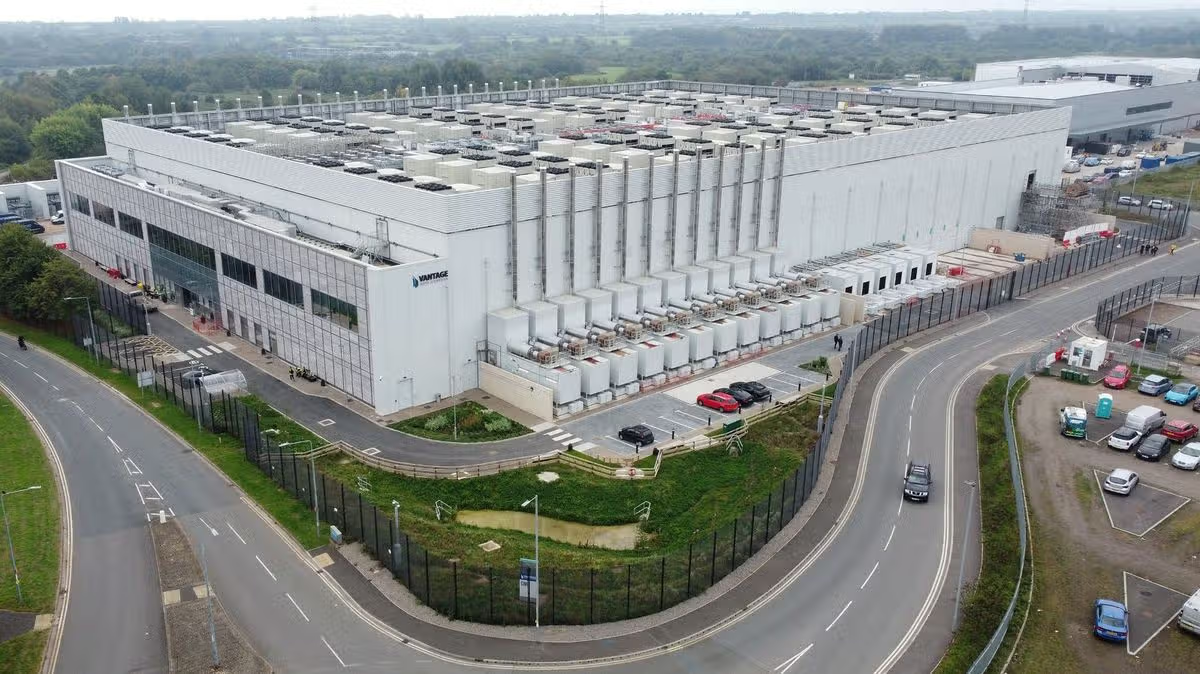
Vantage Data Centers has struck a major deal with Nebius for its CWL1 campus in Newport

Newport CWL1 campus of Vantage Data Centers.

A US hyperscale data centre firm has confirmed a major AI infrastructure investment at its Newport campus.

Vantage Data Centers has struck an agreement with Nasdaq listed AI cloud company Nebius to deploy high-density, Nvidia-powered AI infrastructure at its CWL1 campus.

Advertisement

The deployment represents the first announced commercial capacity commitment in the South Wales AI Growth Zone and will support growing UK demand for domestic AI compute capacity.

Under the agreement, Nebius will lease high-density capacity at CWL1 to support AI training, inference, agentic AI and enterprise AI workloads, serving enterprises, researchers, startups and public sector organisations seeking access to advanced AI infrastructure.

This capacity is part of Nebius’ broader UK expansion and commitment to scale domestic AI compute capacity. In June, the company announced approximately £1.7bn of committed capacity buildout across four UK sites.

The agreement builds on Vantage’s long-standing presence in Newport and reinforces the role hyperscale data centers play in enabling the UK’s AI economy. O

Advertisement

perational since 2010 and one of Europe’s largest data center campuses, the CWL1 campus provides the scale, connectivity and power infrastructure required for high-density AI workloads and serves a diverse base of hyperscale, enterprise and public sector customers.

Its electricity consumption is matched with 100% certified renewable energy, and its newest facilities are designed to minimise operational water consumption through a closed-loop cooling system that recirculates water rather than evaporating/

South Wales was designated as a UK AI Growth Zone in recognition of its concentration of digital infrastructure, fiber connectivity to London, high-capacity electricity grid infrastructure and strong industrial base.

The region is also home to the UK’s largest cluster of semiconductor businesses, creating a growing ecosystem for advanced technology, AI infrastructure and high-value digital investment.

Advertisement

CWL1 is part of Vantage’s multi-billion-pound investment strategy across South Wales, where the company expects to deliver more than 1GW of AI-ready capacity across Newport, Bridgend (where work is under way at the former Ford engine factory site) and the Welsh Government-owned Bro Tathan business park in the Vale of Glamorgan where it has planning for a major campus.

“This is an important milestone for South Wales and for the UK’s AI infrastructure ambitions,” said David Howson, Europe, the Middle East and Africa (EMEA) president for Vantage Data Centers.

He added:“Nebius is scaling AI cloud infrastructure in the UK at a time when demand for domestic compute capacity continues to accelerate. Vantage’s Newport campus provides the scale, connectivity and operational excellence needed to support that growth, and we’re proud to help establish South Wales as a leading destination for AI investment.”

General manager for EMEA at Nebius, Gary Tierney, said“The UK is one of the places where AI is being built, deployed and adopted by startups, enterprises and the public sector.

Advertisement

“Vantage’s Newport campus gives us a strong foundation to expand access to Nvidia-powered AI infrastructure in the UK and support customers building the next generation of AI applications.”

Kanishka Narayan, the Vale of Glamorgan MP

Kanishka Narayan, the Vale of Glamorgan MP(Image: Laurie Noble Photography / Houses of Parliament)

UK AI Minister and MP for the Vale of Glamorgan Kanishka Narayan said: “This government (UK)wants to put AI to work as a tool for renewing Britain and delivering new jobs. It is central to our mission to reindustrialise the country, drive good growth in every postcode and ensure our public services match-fit for the decades ahead.

“Making that happen relies on having cutting-edge compute–the horsepower that makes AI possible–here on home shores. The infrastructure at Newport will create new high skilled jobs in South Wales and help British businesses and innovators using AI to solve some of the toughest problems.”

Adam Price, Cabinet Minister for Enterprise, Connectivity and Energy, said: This announcement marks an important milestone for the South Wales AI Growth Zone and demonstrates Wales’ growing reputation as a strategic location for the infrastructure that will power the AI economy.

Advertisement

“Nebius and Vantage’s investment will help unlock new economic opportunities, support highly skilled jobs and reinforce Wales’ position as a leading destination for advanced digital investment.

“We look forward to working with partners to maximise the benefits of this investment for businesses, communities and the wider Welsh economy.”

Continue Reading

Trending

Copyright © 2025