
Tech
Apple opens Huston Advanced Manufacturing Center


Apple is expanding its U.S. manufacturing footprint with a new Houston center designed to help bolster American manufacturing with education and resources.
On Thursday, Apple opened its 20,000-square-foot Advanced Manufacturing Center (AMC) in Houston, Texas. The center is offering free training for small and medium-sized businesses.
The AMC is housed in the same facility that produces Apple’s AI servers. The site is also set to begin Mac mini production in late 2026.
Apple has invested hundreds of millions of dollars into the project, bringing it to fruition in less than nine months.
“We believe in American workers and American ingenuity, and we are moving at an incredible pace because we want to build more than great products. We want to build the future of American manufacturing,” said Cook.
As part of the kickoff event, Apple hosted U.S. Secretary of Commerce Howard Lutnick, U.S. Senator Ted Cruz, Houston Mayor John Whitmire, U.S. Representative Christian Menefee, and Harris County Precinct One Commissioner Rodney Ellis, along with other officials and community partners.
“Houston is grateful to Apple for this significant investment in our city. The Advanced Manufacturing Center will create local jobs and will continue improving the quality of life of Houston residents,” Houston Mayor John Whitmire said of the opening.
“The AMC also recognizes our city as a growing technology hub and solidifies Houston’s leadership in the manufacturing sector of the United States.”

The AMC’s holographic table – Image Credit: Apple
To mark the opening, the business leaders will spend the day immersed in hands-on training. Apple engineers will cover techniques like machine-learning-driven quality control and advanced automation.
Participants will learn how to identify and adapt to production challenges. They will also engage with the lab’s holographic table and advanced factory-floor equipment.
“I am proud that Apple chose Harris County for this investment. My office has consistently fought to bring good jobs within reach of working people and ensure small businesses — especially those historically shut out — have a fair opportunity to compete and grow,” said Harris County Precinct One Commissioner Rodney Ellis.
“At a time when rising costs are squeezing families here and across the country, this new center can help create pathways to greater economic security.”
The site is Apple’s second-largest manufacturing site in the U.S. The first is Apple’s Manufacturing Academy in Detroit.
Since announcing the $600 billion commitment in 2025, Apple and its American Manufacturing Partners have invested reshoring a portion its manufacturing. This includes custom silicon, cover glass, and advanced components.


Heart Aerospace’s X1, billed as the world’s largest battery-electric aircraft, completed a 27-minute maiden flight in New York using more than 1 MW of power and only about $5 worth of electricity. The 106-foot-wingspan demonstrator is a precursor to the company’s 30-seat hybrid-electric ES-30 regional airliner, targeted for service in 2031. Interesting Engineering reports: Developed by Heart Aerospace, the X1 demonstrator lifted off from Plattsburgh International Airport in New York on Wednesday, August 12. The piloted aircraft remained in the skies for about 27 minutes and made it to a 1,100-foot altitude above ground level (AGL). According to the Swedish aerospace company, the aircraft has a wingspan of 106 feet (32 meters). It’s additionally 76 feet (23 meters) long and has a takeoff weight exceeding 25,000 lbs (11,340 kilograms). “With the first flight of X1, Heart Aerospace has demonstrated electric flight at the scale of a commercial airliner,” said Anders Forslund, Heart Aerospace founder and CEO. “Electric commercial aircraft have the potential to fundamentally reshape airline economics and, ultimately, lower the cost ofÂair travelÂfor passengers.”
“This is at the heart of our vision for abundant air travel, with electrification enabling more affordable, frequent, and cleaner air service to and from airports closer to home.”
You can watch the first flight on YouTube.


Read more of this story at Slashdot.

With the revelation that ICE will spend up to $20 million by March on gloves that can deliver painful electric shocks to subdue an individual, according to a notice published earlier this week by the Department of Homeland Security, it’s worth looking at how this apparel, designated as a nonlethal tool for law enforcement, actually works.
These shock gloves go by the unsubtle acronym of GLOVE (Generated Low Output Voltage Emitter) and are manufactured by Compliant Technologies, based in Lexington, Kentucky. The GLOVE, previously used in jails and police departments in the US, looks and functions like a normal pair of patrol gloves until officers press a switch to activate an electrical mode.
Classified as a CD3 (conductive distraction and de-escalation device), the gloves don’t work like stun guns or Tasers, which shoot out probes or use high voltages to cause neuromuscular incapacitation that overrides the central nervous system. Instead, the GLOVE works using neuro-peripheral interference, essentially shocking the skin to bombard the sensory nerves and temporarily short-circuit the brain’s focus.
Compliant Technologies did not respond to WIRED’s request for comment.
When activated via a one-second press on a wrist switch, conductive pads embedded on the palm and undersides of the fingers of the gloves can transmit high-frequency electrical pulses directly to the wearer’s point of contact on a subject. A rechargeable battery and microprocessor module tucked inside a zippered pouch on the cuff powers the entire system.
The electrical pulse overstimulates nerve endings in the subject’s peripheral nervous system, resulting in pain that inhibits coordinated muscle movement, but without causing systemic muscle lockup. The pain induced is localized to just the area touched by the glove’s conductive pads. The manufacturer claims the gloves result in a subject’s compliance in less than three seconds and leave no burns, marks, or scars.
Because the current flows only between the contact pads on the device and across the subject’s skin, the officer wearing the GLOVE, as well as any assisting officers holding the subject, should not feel electrical shocks. The gloves, capable of operating between 14 and 122 degrees Fahrenheit, come in three versions: Gen 3, 4, and 5. Maximum voltage is capped at 380 V for all, and the minimum voltage for Gen 3 and 4 is 210 V, which rises to 324 V for Gen 5.
Maximum stimulation time on Gen 3 and 4 models is a sobering two hours, though that drops to 90 minutes for Gen 5. The battery is apparently good for 2,000 charge/discharge cycles, and it can recharge to full in two hours. Four LED lights on the gloves display the current charge level, each noting 25 percent battery increments.
Gen 4 and 5 of GLOVE both include mechanisms that record “activation events,” tracking the date, hour, minute, and skin-contact time for audit trails and after-action reporting. Gen 4 stores this data on a removable microSD card, while Gen 5 does away with this in favor of built-in internal memory, accessed via a USB-C cable.
There’s a test function on the gloves, too, where operators can verify they are working by tapping an active pad against their own forearm to feel a minor electrical pulse. According to the manuals, GLOVE users must be certified and then recertified every other year to continue using the device.
GLOVE, which can only be sold to verified professional entities such as the military, correctional facilities, and law enforcement agencies—has some clear usage recommendations in Compliant Technologies’ instruction manuals:
- No more than two GLOVE units (or, in other words, one pair) should be used simultaneously on a single subject.
- Continuous shocks should not exceed 15 seconds.
- Operators must target arms and legs, while strictly avoiding the head, face, throat, chest, and groin.
- The gloves should not be used on the elderly, young children, pregnant individuals, or people with severe disabilities.
- The technology must not be used to counter verbal defiance, as punishment, or for torture.
Tech
Spotify Will Label AI Artists and Stop Recommending Them. So Why Is It Letting Fans Remix Real Music With AI?

Spotify would like listeners to know that fake AI artists are a problem.
Unless, apparently, the AI is being used in a licensed product that lets paying subscribers alter music created by actual human beings.
Spotify has announced that it will begin labeling some artist profiles with an AI Persona badge when the public identity presented by that artist does not represent a real person. Beginning in mid-September, those badges will appear on artist profiles, in search results, playlists and individual track listings. More importantly, Spotify says music from AI Personas will not be included by default in editorial or algorithmic recommendations unless listeners have deliberately followed or engaged with them.
That is a meaningful change. It is also the latest turn in Spotify’s increasingly complicated relationship with artificial intelligence.
Related Reading:

Does Spotify Like AI Music or Not?
The answer appears to be: it depends.
Spotify has never broadly banned music merely because AI was involved in creating it. In September 2025, the company explicitly said that it supports artists using AI creatively and that licensed music would be treated equally regardless of the tools used to make it. At the same time, Spotify tightened its rules against unauthorized voice cloning, fraudulent uploads and industrial-scale music spam.
That distinction made some sense.
Using AI during production is not automatically the same thing as generating 5,000 anonymous tracks, impersonating Drake or creating a photorealistic singer who never existed and hoping listeners don’t notice.
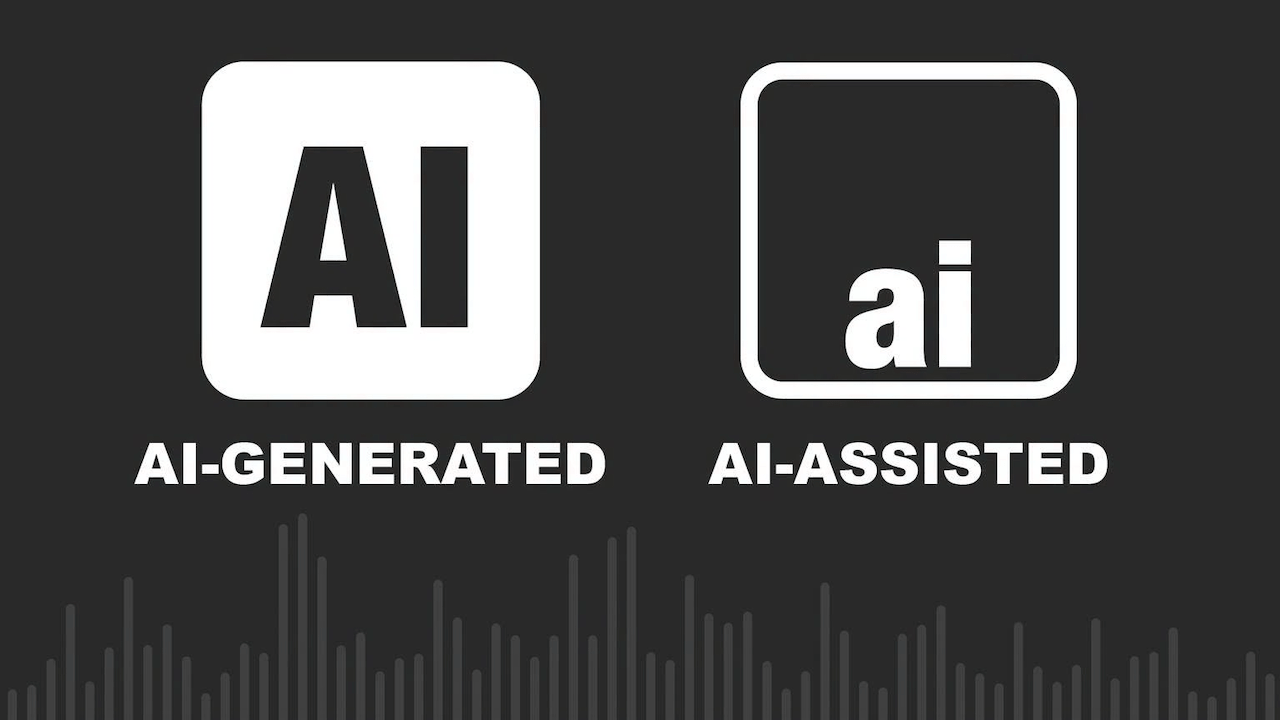
Spotify subsequently introduced AI credits that allow artists and distributors to disclose how AI was used in areas including vocals, lyrics and production. As we reported in July, that industry-wide push toward AI Generated and AI Assisted labeling is ultimately about giving listeners some idea of what they are actually hearing.
Then things became considerably more interesting.
Spotify Decided AI Could Also Be a Business
In May, Spotify and Universal Music Group announced a forthcoming generative AI tool that will allow Premium subscribers to create licensed covers and remixes of music from participating artists and songwriters.
It will be sold as a paid add-on.
Universal signed on first, and Merlin followed on August 4, bringing a large collection of independent labels into the program. Spotify says participating artists will have control over whether their music is included and will receive credit and compensation when fans create new versions.
We recently examined that deal and asked the uncomfortable question: if Spotify is worried about AI undermining musicians, why is it preparing to sell consumers tools that let them modify commercially released music in the first place?
The answer increasingly looks like consent and money.
Unauthorized AI impersonation? Bad.
Mass-generated AI sludge designed to siphon royalties? Bad.
A fictional AI artist pretending to be a real person and being pushed into your Discover Weekly playlist? Apparently bad now as well.
AI used under agreements negotiated with Universal, Merlin and other rights holders, with Spotify charging subscribers for the privilege? Welcome aboard.
That does not necessarily make Spotify hypocritical. There is a legitimate distinction between licensed AI tools used with permission and deceptive AI content designed to fool listeners or manipulate the royalty system.
But from the listener’s side, the rules are becoming awfully complicated.
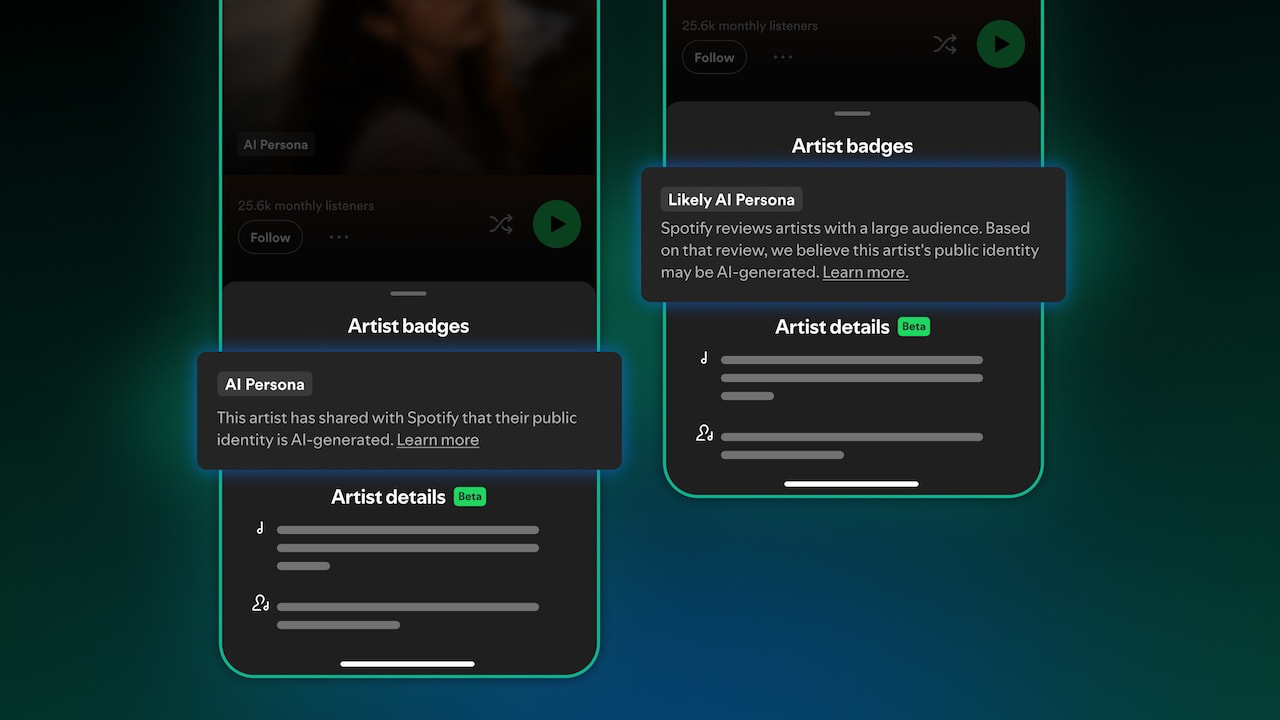
What Is an AI Persona?
Spotify’s new badge is specifically about identity, not whether the music itself was AI generated.
That distinction matters.
An artist can use AI extensively in making a recording without necessarily receiving an AI Persona badge. Conversely, an artist profile portraying a photorealistic fictional human could receive the badge regardless of precisely how the music was created. Spotify says it will initially review profiles that have reached certain audience thresholds rather than relying entirely on voluntary disclosure. Artists can appeal the designation, and Spotify plans to eventually let listeners report suspected AI Personas.
That is considerably more useful than hiding an AI disclosure six menus deep inside the credits. And keeping AI Personas out of recommendations by default may be the most important part of the entire policy.
Spotify’s recommendation engine does not merely help listeners find music; it determines which artists receive enormous amounts of exposure. Removing synthetic personalities from that pipeline makes it harder for AI content farms to compete for attention simply by generating more material than humans possibly can.
Why Listeners Should Care
Listeners should not need forensic training to determine whether the singer Spotify just recommended is an actual person.
That is the larger problem with AI music. The debate is usually framed around copyright, royalties and artist compensation, all of which matter enormously. But streaming services also have a basic responsibility to tell subscribers what they are listening to.
TIDAL recently went further by deciding that wholly AI-generated music can remain on its service but will not receive royalty attribution. Qobuz has also taken a more human-centered approach to curation and AI-generated content. Spotify is choosing a different path: allow AI, disclose more of it, suppress deceptive uses and monetize the versions it can license properly.
There is a logic to that strategy. It just happens to be a logic that becomes considerably easier to understand once somebody is getting paid.
The Bottom Line
Spotify’s AI Persona badge is a positive move for listeners. Clearly identifying fictional artists and keeping them out of recommendations by default should make the service less susceptible to the flood of synthetic content that increasingly threatens genuine music discovery.
But Spotify cannot have this conversation entirely on its own terms.
The company is telling listeners that authenticity matters while simultaneously building a business that will let subscribers use generative AI to alter recordings made by real musicians. Those two positions can coexist if consent, transparency and compensation genuinely remain at the center of the system.
If they don’t, Spotify isn’t drawing an ethical line around AI.
It’s drawing a revenue line.
Related Reading:
An anonymous reader quotes a report from the Financial Times: Anthropic investors expect the AI startup to float at a valuation of $2 trillion or more in October, a dizzying figure that would eclipse SpaceX and make the AI lab’s debut the largest-ever initial public offering. Half a dozen of the company’s backers told the FT that Anthropic’s rapidly rising revenue would enable it to more than double its current valuation in a planned autumn float. A listing at that level could unlock billions of dollars in gains for the five-year-old company’s early investors but would also test public markets that are growing more nervous about the AI boom.
Anthropic’s backers say booming demand for the lab’s advanced AI models and tools justifies their lofty expectations. Investors expect the Claude maker’s annualized revenue to be between $100 billion and $120 billion by the end of 2026 — using the startup’s preferred measure, which infers full-year sales from recent performance — up by more than 10 times over the course of 2026. “If Anthropic is growing 800 percent a year, you’d think at the incredibly low end they would trade at 30 times [revenue],” said one investor in the group. “That would make them a $3 trillion company.” According to Bloomberg (paywalled), Anthropic is currently in talks to acquire Decart AI for roughly $6 billion.
“Decart develops world models alongside software designed to lower AI training expenses by improving how efficiently chips are utilized,” reports Quartz. “That capability could allow Anthropic to get more out of its current infrastructure as demand grows. If the deal closes, Decart’s team would join Anthropic’s inference and performance organization.”
Read more of this story at Slashdot.

The movie theater business is doing something rather inconvenient for everyone who spent the past five years writing its obituary: making a lot more money.
Through August 10, the 2026 domestic box office has generated $6.54 billion, according to Box Office Mojo. That is 19.1% ahead of the same period in 2025 and 28.8% ahead of 2024. It is even running 6.9% ahead of 2023, the year of Barbie and Oppenheimer. For some perspective, the entire domestic box office finished 2025 at $8.66 billion and 2024 at $8.57 billion.
That does not mean everything is back to 2019 levels, and we’ll get to that rather important detail. But the 2026 rebound is no statistical rounding error.
I’ve already seen The Odyssey and Spider-Man: Brand New Day twice. Aside from raising legitimate questions about whether I should be trusted with a movie ticketing app, all four screenings shared something important: I deliberately chose a premium theatrical experience because I wanted something my television and home theater system could not completely reproduce.
Increasingly, I don’t appear to be alone.
Related Reading:
2026 Has More Than One Hero
Spider-Man: Brand New Day has become the monster of the year, reaching $655.1 million domestically and $1.67 billion worldwide in only 10 days. But blaming the entire recovery on Peter Parker would be convenient and wrong.
Toy Story 5 has earned more than $470 million domestically, The Odyssey has crossed $461 million, The Super Mario Galaxy Movie is approaching $430 million, Michael has exceeded $372 million, and Project Hail Mary has generated $344 million. Even Obsession, which didn’t arrive with decades of franchise baggage attached, has surpassed $263 million domestically.

Five 2026 releases have already crossed $1 billion worldwide: Spider-Man: Brand New Day, The Odyssey, Toy Story 5, Michael and The Super Mario Galaxy Movie. That’s more billion-dollar releases than any year since 2019, with plenty of calendar still remaining.
Not everything with a familiar logo has worked. Star Wars: The Mandalorian and Grogu limped to just $177.7 million domestically and $345.2 million worldwide. For comparison, Solo: A Star Wars Story — the film Disney has spent eight years pretending it left in a jacket pocket at Mos Eisley, managed $213.8 million domestically and $392.9 million worldwide back in 2018. Somewhere on Corellia, the Solo crew is high-fiving one another and ordering another round.
But 2026 still has two enormous theatrical wild cards waiting in December. Marvel’s Avengers: Doomsday and Denis Villeneuve’s Dune: Part Three are both scheduled for December 18, and both are being positioned for premium presentation. Dolby currently lists each with Dolby Vision and Dolby Atmos, while Dune: Part Three is already selling advance IMAX 70mm tickets. IMAX also includes Avengers: Doomsday in its 2026 release slate.
That creates a fascinating Christmas problem for theater owners: two films designed to dominate the very IMAX and Dolby Cinema screens that are becoming increasingly valuable. Doomsday looks like the safer bet commercially, even if the footage so far has left me wondering whether Earth’s Mightiest Heroes misplaced the fun somewhere between multiverses; while Villeneuve has turned Dune into exactly the kind of large-scale cinematic event that premium theaters were built to showcase.
The takeaway isn’t that audiences will watch anything Hollywood throws at them again. They clearly won’t. The stronger 2026 slate is giving consumers more reasons to go out, and when the movie feels like an event, they are showing up.
Here’s the Problem: Attendance Hasn’t Really Come Back
This is where the numbers become much more interesting.
U.S. theaters sold an estimated 470.9 million tickets during the first 30 weeks of 2026, compared with 747.3 million over the same stretch of 2019. Placer.ai estimates theater attendance through July was up 8.1% compared with 2025, but remained 27% below 2019.
So how can the box office be booming while substantially fewer people are going to the movies?
Part of the answer is price. EntTelligence puts the average 2026 adult ticket at $13.46, while premium-format admissions such as IMAX average $18.22. More importantly, audiences increasingly appear willing to pay that premium when the experience justifies leaving the house.
And that is where IMAX and Dolby Cinema enter the story.
IMAX Is Having a Ridiculous 2026
Christopher Nolan didn’t merely make The Odyssey for IMAX; he made the first theatrical feature shot entirely with IMAX film cameras. Audiences have responded accordingly.
The Odyssey has now generated $289 million in IMAX box office, making it the format’s highest-grossing release ever. Its $147.3 million domestic IMAX haul is also an all-time company record. July produced $257 million for IMAX worldwide, the highest-grossing month in the company’s more than 50-year history.
This didn’t come out of nowhere. IMAX generated a record $1.28 billion worldwide in 2025, while its domestic box-office share reached 5.2% despite IMAX representing only about 1% of domestic screens. Premium presentation was already growing before Odysseus started sailing around the Mediterranean.

Dolby Cinema Is Seeing the Same Shift
Dolby Cinema generated a record $203 million domestically in 2025. From January 1 through April 6, 2026, revenue had already reached $46 million, 62% higher than the same period a year earlier.
Then Spider-Man showed up.
Brand New Day delivered roughly $10 million from just 177 U.S. Dolby Cinema locations during its opening weekend, the format’s biggest weekend ever. Premium large-format screenings overall accounted for about 24% of Spider-Man’s extraordinary $360 million domestic opening.

That is not a niche audience carrying around calibration meters and arguing about black levels on Reddit. That’s meaningful box-office revenue.
Your Living Room Got Better. Movie Theaters Had To As Well.
The uncomfortable reality for exhibitors is that the average living room became a formidable competitor.
An excellent OLED or Mini-LED television, competent surround system or Atmos soundbar, comfortable sofa and instant access to streaming make the mediocre multiplex experience increasingly difficult to defend. Throw in parking, concessions and the gentleman six seats away illuminating half the auditorium with his phone, and “wait for streaming” starts sounding perfectly reasonable.
But a genuinely great IMAX auditorium or Dolby Cinema changes that equation.
Reuters reports that theater chains are expanding premium large-format screens specifically as audiences become more selective about theatrical trips. AMC said premium-screen demand recently helped produce the highest single-weekend revenue in its 106-year history, with more than 10.2 million customers visiting AMC and Odeon locations.
Streaming didn’t kill movie theaters. Better home entertainment may simply have forced theaters to offer something better.
The 2026 numbers suggest audiences still love going to the movies. They are just becoming far less interested in paying for an ordinary experience they can increasingly duplicate at home.
The movie theater isn’t dying. The ordinary movie theater might be.
Related Reading:
Artificial intelligence has wreaked havoc across secondary and higher education classrooms, leaving educators struggling to figure out how to create cheat-resistant assignments and assessments. While everyone is good at diagnosing the problem, no one seems to have a workable solution. So I designed a free tool to help teachers create uncheatable assessments and avoid the headaches of AI and academic dishonesty.
The Cheat Vulnerability Index
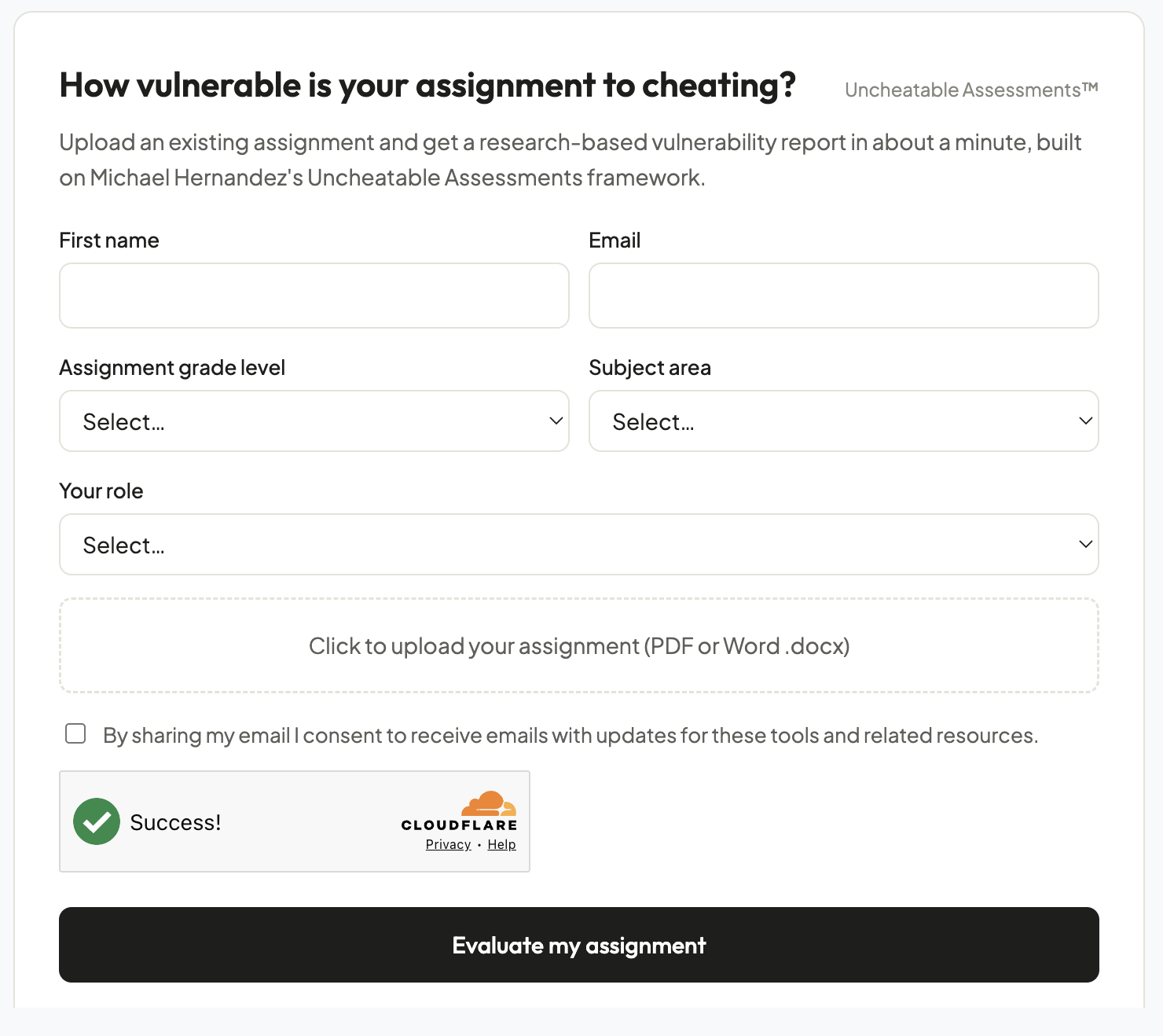
Based on the concepts from my book, course and workshops, I built the Cheat Vulnerability Index, a web app that lets teachers analyze their existing assignments to pinpoint strengths and weaknesses when it comes to vulnerability to cheating. Users upload an assignment, then get a custom report and suggestions for how to make improvements.
I came up with the idea when I noticed that educators struggled to take the ideas from my conference sessions and workshops and implement them in their unique learning contexts. Since I can’t always sit with everyone as they plan lessons or write a syllabus, I wondered how I might scale the concepts and strategies from my content leveraging the power of AI.
I needed to create a brand-new tool that didn’t exist before and to do so with no budget. So I learned to “vibe code,” the method of using natural language in an AI model to create computer code. I hadn’t done coding since I used BASIC in high school, and it took me a while to figure out how it worked, and how to turn the code into an interface on my website.
I trained the index on concepts from my book Storytelling With Purpose: Digital Projects to Ignite Student Curiosity and a variety of other workshops and articles I’ve published as the pedagogical framework for the assignment analysis. The concepts, processes and strategies it produces are unique to my published work, and create suggestions through that research-based, classroom-tested lens.
The intake form for The Cheat Vulnerability Index
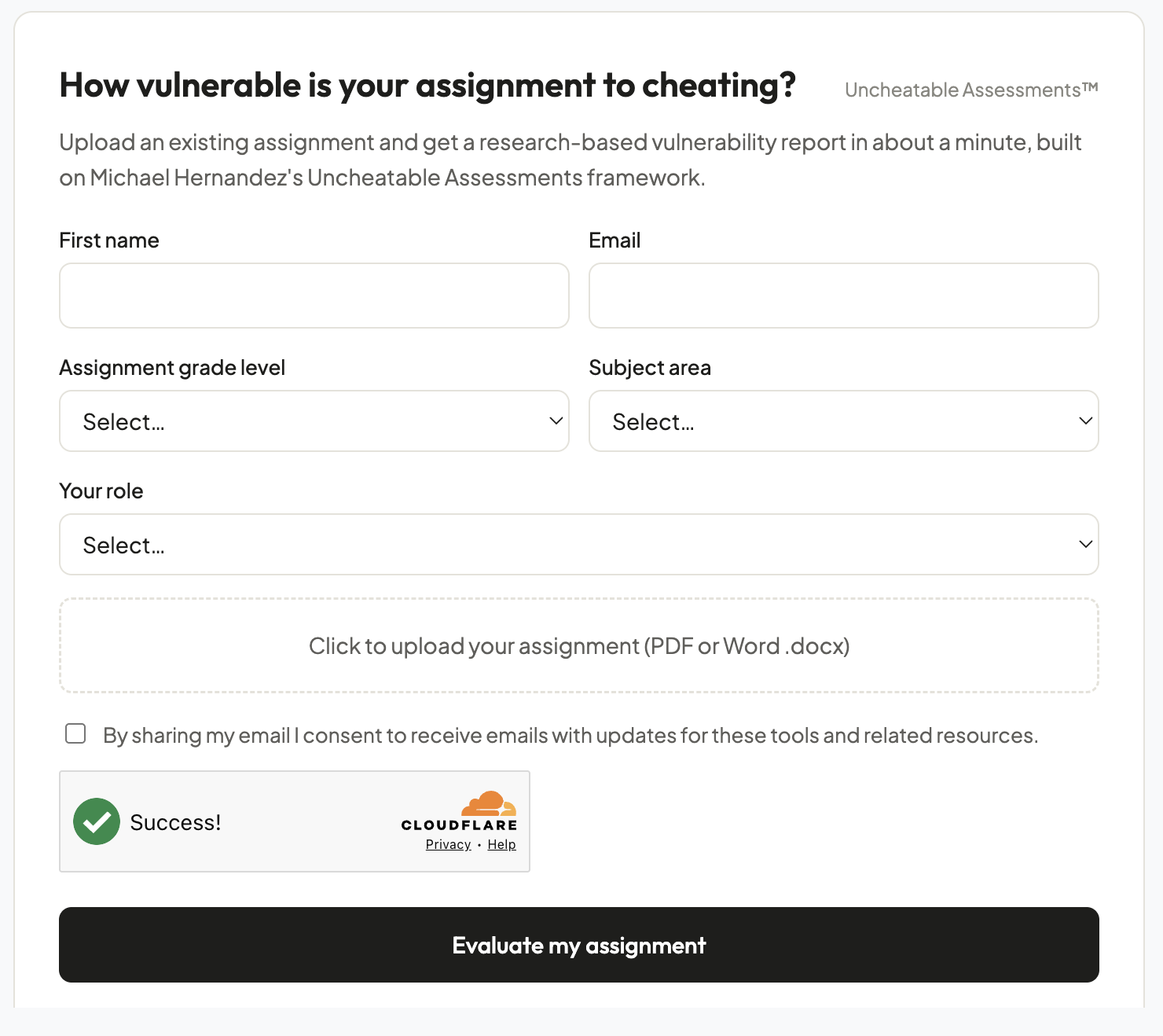
Turns out, vibe coding is a lot like teaching: you begin with deep subject-area expertise (in this case, authentic learning and assessment), create a complex set of detailed instructions and processes for the AI agent to follow (a lesson or unit plan), define what “good” looks like (learning outcomes, standards and rubrics), and how to describe the concepts clearly to an audience (a learning artifact). I was stunned by how well the app turned out, and teachers who have tried it find it useful.
But the biggest takeaway for me is how this experiment revealed the ability of AI tools to remove barriers to learning and how they can facilitate deeper learning through the application of knowledge.
Despite what they say, not everyone can code — including me. So why should coding (or the cost to hire a team of coders) get in the way of my ideas and creating a useful tool to help others? In the same way, how does a student’s writing ability, processing speed or facility as a public speaker affect their grades if our assessments are in-class essays, timed tests or presentations and debates? It got me thinking about the obstacles students face expressing their knowledge and how traditional assessments can get in the way of assessing them.
Students may cheat or cut corners for a lot of reasons, not all of which have to do with moral depravity. Designing uncheatable assessments requires more than adjustments to a single assignment — it requires us to expand our definition of success and to rethink what counts as achievement and how we measure it.
Creating Uncheatable Assessments
The Cheat Vulnerability Index is a quick diagnostic that gives teachers and faculty feedback on a single assignment. But to have meaningful, sustained resilience while maintaining rigor and high standards across an entire school year, teachers need to rethink what and how they assess, and foster cultures of integrity that go beyond any one test or unit.
The diagnostic evaluation for The Cheat Vulnerability Index
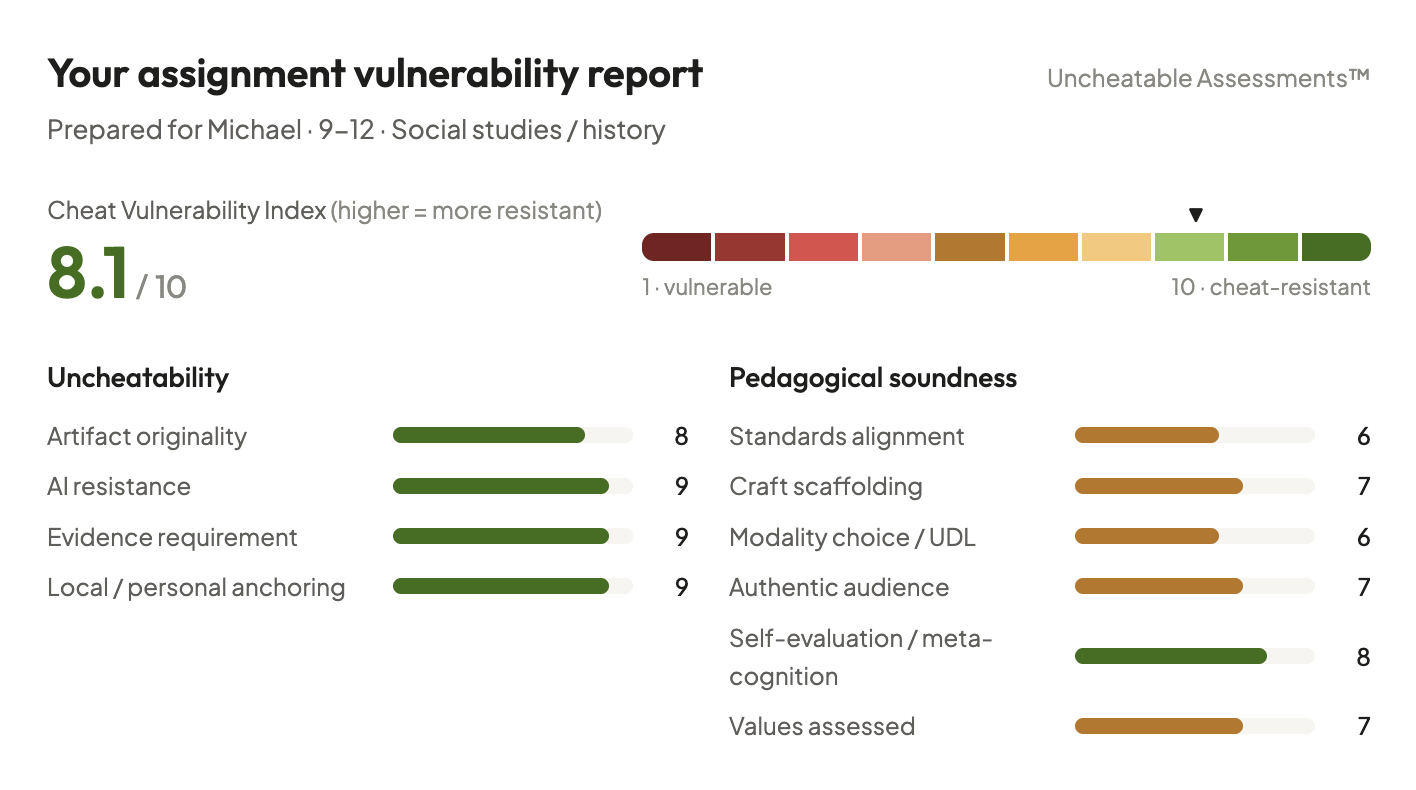
Cheating happens when two conditions are met: when an assignment is cheatable by design and when students have the incentive to cheat.
Assignments like tests, worksheets or essays are all vulnerable to academic dishonesty simply by their design. AI can write essays, and students can share answers, for example. How can the format of an assignment minimize opportunities for cheating or rely on a combination of multiple metrics that make it less possible?
No matter how well an assignment is designed, if a student really wants to cheat, they will. So instead of trying to surveil students and make our job as educators about policing them, we can create assignments that disincentivize cheating before it becomes a problem in the first place.
There are three ways to do this.
Three Uncheatable Assessment Traits
1. Originality. When we expect students to create the same answers at the same time, we’ve set ourselves up for cheating (with or without AI). Authentic learning experiences result in one-of-a-kind learning artifacts that no other student could copy or use AI to complete entirely.
2. Personal connection. To be truly invested in learning, everyone wants to know “why this matters.” Allowing ways for students to connect curriculum to their lives or community helps them personalize an abstract concept and disincentivizes cheating because they care about the outcome and know it will help them or people in their community. Students should also have multiple opportunities for agency throughout the process.
3. Purpose. What’s the point of students’ hard work? If an assignment ends up in the trash, it sends a powerful message about the value of their effort and your curriculum. Instead, have students create learning artifacts that are designed for users or audiences beyond the classroom. Give students a good reason to complete an assignment with integrity and accuracy. Real stakes beat clever rules.
What’s Next
The problem of academic integrity is more fundamental than preventing students from cheating. AI has forced us to recognize that the old proxies we used to assess students are no longer reliable as evidence of learning (if they ever were), and requires us to redefine what counts as evidence of understanding. Like the Cheat Vulnerability Index I designed that didn’t require me to know the vocabulary or grammar of coding, my learning artifact still required me to build subject-area expertise, identify goals and limits, interrogate what good learning means and take responsibility for the outcome of my work.
As mathematician Terence Tao says about AI disrupting mathematics research, it’s like we’ve been trying to drive a car on outdated roads made for horses and pedestrians, and it’s revealed potholes and bumps and cracks. AI is now giving us faster cars that lead to big traffic jams and accidents.
The destination hasn’t changed, just how we get there. What we need isn’t better ways to catch students cheating, but a new pedagogical road forward.
Tech
DeepSeek Harness launches as open source rival to Claude Code, alongside V4-Pro on API with higher prices


DeepSeek is expanding beyond the model layer and deeper into the software developers use to put AI agents to work.
The Chinese AI lab on Thursday launched the official version of DeepSeek-V4-Pro, an updated flagship model focused heavily on agentic workloads, alongside DeepSeek Harness v0.1, a new open-source agent harness that gives developers an alternative to integrated coding-agent environments such as Anthropic’s Claude Code.
Together, the releases amount to a broader developer push from DeepSeek. V4-Pro is now available across DeepSeek’s web interface, mobile app and API, with native support for the OpenAI Responses API and integration with Codex.
DeepSeek Harness, meanwhile, is entering developer preview under the MIT license and the code is available now for download and use on GitHub. It’s built around an unusually modular premise: practically every part of the agent runtime can be swapped out as a plugin.
But developers accessing V4 through DeepSeek’s API will soon pay considerably more for it. DeepSeek is simultaneously abandoning its existing flat API pricing in favor of peak and off-peak rates beginning at 16:00 UTC on Sunday, Aug. 16 (2 am ET).
Even the discounted off-peak cache-miss and output prices will be substantially higher than the prices available today.
The combination is significant because DeepSeek is no longer competing solely over model intelligence and token prices. With Harness, it is moving into the layer that determines how models use tools, manipulate files, maintain sessions and execute long-running agent workflows — territory where Anthropic’s Claude Code and other coding agents have become increasingly important developer products.
DeepSeek builds its own agent harness
DeepSeek describes Harness, or dsh, as an open-source agent harness built on Cordis, a framework designed around composable plugins.
Its guiding principle is simple: “Everything is a plugin.”
That extends to models, tools, skills, sessions, sandboxes, filesystems, loops, orchestration and user interfaces, according to DeepSeek. Rather than making those components fixed pieces of a single coding agent, Harness is designed to let developers mix, replace and extend them.
The project is available under the MIT license and can currently be launched from npm with npx @deepseek-ai/dsh web. DeepSeek also provides instructions for building it directly from source. The repository describes the software explicitly as a developer preview and warns that “THERE WILL BE COMPATIBILITY-BREAKING CHANGES.”
That caveat matters for enterprise developers. Harness is not yet being presented as a stable drop-in production platform. But its architecture points toward a potentially important strategy: DeepSeek can now offer developers not only models but an open framework for assembling the systems that surround them.
That makes Anthropic’s Claude Code and OpenAI’s Codex useful competitive references, although the products should not be treated as functionally identical.
DeepSeek Harness is an open-source, model-agnostic alternative to the agent infrastructure underlying Claude Code and Codex—not yet a full replacement for either product’s broader developer experience.
It can already inspect repositories, edit files, execute shell commands, search files and the web, maintain plans, invoke skills, delegate work to subagents and enforce approval policies. Those are the essential capabilities that make Claude Code and Codex agentic coding tools rather than autocomplete systems.
DeepSeek explicitly describes Standard mode as a full coding agent with file editing, shell access, search, planning, subagents and workflows. Its local web interface lets users select a workspace and approve sensitive operations.
But Claude Code and Codex now extend well beyond that agent loop. Here’s a quick comparison:
|
Dimension |
DeepSeek Harness |
Claude Code |
OpenAI Codex |
|
Read, edit and test a repository |
Yes |
Yes |
Yes |
|
Shell and development tools |
Yes |
Yes |
Yes |
|
Planning and subagents |
Yes |
Yes |
Yes |
|
Permission controls and sandboxing |
Yes, configurable through plugins |
Yes, mature built-in permission and sandbox system |
Yes, granular sandbox and approval controls |
|
Primary interfaces |
Local web UI; headless command; Python SDK |
Terminal, VS Code, JetBrains, desktop, browser, mobile and Slack |
CLI, IDE extension, desktop app, web/cloud and integrations |
|
Hosted background agents |
Not documented as a DeepSeek-managed service |
Yes |
Yes |
|
GitHub-native PR workflow |
Not documented as a finished integration |
GitHub Actions, automatic reviews, issue-to-PR workflows |
Cloud tasks, automatic reviews, PR fixes and GitHub Action |
|
Model choice |
DeepSeek, Anthropic, OpenAI and custom compatible endpoints |
Primarily Claude, including Bedrock, Google Cloud and Microsoft hosting |
Primarily OpenAI models, with configurable providers in the open-source CLI |
|
Extensibility |
Exceptional: virtually every component is replaceable |
Strong: skills, hooks, MCP, plugins and agent teams |
Strong: skills, MCP, custom agents, SDK and app server |
|
Product maturity |
Developer preview; breaking changes expected |
Established commercial product |
Established commercial product plus open-source CLI |
|
License |
MIT |
Commercial product with extensibility interfaces |
Codex CLI is open source; cloud and app services are managed products |
DeepSeek Harness instead emphasizes modularity and replacement: the model itself is another plugin rather than necessarily the center of a vertically integrated stack.
DeepSeek’s repository was already attracting significant developer attention on launch day, showing roughly 27,500 GitHub stars and 2,000 forks as of Aug. 13, although those rapidly changing figures are best viewed as a snapshot rather than an adoption metric.
V4-Pro gets an agent-focused upgrade
Harness arrives alongside the general-availability release of DeepSeek-V4-Pro-0813.
DeepSeek originally introduced the V4 family in preview in April. The lineup consists of the 1.6-trillion-parameter V4-Pro, with 49 billion parameters activated per token, and the smaller 284-billion-parameter V4-Flash, with 13 billion activated. Both support context windows of up to one million tokens.
The company’s Aug. 13 release therefore is not the first appearance of V4-Pro. It is the transition from the earlier preview into an updated official version, with DeepSeek emphasizing agent performance.
“The official version of DeepSeek-V4-Pro has been released, featuring significantly enhanced agent capabilities and support for the Responses API and Codex integration,” DeepSeek says on its API website. “It is now fully available across the web, mobile app, and API; we welcome your testing and feedback.”
DeepSeek’s changelog similarly says the general-availability model has “significantly enhanced Agent capabilities,” particularly in production environments. Developers using the API do not have to change model identifiers: deepseek-v4-pro now resolves to the latest V4-Pro version.
The company has also added native OpenAI Responses API support, lowering the amount of integration work required for applications already built around that interface.
DeepSeek says V4-Pro is optimized for OpenAI’s own open source harness, Codex, with one-click setup. Its current API documentation lists Responses API, tool calling, JSON output and an Anthropic-format API among the supported interfaces for both V4-Pro and V4-Flash.
For developers using DeepSeek directly rather than through an API, V4-Pro is now accessible through “Expert Mode” on the company’s app and website.
Reasoning effort becomes another deployment knob
DeepSeek is also making reasoning effort an explicit control across V4-Pro and V4-Flash.
The V4 model documentation describes three levels: Non-think, designed for fast routine tasks; Think High, intended for more complex problem-solving and planning; and Think Max, which allocates substantially more reasoning to difficult problems.
That distinction can be operationally important for agent systems because maximum reasoning on every step can consume unnecessary time and tokens. A coding agent might use relatively little reasoning to inspect a file or execute a routine tool call, then increase effort when diagnosing a difficult bug or planning a multi-stage code change.
DeepSeek’s latest benchmark table suggests the 0813 model improves substantially on agent-oriented tests, although the figures are company-reported and some results depend on the harness configuration.
DeepSeek reports V4-Pro-0813 scores of 87.9 on Terminal Bench 2.1, 74.1 on Toolathlon-Verified, 71.1 on DSBench-FullStack and 67.2 on DSBench-Hard. It does not lead every comparison in DeepSeek’s own table: Fable 5, for example, scores 77.9 on Toolathlon-Verified and 77.2 on DSBench-FullStack.
There is an especially important qualification buried beneath the benchmark table. For public Code Agent tasks, DeepSeek says V4-Pro-0813 was tested using its upcoming DeepSeek Harness in “minimal mode.”
In other words, some of the agent results arriving alongside Harness are not purely model benchmarks. They measure the model operating inside an agent execution environment — precisely the software layer DeepSeek is now releasing to developers.
A sharp reversal in DeepSeek’s API price trajectory
The bigger immediate change for teams already running DeepSeek in production may be pricing.
DeepSeek’s current API documentation lists V4-Flash at $0.14 per million cache-miss input tokens and $0.28 per million output tokens, while V4-Pro costs $0.435 for cache-miss input and $0.87 for output. Cache hits are dramatically cheaper at $0.0028 for Flash and $0.003625 for Pro.
Those prices themselves represented a major reduction from V4’s original April launch economics. When V4 arrived in April, V4-Pro was priced at $1.74 per million cache-miss input tokens and $3.48 per million output tokens. By late May, DeepSeek had made a 75% reduction permanent, intensifying its position as an unusually inexpensive option for high-volume agent workloads. Now the pendulum is moving in the other direction.
Beginning Aug. 16 at 16:00 UTC, DeepSeek will charge different rates depending on when API calls occur. Peak hours are 01:00–04:00 UTC and 06:00–10:00 UTC (9:00 PM – 12:00 AM ET and 2:00 AM – 6:00 AM ET, respectively) with all other hours classified as off-peak. Off-peak rates are half the corresponding peak prices.
For V4-Flash, off-peak cache-miss input rises from $0.14 to $0.22 per million tokens, while output rises from $0.28 to $0.66. During peak hours those rates reach $0.44 input and $1.32 output.
V4-Pro moves from $0.435 per million cache-miss input tokens and $0.87 output today to $0.66 and $1.98 off-peak, respectively. Peak rates rise to $1.32 input and $3.96 output.
The increases are even more pronounced for cached input. V4-Pro cache hits rise from $0.003625 per million tokens today to $0.022 off-peak and $0.044 at peak. Flash moves from $0.0028 to $0.007 off-peak and $0.014 peak.
|
Model |
Old input (per 1M token) |
Old output (per 1M tok) |
Old total (1M in/1M out) |
|
deepseek-v4-flash |
$0.14 |
$0.28 |
$0.42 |
|
deepseek-v4-pro |
$0.435 |
$0.87 |
$1.305 |
The new prices still position DeepSeek as an affordable alternative via API to Western proprietary labs, but Reuters reported Thursday that, depending on model, token category and time of use, the changes represent increases ranging from 50% to more than 1,100% over existing rates.
|
Model |
Input ($/1M) |
Output ($/1M) |
Total ($/1M) |
Source |
|
Muse Spark 1.2 Contributor |
$0.10 |
$0.20 |
$0.30 |
|
|
MiMo-V2.5 Flash |
$0.10 |
$0.30 |
$0.40 |
|
|
DeepSeek-V4-Flash — off-peak |
$0.22 |
$0.66 |
$0.88 |
|
|
GPT-5.6 Luna |
$0.20 |
$1.20 |
$1.40 |
|
|
MiniMax-M3 |
$0.30 |
$1.20 |
$1.50 |
|
|
LongCat-2.0 — limited-time promo |
$0.30 |
$1.20 |
$1.50 |
|
|
DeepSeek-V4-Flash — peak hours |
$0.44 |
$1.32 |
$1.76 |
|
|
MiMo-V2.5 |
$0.40 |
$2.00 |
$2.40 |
|
|
DeepSeek-V4-Pro — off-peak |
$0.66 |
$1.98 |
$2.64 |
|
|
LongCat-2.0 — standard |
$0.75 |
$2.95 |
$3.70 |
|
|
MiMo-V2.5 Pro (≤256K) |
$1.00 |
$3.00 |
$4.00 |
|
|
DeepSeek-V4-Pro — peak hours |
$1.32 |
$3.96 |
$5.28 |
|
|
Muse Spark 1.1 / 1.2 |
$1.25 |
$4.25 |
$5.50 |
|
|
GLM-5.2 |
$1.40 |
$4.40 |
$5.80 |
|
|
Grok 4.6 — <200K prompt tokens |
$2.00 |
$6.00 |
$8.00 |
|
|
MiMo-V2.5 Pro (>256K) |
$2.00 |
$6.00 |
$8.00 |
|
|
Qwen3.8-Max |
$2.00 |
$6.00 |
$8.00 |
|
|
Gemini 3.6 Flash |
$1.50 |
$7.50 |
$9.00 |
|
|
GPT-5.6 Terra |
$2.00 |
$12.00 |
$14.00 |
|
|
Grok 4.6 — ≥200K prompt tokens |
$4.00 |
$12.00 |
$16.00 |
|
|
GPT-5.4 |
$2.50 |
$15.00 |
$17.50 |
|
|
Kimi K3 |
$3.00 |
$15.00 |
$18.00 |
|
|
Claude Opus 5 |
$5.00 |
$25.00 |
$30.00 |
|
|
Sakana Fugu Ultra (≤272K) |
$5.00 |
$30.00 |
$35.00 |
|
|
GPT-5.6 Sol — Standard mode |
$5.00 |
$30.00 |
$35.00 |
|
|
Claude Fable 5 / Claude Mythos 5 |
$10.00 |
$50.00 |
$60.00 |
|
|
GPT-5.6 Sol — Fast mode |
$10.00 |
$60.00 |
$70.00 |
That makes the “50% lower” off-peak framing potentially misleading without context. Off-peak is 50% cheaper than DeepSeek’s new peak rate; it is not a 50% discount from the API prices developers are paying today.
For a simple workload consisting of one million cache-miss input tokens plus one million output tokens, V4-Pro currently costs $1.305. The same token mix will cost $2.64 off-peak, roughly twice as much, or $5.28 during peak hours, more than four times the current price.
V4-Flash moves from $0.42 under the same simple calculation to $0.88 off-peak and $1.76 peak.
Actual application costs will vary considerably depending on the ratio of cached input, uncached input and generated output, making those combined figures illustrative rather than universal total-cost estimates.
DeepSeek is moving up the agent stack
The timing makes the strategic direction difficult to miss.
When DeepSeek released the V4 preview on April 24, the major story was how much frontier-class capability the company could deliver with an unusually efficient architecture.
V4-Pro uses a hybrid attention design combining Compressed Sparse Attention and Heavily Compressed Attention; at a one-million-token context, DeepSeek says it requires only 27% of the single-token inference FLOPs and 10% of the KV cache required by V3.2.
By late May, the discussion had shifted toward what those efficiencies meant economically for high-volume agents, whose repeated context reads can make caching a major component of inference costs. DeepSeek’s steep V4 price cuts amplified that advantage.
The Aug. 13 releases move the competition another layer upward.
DeepSeek now has an updated V4-Pro tuned around agent workloads, standardized interfaces designed to make it easier to connect with existing developer tooling, configurable reasoning effort, and an MIT-licensed harness for controlling the models, tools, sandboxes, filesystems and orchestration surrounding an agent.
At the same time, DeepSeek is demonstrating that developers cannot assume its aggressively low API rates are permanent. For organizations considering the platform, workload scheduling, caching behavior and the option to run open weights on their own infrastructure now become more important parts of the total-cost calculation.
That leaves DeepSeek pursuing two potentially conflicting advantages at once: making its agent stack more accessible and open while making its own hosted API considerably more expensive.
For enterprise developers, Harness may ultimately be the more consequential part of Thursday’s announcement. Models can increasingly be swapped behind standardized interfaces. The harness that controls how an agent reasons, invokes tools, edits software and persists across a workflow can be much harder to replace.
DeepSeek is now competing for that layer, too.

Amazon’s Beats discounts knock up to 54% off the earbuds and over-ear headphones, while Nomad launches an aggressive overstock sale dropping iPhone and Apple Watch accessories to as low as $19.
If you’re in the market for a new pair of headphones or want to breathe new life into your iPhone with a fresh case, there are deals in effect from just $19.
Save up to $190 on Beats
Apple deals continue to roll in at Amazon, with a price cut on the M5 MacBook Air that we covered earlier today, but now Beats are on sale to pair with your Mac, iPad, or iPhone.
Save up to 51% across the headphones range, with a standout deal being the $159.95 price on Beats Studio Pro for the exclusive Sand Gray color. Other color options are priced at $169.95, still a $180 discount off retail, with Amazon stating the limited-time offers are selling fast.
On the earbuds side, Beats Studio Buds Plus are marked down to $99.95, which is a 30-day low.
Today’s best Beats deals
Nomad iPhone & Apple Watch accessories from $19
Discounts of up to 74% off are in effect as Nomad clears out iPhone 16 and 17 accessories. You can also grab an Apple Watch band at 49% off during the overstock sale.
Nomad iPhone accessory deals
Nomad Apple Watch accessory deals
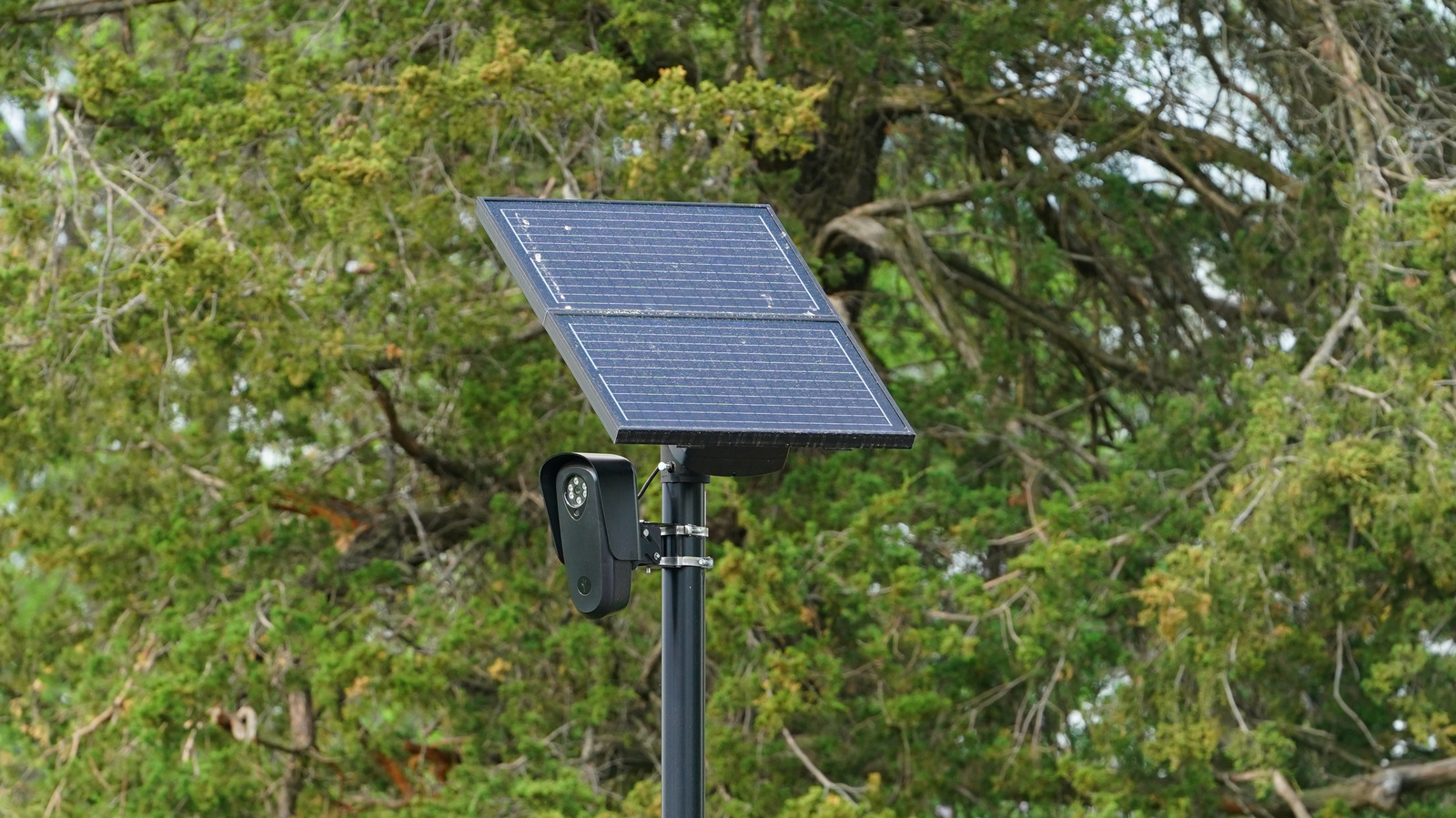
Flock cameras have quickly become some of the most hated things on the planet. One of the primary reasons is the perception that cops abuse the tools for nefarious ends. There have been plenty of reports that allege that officers have used Flock cameras to spy on people or even stalk ex-partners.
The company is finally addressing some of these issues and rolling out updates to make abuse by law enforcement and other entities more difficult. The pre-existing Audit Assistance feature will now be required to use, after being introduced as an optional tool. This flags “abnormal search behavior” and locks out suspicious users until an administrator reviews their activity.
Police officers will now be required to enter case codes to run searches, which is intended to limit personal queries. This can, however, be overridden by an administrator in certain scenarios.
I’ve learned a lot in nine years of building @Flock_Safety. Some of it from our customers, and some of it from the communities they serve.
Today we’re announcing the changes that came from listening. A new standard for privacy, security, and accountability in public safety…
— Garrett Langley (@glangley) August 13, 2026
“This is such an obvious way to curb abuse,” CEO Garrett Langley told The Verge. “And I said, ‘Fine. You know what? I think that’s right, and we got this one wrong. We should make it a requirement.’” It is worth noting that we’ve been seeing Flock-related stalking incidents from police officers since 2021.
The company is also shortening the Automated License Plate Reader (ALPR) data retention period from 30 days to a week. Again, there will be exceptions for “cases that take longer,” like “an active investigation in cold storage.” However, this looks to only apply to new customers. The company is carving out another exception for existing customers, in which they can “keep their current, democratically approved retention periods.”
CEO Langley has long been combative when it comes to critics of Flock, even calling a website that tracks the cameras “terroristic”. He has since apologized for that language and seems to have taken a softer approach, likely due to severe public backlash.
“All I guess I’m asking for is for a fair shot,” he told The Verge. “It took me maybe longer than it should have to realize the sheer impact of the company.” Again, it must be noted that these officer-related offenses have been ongoing for at least five years and the company itself turns 10 next year.
These are largely positive moves that could curb some police misuse, but that’s only one aspect of why people dislike Flock cameras so much. Groups like the ACLU and the Electronic Frontier Foundation have accused the company of misleading the public regarding the capabilities of these cameras, suggesting that they are actually much more than simple license plate readers.
To that end, there are allegations that the cameras have been used to track a woman seeking an abortion. Police have also been using Flock cameras to track people traveling from one state to another for the purpose of purchasing marijuana in a state where it’s legal.
There are multiple reports that Flock data has been shared with ICE, to which Langley has said that “if the state of Texas wants to enforce immigration, they might use Flock, but they’re gonna go enforce immigration no matter what Flock does.” As of this writing, at least 24 people have reportedly died in ICE custody in 2026.
All of this combined has led to serious backlash. Some law enforcement agencies have severed ties with the company, like in Los Angeles. Communities have also begun taking matters into their own hands. Flock cameras have been vandalized, destroyed or straight-up stolen in numerous incidents throughout the country. One Minnesota town found that its entire stock of Flock cameras had disappeared overnight. The city’s police department has announced it will not be replacing the cameras.


Acura is largely known for its reliable models and simple SUVs, but the automaker recently unveiled a shocking concept car that is cool enough to rival any supercar. The Acura NEXERA Vision is debuting at The Quail on August 14th, right in the middle of Monterey Car Week, and will then be showcased at the Pebble Beach Concours d’Elegance on the Concept Lawn on August 16th. Its butterfly doors may very well steal the show.
 Acura
Acura
Acura Creative Director and Vice President of Auto Design, Yasutake Tsuchida, said Acura’s 40th anniversary has sparked the brand to experiment with the design language for future models, including the upcoming fourth-generation RDX Hybrid that’s releasing in the next few years. “Our goal with this new design direction is to define Acura performance through disciplined proportions, sculpted form and the seamless integration of advanced technology, creating an expression that is both progressive and authentic to the brand,” he said in a press release.
 Acura
Acura
The NEXERA Vision concept was designed under Tsuchida’s guidance at the Acura Design California studio in Los Angeles. The Matte Titanium finish gives it a sleek, futuristic appearance, which is paired with a wide stance for extra drama. The butterfly doors elevate that striking profile even further, as you can see in the coolest cars with butterfly doors. But its aggressive appearance is matched by a promise of performance, thanks to an active rear spoiler, high-performance carbon-ceramic Brembo brakes on its 22-inch wheels, and forged carbon accents.
The Acura NEXERA Vision’s leveled up details

The Acura NEXERA Vision concept car features intricate details that make it more dynamic than just its butterfly doors. Upon a closer look, you can see a new lighting signature Acura is calling “phantom lighting” behind the bodywork. It’s revealed when the vehicle is illuminated, creating a layered look that makes the NEXERA Vision come alive.
 Acura
Acura
The thin headlights and taillights are also part of a new lighting signature for Acura, forming an “A” that artistically wraps around the front and back of the vehicle. This will become part of Acura’s identity and will be seen on future production cars. (Although we’d love to see the NEXERA Vision become more than just a concept as well.)
 Acura
Acura
Inside the NEXERA Vision, there is also plenty of detail that may not be seen at first glance. Meant to be a driver-focused cabin, the fixed front seats are integrated into the floor to make them lower, allowing the pedals and steering wheel to “meet” the driver. There are premium materials and forged carbon finishes throughout, giving a luxury feel.
 Acura
Acura
These include many sustainable materials, like recycled aluminum and polyester. Said Tsuchida: “Sustainability is playing an increasingly important role in how premium quality and performance are defined, and the Acura brand is embracing innovative material technologies that bring fresh possibilities to the customer experience while supporting broader environmental ambitions.”

XRP Defends $1 by a Cent Since CLARITY Act Slipped. Now CFTC Steps In

Blueface Kicks Nevaeh Akira Into A Pool, Fans Allegedly Call Police

#1 MONEY EXPERT Reveals The 75/15/10 Money System That Builds Wealth with ANY Income!


-

 Fashion6 days ago
Weekend Open Thread: Mattifying Sunscreen
-

 Fashion6 days ago
Frugal Friday’s Workwear Report: Cap-Sleeve Pointelle Crewneck Sweater
-

 News Videos5 days ago
Can Astrology Help Find Gold and Silver Trends? A Financial Astrology Guide
-

 Tech6 days ago
Rinn Pharma & Biopharma to join NordicPharmaTrain network
-

 Business5 days ago
How to Start a Cleaning Business: A Step-by-Step Guide
-

 Business4 days ago
Datadog: Best Of Breed For Multiple Reasons
-

 Business5 days ago
BDC Weekly Review: Private BDC Q2 Numbers Are Strong
-
 NewsBeat2 days ago
Communication cards help banking customers access services or report scams
-

 Tech7 days ago
Price Hikes May Be Coming for PC Motherboards Next
-

 Business7 days ago
Brightwater secures funding for WA-first dementia projects
-
 Business3 days ago
Oil Price Today (August 11): Crude oil rises to $88 after Trump’s compensation demand dents Hormuz opening. Here’s why
-

 Fashion6 days ago
Weekly News Update, 8.6.26 – Corporette.com
-

 Business7 days ago
Aussie shares lose steam to close record-breaking week
-
 Entertainment7 days ago
Brand New Day’ Characters, Ranked
-
 Fashion7 days ago
The Best Stores Like Ann Taylor
-

 Fashion6 days ago
Irina Shayk Wows in REVOLVE Los Angeles’ Summer Styles
-

 Entertainment7 days ago
Coastal House Media Can Disney Redeem Live Action Dragon Ball?
-

 Fashion6 days ago
Burberry Fall 2026 Takes On Commuter Style
-

 Politics5 days ago
Be quiet, Miriam! – spiked
-

 Fashion4 days ago
Amazon Sundays: Closet Care Before Fall
You must be logged in to post a comment Login