Connect with us
DAPA Banner
DAPA Coin
DAPA
COIN PAYMENT ASSET
PRIVACY · BLOCKDAG · HOMOMORPHIC ENCRYPTION · RUST
ElGamal Encrypted MINE DAPA
🚫 GENESIS SOLD OUT
DAPAPAY COMING

Business

Planning to take international exposure for three years? Here are top 5 global funds with over 40% gain

Published

on

Planning to take international exposure for three years? Here are top 5 global funds with over 40% gain

International mutual funds focused on Taiwan equities, AI, Nasdaq stocks and gold mining delivered over 40% returns in three years. Nippon India Taiwan Equity Fund topped the list with 64.14% gains, while technology and global thematic funds also posted strong one-year performance.

Continue Reading
Click to comment

You must be logged in to post a comment Login

Leave a Reply

Business

Bitcoin faces fresh selling pressure despite U.S.-Iran easing; over $400 million liquidated in 1 day

Published

on

Bitcoin faces fresh selling pressure despite U.S.-Iran easing; over $400 million liquidated in 1 day
Bitcoin is facing fresh selling pressure despite easing U.S.-Iran tensions and over $400 million wiped out from the crypto market in the past 24 hours. The cryptocurrency was trading at $75,398 mark witnessing a decline of nearly 3% in the past 24 hours.

Ethereum also declined 3% to trade at $2,061 mark. Among the major altcoins, BNB, XRP, Solana, Tron, Dogecoin, Hyperliquid and Cardano corrected upto 4.75%. The global crypto market capitalisation edged down 2.31% to $2.52 trillion, according to CoinMarketCap.

Also Read | Planning SIPs for a car or house in 10 years? Experts recommend diversified equity funds for long-term goals

WazirX Market’s Desk said Bitcoin and Ethereum remained under pressure this week as global macroeconomic concerns continued to dominate market sentiment, both recording weekly declines amid rising Treasury yields, persistent inflation concerns, and elevated oil prices driven by geopolitical tensions in the Middle East.

The broader risk-off environment weighed heavily on crypto investment products, which recorded net weekly outflows of over $1.07 billion and Bitcoin funds accounted for the majority of withdrawals, while Ether products also posted significant redemptions, ending a six-week streak of inflows, WazirX Market’s Desk further said.

In the past week, Bitcoin and Ethereum were down 4.31% and 7.15% respectively. Among the major altcoins, BNB, XRP, Solana, Dogecoin, Cardano slipped upto 6.09% whereas Tron and Hyperliquid gained 3.02% and 31.46% respectively.
Piyush Walke, Derivatives Research Analyst, Delta Exchange said Bitcoin showed a second consecutive weekly loss, as easing U.S.-Iran tensions failed to revive sentiment in the crypto market. Continued outflows from Bitcoin ETFs and profit-booking after a U.S. Senate crypto bill breakthrough kept pressure on digital assets.
Also Read | Time to buy rupee assets? DSP Mutual Fund lists 5 reasons favouring Indian equities and bonds

Bitcoin’s decline also triggered fresh liquidations in leveraged positions, with over $400 million wiped out from the crypto market in the past 24 hours and going forward, crypto markets are expected to remain highly sensitive to U.S. inflation data, Fed rate expectations, ETF flows, and geopolitical developments, Walke said.

(Disclaimer: Recommendations, suggestions, views and opinions given by the experts are their own. These do not represent the views of The Economic Times)

Advertisement
Continue Reading

Business

Alphabet: A Great Reset Is Potentially Coming

Published

on

Alphabet: A Great Reset Is Potentially Coming

Alphabet: A Great Reset Is Potentially Coming

Continue Reading

Business

NetApp NTAP Stock Surges 12% Following Strong Earnings Beat Fueled by AI Data Storage Demand

Published

on

NetApp NTAP Stock Surges 12% Following Strong Earnings Beat Fueled

SAN JOSE, Calif. — NetApp Inc. shares rose 12.44% to close at $139.36 on May 22, 2026, on the Nasdaq after the data infrastructure company reported fiscal fourth-quarter results that exceeded analyst expectations and highlighted strong demand for AI-optimized storage solutions.

The stock traded in a range between $123.50 and $140.20 during the session with significantly elevated volume. In after-hours trading, shares were little changed around $139.35.

Fiscal Q4 2026 Results

NetApp reported fiscal fourth-quarter revenue of $1.71 billion, up 8% year-over-year. The company posted non-GAAP earnings per share of $2.15, beating consensus estimates. GAAP net income was $312 million, or $1.48 per share.

Advertisement

For the full fiscal year 2026, NetApp generated revenue of $6.76 billion. The company ended the year with strong cash flow from operations and continued to return capital to shareholders through dividends and share repurchases.

AI and Cloud Momentum

NetApp highlighted growth in its AI-related offerings, particularly with its Intelligent Data Infrastructure platform. The company noted increasing adoption of its solutions for AI training, inference and data management by hyperscalers and enterprise customers.

Public cloud revenue grew 28% year-over-year in the quarter. NetApp also reported strong performance in its hybrid cloud storage portfolio, with ONTAP software and all-flash systems seeing increased demand.

Advertisement

Analyst Reactions

Several firms raised price targets following the earnings release. Piper Sandler increased its target to $165 from $150. Barclays raised its target to $155. Consensus ratings remain generally positive with an average 12-month price target around $148 to $160.

Strategic Position

NetApp provides data management and storage solutions for hybrid and multi-cloud environments. The company has positioned itself as a key player in the AI infrastructure space, offering high-performance storage systems capable of handling large-scale data workloads required for generative AI applications.

Advertisement

The company maintains partnerships with major cloud providers including Amazon Web Services, Microsoft Azure and Google Cloud. NetApp has expanded its software-defined storage capabilities and continues to invest in research and development for AI-accelerated workloads.

Market Context

NetApp operates in a competitive data storage market that has seen increased demand due to AI adoption across industries. The company faces competition from Pure Storage, Dell Technologies and cloud-native solutions. Global data generation continues to grow rapidly, driving investment in storage infrastructure.

Shares of NetApp have shown volatility in 2026 but have benefited from sector-wide interest in companies supporting AI infrastructure. The stock has traded in a 52-week range between approximately $95 and $148. Market capitalization stood near $29 billion following the May 22 close.

Advertisement

Outlook

NetApp provided fiscal first-quarter 2027 guidance with revenue expected between $1.68 billion and $1.73 billion. The company maintained its full-year fiscal 2027 revenue outlook in the range of $7.1 billion to $7.3 billion. Management cited confidence in continued AI-driven demand.

The company will report further details during its earnings conference call. Analysts will monitor gross margin trends, cloud revenue growth and execution on AI-related opportunities in upcoming quarters.

Dividend and Capital Returns

Advertisement

NetApp declared a quarterly dividend of $0.52 per share, payable on July 23, 2026, to shareholders of record on July 3. The company has consistently returned capital through dividends and buybacks while investing in growth initiatives.

Broader Industry Trends

Demand for high-performance storage has accelerated with the expansion of AI training clusters and enterprise data platforms. NetApp’s focus on unified storage architectures that work across on-premises and cloud environments has positioned it to benefit from hybrid IT strategies.

Advertisement
Continue Reading

Business

(PHOTO) Erin Moriarty Reveals Graves’ Disease Diagnosis and Mental Health Crisis in Time Essay

Published

on

Erin Moriarty

LOS ANGELES — Erin Moriarty, who plays Starlight on the Prime Video series “The Boys,” disclosed in a personal essay for Time magazine that she was diagnosed with Graves’ disease in May 2025 after struggling with severe undiagnosed symptoms for nearly two years.

Moriarty, 31, wrote that her symptoms began in September 2023. She described memory failure, incapacitating fatigue, intense mood swings, weakness and numbness in her hands and feet, heart palpitations and persistent urinary pain.

“The most frightening symptom of all was the cognitive decline,” she wrote. “My short-term memory deteriorated so severely that learning even simple lines became difficult — terrifying when you’re filming a television show.”

Moriarty said she was referred to a neurologist while continuing to film the final season of “The Boys.” She noted the challenge of managing chronic illness symptoms publicly.

Advertisement

“I was going through the physical hell of chronic illness on a public stage,” she wrote. “Doing it in private is emotionally damaging enough, but to have my physical symptoms be speculated about, trivialized, and dismissed was devastating.”

In May 2025, as filming wrapped, she received the diagnosis. “The day I was given a diagnosis was the day my life began again,” she stated. “Not because it instantly fixed everything, but because it finally gave shape to the chaos. It gave language to suffering that had gone on for years.”

Moriarty revealed that months after beginning treatment, she was hospitalized on Aug. 1, 2025, following a severe mental-health crisis.

“As my physical health began to improve, I realized how absent from myself I had been for the previous two years,” she wrote. “I had been hormonally dysregulated, cognitively impaired, and psychologically untethered for so long that recovery didn’t bring me peace. It brought me clarity. And for me, clarity arrived carrying grief.”

Advertisement

She described grieving lost time that affected her professionally, creatively, relationally and psychologically. “I spent at least two years of my life physically present but mentally unreachable,” she stated.

Moriarty said she felt compelled to speak publicly. “Illnesses that disproportionately affect women are still too often minimized, misunderstood, or exaggerated,” she wrote. “Silence has consequences. Ignorance does, too. And so, remaining silent about this is no longer an option for me.”

She expressed hope that her story could help others. “I hope the transparency surrounding my symptoms can help even one person catch their illness earlier than I caught mine,” she wrote. “The body speaks long before it screams. Listen to yourself before your body is forced to scream loud enough for the world to hear it, too.”

Background on Graves’ Disease

Advertisement

Graves’ disease is an autoimmune disorder in which the thyroid gland produces too much thyroid hormone. According to medical sources, common symptoms include rapid heartbeat, anxiety, weight loss, fatigue, tremors and cognitive difficulties.

Moriarty had previously hinted at health challenges during production of “The Boys” but had not detailed the extent of her condition until the Time essay published on May 21, 2026.

Career Context

Moriarty has portrayed Annie January, also known as Starlight, on “The Boys” since the series premiered in 2019. She also appeared in the spin-off series “Gen V” and has roles in other projects, including “Jessica Jones.” She continued working through her symptoms during the final season of “The Boys,” which wrapped filming in 2025.

Advertisement

The actress has used her platform to raise awareness about health issues that disproportionately affect women. She described the essay as a step toward greater transparency about invisible illnesses.

Continue Reading

Business

Bandhan Small Cap among top 5 smallcap funds with highest risk-adjusted returns. Check details

Published

on

Bandhan Small Cap among top 5 smallcap funds with highest risk-adjusted returns. Check details

Bandhan Small Cap Fund topped the list of small cap schemes with the highest Sharpe ratio, indicating superior risk-adjusted returns over three years. ITI Small Cap Fund, Invesco India Smallcap Fund and two smallcap index funds also delivered strong performance with balanced risk metrics.

Continue Reading

Business

Newcastle University’s pitch to businesses and investors with new ways to access expertise

Published

on

Business Live

The University wants to make it easier for potential partners to use its research capabilities

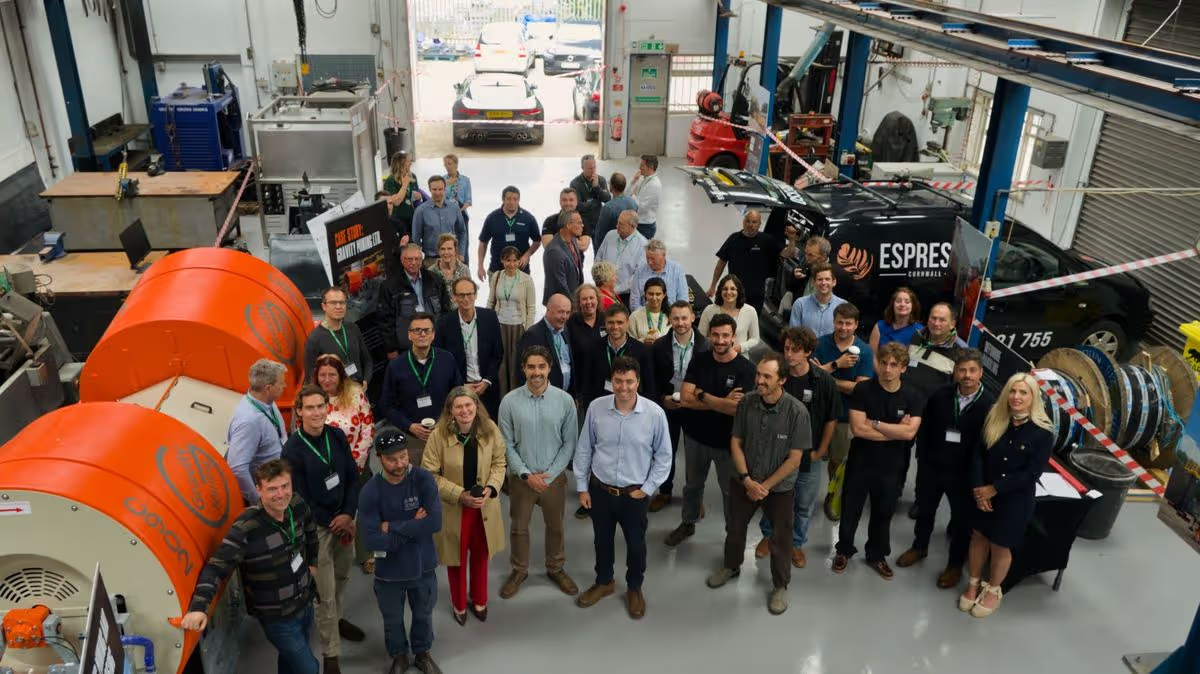
Newcastle Innovations has been launched by Newcastle University.

Estelle Blanks, director of Newcastle Innovations.(Image: Newcastle University)

Newcastle University hopes to help more entrepreneurs, businesses and investors turn ideas into growing companies with the launch of new scheme.

Bosses say Newcastle Innovations will be a single “front door” to the University’s expertise, talent, funding pathways and commercial support for those developing business ideas. The work intends to build on the university’s success in the field with 42 active spin-out companies that are said to have attracted more than £90m of investment in the past two years alone, and created more than 370 jobs.

The team there are appealing to those who want to co-develop new technologies, access specialist research facilities, commission applied research, invest in high-growth spin-outs or build skills for the future workforce.

Estelle Blanks, director of Newcastle Innovations at Newcastle University, said: “From a business perspective, the idea is simple – a clear route into expertise, talent, facilities, and partnerships. We are responding directly to feedback from industry, so that more companies can access our support and expertise to accelerate growth, attract investment and create a skilled workforce.”

Advertisement

Prof Jane Robinson, pro‑vice‑chancellor for business, partnerships and place at Newcastle University, added: “Partnership working is at the heart of what we do. Newcastle Innovations is about removing barriers to turn ideas into impact.

“We are making it easier for organisations to collaborate with us locally, nationally and internationally, to deliver innovation and growth and tangible benefits for businesses, communities and society.”

At an event launching Newcastle Innovations, the university pointed to its partnerships with a wide range of businesses, from small firms and scale-ups through to global names such as Procter & Gamble and Siemens. And to evidence that its National Innovation Centre for Data and Arrow programme, which provides innovation support to SMEs, had delivered productivity gains for businesses.

Among those business partners is outdoor clothing maker Pentland, the owner of the Berghaus brand. The firm used Newcastle University expertise to develop new legwear technology that can adapt to women’s bodies and support them to feel more comfortable when exploring the outdoors.

Advertisement

Biomechanical modelling and physiological analysis was carried out at Newcastle University’s advanced sport and exercise research facilities to refine the final design of the new product, and Berghaus is now incorporating ZonalAdapt into all of its legwear.

Sam Munson, new product development lead at Pentland Group, said: “Our collaboration with Newcastle University has been a fantastic example of how industry and academia can work together to better solve challenges real people experience in the outdoors. Working with Newcastle University brought a level of scientific rigour and technical expertise that was invaluable to this project, helping us to push our innovation further and better support women as they hike.”

Continue Reading

Business

High gas prices, airfares test limits of summer vacation spending

Published

on

High gas prices, airfares test limits of summer vacation spending

Travelers walk through the terminal at Ronald Reagan Washington National Airport on May 1, 2026.

Leslie Josephs | CNBC

Higher fuel prices are testing how badly consumers want to travel this summer, whether flying or driving.

Advertisement

Airfare hasn’t been this high since May 2022, when airlines stumbled out of the pandemic with aircraft and employee shortages to face hordes of consumers ready for “revenge travel.” Gasoline is above $4 a gallon and could go higher, AAA warned this week.

Jet fuel prices doubled in the span of less than three months this year after the U.S. and Israel attacked Iran, kicking off a conflict that has left a key shipping channel effectively closed.

Domestic round-trip airfares in April averaged $623, the highest in nearly four years, according to data from the Airlines Reporting Corporation, which tracks travel agency ticket sales. Jet fuel is the second-biggest expense for airlines after labor, and carriers say they are increasingly passing those costs along to customers.

Separately, airlines are also trimming their growth plans because of higher fuel costs. Even if a route isn’t cut, fewer flights on certain routes means that customers will have fewer seats to choose from and, with demand robust, that could drive up prices even more.

Advertisement

Spirit Airlines, the most famous budget carrier in the U.S., shut down earlier this month, and partially blamed jet fuel prices for its failure to emerge from near back-to-back bankruptcies. It was the biggest U.S. airline collapse in decades. Other airlines swooped in to snatch up those customers in the aftermath, but the carrier’s demise removes a main purveyor of low fares.

Read more about jet fuel’s impact on travel

The fuel spikes have set the stage for higher fares and more expensive gas station visits this summer. The start of the peak travel season Memorial Day weekend will be a taste of how much travelers will shell out to fly while everything from groceries to clothing has become more expensive this year.

The Transportation Security Administration said it expects to screen 18.3 million people between Thursday and next Wednesday, compared with the 18.5 million it saw over a similar period last year.

Lackluster road trip growth

Road trips won’t be a bargain either. AAA this week forecast 39.1 million people will drive at least 50 miles between Thursday and Monday, up just 0.1% compared with last Memorial Day weekend. That was the least growth in a decade, AAA told CNBC.

Advertisement

Gasoline price site GasBuddy forecast this week that prices across the U.S. will average $4.48 on Memorial Day, up from $3.14 last year, and that prices could average $4.80 through Labor Day “if the Strait of Hormuz remains closed for a significant portion of the summer.”

A customer fills his vehicle with fuel at a gas station in Miami, April 13, 2026.

Joe Raedle | Getty Images

Still flying

Leisure travel intentions in the U.S. were slightly lower in March — at 82.8% compared with 83.1% the same month a year earlier — though they are still relatively high, UBS said in a note Monday.

Advertisement

“We believe the year-over-year moderation in travel intentions this year was likely due to higher jet fuel and other geopolitical concerns,” UBS airline analyst Atul Maheswari wrote. He added that the intent to travel is near the highest points in the past nine years.

So far, airline executives said, customers are still booking, and executives are optimistic about the summer travel season. They’ve also said they’re expecting a boost from the FIFA World Cup, which will be held in June and July in the U.S., Canada and Mexico, and from major concerts such as Harry Styles’ residencies in Amsterdam and London this summer.

United Airlines said it expects to carry 53 million travelers between June and August, up 3 million people from last year. American Airlines has forecast 75 million customers between May 21 and Sept. 8, after Labor Day, topping its previous record, in 2019.

Refueling trucks at LaGuardia Airport in New York, April 23, 2026.

Advertisement

Zhang Fengguo | Xinhua News Agency | Getty Images

‘What are you waiting for?’

Airlines have been pruning their schedules and axing unprofitable or less profitable routes but have been eager to fill in the gaps after Spirit’s collapse.

Travelers can still find deals if they’re flexible, said Kyle Potter, who runs the Thrifty Traveler website. He recommended using tools such as the “Explorer” tool in Google Flights that allows users to look up destinations by the length of trip and by month in a map view.

He also suggested flyers consider traveling on a Tuesday or Wednesday, when fares and traffic are often lower.

Advertisement

“That, in many cases, can save you hundreds of dollars per ticket, and multiply that by a family of four,” he said.

He had a simple message for travelers sitting on piles of frequent flyer miles.

“Now is the time to use your miles or your credit card points or both,” he said, warning that miles can end up devalued. “What are you waiting for? I think a lot of people hoard their miles because they want to go to to Europe in 2027.”

— CNBC’s Contessa Brewer contributed to this report.

Advertisement
Choose CNBC as your preferred source on Google and never miss a moment from the most trusted name in business news.
Continue Reading

Business

Firefly Aerospace FLY Stock Surges 15% on Strong Q1 Results and Defense Contracts

Published

on

Firefly Alpha lifting off the pad at Vandenberg Space Force

CEDAR PARK, Texas — Firefly Aerospace Inc. shares rose 15.49% to close at $49.50 on May 22, 2026, extending recent gains as investors reacted to the company’s first-quarter financial performance and ongoing defense and space contract momentum.

The stock traded in a range between approximately $42.93 and $49.80 during the session with elevated volume. In after-hours trading, shares moved to around $49.85.

Q1 2026 Financial Results

Firefly Aerospace reported record first-quarter 2026 revenue of $80.9 million on May 4, representing a 40% increase from the prior quarter and 44.7% growth year-over-year. The results were driven by spacecraft solutions and defense-related work.

Advertisement

The company provided full-year 2026 revenue guidance of $420 million to $450 million. Firefly ended the quarter with total liquidity of $811.6 million, including $551.6 million in cash and equivalents.

Key Contract Wins

Firefly’s subsidiary SciTec was awarded a contract by the Air Force Research Laboratory for advanced algorithm research and verification architecture. The work focuses on deep learning and advanced algorithms on small size, weight and power processors for enhanced target detection, tracking and custody.

SciTec also received a $109 million engineering change proposal under the U.S. Space Force’s FORGE Enterprise OPIR Services contract to accelerate and expand data center delivery. Additionally, SciTec was selected to support the Space Force’s space-based interceptor program under Golden Dome.

Advertisement

Operational Milestones

Firefly completed critical milestones for its Blue Ghost lunar lander mission. The company successfully launched Alpha Flight 7 earlier in 2026 and continues to advance its spacecraft production capabilities.

On May 19, 2026, Firefly announced the expansion of its spacecraft production campus and the opening of a new innovation lab in Central Texas to accelerate manufacturing.

Analyst Sentiment

Advertisement

Jefferies maintained a Buy rating on Firefly Aerospace with analysts citing strong growth prospects in the space and defense sectors. Other firms have offered positive outlooks, though some price targets were adjusted downward in recent weeks.

The stock has experienced significant volatility in 2026, trading in a 52-week range between approximately $16 and $73.80. Market capitalization stood near $6.87 billion with about 160.24 million shares outstanding.

Company Background

Firefly Aerospace, which went public in August 2025, develops small to medium launch vehicles, spacecraft and defense technologies. The company operates primarily from facilities in Texas and focuses on responsive space capabilities for commercial and government customers.

Advertisement

Its Alpha rocket has achieved successful launches, and the company is advancing toward higher cadence operations. Firefly also provides spacecraft solutions and supports national security missions through its SciTec subsidiary.

Industry Context

Firefly operates in a rapidly growing space sector driven by increased defense spending and commercial demand for launch and satellite services. The company benefits from U.S. government initiatives focused on space superiority and responsive capabilities.

Broader sector optimism has lifted multiple space-related stocks in 2026, including Rocket Lab and Intuitive Machines. Firefly’s combination of launch vehicles, spacecraft manufacturing and defense contracts positions it within this expanding market.

Advertisement

Outlook Factors

Management has expressed confidence in achieving 2026 revenue targets, with approximately 80% of the guidance range already contracted or in backlog. The company continues to invest in production capacity and technology development to support future growth.

Upcoming milestones include further Blue Ghost mission progress and potential additional government contract awards. Analysts will monitor execution on revenue guidance, gross margin trends and operational cadence in subsequent quarters.

Advertisement
Continue Reading

Business

Concert ticket prices are reshaping summer live music demand

Published

on

Concert ticket prices are reshaping summer live music demand

Rolfo | Moment | Getty Images

This summer, mega artist Harry Styles will take the stage at Madison Square Garden in New York City for an exclusive 30-show residency – his only planned stop in the country and a show that’s garnered intense attention since its announcement.

Despite her best efforts, Shira Elfassy won’t be there.

Advertisement

“His tickets were absurd,” Elfassy, 29, told CNBC. “It felt like an insult going in and seeing, like, not only can I not get in, not only are there no tickets left, but even then, the most basic price point is $500 for a nose-bleed seat — and this is becoming commonplace.”

Instead, Elfassy said she got tickets to see other artists live, like Florence + the Machine and Olivia Rodrigo, at far lower price points. She said feeling “priced out” of some concerts is now a common occurrence.

“It’s just a weird dynamic now. … At this point, if I have to make the decision between making more summer plans or hanging out with my friends — or even just [to] pay rent — or I can go to this concert, it’s a no-brainer,” she said. “But it didn’t used to be that way.”

Elfassy represents a growing cohort of consumers who aren’t willing to keep up with the rising prices for live music, creating a K-shaped demand curve where higher-income consumers are spending more — and keeping prices inflated — while lower-income consumers are pulling back.

Advertisement

That dynamic has played out across discretionary spending categories, like retail, dining and travel, as Americans grapple with persistent inflation, economic uncertainty and, now, soaring gas prices.

In live music, this K-shaped environment is spurring fears that the lower end of the market is falling out entirely.

Some are calling the demand shifts “blue dot fever,” named for the blue dots on Ticketmaster seating maps that denote an unsold ticket. For some artists, it’s forcing them to take a critical look at their performances. Post Malone, Zayn and The Pussycat Dolls are just a few examples of artists who have canceled shows or tours in recent months, with the last group openly admitting that poor ticket sales was the catalyst.

Last summer, even before the most recent pricing pressures, industry research suggested higher ticket prices were helping to prop up the overall health of the market. Goldman Sachs analysts wrote in a 2025 report that demand for live music was expected to grow at a 7.2% compounded annual growth rate between 2024 and 2030.

Advertisement

Average ticket price for a concert in one of the top 100 global tours, the report found, was $136 in 2024, up 50% from an average of $91 in 2019.

How inflation is changing concert spending

Several of the major ticketing companies told CNBC they’re not seeing more show cancellations this summer than an average year.

“Of all the shows Live Nation has on the books this year, less than 1% have been cancelled,” a spokesperson for the Ticketmaster parent said. “That’s not ‘blue dot fever’ — it’s a normal touring year; in fact, 2026 is shaping up to be a record with concert ticket sales up 11% for the year.”

The spokesperson added that roughly 70% of tickets sold on its platform are priced under $100.

Advertisement

Live Nation and Ticketmaster have faced scrutiny over the company’s ticketing practices and dominant influence in the music industry. The company faced legal challenges over alleged anticompetitive behavior and reached a settlement with the Department of Justice in March. A federal jury found last month that Live Nation held an anticompetitive monopoly, though the company said in a statement at the time, “The jury’s verdict is not the last word on this matter.”

The Live Nation website arranged on a laptop in New York, US, on Wednesday, April 17, 2024. 

Gabby Jones | Bloomberg | Getty Images

StubHub, a ticket reseller, told CNBC that the company is seeing the K-shaped pattern take shape in live music, with demand diverging fast between various events.

Advertisement

While StubHub said overall concert demand is up nearly 10% year-over-year, it’s not across the board. Ticket demand for stadium-scale events is up significantly, while demand for mid-size and smaller venues is waning.

The events that are struggling to sell are facing a “supply-sizing problem,” according to Jill Gonzalez, head of consumer communications at StubHub. The events earning the strongest fan attention, she said, are stadium tours, residencies and marquee festivals.

“What our data makes clear is that fan demand for live music hasn’t softened, but it’s sharpened,” Gonzalez told CNBC. “Fans are making deliberate choices about where they spend, and when they decide a show is worth it, the demand signal is as strong as anything we’ve seen on our platform.”

Ticket platform SeatGeek said while more artists are announcing tours, the resale environment remains healthy.

Advertisement

“If you have more artists that are flooding the market with tours, you’re going to have the gross number of cancellations pick up year-over-year, so that’s expected,” said Oliver Marvin, the company’s senior director of strategic finance. “But the overall number, cancellations as a percentage of people who are out on tour, is not too much different than what we’ve seen in prior years.”

He added that the company is seeing some consumers dive in for last-minute tickets out of hope the prices will drop for tours that aren’t garnering as much immediate demand.

Why stadium tours still draw big demand

Experts say dropping demand for some shows may be more nuanced than what meets the eye.

As prices everywhere rise, and consumers begin to be more intentional about how they’re spending their money, the blame of unsold tickets may be more appropriately placed on the macroeconomic environment rather than on the artists themselves, according to Sam Howard-Spink, the director of music business at New York University.

Advertisement

“It’s really mostly to do with the economics of live performance and touring right now, which is also at the moment, I would say, very closely tied to economic conditions and cost-of-living questions,” Howard-Spink said.

Tighter spending among fans can turn a tour misstep into a disaster, he suggested, like if an artist plans dates at an inappropriately sizes venue or in an off-base market. While nostalgia for older acts can occasionally draw crowds, it’s struggling to outweigh all other factors.

And while bigger artists can still sell out a stadium, less-popular acts are falling short.

“Harry Styles, Bad Bunny, Lady Gaga, Ariana Grande — these are acts of, ‘I’m not really going to have too much trouble,’” he said. “But if you’re talking about like … an early 2000s band that might not just be able to pull in those crowds, maybe they are overconfident in the kinds of venues that they think that they can fill up.”

Advertisement

Artur Debat | Moment | Getty Images

Howard-Spink added that the business of music has long been considered largely “recession-resistant,” even weathering the pandemic well. But because concert tickets are a scarce resource, as opposed to music streaming, it’s allowed the prices to rise rapidly.

Music publicist Eric Alper noted artists couldn’t have foreseen these macroeconomic factors currently at play when booking out their tours months in advance. There’s also more artists on tour this year than past years, he said, crowding the schedule.

With prices broadly higher, fans are also seeking out more experiences that give them a bang for their buck, he added, as the live music scene sees a rise in residencies, along with unique new venues like The Sphere in Las Vegas.

Advertisement

“What people want, they want the choreography, they want the lights, they want the superior sound, they want great sightlines,” Alper said. “They’re not just going to sit there and spend $150 to go watch a band play with very bare bones.”

Still, Alper said, he believes the diehard fans are willing to pay up.

“If you’re a fan of an artist, I don’t think you care about the high ticket prices as much as people think that they do,” Alper said. “People want the experience, and they also want to tell people that they were there.”

Choose CNBC as your preferred source on Google and never miss a moment from the most trusted name in business news.
Advertisement
Continue Reading

Business

Denmark’s Frederiksen gets new chance to form government after centre-right talks fail

Published

on

Denmark’s Frederiksen gets new chance to form government after centre-right talks fail


Denmark’s Frederiksen gets new chance to form government after centre-right talks fail

Continue Reading

Trending

Copyright © 2025