Connect with us

Business

Plans to transform the port of Port Talbot

Published

on

Business Live

The investment will support the delivery of floating offshore wind projects in the Celtic Sea

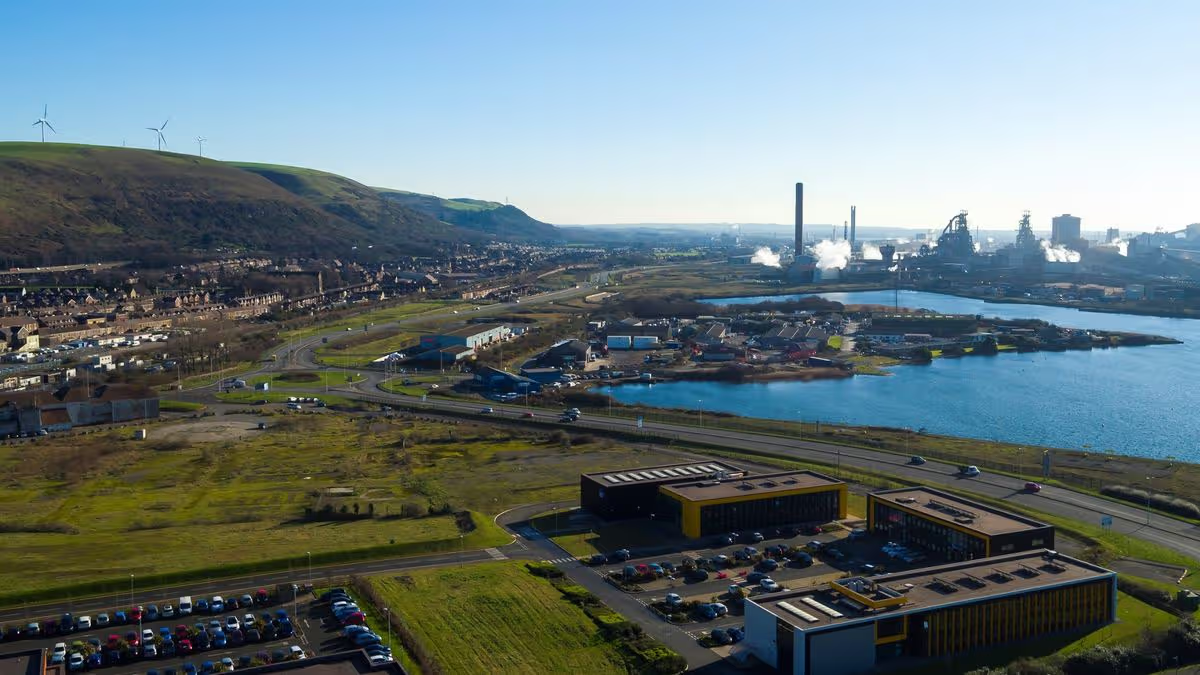
The port of Port Talbot.(Image: Dave Powell Ltd.)

Plans for a “transformative programme” of works to redevelop the port of Port Talbot have taken a step forward after an early stage application to the local council.

Advertisement

The project known as the “Future Port Talbot” programme will look to construct new marine and land-side infrastructure at the south Wales port in order to facilitate the creation of huge floating offshore wind-farms in the Celtic Sea.

The work could eventually see the creation of assembly and manufacturing facilities for the offshore wind industry along with a new quay wall, land-side material and equipment storage if taken forward.

It comes after The UK Government announced a £64m investment into the port of Port Talbot in March to enable Associated British Ports, (ABP) to complete the essential design and engineering work needed.

Additionally, in 2025 the Crown Estate struck a leasing agreement with developers to build three floating offshore wind-farms in the Celtic Sea, one in English waters, one in Welsh waters and a third straddling both.

Advertisement

As a result it is hoped that the port could support thousands of new jobs once completed, potentially unlocking over £500m of investment for the town and wider area.

The latest submission to Neath Port Talbot Council was revealed as part of officers delegated decisions made between March 13 and May 14.

It confirmed the intention of ABP to submit a Harbour Revision Order for the works in Port Talbot. A scoping direction also confirmed the full plans would need to include an environmental impact assessment as well as an application for a Marine Licence from Natural Resources Wales.

A section of the Associated British Ports website which discusses the Future Port Talbot Programme said: “Port Talbot has been at the forefront of industrial change before, and ABP’s vision is to lead that change again. Port Talbot has a natural sheltered deep-water harbour and large land that can be developed.

Advertisement

“It is close to floating offshore wind in the Celtic Sea and has strong export potential. The port sits within communities with a rich industrial heritage and a strong base of relevant skills and experience.

“These plans support growth in Wales and the UK and can help drive wider economic regeneration across South Wales.”

Continue Reading
Click to comment

You must be logged in to post a comment Login

Leave a Reply

Business

Burgers cost more this summer, but farmers say they’re not cashing in

Published

on

Heather Oldfield stands in the centre of the image wearing a burgundy fleece gilet and sunglasses on her head. On either side of her is a young child. They are in a field with cattle behind them.

“I know I’m not going to be a millionaire running a bakery,” says Phil Clayton.

We are speaking in the busy bakery he runs with his wife Tina. It is only 10am, but the operation has been in full swing for nine hours.

Clayton says it is “absolutely not true” that the bakery enjoys more profit due to price rises.

In May, families were paying 2% more for bread rolls than they were a year earlier, according to the CPI.

Advertisement

But in April, farmers were receiving 0.3% less for wheat, the main ingredient, according to API figures.

The 2% increase in prices for customers is smaller than the 3% rise seen across the whole CPI index.

Clayton says he does not regret increasing his prices by 10p to 20p.

“My responsibility is to make sure all of this lot get paid,” he says, referring to his 30-strong team, which includes bakers, delivery drivers and Saturday staff employed in the cafe that adjoins the bakery.

Advertisement

Clayton points out the extra money shoppers pay at the tills goes towards increases in rent, wages, National Insurance, delivery fuel and the rising cost of flour – much of which originates from farms in the region.

Continue Reading

Business

Southeast Asia’s EV Race Heats Up as Foreign and Domestic Producers Chase a Fast-Growing Market

Published

on

China's Record Trade Surplus and What It Means for Thailand's Economy
  • Southeast Asia has emerged as a major electric vehicle market, with Vietnam, Singapore, Indonesia, and Thailand posting EV sales shares that rival or exceed Western benchmarks. Chinese manufacturers, led by BYD, have driven much of this growth through significant factory investments and competitive pricing, capturing dominant market share across the region.
  • Thailand, Indonesia, and Vietnam each represent distinct policy models: Thailand has prioritized manufacturing scale and export capacity, Indonesia is leveraging nickel reserves to demand local production commitments, and Vietnam has developed a domestic champion in VinFast. The trajectory of each market depends on how governments balance foreign investment incentives against the development of local industrial capacity.

Southeast Asia has quietly become one of the most contested electric vehicle battlegrounds on the planet. Vietnam and Singapore have pushed EV sales shares to roughly 40 percent of new car sales, a level that now exceeds the UK and the EU, while Indonesia has overtaken the United States on EV penetration and Thailand has sold more EVs in three quarters of 2025 than Denmark managed in the same period, according to energy think tank Ember. The region’s electric car sales more than doubled year on year, the International Energy Agency notes in its 2026 Global EV Outlook, with Vietnam, Indonesia and Thailand leading the charge.

What began as a Chinese-led price disruption has evolved into a genuine multi-front contest, with Japanese incumbents recalibrating, Korean and European manufacturers staking out production footholds, and Vietnam’s VinFast attempting to become the region’s first credible domestic champion beyond its home market.

Thailand: the manufacturing hub China built

Thailand remains the clearest example of how quickly an EV market can be remade. BYD’s $900 million Rayong plant, opened in July 2024 as the company’s first factory outside China, anchors a cluster that includes Great Wall Motor, SAIC Motor, GAC Aion, Changan Automobile and Chery, most either operating or completing capacity in the Eastern Economic Corridor. The Thailand Board of Investment reported this month that the kingdom has now secured over 4.1 billion dollars in EV supply chain investment pledges across 198 projects, spanning batteries, assembly, components and charging infrastructure, with Hyundai Mobility and China’s Omoda and Jaecoo both scheduled to begin production in 2026.

Chinese brands have translated that manufacturing base into commercial dominance, holding somewhere between 70 and 80 percent of Thai EV market share by most 2025-2026 estimates, with BYD alone commanding around 40 percent. That speed of displacement has not been without friction. Domestic auto sales fell to a fifteen-year low in 2024, several Japanese-oriented parts suppliers have closed, and Thai regulators opened an investigation into BYD’s local distributor over aggressive discounting that angered earlier buyers. Bangkok’s response has been to recalibrate rather than retreat: the government’s “30@30” target, once framed as a battery-electric mandate, is increasingly being pursued through a broader mix that includes hybrids, as Thai policymakers weigh industrial ambition against the risk of hollowing out a legacy auto sector that Japanese manufacturers spent six decades building.

Indonesia: playing the nickel and localization card

Indonesia has taken a different route, using its dominant global nickel reserves as leverage to demand local production in exchange for market access. BYD has committed roughly 1 billion dollars to a West Java plant targeting 150,000 units annually, due to begin operations this year, while VinFast opened its own Subang, West Java facility in December, just seventeen months after breaking ground, with an initial 50,000-unit capacity that could scale toward 350,000 units as later phases are funded. Toyota, GAC Aion and Hyundai (in partnership with LG Energy Solution on battery cells) have all made comparable localization commitments, betting that Jakarta’s local-content thresholds, which require 40 percent local content by 2026, rising to 80 percent by 2030, will reward early movers.

Advertisement

Despite the investment, EV penetration in Indonesia remains modest relative to registered vehicles, and Chinese brands led by BYD, Wuling and Chery continue to hold the advantage on price and brand recognition that VinFast and others are still trying to close.

Vietnam: the one market with a real domestic champion

Vietnam stands apart as the only Southeast Asian market with a large-scale domestic manufacturer rather than an import-and-assemble foreign operation. VinFast delivered around 124,000 EVs domestically in the first ten months of 2025 and closed the year on a record fourth quarter, with roughly 88 percent of that volume still concentrated in Vietnam itself. The company is now attempting to convert that home advantage into a regional one, targeting at least 300,000 deliveries in 2026 and pushing into Indonesia, India, the Philippines and Malaysia through a mix of local assembly, an electric taxi fleet under its Xanh SM brand, and an aggressive charging buildout through its V-Green unit. BYD has entered Vietnam but remains a marginal player there so far, a rare instance in the region of a domestic brand holding off Chinese competition on its own turf.

The foreign-versus-domestic calculus

The pattern across the three largest markets suggests foreign capital, overwhelmingly Chinese, is setting the pace of the region’s EV transition, while domestic policy is shaping where that capital lands and on what terms. Thailand has traded market share for manufacturing scale and export capacity, positioning itself to ship Thai-made EVs to Europe and Australia. Indonesia is trading market access for supply chain localization tied to its mineral wealth. Vietnam is the outlier, having incubated a national champion capable of competing on price with Chinese entrants, though VinFast’s continuing losses underline how costly that path has been.

For investors and business planners tracking ASEAN exposure, the near-term signals worth watching are Thailand’s shift toward a multi-technology, hybrid-inclusive strategy as pure-BEV demand growth moderates, Indonesia’s ability to convert local-content rules into a genuine domestic battery and component industry rather than a captive assembly hub, and whether VinFast’s push into Indonesia, the Philippines and beyond can achieve profitability before Chinese manufacturers close the remaining gap on brand trust.

Advertisement

Continue Reading

Business

Perdue Farms launches protein-packed poultry

Published

on

Perdue Farms launches protein-packed poultry

Purdue Powered features three high protein varieties of frozen chicken.

Continue Reading

Business

Why Men Are Drawn to Thailand for Sex Tourism

Published

on

Why Men Are Drawn to Thailand for Sex Tourism

Thailand, often dubbed the “Land of Smiles,” has become a notable destination for sex tourists. Many men are drawn by the country’s reputation for vibrant nightlife, affordability, and the perceived availability of sex. The red-light districts in cities like Bangkok and Pattaya offer an array of clubs and bars where men can easily engage in paid encounters. Cultural attitudes towards sex work and a non-judgmental environment further contribute to this appeal.

The Allure of Thailand for Men Seeking Companionship

Thailand has become a popular destination for men seeking companionship and intimacy, largely due to the country’s vibrant nightlife and perceived affordability. The appeal lies in its entertainment districts teeming with bars, clubs, and massage parlors that promise an exhilarating experience. Many tourists are drawn by the notion of an adventure that combines exotic allure with a sense of liberation.

Cultural and Social Drivers

Cultural perceptions also play a role, as some men view Thailand as a place where societal norms are different, allowing for more freedom in personal interactions. This perception is often shaped by stories and media portrayals that emphasize relaxation and indulgence. The local hospitality and the welcoming nature of the people further enhance this image, making it a seemingly desirable destination for those yearning for a break from their routine lives.

Lasting Impressions and Impact

For those who visit, the experiences can be memorable, often leaving a lasting impression. The distinctive atmosphere, combined with personal connections formed, sometimes leads men to yearn for a return journey. However, it is crucial to approach these interactions thoughtfully, respecting cultural nuances and considering the broader implications on local communities. Such experiences, while enticing, also call for a respectful and mindful engagement with the rich culture and its people.

Advertisement

Continue Reading

Business

South Korean Actor Hwang Jung-min’s Agency, Accuser Trade Claims Over Stalking Allegations in Court Fight

Published

on

Natalie Portman

A woman who has publicly alleged private misconduct by South Korean actor Hwang Jung-min pushed back Wednesday against her characterization by the actor’s talent agency as a criminal stalker, telling reporters that a legal fight between the two sides remains active in the courts.

The woman, identified only by the initial “A” in Korean media reports in keeping with local privacy conventions, told the entertainment outlet StarNews that she had seen the official statement issued by Hwang’s agency, Sam Company. “Regardless, it’s a fact that a 3 million won fine was issued, and I’m currently disputing multiple cases in formal trial,” she said, referring to roughly $2,200 in South Korean currency.

She went on to characterize the agency’s public statement as a deliberate framing strategy. “That’s probably all Hwang Jung-min’s side can say right now,” she said. “The only thing they can do at this point is push this narrative as far as possible, painting me as a stalking criminal.”

The dispute traces back to allegations the woman first raised on her personal social media account regarding Hwang’s private conduct. According to StarNews’s reporting, Hwang and the woman first met in August 2023 and maintained contact over roughly two years, during which time she says the relationship grew close. The woman has alleged that during that period, Hwang made sexually suggestive remarks to her, proposed meetings and a business partnership, and exchanged selfies and photographs with her.

Advertisement

Hwang’s agency, Sam Company, issued a formal response disputing the woman’s characterization of their relationship entirely, describing her instead as “a stalking crime suspect who has continuously harassed Hwang Jung-min.” The agency said Hwang had filed a criminal complaint against the woman, and that a court had imposed provisional restraining measures against her on three separate occasions, including orders barring her from approaching Hwang. The agency further stated that a summary court order had found her guilty of stalking and imposed a fine of 3 million won, and said the company intended to pursue additional legal action over what it described as maliciously edited posts targeting the actor.

Court records cited in the reporting confirm that the woman received a summary fine order of 3 million won on stalking charges in February. She has not accepted that outcome and is currently contesting it through a formal trial process, according to her own statement to reporters. Separately, in February, the woman filed a civil lawsuit against Hwang seeking approximately 200 million won, or roughly $145,000, in damages, according to the same reporting.

The dispute has continued to escalate publicly in the days since the initial allegations surfaced, with additional claims and counterclaims emerging from both sides. According to related coverage, questions have also been raised about whether the woman contacted a minor connected to Hwang, allegations that have added a further layer of controversy to the case, though the specifics of those additional claims remain contested between the parties. Separately, disputes have emerged online over the authenticity of audio recordings connected to the case, with conflicting claims about whether the recordings were artificially manipulated or whether the application used to create them makes such manipulation technically implausible.

Hwang Jung-min is one of South Korea’s most prominent film actors, known for a body of work spanning several decades and multiple major domestic box office successes, including roles in films that have drawn wide critical acclaim within the Korean film industry. His representation by a major talent agency and his public profile in South Korea mean that legal disputes involving him tend to draw substantial domestic media coverage, as has been the case with this dispute since it first became public.

Advertisement

Cases involving stalking allegations in South Korea are governed under the country’s Act on Punishment of Stalking Crimes, which was substantially strengthened in recent years following a series of high-profile stalking-related violent incidents. Provisional restraining measures of the kind the agency said were imposed against the woman are a common tool used by South Korean courts in stalking cases to separate parties while a criminal investigation or prosecution proceeds, distinct from a final determination of guilt.

Both the criminal case against the woman and her separate civil damages lawsuit against Hwang remain active and unresolved as of Wednesday, according to the available reporting, with the woman having formally challenged her stalking conviction rather than accepting the summary fine order. Neither Hwang nor his agency has publicly addressed the woman’s specific underlying allegations regarding his private conduct in detail beyond disputing her characterization of their relationship and asserting that she is the one engaged in a pattern of unlawful harassment.

With both legal proceedings ongoing, further developments in the case are expected to continue drawing significant attention from South Korean entertainment media in the weeks ahead, particularly as the formal trial contesting the woman’s stalking conviction moves forward alongside her separate civil suit against the actor.

Advertisement
Continue Reading

Business

Lenzing Grimsby jobs at risk as major lyocell plant announces plans to close by 2027

Published

on

Business Live

The Lenzing Group has announced plans to cease production at its Grimsby lyocell manufacturing facility by the end of 2027 as part of a global restructure, putting 215 jobs at risk

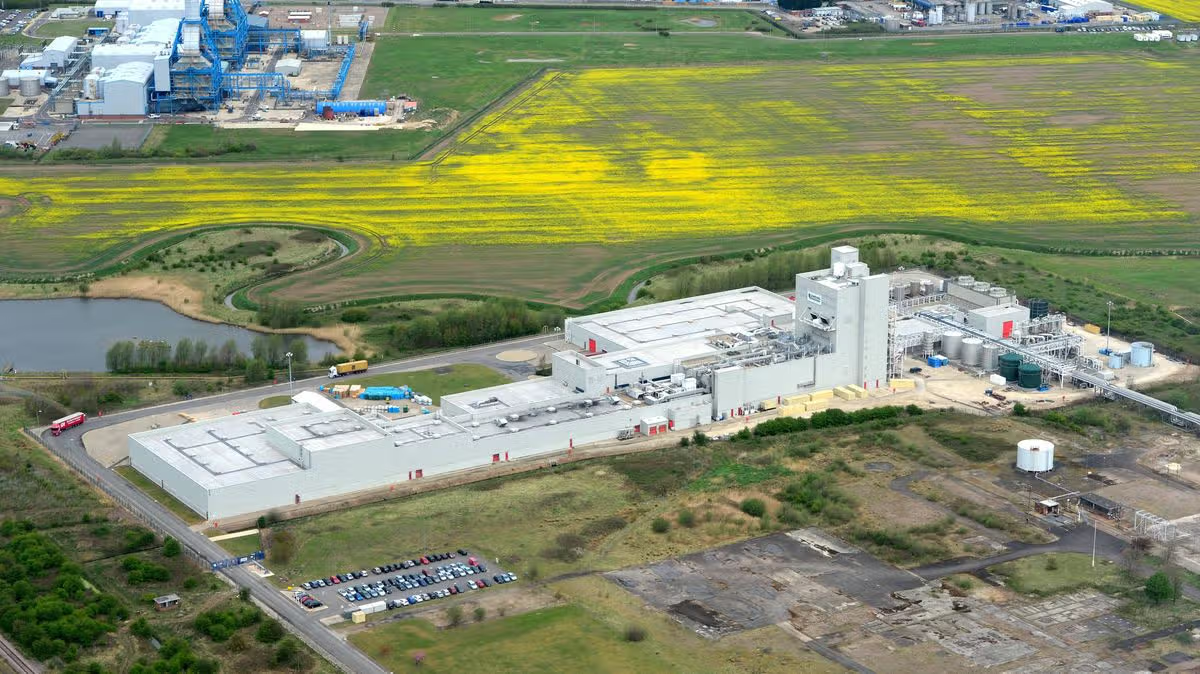
An aerial view of the Lenzing Fibres Grimsby plant

An aerial view of the Lenzing Fibres Grimsby plant(Image: Grimsby Telegraph/Pom Flying Club Ltd)

The owners of a major Grimsby employer have unveiled plans to halt production by the end of next year as part of a worldwide restructure, placing more than 200 jobs under threat.

The Lenzing Group is headquartered in Lenzing, Austria, and operates sizeable production facilities and offices in the US, China, Indonesia and at Grimsby’s Energy Park Way.

Advertisement

Lenzing’s manufacturing plant in Grimsby specialises in producing lyocell – a contemporary, plant-based textile made from wood pulp, widely recognised in the clothing industry under the brand name Tencel. However, group executives have announced proposals to close the facility by the end of 2027 as part of efforts to reduce its overall footprint.

The company says it will explore “strategic options” for the Grimsby plant and other affected sites in Austria and Indonesia, including their potential sale to new owners “or other value-preserving solutions”. Lenzing has confirmed that 215 people are employed at the site.

Shutting the facility would bring to a close nearly 30 years of manufacturing in the region, having originally opened under Courtaulds Fibers in 1998. Its global leadership team in Austria announced the closure as part of a new “Grow Nonwovens, Reset Textiles” strategy, which the company says has been devised to safeguard its long-term future.

Lenzing confirmed: “As part of its transformation and product portfolio optimsation, Lenzing is consolidating its fiber production footprint alongside the ongoing sale process of the Indonesian viscose site, PT South Pacific Viscose. In addition, Lenzing plans to phase out production at its fiber plants in Heiligenkreuz, Austria by end of 2026 and in Grimsby, UK by end of 2027,” reports Grimsby Live.

Advertisement

Georg Kasperkovitz, chief executive of the Lenzing Group, said: “With “Grow Nonwovens, Reset Textiles”, Lenzing is taking decisive steps to reposition the company for long-term success in a fundamentally changing market environment. By combining a streamlined premium product portfolio, improved competitiveness and a strong proprietary innovation pipeline, we are creating the foundation for profitable growth and a more focused, resilient Lenzing.”

He added: “At the same time, this transformation will strengthen our main production site in Lenzing, Austria, and support a sustainably profitable and competitive future for the site. In parallel, Lenzing is evaluating strategic options for the affected sites, including potential divestment or other value-preserving solutions.

“Should no viable outcome be achieved, Lenzing plans to implement a structured and orderly wind-down, with a strong focus on safety, supply reliability, and continuity for customers, as well as social and environmental responsibility. For affected employees in Grimsby, Lenzing will engage with employee representatives and relevant stakeholders regarding appropriate support and mitigation measures.”

The consolidation proposals follow Lenzing having already cut 267 jobs across several sites so far this year, generating annual savings of €25m. The company stated its plan “is designed to improve competitiveness, profitability and return on invested capital, positioning Lenzing for long‐term growth in higher‐value markets” and to “better serve the needs of brands and retailers in Western and Asian markets even better”.

Advertisement

Lenzing’s global headcount is anticipated to be reduced by approximately 2,000 positions by the end of next year, having employed around 8,100 members of staff at the close of 2025. The company confirmed the cuts will “primarily affect employees at the aforementioned sites in Heiligenkreuz (Austria), Grimsby (UK), and Purwakarta (Indonesia).”

The announcement is set to deliver a devastating blow to the region’s manufacturing sector, arriving five years after Lenzing Fibers Grimsby ploughed a reported £20m into a new waste water treatment plant at the site.

The company’s most recent accounts, for 2024, reveal turnover fell from £117m to £107m, though the previous year’s loss of £1.7m was turned around into an operating profit of £19m. Directors pointed to robust demand for its products while cautioning that cost pressures remained an ongoing concern.

A spokesman for Lenzing said: “Around 215 employees work at the Grimsby site. Lenzing will engage with employee representatives and relevant stakeholders regarding appropriate support and mitigation measures for the affected persons. At this point, it is too early to make definitive statements about the transition of employees within the business.”

Advertisement
Continue Reading

Business

High Liner Foods adds frozen seafood meals

Published

on

High Liner Foods adds frozen seafood meals

The line features three frozen prepared meals.

Continue Reading

Business

TransUnion EVP Mohamed Abdelsadek sells $1.99 million in company stock

Published

on


TransUnion EVP Mohamed Abdelsadek sells $1.99 million in company stock

Continue Reading

Business

HRT Financial LP sells $897,030 of Twin Vee PowerCats (VEEE) stock

Published

on


HRT Financial LP sells $897,030 of Twin Vee PowerCats (VEEE) stock

Continue Reading

Business

Nasdaq Falls 1.45% as Oil Surge From Iran Attack and Chip Selloff Rattle Markets Before Fed Decision

Published

on

The Nasdaq logo is displayed at the Nasdaq Market site in Times Square in New York

The Nasdaq Composite fell 1.45%, or 360.37 points, to 24,516.54 in midday trading Wednesday, as surging oil prices tied to renewed fighting between the United States and Iran combined with another sharp selloff in chipmaker stocks to weigh on technology shares ahead of the Federal Reserve’s latest interest rate decision.

A resurgence in Middle East violence drove Brent crude oil prices above $90 a barrel, stoking fresh concerns about inflation and pushing bond yields higher, a combination that dimmed investor appetite for riskier assets across markets. The broader S&P 500 also declined, while the Nasdaq 100 index, which tracks the largest non-financial companies on the exchange, lost 1.2% during the session.

Wednesday’s losses extended a chip-sector selloff that has now stretched across multiple trading sessions. The rout began after reports emerged Monday of a breakthrough in Chinese chipmaking technology, sending semiconductor stocks tumbling and dragging the Nasdaq toward correction territory even before Wednesday’s additional pressure from rising oil prices. The selling intensified further following disappointing earnings from South Korean chipmaker SK Hynix, whose second-quarter profit rose sixfold from a year earlier but still fell short of analyst expectations, a shortfall that reinforced investor concerns about whether the artificial intelligence spending boom driving much of the past year’s chip-sector profits may be beginning to moderate.

The chip selloff has hit Asian markets especially hard in recent sessions. South Korea’s SK Hynix plunged more than 14% at one point this week, while Samsung Electronics fell more than 13% during the same stretch, contributing to the KOSPI index’s worst two-day decline on record. That selling pressure spread to U.S. premarket trading, with Micron Technology down more than 4%, Nvidia off roughly 1.2%, and Intel and Advanced Micro Devices each falling more than 3% at various points during the week’s trading.

Advertisement

Tuesday’s session had shown a notably different pattern from Wednesday’s broader decline, with the Dow Jones Industrial Average climbing 0.93% even as the Nasdaq slipped 0.63%, reflecting a rotation into more defensive, less technology-heavy sectors. Health care and financial stocks reached fresh intraday all-time highs Tuesday, with the State Street Health Care Select Sector SPDR ETF gaining 2.7% and the State Street Financial Select Sector SPDR ETF adding 0.5%, as investors continued shifting away from the technology trade that has dominated market gains for much of the past year.

Even amid the broader tech-sector weakness, some individual stories stood out. Apple briefly became only the second publicly traded company in history to reach a $5 trillion market capitalization on Tuesday, achieving the milestone less than a year after first surpassing $4 trillion, with the achievement coming just a day before the company was scheduled to report its own quarterly earnings.

Not all of Wednesday’s market pressure traced back to chips and oil. Target shares fell more than 7% after the retailer forecast a larger-than-expected decline in full-year sales, while Estee Lauder dropped more than 5% following weaker-than-expected 2026 earnings-per-share guidance, adding company-specific disappointments to the broader macroeconomic headwinds weighing on stocks.

Wednesday’s trading also comes as investors brace for a heavy stretch of corporate earnings from some of the technology sector’s largest AI infrastructure spenders. Results from Microsoft and Meta Platforms, due later this week, are expected to offer additional clarity on whether massive capital expenditure commitments tied to artificial intelligence are translating into revenue growth substantial enough to justify current spending levels, a question that has increasingly weighed on sentiment toward mega-cap technology stocks in recent weeks.

Advertisement

The market’s attention is also fixed on the Federal Reserve’s policy announcement due later Wednesday. JPMorgan’s base case scenario calls for a hawkish hold from the central bank, which the bank has said could leave the S&P 500 roughly flat to slightly lower depending on the specific language used in the accompanying statement. Analysts have said that if Fed Chair Kevin Warsh signals openness to a rate cut at the central bank’s September meeting, markets could respond positively, whereas a more cautious tone emphasizing persistent inflation risks, particularly given this week’s spike in oil prices, could extend the current bout of selling pressure.

Despite Wednesday’s decline, market breadth data from earlier in the week showed a more complicated picture than the headline index moves alone suggest. During Tuesday’s session, 382 individual holdings within a broader market index advanced even as chip stocks were “getting hammered,” according to market commentary, illustrating how narrowly concentrated the technology-sector selling has been relative to the performance of the broader market.

Not every chip-related stock has suffered equally during the recent downturn. Sandisk has remained the best-performing stock in the S&P 500 for the year despite the recent sector-wide selloff, still up more than 360% year to date, according to market data, underscoring the significant divergence in performance even among companies operating within the same beleaguered sector.

With the Fed decision, Middle East tensions and a wave of major technology earnings all converging within the same trading week, investors are broadly expecting continued volatility across the Nasdaq and broader U.S. equity markets in the sessions immediately ahead, as the market works to reconcile competing signals about interest rate policy, geopolitical risk and the durability of the artificial intelligence investment cycle that has driven much of the past year’s technology-sector gains.

Advertisement
Continue Reading

Trending

Copyright © 2025