










Connect with us
DAPA Banner

Business

Platforms, AI Orchestrators, and Workflow Design

Published

on

Most product teams adopt AI tools one by one — a code assistant here, a design generator there — and then wonder why delivery is still slow. The bottleneck was never individual tasks. It was always coordination.

Most product teams adopt AI tools one by one — a code assistant here, a design generator there — and then wonder why delivery is still slow. The bottleneck was never individual tasks. It was always coordination.

That’s what makes end-to-end product development with AI orchestration a different conversation: instead of asking “which AI tool should we add?”,  you start asking, “How do we make the whole system work?”

What is AI orchestration?

AI orchestration is a coordination and control layer for product delivery. When multiple AI models, tools, agents, and humans work on the same product, something has to define how work runs, in what order, with which inputs, and what to validate before progressing.

An AI orchestrator acts as the execution engine within this layer. It translates high-level intent into structured tasks, routes them to the appropriate execution layer, maintains shared context across steps, and triggers human intervention when decisions require judgment.

Isolated AI tools improve individual tasks. Orchestration improves the system. Without it, even strong tools produce fragmented outputs — slowing delivery through rework, misalignment, and unclear ownership at handoff points.

Advertisement

Why end-to-end product development needs AI orchestration

The most common failure mode in AI-assisted product teams isn’t bad tooling. It’s disconnected tooling. Design, engineering, and QA each use AI independently, but integration points — where work moves between disciplines — remain manual and error-prone.

Agentic AI orchestration changes this by treating the entire product lifecycle as a single coordinated system. Work moves from validated spec to generated code to tested output to staged release, with the right humans reviewing at the right moments. The difference between AI assistance and AI-coordinated delivery is what actually ships.

How AI orchestration works across the product lifecycle

Discovery phase: We conduct research, validate assumptions, and define scope simultaneously rather than executing it step by step. This shortens analysis time while keeping depth and accuracy.

Product planning and prioritization: The system models different prioritization options, highlights dependencies, and surfaces risks early. Humans make final decisions based on complete context, not fragmented inputs.

Advertisement

UX/UI design and prototyping: AI generates wireframes, applies design system rules, and flags accessibility issues. Designers focus on user flows and edge cases, while the system keeps everything aligned with the product spec.

Engineering and code generation: We don’t send AI code straight to production. The system runs automated tests and architecture checks before human review, reducing rework and keeping the codebase consistent.

QA, security, and compliance: We run tests automatically after every meaningful change. Compliance checks happen during development instead of at the end. Humans only review exceptions or unclear cases.

Release and post-launch iteration: We continuously collect production data, errors, and user behavior signals. The system feeds this back into development, so improvements happen as part of the workflow, not after release.

Advertisement

Core components of an AI orchestration platform

First, it needs task routing, which decides what work goes to AI, what goes to humans, and under what conditions. Second, it needs shared context management, so information doesn’t get lost between steps. Third, it must connect to existing systems through API and tool integrations.

It also needs human checkpoints for decisions that require judgment, and full visibility (logs and tracking) so every action can be traced and reviewed. Finally, it needs failure handling, so one broken step doesn’t disrupt the whole process.

Teams like Goodface agency have operationalized this as a human-led AI-orchestrated framework — with senior experts owning architecture and decisions while AI handles execution — delivering 25–30% higher efficiency within the same time and budget.

AI orchestration vs related concepts

Vs workflow orchestration: Workflow orchestration handles deterministic sequences. AI orchestration introduces non-deterministic elements — language model outputs, agent decisions — where uncertainty is a first-class concern.

Advertisement

vs AI agent: Agents execute. Orchestrators govern. An AI agent orchestration layer coordinates multiple agents, manages shared context, and enforces rules that individual agents don’t have visibility into.

Vs automation: Automation handles deterministic tasks. Orchestration handles workflows that involve judgment, generation, and variable outputs that require validation before they move forward.

Risks and limitations

Context loss between agents is the most common failure mode. Security exposure from misconfigured data access is the most serious. Tool sprawl, cost overruns from uncontrolled token usage, and accountability gaps when human ownership isn’t clearly defined round out the main risks. Over-automation without accountability is where orchestration projects most often break down in production.

KPIs for measuring AI orchestration

Track delivery cycle time, handoff reduction (manual coordination touchpoints eliminated), defect rates in automated validation versus staging, cost per completed workflow, and human review rate. A declining human review rate indicates the system is routing better; a rising one is an early warning sign worth investigating before it compounds.

Advertisement

FAQ

What is orchestration in AI product development? A coordination system that determines how AI tools, agents, and humans work together across the product lifecycle — routing tasks, sharing context, enforcing quality gates, and managing handoffs from discovery through deployment.

What does an AI orchestrator do in an end-to-end workflow? It decomposes product intent into structured tasks, assigns each to the appropriate execution layer, exchanges context, monitors outputs, and triggers human review where automation isn’t sufficient.

When does a product team need an AI orchestration platform? When multiple AI tools don’t share context, when coordination creates more delay than execution, or when AI output quality is inconsistent across the pipeline.

Can AI orchestration support regulated product environments? Yes — when governance is built in explicitly. Audit trails, configurable human-in-the-loop checkpoints, and access controls can meet fintech and healthtech compliance requirements.

Advertisement

How does AI orchestration improve delivery speed and quality? By running parallel workstreams, reducing rework at handoff points, and enforcing validation continuously rather than end-of-sprint.

What should companies look for in an AI orchestration platform? Human-in-the-loop configurability, deep observability, integration flexibility, and reliability under production load. Legibility — being able to understand what happened when something goes wrong — is a core requirement, not a nice-to-have.

Advertisement
Continue Reading
Click to comment

You must be logged in to post a comment Login

Leave a Reply

Business

Asset Allocation Insights – March 2026

Published

on

Asset Allocation Insights - March 2026

Real estate portfolio dashboard investor reviews house model on documents with digital HUD charts for diversification, allocation and risk metrics, tracking asset performance and return. portfolio

Niphon Phunnu/iStock via Getty Images

By Indrani De, CFA, PRM, Head of Global Investment Research, FTSE Russell | David McNay, CFA, Director, Global Investment Research | Zhaoyi Yang, CFA, FRM, Sr Manager, Global Investment Research

Geopolitics disrupts otherwise robust

Advertisement
Continue Reading

Business

PSU banks under pressure, more consolidation likely before fresh rally: Ajit Nayak

Published

on

PSU banks under pressure, more consolidation likely before fresh rally: Ajit Nayak
In a week marked by hesitation and subdued momentum, India’s benchmark indices have entered a phase where technical signals are beginning to matter more than directional conviction. With the Nifty struggling to find a clear trend and Bank Nifty witnessing visible pressure, market participants are turning cautious—yet not entirely bearish.

Speaking to ET Now, market expert Ajit Nayak from HDFC Securities offered a nuanced reading of the charts, suggesting that while the near-term mood may appear uncertain, underlying patterns hint at a potential continuation rather than a breakdown.

A “Liquidity Sweep” That Could Signal Upside
“First let us speak about the Nifty. So, if we look at the Nifty from a technical perspective, on 24th March it had made a similar kind of a low of 24,790 odd level and today there was an interesting pattern. We did break that low, but we did not sustain below that low. So, we call such behaviour as a sweep of liquidity.”

This “liquidity sweep,” as Nayak explains, is often interpreted as a trap for bearish traders. Markets briefly dip below key support levels, trigger stop losses, and then reverse—often leading to a move higher.

Advertisement

“So, whenever there is a sweep of liquidity, there is a high chance that the market tends to move in a northward territory and can test 24,300 level.”


Open Interest and VIX: The Real Story Beneath the Surface
Nayak emphasizes that price action alone does not tell the full story. He closely tracks open interest (OI) data to understand how large traders are positioned.
“At 24,000 level there is lot of put addition. So, if we see couple of sessions, there was lack of fear in the market but suddenly in a day or two we can see that fear coming back in the market, so that is not really a good sign.”Volatility, too, is at a critical juncture. The India VIX has revisited an important support zone. “If we look at the India VIX, it was taking a support of 17.25 level from where exactly the breakout happened and we saw a rally till 29 level after giving that breakout and we are revisiting that neckline of 17.25. So, it is very important to watch this level.”

According to him, the interplay between VIX and Nifty will determine the next move.

“If we break that 17.29 level on a VIX and we see a rally in Nifty, so that will be a good sign for the trader and for a Nifty player as well that we are consolidating, we are taking a time-wise correction, not a price-wise correction.”

However, a spike in volatility could change the narrative.

Advertisement

“If it did not and this VIX is moving above 20 level and similar kind of OI data keeps on building up at the call side, then there is little risk for the market.”

Key Levels to Watch
For traders, clarity lies in levels rather than opinions. “So, for me as of now 23,800 is a very important level because there is a good intraday pattern which has happened today breaking the low and bouncing back above that low that is a bad trap sign and if it sustain about that level, we can see Nifty heading towards 24,400 to 24,500 mark.”

Stock Picks: A Balanced Approach in an Uncertain Market
Given the lack of a strong bullish setup, Nayak suggests a hedged approach—one long and one short trade.
“Because market is not very bullish friendly, so I am coming up with two picks. One I am looking for a short side and one I am looking for a long side.”
Hindalco (Short Call)

“So, I will come up with first pick as a Hindalco. Hindalco, if you look at the chart, there is some bearishness developing on a Hindalco chart. Also, if you look at a weekly, there is a clear-cut negative divergence which has happened on the Hindalco chart.”

Advertisement

He also points to broader weakness in the metals space.

“If we also look at the metal index, today metal index was showing some pain and similarly even the Hindalco is showing the same kind of pain, a relative performer in a downside.”

Trading strategy remains disciplined.
“So, I am considering Hindalco to sell with a stop loss of 1080, I am looking for the target of 980. The only request for the trader would be as soon as you are in a favour, it is very important to trail the stop loss because the overall trend of the market seems to be quite positive.”

Adani Ports (Long Call)
On the flip side, Nayak finds strength in Adani Ports.

Advertisement

“The second pick from my side is Adani Ports. So, Adani Port’s chart is very fantastic. If we look at the chart from a weekly perspective or also from a daily perspective, we can see a deep cup pattern and it is sustaining above that 1600 odd mark.”

Even during market weakness, the stock has shown resilience.

“Today even in a falling market, it just tested the neckline of 1600 and closing above that level gives us a confidence that there is more steam left on the higher side.”

His recommendation:
“So, I would recommend to go long on Adani Ports with a stop loss of 1586, for the upside target of 1770.”

Advertisement

PSU Banks: More Consolidation Before Opportunity
The PSU banking space, one of the worst-performing sectors this week, is not yet ready for a rebound—at least from a technical standpoint.

“If you look at PSU index, if we look at on a monthly or a weekly time frame, yes, they are still positive. But the rally was so much and the angle of the rally is so steep that we should look for some more consolidation.”

Nayak advises patience rather than aggressive buying.

“If it consolidates for, say, next four to five weeks, then I would be looking for the PSU stocks to go for a long side because if we look at the chart on a monthly time frame, there is a negative pattern on the candlestick which has developed.”

Advertisement

Key levels remain crucial.
“So, I would wait for the PSU to come around 7500 mark, then consolidate and give some bullish indication with a good candlestick pattern and then we would think of entering on a long side, otherwise till it does not cross 9070 mark it is a sell on a rally kind of a sector.”

The Takeaway
For now, the market appears to be in a phase of digestion rather than distribution. While volatility and global cues continue to inject uncertainty, technical indicators suggest that the broader trend may still be intact—provided key levels hold. In such an environment, discipline, selective positioning, and respect for risk management may matter more than chasing momentum.

Continue Reading

Business

Japan’s Toto shares surge on record FY earnings, chip-related investment plans

Published

on


Japan’s Toto shares surge on record FY earnings, chip-related investment plans

Continue Reading

Business

Make Glossy, Golden Hues, Bird Features and Altered Numbers

Published

on

Nancy Guthrie

NEW YORK — The New York Times Connections puzzle for May 1, 2026 (#1055) delivered a clever mix of everyday actions, shimmering imagery, avian anatomy and linguistic twists, with thousands of players logging in Thursday morning to tackle the 16-word grid that tested both vocabulary and lateral thinking. The solution featured four distinct categories: words meaning “make glossy,” translucent golden things, features of a bird’s head, and numbers with their first letter changed.

The New York Times Connections

Yellow (easiest): Make Glossy — BUFF, POLISH, SHINE, WAX Green: Translucent Golden Things — ALE, AMBER, CITRINE, HONEY Blue: Features of a Bird’s Head — BEAK, COMB, CREST, WATTLE Purple (hardest): Numbers with First Letter Changed — HIVE, MIX, POUR, WIGHT

The puzzle, designed by the New York Times Games team, rewarded players who spotted the shiny action verbs early while the trickier purple category — altering the initial letter of number words (five → hive, six → mix, four → pour, eight → wight) — stumped many until the final guesses. Difficulty was rated around 2 out of 5 by the official Connections Bot, making it accessible yet satisfying for daily solvers.

Social media platforms exploded Thursday with shared grids and victory emojis. Many players celebrated four-guess perfect games, while others admitted struggling with the purple group. One popular X post read: “Got PLUME in Wordle and perfect Connections today — May 1 is my lucky day!” The communal nature of the game continues to drive its massive appeal more than four years after its launch.

Connections, created by Josh Wardle (the same mind behind the original Wordle), challenges players to group 16 words into four thematic categories of four words each. Categories range from straightforward (yellow) to devious (purple), with color-coded feedback after each attempt. The May 1 edition stood out for its elegant themes blending practical actions, natural imagery and wordplay.

Advertisement

Strategy experts recommend scanning for obvious clusters first. On Thursday, many began with the glossy verbs — BUFF, POLISH, SHINE and WAX — which formed a clean yellow group. The golden translucent items (ALE, AMBER, CITRINE, HONEY) followed naturally for those thinking about colors and beverages. Bird features (BEAK, COMB, CREST, WATTLE) required some ornithological knowledge or pattern recognition, while the purple category demanded the clever letter-shift insight.

The New York Times has refined Connections since its 2023 debut, maintaining one puzzle per day to build anticipation and community. Puzzle editor Tracy Bennett and her team select words that balance challenge with fairness, avoiding overly obscure terms while still offering satisfying “aha” moments. May 1’s puzzle exemplified this approach perfectly.

For newcomers or those seeking to improve, starting with common categories such as colors, verbs or household items often unlocks the grid. The official Connections Bot, available to subscribers, provides personalized analysis of solving efficiency and suggests optimal next moves. On Thursday, it highlighted the purple category as the most missed.

Word game enthusiasts note that Connections complements Wordle beautifully. While Wordle focuses on letter deduction, Connections emphasizes semantic grouping and creative associations. Together they form a morning ritual for millions, often paired with the Mini Crossword or Spelling Bee.

Advertisement

The May 1 solution resonated thematically with springtime — glossy surfaces evoking polished spring cleaning, golden hues suggesting sunlight and honey, bird features celebrating nature’s return, and altered numbers adding intellectual play. Solvers appreciated the puzzle’s gentle difficulty on a busy news day.

Player statistics shared informally across forums show average solve rates hovering around 70-80% for most daily puzzles, with perfect games rarer. Thursday’s edition saw strong engagement, with many reporting improved streaks after early-week struggles.

Beyond entertainment, Connections serves as a gentle cognitive workout. Educators and therapists recommend it for vocabulary building, pattern recognition and mental flexibility. Families often compete at breakfast tables, turning the daily puzzle into shared bonding time.

The game’s enduring popularity reflects broader trends in casual gaming. Simple, daily, shareable experiences thrive in a fragmented attention economy. The New York Times has expanded the Connections ecosystem with companion content, difficulty ratings and community discussions while keeping the core experience clean and ad-light.

Advertisement

As May begins, players look forward to the rest of the month’s puzzles. With summer approaching, themes may lean toward seasonal topics, travel and outdoor activities. For now, Thursday’s solution stands as a fine example of the game at its best — clever without being cruel, challenging without frustrating.

If you missed today’s puzzle, tomorrow always brings a fresh grid at midnight local time. Until then, celebrate those who elegantly grouped BUFF-POLISH-SHINE-WAX, spotted the golden translucents, identified bird anatomy and cracked the letter-shifted numbers. Connections continues proving why millions return daily: the joy of connection through words.

Continue Reading

Business

Fertiliser boss says war puts 10 billion meals a week at risk

Published

on

Fertiliser boss says war puts 10 billion meals a week at risk

A shortage of fertiliser due to the Iran conflict could reduce crop yields and push prices higher, says the boss of Yara.

Continue Reading

Business

U.S. Federal Reserve Holds Interest Rates Steady

Published

on

OneWater Marine Inc. (ONEW) Q1 2026 Earnings Call Transcript

The U.S. Federal Reserve kept interest rates on hold as officials consider the implications of elevated oil prices on efforts to contain inflation. James Marple, Associate Vice President and Senior Economist with TD Bank Group, discusses the impact of the oil shock and whether rates may have to stay on hold longer than previously expected.

Transcript

Anthony Okolie: As widely expected, the US Federal Reserve kept its benchmark interest rate unchanged. Joining me now to discuss the latest decision is TD Senior Economist James Marple.

And James, what stood out to you today?

James Marple: Well, no change in the decision itself. They talked about, obviously, the Strait of Hormuz and the oil price shock, and how much uncertainty that’s created for the outlook. That was certainly front and center. But not really any changes to the statement. They kept the characterization of interest rates exactly as it was, and even their forward guidance.

Advertisement

The, perhaps, most interesting thing was that there were four total dissents in the statement. And that’s the most there have been since 1992. One was the obvious one, Stephen Miran, who dissented, wanted a 1/4 rate cut. But then there were three dissents from regional Fed governors that wanted a little bit of forward language that suggests, perhaps, an easing bias. And that’s the way it was characterized in terms of their dissent. They wanted that removed from the statement. So, more hawkish in tone there just on the dissents more than anything in the statement itself.

Anthony Okolie: OK. With that backdrop, we still have the US-Iran conflict. It’s still unresolved. Energy prices are still elevated. How worried should the US be about stagflation risk?

James Marple: Well, I’m not sure I’d call it stagflation, per se. When people hear stagflation, they really think of the 1970s and

Advertisement
Continue Reading

Business

Japanese yen soft after reported govt intervention; dollar steadies

Published

on


Japanese yen soft after reported govt intervention; dollar steadies

Continue Reading

Business

How Digital Payment Platforms Are Supporting Cross-Border Commerce

Published

on

New research showing that concerns around international payments are a leading barrier stopping UK SMEs from exporting overseas.

Digital payment systems have changed significantly over the past few years. With every step toward more advanced technology, digital platforms have had to keep pace.

Online payment providers have to be versatile, flexible and adjust to global demands with ease. Given that the global payment industry is in the trillions of dollars and people from all over are placing orders for products and services internationally, digital payment infrastructures need to support cross-border commerce.

The scale of growth is substantial. Industry trends show that a large percentage of global consumers now purchase from international retailers, with the cross-border e-commerce market projected to reach trillions in value over the next decade. In response, providers are working to deliver a global payments solution that can support this demand while balancing efficiency, compliance and accessibility.

Unpacking Multi-currency Functionality

A key aspect of this growing global market is the ability to operate with a multi-currency business account, allowing organisations to hold and transact in different currencies, making global operations more accessible and streamlined. This simplifies financial operations and supports smoother cross-border activity. Platforms such as BONCA, a digital payment platform supporting cross-border transactions, can be viewed as examples of how providers are developing more unified financial environments that aim to streamline international transactions.

Looking at Payment Infrastructure Evolution

An additional notable development in recent years is the rise of integrated platforms that bring multiple financial services into one environment. According to the World Bank, 79% of adults globally now have a financial account and in 2024, 40% of adults in developing economies saved in a financial account. This is a 16-percentage-point increase since 2021. This rise has been possible due to consolidated systems designed to manage international transactions. Systems typically support features such as account management, payment processing and access to global networks – all in one.

Advertisement

Online Gateway and Integration Capabilities

In addition to account functionality, many providers now incorporate card services and connections to an online payment gateway. This allows for payments across various digital channels. These integration capabilities also support smoother customer experiences by reducing friction during the payment process. When systems are well-connected, transactions can be completed more quickly and with fewer errors. A borderless payment platform is particularly important for businesses operating internationally, where delays or complications can impact customer satisfaction and conversion rates.

Improving Transparency is Key

Another area where digital payment platforms are growing is in the handling of currency conversion and transaction transparency. Before, cross-border payments were often associated with unclear fees and fluctuating exchange rates that were difficult to track. Many providers are working to improve visibility around these topics. The aim is to create transparency so that all users fully understand all terms and conditions.

This shift towards transparency is also influenced by competition within the sector. To capture your attention, they need to build trust and having access to as much information as needed is what builds this trust. Transparency is much easier to offer, as well, because providers operate better due to advanced technology.

An online payment gateway is not only safe and secure but it’s easy to use and designed with interactions in mind. As a user of this kind of infrastructure, it’s easy to find information because it’s all on one menu drop-down on a site. Systems know that users don’t want to spend hours trying to figure something out.

Advertisement

Currency Conversion And Fee Visibility

In this digital age, it is common for financial infrastructures to show real-time exchange rate information and clearer breakdowns of transaction fees before payments are completed. This allows businesses and users to better understand the financial implications they’re facing. The key point is that this information is visible before online transactions are made. This means businesses can fully understand the associated fees before completing a transaction.

Strengthening Security in Cross-Border Transactions

Security remains a central concern in any financial environment and this becomes even more critical when transactions cross multiple jurisdictions. Digital payment systems are increasingly incorporating layered security measures designed to protect both data and funds as they move across borders. These typically include encryption protocols, multi-factor authentication and continuous monitoring of transaction activity.

Given the complexity of international payments, these safeguards play a vital role in maintaining system integrity. The focus is on identifying and mitigating risks early, rather than reacting after issues arise. In addition, the use of artificial intelligence and advanced analytics has become more prominent in fraud detection.

Integration and the Future of Global Commerce

Another important development is the increasing integration of payment systems with global marketplaces and digital services. Rather than operating independently, many systems now connect directly with e-commerce platforms, subscription services and other online environments.

Advertisement

Looking ahead, cross-border commerce is expected to continue expanding as digital trade becomes more accessible worldwide. Payment infrastructure will play a central role in supporting this growth, particularly as providers continue to refine transparency, security and system interoperability. While challenges remain, the ongoing development of international payment systems reflects a broader shift towards a more connected and efficient global economy that supports international solutions.
Continue Reading

Business

Spotify Adds Verified Checks For Artists to Prove They Are Humans With Legit Content

Published

on

Verified by Spotify
Verified by Spotify

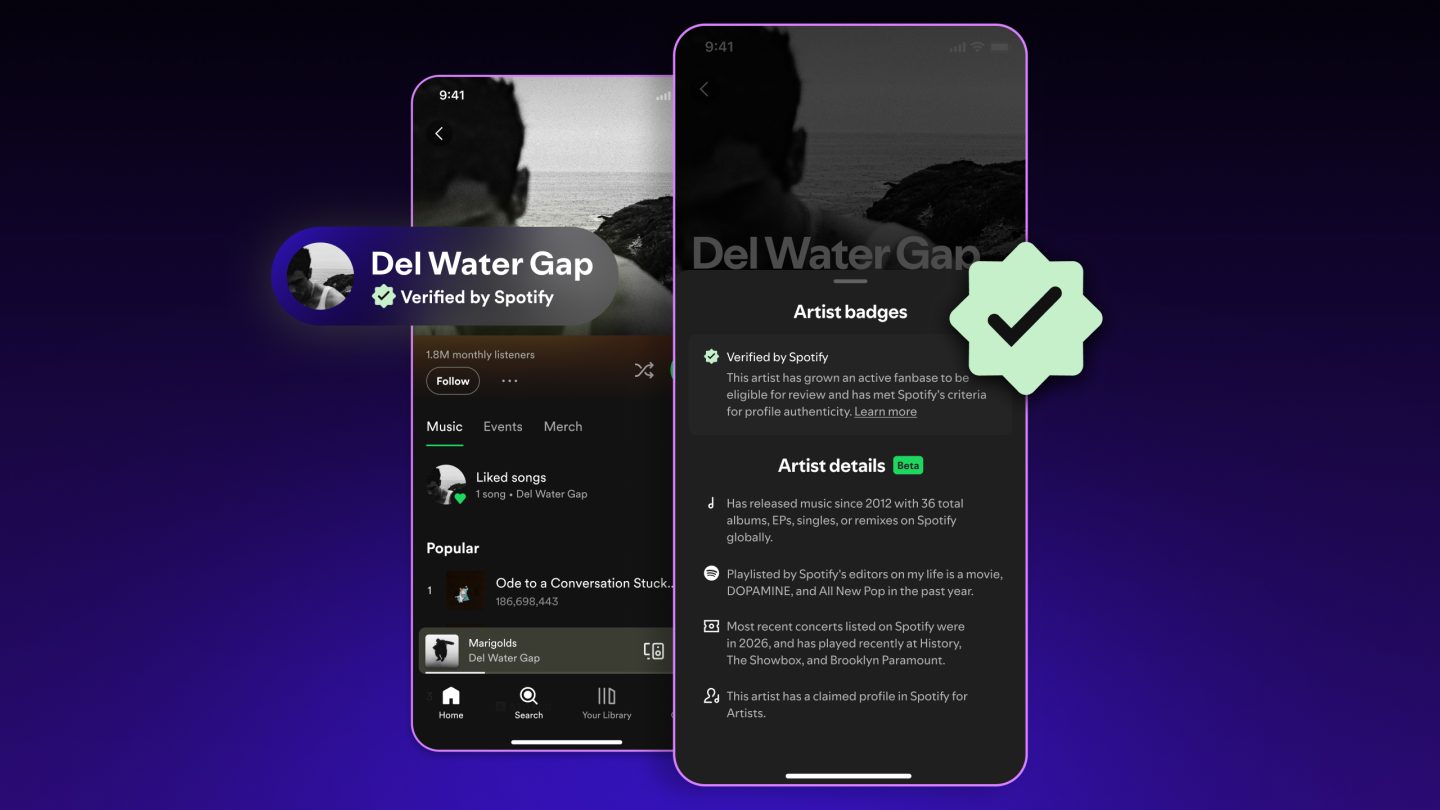
Spotify is one of the online platforms that has been seeing an influx of AI slop, but that is changing now as the streaming app is adding “Verified” checkmarks to artists to ensure that they share only authentic and legitimate content.

Spotify Adds Verified Checks For Artists

The Swedish streaming company announced in its latest blog post that they are now launching its version of verification checks on the platform with the “Verified by Spotify” program in beta testing.

This latest verification program aims to help artists, creatives, and the public to easily prove the authenticity of content through the new Spotify badge.

The Verified by Spotify badges will appear on an artist’s profile page, and according to the platform, this will help let the public know that this specific musician has been reviewed by the company and meets the latest criteria.

Additionally, Spotify also launched the Artist Profile Protection, also in beta testing, which will help artists gain control and protection of their profiles. This will also help the public get assurance that the music available comes from the actual artists themselves.

Advertisement

Spotify Wants to Separate AI-Generated Content

Spotify said that they have launched this new set of protections for artists and the public to combat the growing availability of generative AI tools and content across online platforms.

According to Spotify, this latest feature adds layers to its previous rollouts like SongDNA, expanded song credits, and features like AI credits.

While generative AI policies remain vague on Spotify, especially as there is still AI-generated content that thrives on the platform, this latest verification checkmark will help the streaming platform assure its artists and users alike that there is authentic, human-made content on Spotify.

For now, Spotify is still beta testing the features and only select artists and users will get to see the Verified by Spotify badges.

Advertisement

Originally published on Tech Times

Continue Reading

Business

Grid Dynamics Holdings, Inc. (GDYN) Q1 2026 Earnings Call Transcript

Published

on

OneWater Marine Inc. (ONEW) Q1 2026 Earnings Call Transcript

Cary Savas
Director of Branding & Communications

Good afternoon, everyone. Welcome to Grid Dynamics First Quarter 2026 Earnings Conference Call. I’m Cary Savas, Director of Branding and Communications.

Joining us on the call today are CEO, Leonard Livschitz; CFO, Anil Doradla; CTO, Eugene Steinberg; and SVP, Global Head of Partnerships and Marketing, Rahul Bindlish.

Following the prepared remarks, we will open the call to your questions. Please note that today’s conference call is being recorded.

Advertisement

Before we begin, I’d like to remind everyone that today’s discussion will contain forward-looking statements. This includes our business and financial outlook and the answers to some of your questions. Such statements are subject to the risks and uncertainty as described in the company’s earnings release and other filings with the SEC. During this call, we will discuss certain non-GAAP measures of our performance. GAAP to non-GAAP financial reconciliations and supplemental financial information are provided in the earnings press release and the 8-K filed with the SEC. You can find all the information I just described in the Investor Relations section of our website.

I now turn the call over to Leonard, our CEO.

Leonard Livschitz
CEO & Director

Advertisement

Thank you, Cary. Good afternoon, everyone, and thank you for joining us today.

Continue Reading

Trending

Copyright © 2025