Connect with us
DAPA Banner
DAPA Coin
DAPA
COIN PAYMENT ASSET
PRIVACY · BLOCKDAG · HOMOMORPHIC ENCRYPTION · RUST
ElGamal Encrypted MINE DAPA
🚫 GENESIS SOLD OUT
DAPAPAY COMING

Business

Poland’s Breakthrough Star at Roland Garros 2026

Published

on

Elina Svitolina
Maja Chwalińska
Maja Chwalińska

Maja Chwalińska, the 24-year-old Polish left-hander ranked outside the top 100 at the start of the 2026 French Open, has captured global attention with a remarkable run to the quarterfinals at Roland Garros, emerging as one of the biggest Cinderella stories of the tournament.

Chwalińska’s journey from qualifier to quarterfinalist, defeating high-profile opponents including Olympic champion Qinwen Zheng and former top-10 player Maria Sakkari, highlights her resilience and talent. Her story combines athletic achievement with personal challenges, making her one of the most compelling figures in women’s tennis this season.

Here are 10 essential things to know about the rising Polish player:

1. Rapid Rise at Roland Garros 2026 Chwalińska entered the 2026 French Open as a qualifier ranked around No. 114. She stormed through the qualifying rounds and main draw with dominant performances, reaching the quarterfinals after victories over Zheng, Elise Mertens, Sakkari and Diane Parry. Her run marked the first time a player ranked outside the top 100 achieved such a deep breakthrough at Roland Garros in recent memory.

2. Career-High Ranking and Momentum The Polish player achieved a career-high singles ranking of No. 113 in May 2026. Her French Open success is projected to propel her significantly higher, potentially into the top 50. This surge reflects strong form on the WTA 125 and ITF circuits, where she captured multiple titles.

Advertisement

3. Left-Handed Game with Technical Precision Standing at 5-foot-5 (1.64 m), Chwalińska plays left-handed with a two-handed backhand. Observers praise her clean technique, variety, and court craft. Analysts describe her style as old-school with modern efficiency, generating consistent pressure on return games while maintaining solid baseline rallies.

4. Early Start and Polish Roots Born on October 11, 2001, in Dąbrowa Górnicza, Poland, Chwalińska began playing tennis at age 7. She turned professional in 2015-2016 and has remained based in her home country, representing Poland in Fed Cup/Billie Jean King Cup competition with a solid 4-3 record.

5. Openness About Mental Health Struggles Chwalińska has been candid about her battle with depression, which sidelined her for periods and affected her early career progression. Her willingness to discuss mental health has resonated with fans and fellow athletes, positioning her as an advocate for greater awareness in professional sports.

6. Strong Challenger and ITF Success Before her Grand Slam breakthrough, Chwalińska built her career through consistent performances on the ITF and WTA 125 circuits. She has won three WTA Challenger singles titles, including events in Montreux (2025) and Florianopolis (2024), along with seven ITF singles titles.

Advertisement

7. Doubles Expertise In addition to singles, Chwalińska has enjoyed success in doubles, with a career-high ranking of No. 91. She has secured three WTA 125 doubles titles, demonstrating versatility and strong net play that complements her baseline game.

8. Coaching Stability She is coached by Jaroslav Machovsky, who has helped guide her technical development and mental approach. Their partnership has been credited with her recent consistency and ability to perform under pressure at major tournaments.

9. Historic Polish Representation Chwalińska’s deep run at Roland Garros 2026 made her the second Polish woman, alongside world No. 3 Iga Świątek, to reach the fourth round in the same year. This milestone underscores the growing strength of Polish women’s tennis on the international stage.

10. Humble Personality and Future Ambitions Known for her humble and grounded demeanor, Chwalińska expressed surprise and gratitude during her French Open press conferences. She stated her seasonal goal was simply to break into the top 100, a target she has now surpassed. Fans and commentators highlight her likeable character and work ethic as key factors in her appeal.

Advertisement

Chwalińska’s prize money has surpassed $860,000 in her career, with a significant boost expected from her Paris performance. Her story echoes previous Grand Slam underdog runs, drawing comparisons to players who used breakthrough tournaments to launch sustained top-level careers.

The left-hander’s success comes after years of grinding on lower circuits while managing personal challenges. Her mental health advocacy adds depth to her profile, showing strength beyond on-court results. As she faces higher-ranked opponents in the quarterfinals and beyond, Chwalińska’s composure and fighting spirit will be tested.

Tennis experts note her well-rounded game suits clay courts particularly well, where her patience and tactical awareness shine. If she maintains this level, a top-50 breakthrough appears likely, with potential for further Grand Slam success in the coming seasons.

Poland’s tennis federation and fans have rallied behind Chwalińska, celebrating her as a fresh talent alongside established stars like Świątek. Her run has boosted national pride and inspired younger players in the country’s growing tennis community.

Advertisement

As the 2026 season progresses, Chwalińska’s focus will shift toward consistency at the tour level. Sustaining momentum after a major deep run often presents challenges, but her proven resilience suggests she is prepared for the next steps in her career.

Chwalińska represents the new generation of Polish tennis talent — technically sound, mentally tough, and authentically connected with supporters. Her breakthrough at Roland Garros serves as a reminder that perseverance and belief can overcome ranking disadvantages on tennis’s grandest stages.

With several years ahead in her prime, the tennis world will watch closely to see how far this late-blooming star can climb. For now, her magical run in Paris has already secured her place among the memorable stories of 2026.

Advertisement
Continue Reading
Click to comment

You must be logged in to post a comment Login

Leave a Reply

Business

Rivian Automotive, Inc. (RIVN) Presents at UBS Auto and Auto Tech Conference 2026 Transcript

Published

on

OneWater Marine Inc. (ONEW) Q1 2026 Earnings Call Transcript

Rivian Automotive, Inc. (RIVN) UBS Auto and Auto Tech Conference 2026 June 3, 2026 1:50 PM EDT

Company Participants

Claire McDonough – Chief Financial Officer

Conference Call Participants

Advertisement

Joseph Spak – UBS Investment Bank, Research Division

Presentation

Joseph Spak
UBS Investment Bank, Research Division

Advertisement

Thanks, everyone, for joining us for the next session. Very pleased to have with us from Rivian, Claire McDonough, CFO.

Question-and-Answer Session

Advertisement

Joseph Spak
UBS Investment Bank, Research Division

So just to get started, Claire, I mean, a couple of things we want to sort of really touch on here. But I think first and foremost is the upcoming R2, right, which I think everyone is sort of pretty excited about. Maybe you can sort of just tell us about how the preparations for that vehicle are going. I think it start — officially sort of maybe opening things up to configuration sort of in the coming weeks. So where we are in the process and sort of how investors should sort of think about the cadence of R2 over the balance of the year?

Claire McDonough
Chief Financial Officer

Advertisement

Sure. Well, first off, Joe, thanks so much for having us. For those of you in the audience that haven’t seen it already, we do have an R2.

Joseph Spak
UBS Investment Bank, Research Division

Sorry, I should have mentioned that. Yes.

Advertisement

Claire McDonough
Chief Financial Officer

So definitely the better than listening to me is to go and experience the vehicle directly yourself, and you’ll understand what we’re going to talk about a little bit more today in terms of the intentionality in the design, the technology and the utility and performance that gets unlocked with the smaller and more affordable package that we’ve brought to market with R2. So on June 9, we’ll kick off the first

Advertisement
Continue Reading

Business

Hewlett Packard Enterprise Company (HPE) Presents at Bank of America 2026 Global Technology Conference Transcript

Published

on

OneWater Marine Inc. (ONEW) Q1 2026 Earnings Call Transcript

Q2: 2026-06-01 Earnings Summary

EPS of $0.79 beats by $0.26

 | Revenue of $10.68B (40.00% Y/Y) beats by $917.95M

Hewlett Packard Enterprise Company (HPE) Bank of America 2026 Global Technology Conference June 3, 2026 2:20 PM EDT

Company Participants

Shannon Cross – Senior VP, Chief Strategy Officer & Investor Relations

Advertisement

Conference Call Participants

Wamsi Mohan – BofA Securities, Research Division

Advertisement

Presentation

Wamsi Mohan
BofA Securities, Research Division

Welcome to Day 2 of Bank of America’s Global Tech Conference. I’m Wamsi Mohan. I cover IT hardware here for the bank. Delighted to welcome HP Enterprise today to the stage. We have Shannon Cross, who’s Chief Strategy Officer. A lot of you probably know Shannon Cross from her prior roles as well. So Shannon, welcome. Pleasure to have you here.

Advertisement

Shannon Cross
Senior VP, Chief Strategy Officer & Investor Relations

Thank you. Very excited to be here. It’s a great time to be talking about the company.

Advertisement

Question-and-Answer Session

Wamsi Mohan
BofA Securities, Research Division

Yes, absolutely. I mean this has been a pretty incredible earnings season from a hardware standpoint and you guys really knocked it out of the park. The question that we get a lot is how sustainable is this? And you expressed confidence by giving an outlook for ’27 as well. So I would love to — for you to frame that a little bit for everyone.

Advertisement

Shannon Cross
Senior VP, Chief Strategy Officer & Investor Relations

Sure. I think when we see what we — obviously, we’re very pleased with what we were able to report for the quarter, how we’re looking at the growth that we expect, I mean, in ’26, we took up our EPS target by 40%. And then we did provide a financial framework for ’27 that I think underscores our belief that what we’re seeing is durable and sustainable. What we’ve been getting in terms of questions clearly on the sustainability and durability side is far more on the server versus networking. I think

Advertisement
Continue Reading

Business

Cookies supporting focus, protein and sleep launch

Published

on

Cookies supporting focus, protein and sleep launch

Daughter of Mrs. Fields founder and her friend launch Fields Good company.

Continue Reading

Business

Constellium: Quality Segments, Better Cash Flow, And Still Reasonable Upside (NYSE:CSTM)

Published

on

Constellium SE: My Conviction Just Got A Boost As Earnings Come In Strong (NYSE:CSTM)

This article was written by

I’m an independent equity trader and licensed financial advisor focused on uncovering high-upside opportunities in overlooked sectors especially focusing on small-caps, energy, commodities, and special situations. My investment strategy is based on growth. I look for fundamental momentum (EPS, ROE, revenue), price-volume confirmation, and macro filters. I also use econometric tools and calculations to analyse market direction, cycles and behaviour. I’ve been managing personal capital since 2020 and advising under MiFID II since qualifying with a license. I hold a bachelor’s in Business Administration and Economics and am currently completing a master’s in Finance. My masters thesis topic: Impact of Financial Results Announcements on Stock Returns and Trading Volumes of Micro-Capitalization Gold Mining Companies.

Analyst’s Disclosure: I/we have no stock, option or similar derivative position in any of the companies mentioned, but may initiate a beneficial Long position through a purchase of the stock, or the purchase of call options or similar derivatives in CSTM over the next 72 hours. I wrote this article myself, and it expresses my own opinions. I am not receiving compensation for it (other than from Seeking Alpha). I have no business relationship with any company whose stock is mentioned in this article.

Seeking Alpha’s Disclosure: Past performance is no guarantee of future results. No recommendation or advice is being given as to whether any investment is suitable for a particular investor. Any views or opinions expressed above may not reflect those of Seeking Alpha as a whole. Seeking Alpha is not a licensed securities dealer, broker or US investment adviser or investment bank. Our analysts are third party authors that include both professional investors and individual investors who may not be licensed or certified by any institute or regulatory body.

Advertisement
Continue Reading

Business

Adobe Stock Drops 3% to $253.81 as Tech Rotation Hits Software Giants

Published

on

Executives at Silicon Valley chip maker Intel say 'fluid' US trade policies and regulatory moves have increased the chances of economic slowdown

NEW YORK — Adobe Inc. shares fell sharply on Wednesday morning, declining 3.17% or $8.30 to trade at $253.81 as investors rotated out of high-valuation software stocks amid mixed signals on artificial intelligence spending and broader market caution.

The drop in Adobe, a leader in creative software and digital experience tools, came as the Nasdaq Composite showed limited gains while small-cap indexes advanced. Trading volume was elevated in morning sessions, reflecting active position adjustments by institutional investors.

Adobe has been a major beneficiary of the AI boom through its Firefly generative AI tools integrated across Creative Cloud and Experience Cloud platforms. However, some investors appear to be taking profits after strong gains earlier in 2026, citing concerns over valuation multiples and increasing competition in the generative AI space.

The company’s current price-to-earnings ratio remains elevated compared to historical averages, even as growth in subscription revenue has remained solid. Adobe has consistently delivered strong cloud-based recurring revenue, but recent market sentiment has favored companies with clearer near-term catalysts or lower valuations.

Advertisement

Analysts maintain generally positive outlooks on Adobe’s long-term prospects. The company continues expanding its AI capabilities, with Firefly now powering features across Photoshop, Illustrator and other flagship applications. Enterprise adoption of Adobe’s Experience Cloud suite has also shown resilience, particularly in digital marketing and analytics tools.

Wednesday’s decline fits within normal market fluctuations for a stock that has delivered substantial returns over the past several years. Adobe’s market capitalization still exceeds $110 billion, reflecting its dominant position in creative software and its successful transition to a cloud-first business model.

Broader technology sector dynamics influenced the move. While artificial intelligence enthusiasm remains strong, investors have shown increasing selectivity, favoring hardware providers and companies with direct exposure to data center buildouts over pure software plays. This rotation has affected several high-profile software names in recent sessions.

Adobe’s business fundamentals remain robust. The company reported solid quarterly results earlier in 2026, with Creative Cloud revenue continuing to grow through new AI features that enhance productivity for designers and creators. Document Cloud, including Acrobat, has also benefited from AI-powered search and summarization tools.

Advertisement

Competition in generative AI presents both challenges and opportunities. While OpenAI, Midjourney and other tools have gained attention, Adobe has differentiated itself through commercial safety, intellectual property protection and seamless integration with existing creative workflows. The company’s focus on enterprise-grade AI has resonated with professional users concerned about copyright and brand consistency.

Macroeconomic factors also played a role in Wednesday’s trading. Persistent questions about the pace of Federal Reserve rate cuts have kept pressure on growth stocks. Adobe, with its high multiple, is sensitive to changes in interest rate expectations as higher rates increase the discount applied to future earnings.

Despite the daily decline, many long-term investors remain bullish on Adobe’s moat in creative tools. The company’s installed base of professional users creates significant switching costs, while its subscription model provides predictable revenue visibility. New product innovations, particularly around video and 3D design tools, continue expanding addressable markets.

Analysts project continued mid-teens revenue growth for Adobe in coming quarters, supported by AI-driven feature updates and enterprise expansion. Price targets on Wall Street generally remain well above current trading levels, though some firms have noted the need for Adobe to demonstrate accelerating AI monetization to justify premium valuations.

Advertisement

The stock’s performance year-to-date has still been positive, though it has lagged some other technology leaders. Adobe shares have faced periodic pressure during broader market rotations but have shown resilience during periods of AI optimism.

Looking ahead, investors will watch for Adobe’s next earnings report and any updates on AI product adoption metrics. The company has scheduled several industry events where it is expected to showcase further advancements in generative AI tools for creative professionals.

Adobe’s strategic acquisitions and partnerships have strengthened its position in the digital economy. Its purchase of Figma, though facing regulatory scrutiny in previous years, highlighted ambitions in collaborative design tools. The company continues investing in cloud infrastructure and AI research to maintain technological leadership.

For retail investors, Wednesday’s decline may present a buying opportunity for those with long-term conviction in digital transformation and creative software demand. However, near-term volatility is likely as markets digest economic data and corporate guidance.

Advertisement

The technology sector overall has shown resilience in 2026 despite periodic pullbacks. Adobe’s role as an essential tool for marketers, designers and enterprises provides a defensive quality even during periods of market rotation.

Broader economic context remains supportive for software companies. Corporate spending on digital transformation continues, driven by competitive pressures and efficiency goals. Adobe’s ability to embed AI features that deliver measurable productivity gains positions it well within this trend.

As trading continued Wednesday morning, Adobe shares stabilized somewhat after the initial drop, though they remained in negative territory. The move highlights the stock’s beta to overall technology sentiment while underscoring ongoing investor selectivity within the sector.

Adobe has transformed significantly over the past decade, successfully shifting from perpetual licenses to a cloud subscription model that has driven consistent revenue growth and improved margins. This strategic evolution has been well-received by investors, contributing to substantial share price appreciation over time.

Advertisement

The company’s focus on artificial intelligence represents the next phase of growth. By integrating responsible AI tools directly into creative workflows, Adobe aims to maintain its leadership position while addressing ethical concerns around generative technology.

Market watchers will continue monitoring Adobe’s performance relative to peers. While some software stocks have faced pressure, those demonstrating clear AI differentiation and strong execution have generally held up better during rotational periods.

Wednesday’s trading in Adobe shares serves as a reminder of the dynamic nature of technology investing. Despite strong fundamentals, stocks can experience short-term volatility based on sentiment shifts, macroeconomic data and sector rotations.

Longer-term, Adobe’s combination of market leadership, recurring revenue and innovation pipeline supports a constructive outlook for patient investors. The company’s ability to adapt to changing technology landscapes has been a hallmark of its success over multiple decades.

Advertisement

As the trading day progresses, further developments in broader markets or sector-specific news could influence Adobe’s direction. For now, the 3.17% decline reflects normal market mechanics rather than any fundamental shift in the company’s competitive position.

Continue Reading

Business

Honeywell Aerospace CEO forecasts big growth ahead of standalone debut

Published

on

Honeywell Aerospace CEO forecasts big growth ahead of standalone debut
Honeywell Aerospace CEO on Q2 spinoff: The biggest unlock for us will be around capital allocation

SCOTTSDALE, ARIZONA — For Honeywell Aerospace CEO Jim Currier, it’s time to show investors what his company can do as a standalone business.

“We have a purpose-built management team just solely focused on one strategy, one mission as opposed to disparate missions of a conglomerate,” Currier told CNBC at his company’s investor day.

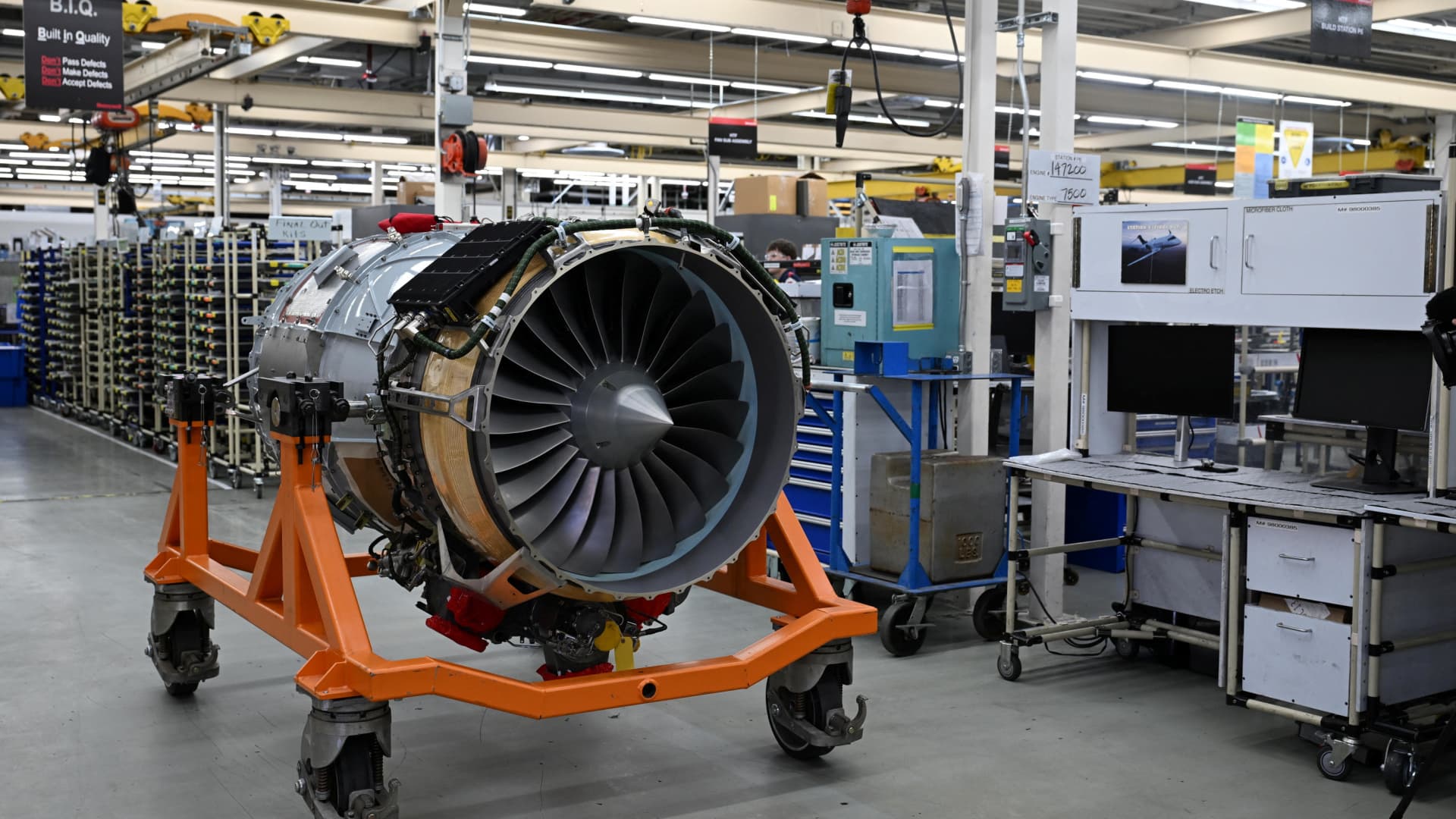
When it’s officially spun off from its parent company later this month, Honeywell Aerospace will be aggressively pushing its advantages in avionics, engine control systems and a host of technologies from the nose to tail of commercial airplanes, business jets and military aircraft.

The hope is to accelerate growth.

Advertisement

As a standalone company, Honeywell Aerospace expects to generate full-year 2026 adjusted earnings before interest and taxes of $4.65 billion to $4.75 billion with free cash flow in the second half of the year of between $1 billion and $1.5 billion.

By 2030 Honeywell is targeting annual earnings of at least $6.5 billion and full-year free cash flow of at least $4 billion.

“The greatest growth for us is occurring in the commercial transport market and in defense and space,” Currier said Wednesday. “We have opportunities where we are well positioned in our products and technologies.”

Currier added Honeywell has “record” backlog orders from Airbus and Boeing.

Advertisement

Why separate Honeywell

As a part of Honeywell International over the last several decades, the aerospace division became one of the largest manufacturers and suppliers in the commercial and business aviation markets as well as in the defense industry.  

From flight management systems in the cockpit to engine controls under the wing to the auxiliary power unit in the tail, its technology and components are in thousands of planes.

Last year the business generated profits topping $4.2 billion with margins of 24.5%.

Those results failed to impress investors, however, because they were clouded by the overall results of Honeywell, a conglomerate struggling to generate the stock returns enjoyed by the market and competing companies in the last several years. 

Advertisement

Since June 2023, Honeywell shares have gained about 20%, compared to the S&P 500’s roughly 77% gains.

That underperformance is a primary reason Honeywell decided in 2024 to eventually break up operations into three separate companies: Solstice Advanced Materials, Honeywell Technologies and Honeywell Aerospace.

“Essentially, on the other side of the separation … each business is positioned so well for the market it serves,” Honeywell CEO Vimal Kapur told CNBC last month.

Converting aerospace skeptics

For investors, Honeywell Aerospace represents a pure play on the growth of commercial aviation and the defense industry.

Advertisement

That focus on aviation and defense has paid off for GE Aerospace, which has seen its stock jump about 125% since it became a standalone company in April 2024, easily outpacing the S&P 500 — up almost 45% over the same timeframe — and Honeywell, which is up almost 20%.

Currier believes Honeywell Aerospace has the team and technologies to capitalize on the expected continued demand for air travel worldwide.

The company is targeting organic annual sales growth of 6% to 8% through 2030, with annual earnings growth of 9%.

While Currier is optimistic about growing profits as a standalone company, Honeywell Aerospace has faced a number of questions about recent challenges with key suppliers during the first quarter.

Advertisement

The company says the temporary issues were tied to the war in the Middle East, which weighed on its engines and control systems divisions in January and February.

Since then, Honeywell Aerospace executives say the problems with some of its suppliers have been corrected.   

Nonetheless, analysts will likely push Currier for a greater understanding of the state of the Honeywell Aerospace supply chain.

“Bottom line: This is an opportunity for management to convert a generally skeptical crowd of aerospace specialists,” said Wolfe Research analyst Nigel Coe in a recent note.

Advertisement
Choose CNBC as your preferred source on Google and never miss a moment from the most trusted name in business news.
Continue Reading

Business

Eurozone Inflation Rises to 3.2%, ECB Interest Rate Hike Looms

Published

on

Eurozone Inflation Rises to 3.2%, ECB Interest Rate Hike Looms

Higher energy costs and a pickup in services prices drove inflation in the eurozone further beyond the European Central Bank’s target in May, cementing expectations that policymakers will raise the key interest rate next week.

Ahead of the first U.S. and Israeli strikes on Iran at the end of February, inflation in the 21-nation currency area had been close to the ECB’s 2% target for around a year, falling below the threshold to 1.7% in January. The central bank’s President Christine Lagarde had repeatedly said monetary policy was in a “good place.”

Copyright ©2026 Dow Jones & Company, Inc. All Rights Reserved. 87990cbe856818d5eddac44c7b1cdeb8

Continue Reading

Business

See Berkshire Hathaway’s Other Bets on Housing

Published

on

Jack Pitcher hedcut

With an all-cash agreement Sunday for Taylor Morrison Home Corp., the Omaha, Neb.-based conglomerate is poised to become a top-five U.S. home builder, adding to its growing portfolio of housing-related companies:

Continue Reading

Business

Form 13D/A Repay Holdings Corp For: 3 June

Published

on


Form 13D/A Repay Holdings Corp For: 3 June

Continue Reading

Business

Bernie Sanders proposes taking 50% of stock from OpenAI, xAI, others

Published

on

Bernie Sanders proposes taking 50% of stock from OpenAI, xAI, others

Democratic socialist Sen. Bernie Sanders, I-Vt., is arguing that the federal government should establish a sovereign wealth fund that’s financed by taking possession of half of the stock in AI giants like OpenAI, Anthropic and xAI, among others.

Sanders wrote an op-ed in The New York Times on Sunday that AI companies built and trained their models using the creative work of millions of people to inform generative AI tools, mostly without receiving permission from the creators or compensating them.

Advertisement

He explained that those creative works have “essentially been stolen by some of the wealthiest people in the world. It’s time for us to reclaim it.”

“Since AI is built on the collective knowledge of humanity, the wealth it generates must benefit humanity,” Sanders wrote, rather than benefiting the founders of leading AI companies or “venture capitalists in Silicon Valley or money managers on Wall Street who undoubtedly see AI as the next great wealth-extracting machine.”

BERNIE SANDERS WARNS OF ‘THE MOST TRANSFORMATIVE ECONOMIC REVOLUTION IN THE HISTORY OF THIS COUNTRY’

Senator Bernie Sanders speaking

Sen. Bernie Sanders, I-Vt., is calling for an AI sovereign wealth fund with large stakes in leading U.S.-based AI companies. (Nathan Posner/Anadolu via Getty Images)

Sanders explained that he’s planning to introduce legislation that will be called the American AI Sovereign Wealth Fund Act, which would impose a one-time 50% tax payable with the stock of leading AI companies like OpenAI, Anthropic, xAI and others.

Advertisement

The senator said the bill would give the public “a direct role in determining the future of this technology,” if his legislation were enacted.

“No longer would the future of AI and the transformation of human life that it will bring be dictated by a handful of Big Tech oligarchs,” Sanders wrote. “The federal government would have the power, through its voting shares and an equal representation on each company’s board, to block decisions that hurt our citizens and to push for policies that help them.”

ROWE WARNS OF MASSIVE WORKFORCE SHAKEUP, SAYS SANDERS IS RIGHT: ‘REVOLUTION UNLIKE ANYTHING’ WE’VE SEEN COMING

Elon Musk Sam Altman

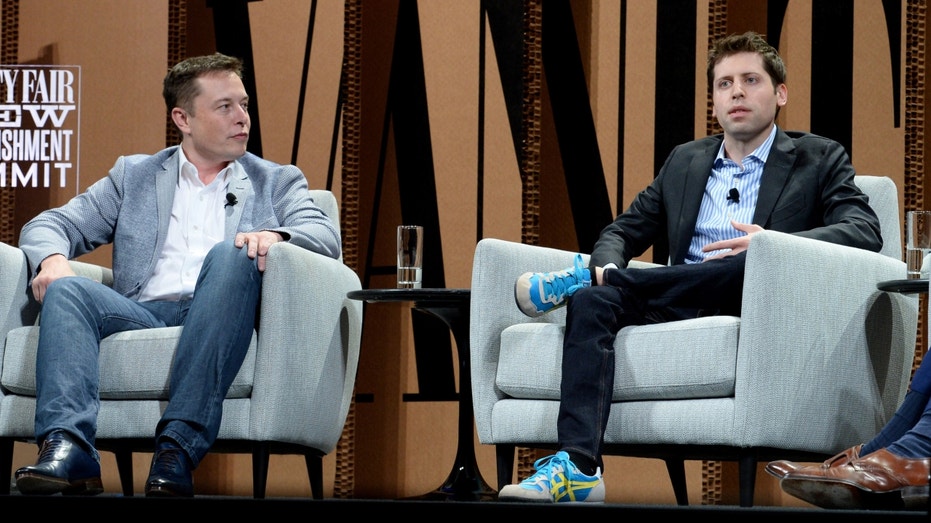
Sanders’ bill aims to take large ownership stakes in AI companies founded by “Big Tech oligarchs” like Elon Musk and Sam Altman. (Michael Kovac/Getty Images for Vanity Fair)

He added that the bill would also “guarantee that the trillions of dollars potentially generated by AI are used to improve the lives of all of us – not simply to make the richest people in the world even richer.”

Advertisement

“If the big AI companies continue to grow as rapidly as many analysts expect, then the value of the sovereign wealth fund will grow as well – and the benefits to the American people will grow along with it,” the senator wrote.

Sanders said other sovereign wealth funds, like the one operated by Norway’s government derived from oil revenues, give the government a say in how those resources should be used for the nation rather than allowing oil companies to direct those funds. 

He also noted Alaska’s oil fund as well as state pension systems holding stock in companies as other examples of the role the government can play.

ELON MUSK CALL HIMSELF A ‘MAKER,’ SLAMMING POLITICIANS LIKE BERNIE SANDERS: ‘THEY TAKE’

Advertisement
Sen. Bernie Sanders speaks at a

Sen. Bernie Sanders speaks during a “Fight Oligarchy” rally in Orono, Maine, where he warned that artificial intelligence and robotics could replace workers and deepen economic inequality. (Fox News / Fox News)

Sanders’ proposal for the AI sovereign wealth fund to control 50% of the stock in U.S. AI companies goes well beyond the limit imposed by Norway’s sovereign wealth fund, which prohibits the fund from holding more than 10% of the shares in public companies, aside from real estate firms.

Additionally, state pension funds typically hold relatively small amounts of stock in individual companies as the funds tend to diversify their holdings to help safeguard the pensions’ assets.

Under the senator’s proposal, the “billions, if not trillions, of dollars generated by this fund would provide direct payments to the American people. And as the fund generates more and more wealth, the proceeds would be used to ensure that every man, woman and child in our country has a decent and dignified standard of living, including healthcare, education and housing.”

“I recognize that for the government to have a major stake in a company, particularly one for which AI is only part of its business, is complicated. More details – including the specific spending priorities and the mechanics of implementation – will be included in the legislation I unveil in the coming weeks,” Sanders said.

Advertisement

GET FOX BUSINESS ON THE GO BY CLICKING HERE

“But the principle is simple: when a public resource generates wealth, the public should share in that wealth. AI is being built on a public resource far more valuable than oil: the accumulated knowledge, creativity and labor of mankind,” he explained.

Continue Reading

Trending

Copyright © 2025