Protean Small Cap declined by -0.9% in March. The benchmark index declined -3.1%. Since launching in June 2023, the fund has gained 55.6%. The Carnegie Nordic Small Cap Index is up 22.1% in the same period.
The hedge fund Protean Select returned 0.5% in March.
Protean Aktiesparfond Norden returned -2.8%. The benchmark was down by -2.6%. Since inception, twelve months ago, the fund is up 18.3%, and in the same period the VINX Nordic Cap index is up 12.8%. The fund now manages 1.7bn SEK.
All figures are net of fees.
Advertisement
This month’s letter elaborates on Aktiesparfonden’s encouraging first year, the Fog of War that plagued markets in March, why we remain cautious but not as cautious as mid-March and why we were unusually active. Plus, as always, commentary on the month’s various winners and losers.
Thank you for being an investor!
// Team Protean
Nowhere to hide
March 2026 • Written by Pontus Dackmo
Advertisement
Wouldn’t it have been convenient to write this month’s missive about something completely different? A company deep-dive, a reflection on Nordic small cap valuations, perhaps an observation about the underappreciated capital cycle in some obscure industrial niche. We’d have preferred that. You’d probably have preferred that too.
The instinct, as a Nordic-focused fund manager, is to treat geopolitical events as background noise. We don’t trade oil futures, we don’t run a macro fund, and we certainly don’t have an edge on the intentions of the Iranian Revolutionary Guard or US Commander in Chief. It would be comfortable to dismiss the Middle East crisis as someone else’s problem and retreat to the familiar terrain of Nordic company fundamentals.
The problem is: there is no such retreat. An inconvenient fact about the Nordic equity markets is that most of our listed companies have international operations and are deeply embedded in global supply chains. A Swedish industrial company might report in kronor, hold its AGM in Stockholm, and have a thoroughly Nordic board – but its input costs are denominated in dollars, its customers are in Germany and China, and its order book is a function of global capex cycles. An energy shock in the Strait of Hormuz doesn’t stop at the Persian Gulf. It travels through Brent crude, through European gas prices, through the front end of rate curves, through the krona, through sentiment, and eventually lands on the desk of a CFO in a mid-sized Swedish town, wondering whether to revise guidance.
There is nowhere to hide from a physical supply shock. Not in Scandinavia, not in small caps, not in “quality compounders”.
Advertisement
The fog
General Carl von Clausewitz coined the term “fog of war” almost two centuries ago. In the chaos of conflict, the information available to decision-makers is incomplete, contradictory, and often deliberately
misleading. The rational response, he argued, is not to seek certainty, but to make decisions robust enough to survive being wrong.
March offered a masterclass in modern fog of war, except now the fog is generated not by cannon smoke but by tweets and nonsense.
We have no edge in forecasting the outcome of the Middle East conflict. None. We do not know whether the Strait of Hormuz will reopen next week or remain contested for months. We do not know if escalation leads to a ground operation or if a face-saving deal materializes over Easter. And critically, we don’t think anyone else knows either – regardless of how confidently they narrate it. What we can control is how we position for the range of outcomes.
Advertisement
Active Portfolio Management
March was, in all likelihood, the most active month we have had in a long while. Possibly ever.
That warrants some explanation. We do not celebrate turnover. Trading is, at its core, a necessary evil since every ticket is connected to a commission cost borne by the fund, every spread has two sides. We are fully aware that activity for activity’s sake is a reliable way to erode returns whilst just producing a feeling of being busy.
What happened in March is that prices moved, on a daily basis, in ways that had very little to do with company fundamentals. Tariff announcements, reversals, threats, walk-backs – the signal-to-noise ratio collapsed. When the market reprices a business by 10% because a politician said something on a Sunday, and then reprices it back 8% two days later, the question we ask ourselves is not “should we trade?” but “can we afford not to?” The disconnect between price and value was, on certain days, wide enough to drive a truck through.
So we traded. We trimmed things that moved too far. We added to things that got dragged down indiscriminately.
Advertisement
We do not fetishize this. The goal is never to be active. It is to own businesses at prices that make sense. Some months that means sitting on our hands. March was not that month. When the market hands you volatility as a gift, and the underlying thesis hasn’t changed, the correct response is to use it.
The honest addendum: a fair few trades in March were wrong. Some we were too early on; some we shouldn’t have touched at all. Elevated activity is a double-edged sword: more opportunities to profit, but also more chances being wrong.
What we’re watching
The honest answer is: we’re watching the same thing as everyone else. The Middle East. The Strait of Hormuz. The oil price. But we’re also watching for the second-order effects that tend to arrive with a lag and matter more than the headlines.
More speculatively: we are watching for the moment when the market shifts from treating this as a binary event (resolved / not resolved) to treating it as a new baseline. That shift, when it happens, tends to be where opportunity is greatest. Because once the question changes from “will things go back to normal?” to “what does the new normal look like?”, the answer requires fundamental analysis rather than geopolitical punditry.
Advertisement
But you don’t always need to wait for the fog to lift. Some conclusions are robust regardless of how the binary question resolves. Here’s an example from our own process.
In the middle of March, we bought a meaningful amount of Nibe (NDYLF) (NDYLF). The thesis is not that the war ends tomorrow, nor that it drags on for months. The thesis is that regardless of outcome, this crisis will put energy efficiency and reduced oil dependence back on the political agenda across Europe – forcefully, and probably durably. It happened after the 2022 Ukraine shock, when heat pump sales exploded and energy renovation became a political priority. That impulse then faded as gas prices normalised and populist backlash pushed governments to soften their climate ambitions. Well, here we are again. Except this time, the lesson should be harder to forget: Europe’s energy dependence is not a theoretical risk discussed at think tanks. It’s a physical vulnerability that disrupts economies when things go wrong in places we can’t control.
Nibe is the dominant European manufacturer of heat pumps. The stock has been in the penalty box for two years – inventory destocking, normalising demand, increasing competition, a weak Swedish housing market. It’s down 70% from its peak. We think the market is pricing a permanently impaired business, while the structural case for energy-efficient heating has just been handed another powerful catalyst.
This is the kind of analysis we prefer: not “will there be a ceasefire by April 6th?” but “what is likely true about the world on the other side of this, no matter what?” The best investments tend to come from conclusions that don’t depend on the impossible task of predicting the unpredictable.
Advertisement
Aktiesparfond Norden – One Year In
March 31st marked one year since launch. The fund has returned +18.3% against the VBCSKN index’s +12.8%. That is an outperformance of 5.5%.
Twelve months is not a track record. It’s a start. A better start than a bad start, which is all we’ll claim.
The more instructive number is the 1.7bn SEK in assets attracted. To understand why that matters, you need to remember the problem we set out to solve.
The active fund management industry has a well-documented flaw: virtually all serious research shows that actively managed funds underperform their benchmarks after fees. Not because the underlying stock-picking is necessarily bad, but because fees are too high, portfolios too bloated, and the incentive structure backwards. Fund companies optimize for asset gathering. Banks optimize for captive distribution. Neither optimizes for the person actually trying to compound their savings.
Advertisement
The obvious counter is the index fund. Cheap, transparent, honest. Except it owns everything indiscriminately – the frauds, the fads, the structurally declining businesses – with no judgment or overlay.
Our argument has always been that there is a gap between these two options. A white space that nobody has an incentive to fill: a low-fee, genuinely active, long-term oriented fund owning decent Nordic businesses. Just a manager with skin in the game, focused on long-term cash flow generation, making decisions without anyone else’s approval required.
The Aktiesparfond was built on the premise that a long-term Nordic saver deserves access to that kind of independent, genuinely active management. At 0.5% per year, with daily liquidity, alongside every expensive active fund and index fund in existence.
That 1.7bn SEK after one year suggests the gap was real. Whether the performance holds is a separate question, the last one year tells us almost nothing with statistical significance. But the structure is working, the thesis is intact, and the alignment of interests remains the foundation.
Advertisement
A Punch In The Mouth
The Prussian military strategist Helmuth von Moltke was a contemporary of Clausewitz. He is remembered for the observation that no plan survives first contact with the enemy (a version of which Mike Tyson famously converted to “Everyone has a plan until they get punched in the mouth.”). The investment equivalent is that no portfolio survives first contact with a real-world shock.
We came into 2026 positioned for a world of monetary tailwinds, deregulation, and an improving European outlook. That world has been interrupted – perhaps temporarily, perhaps not.
Months like March are uncomfortable. They are supposed to be. Comfort is rarely where returns are found. We remind ourselves – and you – that our process is designed to compound over years, not months. The key is to stay in the game, avoid big draw-downs, suffer intelligently when suffering is unavoidable, and be ready to act when the fog lifts.
Thank you for being an investor.
Advertisement
// Team Protean
Protean Select
March 2026 • Written by Pontus Dackmo
Protean Select returned +0.5% in March. After two softer months to start the year, this is a welcome result, and more importantly, it is the kind of month that gives the strategy its reason for existing.
Nordic indices were down between 5 and 10% this month, depending on which one you pick. We ran an average net exposure of around 20%. The fund made a small positive return. That is roughly what we designed this thing to do.
Advertisement
We are not a market-neutral fund. Or a short-biased fund. We are a fund that believes, with some conviction, that things generally want to work out in the end, and that the majority of long-term returns are made by owning businesses, not by being overly clever about when to be short them. That belief is why we almost always keep a positive net exposure, even in difficult conditions. The shorts are there not just to make money in isolation, but to act as an airbag: you don’t drive with an airbag hoping it deploys, but you’re grateful it’s there when it does. Like this month.
Biggest contributors were the OMX future short position (plus put-spread), Rusta long, NIBE long and Electrolux (ELUXY) short, in that order.
Biggest detractors were Devyser, Lundin Mining (LUNMF) (although offset by a short in Boliden (BDNNY) (BDNNY)), Volvo (VLVLY) and Getinge (GNGBY) long positions.
We enter April at 19% net exposure. Gross is now at 117%, having nudged it upward from more cautious levels, moving gradually back toward our historical average of around 135%. This is a deliberate, incremental decision, not a conviction call. The market feels non-linear right now. If conditions continue to feel constructive enough to justify additional risk, we will add. If not, we won’t.
Advertisement
We said going into the year that we wanted to earn the right to take more risk. March was a small step in that direction. Let’s see what April has to say about it.
Lowering the capacity limit
We announced during the month that we are lowering the capacity limit for Protean Select from SEK 2 billion to SEK 1 billion. The fund currently manages approximately SEK 970 million. We are, in other words, very close.
Some context. When we originally set the cap at SEK 2 billion, we assessed capacity based on the fund in isolation. That was reasonable at the time. But circumstances have changed. We now manage institutional mandates alongside the fund, applying a similar investment strategy in the same universe of Nordic small- and midcap companies. Running larger aggregate capital through the same opportunity set degrades the things that matter most: execution quality, the ability to take meaningful positions in less liquid names, and the speed of decision-making that comes with being small. We’d rather close too early than too late.
Here is how it will work. Once we pass SEK 1 billion, we will communicate that the fund is closing. There will then be a final subscription window of approximately one month. After that, the fund is closed to new capital. Withdrawals are always possible – this only affects new deposits.
Advertisement
Readers of these letters will recognise the philosophy.
We have said since day one that we optimise for performance, not for convenience, size, or marketing. We have written at length – perhaps at tedious length – about the perverse incentives in fund management, how AUM-maximising behaviour dilutes returns, and how size is one of the primary ways performance dies. We have said we would cap the fund early. We have said we would sacrifice revenue for return quality. And now, approaching the moment where those words become action, it feels worth pausing to acknowledge what this means.
On a personal level, the prospect of actually closing the fund is a source of pride. Not because turning away capital is clever business – it obviously isn’t. But because it means we are doing what we said we would do. When we started Protean, the motivation was to invest our own savings in an institutional setting, not to build an asset gathering machine. Every structural choice we’ve made has pointed in this direction: the quarterly redemptions that scare off allocators, the size cap that limits our fee income, the high hurdle rates that make performance fees genuinely hard to earn. None of this is “How to Build a Big Profitable Fund Management Business”. If there were a textbook on the subject, we’d feature as a cautionary tale.
But here’s the thing. Almost four years in, the fund has delivered competitive risk-adjusted returns. We even won an actual prize for it. Assets have grown to the cap not through marketing campaigns, but through performance and word of mouth. Our investors include some of the most sophisticated allocators we know, alongside friends, family, and our own savings. That this motley crew has collectively brought us to the point of closure feels like vindication of a philosophy.
Advertisement
We recognise this limits flexibility for both existing and prospective investors. That trade-off is deliberate. Protecting the conditions for good long-term returns is, in our view, the most important thing we can do for the people who have already entrusted us with their capital.
Protean Small Cap
March 2026 • Written by Carl Gustafsson
Protean Small Cap returned -0.9% in March. Our benchmark CSRXN (SEK) was down -3.1% during the month. Hence, the fund outperformed the index by 2.3%. Since inception in June 2023, the fund has outperformed the index by 33.5%. Total performance since inception is 55.6% net of fees.
The fund now manages c. SEK 990m following a continued inflow of funds, thank you for believing in us.
Advertisement
March recap
Top contributors were Cint, Rusta, BTS, Smartoptics and Nibe. Notable detractors were Devyser, Balder (BALDY) (BALDY), Arctic Falls, Nyfosa and ITAB.
Cint reported a considerable sequential improvement in sales during the fourth quarter and we increased our stake in the company on the day of the report in February. Since then, the share has continued to climb and it became our biggest contributor in March. It’s not a stock for widows and orphans but we believe the market is underestimating the growth opportunity within the business area Media Measurement. We acknowledge a string of operational issues, as well as about the impact of AI on the market research sector, but Q3 was likely the trough in terms of pain. The valuation is very appealing.
Rusta reported a very strong quarter, where the benefits of the stronger SEK started to have an impact. Healthy LFL, as well as a firmer outlook for store openings, lead to share to gain in an otherwise gloomy March for consumer exposure.
On the detractor side, Devyser continued its slump, with the share down by a third year to date. As we write this, the share now trades below its IPO price from 2021, despite clearly approaching cash-flow break-even and strong growth prospects in several areas. Devyser is active within genetic testing where DNA is used to assess disease risk as well as detecting them. Introducing new testing protocols takes time, but they are very sticky once established. The market might have overestimated the speed at which Devyser can establish itself, but we believe it underestimates the duration of the opportunity.
Advertisement
Balder and Nyfosa suffered from concerns over long-term rates.
While March was less busy in terms of portfolio activity, we take the opportunity to catch-up on some of the changes we have made so far this year.
We have added Vimian as a mid-sized position. This is a Swedish animal health company, focusing mainly on pets. It has a relatively broad product offering partly due to an opportunistic acquisition strategy. As for many others, a string of acquisitions during the pandemic led to some issues, financially as well as operationally. The financial issues were resolved through a rights issue, while the operational issues have been gradually, but not fully, addressed through restructuring and cost savings.
Where does the attraction lie? Q4 was strong with improved earnings quality, as well as stronger cash flow. This positive step has been disregarded in the overall market turmoil, and the share is trading at the low-end of its post-pandemic range, and considerably below levels where the main owner Fidelio (the PE sponsor that owns 60% of the stock) has added shares as recently as this autumn. The valuation does not fully capture the thematic exposure, we believe. With continued margin improvement, a return to more M&A and upside towards sector valuation, we see good risk/reward.
Advertisement
We have also added smaller stakes in a few interesting growth stories where shares can typically be hard to come by. These include Vertiseit , which describes itself as a supplier of “in-store Experience Management (IXM) platforms”. This can be translated into ‘software that runs all the screens you see in stores’ to simplify. The appeal of the business lies in the execution, we believe. The company is led by owner-operators who have ten-folded annual recurring revenue over the last decade. This is partly due to organic growth but also complemented by successful acquisitions where there are considerable synergies that can be extracted. We visited Grassfish, one of Vertiseit’s subsidiaries, in Vienna earlier this month, and were enthused by the growth opportunities that remain.
We have exited our positions in Hexpol and Sinch (as the buyback programme we alluded to last month led to some outperformance and provided a window of exit).
Our top ten positions as we enter April are as follows:
Advertisement
Rank
Holding
% of portfolio
Rank
Holding
% of portfolio
1
Acast
4.5%
6
ITAB
3.3%
2
Storytel
4.1%
7
Storskogen
3.2%
3
Sdiptech
4.0%
8
Vimian
3.2%
4
BTS
3.7%
9
Devyser
3.1%
5
Cint
3.5%
10
Vitec
3.0%
Protean Aktiesparfond Norden
MARCH 2026 • WRITTEN BY RICHARD BRÅSE
Aktiesparfonden is a Nordic long-only fund aiming to generate above-market returns over the long term by active investing in value-creating companies and charging a low fee. A fee that is reduced further as the fund grows, sharing the scale advantages with investors.
Aktiesparfonden has, since inception one year ago, delivered a 18.3% return, in the same period the VINX Nordic Cap index is up 12.8% . The fund now manages 1.7bn SEK.
Our communication for Aktiesparfonden is currently only in Swedish, and updates can be found at www.aktiesparfonden.se by clicking the headline “Anslagstavla”.
Advertisement
Thank you for your long-term perspective and trust in our process.
Thank you for being an investor.
Pontus Dackmo CEO & Investment Manager Protean Funds Scandinavia AB
The monthly reminder
We optimize for performance, not for convenience, size, or marketing. You can withdraw money only quarterly in Select (monthly in Small Cap). We will tell you very little about our holdings. Our strategy is tricky to describe as we aim to be versatile. A hedge fund can lose money even if markets are up. We charge a performance fee if we do well. You do not get a discount if you have a larger sum to invest. We only have a medium-sized track record.
Advertisement
Aktiesparfonden’s reminder
We aim to generate above index returns over 3-5 years, but there are no guarantees. The fund is traded daily, but that doesn’t mean you should. To beat the index, you need to deviate from the index. This means taking uncomfortable positions. Be aware that the fund can underperform the index during periods. Sometimes, long periods. We lower the fee as the fund grows. The first 10 basis point cut comes at 10bn SEK in AUM.
Albert Anthony is the pen name of a business author on Amazon and his newest book is “How To Pick Stocks: 8 Steps For Long-Term Investing with Fundamental & Technical Analysis,” now available as a 2026 edition paperback and Kindle ebook in several regions including the US, UK, Canada, and Europe. The author is an analyst & contributor for investing platform Seeking Alpha since 2023, where he has nearly 2,000 followers and has covered hundreds of stocks in multiple sectors including banks/financials, REITs, insurance, pharma, and more. He has also written for platforms like Investing dot com, and has taken part in many business conferences includes Bloomberg Adria’s Investment Outlook 2026 as well as Money Motion 2026. Albert Anthony has Croatian-American roots, having grown up in the US and living in the NYC/New Jersey area as well as the Austin Texas area while working in enterprise IT roles at several prominent companies, including a top 10 financial firm. The author earned a B.A. from Drew University, and also completed certifications from Microsoft, CompTIA, and Corporate Finance Institute where he earned the specialization in risk management. He is founder of a boutique equities research firm, Albert Anthony & Company, which is a trade name both in the US and Croatia. Besides his writing and analyst work, the author has been active on camera as well, as a film/TV extra for casting agencies in Croatia/Europe, and also took part in roundtable panel discussions and appeared in several media stories in that region. You can also check out the author’s video content on the Albert Anthony channel on YouTube where he discusses investing topics, @author.albertanthony Please note: The author does not write about non-publicly traded companies, small cap stocks, crypto, or startup CEOs, so any such mail received and pitches from PR agencies will be deleted. Any official mail to the author should be sent to albertanthony.info@gmail.com. *Author Disclaimer: Albert Anthony and Albert Anthony & Co, is a US-based sole proprietorship registered as a trade name in Austin, Texas, and a sole proprietor registered in Croatia. The author nor his company are registered financial advisors and do not provide personalized financial advisory services to clients and do not manage client assets but provide general markets commentary and research as well as actionable insights based on publicly-available data and their own analysis. The author does not sell or market financial products and services, nor is compensated by any company for rating them. The author does not hold any material position in any stock he rates at the time of writing, unless otherwise disclosed. All investment is assumed to be at risk and readers are expected to do their due diligence beyond the scope of this author’s commentary, agreeing to indemnify the author of any liability for potential investment losses.
Analyst’s Disclosure: I/we have no stock, option or similar derivative position in any of the companies mentioned, and no plans to initiate any such positions within the next 72 hours. I wrote this article myself, and it expresses my own opinions. I am not receiving compensation for it (other than from Seeking Alpha). I have no business relationship with any company whose stock is mentioned in this article.
Author does not own any shares in PINE, however he does invest in Netstreit and other retail REITS not mentioned here.
Advertisement
Seeking Alpha’s Disclosure: Past performance is no guarantee of future results. No recommendation or advice is being given as to whether any investment is suitable for a particular investor. Any views or opinions expressed above may not reflect those of Seeking Alpha as a whole. Seeking Alpha is not a licensed securities dealer, broker or US investment adviser or investment bank. Our analysts are third party authors that include both professional investors and individual investors who may not be licensed or certified by any institute or regulatory body.
Focus on trying to piece together the big things (both at a macro and industry level) Twenty years in Asia (mainly China).
Analyst’s Disclosure: I/we have a beneficial long position in the shares of INTC either through stock ownership, options, or other derivatives. I wrote this article myself, and it expresses my own opinions. I am not receiving compensation for it (other than from Seeking Alpha). I have no business relationship with any company whose stock is mentioned in this article.
Seeking Alpha’s Disclosure: Past performance is no guarantee of future results. No recommendation or advice is being given as to whether any investment is suitable for a particular investor. Any views or opinions expressed above may not reflect those of Seeking Alpha as a whole. Seeking Alpha is not a licensed securities dealer, broker or US investment adviser or investment bank. Our analysts are third party authors that include both professional investors and individual investors who may not be licensed or certified by any institute or regulatory body.
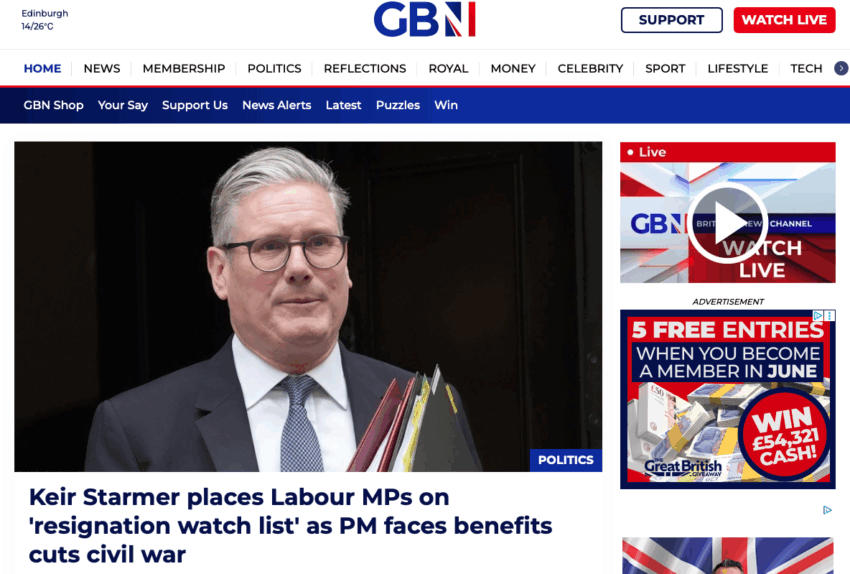
GB News has made a bold bid for access to the public purse, arguing that government broadcasting grants should be opened up to competitive tender rather than flowing automatically to the BBC.
The loss-making news channel, backed by hedge fund financier Sir Paul Marshall, set out its case in a submission to the government’s consultation on the BBC’s royal charter. At its heart is a call for “contestable funding”, a mechanism that would allow broadcasters beyond the traditional public service operators to bid for taxpayer-backed support.
The BBC’s World Service is the most obvious target. Once funded entirely by Whitehall, the service now draws primarily on the licence fee but still receives grants from the Foreign, Commonwealth & Development Office worth £137 million last year. GB News believes it should be eligible to compete for a share of that pot, assessed on criteria including quality, audience reach and value for money.
It is a striking proposition from an organisation that has accumulated losses exceeding £100 million since launching in 2021, and one that is unlikely to find a warm reception at Broadcasting House. GB News framed the argument in the language of market competition, contending that opening funding to tender would drive innovation and encourage what it called “diversity of thought and content”.
The channel pointed to precedent. Between 2019 and 2022, two pilot schemes, the Young Audiences Content Fund and the Audio Content Fund, distributed £48 million across a range of broadcasters and independent producers. GB News also drew attention to New Zealand’s NZ On Air model, which allocates public money to a variety of media outlets, suggesting a similar framework could bolster plurality in Britain’s broadcasting landscape.
Advertisement
The submission to the charter review is part of a broader lobbying campaign. In a separate filing with Ofcom, GB News made a parallel case for contestable funding. It is also pressing for prominence rights currently enjoyed only by the established public service broadcasters, the BBC, ITV, Channel 4, Channel 5 and S4C, which guarantee their channels favourable positioning on television sets, albeit in return for strict obligations around regional production and news output.
Whether the government has any appetite for redirecting public funds towards a commercially owned, politically divisive broadcaster remains to be seen. But GB News’s intervention ensures the question of who qualifies as a public service provider, and who should pay for it, will sit squarely at the centre of the charter debate.
Amy Ingham
Amy is a newly qualified journalist specialising in business journalism at Business Matters with responsibility for news content for what is now the UK’s largest print and online source of current business news.
The winners of the HR in Wales Awards will be revealed in May
Winners of the 2025 HR in Wales Awards
Businesses and organisations across Wales have been recognised for their outstanding HR and people development practices with the announcement of the shortlist for the second ever HR in Wales awards.
Launched by Lesley Richards, independent HR consultant and former head of the CIPD in Wales, in 2025 with support from industry experts Louise Price (Hugh James), Mera Mann (Human Resourcing), and Paul Harris (Skylite Associates), the HR in Wales awards will celebrate the achievements of HR and people development professionals across Wales with a special lunchtime ceremony.
This year’s awards will take place at the Marriott Hotel, Cardiff on May 1st and will be hosted by former Wales international Alex Cuthbert.
Building on the success of last year’s ceremony, 98 businesses, teams and individuals entered across nine categories, with a shortlist of 53 going forward for judging. The shortlist reflects the achievements of a range of organisations, both large and small, during a year shaped by ongoing economic uncertainty, global challenges and a rapidly changing talent landscape.
Advertisement
Finalists for 2026 include: Atradius, Cwm Taf Morgannwg University Health Board, Bangor University, S4C, St John Ambulance Cymru, Welsh Local Government Association, Valleys to Coast, Freshwater and last year’s Learning and Development winner, Mrs Buckét Cleaning Services.
Commenting on finalists, Ms Richards, said: “We are very proud to host the second HR in Wales Awards ceremony and those who show what great HR looks like in practice. The competition this year has been fierce, with an impressive number of entries in the Transformation and Change category in particular.
“After what’s been such a challenging year for so many businesses it’s so incredible to see employers respond to economic uncertainty and turn it into an opportunity to strengthen their workforce and streamline operations. People are at the heart of what we do in HR and people development and The HR in Wales a shortlist truly is a reflection of the life-changing work being done here in Wales.”.
The shortlisted finalists:
Advertisement
Equality, Diversity and Inclusion
Bangor University.
Cardiff Community Housing Association.
LBS Builders Merchants.
Advertisement
Valleys to Coast.
WJEC CBAC.
Employee Engagement
Atradius.
Advertisement
Cartrefi Cymru Cooperative.
Cwm Taf Morgannwg University Health Board.
Health Education and Improvement Wales.
HPMA Cymru.
Advertisement
Rocialle Healthcare.
Learning and Development
Cardiff Community Housing Association.
Cwm Taf Morgannwg University Health Board.
Advertisement
HPMA Cymru.
S4C.
Sweetmans and Partners with Sero.
Siderise.
Advertisement
Transformation and Change
Codi Group.
Health Education and Improvement Wales.
Mrs Buckét Cleaning Services.
Advertisement
Rhondda Cynon Taf County Borough Council.
S4C.
St John Ambulance Cymru.
WCVA.
Advertisement
Talent Management
Bipsync.
Freshwater.
St John Ambulance Cymru.
Advertisement
Welsh Local Government Association.
Wellbeing
Codi Group.
Creditsafe Business Solutions.
Advertisement
Cwm Taf Morganwwg University Health Board.
First Choice Housing Association.
Freshwater.
Individual Impact
Advertisement
Sian Fisher – Confident Style Academy.
Emma del Torto – Effective HRM.
Universal Coaching Alliance Wales.
Ann Rowley – Lighthouse HR.
Advertisement
Gemma Littlejohns – Siderise.
Rosie Sweetman – Sweetmans and Partners with Williams Medical Supplies
Dr Ioan Rees – SYCOL
Rising Star
Advertisement
Alex Davies – Siderise.
Emily Summerhayes – Cwm Taf Morgannwg University Health Board.
Harry Underhill – Creditsafe.
Jen Walters – Principality Building Society.
Advertisement
Sadie Govier – Cardiff Airport.
Sophie Cole – ACT Training.
Tammi Jones – Effective HRM.
Toni Louise Davies – HMPA Cymru / NHS Wales.
Advertisement
Excellence in HR leadership
Angela Overment – St John Ambulance Cymru.
Angie Lewis – Welsh Ambulances Services Trust.
Kate Ablett – Mrs Bucket.
Advertisement
Nadine Beacon – S4C.
Simon Argent – Vishay Newport.
The HR in Wales Awards are supported by Hugh James, Vester Group, Human Resourcing, Lesley Richards Limited, Skylite Associates, HSF Health Plan, ALS/ACT, Monmouthshire Building Society, Welsh Government, Hoop Professional Services and HR, and the CIPD.
As the fuel crisis continues along with the Iran war, Energy Minister Chris Bowen has assured that fuel shipments have been secured “well into May.”
However, an economist has raised the alarm regarding the fuel situation, calling for Australia to be more self-sufficient when it comes to fuel.
Fuel Shipments Secured ‘Well Into May’
According to a report by ABC News, Bowen has assured the public that the government has been hard at work to ensure that enough supplies for May will be secured.
“All the orders are locked in and contracted,” said Bowen. “Once it’s contracted, the fuel belongs to the Australian company that’s bought it … that is legally locked in, so that’s encouraging.”
Advertisement
He added, “Of course, there is a risk in international circumstance and [the] international situation, but every step that can be taken is being taken.”
Bowen previously disclosed that 53 ships carrying fuel are now on the way to Australia from different countries in Asia, as well as the United States and Mexico.
‘Wake Up Call for Australia’
Despite the promising developments, an economist is urging Australia to do more amid the ongoing crisis.
According to Sky News, MST Financial energy analyst Saul Kavonic went as far to say that Australia “ceded our fuel security to foreign powers.”
Advertisement
“This is a wake up call for Australia to become more self-sufficient in fuel again. The next disruption to maritime trade could occur closer to home in the Pacific, leaving Australia without any fuel, and our economy would grind to a halt within weeks,” said Kavonic.
“Australia must act to avert the economic and national security risks posed by our fuel import dependence,” he added.
Addressing the calls to turn to renewable sources of energy, Kavonic pointed out that “renewables are simply not practical to replace jet fuel and diesel at this time.”
Shares of RBL Bank surged nearly 4% on Monday after a strong Q4 business update and Reserve Bank of India’s (RBI) approval for up to 74% stake acquisition by Dubai-headquartered Emirates NBD Bank (PJSC).
Shares of the lender jumped to Rs 312.70 apiece in the morning trading hours of Monday, the highest level in more than a month. The sharp surge added more than Rs 720 crore to the total market capitalisation of the company, pulling it higher up to rise above Rs 19,310 crore.
In an exchange filing released on Thursday, RBL Bank said that the RBI has approved Emirates NBD Bank to acquire up to 74% stake in the lender. After the completion of the stake sale, the Dubai-based bank will become a promoter holder, crossing the 51% threshold as per the RBI’s conditions. The lender has no promoter, currently. The private lender, meanwhile, will be classified as a foreign bank operating in wholly owned subsidiary (WOS) mode, with Emirates NBD as its parent. RBI’s approval is now valid for one year.
The approval was communicated via a letter dated April 1, 2026, ET had earlier reported, citing sources. The report said that an approval from the Securities and Exchange Board of India (Sebi) is also expected soon.
Advertisement
RBL Bank Q4 business update
Live Events
RBL Bank on Thursday released its provisional business update for the fourth quarter of the financial year 2026. The lender’s total deposits rose 25% year-on-year (YoY) to Rs 1.39 lakh crore in Q4 FY26, from 1.11 lakh crore in the corresponding quarter of the previous financial year. Sequentially, total deposits grew 16% QoQ from Rs 1.2 lakh crore in Q3 FY26. Gross advances meanwhile increased 22% YoY and 11% QoQ to Rs 1.15 lakh crore during the quarter under review. RBL Bank’s CASA (current account and savings account) deposits grew 23% YoY to Rs 46,723 crore, while CASA ratio stood at 33.6% in Q4 FY26, slightly lower than 34.1% in the same period of the previous year. Also read: Earnings downgrade alert: How $110 crude and Iran war are threatening India Inc’s double-digit dream
RBL Bank’s deposits worth under Rs 3 crore grew 16% YoY to Rs 63,943 crore, while the average liquidity coverage ratio stood at 130%, lower than 133% recorded in Q4 FY25. The bank said that its total business crossed Rs 2.5 lakh crore at the end of the quarter, marking a 24% YoY increase from Q4 FY25.
Secured retail advances grew 36% YoY and 17% QoQ. Retail advances rose 18% YoY and 10% QoQ, while unsecured retail advances grew 2% QoQ. Wholesale advances grew 27% YoY. Within wholesale, commercial banking advances grew 29% YoY. The mix of retail: wholesale advances was reported at approximately 59:41.
Advertisement
Motilal Oswal on RBL Bank’s Q4 update
Motilal Oswal Financial Services said that RBL Bank’s exceptional growth of 22% YoY in gross advances is fairly higher than its estimate of 16%. It noted that deposits also witnessed exceptional growth of 25% YoY, significantly higher than its estimate of 12.2%.
“RBL reported remarkable business growth, led by both advances as well as deposits growth,” it said, maintaining its ‘Buy’ call on the stock.
RBL Bank shares have gained more than 8% in the past week, and over 3% in the past month. In the longer term, the stock has surged 78% in one year, and more than 118% in three years.
(Disclaimer: Recommendations, suggestions, views and opinions given by the experts are their own. These do not represent the views of The Economic Times)
I have been a Merchant Seaman that has traveled the world for over 30 years. Within the last 15 years, I developed a very intense interest in investing. I learned a lot of what I know about investing from The MF. Also because I have a engineering background, I often tend to gravitate to Tech stocks
Analyst’s Disclosure: I/we have no stock, option or similar derivative position in any of the companies mentioned, and no plans to initiate any such positions within the next 72 hours. I wrote this article myself, and it expresses my own opinions. I am not receiving compensation for it (other than from Seeking Alpha). I have no business relationship with any company whose stock is mentioned in this article.
Seeking Alpha’s Disclosure: Past performance is no guarantee of future results. No recommendation or advice is being given as to whether any investment is suitable for a particular investor. Any views or opinions expressed above may not reflect those of Seeking Alpha as a whole. Seeking Alpha is not a licensed securities dealer, broker or US investment adviser or investment bank. Our analysts are third party authors that include both professional investors and individual investors who may not be licensed or certified by any institute or regulatory body.
The Thai Meteorological Department has warned of hot to extremely hot conditions across Thailand from April 4–9, 2026, with temperatures reaching up to 42°C, accompanied by hazy skies and isolated thunderstorms.
Key Points
Temperatures in upper Thailand (North, Northeast, Central, Bangkok) are expected to reach 36–42°C during the day, driven by a heat-induced low-pressure system.
Hazy conditions are forecast across most regions during the day, with residents in the North, Northeast, and upper Central regions advised to wear N95 masks outdoors.
Thunderstorms and gusty winds are expected in scattered areas despite the extreme heat, with some rainfall (10–20% coverage) forecast from April 7–9.
Bangkok temperatures will range from 26–28°C at night to 35–41°C during the day, with southerly winds at 10–15 km/h.
Southern Thailand will see isolated thunderstorms with wave heights around one metre, rising higher during storms.
Mariners have been advised to avoid sailing in storm-affected areas of the Gulf of Thailand and Andaman Sea.
Residents are urged to avoid prolonged outdoor activities due to health risks from the extreme heat.
Why It Matters
The Thai Meteorological Department has issued a heat warning from today until April 9. Many areas in Thailand could see temperatures exceed 42°C, along with hazy skies during the day.
Upper Thailand will be affected by a heat-induced low-pressure system, resulting in widespread high temperatures and reduced visibility. Weak southerly and westerly winds are also contributing to unstable weather, leading to potential thunderstorms and gusty winds in certain areas.
The combination of record-level heat, poor air quality from haze, and unpredictable storms poses significant health and safety risks across Thailand as the country moves deeper into its hot season.
Prolonged exposure to extreme heat can lead to heat-related illnesses, while deteriorating air quality contributes to respiratory issues, particularly among vulnerable populations such as children, the elderly, and those with pre-existing conditions. Additionally, the unpredictability of storms raises concerns about sudden flooding, property damage, and disruptions to daily life, highlighting the urgent need for comprehensive disaster preparedness and sustainable environmental policies to mitigate these growing risks.



























































You must be logged in to post a comment Login