

Business
Q1 earnings this week: Infosys, Eternal, Bajaj Auto among 256 companies set to announce June quarter results


The Q1 earnings season kicked off earlier this month with IT services major Tata Consultancy Services (TCS) reporting its results. On Friday, leading private sector lenders HDFC Bank, ICICI Bank, Axis Bank and Kotak Mahindra Bank also announced their June-quarter earnings.
July 20 (Monday)
UltraTech Cement is set to report its Q1 FY27 results on Monday. Paytm and Indian Overseas Bank will also announce their June-quarter earnings, along with Karur Vysya Bank, Shyam Metalics and Sobha.
July 21 (Tuesday)

Several major companies are scheduled to announce their Q1 results on Tuesday, including Bajaj Auto, Adani Energy Solutions, TVS Motor Company, Indian Hotels Company, JSW Infrastructure, Adani Gas, Mahindra & Mahindra Financial Services and Anthem Biosciences.
July 22 (Wednesday)Quick commerce and food delivery major Eternal will report its June-quarter earnings on Wednesday. FMCG giant Nestlé India will also announce its results. Other key companies on the earnings calendar include Adani Power, Adani Green Energy, BPCL, Oracle Financial Services Software, Dr. Reddy’s Laboratories and United Spirits.
July 23 (Thursday)
IT services major Infosys will announce its June-quarter earnings on Thursday. Other companies reporting results include IndiGo, Cipla, Motilal Oswal Financial Services, Mphasis, Sona BLW Precision Forgings, Go Digit General Insurance and Chennai Petroleum Corporation.
July 24 (Friday)
Shriram Finance, CG Power, Bank of Baroda, Jindal Steel & Power (JSPL), Laurus Labs, Apar Industries, Welspun Corp and Container Corporation of India (CONCOR), among others, will announce their April–June quarter (Q1 FY27) results.
Market outlook
Vinod Nair, Head of Research at Geojit Investments, said market sentiment continues to be supported by encouraging Q1 FY27 business updates and growing optimism over a healthy earnings season.
Meanwhile, Goldman Sachs expects the Nifty 50 to rebound to 26,500 by June 2027, above its current record high of 26,373, as it turns more constructive on India amid an improving macroeconomic backdrop.
Looking ahead, Nair said global investors will closely track Japan’s inflation data for clues on the future path of interest rates, while India’s PMI readings will provide fresh insights into economic activity and business confidence.
He added that corrections in select Asian markets amid concerns over elevated AI-driven valuations could enhance India’s relative attractiveness among emerging markets. Supported by strong macroeconomic fundamentals, resilient domestic demand and a diversified growth profile, India remains well positioned to attract long-term capital inflows.
(Disclaimer: Recommendations, suggestions, views and opinions given by the experts are their own. These do not represent the views of The Economic Times)

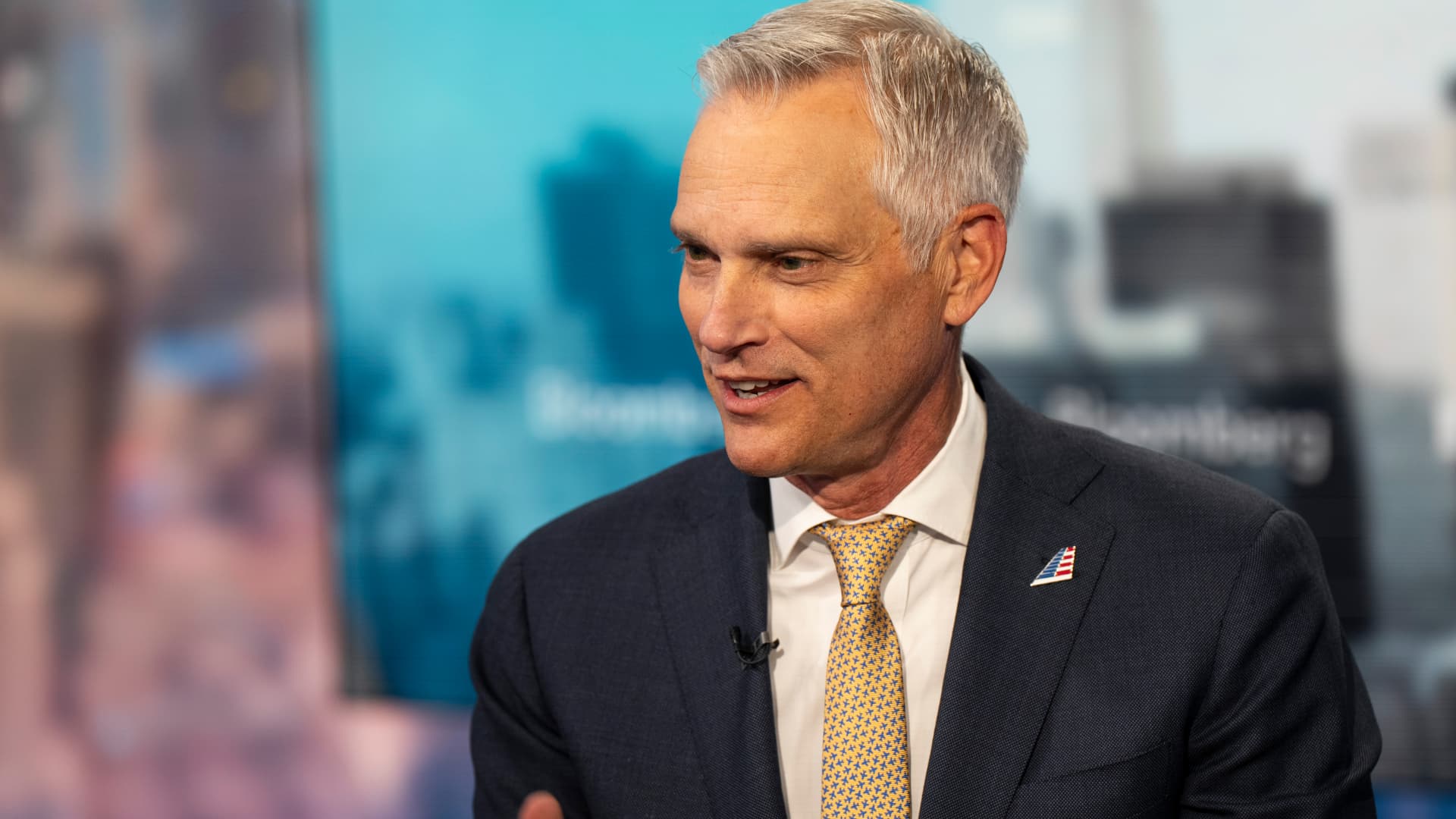
Robert Isom, chief executive officer of American Airlines Group Inc., speaks during a Bloomberg Television interview in New York, US, on Wednesday, Dec. 10, 2025.
Christian Monterrosa | Bloomberg | Getty Images
FORT WORTH, Texas — American Airlines CEO Robert Isom has a math problem.
The carrier is flying about 6,500 flights per day this year — nearly an entire Alaska Airlines more worth of travel more than its closest competitor, according to Cirium — yet American’s profit gap has grown. United Airlines brought in about $3 billion more than American last year, and U.S. profit leader Delta Air Lines made nearly $5 billion more.
In an exclusive interview with CNBC late last month, Isom said American and its nearly 140,000 employees want “to be best at everything that we do.” He said that carrier’s “long-range plan is certainly making up the margin gap,” but he didn’t put a timeline on that goal.
American’s top executives at the carrier’s headquarters late last month outlined new initiatives to CNBC: bigger, more luxe airport lounges, a new wide-body aircraft order, and fresh interiors for even more of its long-haul fleet to attract big spenders.
Isom described the carrier’s identity as “a premium global airline with the largest footprint in North America.”
American has more decisions it needs to make — and soon — to close the gap. Perhaps its biggest challenge is getting customers to shell out more to fly, something Delta and United zeroed in on years ago.
American has mastered running an efficient business but “what we will measure over time is: Are we closing this revenue gap and closing the unit revenue gap?” American CFO Devon May said.
Cabins, planes and lounges
The carrier’s executives reiterated that American’s plan rests on growing its ever-more important loyalty program, improving customers’ experience, expanding its network and increasing higher-end revenue.
The airline is forecast to earn 64 cents a share this year, on an adjusted basis, which would be up almost 80% from last year, according to analyst estimates. It will give an updated forecast when it reports second-quarter results on Thursday.
United and Delta earlier this month reported bookings are still strong. The surge in fuel prices have both helped and hurt the industry this year: The sudden run-up in prices because of the Iran war took carriers off guard, though they’re passing more of those costs along to travelers, and executives don’t expect fares will drop much anytime soon.
Wall Street is optimistic American will continue to improve, expecting it to quadruple adjusted earnings in 2027 to $2.58 a share.
American is now remodeling cabins across the fleet and taking deliveries of new planes with interiors that feature new amenities and more premium seats. Executives have said they’re considering but haven’t decided on bringing back seatback screens to much of its narrow-body fleet, though American recently joined the ranks of airlines that are adding satellite Wi-Fi from SpaceX‘s Starlink.
Customers who are willing to pay more for premium seats or other perks like lounge access have been a bright spot across the industry, and everyone from profit leader Delta to now-defunct budget carrier Spirit Airlines has tried to woo those travelers as airlines rush to get fancy, new seats — small but profitable real estate — in the air.
Isom told CNBC that work to refresh cabins will soon expand to American’s Boeing 787-8 Dreamliners. Its revamped cabins on its largest planes, the 777-300ERs, could debut in the next few weeks. Each business-class, lie-flat seat can bring in close to $10,000 on some long-haul international routes compared with $2,000 or even much less for a seat in the back.
Keeping up high-touch service levels could be a challenge, the airline’s flight attendant union said, as the 70-seat business class soon comes online. American has been phasing out planes with separate first and business classes.
“Now, as American introduces 70 Business Suites and markets a premium international experience, they’re expecting a reduced number of Flight Attendants to deliver significantly more personalized service,” Julie Hedrick, president of the Association of Professional Flight Attendants, said in a statement. (American reduced flight attendant staffing on those aircraft from 13 to 11 in 2020. Other carriers have made similar moves.) “The result will be longer service times and a customer experience that falls short of what passengers expect.”
In another lure for premium travelers, Chief Customer Officer Heather Garboden told CNBC that American is going to build the biggest Admirals Club lounge in its network, at 37,000 square feet, at its sprawling Dallas Fort Worth International Airport hub in Terminal C.
Dallas Fort Worth International Airport under construction, American Airlines’ largest hub, June 2026.
Leslie Josephs/CNBC
At the under-construction Terminal F at that airport, American is also planning a grab-and-go Provisions airport lounge, as well as a Flagship check-in area in Terminal D. The entire airport, American’s largest hub, is undergoing a $12 billion makeover, and the carrier recently unveiled new gates in Terminal C, which will expand further. American and others have been upgrading and expanding airport lounges for the spendiest customers around the U.S.
But United has had a roughly decade head start at catering to higher-paying travelers, while Delta has close to two decades of experience. In the late 2000s, Delta was giving away about 90% of its domestic first-class seats through free upgrades for frequent flyers, but now it says it sells the vast majority, with customers paying cash or redeeming miles, now a trend among big carriers, though American wants to increase buy-ups.
Under Isom, American has been upping its game in premium investments. American’s commercial team is working on technical changes that aim to offer customers more opportunities to buy pricier seats.
Aside from its of fortress hubs, American’s chief commercial officer, Nat Pieper, said the airline needs to win in so-called jump-ball markets like Los Angeles, Chicago and Washington, D.C. He said American continues to grow sign-ups for its lucrative credit card program in some of those, including New York.
American said it’s flying is split about 80% domestic versus 20% international. International flights often carry a high premium compared with domestic routes — and the planes serving them generally have more luxurious seats on board.
Isom said the airline’s network breadth is a major strong suit and will continue to be.
While American and other airlines rely on alliances and partnerships to expand reach, United is flying a lot of that itself.
United flies more internationally than Delta and American, and made its geography quiz-like network a calling card and , adding dots on the map from Mongolia to Galicia, Spain.
‘Never been deterred’
Robert Isom, chief executive officer of American Airlines Group Inc., center, following a news conference at the US Department of Transportation in Washington, DC, US, on Thursday, May 8, 2025.
Samuel Corum | Bloomberg | Getty Images
A mechanical engineer by education who took his first flight at about age 4, Isom rose up the ranks at Northwest Airlines and America West Airlines, which through mergers became modern-day Delta and American, respectively.
The airline industry is one of the most insular. In part, because of the safety-critical and specific knowledge needed to keep thousands of planes on track every day, airlines don’t often hire from other industries, especially at the top.
The executive team that long worked at American is split between that carrier and United. The CEO of United, Scott Kirby, used to work at American, until he was fired almost exactly 10 years ago. United announced it hired Kirby as president the same day.
Isom, 62, took over the top role at American in March 2022, after the airline industry had been rocked by the pandemic.
“I’ve never been deterred, no matter what the challenges that we face,” he said.
He took over in a quarter when American lost $1.6 billion.
“I’m clear-eyed about the challenges in this business,” he said, pointing to an industry that has been through everything from the 9/11 terrorist attacks, to the financial crisis, bankruptcies, mergers and wars and disease.
American ranked sixth of 11 U.S. airlines in punctuality in the first half of the year, according to Cirium data that pointed to with a 76.6% on-time rate, while Delta and United took the No. 2 and No. 3 spots, respectively. Under Isom and COO David Seymour, the carrier is working to improve its on-time rate, spreading out its schedule instead of jamming chaotic connecting banks in major hubs, and using artificial intelligence to predict maintenance problems.
On top of that, the carrier’s earnings are still hamstrung from its $35 billion debt load though American has slashed that from around a $54 billion peak coming out of the pandemic, with balance sheet improvement a major priority.
“They’re a giant — with a limp,” said Dennis Tajer, spokesman for the Allied Pilots Association, which represents American’s 15,000 aviators. Earlier this year, the APA and the flight attendants’ union called Isom’s leadership into question. Underperformance from the broader company means less profit-sharing for staff.
Getting customers to notice improvements could take time.
“Changing a service culture is hard, but not impossible,” said Jay Barney, a professor of strategic management at the University of Utah David Eccles School of Business. To alter overall brand perception, he said, “You have to make the changes obvious and visible, to current customers and potential customers.”
One issue is that flyers are often locked in because the biggest airlines have such overwhelming market share at major hub airports, he added.
What airlines might be trying to do is “charge more to their current customers,” Barney said.
Wide-body planes
An American Airlines Boeing 787-9 Dreamliner approaches for a landing at the Miami International Airport on December 10, 2021 in Miami, Florida.
Joe Raedle | Getty Images
American might be behind in its premium game, but Isom said customer satisfaction scores are rising. Chief Commercial Officer Pieper, an airline industry veteran whom the company appointed last fall as the carrier was recovering from a failed corporate sales strategy in 2024, said demand is strong across the board.
Buying new wide-body planes will be key to the airline’s next phase, Isom said. An order is on the table for this year, with both Boeing and Airbus in the mix, he said.
American’s more than 1,000 planes make up the youngest fleet of the three largest U.S. airlines, according to 2025 annual filings, thanks in part to a more than 400-airplane order it made about 15 years ago for new Boeing and Airbus narrow-body planes, but dozens of its Boeing 777 wide-bodies average more than two decades old.
American’s refresh of those older planes, Boeing 777-200s, are next, Isom said, but the carrier is shopping for new planes.
“I think that Airbus could play a big role” in the new order, Isom said. American’s wide-bodies are all currently Boeing planes.
American declined to say the size of its planned order. New aircraft for American would likely arrive in the early or middle of the next decade.
Up in Chicago, rival United — which has been duking it out with American at O’Hare International Airport — snatched up delivery slots for more than 100 Boeing Dreamliners in the last four years.
A future without United
As Isom lays out his vision for the future of the airline, there’s one path he says the carrier doesn’t see as feasible.
United CEO Kirby suggested this year a merger with American, an idea the airline rebuffed.
“I spoke with Scott,” Isom told CNBC. “Given history, given law, given past mergers, there wasn’t anyone that we talked to, our advisors, interested parties, politicians, that said that there was any chance of this happening.
“At the end of the day, we spend time looking at things that have a chance of happening. We don’t spend a lot of time pursuing impossibilities,” he said.
United has a partnership with JetBlue (American had a more involved one with JetBlue in the Northeast but it was blocked by a judge on antitrust grounds in 2023). But Kirby has repeatedly said this year he’s not interested in acquiring that New York airline. He also acknowledged that a merger with American won’t happen without a willing partner in that carrier’s management.
United, meanwhile, gets several slots at New York’s John F. Kennedy International Airport as early as next year under the JetBlue deal.
“Why buy the cow if you’re getting the milk for free?” said Brett Snyder, who writes the Cranky Flier blog.
Isom gave a standard line from executives when CNBC asked his own appetite for possible mergers and acquisitions, saying the carrier is always on the lookout for opportunities to serve the company’s customers.
For now, though, Isom said he is firmly focused on American’s new chapter.
He said he gravitated toward the industry “to be involved with something where you can make a difference.
“This is this one that you never wake up in the morning or going to bed at night thinking: Did I do good for somebody or something?” he said. “You certainly had the chance to in this business.”
Business
Retired FBI Agent Urges Fresh Desert Search for Nancy Guthrie, Citing the Recently Solved 40-Year Case


A retired FBI agent who has closely followed the disappearance of Nancy Guthrie, mother of “Today” show co-anchor Savannah Guthrie, is calling on investigators to renew and expand desert searches in the case, pointing to the recent resolution of a decades-old California missing person case as evidence that such searches can eventually pay off.
Former FBI special agent Jennifer Coffindaffer posted on X on July 17, comparing Nancy Guthrie’s case to that of Thelma Gaston, an 80-year-old California multimillionaire whose remains were only identified this month, more than four decades after her 1981 disappearance. Coffindaffer’s post featured side-by-side photos of the two women. “Thelma was a millionaire who went missing 40 years ago when she was 80 YO. Her remains were finally found near Sugarloaf Mountain in a desolate area,” Coffindaffer wrote. “She was murdered by her paramour, Lawrence Remsen, who received life for killing her.”
Coffindaffer went on to argue that Gaston’s case underscores why continued desert searches remain essential in the Guthrie investigation, even after more than five months without a confirmed break in the case. “This is exactly why searches need to be conducted for Nancy,” she wrote. “Unless they know where she is — search that desert.”
The case Coffindaffer referenced involved Thelma Jeanette Gaston, who disappeared from her home near Century City, California, on June 28, 1981, at age 80. A note left on her front door at the time claimed she had gone out looking for a missing cat, but she never returned. Investigators later determined that Lawrence Remsen, then 39 and described by police as Gaston’s “sometime companion,” had produced letters purportedly written by Gaston granting him power of attorney over her estate, estimated at roughly $20 million. Detectives eventually determined those letters had been forged, using a stolen notary stamp. Remsen was convicted of Gaston’s murder in a nonjury trial in 1983 and sentenced to life in prison, despite the fact that her body had never been found; he testified at trial that he discovered her dead of natural causes and disposed of her body at sea after attaching weights to it, a claim the court did not believe.
Gaston’s remains were actually discovered in a shallow grave near Sugarloaf Mountain in Riverside County on November 28, 1981, by a passerby gathering firewood, but the severely decomposed remains could not be identified at the time despite extensive investigative efforts. It was not until 2024 that the Riverside County Sheriff’s Coroner’s Bureau reopened the case, extracting a DNA profile from the bones and working with Othram Labs using investigative genetic genealogy techniques that ultimately linked the remains back to the Gaston family, restoring Thelma Gaston’s identity more than four decades after she vanished. Remsen, now in his 80s, remains incarcerated at the California Institution for Men in Chino; he was denied parole in 2025, with his next parole suitability hearing scheduled for July 2028.
Coffindaffer’s latest comments continue a pattern of public advocacy she has maintained throughout the Guthrie investigation. She previously called on investigators to update public billboards featuring images of the masked suspect captured on Nancy Guthrie’s doorbell camera the night of her disappearance, a figure sometimes referred to online as “Porch Guy.” Coffindaffer has also urged authorities to pursue what she described as a “tickle the wire” strategy, suggesting investigators deposit money into a Bitcoin account tied to ransom demands received in connection with the case, and has separately called for an increase in the total reward being offered for information leading to Guthrie’s recovery.
Nancy Guthrie, 84, was last seen at her Catalina Foothills home in Tucson, Arizona, on the evening of January 31. Despite Savannah Guthrie offering a $1 million reward on top of additional reward funds from the FBI and local crime-tip organizations, no suspect has been publicly named in the case, which the FBI continues to investigate as a kidnapping. Multiple ransom notes were sent to the Guthrie family and to media outlets in the days following her disappearance, though none has led to her recovery or to the identification of a suspect.
The Pima County Sheriff’s Department has continued working the case alongside the FBI in the months since Guthrie’s disappearance, with Sheriff Chris Nanos providing periodic public updates on the investigation’s progress, including the use of forensic genealogy techniques to analyze DNA evidence recovered from the scene. In a separate development this month, authorities confirmed that human remains discovered in a desert area near North Swan Road in October 2025, roughly eight to eleven miles from Guthrie’s home, belonged to 77-year-old Thomas Reuter, identified through familial DNA comparison. Investigators have said that discovery is not believed to be connected to Guthrie’s disappearance, though it has drawn renewed attention to the broader pattern of unidentified remains periodically recovered across the Arizona desert.
Coffindaffer’s comparison to the Gaston case reflects a broader argument she has made throughout her public commentary on the Guthrie investigation: that persistence in searching remote, difficult-to-access terrain, combined with continued advances in forensic DNA technology, can eventually resolve even the coldest missing person cases, sometimes decades after a disappearance first occurred. Whether her call for expanded searches leads to any new developments in Guthrie’s case remains to be seen, as authorities have not announced any recent breakthroughs and continue urging anyone with information to come forward.

Saudi Arabia stocks lower at close of trade; Tadawul All Share down 0.03%

Trump says Republicans should add Iran to Russian bill
Business
Top 10 Must-Visit Vietnam Destinations for 2026, From Bustling Hanoi’s Old Quarter to Phu Quoc Island

Vietnam has continued to draw growing numbers of international travelers heading into 2026, with the country’s blend of centuries-old culture, dramatic landscapes and affordable travel costs keeping it firmly among Southeast Asia’s most in-demand destinations. From the terraced mountains of the north to the tropical islands of the south, here are 10 destinations travel guides say should top any Vietnam itinerary this year.
Hanoi. Vietnam’s capital sits at the heart of the Red River Delta in the north and continues to charm visitors with its slower, more traditional pace compared with the country’s southern metropolis. Travelers typically spend their time exploring the bustling Old Quarter, sipping traditional Vietnamese coffee, and taking in the calm surrounding Hoan Kiem Lake. The city’s historical landmarks, including the Ho Chi Minh Mausoleum and the Temple of Literature, remain top draws, alongside its widely praised street food scene and easy access to the newly expanded metro system, which has made the city considerably easier to navigate for visitors in recent years.
Ha Long Bay. Roughly three hours east of Hanoi, Ha Long Bay remains one of Vietnam’s most iconic destinations, defined by its emerald waters and thousands of towering limestone karsts rising dramatically from the sea. Most travelers experience the bay via overnight or multi-day boat cruises, which typically include stops for kayaking, cave exploration and swimming among the dramatic rock formations that have made the bay a UNESCO World Heritage Site.
Sapa. For travelers drawn to Vietnam’s mountainous north, Sapa remains the primary gateway to trekking through terraced rice fields and visiting hill tribe villages, offering some of the country’s most striking panoramic views. Guides note that Sapa pairs well with nearby Mu Cang Chai for travelers seeking an extended highland trekking itinerary, and the region has become increasingly popular for multi-day guided hiking expeditions.
Ninh Binh. Often described as “Halong Bay on land,” Ninh Binh has grown rapidly in popularity as travelers seek out its dramatic limestone karsts rising above lush rice paddies and quiet rivers. Highlights include boat trips through the emerald waters of Tam Coc, the climb to the Hang Mua viewpoint for sweeping panoramic views over the region, and the ancient temples of Hoa Lu, Vietnam’s first capital. With its tranquil villages, cycling paths and warm local hospitality, guides consistently rank Ninh Binh among the destinations that best combine nature, history and relaxation in a single stop.
Hoi An. This lantern-lit ancient town in central Vietnam continues to draw travelers with its well-preserved architecture and atmospheric old streets. Just outside the town, the My Son Sanctuary offers a striking group of temples built by the Cham people between the seventh and 13th centuries, with sunset tours frequently recommended as a way to experience the ruins with fewer crowds. The nearest airport, in Danang, sits roughly a 45-minute taxi ride from Hoi An’s town center.
Da Nang. Sitting along Vietnam’s central coast, Da Nang combines modern city energy with striking natural scenery, anchored by the sprawling golden sands and turquoise waters of My Khe Beach. The city’s iconic Golden Bridge at Ba Na Hills and the nearby Marble Mountains continue to draw thousands of visitors annually, and Da Nang also serves as the starting point for the Hai Van Pass, a scenic coastal motorbike route connecting the city to Hue that has been described as one of the most spectacular coastal drives in the world.
Hue. Vietnam’s former imperial capital rounds out central Vietnam’s cultural core, offering a deeper look at the country’s dynastic history alongside Hoi An’s colonial-era charm. Travel guides consistently pair Hue with Hoi An and Da Nang as part of a natural central Vietnam route that balances history, coastline and adventure.
Phong Nha-Ke Bang National Park. For travelers seeking adventure beyond Vietnam’s more established tourist circuit, this UNESCO-listed national park offers world-class cave exploration, including access to Son Doong Cave, recognized as the largest cave in the world. The park has become an increasingly popular stop for adventure travelers looking to combine Vietnam’s cultural highlights with more rugged, off-the-beaten-path experiences.
Ho Chi Minh City. Formerly known as Saigon, Vietnam’s largest city remains the commercial and cultural hub of the south, offering a sharp contrast to Hanoi’s more relaxed pace. Visitors typically split their time between the War Remnants Museum and the Cu Chi Tunnels for history enthusiasts, Ben Thanh Market for shopping and street food, and the city’s growing collection of rooftop bars offering panoramic views over the skyline.
Mekong Delta and Phu Quoc. Just outside Ho Chi Minh City, the Mekong Delta offers an authentic window into rural Vietnamese life, with early-morning floating markets at Cai Rang and Phong Dien among the most recommended experiences, alongside boat trips showcasing the region’s agricultural and fishing traditions. For travelers seeking a beach-focused finish to their trip, Phu Quoc Island offers a more tropical, laid-back alternative, combining pristine beaches with snorkeling, diving in crystal-clear waters, and visits to local pepper farms and fish sauce factories that reflect the island’s traditional industries.
Guides note that Vietnam’s geography naturally lends itself to a north-to-south travel route, allowing visitors to experience the country’s distinct regional identities in sequence: the mountains and rice terraces of the north, the coastal towns and ancient cities of the central region, and the lively cities and tranquil delta landscapes of the south. For thrill-seekers, additional 2026 highlights include kitesurfing along Mui Ne’s consistently windy coastline, best enjoyed from November through March, and the increasingly popular multi-day Ha Giang Loop motorbike route through Vietnam’s far north.
With affordable travel costs, an expanding transportation network and a well-established circuit of destinations spanning mountains, coastline, ancient cities and modern metropolises, travel guides say Vietnam continues to offer one of Southeast Asia’s most complete and accessible travel experiences heading into 2026, whether visitors are drawn to history, adventure, cuisine or simply the country’s famously warm hospitality.
Business
World Cup 2026 Set to Generate Record $13 Billion in Revenue for FIFA This Summer as Tournament Ends

The 2026 FIFA World Cup, wrapping up its month-long run across the United States, Mexico and Canada, is on pace to become the most financially successful tournament in the sport’s history, with soccer’s governing body projecting total revenue of roughly $13 billion across its four-year commercial cycle, the majority of it generated directly by this summer’s expanded 48-team tournament.
According to data compiled by Sports Value based on FIFA’s own annual reports, total revenue for the 2026 tournament is projected to reach approximately $10.9 billion, a 56% increase over the $7 billion generated by the 2022 World Cup in Qatar. That prior tournament had itself marked a 32% jump over the cycle before it, underscoring the pace at which FIFA’s revenue has continued climbing with each successive edition. Business Standard reported that FIFA’s broader four-year commercial cycle, which culminates in this year’s tournament, is expected to bring in close to $13 billion in total income, with roughly $8.9 billion of that figure generated by the World Cup itself. That total represents a 72% increase over the cycle that ended with the Qatar tournament and more than double the revenue generated during the 2015-2018 cycle.
FIFA’s original budget for the current 2023-2026 commercial cycle had projected revenue of $11 billion, a figure that was already a substantial increase over prior cycles before being revised upward as the tournament approached. Given that FIFA exceeded its own revenue forecasts for the 2022 Qatar World Cup by more than $1 billion, some analysts have suggested the final tally for 2026 could climb even higher once all figures are finalized after the tournament’s conclusion.
Broadcasting rights remain FIFA’s single largest source of income, projected to contribute close to $4 billion to the current cycle, according to Business Standard. Sponsorship revenue is expected to add roughly $1.8 billion, boosted by new commercial partnerships secured ahead of this year’s tournament, including a deal with Saudi energy company Aramco. The expansion from 32 to 48 participating teams, which added significantly more matches to this year’s tournament compared with previous editions, has also played a direct role in driving broadcasting revenue higher, with FIFA expecting television rights income to surpass every previous World Cup edition, according to reporting cited by The Guardian.
Beyond FIFA’s own direct revenue, the tournament’s broader economic footprint has been the subject of extensive analysis by FIFA and the World Trade Organization, which jointly released a socioeconomic impact study estimating the 2026 World Cup could generate a global gross output impact of $80.07 billion. Of that total, roughly 38%, or $30.46 billion, is projected to flow to the United States, with the remaining 62%, or $49.61 billion, distributed across the rest of the world. The same study estimated the tournament’s impact on global gross domestic product at $40.92 billion, with 42% of that figure benefiting the U.S. economy, alongside an estimated $20.77 billion in global labor income, of which roughly 49% is projected to reach American workers. FIFA said in its report that spending tied to the World Cup has rippled through value chains across the U.S. economy, with the accommodation and food services sector benefiting most, followed by real estate and wholesale and retail trade.
FIFA and the WTO’s analysis also projected the tournament would support the creation of nearly 824,000 jobs globally, including roughly 185,000 full-time equivalent positions within the United States alone, alongside $17.2 billion in U.S. gross domestic product and $30.5 billion in U.S. gross output specifically. Attendance projections tied to those economic estimates put expected World Cup turnout at approximately 6.5 million fans across the tournament’s run.
Not every analysis of the tournament’s economic impact has painted an entirely rosy picture for host cities specifically. Research examined by North Carolina State University in June cautioned that economic impact studies surrounding major events like the World Cup often overstate local benefits by counting total visitor spending without accounting for public costs or spending that would have occurred regardless of the tournament. According to that analysis, FIFA captures the substantial majority of the tournament’s financial gains through media rights, sponsorships and ticketing, while host cities themselves generally absorb major costs tied to security, transportation, stadium preparation and public services, with limited direct revenue flowing back to local governments. “Historical evidence gives us little reason to expect substantial, lasting economic gains for host cities,” one researcher involved in that analysis said, noting that local economic benefits tend to be concentrated in tourism and hospitality sectors and typically fade once the tournament concludes.
That tension has played out publicly in some host cities. In New York, a spokesperson for Mayor Zohran Mamdani pushed back on a city comptroller’s more conservative economic estimate ahead of the tournament, arguing it failed to capture the full scope of the World Cup’s benefit to the city, pointing instead to a projected $1.7 billion in direct regional spending expected to translate into hundreds of millions of dollars in tax revenue. Fortune reported that figure, along with FIFA’s own separate claim of $432 million in projected state and local tax revenue, actually described the broader New York-New Jersey region rather than New York City’s specific share of that economic activity. The New York-New Jersey host committee, working alongside the consultancy Tourism Economics, separately projected $3.3 billion in regional economic impact and more than 26,000 jobs tied to the tournament, a figure the committee unveiled during a ceremony at the New York Stock Exchange.
In Canada, the country’s Parliamentary Budget Officer estimated total government support for hosting World Cup matches at 1.066 billion Canadian dollars, including 473 million dollars from the federal government and 593 million dollars from other levels of government, working out to roughly 82 million Canadian dollars per match across the 13 matches hosted in the country.
FIFA President Gianni Infantino campaigned for his role in 2016 on a promise to quadruple the organization’s income, a goal Fortune reported he appears on track to fulfill once final 2026 revenue figures are tallied following Sunday’s championship match. With the tournament now concluding after Argentina and Spain’s World Cup final in East Rutherford, New Jersey, FIFA is expected to release updated revenue figures in the coming months as final broadcasting, sponsorship and ticketing totals are confirmed, figures that could ultimately push the 2026 World Cup’s total economic footprint even higher than current projections suggest.

Argentina and Spain meet today at MetLife Stadium in East Rutherford, New Jersey, in a World Cup final that both statisticians and tacticians have described as one of the most historically rich matchups in the tournament’s history, pitting Lionel Messi’s bid for a second consecutive title against Spain’s chance to become just the seventh nation to win multiple World Cups.
The two sides enter the final with a nearly even head-to-head record dating back to their first meeting in 1966. Across 14 previous encounters spanning all competitions, the series sits at six wins apiece with two draws, according to Fox Sports. Spain has won four of the last six meetings between the nations, though Argentina’s most recent victory in the series came in 2010, the same year Spain went on to win its only previous World Cup title. The two teams have not met since a March 2018 friendly, which Spain won 6-1, though neither current roster closely resembles the one that took the field in that lopsided result.
Argentina arrives at the final riding one of the most statistically dominant scoring stretches in World Cup history. According to Fox Sports, Argentina has scored multiple goals in 13 straight World Cup matches, the longest such streak in tournament history, and remains unbeaten in 19 consecutive major-tournament games, a run that includes 16 wins and three penalty-shootout victories. The team has also scored eight goals after the 85th minute of matches during this tournament alone, including extra time, a single-edition record for late-game scoring in World Cup history, reflecting the pattern of dramatic, come-from-behind victories that has defined Argentina’s run through the knockout stage, including Wednesday’s stunning 2-1 semifinal win over England.
Individual milestones are also within reach for several Argentine players. Should Messi score in the final, he would become just the sixth man in World Cup history to find the net in two separate finals, joining Vavá, Pelé, Paul Breitner, Zinedine Zidane and Kylian Mbappé on that list. Messi already holds the tournament’s all-time career scoring record with 21 goals across six World Cups, a mark he set earlier this summer. Teammate Alexis Mac Allister has also quietly built a historic individual record of his own, having played in more World Cup matches without a loss than any player in tournament history, a streak now standing at 13 matches.
Argentina’s path to today’s final has been built on resilience rather than dominance, needing extra time or dramatic late goals in multiple knockout matches, including wins over Cape Verde, Egypt and Switzerland before Wednesday’s comeback against England, in which Enzo Fernández and Lautaro Martínez scored in the match’s closing minutes off assists from Messi.
Spain, by contrast, enters the final having conceded just once through seven tournament matches, that lone goal coming against Belgium in the quarterfinals, the stingiest defensive record of any team remaining in the competition. Manager Luis de la Fuente’s side delivered a controlled, disciplined performance in Tuesday’s 2-0 semifinal win over France, with full-backs Pedro Porro and Marc Cucurella limiting space for Kylian Mbappé, Michael Olise and Ousmane Dembélé throughout that match. Spain’s path to the title carries its own historic weight: a win would make it just the third nation to capture the World Cup in both of its first two final appearances, following Uruguay in 1930 and 1950 and Italy in 1934 and 1938. Spain would also become the seventh country to win multiple World Cup titles overall, having captured its only previous crown in 2010.
At the center of Spain’s attack sits 19-year-old Lamine Yamal, whose tournament form has drawn scrutiny relative to the outsized expectations placed on him entering the summer. According to Fox Sports, Yamal has yet to record a goal or an assist during the tournament’s knockout stage, though he remains just the third teenager in tournament history to make seven World Cup appearances, joining Mbappé and Spain teammate Pau Cubarsí on that list. Despite the modest individual output, Yamal has consistently drawn defensive attention from opposing teams throughout the tournament, a dynamic Spain’s coaching staff has said has helped create space for other attacking players, including forward Mikel Oyarzabal, who has scored five goals this summer.
Beyond the individual and team storylines, today’s final carries broader historical significance for Spain’s soccer program overall. A win would make Spain the first country to hold both the men’s and women’s World Cup titles simultaneously, a milestone tied to the Spanish women’s national team’s own recent championship success.
Betting markets ahead of kickoff have consistently favored Spain, with FanDuel Sportsbook odds listing Spain at +125 to win in regulation, meaning a $100 wager on Spain would return $225 total, while Argentina was priced at longer odds reflecting its underdog status entering the match, with a winning $100 bet on Argentina projected to return $355 total according to Fox Sports’ pregame coverage.
Tactically, analysts have framed the final as a clash of styles as much as talent. Spain’s approach has centered on puncture-resistant possession and defensive organization, limiting high-quality scoring chances against a string of dangerous opponents throughout the tournament. Argentina, meanwhile, has repeatedly shown an ability to manufacture goals in the tournament’s most pressure-filled moments, frequently through Messi’s vision and precision passing in the attacking third, even when the team’s overall play has appeared to labor for long stretches of individual matches.
With both nations chasing distinct pieces of soccer history, Argentina pursuing a first back-to-back World Cup title since Brazil accomplished the feat in 1962, and Spain chasing just its second championship and a chance to complete a rare men’s-and-women’s World Cup double, today’s final in New Jersey carries stakes that extend well beyond the individual matchup between Messi and Yamal that has anchored much of the tournament’s promotional buildup. Whichever side ultimately lifts the trophy, both the numbers and the narratives entering kickoff suggest today’s match was always destined to add another significant chapter to the World Cup’s long history.
Business
The 10 Most-Watched Australian Movies of 2026 So Far, From Elvis Concert Films to Zombie Thrillers


Australian filmmakers have delivered one of the most varied slates of homegrown cinema in recent memory so far in 2026, spanning family animation, zombie horror, concert documentaries and Indigenous drama, even as local audiences continue to favor streaming platforms over cinemas for many of the year’s biggest Aussie-made titles. Here is a look at 10 of the most-watched Australian films of the year to date, based on box office performance, streaming popularity and critical attention.
EPiC: Elvis Presley in Concert. Baz Luhrmann’s latest ode to the King of Rock ‘n’ Roll stands as the highest-performing homegrown release at the Australian box office so far in 2026, by a significant margin over every other local production. Built around meticulously restored live footage of Elvis Presley, the film has drawn strong turnout from audiences eager for the kind of imported-star validation that has historically boosted Australian films at the box office, even though Presley himself never performed in Australia.
The Pout-Pout Fish. Sitting just behind EPiC as the second-highest-performing Australian release of the year, this colourful family animation from Brisbane-based studio Like a Photon Creative adapts the popular children’s book of the same name and kicked off the year’s slate of local releases.
We Bury the Dead. Directed by Zak Hilditch and starring Daisy Ridley alongside Brenton Thwaites, this Tasmanian-set zombie thriller has emerged as one of the year’s most talked-about genre entries, following an American woman collecting corpses amid a post-accident zombie outbreak. The film premiered at South by Southwest before its Australian theatrical rollout in February and has drawn praise for its blend of horror and dark comedy set against the Tasmanian landscape.
War Machine. A Victoria-shot science-fiction action film pitting soldiers against robots, War Machine features Australian director Patrick Hughes, co-writer James Beaufort, and cast members including Jai Courtney, Keiynan Lonsdale and Daniel Webber. Despite an $80 million U.S. budget, the film earned just $82,000 at the Australian box office during its brief theatrical run, illustrating a broader trend this year: Australian audiences have overwhelmingly preferred watching Aussie-shot productions like War Machine from their couches on Netflix rather than in cinemas.
Bring Her Back. From brothers Danny and Michael Philippou, following up their breakout horror hit “Talk to Me,” Bring Her Back claimed the Best Film honor at the 2026 AACTA Awards, cementing the Philippou brothers as two of the most closely watched genre filmmakers currently working in Australian cinema.
The Deb. Rebel Wilson’s directorial debut, adapting the acclaimed stage musical by Hannah Reilly and Megan Washington, overcame production delays and legal controversy to become a genuine crowd-pleaser upon its April release. Set in a fictional country town, the film follows cousins clashing in the lead-up to a debutante ball, blending big laughs and pop-inflected musical numbers with a distinctly Australian sense of humor and local flavor.
Wolfram. Widely regarded as one of the standout Australian films of the year, Wolfram is a spiritual successor to Warwick Thornton’s acclaimed “Sweet Country” and continues the celebrated Indigenous filmmaker’s exploration of colonial violence and its lasting impact, dating back to his Cannes Caméra d’Or-winning debut, “Samson and Delilah.” Critics have singled out Thornton’s cinematography as demanding to be seen on the biggest screen possible.
Alphabet Lane. Among the strongest new releases of the year, this debut feature from first-time filmmaker James Litchfield stars Tilda Cobham-Hervey and strands its characters against the outback landscape, offering what reviewers described as a playful and unexpectedly original exploration of long-term relationships, loneliness and the difficulty of making friends as an adult, avoiding the sameness sometimes associated with outback-set Australian films.
Jimpa. Sophie Hyde’s heartfelt drama stars John Lithgow and Olivia Colman and has drawn attention as one of the year’s most emotionally resonant Australian releases, adding to a 2026 slate that has spanned everything from horror and comedy to intimate family drama.
Apex, The Bluff and Balls Up. Rounding out the year’s most-watched Aussie-shot content are a trio of major streaming titles that, while not all technically classified as Australian productions given their international financing and creative teams, have nonetheless dominated local streaming charts. Apex, a Netflix survivalist thriller blending elements of a serial-killer story and starring Taron Egerton in an Australian accent, has become one of the platform’s most-watched titles domestically. Prime Video’s swashbuckling adventure The Bluff and Mark Wahlberg comedy Balls Up, both filmed in Queensland, have similarly drawn strong local streaming numbers, reflecting how Australian audiences are increasingly encountering Aussie-filmed content through their couches rather than at the cinema.
Beyond this list, several other Australian titles have drawn critical acclaim and audience attention throughout 2026, including the Teresa Palmer-led romantic comedy Addition, the Lismore flood documentary Floodland, the Mental As Anything documentary Live It Up, sailing documentary True South, horror debut Proclivitas, Mongolia-set documentary Iron Winter, World War II documentary Under a Bamboo Sky, the fight drama Beast starring Daniel MacPherson and Russell Crowe, and Seven Snipers, featuring Radha Mitchell and Tim Roth.
Industry analysts have continued to push back on the long-standing narrative that Australian films struggle at the box office because they all resemble one another, pointing to 2026’s slate as clear evidence to the contrary. Over the course of just a few months, local filmmakers have delivered family animation, romantic comedy, undead horror, Elvis concert footage, queer family drama, Indigenous historical drama and documentary work spanning band biography, natural disaster and rural Mongolia, a level of genre diversity industry observers say rivals any comparable stretch in recent Australian film history.
Despite that variety, Hollywood productions continue to dominate Australia’s overall box office rankings for 2026, with only a handful of homegrown or Australian-adjacent titles, including EPiC, The Pout-Pout Fish, and international productions featuring prominent Australian actors such as Wuthering Heights, Song Sung Blue and Crime 101, cracking the year’s top 20 releases. Even so, industry figures say the strength and range of this year’s Australian film slate suggests local audiences have more reason than ever to support homegrown cinema in theaters, rather than waiting to catch Aussie-made films once they arrive on streaming platforms months later.

These 3 Stocks Are So Good, I May Never Sell Them

The electric pickup truck market has grown considerably more crowded since Tesla’s Cybertruck first hit roads, and 2026 has brought a fresh wave of competitors offering everything from higher towing capacity to significantly lower price tags. For buyers drawn to the idea of an electric truck but put off by the Cybertruck’s polarizing angular design, here are five alternatives industry reviewers say are worth serious consideration this year.
Rivian R1T. Widely regarded by automotive reviewers as the strongest overall alternative to the Cybertruck currently on the market, the Rivian R1T pairs a distinctive, more conventional truck silhouette with genuinely usable off-road capability and a well-regarded interior. Autoblog’s testing found the R1T easy to see out of, free of the driving gimmicks associated with Tesla’s truck, and among the most daily-driver-friendly options in its class, even if some testers noted a slightly stiff ride and preferred keeping towing loads closer to 8,000 pounds rather than pushing toward its 11,000-pound rated maximum. U.S. News currently lists the R1T as offering the highest efficiency figures among electric pickups, with EPA-estimated ratings of 85 to 93 MPGe in city driving and 72 to 80 MPGe on the highway for the base 2026 model.
Chevrolet Silverado EV. For buyers prioritizing maximum driving range above all else, the Chevrolet Silverado EV currently leads the electric pickup segment. According to CarGurus, the base Silverado EV equipped with GM’s Max Range battery pack, a massive 205-kWh unit, delivers an estimated 493 miles of range for 2026, comfortably outdistancing the Cybertruck’s roughly 325-mile range on a full charge. Pricing spans a wide range, from around $55,000 up to nearly $100,000 depending on trim and configuration, giving buyers meaningful flexibility depending on how much range and capability they actually need.
GMC Sierra EV. Built on the same underlying platform as the Silverado EV and the GMC Hummer EV, the Sierra EV offers a somewhat more traditional pickup truck experience within GM’s electric lineup, positioned to appeal to contractors, tradespeople and other buyers who want genuine work-truck functionality rather than the more image-focused styling of vehicles like the Cybertruck or Hummer EV. U.S. News notes the base 2026 Sierra EV ranks among the most efficient electric trucks currently available in terms of its city and highway performance figures.
Scout Terra. Revived last year by Volkswagen after decades of dormancy, the relaunched Scout brand’s all-electric Terra pickup has drawn attention as one of the more compelling upcoming entries in the segment. The Terra offers an estimated 350 miles of range and a towing capacity of up to 10,000 pounds, and crucially, will be sold directly to consumers rather than through a traditional dealer network, a structure Jalopnik noted should help buyers avoid the kind of markup pressure sometimes associated with dealer-negotiated pricing. According to Pickup Truck Talk, the Scout Terra is expected to start roughly $40,000 cheaper than the Cybertruck while still rivaling its off-road and towing capabilities, positioning it as one of the more direct value-oriented challengers to Tesla’s truck.
Slate Truck. For buyers seeking the most dramatic price difference from the Cybertruck, the Slate Truck represents perhaps the starkest alternative on the market. Backed by Michigan-based startup Slate Automotive and funded in part by Amazon founder Jeff Bezos, the Slate Truck is designed around radical simplicity, featuring steel wheels, flat body panels, manual windows and no central touchscreen, built around a philosophy of “buy what you need and add the rest yourself” through a wide range of factory and aftermarket customization options. At just 174.6 inches long, smaller than even a Ford Maverick, the Slate Truck is projected to start in the mid-$20,000s when shipments begin at the end of 2026, according to Pickup Truck Talk, undercutting the Cybertruck’s roughly $82,000 starting price by a wide margin.
Notably absent from this list is the Ford F-150 Lightning, once considered one of the Cybertruck’s most direct competitors. Edmunds confirmed that Ford has already announced it is no longer building the electric F-150 Lightning, though the company has said a replacement model is in development, meaning buyers specifically interested in Ford’s next electric pickup offering will need to wait for further details on that upcoming vehicle rather than shopping the current Lightning.
Buyers willing to wait even longer for additional options also have Stellantis’ Ram 1500 REV on the horizon, Ram’s first fully electric pickup, slated to launch once the brand’s hybrid Ramcharger model reaches the market. When it does arrive, the 1500 REV is expected to offer the highest towing capacity among major electric pickup competitors, at roughly 14,000 pounds, alongside an estimated 350 miles of range and a payload capacity exceeding 2,600 pounds, more than 100 pounds greater than what the Cybertruck can manage.
For context, the current 2026 Tesla Cybertruck starts at $81,985, with the range-topping tri-motor Cyberbeast trim beginning at $116,985, according to Kelley Blue Book. Equipped with a 123-kWh battery, the Cybertruck offers an estimated 325-mile range in its all-wheel-drive configuration and can tow up to 11,000 pounds, with the Cyberbeast capable of reaching 60 mph in as little as 2.6 seconds. Despite its high price and polarizing design, the Cybertruck briefly became the best-selling vehicle in the United States following its launch, reflecting the strong demand and cultural attention the truck has generated even amid persistent criticism of its off-road limitations, cargo bed constraints and reported build-quality issues.
For buyers who want an electric pickup without the Cybertruck’s angular styling or its reported off-road shortcomings, the current market offers a genuinely diverse set of alternatives, ranging from the Rivian R1T’s daily-driver-friendly refinement to the Slate Truck’s back-to-basics affordability, giving shoppers considerably more choice in 2026 than existed when Tesla’s truck first arrived on the market.

How to Save Money in College

NYC flooding horror brings travel chaos just as 80,000 set out for World Cup Final at MetLife Stadium

American Airlines CEO lays out vision to close $3 billion profit gap


-
 NewsBeat3 days ago
London Mayor Sadiq Khan handed a peerage by Keir Starmer alongside 15 other Labour figures… just days before the PM leaves No10
-

 Fashion2 days ago
Weekend Open Thread – Corporette.com
-

 Politics1 day ago
The House | The City of London can help the new chancellor deliver growth in every postcode
-

 Politics4 days ago
Young campaigners urge incoming PM to act on outdoor junk food ads
-

 Crypto World4 days ago
CFTC blocks Kalshi from unwinding Michigan trades after court order
-

 Business3 days ago
Nvidia Stock Slips After Big Tuesday Rally as Huang Confirms Vera Rubin Chip Is Now in Production Today
-

 Crypto World1 day ago
Ripple Payments Joins MiCA With 14 Firms, Does It Mean Anything For XRP?
-
 Entertainment4 days ago
Disney’s Most Ambitious Failed Star Wars Attraction Is Coming to SDCC
-

 Crypto World2 days ago
Ripple wins EU-wide access as ESMA adds it to MiCA register
-

 Business3 days ago
Palantir Shares Rise After Expanded Nvidia Partnership and Fresh Analyst Upgrades Ahead of Earnings Day
-

 Crypto World3 days ago
Injective Submits SEC Transfer-Agent Registration to Onchain Ownership Records
-

 NewsBeat2 days ago
Registration is now open for March for Men with Kev 2026
-

 Tech5 days ago
Get Your ESP32 Sunny Side Up With This Solar Dev Board
-

 News Videos5 days ago
XRP BOMBSHELL… XRP OMBOARDED FOR TRANSACTIONS!!!
-
 Crypto World2 days ago
Two July Windows Left: The CLARITY Act’s Senate Fight and What Failure Means
-

 Tech5 days ago
Dark Secrets Emerge When Jailbreaking LLMs
-
 Sports4 days ago
New Cornerback Enters Vikings Trade Rumor Mill
-

 News Videos2 days ago
Money | Class 12 Economics | CBSE Board Exam 2026-27
-

 Business2 days ago
Banco Bilbao Vizcaya Argentaria, S.A. (BBVA) Discusses Global Macro Environment and Economic Outlook for Core Markets Transcript
-

 Crypto World3 days ago
Claude Fable 5 Slips to Second in AI Coding Leaderboard
You must be logged in to post a comment Login