








Connect with us
DAPA Banner

Business

Republicans retool midterm strategy: Trump’s policies, but less Trump

Published

on

Republicans retool midterm strategy: Trump’s policies, but less Trump
Continue Reading
Click to comment

You must be logged in to post a comment Login

Leave a Reply

Business

US to let Venezuela pay Maduro’s lawyer in drug trafficking case

Published

on

US to let Venezuela pay Maduro’s lawyer in drug trafficking case


US to let Venezuela pay Maduro’s lawyer in drug trafficking case

Continue Reading

Business

Romania finds parts of second drone after overnight Russian attack on Ukraine

Published

on

Romania finds parts of second drone after overnight Russian attack on Ukraine


Romania finds parts of second drone after overnight Russian attack on Ukraine

Continue Reading

Business

Handel’s Ice Cream CEO outlines growth strategy while preserving tradition

Published

on

Handel’s Ice Cream CEO outlines growth strategy while preserving tradition

Handel’s Homemade Ice Cream is entering a new phase of growth under CEO Jennifer Schuler, who says the 80-year-old brand is focused on balancing expansion with long-standing tradition.

Schuler, who was appointed to take the helm in March 2024, told FOX Business she is intentionally taking a measured approach as the Ohio-founded chain looks to grow. 

Advertisement

“I’ve heard people say, when you’re joining a new brand or business, don’t come in and cannonball in the pool and send splash waves,” Schuler told FOX Business. “Start by putting your toe in the water and getting a feel for it — and that’s especially true with hospitality brands and brands that are…80 years [old].”

COSTCO’S NEW BAKERY ITEM QUICKLY BECOMES LATEST CRAZE

Handel’s Homemade Ice Cream CEO Jennifer Schuler

Handel’s Homemade Ice Cream CEO Jennifer Schuler was appointed to take the helm in March 2024. (Fox News Digital)

Founded in 1945 by Alice Handel as a single neighborhood shop, the company built its reputation on handcrafted ice cream. Decades later, entrepreneur Lenny Fisher expanded the business through franchising, according to the company’s website.

Now, in what Schuler describes as its “third era,” Handel’s is focused on further scaling nationally while maintaining its core identity.

Advertisement

“We’re just stewards of it,” Schuler said. “… My job is to take what was true about it 80 years ago and make sure we’re carrying that forward with time.”

FDA ANNOUNCES RECALL OF FROZEN DESSERT PINTS OVER POSSIBLE ‘SMALL STONES’

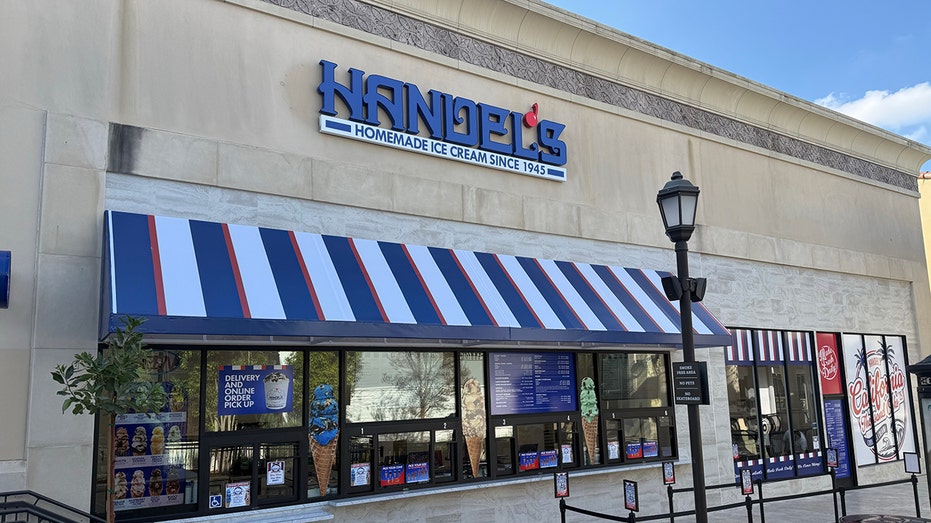
Handel’s Homemade Ice Cream store exterior

An exterior view of a Handel’s Homemade Ice Cream location. (Handel’s Homemade Ice Cream)

The company has grown to roughly 175 locations, with franchising remaining central to its strategy. Still, Schuler emphasized that Handel’s has a highly selective approach.

“We have a very high bar for the franchise partners that we bring in and talk a lot about the values of the business and the vision we have for the business,” she said.

Advertisement

Schuler also noted that there is still significant room for expansion.

“There are a lot of exciting times ahead for the brand and a lot of potential to grow because there is so much white space,” she said. “Yet, you have this proven history of the brand that just kind of keeps on chugging.”

MCDONALD’S EXPANDS INTO SPECIALTY DRINKS WITH ‘DIRTY SODAS,’ REFRESHERS PUSH

handels ice cream pints

Pints of Handel’s Homemade Ice Cream are shown in a variety of classic flavors. (Handel’s Homemade Ice Cream)

In a competitive dessert market, Handel’s is prioritizing consistency over trends.

Advertisement

“You’re not going to see us introduce, like, a fig and olive type of flavor. … I bet there are some brands out there that do it great — We’re not going to do that,” Schuler said. “…. We are going to do things that are very classic and deliver on those flavors very, very well.”

Schuler said her leadership approach was shaped in part by a year-long break after leaving Wetzel’s Pretzels, when she reflected on what she wanted in her next role.

Handel’s Homemade Ice Cream pints

Assorted flavors of Handel’s Homemade Ice Cream are displayed with toppings and serving utensils. (Handel’s Homemade Ice Cream)

“I wanted to be part of a brand that I thought could be special in a community — a gathering place in a world where there’s more disconnection,” she said.

That vision aligns with Handel’s identity, which Schuler believes sets it apart in the digital world.

Advertisement

CLICK HERE TO GET FOX BUSINESS ON THE GO

“Especially in times of uncertainty, when people are feeling uncertain about the stock market or global conflicts, we generally find that’s when the ice cream business is just as steady and strong as ever, because it’s the little pleasures in life that I think people seek out.”

Continue Reading

Business

Indian firms slip in global ranking; four move out of Top-500

Published

on

ET Search
LONDON: The upheaval in stock market has taken a toll on the global rankings of Indian companies, with 14 of them present in a new list of world’s 500 most valued firms together seeing an erosion of about $150 billion in their market value in the first three months of this year.

While 13 of the 14 present in the latest list have taken a dip in their rankings, four companies — Mukesh Ambani-led Reliance Petroleum, state-run Indian Oil Corp (IOC), realty major Unitech and housing loan giant HDFC — have completely moved out of the league.

The latest FT Global 500 list was published by the UK business daily Financial Times over this weekend, is based on the companies’ market capitalisation as on March 31, 2008. The previous rankings were based on December 2007-end figures.

Reliance Industries, flagship company of India’s biggest corporate house Mukesh Ambani group, is top ranked 80th in the latest list, topped by the US energy giant ExxonMobil.

Except for tobacco-to-consumer goods major ITC, ranked 484th, all other Indian companies have seen their rankings decline from the previous list.

Together, the market value of these 14 firms has dropped by about $ 150 billion since December last year and currently stands at about $ 440 billion.

Advertisement

There were 17 Indian companies in the previous list and had a total market capitalisation of about $ 590 billion.

In the country-wise ranking based on total market cap of all their companies present in the list, India has been placed 15th. The US is at the top with 169 companies worth a total $ 9.6 trillion, followed by UK, China, France and Japan.


Other countries ranked ahead of India include Germany, Canada, Switzerland, Russia, Spain, Brazil, Hong Kong, Italy and Australia.
In terms of the number of companies present in the list, India and Russia are jointly ranked ninth after the US (169), the UK (35), Japan (39), France (31), China (25), Canada (24) and Germany (22). Among the Indian firms, RIL is followed by two state-run firms ONGC and NTPC at 148th and 206th positions respectively.

While RIL has slipped 15 positions from its 65th rank in the previous list, ONGC and NTPC have also moved down from their 115th and 163rd ranks previously.

Other Indian firms include Sunil Mittal-led telecom giant Bharti Airtel at 218th (down from 193), realty major DLF at 329th (down from 195) and Anil Ambani-led Reliance Comm at 350th position (down from 252).

Advertisement

However, ITC climbed six spots to the 484th place, even as its market cap fell to $ 19.38 billion from $ 20.8 billion previously.

Realty major DLF saw the steepest market value fall of $ 40.66 billion, followed by the country’s biggest private sector lender ICICI Bank with a plunge of $ 38.51 billion and Steel Authority of India ($ 35.46 billion).

RIL, the country’s most valued firm, saw its market cap falling by about $ 21 billion, dipping from about $ 105 billion to $ 82 billion in the latest list.

In the global list, ExxonMobil has replaced China’s PetroChina at the top, while US industrial conglomerate GE has retained its third position. Other firms in the top 10 include Gazprom, China Mobile, Industrial and Commercial Bank of China, Microsoft, AT&T, Royal Dutch Shell and P&G.

Advertisement
Continue Reading

Business

Six Indian cos among BusinessWeek’s top 100 Infotech firms

Published

on

ET Search

NEW DELHI: Notwithstanding the turmoil in global economic environment, as many as six Indian firms, including Reliance Comm and Bharti Airtel, have been named among top 100 best-performing infotech companies in the world by a US magazine BusinessWeek.

The BusinessWeek’s latest annual list ‘The Infotech 100’, which ranks the firms on the basis of shareholder return, return on equity, total revenues and revenue growth, has ranked telecom major Bharti Airtel at the 21st position followed by Reddington India (55th) and RCom (66th).
The list is topped by US firms –Amazon.com and Apple– who have taken the top two spots this year. However, the magazine said in an accompanying report that “the dominance of US companies is in decline, the country has 33 companies among the IT 100 this year, down from 43 in 2007.”

Other Indian firms on the list, includes — Azim Premji-led Wipro at the 74th position, Satyam at 91 rank and HCL Technologies has been ranked at the 95th position among the list of 100 firms.


South African telecom firm MTN Group, which is in exclusive talks with Anil Ambani Group flagship firm Reliance Communications, has been ranked at the 12th position in the global list even ahead of global IT giants IBM and Microsoft, which are at 13th and 23rd ranks in the list, respectively.

Besides, the other fast emerging country China also has six companies among the top 100 Infotech companies in the world.
The magazine has compiled the information for the list by sorting through the financial results of 30,500 publicly traded companies and has ranked the technology players on four criteria –shareholder return, return on equity, total revenues and revenue growth.

The companies leading the list are those with the lowest aggregate ranking.

The companies which qualified had to have revenues of at least 300 million dollar then the collection of about 800 companies was divided into eight industry categories, such as software and semiconductors.
“Companies whose stock price has dropped more than 75 per cent, whose sales shrank, or where other developments raised questions about future performance were eliminated from contention.
“We also dropped some phone companies whose monopoly or near-monopoly power gives them an unfair advantage over competitors,” the magazine added.

Continue Reading

Business

Cloud Titans Battle 2026: Microsoft Azure vs AWS vs Google Cloud

Published

on

Anthropic says it will expand use of Google Cloud computing, which says it is constantly ramping up performance of the internet giant's custom-designed Tensor Processing Units that power artificial intelligence in data centers

NEW YORK — As artificial intelligence reshapes the global economy, the battle among cloud computing giants Microsoft, Amazon and Alphabet’s Google Cloud is intensifying, with investors scrambling to pick the best stock for 2026 gains amid surging demand for data centers, AI infrastructure and enterprise software.

Anthropic says it will expand use of Google Cloud computing, which says it is constantly ramping up performance of the internet giant's custom-designed Tensor Processing Units that power artificial intelligence in data centers
Google Cloud
AFP

Microsoft’s Azure platform has narrowed the gap on market leader Amazon Web Services, while Google Cloud continues posting the fastest percentage growth. Yet with all three companies pouring billions into AI-related capital expenditures and reporting earnings the week of April 29, analysts say the winner for shareholders may hinge on execution, valuation and long-term AI monetization rather than raw market share.

As of early 2026, AWS holds roughly 31 percent of the global cloud infrastructure market, followed by Azure at 24 percent and Google Cloud at about 12 percent, according to multiple industry trackers. The trio controls roughly two-thirds of the worldwide market. AWS remains the default choice for startups and cloud-native workloads with its vast service catalog exceeding 200 offerings.

Azure, however, is growing fastest in absolute revenue terms and has gained ground with enterprises already locked into Microsoft 365, Windows and Copilot tools. In its fiscal second quarter ending December 2025, Azure and other cloud services revenue rose 39 percent year-over-year, contributing to overall cloud revenue of $51.5 billion.

Google Cloud, the smallest of the three, delivered the most eye-popping growth, jumping 48 percent in the fourth quarter of 2025 to $17.7 billion — its fastest pace in four years — fueled by demand for Gemini AI models and Vertex AI platform. Traffic-share data from Cloudflare showed Azure posting a 58 percent year-over-year gain in Q1 2026, outpacing rivals.

Advertisement

The AI boom is driving unprecedented capital spending. Amazon guided for about $200 billion in capex for 2026, much of it for AI infrastructure. Alphabet plans roughly $175 billion, while Microsoft has accelerated spending to support OpenAI integration and its own Azure AI services.

Wall Street remains bullish across the board but sees nuances. Microsoft stock, trading near $424 in late April, carries the highest analyst price-target upside and buy ratings among the trio, according to TipRanks data. Its forward price-to-earnings multiple of roughly 31 reflects strong enterprise moat and recurring revenue from long-term contracts.

Amazon shares around $264 trade at a forward P/E near 28, offering relative value. AWS growth accelerated to 24 percent in the fourth quarter of 2025 — its fastest in 13 quarters — as CEO Andy Jassy highlighted AI-driven demand. The company’s retail business provides diversification but also compresses overall margins compared with pure-play software peers.

Alphabet’s Google Cloud, while smaller, has won praise for cost efficiency and AI leadership. GOOGL shares near $344 have rallied strongly but analysts project more modest upside relative to Microsoft. Google Cloud’s operating margins have turned profitable, and its backlog grew sharply.

Advertisement

Stock performance in 2026 so far has been mixed. Microsoft has lagged the broader market year-to-date amid concerns over heavy AI spending, while Amazon and Alphabet have held up better. Yet longer-term charts show all three have delivered triple-digit returns over five years as cloud adoption accelerated.

Investors weighing the options must consider different strengths. Microsoft excels in hybrid cloud and enterprise digital transformation, leveraging its productivity suite to bundle Azure services. The company’s remaining performance obligations — a proxy for future revenue — surged 110 percent to $625 billion.

Amazon dominates in scale and ecosystem breadth. AWS powers everything from Netflix to NASA and continues adding high-margin AI services such as Bedrock and Trainium chips. Jassy has emphasized that AWS added more absolute revenue in 2025 than either rival.

Google Cloud appeals to data-heavy and AI-first workloads with strengths in Kubernetes, BigQuery analytics and custom Tensor Processing Units. Multi-cloud strategies now dominate 89 percent of enterprises, giving all three room to grow even as they compete head-to-head.

Advertisement

Risks abound. Skyrocketing capex could pressure free-cash-flow margins if AI returns take longer than expected. Geopolitical tensions, energy constraints for data centers and potential regulatory scrutiny over market concentration add uncertainty. Interest-rate sensitivity also lingers, though most economists expect cuts later in 2026.

Analysts at firms such as J.P. Morgan have raised price targets on Amazon, projecting AWS growth in the high-20s percent range through 2026. Microsoft receives the most “buy” recommendations, reflecting confidence in its diversified cloud-plus-software model. Google’s cloud momentum is real but its overall business remains advertising-heavy.

For long-term investors, Microsoft often emerges as the consensus favorite for 2026. Its Azure growth, OpenAI partnership and massive installed base provide a flywheel effect that many believe will translate into superior earnings visibility and margin expansion. Yet Amazon’s valuation and AWS leadership make it attractive for those seeking growth at a discount, while Google offers pure-play AI upside at a smaller base.

The cloud market itself shows no signs of slowing. Worldwide infrastructure services revenue hit $119 billion in the fourth quarter of 2025, up 30 percent, and analysts forecast continued double-digit expansion through the decade as AI workloads explode.

Advertisement

Corporate boards continue shifting budgets toward cloud and AI, with hybrid and multi-cloud approaches the norm. Flexera’s 2026 State of the Cloud report highlighted spending tiers where Google often wins smaller deals while Azure and AWS capture enterprise-scale contracts.

Dividend-minded investors favor Microsoft, which yields about 0.8 percent. Amazon and Alphabet remain focused on reinvestment and buybacks rather than payouts. All three companies trade at premiums to the broader market, underscoring expectations for outsized growth.

Looking ahead, the April 29 earnings reports from all three will be closely watched for updated capex guidance, AI revenue disclosure and cloud growth trajectories. Early indications suggest another strong quarter driven by generative AI, but any softening in backlog or margin pressure could spark volatility.

Ultimately, the “best” stock depends on portfolio goals. Growth-oriented investors may tilt toward Google Cloud’s momentum. Value seekers could prefer Amazon’s blend of cloud leadership and e-commerce scale. But for balanced exposure to enterprise cloud dominance, AI tailwinds and reliable cash generation, many Wall Street pros continue pointing to Microsoft as the standout pick for 2026.

Advertisement

The cloud titans are not standing still. Each is racing to build the infrastructure backbone of the AI era, and shareholders who choose wisely stand to benefit as digital transformation accelerates worldwide. With the market still in early innings, the real competition — and opportunity — is only beginning.

Continue Reading

Business

TDVG ETF: Quietly Holding Up Amidst Market Chaos (NYSEARCA:TDVG)

Published

on

TDVG ETF: Quietly Holding Up Amidst Market Chaos (NYSEARCA:TDVG)

This article was written by

With over three years of finance and consulting experience, Nikola is laser focused on finding value in North American public equities and ETF’s. His professional experience includes corporate credit risk analysis, consulting for government entities, and venture capital analysis in the med-tech space. More recently, Nikola has helped investors narrow down better options for ETF’s – every asset manager seems to have similar offerings these days. Nikola is not a licensed financial advisor and nothing in his commentary here on Seeking Alpha should be regarded as advice. All of his opinions are his own, and not on behalf of any other entities.

Analyst’s Disclosure: I/we have no stock, option or similar derivative position in any of the companies mentioned, but may initiate a beneficial Long position through a purchase of the stock, or the purchase of call options or similar derivatives in TDVG over the next 72 hours. I wrote this article myself, and it expresses my own opinions. I am not receiving compensation for it (other than from Seeking Alpha). I have no business relationship with any company whose stock is mentioned in this article.

Seeking Alpha’s Disclosure: Past performance is no guarantee of future results. No recommendation or advice is being given as to whether any investment is suitable for a particular investor. Any views or opinions expressed above may not reflect those of Seeking Alpha as a whole. Seeking Alpha is not a licensed securities dealer, broker or US investment adviser or investment bank. Our analysts are third party authors that include both professional investors and individual investors who may not be licensed or certified by any institute or regulatory body.

Advertisement
Continue Reading

Business

France and Greece extend defense pact, expand strategic cooperation

Published

on


France and Greece extend defense pact, expand strategic cooperation

Continue Reading

Business

Wait for more signals before turning positive

Published

on

ET Search
At the recent low of 12514 points, the Sensex has tested the 12800-12000-pts support zone and has since then attempted a corrective rally. During the past trend phases in the Sensex, a monthly moving average convergence/divergence (MACD) cross-down below its trigger line, have, typically, led to a significant value erosion, with the corrective phase lasting, at least, for a year.
Therefore, immediate rallies would be interpreted as corrective in nature until the medium-term technical parameters turn positive. The recent upmove in the Sensex since the low of 12514 pts has been very sharp. The upside gap of July 23, 2008 had created a bullish ���Island Reversal Gap��� on the daily charts between 14510 pts and 14519 pts.

Normally, the implications of this on the medium-term outlook would be very positive, especially since the ���Island��� comprised of 22 trading sessions. When a stock indicates an uptrend, trades above the gap which occurs, then gaps back down and trades below the initial price, an island reversal has occurred.

However, the Sensex has since run into a strong resistance zone between 15026 pts and 15390 pts. The monthly mid-point of June 2008 is at 15026 pts. The 50% retracement level of the fall from the May 2008 peak (17735 pts) is at 15124 pts. The positive implications of the bullish ���Island Reversal Gap��� would thus get negated if the Sensex has a daily close below 14104 pts (the close on July 22, 2008). The Sensex is then expected to have an initial downside of 13513 pts, the 61.8% Fibonacci retracement level of the recent rise from 12514 pts to 15130 pts.

If the bearish ���Island reversal gap��� of 14484-14568 pts is immediately filled and the Sensex manages to decisively overhaul the resistances between 15130 pts and 15390 pts, the ongoing upmove would continue. The Sensex may then test higher levels between 16618 pts and 16860 pts.

The 78.6% Fibonacci retracement level of the fall from the May 2008 peak is at 16618 pts while 16860 pts is the 50% retracement level of the entire fall from the January 2008 peak. Hence, one would await further confirmation before turning positive on the medium-term outlook.
(The author is VP of technical research at Darashaw)

Advertisement
Add ET Logo as a Reliable and Trusted News Source


Continue Reading

Business

People on the move: North East appointments and promotions

Published

on

Business Live

Companies and organisations featuring in this week’s round-up include: Groundwork NE & Cumbria, Route, the Lighthouse Charity, Screen Alliance North, Burnetts Solicitors and Stelrad Group.

Alison Fellows has a career in law and economic regeneration.

Alison Fellows, the new chair of Groundwork NE & Cumbria’s Board of Trustees.(Image: Groundwork NE & Cumbria)

Community and Environmental Charity Groundwork NE & Cumbria has appointment Alison Fellows as its new chair of the board of trustees.

Ms Fellows joins the charity at a time when Groundwork says North East communities face economic uncertainty, persistent inequalities, climate and nature emergencies and sustained pressure on public services. She will help guide Groundwork through these challenges and support the charity’s mission to improve the lives and opportunities of people and communities across the region.

With a career in commercial law and economic regeneration in both the public and private sectors, Ms Fellows is entering what she calls her “third career”. She said: “I am excited to be joining Groundwork NE & Cumbria, a charity whose work I have admired for some time. I am keen to use my skills, experience and the contacts and connections I have made throughout my career to support the charity and deliver meaningful impact across the region.

“I am a proud Northerner, and it is very important for me to give back to the region and to improve life chances for people and strengthen the resilience of North East communities. Having worked in the region for over 30 years, I have seen the challenges many people, families, and communities face in both rural and industrial areas.”

Advertisement
Route is based in Newcastle.

Marketing agency Route has made internal promotions amid its 10th anniversary.(Image: Route)

Newcastle marketing agency Route has made two promotions in its 10th year.

Co-founder Ben Dascombe said: “We wouldn’t be able to attract and retain such high-profile clients without the strength of our team. That’s why building a culture where talented people can thrive has always been central to our growth.

“Recently, we’ve promoted long-standing team member Kane Elgey to account director, and Sophie Tuck to account manager in recognition of their personal and professional development, and the contribution they’ve made to the business. They form part of a skilled workforce, which really reflects the depth of capability we’ve developed over the past decade.”

Route says it has seen growth thanks to a new of new client wins including Merry Hill shopping centre, the Federation of Master Builders, and Tyneside Home Improvements. They join existing clients such as First Bus, The Royal Institute of British Architects (RIBA), Darlington Building Society and Environment Bank,

Advertisement
The Lighthouse Charity was formed in 1956.

Gary Brannighan and Sarah Sidey.(Image: The Lighthouse Charity)

Construction industry organisation the Lighthouse Charity has announced Gary Brannighan as a new committee member.

The business development manager at Hodgson Sayers joins a team of industry professionals at the charity, which offers 24/7 holistic support to the UK and Ireland construction community on all aspects of emotional, physical and financial wellbeing. This year it celebrates its 70th anniversary, with its name deriving from St Mary’s Lighthouse in Whitley Bay.

Mr Brannighan said, “Promoting wellbeing within construction is something I am deeply committed to. Ours is an industry that comes with unique pressures and its vital people can speak openly and access support without fear or stigma. At Hodgson Sayers, the health and wellbeing of our people is a priority and joining the Lighthouse Charity committee allows me to help amplify the message that no one in construction should face life’s challenges alone. I’m proud to support the charity’s work and play a role in helping it reach even more people.”

Sarah Sidey, regional chair of the Lighthouse Charity in the North East, said: “We are delighted to welcome Gary to the North East committee at such a significant time in the charity’s history. Since its beginnings here in the North East 70 years ago, it has ensured construction workers and their families have somewhere to turn to for support.”

Advertisement
Screen Alliance North is an industry skills cluster.

The first cohort of Screen Alliance North’s Sustainability Managers Training programme.(Image: Screen Alliance North)

Screen industry skills cluster Screen Alliance North has launched the first cohort of its Sustainability Managers Training programme – featuring two from the North East.

Julie Moran and Daniel Shepperson both represent the North East on the course which takes eight TV and film professionals from across the North of England to train them at head of department level for sustainable production roles.

Screen Alliance North is made up of Liverpool Film Office, North East Screen, Screen Manchester and Screen Yorkshire, is proud to launch the first cohort of their Sustainability Managers Training programme. And this is the first-ever training course built specifically on the newly created National Occupational Standards (NOS) for sustainability managers.

Sally Mills, course lead and sustainability programme director said: “This is the first course to align with the pioneering Sustainability National Occupational Standards, launched by ScreenSkills, the BFI and BAFTA albert, with the support of our TV and Film industry last year. It will ensure sustainability is a core, expertly-managed part of every production across the North.”

Advertisement
Burnett's is based in Newcastle.

From left: Mike Nicholls, Helen Hayward, Nick Gutteridge and Jennifer Bell.(Image: Burnetts Solicitors LLP)

Newcastle law firm Burnetts Solicitors LLP has appointed two new equity partners.

Corporate partner Jennifer Bell and co-head of Agri and Estates Mike Nicholls, have both joined the equity partnership. Ms Bell is a corporate lawyer advising private companies, owner‑managed businesses and management teams across a broad range of commercial and corporate matters. Mr Nicholls has extensive experience in private client and property law.

Ms Bell said: “Becoming an equity partner at Burnetts is something I’m extremely proud of. The firm places a real emphasis on teamwork and delivering practical, commercially focused advice, and I’m looking forward to working alongside colleagues to continue delivering the best outcomes for our clients.”

Mr Nicholls said: “I’m delighted to have been appointed as an equity partner at Burnetts and to be part of a firm with such a strong, values‑based culture. I look forward to contributing to the firm’s growth and continuing to provide high‑quality, trusted advice to our clients.”

Advertisement
Mr Coffey will success Bob Ellis as chair designate of Stelrad Group.

Martyn Coffey.(Image: Stelrad)

Radiator manufacturer Stelrad Group has announced Martyn Coffey as an independent non-executive director and chair designate.

He will succeed Bob Ellis as chair following the London Stock Exchange-listed firm’s annual general meeting on May 20. Mr Coffey has extensive board experience across the manufacturing, NVAC, building materials and construction industries.

He is currently a non-executive director at Taylor Wimpey plc and a non-executive director and chair of the Remuneration Committee at Luceco plc. His career has also included 11 years as CEO of Marshalls plc, a FTSE 250 company, and as CEO of Baxi Group, manufacturer of heating and hot water solutions.

Trevor Harvey, chief executive officer said: “I would like to thank Bob for his leadership during his tenure as chair. He has played a key role in Stelrad’s continued development. I look forward to working with Martyn as our new chair. He brings a valuable and complementary perspective from his executive and non-executive leadership roles, his experience in the UK listed company environment and his knowledge of the building products and HVAC industries.”

Advertisement
Continue Reading

Trending

Copyright © 2025