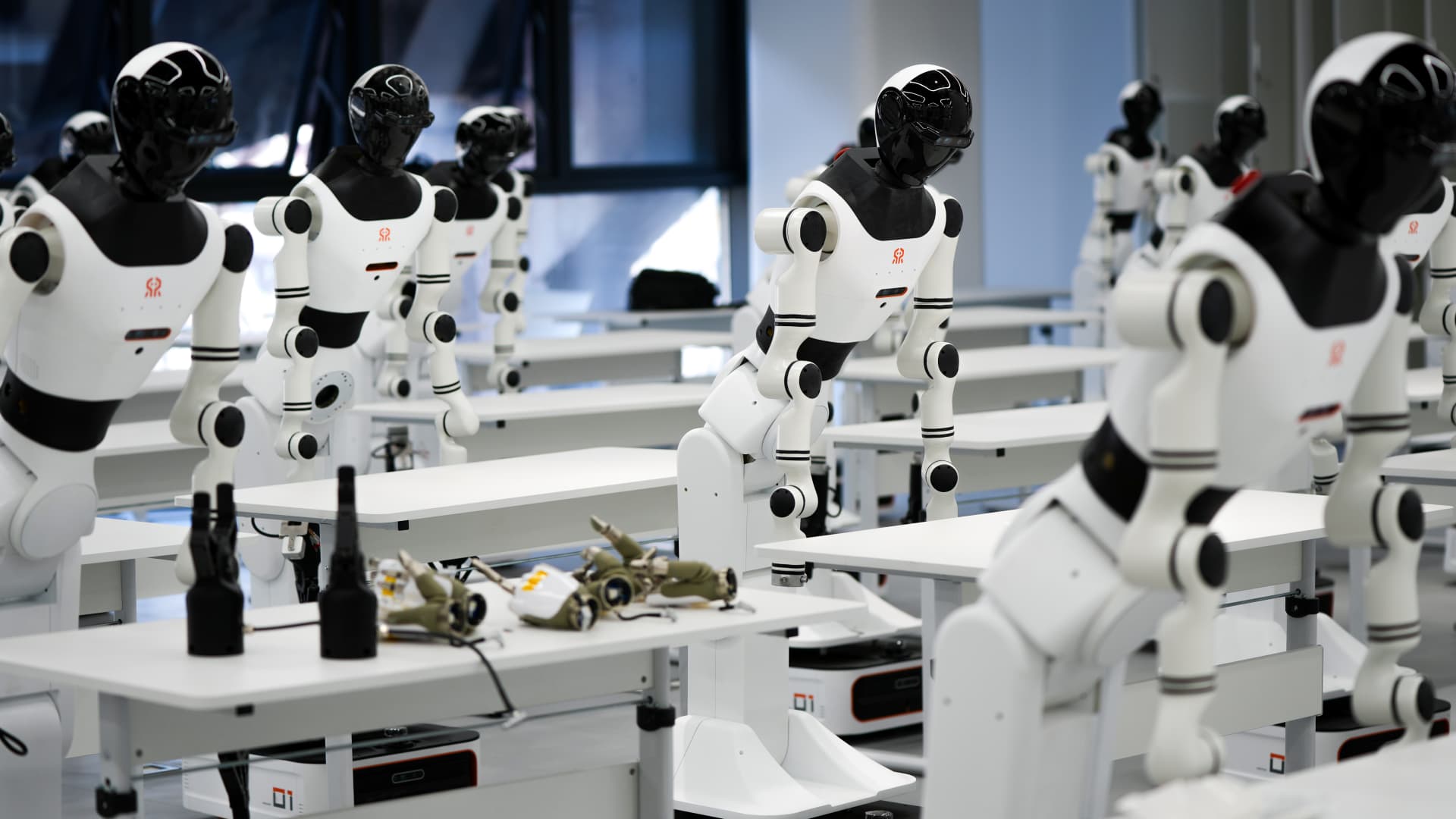
Humanoid industrial robot are on display at the humanoid robot data training center in Shougang Park on March 27, 2025 in Beijing, China.
VCG | China News Service | Getty Images
PARK CITY, Utah — Rivian Automotive CEO RJ Scaringe envisions a day in the not-so-distant future when the electric vehicle maker’s manufacturing employees will have a new type of colleague: humanoid robots.
Advertisement
“There’s going to be thousands of people that are collaborating alongside these robots. They’re going to be taking pictures, ‘Hey, check this out! My co-worker’s name is Phil, and he’s a robot,’” Scaringe said during a media event for the launch of the Rivian R2 EV.
The 43-year-old automotive enthusiast and tech entrepreneur started a robotics company last year called Mind Robotics. The company has raised more than $1 billion, according to Scaringe.
Humanoid robots are designed to be shaped and move like people. Artificial intelligence algorithms power their abilities along with complex hardware like semiconductors. Proponents say they could be used in various settings, from factories to hospitality and even in the home, while others have raised concerns about the devices replacing human jobs.
Scaringe said the company expects to reveal its first product in less than a year, with Rivian as a large minority shareholder and launch customer. Mind currently has roughly 20 open positions ranging from software and hardware engineers to data architects, according to its website.
Advertisement
Rivian CEO RJ Scaringe, who founded Mind Robotics late last year, speaks with media on June 3, 2026 during a launch event for the R2 electric SUV in Utah.
Michael Wayland / CNBC
Scaringe, who is executive chair and acting CEO of Mind, told CNBC that the plan is to keep the robotics company separate from Rivian, as opposed to the automaker partially shifting to make humanoid robots, like Tesla CEO Elon Musk is doing with his company.
“We have a deep relationship, and that was actually how we structured it,” Scaringe said during an interview. “A big part of structuring the business was to allow me to be able to spend time on both.”
Advertisement
The robotics strategy adds to a narrative of Scaringe doing things differently than Musk, despite obvious similarities in their companies. There have been enough comparisons that Rivian has even been called the “anti-Tesla” and Scaringe has been referred to as the “anti-Elon.”
“I’d say there’s a lot of alignment there, and I think that’s because, obviously, I’m biased, but I think they’re right … that autonomy is a super important technology,” Scaringe said about Tesla and Rivian. “But in terms of the products, they, in many ways, couldn’t be more different.”
So far Rivian and Mind are assisting each other, though, much like Musk’s companies have also done during developmental phases. That includes Musk’s xAI company merging with SpaceX before the company’s record-setting initial public offering on Friday as well as SpaceX purchasing vehicles from Tesla.
Scaringe said Rivian will be a “huge beneficiary” of Mind, which is using data from Rivian for training its AI models. Along with Rivian’s equity stake, the automaker will be Mind’s first customer for the robots.
Advertisement
“We realized it was such a big opportunity that deserved to be its own company,” said Scaringe. He said he believes there is a multitrillion-dollar total addressable market for industrial labor.
A Tesla Optimus robot hands out candy in front of the Nasdaq MarketSite in New York, US, on Monday, Oct. 27, 2025.
Michael Nagle | Bloomberg | Getty Images
Scaringe was visibly excited when speaking with media about the potential for AI and humanoid robotics, calling it “one of the most exciting times, perhaps in human history.”
Advertisement
“One hundred years from now, they’re going to be inheriting the work that we do over our lifetimes, and so I just think we’re so lucky that we get to be alive at the birth of AI,” Scaringe said.
Despite the optimism for humanoid robots, Scaringe said he expects the devices to work alongside humans rather than replace them completely for the foreseeable future, saying it takes a “long time” for vehicle assembly plants to become so-called “dark factories” which can be almost entirely run by robots.
“What I see happening is the simplest tasks will be taken on by robots. The more complex tasks that require higher levels of reasoning or more complex, more tactile levels of dexterity [will be done by humans],” he said.
Scaringe said manufacturers are dealing with an “extreme lack of labor,” from other automakers. Rivian currently has more than 30 open manufacturing and engineering jobs, according to the company’s website.
Advertisement
The need for such workers, as well as the rapid development of AI, Scaringe believes, will mean human employees will be working alongside a robot named “Phil” far sooner than they may expect.
“The rate at which this is moving is far faster than I’d say — like an order of magnitude faster — than the average person in society understands,” he said. “That’s going to be a particularly big challenge in the short-term to just have the average person … realize how fast the models are learning and how capable they are at doing almost everything.”
Hexcel Corporation (HXL) Q2 2026 Earnings Call July 30, 2026 9:30 AM EDT
Company Participants
Kurt Goddard – Vice President of Investor Relations Thomas Gentile – CEO, President & Chairman James Coogan – Executive VP & CFO
Advertisement
Conference Call Participants
Gavin Parsons – UBS Investment Bank, Research Division Kenneth Herbert – RBC Capital Markets, Research Division Sheila Kahyaoglu – Jefferies LLC, Research Division Joshua Korn – Wells Fargo Securities, LLC, Research Division Richard Safran – Seaport Research Partners Myles Walton – Wolfe Research, LLC Scott Mikus – Melius Research LLC Kristine Liwag – Morgan Stanley, Research Division Mariana Perez Mora – BofA Securities, Research Division Anton Rinnert – TD Cowen, Research Division
Presentation
Advertisement
Operator
Thank you for standing by, and welcome to Hexcel’s Second Quarter 2026 Earnings Call. [Operator Instructions] I would now like to turn the call over to Kurt Goddard, Vice President, Investor Relations. Sir, please go ahead.
Kurt Goddard Vice President of Investor Relations
Advertisement
Hello, everyone. Welcome to Hexcel Corporation’s Second Quarter Earnings Conference Call. Before beginning, let me cover the formality. I would like to remind everyone about the safe harbor provisions related to any forward-looking statements we may make during the course of this call. Certain statements contained in this call may constitute forward-looking statements within the meaning of the Private Securities Litigation Reform Act of 1995. They involve estimates, assumptions, judgments and uncertainties caused by a variety of factors that could cause future results or outcomes to differ materially from our forward-looking statements today.
Such factors are detailed in the company’s SEC filings and earnings release. A replay of this call will be available on the Investor Relations page of our website.
Lastly, this call is being recorded by Hexcel Corporation and is copyrighted material. It cannot be recorded or rebroadcast without our express permission. Your participation on this call constitutes your consent to that request.
HermesRMS 2.78%increase; up pointing triangle shares dropped despite the luxury group booking an acceleration in sales, with some analysts pointing to a lack of a convincing rebound in the key Chinese market.
The Parisian fashion house, maker of the famed Birkin bag, made revenue of 4.09 billion euros ($4.66 billion) over the quarter through June. That marks an organic increase of 6.7% from the same period a year earlier. For the first quarter, the group booked a 5.6% rise in revenue.
The euphoria for this technology has boosted the value of some world’s biggest companies even as they spend hundreds of billions of dollars on the building blocks of the technology.
But over the last few weeks, the value of some of the companies that make those building blocks has plummeted – prompting some to question whether what some have dubbed “the AI bubble” is about to burst.
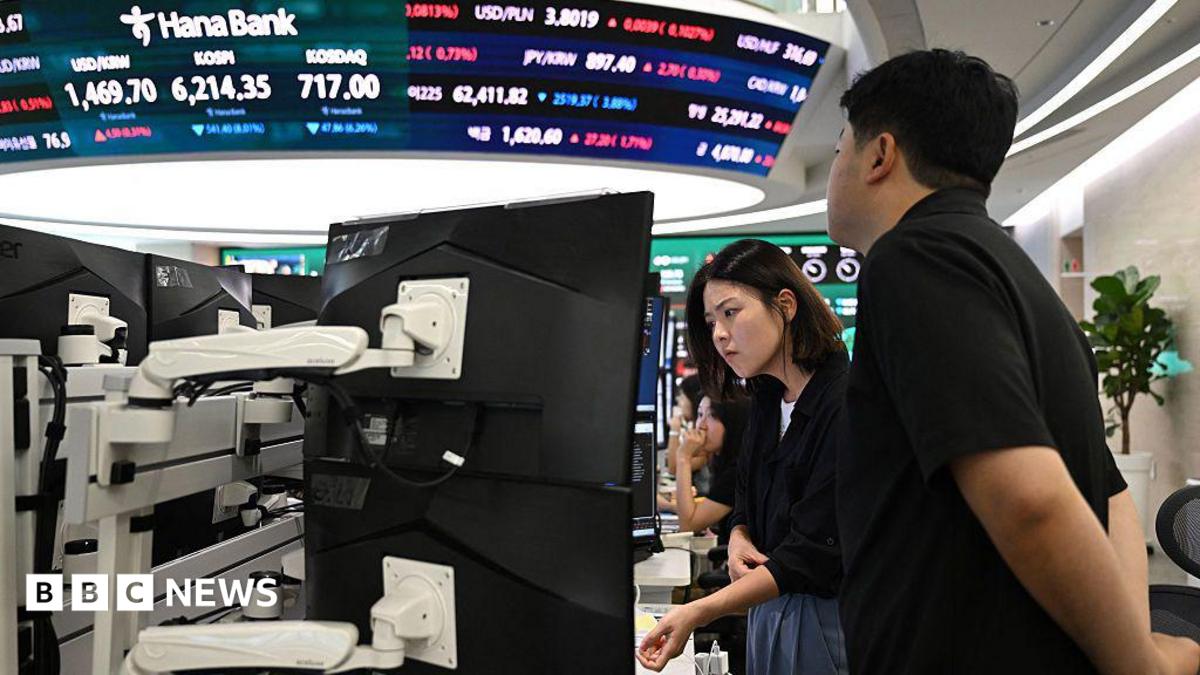
Some of the sharpest falls have been in Asia, with shares in Korean chip makers such as SK Hynix and Samsung down 46% and 35% respectively over the last month as investors worry the recent boom in demand for the chips that power AI is unsustainable.
Yet these shares still are up threefold and fivefold respectively over the last year, leading many to conclude that some caution and profit taking after such massive gains was inevitable – and indeed healthy.
Advertisement
The South Korean stock market is notoriously volatile, but concerns have spilled over into the big US companies.
Shares in Google and Tesla plunged briefly before recovering last week after both firms pledged to spend billions more on AI in the months and years to come despite so far it losing them money.
And with other big names such as Meta, Microsoft and Amazon reporting their latest financial results this week, investors have the opportunity to scrutinise just how much these companies are now betting on AI.
On Wednesday, the tech-heavy Nasdaq ended the trading day about 9% below its June record high, driven down in part by worries over heavy AI spending.
Advertisement
“There is still a healthy degree of scepticism about the ability of these investments to generate a commensurate level of return,” Russ Mould, an investment director at AJ Bell, said.
But according to leading tech investor Eileen Burbidge despite the concerns there’s not yet a serious reckoning.
“The AI bubble hasn’t burst but it’s letting out air,” she told the BBC.
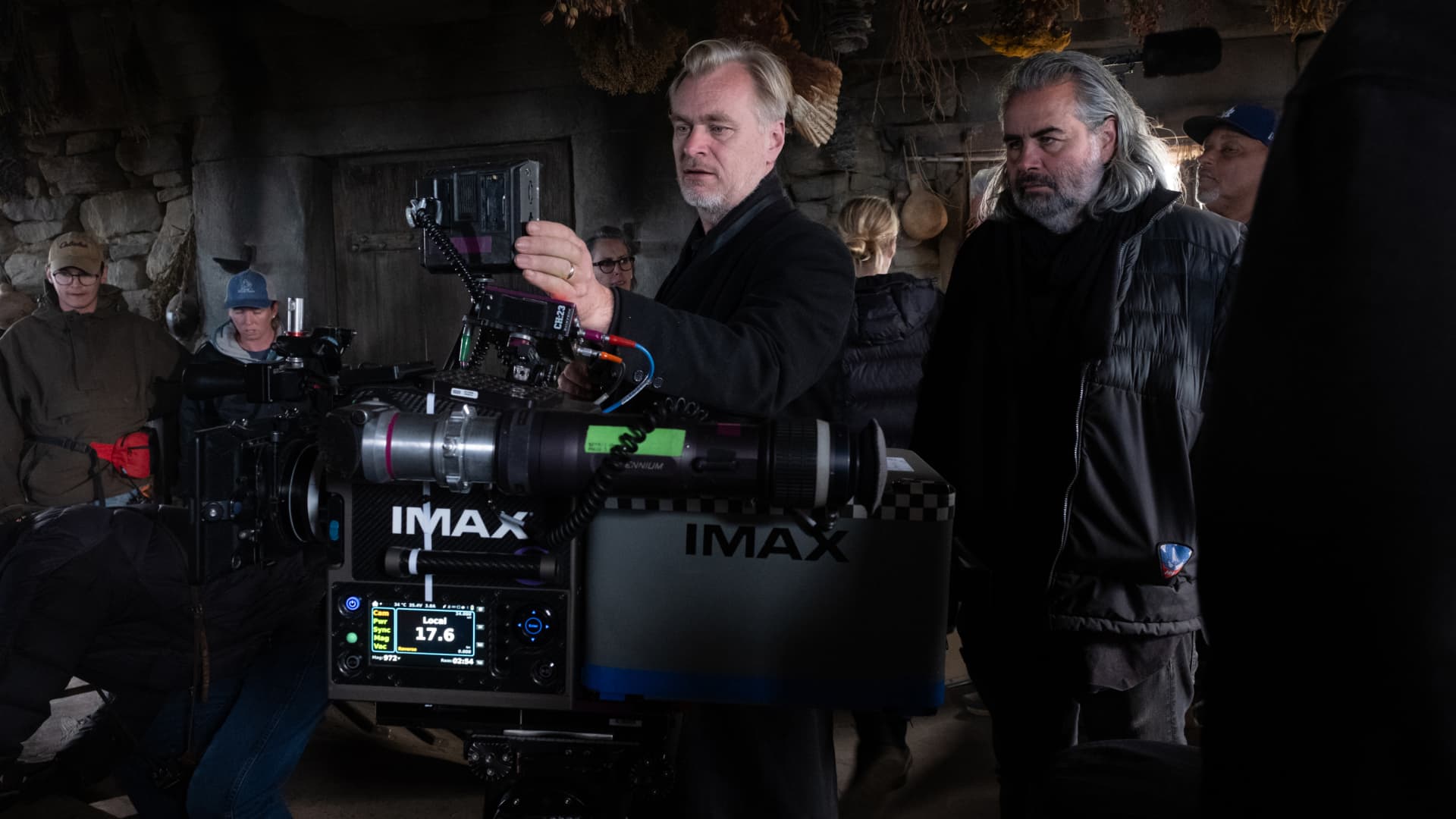
L to R: Director Christopher Nolan with Cinematographer Hoyte van Hoytema, ASC on set of his film THE ODYSSEY, written, produced, and directed by Christopher Nolan.
Courtesy: Melinda Sue Gordon | Universal Studios
“The Odyssey” continues.
Advertisement
Universal and IMAX have extended the availability of 70mm screenings of Christopher Nolan’s retelling of Homer’s epic into mid-September, but that might not be enough to meet demand.
Tickets are selling out as quickly as they are being released to the public as moviegoers seek to see Nolan’s film in the aspect ratio that it was shot in and on physical film. While IMAX offers a variety of screen options, including digital versions of the 70mm aspect ratio, these viewings are often cropped to fit the auditorium in which they are being shown.
There are only 25 screens in the U.S. that can play physical film reels of Nolan’s “The Odyssey” and only 41 locations in total globally. Those screens are limited because the majority of movies are filmed and screened digitally. As demand for “The Odyssey” soars, IMAX has introduced late night and early morning screenings to accommodate some of the demand.
As of the weekend, IMAX ticket sales for “The Odyssey” have surpassed $140 million worldwide. That’s a little more than 20% of the $652 million the film has tallied globally. Yet, the IMAX locations represent less than 1% of total screens.
Overall, “The Odyssey” has dominated at the box office, with second week ticket sales dropping just 27% from its domestic opening weekend. Typically, Hollywood blockbusters will see ticket sales fall between 50% and 70% each week after its debut. A smaller decline often indicates strong word of mouth and repeat viewings.
“The Odyssey” has also benefitted from audiences booking tickets in advance. Some screenings of the film became available for purchase in July 2025, a year before its release.
For the last three weeks, “The Odyssey” has run in theaters with relatively low competition. However, with Sony and Marvel’s “Spider-Man: Brand New Day” arriving this Friday as well as the filmed-for-IMAX features “The End of Oak Street” and “Resident Evil” on the horizon, “The Odyssey” will have to share screen time with others.
Advertisement
However, IMAX’s next 70mm commitment isn’t until Dec. 18, when Warner Bros. and Denis Villeneuve’s “Dune: Part Three” hits theaters.
A panel discusses the weeks market selloff, driven by inflation fears, rising oil prices and disappointing Big Tech earnings on Barrons Roundtable.
The Federal Reserve’s preferred inflation gauge fell in June, as the pace of price growth pulled back amid volatility in energy markets.
The Commerce Department on Thursday reported that the personal consumption expenditures (PCE) index declined 0.1% on a monthly basis in June and was up 3.7% from a year ago. Both figures were in line with the expectations of economists polled by LSEG.
Advertisement
Core PCE, which excludes volatile measurements of food and energy prices, was up 0.1% on a monthly basis and 3.3% from a year ago. The monthly figure was cooler than the 0.2% predicted by the LSEG poll of economists, while the annual figure was in line with expectations.
Federal Reserve policymakers are focused on the PCE headline figure as they try to bring inflation back to their long-run target of 2%, though they view core data as a better indicator of inflation. Compared with May’s readings, headline PCE declined from 4.1% to 3.7%, while core PCE fell from 3.4% to 3.3%.
Goods prices were up 3% in June compared with one year ago, while they were up 0.7% from the prior month.
Advertisement
Services prices rose 2.3% from a year ago, while they rose 0.3% on a monthly basis.
PCE inflation eased but remained elevated in June. (Will Newton/Getty Images)
The personal savings rate as a percentage of disposable personal income was 2.7% in June, down slightly from 2.8% in May.
Since the start of 2025, the personal savings rate has declined from a peak of 5.5% in April 2025, and it began this year at 4.4%.
Advertisement
What experts are saying
Bret Kenwell, U.S. investment analyst at etoro, noted that “June’s in-line PCE report did not show the same cooling reflected in the CPI report earlier this month.”
“Still, investors may be inclined to look past it. The data predates July’s sharp rebound in energy prices, which could put renewed upward pressure on inflation throughout the summer,” Kenwell explained. “As long as tensions continue driving oil prices higher, consumers could face additional pressure at the pump while markets contend with a more complicated inflation outlook.”
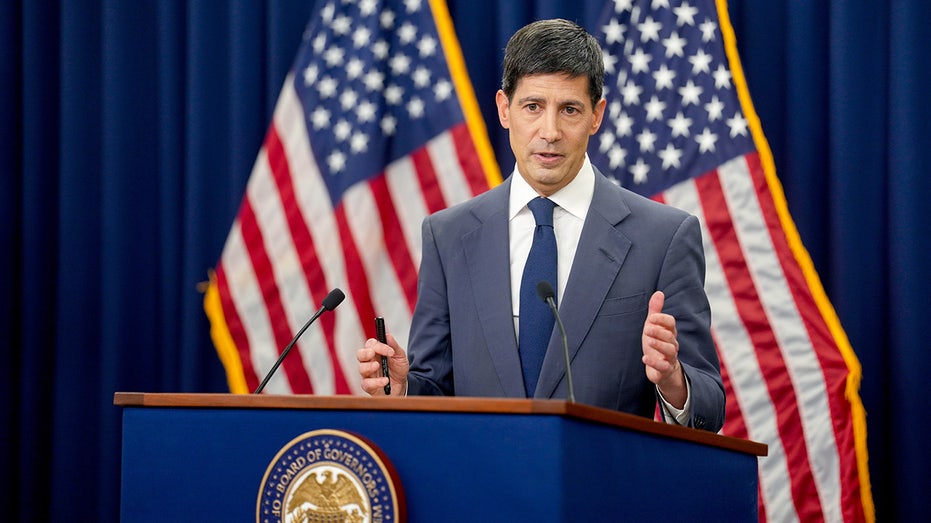
Federal Reserve Chair Kevin Warsh and the FOMC left interest rates unchanged on Wednesday. (Al Drago/Bloomberg via Getty Images)
Ellen Zentner, chief economic strategist for Morgan Stanley Wealth Management, said that, “Despite moderating inflation, strong domestic activity across consumption and business investment will keep the Fed diligent about the risks overheating could have on the inflation trajectory.”
Advertisement
“We continue to expect the Fed to be patient as it waits for more inflation data,” Zentner added.
DOHA, Qatar-Saudi Basic Industries Corp. reported a narrower second-quarter loss helped by higher average selling prices across key products, but revenue declined on lower sales volumes.
Sabic, which ranks among the world’s largest petrochemicals manufacturers, said its net loss narrowed to 833 million Saudi riyals ($222 million) from 4.07 billion riyals in the same period a year earlier. Revenue fell to 24.81 billion riyals from 30.23 billion riyals.
Rep. Jim Jordan, R-Ohio, discusses the House voting on reconciliation framework and the urgent need for voter ID.
FIRST ON FOX: The Trump administration is sending notices of intent to 100 agents affiliated with the Obamacare marketplace who allegedly violated the exchange’s standards of conduct by submitting insurance applications without recipients’ Social Security numbers or other identifying information.
The Centers for Medicare & Medicaid Services (CMS), led by Dr. Mehmet Oz, alleged that agents did this “repeatedly.”
Advertisement
A marketplace agent is a professional who helps people shop for healthcare through the Affordable Care Act (ACA) exchange.
More broadly, CMS estimates that “roughly 35% of Marketplace enrollments may be illegitimate.”
Administrator of the U.S. Centers for Medicare and Medicaid Services Dr. Mehmet Oz speaks about the Trump administration’s anti-fraud initiatives on July 8, 2026. (Mark Schiefelbein-Pool/Getty Images / Getty Images)
If 35% of enrollments by agents are illegitimate, that represents about 5 to 6 million people “whose premiums could be improperly subsidized,” CMS said in a statement to Fox News Digital.
Advertisement
The action being taken against the 100 agents comes after a report published by the Health and Human Services Department found that “2.6 million improper or phantom enrollments remain, including more than 1 million enrollments submitted without a Social Security number.”
In response, the CMS has advanced a number of ACA reforms meant to protect taxpayers and patients from alleged fraud, waste and abuse.
The proposed reforms, the CMS said, would have saved $3 billion. The agency accused Democrats in Congress of preventing the full implementation of these provisions.
Vice President JD Vance speaks during a Congressional Tribute to the late Sen. Lindsey Graham, R-S.C., in the Rotunda of the U.S. Capitol on July 28, 2026. (im Lo Scalzo-Pool/Getty Images / Getty Images)
The CMS’s latest action against ACA agents is another step in the agency’s crackdown on fraud.
Oz sent letters in May to Minnesota, California, Florida, New York and Maine about possible medical equipment fraud.
An anti-fraud task force, led by Vice President JD Vance, announced in February that durable medical equipment, prosthetics, orthotics and supplies (DMEPOS) suppliers will be targeted through a nationwide moratorium.
That task force revealed new figures in early July that show a drastic 7,100% spike in Medicare claims for skin substitutes in just six years.
Advertisement
Still photo of a manual handbook for the Patient Protection and Affordable Care Act. (Yin Yang / Getty Images)
The staggering increase in claims occurred between 2019 and 2025, surging from $200 million to $14.4 billion, prompting the anti-fraud task force and CMS to identify potentially fraudulent claims and deny 96% of claims made since March.
The CMS identified 4,200 suspicious claims for skin substitutes, known as allografts, totaling $224 million in charges through May of this year.
ASM InternationalASM 9.53%increase; up pointing triangle shares plunged after a boost to revenue guidance for next year came short of rosy forecasts, as investor expectations for companies exposed to artificial intelligence keep growing.
The Dutch group, which supplies chip makers with wafer processing equipment for the deposition of thin films, in September set a 2027 revenue target between 3.7 billion and 4.6 billion euros, equivalent to $4.21 billion to $5.24 billion.
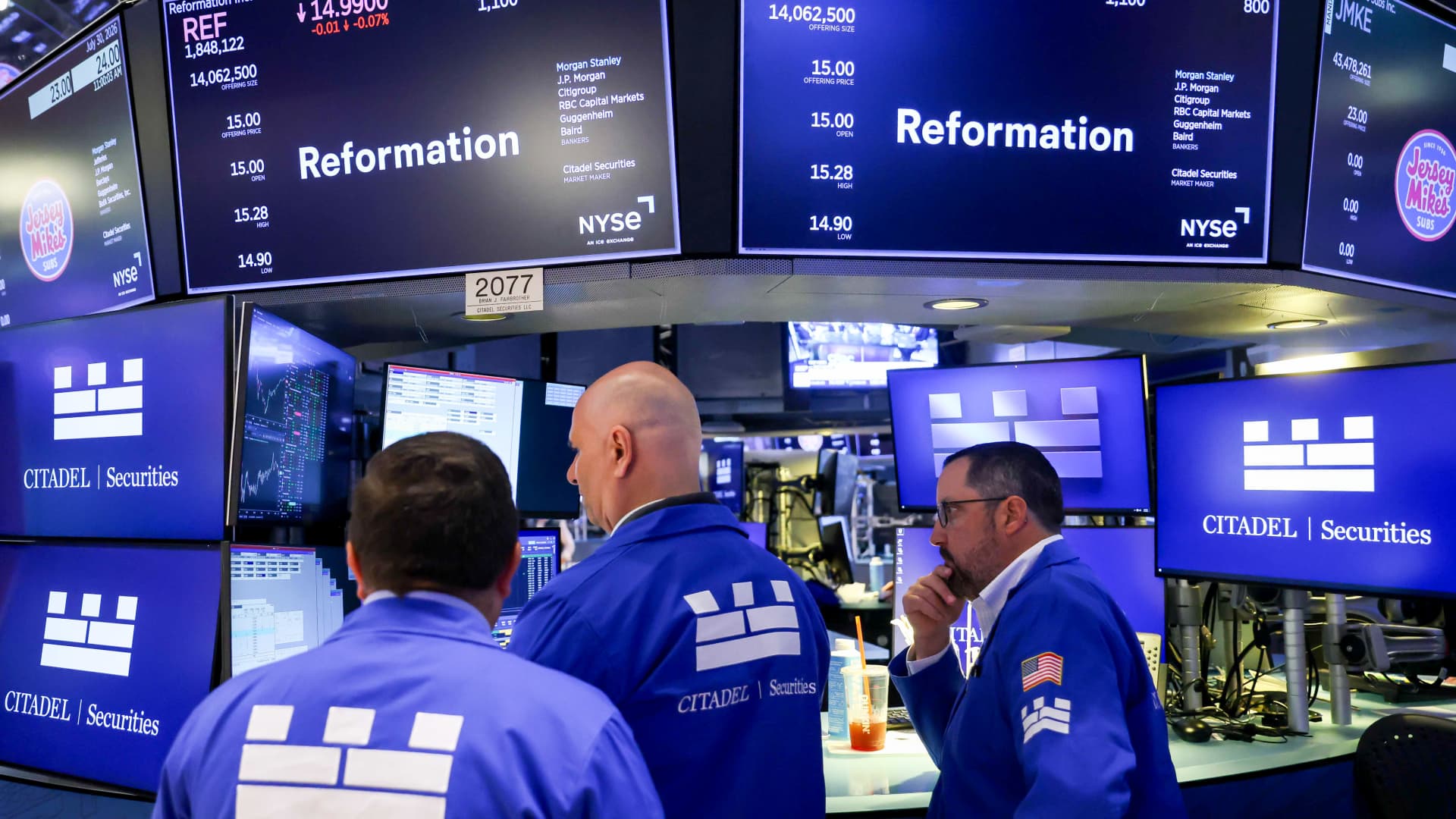
Reformation Inc. signage as traders work during the company’s initial public offering (IPO) on the floor of the New York Stock Exchange (NYSE) in New York, US, on Thursday, July 30, 2026.
Michael Nagle | Bloomberg | Getty Images
Women’s clothing retailer Reformation began trading on the New York Stock Exchange on Thursday, with the stock essentially unchanged after pricing its IPO at $15.
Advertisement
The company, which is trading under the ticker symbol “REF,” is offering 14,062,500 shares, putting its IPO raise at $210.9 million.
“Reformation is ready, and that is really the driving reason we’ve spent a lot of time working to build a business that redefines retail, really innovates on what the role of a brand is in the fashion space, and we’ve done a great job at that,” CEO Hali Borenstein told CNBC on Thursday. “Today, we have a foundation that is ready to scale.”
It joins just a handful of consumer and retail companies that have gone public this year amid a slump in IPOs since the 2021 boom. Reformation went public the same day as sandwich chain Jersey Mike’s, which also listed on the NYSE.
According to its S-1 fact sheet, Reformation has seen 20 consecutive quarters of double-digit net revenue growth through the first quarter of 2026. Its net revenue for the full year 2025 came in at $507.1 million, and net income was $12.6 million, including the impact of President Donald Trump‘s tariffs.
Advertisement
As of the first quarter of 2026, the company owns 70 stores across the U.S., UK, Canada and France.
“We believe we will continue to benefit from operating within the highly fragmented fashion industry, and that we are well positioned to capitalize on growing global demand for sustainable fashion,” the company wrote in its S-1 filing.
Borenstein said Reformation’s focus in its next phase of growth is to increase its distribution with more stores, accelerate its e-commerce business, invest in category diversification and expand overseas.
She added that the retailer is seeing “really strong double-digit growth” across the U.S., with 70% of its revenue coming from outside of New York and California.
Advertisement
Reformation also said it saw more than 1 million active customers across its direct-to-consumer channel in 2025. The majority of its customers, 70%, are aged between 25 and 50 years old.
Borenstein told CNBC’s “Morning Call” that the company’s customer base is diverse, with 20% of new customers last year under the age of 25 and 20% over the age of 50.
She added that the company’s average consumer makes over $100,000 in a year, making it more insulated from macroeconomic pressures hitting other retailers.
Despite tariff and trade uncertainty, Borenstein told CNBC the company has a “good track record” of navigating the macro backdrop, with 34% of its units last year coming from North America.
“We are really focused on two things: our brand and our product. We think those are the winning recipes for consumers, so Reformation has a brand that cuts through,” Borenstein said.
As the company embarks on its public journey, Borenstein said she’ll define success as the way that Reformation makes its customers feel.
“Today is the first day,” she said. “It’s a long journey ahead, and at Reformation, we have very big goals. We’re ambitious, and so where we are really focused is on building a once-in-a-generation type brand.”
























































You must be logged in to post a comment Login