
Business
Ross Gerber Wants Elon Musk To Build A Starlink AI Phone That Has No Apps At All, Investor Says Today


Investor Ross Gerber is pitching Elon Musk on a new kind of smartphone: one built around Starlink’s satellite network, powered by artificial intelligence, and stripped of the app-based interface that has defined mobile devices for nearly two decades.
Gerber, the chief executive of Gerber Kawasaki Wealth and Investment Management and a longtime commentator on Musk’s companies, laid out the concept in a series of posts on the social platform X over the weekend. He described envisioning a Starlink-powered phone with roughly three days of battery life that would abandon traditional app icons entirely in favor of a single, instruction-driven interface. According to Gerber, the device would simply do what it’s told, functioning less like a conventional smartphone and more like a direct extension of an AI assistant.
The idea emerged partly as a response to a competing device concept from OpenAI. Gerber criticized reports of a smart speaker under development at the Sam Altman-led company, calling the move an “obvious miss” and arguing that a phone-based approach, rather than a stationary speaker, made more sense as a vehicle for consumer AI. Details of OpenAI’s hardware plans have circulated for months amid broader industry speculation about a wave of new AI-native devices, including wearables and other non-traditional form factors, following high-profile hires and partnerships in the space.
In his vision for the Starlink phone, Gerber said the device would be able to connect to the internet anywhere in the world by relying on SpaceX’s satellite network rather than traditional cellular infrastructure, and that it would come with a fixed-rate cost structure rather than the tiered data plans typically offered by wireless carriers. The pitch drew on Starlink’s existing reputation for providing connectivity in remote or underserved areas, a capability SpaceX has marketed heavily since the satellite internet service’s public launch.
The concept gained additional traction in the replies to Gerber’s posts, where another user directly suggested that Musk build a Starlink-branded smartphone, adding that they would switch away from their current wireless carrier if such a device became available. Gerber endorsed the idea in his response, saying, “Many would buy one just as a back up… I have two starlink systems.” His reply pointed to Starlink hardware’s existing appeal among a subset of consumers already using the satellite service as a backup or supplemental connection alongside traditional broadband or cellular service.
Neither Musk nor SpaceX has publicly responded to Gerber’s proposal, and there has been no indication that a Starlink-branded phone is currently in development. Musk has, however, spoken recently about expanding Starlink’s role in connected devices more broadly. The billionaire recently discussed plans to eventually equip what he described as billions of vehicles with Starlink connectivity, following the appearance of a Tesla robotaxi, sometimes referred to as a cybercab, spotted testing in Dallas equipped with a Starlink dish. Musk has framed satellite-based connectivity as one of the only practical ways to deliver high-bandwidth internet access to a global fleet of connected vehicles, given the limitations of relying solely on terrestrial cellular networks.
Gerber’s proposal comes at a notable moment for SpaceX, whose stock traded higher in premarket activity Monday. Shares climbed more than 3% to above $137, pushing the stock back above its initial public offering price of $135 per share after a stretch of declines in recent weeks. SpaceX had fallen sharply from its post-IPO high in the weeks following its public listing, a decline that drew commentary from other market watchers questioning whether the stock’s valuation had run ahead of the company’s near-term fundamentals. Despite Monday’s rebound, ranking data tracked by Benzinga has continued to show an unfavorable price trend for the stock across short, medium and long-term measures.
The idea of a satellite-connected, AI-driven phone touches on several trends converging across the technology industry in 2026, as major players race to define what a truly AI-native device might look like. Apple, Google and a range of startups have all faced questions in recent months about how artificial intelligence assistants might eventually reshape or replace the app-centric interface that has defined smartphones since the iPhone’s debut in 2007. OpenAI’s reported hardware ambitions, along with device concepts from other AI labs, reflect a broader industry bet that voice- and instruction-based interaction could eventually reduce reliance on the grid-of-apps format that has dominated mobile computing for nearly two decades.
For SpaceX and Starlink specifically, a phone concept would represent a significant expansion beyond the company’s current hardware lineup, which has centered on satellite dishes and routers designed for home, business and vehicle connectivity rather than handheld consumer devices. Musk has previously discussed direct-to-cell satellite technology enabling standard smartphones to connect to Starlink’s network without specialized hardware, a service SpaceX has been rolling out in partnership with wireless carriers including T-Mobile in the United States. A dedicated Starlink-branded phone, as described in Gerber’s posts, would go further by building satellite connectivity directly into a standalone device rather than layering it onto existing carrier networks.
Whether Musk or SpaceX ultimately act on Gerber’s suggestion remains unclear, and no formal announcement or roadmap for such a device has been made public. For now, the proposal remains a piece of investor commentary rather than a confirmed product in development, though it adds to a growing public conversation about what shape the next generation of AI-driven consumer hardware might take.


Automobiles
Hits: Maruti Suzuki’s market share increased by 230 basis points year-on-year to 41.2%, aided by a double digit increase in volumes of mall cars and SUVs amid GST rationalisation. Bajaj Auto reported record export volume of 7.3 lakh units, up 54% YoY.
Misses: Higher input costs put pressure on sector’s aggregate margin, which shrank by 210 basis points to 14.4%. Mahindra and Mahindra’s operating margin before depreciation and amortization (Ebitda margin) contracted by 210 basis points to 12.2%.
Outlook: Adverse commodity prices, rising competition and likely slack in rural demand in the case of a deficient monsoon are major risks for the sector in the short term. Companies with new product launches in the pipeline stand to gain volume share.

Revenue change (YoY): 31.6%
Net profit change (YoY): 5.9%Banking
Hits: Asset quality continued to improve. State bank of India reported its lowest gross nonperforming asset (GNPA) ratio of 1.5% in any of the quarters in over two decades and a record quarterly net profit of ₹21,121.2 crore. The retail, agriculture and micro, small and medium enterprises (MSME) portfolio of banks continued to show double digit YoY growth.
Misses: Profitability remained under pressure for most banks as net interest margins (NIM) either contracted or remained flat sequentially and year-on-year.
Outlook: Credit growth is likely to moderate in the coming quarters on a higher base in the previous year and sustained geopolitical uncertainties. On the liabilities front, attracting deposits may remain competitive for most banks thereby limiting improvement in NIMs.
Revenue change (YoY): 7.0%
Net profit change (YoY):25.1%
Read more: Indian equities could hit new highs next year: Aditya Birla MF
Cement
Hits: Cement prices firmed up 3% sequentially in the June quarter. Ultratech Cement delivered its strongest-ever first quarter in terms of volume, revenue, Ebitda and profit. Cement makers protected profitability through cost optimisation amid rising transportation and packaging costs.
Misses: Barring Ultratech and Shree Cement, which reported double-digit revenue growth, other top companies including Ambuja Cements and ACC posted around 8% drop in their respective top lines amid lower volume.
Outlook: The September quarter will likely show muted volume growth given slower construction activities due to rainy season. Given the continued input cost inflation, companies will be prompted to rely more on cost control to protect margins.
Revenue change (YoY): 7.6%
Net profit change (YoY): -5.3%
CONSUMER
Hits: Volume recovery was a major theme in the June quarter with companies reporting growth across categories. HUL reported 13-quarter strong underlying sales growth driven by 5% volume growth. Nestle reported 24.2% Ebitda margin, the highest June quarter margin in at least four years. Quick commerce remained a major area of
expansion.
Misses: Higher transportation and packaging costs dented profitability on a sequential basis.
Outlook: Input cost inflation in categories including edible oil, dairy products, sugar and cocoa is expected to affect profitability. It may prompt companies to undertake another round of price increases across products to defend margins.
Revenue change (YoY): 9.5%
Net profit change (YoY): 0.8%
IT
Hits: Order bookings remained buoyant during the June quarter despite delays in decision making by clients. Tech Mahindra reported 2.2% sequential growth in dollar denominated revenue, the strongest among top IT companies.
Misses: HCL Technologies and Wipro reported sequential squeeze in dollar revenue amid delays in project ramp ups.
Outlook: Process efficiency through artificial intelligence (AI) related routes is expected to compress the revenue growth rates of IT exporters in the medium term. Adoption of AI tools and methods through collaborations will be crucial for Indian IT companies to stay relevant.
Revenue change (YoY):15.9%
Net change (YoY):11.9%
OIL AND GAS
Hits: Oil producers reported strong numbers helped by higher crude oil prices. ONGC and Oil India reported multi-fold jump in their respective standalone net profits. Oil marketing companies (OMC) reported strong demand. Indian Oil posted record quarterly revenue of Rs 2.8 lakh crore.
Misses: Under-recoveries for OMCs shot up in the June quarter denting profitability. Staterun OMCs reported net losses for the quarter.
Outlook: A higher volatility in crude oil prices reduces revenue and profit visibility for the sector. At the prevalent crude oil prices, upstream companies would be able to sustain their profits and profitability. Lack of meaningful increase in product prices will affect performance of OMCs.
Revenue change (YoY): 32.6%
Net profit change (YoY):
-57.2%
PHARMA
Hits: Domestic and specialty sales remained buoyant. Sun pharma’s domestic sales grew 16% YoY, faster than the overall revenue growth of 10%.
Misses: Ebitda margin of Dr Reddy’s contracted sharply to 10.6% from 25.3% a year ago following price erosion in the US generics market. Cipla’s margin fell by around 900 basis points to 16.7% due to cost inflation, inventory write-offs and investments in product development.
Outlook: Specialty and innovative products are emerging as major growth drivers amid slowing sales of generics in the US market. Segments including peptides and respiratory drugs are likely to generate growth traction.
Revenue change (YoY): 15.8%
Net change (YoY):15.9%

Operator
Good evening, and welcome to NIQ’s Second Quarter 2026 Earnings Conference Call. [Operator Instructions] With that, I’d like to turn the call over to Will Lyons, Head of Investor Relations. Please go ahead.
William Lyons
Senior VP & Head of Investor Relations
Thank you. Hello, everyone, and welcome to NIQ’s Second Quarter 2026 Earnings Call. Joining me today are CEO, Jim Peck; and CFO, Mike Burwell. Following Jim’s and Mike’s prepared remarks, we’ll open the line for Q&A with Jim, Mike and our Chief AI and Product Officer, Troy Treangen.
As a reminder, today’s remarks will include forward-looking statements regarding our expectations and outlook. Actual results may differ materially from those expressed or implied in these statements.
For information about factors that could cause actual results to differ materially, please refer to today’s earnings press release and our SEC filings. We undertake no obligation to update any forward-looking statements made on this call, except as required by law.
During this call, we will also discuss both GAAP and non-GAAP financial measures. Reconciliations of non-GAAP measures to the most directly comparable GAAP measures are
Business
National Energy Services Reunited Shares Jump 16% On A Blowout Second-Quarter Earnings Beat Monday

HOUSTON — Shares of National Energy Services Reunited Corp. jumped nearly 16% Monday after the oilfield services company reported second-quarter results that came in well ahead of Wall Street expectations, with revenue climbing 59% from a year earlier and net income nearly tripling.
The stock, listed on the Nasdaq under the ticker NESR, closed up 15.76% at $33.60, on trading volume of roughly 596,000 shares, giving the Houston-based company a market capitalization of approximately $3.44 billion. Shares had jumped as much as 18.6% in premarket trading before settling into a still-substantial gain by the close.
National Energy Services Reunited reported adjusted earnings per share of $0.44 for the quarter, beating the average analyst estimate of $0.34 by a wide margin. On a GAAP basis, the company posted earnings of $0.43 per share, roughly 29% above consensus expectations. Quarterly revenue reached $520.8 million, well above analyst forecasts of around $442 million to $444 million, representing growth of 59.1% compared with $327.4 million in the same quarter a year earlier.
Net income for the quarter totaled $44.0 million, an increase of 189.6% from the year-earlier period and up 84.7% from the previous quarter. Adjusted EBITDA came in at $106.2 million, roughly 17% ahead of analyst estimates, with an EBITDA margin of 20.4%. Operating margin improved to 12.5%, up from 8.3% in the same quarter last year, while free cash flow margin eased slightly to 19.2% from 21% a year earlier.
The company attributed the outperformance primarily to higher activity levels across its hydraulic fracturing, well testing and wireline logging businesses, segments that have benefited from increased drilling and completion activity among the company’s customers across the Middle East and North Africa region, where National Energy Services Reunited maintains a significant share of its operations.
Sherif Foda, the company’s chairman and chief executive officer, credited the results to the underlying strength of the business heading into the back half of the year. “Our stellar second quarter performance reflects the strength of NESR’s differentiated platform,” Foda said, pointing to the contributions of the company’s workforce and continued customer confidence in the business. Foda also noted that the company had maintained uninterrupted operations across all of its business units despite ongoing regional conflict, with no disruption to customer activity during the quarter.
Alongside the earnings beat, the company’s balance sheet showed meaningful improvement. Cash and cash equivalents rose to $175.0 million as of June 30, up from $124.8 million at the end of 2025. Net debt fell sharply to $99.6 million from $185.3 million at the end of last year, a reduction the company attributed to stronger cash generation and improved working capital management across its operating segments.
Monday’s results extend a pattern of outperformance for National Energy Services Reunited this year. The company had already topped analyst expectations in the first quarter of 2026, when it reported revenue of $404.6 million, a 33.5% increase from the prior year and well ahead of the $361.1 million consensus estimate at the time, alongside earnings of $0.23 per share against a $0.195 estimate. That first-quarter beat had already pushed analysts to raise their full-year forecasts heading into Monday’s report, with 2026 revenue estimates climbing from roughly $1.78 billion to $1.89 billion over the preceding 90 days and full-year earnings-per-share projections rising from $1.49 to $1.67. Estimates for 2027 also moved higher over the same period, with revenue projections increasing to $2.34 billion from $2.23 billion.
Heading into Monday’s report, Wall Street analysts had maintained a broadly bullish stance on the stock, with an average price target of $33.33, implying roughly 15.5% upside from the stock’s pre-earnings trading level. That target was reached and exceeded within the trading session itself following the earnings beat, as shares climbed toward the day’s high.
Not all valuation models shared that optimism heading into the print, however. Some independent intrinsic-value assessments had flagged the stock as potentially overvalued relative to fundamentals prior to Monday’s results, illustrating a divergence between analyst sentiment and certain model-based valuation approaches that has characterized the stock in recent months.
National Energy Services Reunited provides a broad range of oilfield services, including drilling and workover rig operations, directional drilling, wireline logging, well testing, hydraulic fracturing, and a variety of production-related technologies, primarily serving customers across the Middle East and North Africa. The company was incorporated in 2017 and is headquartered in Houston, with operations concentrated in one of the world’s most active oil and gas producing regions.
Monday’s earnings beat marks the latest in a string of strong quarterly reports for the company over roughly the past 18 months, a run that has included previous double-digit share price gains following earnings releases in both the fourth quarter of 2025 and the first quarter of 2026. With the second-quarter results now in hand, investor attention is likely to turn toward the company’s outlook for the remainder of 2026, as well as continued monitoring of regional stability across its core operating markets in the months ahead.
Business
Archer Aviation Shares Surge 14% As eVTOL Flight Tests And Anduril Deal Fuel Investor Optimism Today

SAN JOSE, Calif. — Shares of Archer Aviation Inc. surged more than 14% Monday, extending a run of gains driven by a series of technical and partnership milestones for the electric air taxi developer, as investors positioned ahead of the company’s second-quarter earnings report due after markets close.
The stock closed up 14.22% at $6.39, on volume of nearly 22.7 million shares, well above its three-month average of roughly 42.5 million shares, giving the company a market capitalization of approximately $4.83 billion. Despite Monday’s advance, shares remain down 41.40% over the past 12 months, reflecting a difficult stretch for electric vertical takeoff and landing, or eVTOL, companies more broadly over the past year.
Monday’s rally followed a piloted round-trip test flight of Archer’s Midnight aircraft between Salinas Municipal Airport and Monterey Regional Airport, conducted in coordination with the Federal Aviation Administration. Each leg of the roughly 40-mile route took about nine minutes to complete by air, compared with a typical drive time of 35 minutes or more by car. Archer has said it intends to use the route as a template for scaling similar operations, including potential service in the Los Angeles area, and has pointed to the flight as a step toward participation in the federal government’s eVTOL Integration Pilot Program. The company has not yet begun commercial passenger service.
The stock also drew support from continued momentum tied to Archer’s expanding partnership with Anduril Industries, the defense technology company known for its autonomous systems work. The two companies have been developing a new autonomous VTOL aircraft platform under the partnership, including a defense-oriented variant referred to as Thunder, which is intended to extend Archer’s technology into longer-range, heavier-payload missions beyond its original focus on urban air taxi service. The Anduril collaboration has been credited in recent market commentary with helping push Archer’s aircraft development into new defense and government-linked applications, an area investors have increasingly focused on for the company given persistent questions about the near-term commercial timeline for urban air taxi operations.
Institutional buying also appeared to contribute to Monday’s move, with Cathie Wood’s ARK Invest reported to have purchased roughly 940,000 shares of Archer stock, adding to a stretch of renewed momentum trading and institutional interest in the name over recent sessions.
Archer has also continued to expand its technology offerings beyond aircraft manufacturing in recent weeks. The company disclosed that its aviation artificial intelligence platform, known as ZEE, achieved a technical milestone in predicting real-time aircraft movements on airport surfaces, giving pilots and air traffic controllers additional advance warning of potential safety risks. According to the company, the ZEE system is capable of modeling multiple possible aircraft routes rather than producing a single fixed forecast, and uses satellite imagery to identify runways, taxiways and parking areas. Archer has begun testing the technology at Hawthorne Airport in California, which the company took over operational control of late last year, and has said it has demonstrated the system to both commercial partners and regulators as it pursues potential pilot programs with government agencies.
Monday’s share price gains came just ahead of Archer’s second-quarter 2026 earnings report, scheduled for release after market close, with a conference call for investors set for later in the day. Analyst estimates compiled ahead of the report called for a quarterly loss of approximately 25 cents per share, alongside revenue of roughly $1.95 million to $2 million, figures that reflect the company’s continued position as a pre-revenue, development-stage business rather than one generating meaningful commercial sales. Archer has beaten consensus earnings estimates in three of its trailing four quarterly reports, with an average earnings surprise of nearly 8% over that stretch, though some models had flagged a less certain setup heading into Monday’s release given a negative estimate revision trend in the days leading up to the report.
As of its most recent quarterly disclosure, Archer reported approximately $951.1 million in cash on hand, with total cash and short-term investments of roughly $1.78 billion, a liquidity position the company has said provides runway to continue funding its aircraft certification and manufacturing buildout as it works toward commercial launch. The company has previously guided to an annual adjusted EBITDA loss in the range of $170 million to $200 million as it continues to invest heavily in research, development and manufacturing scale-up ahead of anticipated commercial operations.
Archer is one of a small number of companies racing to bring electric air taxi service to market in the United States, alongside competitors such as Joby Aviation, which has also seen its shares decline sharply over the past year amid similar questions about certification timelines and the path to commercial revenue. Shares of both companies have faced pressure for much of 2026 even as each has continued to report technical progress, reflecting broader investor caution about how quickly the eVTOL industry can translate flight-test milestones and partnership announcements into meaningful, sustained revenue.
With Monday’s earnings report expected to provide updated detail on Archer’s cash position, regulatory progress, and the commercial trajectory of both its air taxi and defense-related programs, investors are likely to look closely at whether the recent run of technical and partnership announcements is beginning to translate into a clearer near-term path toward revenue generation, or whether the stock’s rally remains driven primarily by headline-level milestones rather than underlying commercial progress.

Getty Images

By Jennifer Nash
Our global markets watchlist tracks nine prominent indexes from economies around the world. The list includes the S&P 500 from the United States, TSX from Canada, the FTSE 100 from England, the DAXK from Germany, the CAC 40 from

Palantir: Doubling Down On The Same Mistakes
Business
Ford Otomotiv Sanayi A.S. 2026 Q2 – Results – Earnings Call Presentation (OTCMKTS:FOVSY) 2026-08-10

Seeking Alpha’s transcripts team is responsible for the development of all of our transcript-related projects. We currently publish thousands of quarterly earnings calls per quarter on our site and are continuing to grow and expand our coverage. The purpose of this profile is to allow us to share with our readers new transcript-related developments. Thanks, SA Transcripts Team

US SEC exempts certain data center bonds from key securitization rules
Seeking Alpha’s transcripts team is responsible for the development of all of our transcript-related projects. We currently publish thousands of quarterly earnings calls per quarter on our site and are continuing to grow and expand our coverage. The purpose of this profile is to allow us to share with our readers new transcript-related developments. Thanks, SA Transcripts Team
Seeking Alpha’s transcripts team is responsible for the development of all of our transcript-related projects. We currently publish thousands of quarterly earnings calls per quarter on our site and are continuing to grow and expand our coverage. The purpose of this profile is to allow us to share with our readers new transcript-related developments. Thanks, SA Transcripts Team

Cole Anthony Makes Shock Move to Melbourne United

Hackers breached a small Polish energy plant via private APN last year

California’s beloved bald eagle Jackie dies from illness weeks after being attacked

Renter of Home in Anne Heche Crash Denies Settlement With Son

No Jackpot Winner as $257 Million Prize Rolls Over to $269 Million Monday Draw

Weekend Open Thread: Staud – Corporette.com

Hugely Boosting XRP And Bitcoin Holdings The Crypto Market Dip Has Created A Great Opportunity

1| Financial Management : Meaning, Definition, Objectives, Importance, financial management bba lu

How to become Financial Analyst in 2026 | Skills required for Financial Analyst #shorts #simplilearn
-

 Fashion3 days ago
Weekend Open Thread: Mattifying Sunscreen
-

 Fashion4 days ago
Frugal Friday’s Workwear Report: Cap-Sleeve Pointelle Crewneck Sweater
-

 Sports5 days ago
Jordan Coyle & Cordiamo take Laya Arena Stakes at RDS
-

 News Videos3 days ago
Can Astrology Help Find Gold and Silver Trends? A Financial Astrology Guide
-
 Business5 days ago
US stocks: Dow closes at record on Mideast optimism; SpaceX, AMD drag Nasdaq
-

 Politics5 days ago
Reform UK And Greens Sink To Lowest Favourability Ratings To Date
-

 Tech6 days ago
OpenAI, Anthropic AI agents targeted real people and systems in cyber tests
-

 Business6 days ago
Nvidia Stock Climbs 2.5% as Chip Sector Rally Builds Ahead of AMD Earnings, Nvidia’s Own Report Looms
-

 Crypto World6 days ago
Polymarket targets $20 billion valuation as competition heats up in prediction market sector
-

 Business5 days ago
Supply chain issues impact Ingredion
-
 Crypto World7 days ago
CLARITY Act Senate Vote Locked In, But 60-Vote Hurdle Looms Large
-

 Tech3 days ago
Rinn Pharma & Biopharma to join NordicPharmaTrain network
-
 Crypto World6 days ago
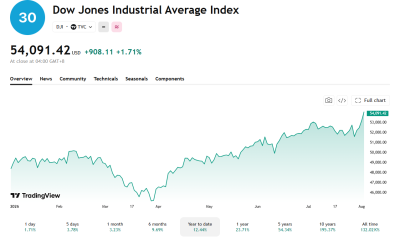
Dow and S&P 500 Hit Records on AI Earnings: When Will the Bubble Burst?
-

 Business2 days ago
How to Start a Cleaning Business: A Step-by-Step Guide
-

 Crypto World7 days ago
The Senate has one week: CLARITY’s last August window
-

 Business2 days ago
Datadog: Best Of Breed For Multiple Reasons
-

 Business2 days ago
BDC Weekly Review: Private BDC Q2 Numbers Are Strong
-
 Crypto World6 days ago
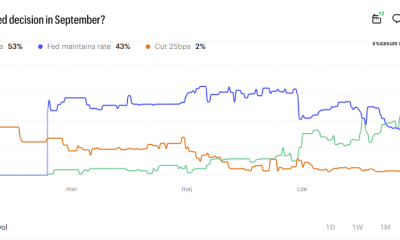
Dollar Index Trapped at 100 as Hawkish Fed Meets Official Selling
-

 Crypto World7 days ago
New York sued, who is next
-

 Business6 days ago
McDonald’s (MCD) Q2 2026 earnings
You must be logged in to post a comment Login