





Connect with us

Business

Rustik Oven rolls out artisan-quality sourdough bagels

Published

on

Rustik Oven rolls out artisan-quality sourdough bagels

IRVING, TEXAS — Bimbo Bakeries USA (BBU) has rolled out a new line of artisan-style sourdough bagels under its The Rustik Oven brand nationwide.

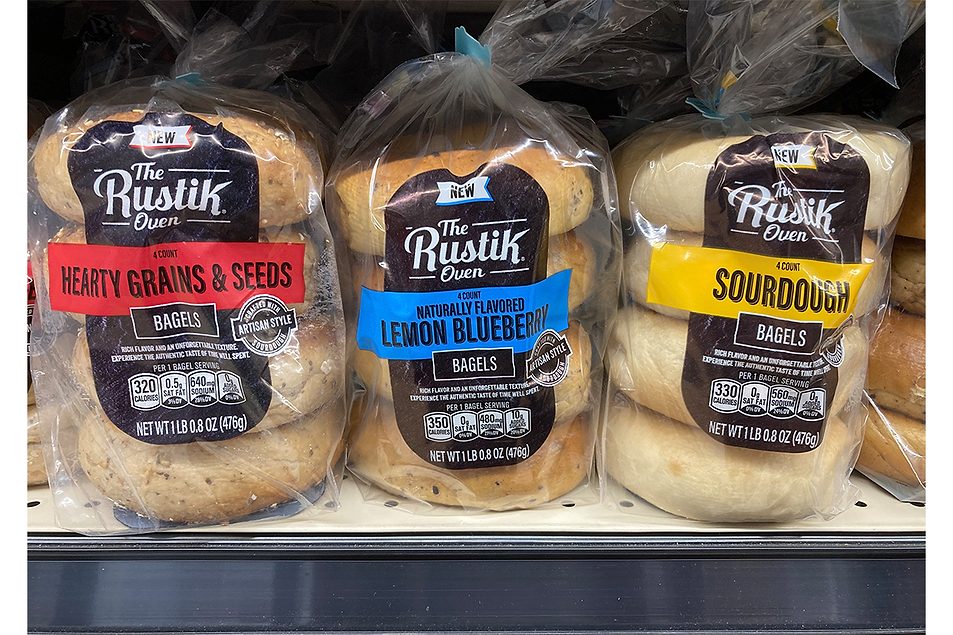
Irving-based BBU said the new Rustik Oven bagels are made using a signature process that includes 12-hour fermentation and slow baking, bringing the taste and texture of artisan-quality bread with the convenience of packaged bread. The product comes in three varieties: sourdough, hearty grains and seeds, and lemon blueberry.

BBU noted that sourdough has been one of the fastest-growing trends in the bakery aisle, driven by consumer demand for artisan-style products. The company said that, according to “The Hottest Bakery Trends for 2026” report from Puratos, 70% of consumers said sourdough enhances the flavor of bread.

The Rustik Oven bagels, which began hitting stores in July, are now available at Kroger, Walmart and other major retailers across the country in four-count packages for a suggested retail price of $6.19.

Advertisement

BBU said the launch comes as The Rustik Oven introduces its new campaign, “The Bread You’d Make If You Made Bread,” which focuses on delivering the quality of craft-made bread without the time and effort of making them from scratch.

“Consumers increasingly want great-tasting foods that bring something special to everyday meals, but that doesn’t mean they always have hours to spend in the kitchen,” said Mollie Crudden, senior director marketing for the artisan portfolio at Bimbo Bakeries USA. “At The Rustik Oven, we believe your time should be spent enjoying great bread and imagining all the delicious ways to serve it. With our new artisan-style bagels and ‘The Bread You’d Make If You Made Bread’ campaign, we’re giving consumers a convenient way to enjoy the sourdough taste they crave while leaving more time for the fun part — deciding what to put on top.”

Continue Reading
Click to comment

You must be logged in to post a comment Login

Leave a Reply

Business

Nine lifts profit, maintains streaming focus

Published

on

Nine lifts profit, maintains streaming focus

Nine Entertainment has increased its full-year net profit as it continues to focus on its streaming and broadcast assets.

Continue Reading

Business

Private label’s rising role in beverage innovation

Published

on

Private label’s rising role in beverage innovation

WILMINGTON, NC. — With consumers turning to functional beverages, private label manufacturers are benefiting from the trend by helping their clients succeed in the category.

FedUp Foods, one of the largest private label fermented and functional beverage manufacturers in the United States, has had positive experiences with transforming product concepts into market results.

“We’re at the forefront of charting out the innovation roadmap for functional beverages, which is a focus for our business,” said Ravi Jhala, vice president of commercialization. “It’s a very collaborative role on the commercialization side because we work all the way from concept to product launch.”

Beverages were one of food retail’s strongest growth categories in 2025, according to the “Power of Beverage” report from FMI — The Food Industry Association. Almost $295 billion in sales were recorded last year, a 3% boost from 2024.

Advertisement

Along with functional benefits such as hydration, protein, energy, mood support, immune health and digestive health, the report found the better-for-you qualities consumers most want from beverages are caffeine content, low or no added sugar, electrolyte content and natural flavors.

Jhala told Food Business News FedUp Foods recently worked on a regional cold-brew coffee product featuring responsibly sourced organic coffee sold in 48-oz post-consumer plastic bottles.

“We are pretty proud of it because that business has actually grown for us, and we have more than a few products that we serve through that,” he said. “It’s making products available to people at a reasonable price.”

Not to be left behind, branded beverage products are taking advantage of the favorable trend as well. In addition, foodservice operators like McDonald’s Corp. have jumped on the bandwagon by introducing cold coffee, craft sodas, refreshers and Red Bull “energizer” drinks in the United States and elsewhere.

Advertisement

The pivot to private label

Founded in 2008, FedUp Foods pivoted to a private label business model in 2017 and now primarily is focused on kombucha, prebiotic and probiotic soda and, since last year, cold-brew coffee.

The timing of the shift has been fortuitous since private label volume growth was highest for the first half of 2026 in the beverage and refrigerated categories, according to the Private Label Manufacturers Association.

Private label sales in the United States hit $330 billion last year, according to the market researcher Circana. That total was 24% of retail food and beverage dollar share in the country, which was up 0.4 percentage points from 2024.

Advertisement
AdobeStock_2049124241_Editorial_Use_Only.jpg

Private label sales in the United States hit $330 billion last year, according to the market researcher Circana.

| Photo: ©JAMMER GENE – STOCK.ADOBE.COM

Younger consumers are helping to drive the private label trend by their interest in product transparency and by being less brand loyal, Jhala said.

“They’re not necessarily seeking out brands as other generations do,” he said. “This is one thing helping private label brands rise.”

A survey conducted by FMI — The Food Industry Association found millennial and Generation Z shoppers are influencing the increase in private label purchases. Fifty-nine percent of Gen Z and 53% of millennials said they had increased their private label purchases in the past year, compared with 49% of shoppers overall.

Advertisement

Private label innovation

Private label brands benefit by being able to offer retailers the product innovation and variety today’s consumers are looking for, Jhala said.

“We definitely can do agile manufacturing and conversion of consumer insights to launch premium products faster compared to what legacy brands can do,” he said.

The company’s private label clients also don’t shy away from putting limited-time brands on the shelf, which he said is another advantage.

Advertisement

“Legacy brands take much more of a time commitment to pursue that,” Jhala said. “The cycle time for a private label brand to work directly with a retailer is much faster. That’s what makes private label brands stand out.”

Nurturing the soil

FedUp Foods is “one of the companies that believes in values-oriented business,” Jhala said.

As a Public Benefit Corporation, it must factor social and environmental goals into its business decisions. The company also prioritizes working with certified partners, including suppliers holding B Corp status.

Advertisement

Jhala said FedUp Foods applies values-based sourcing and literally nurtures the soil from organic inputs for tea and kombucha.

“By being a responsible manufacturer in the communities where we operate, we nurture the community soil as well,” he said.

The third way is by “making good food we actually make accessible to more people,” he said. “Through the private label system we operate in, we are able to do that by working directly with retailers on their brands and making products accessible at a good price point.”

Jhala said he thinks functional beverages align well with private label because people want novelty and to know about the latest flavor trend, plus they want the functional benefits of clean energy, gut health and immunity.

Advertisement

“As long as you can deliver this functionality through the beverage by keeping them tasting good, I think that’s what makes private label more exciting,” he said. “We are definitely enjoying this moment.”

Continue Reading

Business

Bitcoin Holds Near $79,200 After Briefly Surpassing $80,000 Amid Treasury Moves and ETF Inflows

Published

on

Bitcoin

NEW YORK — Bitcoin traded near $79,195 on Tuesday after climbing above $80,000 for the first time since mid-May, extending a sharp multi-day rally driven by U.S. Treasury bond purchases, strong exchange-traded fund inflows and a wave of short-covering in derivatives markets.

The cryptocurrency rose about 0.27 percent in the latest session, adding roughly $214 from the prior close. Intraday trading saw Bitcoin briefly reach highs near $81,000 to $81,200 before consolidating in the high $78,000 to low $80,000 range. The move marked a recovery of more than 20 percent over the prior week from levels near $63,000 to $64,000 and erased much of the losses accumulated since earlier in the summer.

Market participants pointed to a combination of macroeconomic signals and institutional demand. Last week the U.S. Treasury announced it would expand repurchases of long-dated securities to at least $4 billion per operation, a step aimed at moderating long-term yields. The announcement contributed to a softer U.S. dollar and revived interest in assets viewed as hedges against currency debasement, including Bitcoin and gold.

Spot Bitcoin ETFs recorded robust inflows, with U.S.-listed funds attracting approximately $1.9 billion in net creations during the prior week—the strongest weekly total since October 2025. Daily figures in recent sessions included hundreds of millions of dollars, extending a streak of positive flows that has added billions to month-to-date totals. Analysts noted that the consistent buying helped absorb available supply even as leveraged short positions were forced to cover.

Advertisement

Derivatives markets saw significant liquidations of short positions, estimated in the billions of dollars across crypto platforms earlier in the week. The forced buying amplified the upward momentum once prices began to break higher. Open interest in futures remained elevated, reflecting continued speculative activity around the key psychological level of $80,000.

Bitcoin remains well below its peak of approximately $126,000 reached in October 2025. The recent advance has brought the asset closer to its 50-week moving average near $81,000, a technical threshold watched by some traders as a potential signal of sustained momentum. Support has been identified in the mid-to-high $70,000 area following the rapid recovery.

Broader market context includes ongoing discussions of regulatory clarity in the United States. Recent White House engagement with crypto industry representatives and calls for legislation such as a version of the Clarity Act have contributed to a more constructive sentiment among institutional participants. While no major legislative breakthroughs were announced in the immediate period, the tone of policy signals has reduced some of the regulatory risk premium that weighed on prices earlier in the year.

Trading volume remained elevated during the advance, with 24-hour figures in the tens of billions of dollars as both retail and institutional activity increased. Ethereum and other major cryptocurrencies also posted gains, though Bitcoin’s relative strength underscored its role as the primary benchmark for the sector.

Advertisement

Analysts described the rally as a confluence of liquidity support, improved fund flows and mechanical buying from short liquidations rather than a single catalyst. The Treasury’s bond repurchase program, while not formal quantitative easing, was interpreted by some market participants as a signal of lower tolerance for rising long-end yields, particularly ahead of midterm elections. That perception helped shift capital toward scarce assets.

Short-term technical indicators showed signs of overbought conditions following the rapid climb, with some momentum oscillators reaching elevated levels. Traders monitored whether Bitcoin could sustain closes above $80,000 or would face resistance near the clustered moving averages in that region. Profit-taking and range-bound consolidation remained possible after such a steep multi-day move.

The recovery has restored profitability for many short-term holders who had been underwater earlier in the month. Longer-term holder cost bases remained lower, providing a foundation of less price-sensitive demand. On-chain metrics and exchange flow data continued to be watched for signs of sustained accumulation or distribution.

Looking ahead, attention is focused on upcoming economic data, including inflation readings, and any further commentary from Treasury or Federal Reserve officials. A continued soft-dollar environment and steady ETF demand would support higher prices, while a reversal in bond-market dynamics or a sudden increase in regulatory uncertainty could pressure the asset.

Advertisement

Bitcoin’s market capitalization has expanded by hundreds of billions of dollars during the recent advance, reinforcing its dominance within the broader cryptocurrency complex. The asset’s performance relative to traditional markets and other risk assets remains a key point of analysis for portfolio managers allocating to digital assets.

For now, the price action near $79,000 reflects a market that has absorbed a significant short squeeze, benefited from policy-driven liquidity expectations and seen renewed institutional participation through regulated investment vehicles. Whether the move evolves into a more durable uptrend will depend on the persistence of these supporting factors in the weeks ahead.

Continue Reading

Business

Walmart tap-to-pay rollout coming to US stores and Sam’s Club locations

Published

on

Walmart tap-to-pay rollout coming to US stores and Sam's Club locations

Walmart is rolling out tap-to-pay technology across its U.S. stores, giving shoppers another way to make purchases with contactless cards, smartphones and smartwatches.

The retail giant said the payment option will begin appearing at select Walmart stores and Sam’s Club locations starting Aug. 24, with plans to expand it to all U.S. stores and clubs by the end of 2026.

Advertisement

Walmart also plans to bring tap-to-pay capabilities to its fuel stations by mid-2027.

The checkout expansion comes as Walmart increasingly focuses on convenience across its physical and digital businesses.

WALMART SAYS IT WILL USE BILLIONS IN TARIFF REFUNDS TO KEEP PRICES LOW

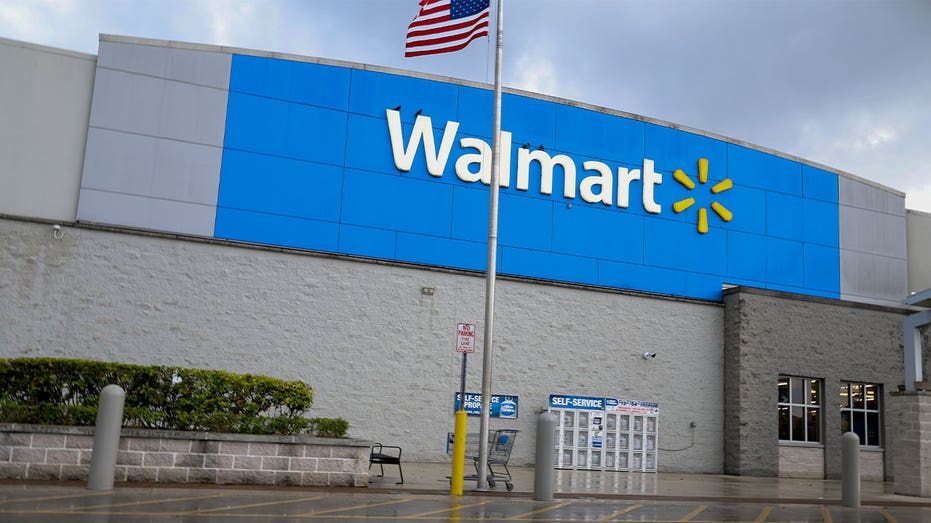
Walmart store exterior with the retailer’s logo and an American flag outside the building

A Walmart store as the retailer prepares to roll out tap-to-pay technology across its U.S. locations. (Joe Raedle/Getty Images / Getty Images)

Walmart’s U.S. e-commerce sales jumped 24% in the second quarter, with strength in store-fulfilled delivery, advertising and its online marketplace. Sam’s Club U.S. e-commerce sales climbed 26%, driven by continued growth in club-fulfilled pickup and delivery.

Advertisement

Walmart President and CEO John Furner pointed to the retailer’s online growth as evidence that customers are responding to its “price, speed and convenience.”

Walmart’s e-commerce gains extended beyond its U.S. operations. Walmart International reported a 19% increase in e-commerce sales during the second quarter, driven by store-fulfilled pickup and delivery.

The retailer reported $187.9 billion in second-quarter revenue, up 5.9% from a year earlier, and raised its outlook for the fiscal year.

WALMART E-COMMERCE SALES SURGE AS CEO TOUTS ‘PRICE, SPEED AND CONVENIENCE’

Advertisement

Walmart plans to expand tap-to-pay to all of its U.S. stores by the end of 2026.

The new tap-to-pay option will allow Walmart and Sam’s Club shoppers to check out using eligible contactless cards, smartphones or smartwatches. Customers and members will also be able to add eligible Walmart, Sam’s Club and OnePay cards to their digital wallets.

The rollout adds contactless payments to a lineup that already includes cash, credit cards and Walmart Pay. Through Walmart Pay, customers can use the Walmart app to pay at checkout, view purchases and receipts and access Walmart+ fuel savings.

Ticker Security Last Change Change %
WMT WALMART INC. 105.38 -1.11 -1.04%

At Sam’s Club, members have another checkout alternative through Scan & Go, which allows shoppers to scan merchandise and pay as they shop without using a traditional checkout line.

Beyond checkout, Walmart said its financial services include options designed to help customers save, build credit and pay for purchases over time.

Advertisement

WALMART, SAM’S CLUB SLASH PRICES ON THOUSANDS OF PRODUCTS AS TRUMP SAYS MOVE CAME AT HIS REQUEST

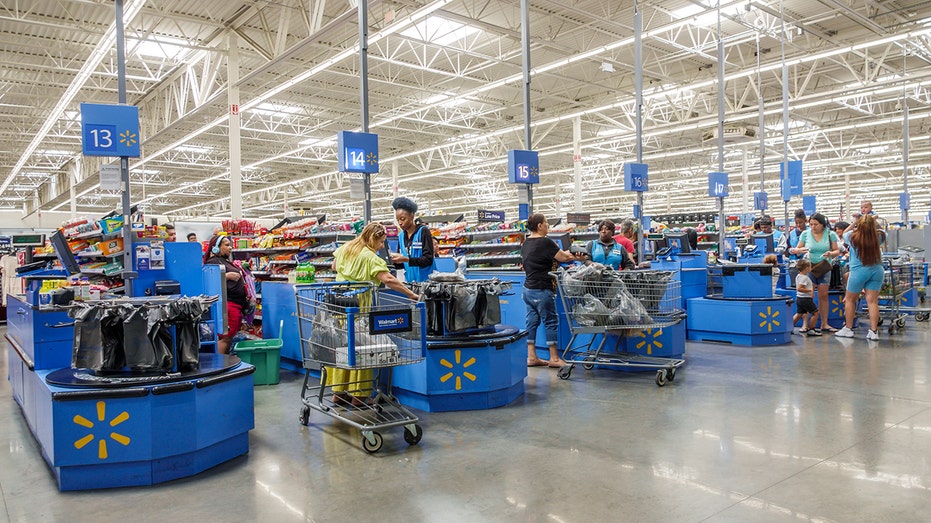
A view of the checkout counters inside Walmart

The tap-to-pay option will allow Walmart and Sam’s Club shoppers to check out using eligible contactless cards, smartphones or smartwatches. (Jeffrey Greenberg/Universal Images Group via Getty Images / Getty Images)

Sam’s Club members also have access to Sam’s Cash and Sam’s Club credit. Members can earn Sam’s Cash through qualifying purchases and programs.

Walmart already offers Walmart Pay through its app, which allows customers to make purchases, view receipts and access Walmart+ fuel savings.

At Sam’s Club, members can use Scan & Go to scan items and pay as they shop without going through a traditional checkout line.

Advertisement

CLICK HERE TO GET FOX BUSINESS ON THE GO

The new payment option is part of Walmart’s broader effort to give customers and members more choices for managing and spending their money. The retailer offers financial services aimed at helping customers save, build credit and pay over time.

Sam’s Club members also have access to Sam’s Cash and Sam’s Club credit, with opportunities to earn Sam’s Cash through qualifying purchases and programs.

Advertisement
Continue Reading

Business

Tracking David Tepper's Appaloosa Management Portfolio – Q2 2026 Update

Published

on

Tracking David Tepper's Appaloosa Management Portfolio - Q2 2026 Update

Tracking David Tepper's Appaloosa Management Portfolio – Q2 2026 Update

Continue Reading

Business

Barbour creates 40 South Shields factory jobs amid ‘unprecedented global demand’

Published

on

Business Live

Outdoor clothing brand Barbour has unveiled plans to create 40 jobs through an expansion of its factory in South Shields. The heritage firm — whose legendary jackets have won admirers from pop stars to members of the Royal Family — says it is growing its Simonside site in response to “unprecedented global demand”.

The expansion will see additional production lines installed at the factory where the company manufactures its Bedale wax jackets, generating new employment opportunities through the recruitment of approximately 40 machinists. To support this recruitment drive, Barbour has established an on-site training facility known as the Barbour Academy.

The training programme spans around three months, after which recruits will take to the factory floor under close supervision. Barbour notes it can take up to a year for machinists to reach full proficiency.

Trainees will begin with simpler items such as tote bags before progressing to more complex garments.

Advertisement

The first five trainee machinists have already commenced their training at the academy, with Barbour working alongside Smart Works North East and Suitability, both of which help women and men return to employment. The firm is also seeking referrals from existing members of staff, their family members and friends, reports Chronicle Live.

Barbour House, Bedesway, South Tyneside Picture: Google Maps

Barbour House, Bedesway, South Tyneside(Image: Google)

Sam Fender is working with Barbour International on its latest campaign

Sam Fender is working with Barbour International on its latest campaign(Image: Barbour)

All machinist training is expected to be completed by mid-February next year, ahead of the planned relocation of Barbour’s customer services team — which encompasses re-waxing, repairs and Barbour Re-Loved — to a new facility at Simonside. Company chairman Dame Margaret Barbour said “We are excited to be recruiting for trainee machinists to join our team in South Shields. No experience is necessary as full training will be provided.

“This is a fantastic opportunity to learn a highly skilled craft and to play an important role in creating our iconic wax jackets. It also demonstrates our commitment to the region which has been home to Barbour for over 130 years.”

Earlier this year, Barbour published accounts for the year ending April 2025 showing revenues climbed 9% to £350.8m while operating profit increased to £49.5m. Barbour – which has a workforce exceeding 1,100 people – noted that the period covered by the accounts witnessed a “recovery” in sales, with particularly robust performance across its ecommerce platforms.

Advertisement

The firm traces its origins to 1894 and continues to be headquartered in South Shields under the stewardship of the founder’s family. In recent years it has established collaborations with television presenter Alexa Chung, musician Sam Fender and brands such as Emma Bridgewater and Fenwick.

For further information, or to apply for a machinist role, please visit www.barbourcareers.co.uk/vacancies.

Continue Reading

Business

Small- and midcaps shine as blue-chip stocks struggle for momentum

Published

on

Small- and midcaps shine as blue-chip stocks struggle for momentum
Mumbai: India’s weary blue-chip stocks might suggest the equity market is in a rather comatose state, but beneath the surface, the picture is decidedly more sanguine.

Mid- and small-cap stocks have continued to defy index-level inertia amid a rush in primary-market listings. The average advance-to-decline (A/D) ratio – a widely watched indicator of overall market health – in August is up for the fifth consecutive month, its longest winning streak in more than two and a half years, pointing to significant investor interest beyond the typical frontbenchers that populate the two broadest gauges on the two competing exchanges.

Read more: Q1 earnings show resilience, but downside risks still loom. HSBC explains why

The average advance-to-decline ratio, a measure of the number of stocks rising versus those falling, stood at 1.07 so far in August, its highest level in four months. It has remained above 1 for five consecutive months, indicating that more stocks have advanced than declined. “This shows more stocks are rising than falling even though IT, FMCG and metals have not participated meaningfully,” said Manish Bhandari, CEO and Portfolio Manager at Vallum Capital.

Advertisement

The last time the A/D ratio showed similar strength for a longer stretch was between April 2023 and January 2024, when the ratio remained above one for 10 consecutive months.

Key Gauge Shows Small & Midcaps Powering St PlayAgencies

Investor Participation
A rising ratio indicates that buying is across a larger number of stocks, signalling strong market breadth. A falling ratio suggests gains are becoming concentrated in fewer stocks or that selling is becoming more widespread.
Retail investors’ appetite for mid- and small-cap stocks has kept this measure higher with equity schemes betting on these share segments getting a bulk of the flows in recent months.

In August, mid- and small-cap schemes received Rs 13,960 crore or 56% of the total equity flows, compared with Rs 11,692 crore, or 40% of the flows in the previous month. In contrast, large cap funds saw outflows of Rs 1,322 crore, their first outflow in 30 months, pointing to the lack of appetite for blue-chips in general.

The divergence between the key indices and the broader market is also visible in their performance. Since April, the Sensex and Nifty have gained 8% and 9%, respectively, while the Nifty Midcap 100 and Nifty Smallcap 100 have jumped 22% and 31%, respectively. The Nifty 500 has gained 15% during the period.

“The explanation is increasingly bottom-up: June-quarter profit growth for Nifty 50 companies reached 18%, the highest in 10 quarters, while 19 sectors beat earnings expectations and the upgrade-to-downgrade ratio improved to 1.5,” Bhandari said.

Advertisement

Experts said the divergence suggests that participation has been broader across the market, with investors finding value beyond the largest stocks. This includes stocks that became cheaper after earlier declines as well as growth stocks available at a discount to their potential returns.

Continue Reading

Business

Woolworths' profits boosted by Ooshies sales jump

Published

on

Woolworths' profits boosted by Ooshies sales jump

Australia’s biggest supermarket chain has boosted its annual profit by 18 per cent, despite a challenging economic environment that has strained household budgets.

Continue Reading

Business

Perseus Mining Limited 2026 Q4 – Results – Earnings Call Presentation (OTCMKTS:PMNXF) 2026-08-25

Published

on

OneWater Marine Inc. (ONEW) Q1 2026 Earnings Call Transcript

This article was written by

Seeking Alpha’s transcripts team is responsible for the development of all of our transcript-related projects. We currently publish thousands of quarterly earnings calls per quarter on our site and are continuing to grow and expand our coverage. The purpose of this profile is to allow us to share with our readers new transcript-related developments. Thanks, SA Transcripts Team

Continue Reading

Business

Thailand’s Eastern Economic Corridor Capital City (EECiti): Key Developments and Investment Opportunities

Published

on

Thailand's Eastern Economic Corridor Capital City (EECiti): Key Developments and Investment Opportunities

Thailand’s flagship special economic zone is entering its most concrete phase yet with the EEC Capital City, or EECiti, a planned smart city rising between Pattaya and U-Tapao airport that officials are billing as the administrative and commercial heart of the Eastern Economic Corridor. After years of master planning, 2026 has brought land compensation, a draft zoning blueprint, and the first serious test of investor appetite for the infrastructure that will underpin the city.

A new city rising in Chonburi

EECiti is being built on land in Huay Yai subdistrict, Bang Lamung district, Chonburi province, positioned within easy reach of both Pattaya and U-Tapao International Airport. The project’s Secretary-General, Chula Sukmanop, has described it as the capital of the EEC, and the numbers involved are substantial. The city is planned to cover 2,339 hectares in Huay Yai, with sports and recreational facilities envisioned under a sport and entertainment complex concept that officials say will not include a casino.

Phase one alone is significant in scale. By June 2026, the EEC Policy Committee had confirmed that compensation payments to landholders had progressed to the point where roughly 6,168 rai were ready for development, with the area designated as a special economic promotion zone and development master planning underway. An earlier draft plan put the broader development area at closer to 14,619 rai, with phase one focused on a central business district, government offices, medical centers, and residential areas.

The guiding concept, repeated consistently by EEC officials throughout the year, is a “Smart & Sustainable LIVE-WORK-PLAY City” designed to serve as a livable, tech-enabled urban centre rather than another industrial estate. Deputy Prime Minister and Transport Minister Phiphat Ratchakitprakarn has framed the project as part of a broader effort to position eastern Thailand as a global centre for business, tourism, and entertainment.

Advertisement

The 72-billion-baht infrastructure package

The commercial core of EECiti’s near-term story is a large public-private partnership covering the city’s basic infrastructure. The EECO’s plan calls for private co-investment across ten infrastructure and utility systems: electricity and energy, water supply, wastewater collection and recycled water, water management, waste management, digital infrastructure and telecommunications, firefighting and disaster warning, road networks supporting public transport, a common utility rail system, and central green spaces and landscaping.

Estimates of the package’s value have shifted slightly as the project has been refined, from an early figure of roughly 74.4 billion baht to the 72.04 billion baht ($2 billion-plus) figure cited by officials mid-year. Beyond the ten infrastructure systems, EECO is also studying central green spaces and landscape systems as part of the same PPP scheme.

To gauge appetite before finalising the bidding terms, EECO convened a market sounding session on July 21 at the Grand Centre Point Prestige Hotel in Bangkok. More than 100 private-sector companies attended, spanning infrastructure and real estate developers, financial institutions, and Thai and foreign investors, signalling strong interest in the future smart city development. Officials described the turnout as exceeding expectations, and the feedback gathered is now being folded into the final project documentation and private-sector selection criteria ahead of formal bidding.

Timeline: from market sounding to groundbreaking

The path from consultation to construction is now reasonably well defined, though it stretches out over several years. The EEC Policy Committee approved the launch of the PPP bidding process for early 2028, with construction expected to begin that same year. That timeline is somewhat later than the invitation date floated in late 2025, when EECO had targeted issuing an invitation for private investors to participate in early 2027, followed by proposal review, selection of the private partner, contract drafting, and construction of initial infrastructure.

Advertisement

For investors, that gap between now and formal bidding is where the groundwork gets laid: further refinement of risk allocation, financing structures, and investment incentives based on the market sounding feedback, followed by publication of the official call for PPP proposals.

Entertainment, sport and the theme park ambition

EECiti’s brief extends well beyond utilities and office space. Thai authorities have floated an ambitious entertainment component for the site, including discussion of a Disneyland-style theme park as part of a broader push to diversify the corridor’s economic base beyond manufacturing. The sports and entertainment centre is expected to occupy around 240 hectares within the wider development, positioned as a new landmark capable of anchoring an international-standard sports centre alongside a world-class entertainment and leisure hub.

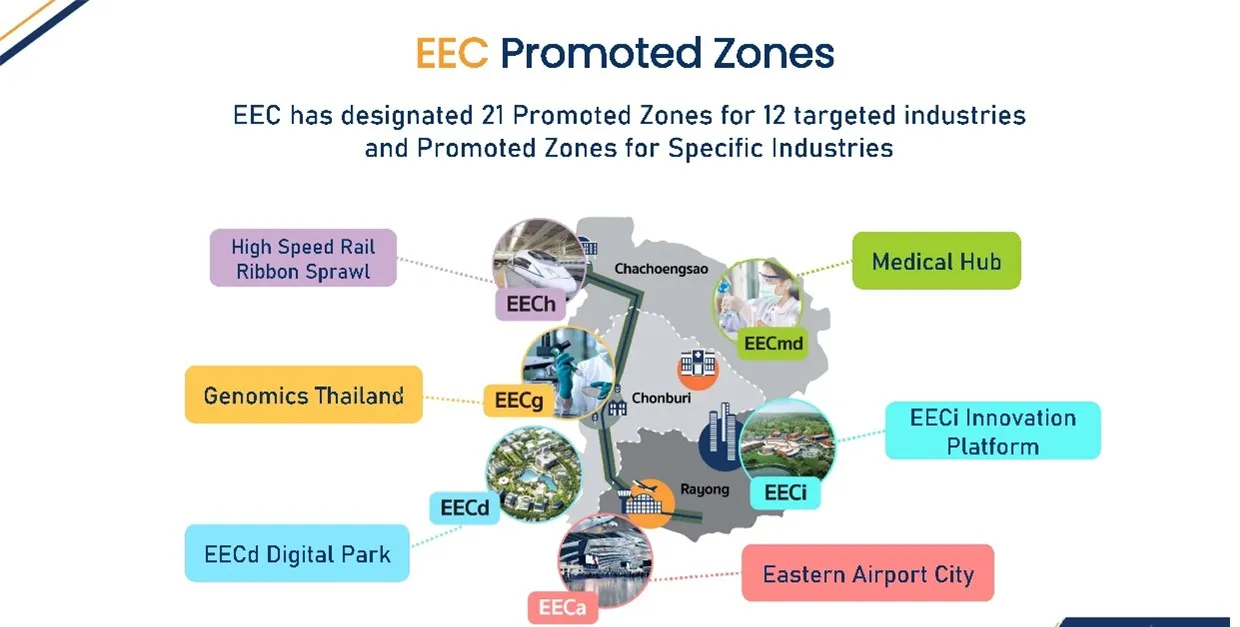
This ambition sits alongside the EEC’s existing innovation districts, including the Eastern Economic Corridor of Innovation focused on biotechnology, biofuels, petrochemicals and robotics, and complements Thailand’s broader effort to court high-value industries and foreign investment across the corridor.

Connectivity: linking EECiti to the region

Transport links are central to the EECiti pitch. The site sits within 20 kilometres of the Pattaya high-speed rail station, and a monorail system is planned to connect the new city to that station. That high-speed line is itself part of a wider scheme intended to link Don Mueang, Suvarnabhumi and U-Tapao airports, though as Thailand Business News has reported, cabinet approval for revised contract terms on that broader rail link remained pending as of early 2026. EECiti’s own success will depend in part on those regional connectivity projects landing on schedule.

Advertisement

What it means for investors

For infrastructure developers, financial institutions and construction groups, EECiti represents one of the larger PPP opportunities to emerge from the EEC programme since its 2017 launch. The structure favoured by EECO, a single-package investment model spanning multiple utility systems, is designed to make the project more bankable by bundling revenue streams rather than tendering each system separately, though final terms will depend on feedback from the market sounding process.

Real estate developers and hospitality groups will be watching the entertainment and residential components more closely, particularly if the theme park and sports complex plans advance from concept to formal tender. Given the 2027-2028 window for invitations and bidding, most of the near-term opportunity lies in positioning, consortium-building, and engaging with EECO’s ongoing consultation process rather than in construction contracts themselves.

More broadly, EECiti is a useful signal of where Thailand’s industrial strategy is heading: away from pure manufacturing incentives and toward the kind of integrated, livable urban infrastructure that the government hopes will help the EEC retain skilled workers and attract the service, finance and technology firms that follow industrial investment rather than lead it. Details on incentive structures and land-use rules will continue to firm up as the project moves toward its 2027 investor invitation, and Thailand Business News will continue tracking developments as EECO finalises the PPP terms.

Advertisement
Continue Reading

Trending

Copyright © 2025