

Business
SaltLight Capital Q1 2026 Co-Investor Letter


AoZaaStudio/iStock via Getty Images

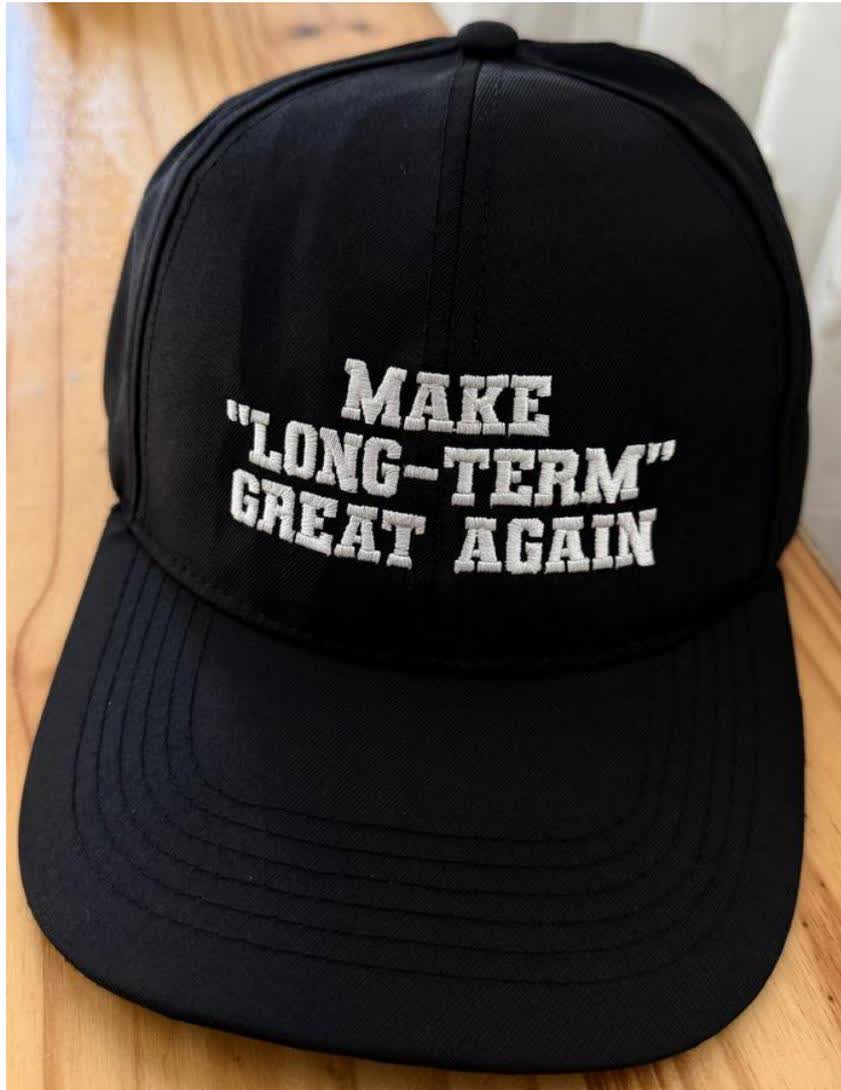
Make “Long-Term” Great Again
At a recent investment conference, we made some baseball caps that bashfully shouted on the front: ‘ Make “Long-Term” Great Again ’. This was our brief dalliance with Trumpian ‘merch’ culture, mercifully without the red caps, rallies, or promise of instant results. Its purpose was to be an icebreaker, but at its heart, a statement of principle.
Meanwhile, another attendee at one of the snack tables had a similar idea and wore a cap that said: “Make Volatility Great Again. ” We guessed that he was working for a brokerage firm.
We can already feel your scepticism. “Long-term” is one of the oldest cards in the fund manager’s deck, usually pulled from the inside pocket as soon as performance goes awry. Sometimes it’s a philosophy; sometimes it’s just a way to launder underperformance.
We hope that by the end of this letter, you will believe that our intention was the former.
What Has Been Going On?
This was the second negative quarter since 2022 for the SaltLight BCI Worldwide Flexible Fund. Over the last six months, we have been deliberately harvesting profits in parts of the portfolio, particularly in AI infrastructure, and reallocating capital to better expected-value opportunities.
As fate would have it, at the same time we have experienced meaningful declines in companies such as Blu Label Unlimited, Sea Ltd (SE), and MercadoLibre. We think this sell-off has been an absolute gift, especially with a little cash on hand. In the short term, for these companies, the market has decided that we are either wrong or. . . early. For a time, those two things could look identical.
Back in the US, fast capital has flowed into what we would opine are mediocre AI infrastructure businesses, with revenue surges driven by short-term AI bottlenecks. Time will tell if great businesses are born from these shortages, but our job is not to chase every price move. We must distinguish between temporary scarcity and focus our attention on enduring advantage.
What Is the Game that SaltLight is Playing
The most important question about an investment manager is not what they own today or what they think will happen next quarter. It is what game they are playing.
Some managers play the very difficult event game . They try to predict quarterly earnings, elections, wars, tariffs, interest rates, currencies, and the next macro surprise.
Others play the safer benchmark game : stay close enough to the index to avoid embarrassment, but far away enough to justify a fee.
Meanwhile, SaltLight is trying to play a different game: the waiting-and-building game. . . And at times, despite our best intentions, it can become a building-and-waiting game.
S-Curves: Do Shareholders Have What It Takes?
When we communicate to potential investors what we plan to do with their hard-earned capital, our goal is to convey a fairly simple idea that is hard to execute.
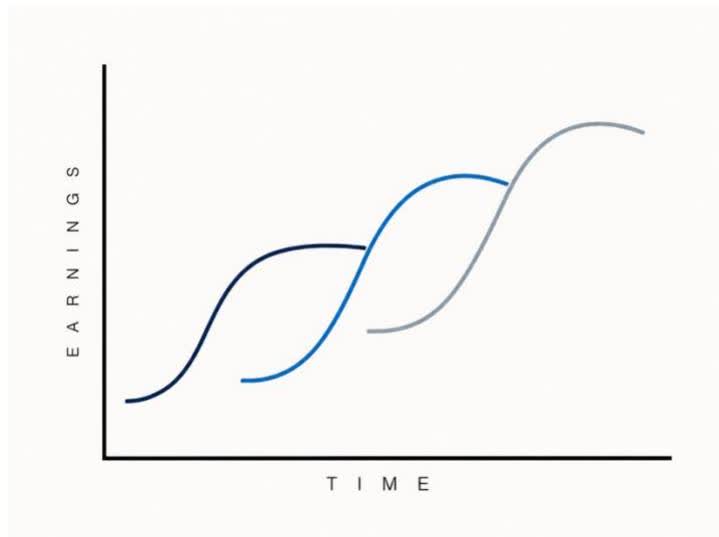
We are curating a portfolio of exceptional global businesses that can become materially more valuable over many years by adapting, innovating, serving customers better, expanding their opportunity set, and reinvesting intelligently.
What *Should* Happen
Ideally, the best of these companies does not rely on a single product, a single market, or a short growth curve. They stack new S-curves on top of existing ones and press their differential and durable advantages. Yet few second-, third-, or tenth-act businesses succeed. Almost all companies fail to build the “next thing”, and so market participants tend to shoot first and ask questions later.
Why Do ‘Long-Term’ and ‘Great’ Not Happen?
1) Culture
Most businesses lack the culture of innovation and management ambition required to invest in a future not yet visible in this quarter’s numbers. Pair that institutional timidity with the incentive structure of a hired CEO on a five-year contract: protect current margins, defer tomorrow’s opportunity, collect the bonus, and let someone else explain the missing growth. Before long, Long-Term and Great are no longer guiding principles. They survive as corporate folklore, stories told about a company that once knew how to build.
2) Shareholders and Investment Industry
Here the lunacy reaches its full bloom. Shareholders say they want growth. They wail and gnash their teeth at the cost of producing it. Their pressure flows downhill from clients, consultants, ratings tables, quarterly league tables, and the endless industry of measurement that surrounds them. The result is a negative feedback loop of mutually reinforcing mediocrity, in which managers stop investing in the future, and shareholders later wonder where greatness disappeared.
3) Accounting in the Technology Age
Another quirk is accounting. In the industrial era, if a company built a factory to support growth, the cost was capitalised and then depreciated over many years through the income statement.
Technology businesses are different. Building a consumer habit, subsidising logistics, hiring engineers, or acquiring customers often hits the income statement immediately. Long-term investment is often conflated with an “expense” and can easily be mistaken for deteriorating economics.
How Have We Found Success Over the Years? How Do We Wake Up ‘Long Term’ and ‘Great’ Again?
But a treasured few companies get Long-Term right; and when they do, they generate incredible value for shareholders. NVIDIA (NVDA), AppLovin (APP), Sea Ltd, and Blu Label have materially grown our capital. One pattern is that, more often than not, companies run by founders tend to have a different license to operate than those run by hired guns do.
Part of the reason we chose the harder path of building SaltLight from scratch a decade ago was shaped by our own experience as entrepreneurs. We wanted to be a different kind of shareholder. We project ourselves sitting on the same side of the table as the builders in our portfolio companies. We make a concerted effort to understand their ambition behind their investments, judge whether the opportunity is real, and back those with the courage, competence, and staying power to build what comes next.
A Portfolio of Builders
Back to what has been going on with our portfolio. Over the last six months, we have deliberately reoriented the portfolio toward a quasi-building mode again. By our estimate, roughly 46% of the portfolio’s exposure is in businesses that are either already undertaking or about to enter a multi-year investment cycle . We have chosen the lonely path to Long-Term martyrdom. It is likely to be choppy, but this is how we play our part in making Long-Term Great again.
Before you flee to the comforting arms of near-term certainty, in this letter, we want to walk through how several of our portfolio companies are investing for the future. MercadoLibre is building the financial ecosystem for Latin America. Tencent (TCEHY) is building AI services on top of one of the world’s most valuable consumer and enterprise ecosystems. AppLovin is extending its advertising engine across more than one billion users. WeBuyCars is building a national scale in South Africa’s fragmented second-hand vehicle market.
Let’s delve into the details on MercadoLibre that demonstrate our thinking and where we differ from the market.
MercadoLibre – Torne o Longo Prazo Grande Novamente ¹
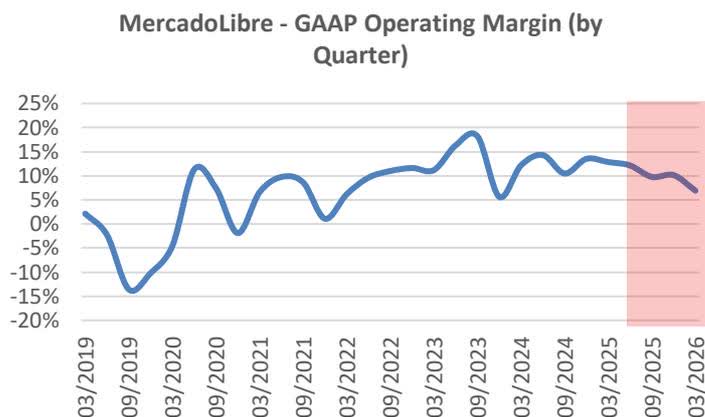
MercadoLibre (MELI) has recently made several decisions that have put pressure on short-term margins. History shows that MELI has gone through this investment cycle before and emerged significantly stronger as a result. We think that the market reaction misses some key points. It has (1) lowered free-shipping thresholds, (2) expanded its credit card offering, and (3) pushed further into cross-border commerce. Investors, without mincing words, have punished its share price.
Figure 1- Source: Company (red is when shipping threshold was reduced)
Lowering Free Shipping Thresholds
The last time MELI cut free-shipping thresholds by a mere 20%, commerce revenues subsequently increased 3.3x over the following years. In a network-effect business like 3P e-commerce, this creates multiple layers of opportunity. The first-order benefit is that more buyers attract more sellers due to the larger customer base. The second-order benefits are the more profitable ones: MELI sells more high-margin advertising and financial services to both sides of the network.
The 2025 Brazil threshold reduction is far more aggressive (~75%) and has resulted in a halving of contribution margins in the last year. But we already see early signs of a substantial increase in contribution margin dollars in the graph below ² .
Figure 2 – Source: Company (red is when shipping threshold was reduced)
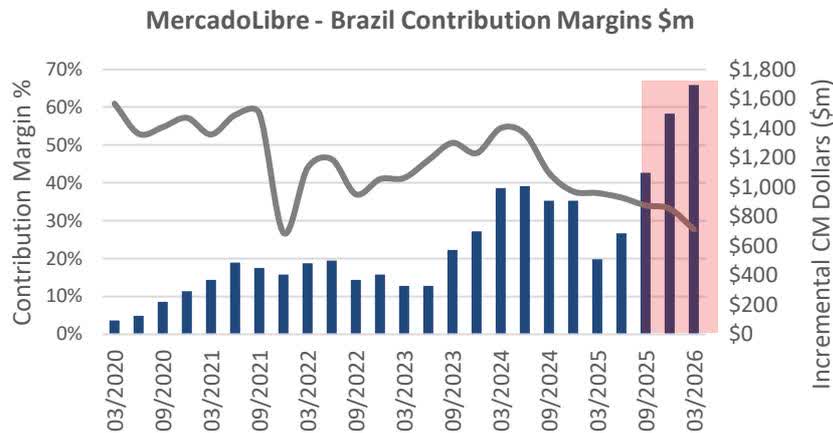
Now, investors tend to focus too much on margin percentages rather than on incremental margin dollars. The truth is that we do not mind lower margin percentages when margin dollars increase, provided that fixed capital investments, such as logistics, are leveraged. Jeff Bezos understood this dynamic well when building Amazon (AMZN)’s unassailable position, because the other side of the equation is that a competitor must operate at similar gross margins, resulting in much smaller gross profit dollars – but at a lower scale. The most-scaled player (MELI, in this case) is usually the winner in the long term. We think this will play out again.
Building a Latam Consumer Bank
The second initiative is MELI’s rapidly expanding credit card portfolio. Over the years, MELI initially focused on short-duration loans for the underbanked. More recently, it has moved upmarket, serving a higher-quality middle-income customer base and steadily laying the foundations for a broader Latin American bank.
Fast-growing loan books are a double-edged sword. When any loan is extended, MELI (or any bank in that manner) prudently recognises an upfront provision for expected credit losses rather than waiting for the default to occur. Faster growth, therefore, mechanically creates higher upfront provisions which hit the income statement immediately. With the credit book growing at roughly 87% YoY ³ , this depresses current reported profitability.
Mercado Pago – New Cards Issued ((est. ))
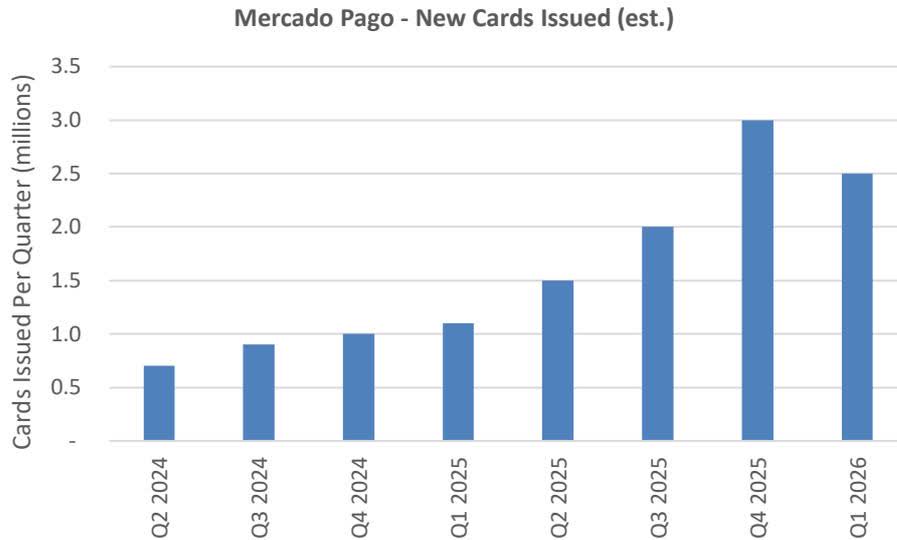
The obvious risk is that the book proves to be of poor credit quality and today’s growth becomes tomorrow’s credit problem. That is the right question to ask. However, based on our analysis today, provisioning appears adequate.
Cross-Border Trade
The third initiative is cross-border trade, which links MELI’s consumers directly to Chinese and US suppliers. We think this is another S-curve that demonstrates the strength and optionality of the MercadoLibre ecosystem.
Consider the challenge from a supplier’s perspective. A Chinese manufacturer trying to sell into Brazil, Mexico, Argentina, or Chile faces a market on the other side of the world, with different languages, payment systems, logistics infrastructure, tax regimes, customer service expectations, and returns processes.
That is a hard problem to solve alone, and so MercadoLibre is turning those multiple friction points into a product. Borrowing from models pioneered by companies such as Pinduoduo (PDD), it now offers semi-managed and fully-managed cross-border solutions. In the semi-managed model, the supplier can drop product into a MercadoLibre warehouse in China. In the fully-managed model, MercadoLibre can handle pricing, shipping, marketing, and customer fulfilment on behalf of the supplier.
This is the pattern we like to see, where it leverages existing infrastructure (an investment cycle from a decade ago) to attack adjacent opportunities. Logistics, payments, credit, advertising, and merchant services are not separate businesses bolted on. They are mutually reinforcing layers of the same ecosystem.
That is why we are less concerned by near-term margin pressure than the market appears to be. MercadoLibre is not simply spending to defend its current business. It is investing to make the next version of the business larger, harder to replicate, and more valuable.
So, where else in our portfolio are companies going into ‘building mode’?
Tencent: Sacrificing 4.5 percentage points of operating margin to invest in new AI initiatives that sit atop one of the most formidable distribution systems in China.
We Buy Cars: Increased its footprint by 23% over the last two years. The investment is impacting margins and free cash flow today, but if returns on capital follow previous locations, we anticipate a substantial earnings lift next year as these new locations mature.
Roblox (RBLX): Took the difficult but welcome decision to improve age identification using AI. Predictably, bookings have suffered, but we believe this will vastly improve network effects and safety for all users.
Karooooo (KARO): has invested significantly in its sales organisation to accelerate its business in South-East Asia. Cartrack has one of the most enviable unit economics in the sector and is unlikely to be disrupted by AI.
Blu Label Unlimited (BLU): Restructuring and simplification are ongoing, and we anticipate this process will take about 18 more months. We remain hopeful for a repurchase announcement with the 2H26 results. Additionally, BLU plans to launch a unified voucher within the next six months, which will significantly change the company’s working capital dynamics.
2022 Vintage
2022 was an exceptionally tough year for us, and yet it was the most fruitful time to deploy capital. That sounds odd, but it is often how long-term investing works. The best sowing rarely feels good at the time. It happens when prices are falling, confidence is scarce, and the temptation to optimise for reported comfort is strongest.
Since then, market participants have had to contend with sharply higher interest rates, the Russia-Ukraine war, Trump 2.0, tariffs, China decoupling, and now the war in Iran. The headlines have not lacked for drama.
The more important question is: what did the companies do?
A few examples from that 2022 vintage:
- • SEA Ltd: emerged from the post-2021 reset as the leading e-commerce platform in Southeast Asia. Revenue grew roughly 80% from 2022 to 2025, while net profit moved from a loss of $1.6 billion to a profit of $2.2 billion.
- • AppLovin: positioned itself as a serious force in performance advertising, increasingly competing in a market long dominated by Google (GOOGL) and Meta (META). Revenue grew 104% from 2022 to 2025, while net profit moved from a loss of $0.2 billion to a profit of $3.6 billion.
- • Pinduoduo: built Temu into a global e-commerce platform, demonstrating an extraordinary ability to adapt, scale and compete internationally. Revenue grew 231% from 2022 to 2025, while net profit rose from $4.5 billion to $16 billion.
- • NVIDIA became the de facto compute provider for the AI epoch. What the market once largely treated as a gaming hardware company became the world’s largest company by market cap. Revenue grew 380% from 2022 to 2025, while net profit increased from $10 billion to $73 billion.
The common thread is that these companies had to go through an investment cycle, and the market hated it. Their management teams played the right game. They invested, adapted, endured, and compounded through a period when the market was far more interested in near-term discomfort than long-term potential.
Over time, investment returns are ultimately driven by revenue growth, earnings growth, and the durability of the opportunity set. Narratives matter in the short run. Fundamentals matter in the end.
In aggregate, we believe our portfolio of builders is now available at attractive valuations. Individually, they are not all the same bet. They have different risks, different time horizons, and different failure modes. Some will work, and a few, where we are wrong, will not.
But this is the game we are playing.
Let’s Make “Long-Term” Great Again! (Thank you for your attention to this matter).
Once again, we remind co-investors that our personal and family wealth is in the very same funds as yours. We inherently have a multi-decade perspective on how to grow our capital alongside yours.
P. S. The SaltLight Global Opportunity Fund , our USD-denominated global portfolio, is now operational and is approved under section 65 of the Collective Investment Schemes Control Act, 2002, for solicitation of South African investors. Please reach out if you are interested in learning more*.
David Eborall
Portfolio Manager
References
- 1 Translated as Make Investing Great Again in Portuguese
- 2 MercadoLibre introduced the reduce shipping threshold from R$80 to $19 in June 2025.
- 3 Company: Net loan book growth at 1Q26
Editor’s Note: The summary bullets for this article were chosen by Seeking Alpha editors.

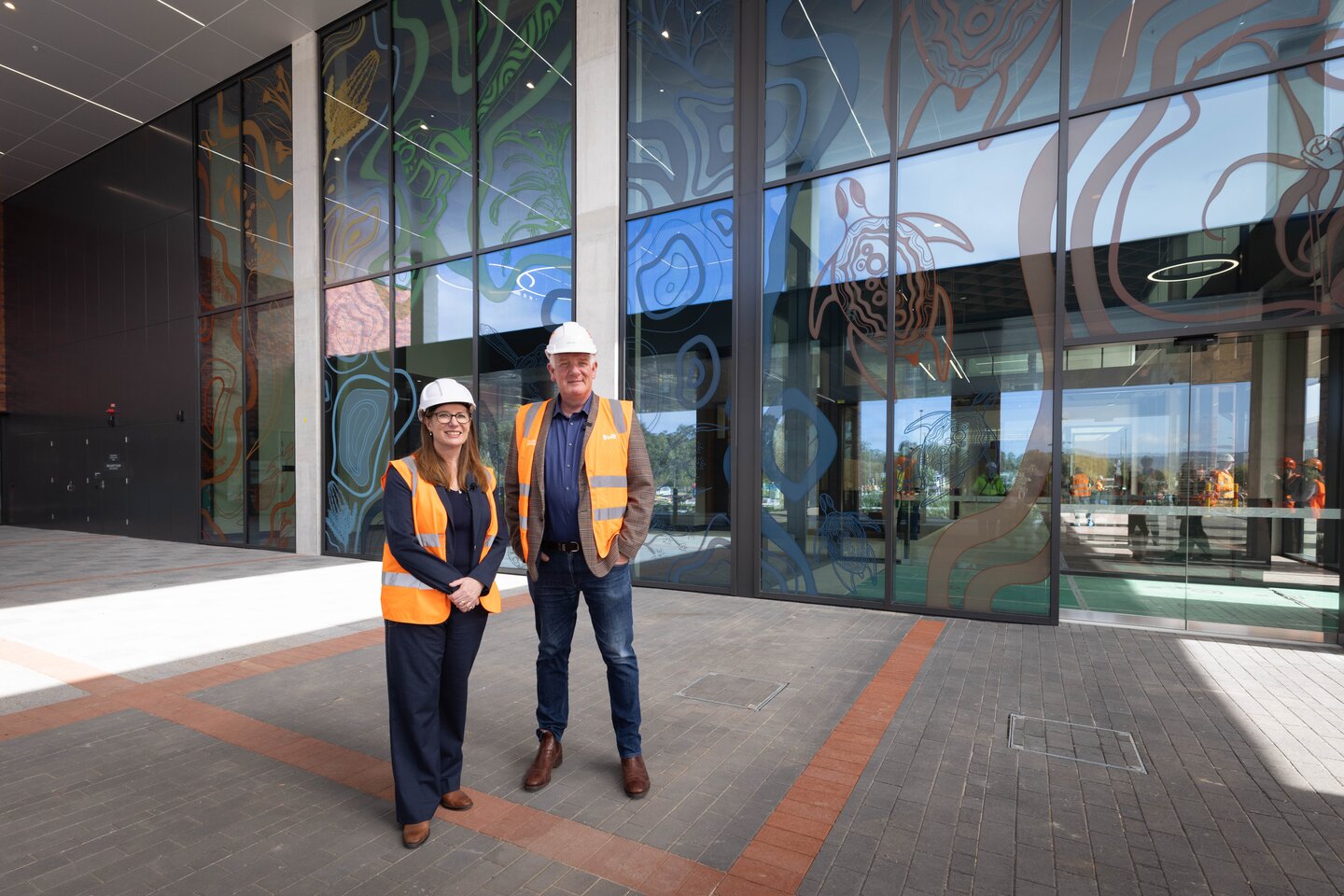
St John of God Health Care’s new private hospital in Midland has reached practical completion, paving the way for the state government to take over St John’s existing private hospital.
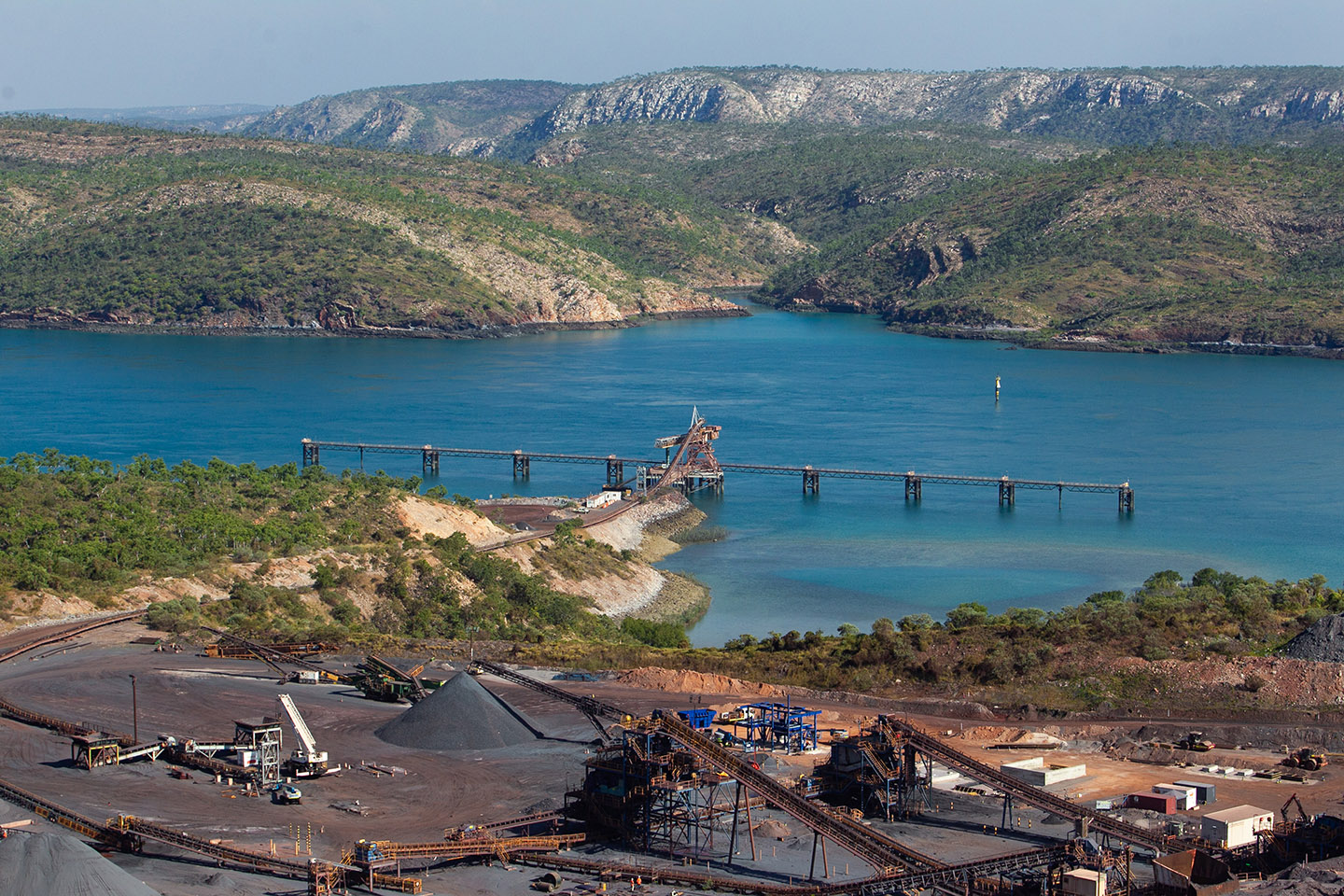
Private port proponent Crestlink has struck a deal to buy the Koolan Island iron ore mine for $20.2 million from MGX Resources.


Uber sues New York City over ’reckless’ driver protection law

STEW: Deep Discount Gets Deeper (Rating Upgrade)
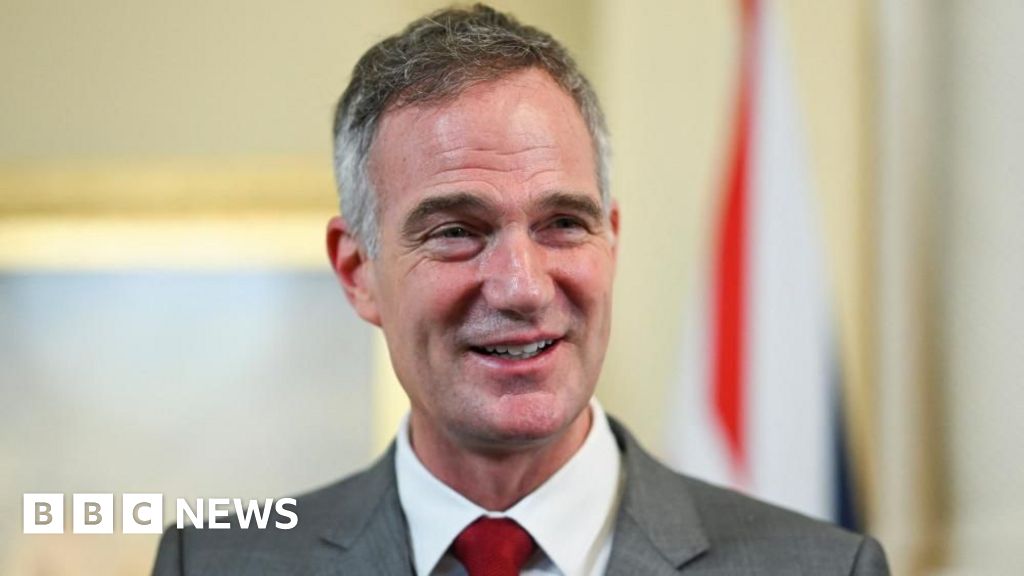
Peter Kyle’s comments come as the government sets out how it would back British technology companies.

Operator
Good day, and welcome to the Aethlon Medical Fiscal Year-end March 31, 2026, Financial Results and Corporate Update Conference Call. [Operator Instructions]
Please note this event is being recorded. I would now like to turn the conference over to Jim Frakes, CEO and CFO of Aethlon Medical. Please go ahead.
James Frakes
CEO, CFO, Chief Accounting Officer, Secretary & Director
Thank you, operator, and good afternoon, everyone. Welcome to Aethlon Medical’s Fiscal Year-end March 31, 2026, Earnings Conference Call. My name is Jim Frakes, and I’m the Chief Executive Officer and Chief Financial Officer of Aethlon Medical. At 4:15 p.m. Eastern Time today, Aethlon Medical released financial results for its fiscal year ended March 31, 2026. If you have not seen or received Aethlon Medical’s earnings release, please visit the Investors page at www.aethlonmedical.com to view it.
Following this introduction and the reading of the company’s forward-looking statement disclaimer, Dr. Steven LaRosa, our Chief Medical Officer, and I will provide an overview of Aethlon’s strategy and recent developments. I will then make some brief remarks on Aethlon’s financials. We will then open up the call for the Q&A session.
Before we start the business portion of the call, please note that the news release today and this call contain forward-looking statements within the meaning of the Securities Act of 1933, as amended, and the Securities Exchange Act of 1934 as amended. The company cautions you that any statement that is not a statement of
Check out what’s clicking on FoxBusiness.com.
Soccer fans hoping to watch the World Cup in person may need a housing-sized budget.
The tournament kicks off Thursday in Mexico City, launching a six-week event expected to draw between 5 million and 6 million fans across 16 North American host cities. But for many U.S. fans, getting inside the stadium has become a major financial hurdle, according to Realtor.com.
In five of the 11 U.S. host cities, the cheapest available World Cup tickets for late-stage tournament matches cost more than the average monthly mortgage payment in that market, Realtor.com reported, citing real estate research firm PropertyShark.
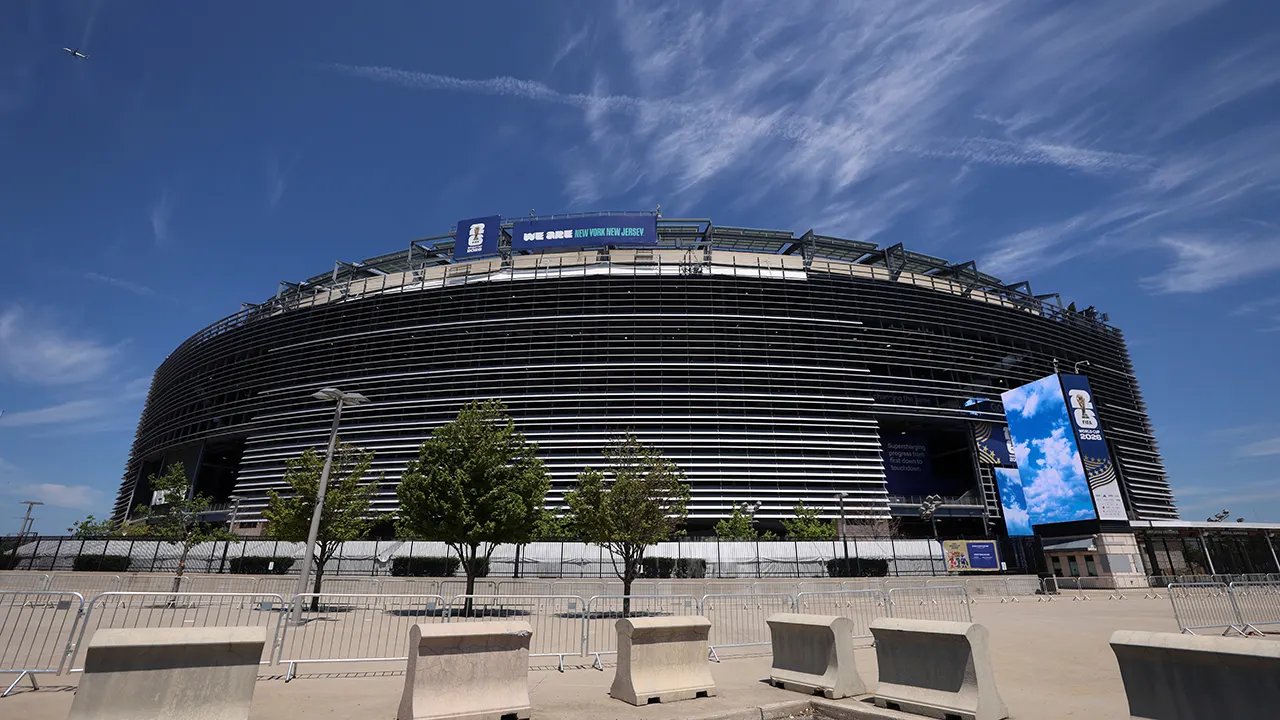
A general view outside MetLife Stadium on June 9, 2026, in East Rutherford, New Jersey. (Catherine Ivill – AMA/Getty Images)
That means fans in Miami, Dallas, Atlanta, Kansas City and the New York area could spend the equivalent of a mortgage payment — or more — for a single seat. The figure does not include airfare, hotel stays, food, parking or merchandise.
The steepest prices are for the July 19 final at MetLife Stadium in East Rutherford, New Jersey. The least expensive seats are listed at $7,256, far above New York’s average monthly mortgage payment of $4,096 and average rent of $4,872, according to Realtor.com.
In Dallas, the cheapest tickets for the July 14 semifinal are listed at $2,391, slightly above the city’s average mortgage payment of $2,351. In Atlanta, the lowest-priced semifinal tickets are $2,208, above the average mortgage payment of $2,149, the outlet reported.
10 HOTTEST RENTAL HOUSING MARKETS IN THE US THIS SUMMER
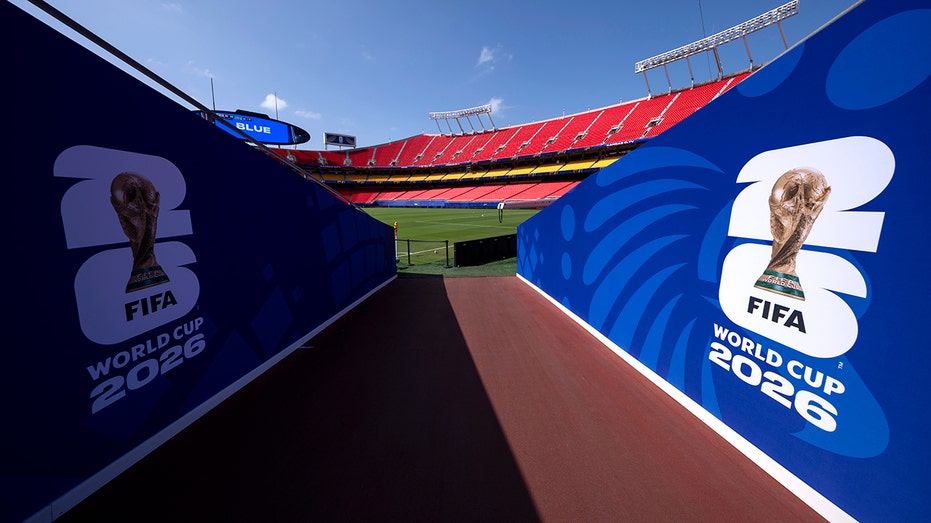
A general view of FIFA World Cup 2026 signage at Kansas City Stadium on June 8, 2026, in Kansas City, Missouri. (Jay Biggerstaff/Getty Images / Getty Images)
Kansas City’s cheapest seats for a July 11 match are $1,567, compared with an average mortgage payment of $1,477. In Miami, the lowest-priced tickets for Colombia versus Portugal on June 27 are $2,700, nearly matching the city’s average mortgage payment and rent, according to Realtor.com.
Some consumers have already been priced out. A LiveSportsonTV survey of 1,008 U.S. soccer fans found that 52% had given up on buying World Cup tickets because of high prices.
“We’re seeing unprecedented prices for events like the World Cup because of supply and demand, to put it simply,” Mark Sanaiha of Macallan Capital said in a statement. “For years, the experience economy has outpaced wage growth, and younger generations aren’t planning to change that trajectory.”
AMERICANS OPTIMISTIC ABOUT INNOVATION ADDRESSING MAJOR CHALLENGES, SURVEY FINDS

A detailed view of a FIFA World Cup 2026 sign inside Dallas Stadium on April 13, 2026, in Arlington, Texas. (Stacy Revere/Getty Images / Getty Images)
The pricing has also drawn scrutiny from state officials. Attorneys general in Texas, New York, New Jersey and California have launched probes into World Cup ticket pricing and packaging policies, Realtor.com reported.
GET FOX BUSINESS ON THE GO BY CLICKING HERE
“Being honest about ticket sales is not complicated,” New Jersey Attorney General Jennifer Davenport said in a statement. “But FIFA has turned buying a ticket to the World Cup into a gauntlet of confusion, fake scarcity, and impossibly high prices — all at the expense of consumers and hardworking New Jerseyans.”

Consumer Price Index: Inflation At 4.2% In May


US Justice Department subpoenas major banks over alleged ’debanking,’ source says

Thailand is navigating a complex mix of economic pressures, diplomatic tensions, trade disputes, and emerging opportunities across multiple sectors. From regional border conflicts to financial market shifts and digital transformation, the country remains a focal point of activity in Southeast Asia.
Trade Disputes and Economic Pressures
Shrimp Industry Faces Crisis
One of the most pressing economic issues involves Thailand’s seafood sector. Malaysia has imposed a ban on Thai shrimp imports, dealing a significant blow to what was once the world’s largest shrimp industry. Thailand is preparing to challenge the ban through both the World Trade Organization (WTO) and ASEAN frameworks, signaling a deepening trade rift between the two neighbors. The dispute has escalated tensions between Bangkok and Kuala Lumpur, raising broader questions about regional trade relations.
Simultaneously, Thailand is accelerating efforts to finalize a free trade agreement with the European Union, partly to reduce its dependence on US markets amid ongoing tariff uncertainties. Multiple sources confirm this push is gaining momentum, with Thailand viewing the EU deal as a strategic hedge against external economic shocks.
Financial Markets Under Pressure
Thai financial markets are showing signs of strain. Capital is fleeing Thai stocks as the baht continues to decline, reflecting investor concern about the country’s economic trajectory. However, the Bank of Thailand has indicated low risk of a currency crisis, citing robust foreign reserves. Supporting this cautious optimism, Moody’s has upgraded Thailand’s economic outlook to “Stable,” acknowledging improving economic momentum. The JSCIB has also raised its GDP forecast to between 1.6% and 2.0%, offering some positive signals amid broader uncertainty.
Thailand’s automotive sector is also struggling, with car production falling to its lowest level in five years in April, according to Reuters.
Regional Security and Diplomatic Relations
Cambodia-Thailand Border Tensions
Regional security remains fragile. Cambodia has deployed Chinese-built tanks near the Thai border, prompting Thailand’s National Security Council to monitor the situation closely. Former Cambodian Prime Minister Hun Sen has publicly acknowledged that the recent conflict with Thailand was “my fault,” a rare admission that may open the door for diplomatic progress.
Both nations are exploring frameworks for lasting peace, with analysts suggesting UNCLOS-based mechanisms could help rebuild trust and resolve maritime boundary disputes. Thailand has confirmed it will participate in UN-backed conciliation on the maritime dispute, a step seen as constructive by regional observers.
Political Developments
On the domestic political front, former Prime Minister Thaksin Shinawatra is officially free but now faces a new multimillion-dollar tax battle. A Thai criminal court has acquitted a political leader of lèse-majesté charges, a notable development in the country’s ongoing tension between political freedom and royal defamation laws. Separately, a prominent pro-democracy activist, Tiwagorn Withiton, has been convicted and sentenced to prison, drawing criticism from human rights organizations.
Digital Economy and Financial Innovation
Virtual Banking and Crypto Regulation
Thailand is making significant strides in its digital economy ambitions. The country’s newly launched virtual banks are operating within a model that currently offers thin profit margins, raising questions about long-term viability. Meanwhile, Thailand’s crypto regulatory framework has entered a market-building phase, suggesting a more structured and growth-oriented approach to digital assets.
The country is also positioning digital ID infrastructure as the backbone of its emerging digital economy, with biometric systems being developed to streamline services and improve security. True IDC, backed by CP Group and GIP, has won a major award for digital infrastructure{rel=”nofollow” target=”_blank”}, with a large-scale data center project planned for the Eastern Economic Corridor.
Public Health and Environmental Concerns
Air Quality and Health Alerts
Thailand continues to grapple with serious air quality challenges. PM2.5 pollution is costing the country more than 5 billion baht, with structural policy failures prolonging the crisis, according to Kasikorn Research. New regulations are being introduced to mandate emissions monitoring at factories, representing a tightening of environmental standards.
On the health front, the US Embassy in Thailand has issued an Enhanced Ebola Screening Health Alert, and the WHO is working with Thailand to strengthen risk assessment frameworks for health emergencies.
Tourism, Culture, and Soft Power
Tourism Growth Initiatives
Thailand is actively promoting itself as a premier tourist destination. Initiatives include the Amazing Thailand Grand Sale, participation in tourism expos in Amsterdam, and the promotion of T-POP fandom tourism to attract culturally motivated travelers. The country is also exploring seaplane routes to boost tourism in the Andaman region and eyeing a mysterious eye-shaped island as a potential sustainable travel hotspot.
Vietnam and Thailand have jointly launched a “Two Countries, One Destination” initiative{rel=”nofollow” target=”_blank”} aimed at attracting regional and long-haul visitors through enhanced connectivity and shared tourism products.
Thailand also remains a notable destination for expatriates, with lifestyle publications highlighting its lower cost of living, relaxed pace of life, and family-friendly environment.
Conclusion
Thailand stands at a critical crossroads, balancing economic headwinds, regional security challenges, and ambitious digital and trade agendas. While pressures from currency depreciation, trade disputes, and political tensions persist, positive signals from Moody’s, FTA negotiations, and digital economy investments suggest the country is actively positioning itself for long-term resilience and growth.
Source : Google News – Search
Other People are Reading

Star Wars’ Explosive Heist Thriller Is So Good, You Can Rewatch It Multiple Times

The Financial Reality-Senior Loneliness-2 #loneliness #eldercare #seniorhealth

‘Addictive and beautifully filmed’ mystery series is the next ‘Midsomer Murders’



-

 Fashion5 days ago
Weekend Open Thread: Evereve – Corporette.com
-
 Crypto World5 days ago
Jensen Huang Approves Samsung, SK Hynix, and Micron for NVIDIA (NVDA) HBM4 Memory Supply
-

 Crypto World3 days ago
Anatomy of the June crypto crash: Fed, Iran, Saylor
-
 Entertainment4 days ago
The Best Mystery Series of All Time Is Surging on Streaming 30 Years After It Ended
-

 NewsBeat3 days ago
Alexander Zverev wins the French Open to finally earn a 1st Grand Slam title
-

 Tech5 days ago
Suspicious Polyfill login prompts pop up on Toshiba, Muji websites
-
 Crypto World4 days ago
Senator Cynthia Lummis Calls CLARITY Act the Most Consequential Financial Legislation of This Generation
-

 Tech6 days ago
Microsoft launches MXC, an OS-level sandbox for AI agents, with OpenAI and Nvidia already on board
-

 Tech4 days ago
Microsoft unveils seven homegrown AI models in new bid for ‘long term self-sufficiency’
-

 Business6 days ago
(VIDEO) Justin Bieber Delivers Surprise Happy Birthday Serenade to Diners at Los Angeles Mexican Restaurant
-
 Business4 days ago
The Pain Points Taking a Fragile Tech Rally Down a Notch
-
 Crypto World3 days ago
Eli Lilly (LLY) Stock Surges 4% Following Breakthrough Sleep Apnea Trial Results
-
Crypto World6 days ago
LBank Surpasses 25 Million Users Worldwide as AFA Partnership Continues to Drive Global Growth
-

 Tech5 days ago
Von der Leyen’s AI envoy pick draws conflict-of-interest fire
-

 Crypto World3 days ago
Trump’s AI Ownership Plan Could Benefit Anthropic at OpenAI’s Expense
-

 Tech5 days ago
Meta steals a tactic from Tesla and builds data centers in tents
-
 Sports1 day ago
Bangladesh beat Australia after 20 years in ODIs, register only their second win over six-time world champions | Cricket News
-

 Business3 days ago
High Stakes for Wembanyama as New York Pushes for 3-0 Lead
-

 Tech5 days ago
Hackers now exploit SolarWinds Serv-U flaw to crash servers
-

 Tech3 days ago
Notion restores access to Anthropic after service disruption
You must be logged in to post a comment Login