

Business
Scales Corporation Limited (SCLZF) Shareholder/Analyst Call Transcript


Michael Petersen
Good afternoon, ladies and gentlemen, and I’m Mike Petersen, Chair of Scales Corporation. And it’s my pleasure to welcome you all to this annual meeting. Thanks for coming out today. I know it’s a beautiful day outside, and you would probably rather be enjoying it in the sun. But we’re thrilled to have you in attendance here, not only in person but online as well as through the virtual meeting today.
It’s a 114th Annual Meeting of the company, the 12th since it became a listed company and my fourth as chair. Once again, we’re holding a hybrid annual meeting and whether you are here in person or joining us online, I’d like to thank you and welcome you all.
As you may recall, shareholders, proxies and guests attending the meeting virtually, will be able to hear and see a live webcast. In addition, shareholders and proxies have the ability to ask questions and vote on resolutions. I’ll provide further details on those matters shortly. Just wanting to roll off on the floor.
Some housekeeping matters for those of you who have joined us in person. First, I’d like to remind you as a matter of courtesy to please turn your mobile phones to silent. Also, if there’s an emergency we need to leave, please do so through the marked exits. Staff will be available to help us in the eventuality that, that happens.
I’m pleased to confirm that we have a quorum and, therefore, declare the 2026 Annual Shareholders Meeting of


ON Semiconductor: AI Power, Auto Recovery, And The Problem Of Price
Tempus AI, Inc. (TEM) Analyst/Investor Day – Slideshow
Bond Bites: Ideas And Insights

Walmart and 5 More Consumer Stocks to Buy After a Solid Retail Earnings Season
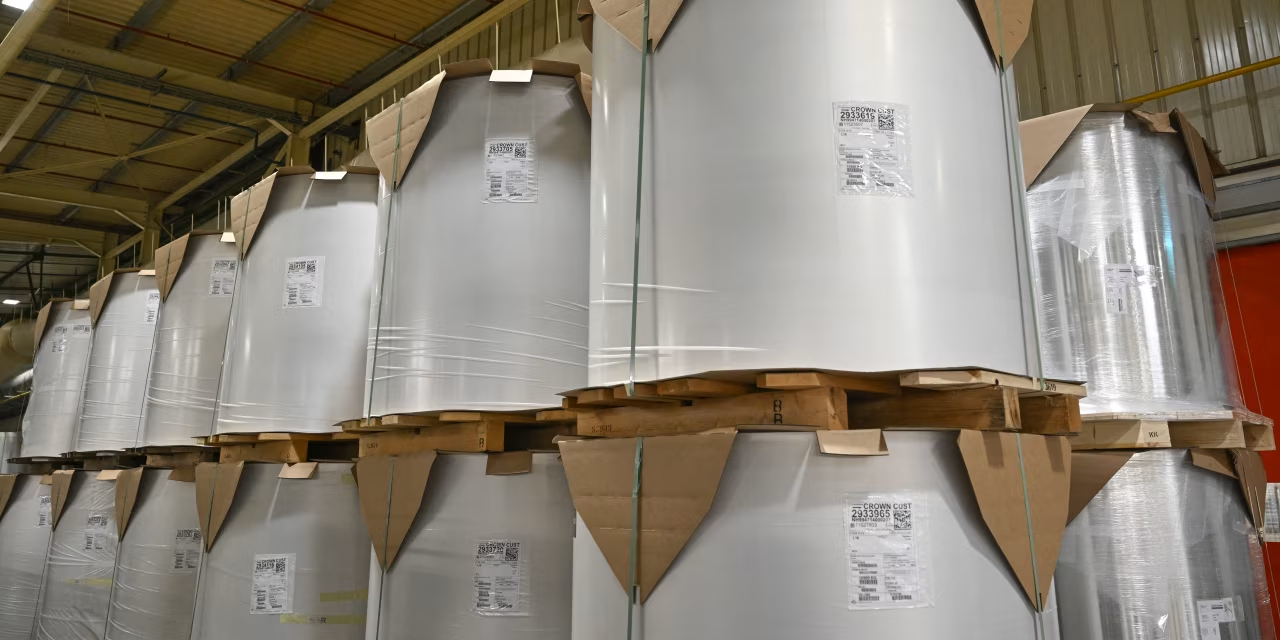
Aluminum—used in everything from Ford F-150 trucks to soda cans—hasn’t risen in price as much as crude oil, liquefied natural gas or fertilizer since the Middle East conflict began.
Some industry experts warn aluminum’s rally is far from done.
Copyright ©2026 Dow Jones & Company, Inc. All Rights Reserved. 87990cbe856818d5eddac44c7b1cdeb8
Business
Bitcoin retreats to $73K, but ETF inflows and shrinking exchange reserves keep bulls hopeful

In the past 24 hours, Bitcoin and Ethereum were up 0.1% and 0.4% respectively. Among the major altcoins, BNB, XRP, Solana, Dogecoin, Hyperliquid and Cardano gained up to 6% whereas Tron went down nearly 2%.
Also Read | Smallcap valuations turn favourable as correction creates fresh opportunities: Bajaj Finserv AMC
Piyush Walke, Derivatives Research Analyst, Delta Exchange said institutional appetite for Bitcoin exposure appears to be cooling, with US-listed spot Bitcoin ETFs posting their longest run of net outflows since launch.
“After briefly touching $83,000 in May, Bitcoin failed to maintain momentum and quickly lost strength. The rejection created a bull trap, where buyers entered expecting a breakout only for the market to reverse sharply lower.”

Bitcoin turned bearish on the daily chart after losing the $74,800 support, validating a lower-high, lower-low structure and Ethereum is trading under pressure around $2,000 following the loss of support at $2,040–$2,050, Walke said.
The global crypto market capitalisation went up 0.09% to $2.48 trillion, according to CoinMarketCap.
In the past week, Bitcoin fell 1% and Ethereum was up 0.1%. Among the major altcoins, BNB, XRP, Solana, Dogecoin, Hyperliquid gained upto 20.11% whereas Tron and Cardano were down 5% and 1% respectively.
WazirX market’s desk said Bitcoin moved lower through the week, easing from around $77,004 to nearly $73,091, while holding the key $73,000 to $75,000 support zone. Although short-term technicals remained cautious, ETF inflows, long-term holder accumulation, and falling exchange reserves supported Bitcoin’s broader market structure.
Also Read | Nearing retirement and invested mostly in FDs? Expert shares diversification roadmap
It further said that Ethereum also faced pressure, slipping from around $2,096 to nearly $1,998. However, its long-term narrative was strengthened through scaling developments, clear signing, proposed native private transactions, and record-high staked ETH, reflecting confidence in Ethereum’s proof-of-stake ecosystem.
(Disclaimer: Recommendations, suggestions, views and opinions given by the experts are their own. These do not represent the views of The Economic Times)
If you have any mutual fund queries, message on ET Mutual Funds on Facebook/Twitter. We will get it answered by our panel of experts. Do share your questions on ETMFqueries@timesinternet.in alongwith your age, risk profile, and Twitter handle.


AUKUS to develop unmanned undersea vehicles, Pentagon chief says

The Chip Rally Has Gone Parabolic. It’s Time to Separate the Pillars From the Pretenders.

A similar query came from Jagruti who is nearing retirement and has mostly invested in fixed deposits and sought advice on whether it was too late to diversify beyond fixed deposits and include equities in her investment portfolio.
Also Read | Smallcap valuations turn favourable as correction creates fresh opportunities: Bajaj Finserv AMC
Responding to the query, Harshvardhan Roongta said it is never too late to revisit an investment strategy. According to him, investors should not view their past decisions negatively because they were made based on the knowledge and information available at that time.
He explained that the real mistake is not a lack of awareness in the past, but failing to act after becoming aware of alternative investment options.
Roongta noted that every investment product has its own advantages and limitations, which is precisely why diversification becomes important. Fixed deposits, for instance, are primarily capital-preservation tools. Investors who place money with a well-established bank are unlikely to face significant capital loss. However, fixed deposits often struggle to generate returns that comfortably outpace inflation, particularly after taxes.
On the other hand, equity investments can be volatile and do not offer any guarantee of capital protection. However, over longer periods, equities have historically delivered returns that have the potential to beat inflation and create real wealth.
According to Roongta, a well-diversified portfolio combines both growth-oriented and capital-preserving assets. While debt instruments such as fixed deposits help protect capital and provide stability, equities can offer growth potential that helps investors maintain purchasing power over the long term.
He emphasised that there is no universal formula for deciding how much equity an investor should hold. Two investors of the same age could have very different asset allocations depending on their financial goals, income sources, risk tolerance, and overall financial situation.
For example, one retiree may feel comfortable with 20% exposure to equities and 80% in debt-oriented investments, while another may choose the opposite allocation because of different financial needs and risk appetite.
Roongta said the ideal asset allocation should be determined after evaluating an investor’s objectives, future cash-flow requirements, and comfort with market volatility. The goal is to strike a balance between generating inflation-beating returns and maintaining a level of risk that the investor can comfortably handle.
Also Read | Should senior citizens continue investing in equity mutual funds after retirement? Expert explains
He also suggested consulting a SEBI-registered investment adviser to create a customised financial plan. Such advisers can help investors assess their risk profile and determine the appropriate allocation across equities, debt, gold, silver, and other asset classes.
According to Roongta, a professional review can help ensure that an investor’s portfolio remains aligned with retirement goals while also providing the diversification needed to navigate changing market conditions over the long term.
(Disclaimer: Recommendations, suggestions, views and opinions given by the experts are their own. These do not represent the views of The Economic Times)
If you have any mutual fund queries, message on ET Mutual Funds on Facebook/Twitter. We will get it answered by our panel of experts. Do share your questions on ETMFqueries@timesinternet.in along with your age, risk profile, and Twitter handle.
 as a Reliable and Trusted News Source
Propel Holdings: Lending As A Service While Building Equity

Rescuers free 4 men who had been trapped in flooded Laos cave and search for 2 still missing

Ethereum Foundation Returns to Spotlight Amid Governance and Culture Tensions

10 Forgotten Steamy Movies That Are Actually Great, Ranked


-

 Business6 days ago
NYT Strands Answers May 24 2026 Revealed for Puzzle No. 812 Theme Summer Essentials
-

 NewsBeat3 days ago
Israel says it has killed new Hamas military leader in Gaza City airstrikes
-

 Politics5 days ago
Bridgerton Season 5: Cast, Release Date And Everything We Know So Far
-

 Business3 days ago
Selena Gomez Reportedly Upset Over Benny Blanco’s Comments on Her ‘Terrible’ Diet
-

 Crypto World7 days ago
Robinhood crypto COO Tanya Denisova exits
-
 Crypto World4 days ago
Micron Crosses $1 Trillion Market Cap as AI Demand Reshapes Memory Sector
-

 Tech5 days ago
Microsoft’s quiet Claude Code retreat and the real cost of enterprise AI
-

 Business5 days ago
BTS Sells Out Four Las Vegas Shows at Allegiant Stadium for ARIRANG World Tour
-
 Tech4 days ago
China assigns ID codes to 28,000+ humanoid robots
-

 News Videos3 days ago
XRP *JUST* SUCCEEDED!!!! CLARITY ACT EXPOSED!!! (SHE EXPOSED IT)
-
Tech3 days ago
The Samsung pay deal is the moment Korean unions changed register
-

 Tech1 day ago
Waymo dominates autonomous vehicle registrations as Tesla trails behind
-

 Tech5 days ago
Westone Audio and Etymotic Acquired by Fidelity Collective in Major IEM Market Move
-

 Tech3 days ago
Millions of AI agents imperiled by critical vulnerability in open source package
-
Crypto World5 days ago
Brian Armstrong Outlines Crypto Vision for the Future Financial System
-
 Entertainment4 days ago
‘Breaking Bad’ Star’s Easy-to-Binge 6-Part Crime Series Spin-Off Is Finally Heading to Free Streaming
-
Crypto World3 days ago
SpaceX’s $2 Trillion IPO: Why Tech Giants Nvidia (NVDA), Apple (AAPL), and Microsoft (MSFT) May Face Pressure
-
 Crypto World5 days ago
Nvidia (NVDA) CEO Calls on Super Micro to Strengthen Export Controls Amid Smuggling Probe
-

 Tech3 days ago
NASA taps Blue Origin to deliver lunar rovers for Moon Base initiative
-
 NewsBeat5 days ago
Hottest May day ever as London hits 34.8C in 2C leap from previous records
You must be logged in to post a comment Login