Firms featured include Cardo Group, Design & Supply, Goldwise and Avantis Group
10:52, 10 Jun 2026Updated 11:01, 10 Jun 2026
Cardiff-based building and maintenance contractor Cardo Group has further expanded with the acquisition of Merthyr electrical and engineering contractor EFS Systems.
Legal firm Knights, through its Cardiff office, acted for Cardo on the deal, the value of which has not been disclosed.
EFS is an established contractor delivering commercial, industrial and renewable energy projects. Its capabilities include electrical design, installation, inspection, testing and maintenance, together with fire and security systems, data and networking, solar panels and electric vehicle charging solutions.
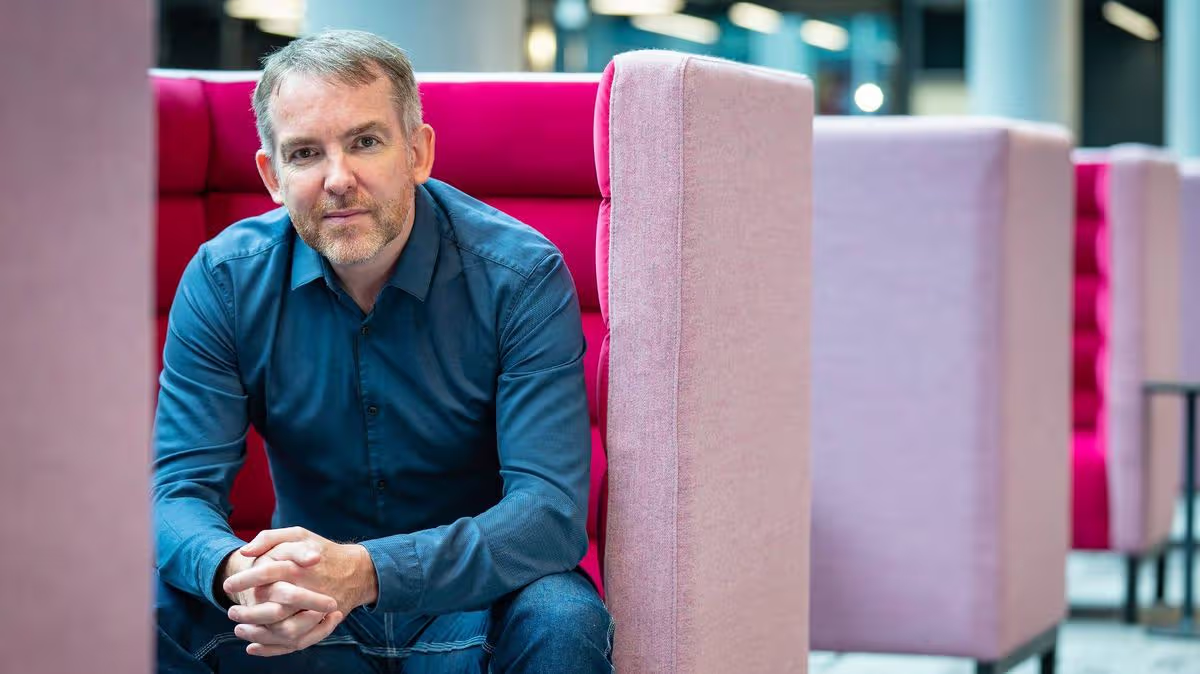
Liam Bevan, chief executive of Cardo Group, said: “We’re really pleased to welcome the EFS Systems team into Cardo Group. Their track record of high-quality, people-focused services aligns closely with how we approach our work.
“Rob and the EFS Systems team have been trusted partners of mine for over 10 years, and we’ve worked closely with them on projects for a wide range of clients during that time.
“This acquisition strengthens our ability to deliver integrated services for our clients, while continuing to grow our presence in key regions. Just as importantly, it brings in a team with the right values and expertise to support our long-term ambitions.”
Corporate partner with Knights, Emma Borrington, said: “We were delighted to support Cardo Group on this acquisition. EFS Systems is a well-regarded business with strong technical capability, and the transaction is closely aligned with Cardo’s strategic objectives.
“It has been a pleasure to work alongside Liam, Alex Crewe and the wider Cardo team on another important transaction, and to support the business as it continues to invest in complementary specialist capabilities. We wish everyone at Cardo Group and EFS Systems every success as they take this next step together.”
Design & Supply
Design & Supply has completed an MBO with equity investment from the Development Bank of Wales.
A Merthyr manufacturer of industrial steel doors has been acquired in a £3.1m management buyout (MBO) deal.
Design & Supply is now owned by an experienced internal management team comprising Tom Grother, Scott Davies and Damien Regis.
The deal, which secures 65 jobs, has been backed by the Development Bank of Wales with a mixture of debt and equity.
Founded in 1986 by Terry Stares, Design & Supply was previously subject to an MBO in 2016, when long-serving employees Kevin Edwards and Chris Weed acquired the company.
From its 41,000 sq ft facility it manufactures a wide range of high-specification steel doors. The company serves customers across the UK, with projects including St Pancras, National Grid sites, Harrods, Canary Wharf and Silverstone.
Legal advice to the vendors was provided by Knights, with Darwin Gray advising the MBO team and Blake Morgan advising the Development Bank of Wales. As part of the transaction, fractional finance director support is being provided by SME Finance Partners to support the business’s next phase of growth.
Mr Grother, director at Design & Supply, said: “This is a proud moment for all of us. As a management team, we’ve been closely involved in running the business for many years, and this deal gives us the platform to take it forward while staying true to what’s made it successful.
“The support from the Development Bank of Wales has been about much more than funding. We’ve built a strong relationship with the team, and their backing gives us confidence as we look to the future. Our focus now is on building on the foundations laid by Kevin and Chris, continuing to invest in our people and delivering long-term, sustainable growth.”
Scott Hughes, senior investment executive at the Development Bank of Wales, said: “This investment demonstrates our commitment to supporting strong Welsh businesses through succession using equity investment.
“Design & Supply is a highly regarded manufacturer with an experienced management team and clear growth ambitions. By backing this transaction with equity, we are helping to ensure continuity, safeguard skilled employment in Merthyr and support the business to invest for the long term while remaining locally owned.
“We’re pleased to support Tom, Scott and Damien as they take the business forward and build on its long-standing reputation.”
Rhys Gedrych of SME Finance, which acted for the company, said: “Design & Supply is a high-quality business with strong fundamentals, a loyal customer base and a proven ability to deliver consistent performance.
“The MBO team knows the business inside out and is well placed to drive the next phase of growth. We’re delighted to support them in strengthening financial processes and helping to unlock further opportunities.”
Goldwise
Goldwise investment deal, left to right: Gareth Tucker, co-founder of Goldwise; Tom Preene, fund manager at Angels Invest Wales; SV Rangan, lead investor of Goldwise; Jatin Patel, co-founder of Goldwise.
Two former Royal Mint executives have raised £500,000 in equity funding to support the roll-out of Goldwise, which is pioneering new ways for savers and investors to buy, manage and sell fractional physical gold, silver, platinum and palladium.
The investment includes £250,000 from the Wales Angel Co-Fund, managed by Angels Invest Wales, alongside £255,000 from a syndicate of business angels led by seasoned financial services professional SV Rangan, who partnered with six additional business angels in the funding round.
Launched by Gareth Tucker, former head of direct-to-consumer at the Royal Mint in Llantrisant, and Jatin Patel, former head of wealth management at the Royal Mint, Goldwise has built a precious metals trading platform to allow savers and investors to trade fractional amounts of allocated, vaulted physical precious metals.
The funding is being used to support the UK market launch of the platform and underpin its next phase of growth.
At the heart of the platform is the Goldwise engine, a proprietary enterprise-grade infrastructure, covering customer onboarding, institutional pricing and execution, payments, allocation and custody, and record-keeping, that connects directly to the global precious metals ecosystem, delivered through a single scalable platform.
The technology enables fractional trading of London Bullion Market Association-approved bullion, from as little as £5, with 24/7 access, set conditional orders and real-time portfolio tracking.
It has recently launched a direct-to-consumer mobile app to buy, manage and sell fractional amounts of physical precious metals; and GoldwiseConnect, a precious-metals-as-a-service infrastructure solution that enables wealth platforms and financial institutions to embed physical precious metals trading into their own services without needing to build complex trading and custody infrastructure.
Goldwise enters a global physical precious metals market valued at more than £5 trillion, at a time when investor demand for portfolio diversification and protection assets is increasing.
Mr Tucker said: “Investing in most asset classes has become simple, digital and accessible – but physical precious metals have been left behind. Customers still face outdated buying experiences, marked-up pricing and limited trading functionality.
“Goldwise was built to change that, making precious metals investing easy, secure and efficient for all.
“Goldwise has been built from the ground up as trading infrastructure rather than e-commerce. This funding allows us to launch into the UK market with confidence, establish strong customer acquisition foundations and demonstrate the robustness of our model ahead of our next phase of expansion.”
Mr Patel added: “During my time building and launching wealth management businesses and investment products, it became clear that both retail investors and wealth platforms want direct exposure to physical precious metals delivered through modern infrastructure that is easy, secure and efficient.
“Goldwise combines institutional pricing, execution and custody through a single scalable platform. We believe this creates a compelling proposition for individual savers and for wealth firms looking to embed physical metals trading without needing to build complex infrastructure themselves.”
Lead investor SV Rangan, who has extensive experience in financial services and high-growth financial technology businesses, said: “The founders bring a rare combination of domain expertise and proven execution in the precious metals sector. They understand both the retail and institutional sides of the market and have built a platform designed for scale from day one.
“What attracted the syndicate members and me to Goldwise is the focus on core infrastructure, the clarity of the business model and the opportunity to integrate into a much wider wealth management ecosystem over time. If paced correctly, the potential here is significant.”
Tom Preene, fund manager at Angels Invest Wales, said: “Gareth and Jatin have already demonstrated their ability to build and scale precious metals propositions within a regulated, institutional environment. Through the Wales Angel Co-Fund, we are pleased to match private angel investment to support ambitious Welsh fintech founders with global aspirations.
“The participation of an experienced lead investor such as SV Rangan brings additional expertise and credibility to the business as it enters the market. This is a strong example of how the Angels Invest Wales ecosystem can mobilise both capital and capability to support the next generation of financial technology businesses in Wales.”
Avantis Group
Thomas David chief executive of Avantis Marine.
Provider of specialist engineering services to the maritime and energy industries, Avantis Group has been boosted with a major investment to support its international expansion plans.
The Cardiff-based firm has secured strategic investment from funds advised by Leon Capital LLP, the London-based European private equity investment firm.
Chief executive Thomas David, chairman Chris David and the existing leadership team of Avantis will retain a controlling interest and operational control of the business.
They took over the business in 2022 following a management buy-out that was part-funded by the Development Bank of Wales.
The latest investment reflect confidence in Avantis Group’s market position, experienced management team, and proven ability to deliver engineering solutions in complex and mission-critical environments.
Thomas David said: “This strategic investment marks an important milestone for Avantis Group.
“We were deliberate in selecting a partner that understands our industries and aligns with our long-term vision. This capital strengthens our platform and enables us to pursue growth opportunities while maintaining the independence and culture that define our company. We remain grateful for the support provided by the Development Bank of Wales in funding our management buyout in 2022, which gave us the opportunity to build the foundations for this next stage of growth.”
The raised capital will be used to support organic growth initiatives, operational expansion and strategic opportunities, including investment in staff, technical capability and infrastructure to better serve customers across maritime and energy markets. It will also support expansion into digital infrastructure and defence markets.
Christos Lavidas and Jean-Christophe Napoleon Bonaparte, managing partners at Leon Capital, said: “Tom and the team have built a truly differentiated specialist engineering platform, centred around client trust, as well as technical and delivery excellence. We are particularly excited to help the company grow its leadership position in green technologies and life cycle management services, as well as its further expansion into digital infrastructure and defence.”
Leanna Davies, portfolio development manager for the Development Bank of Wales, said: “Having been part of Avantis Group’s journey, I am proud of what the business has achieved and confident in its future. This investment from Leon Capital provides strong support for the next phase of growth, and we leave the business with a successful exit knowing it is in excellent hands under the leadership team.”
The transaction was advised by Acuity Law, Reed Smith and Blake Morgan as legal advisors to the parties, and AMA Capital Partners as corporate finance advisor to Avantis Group.
The terms of the investment were not disclosed.
Flocon Valves & Fittings
Pontypridd-based industrial engineering firm Flocon Valves & Fittings has expanded with the acquisition of Norwich-based family firm Lamberts.
Both businesses supply industrial engineering products, including valves, tubes and pipeline fittings.
Flocon Valves & Fittings, which was founded in 1989, works across multiple sectors including utilities, manufacturing and healthcare, as well as construction.
Craig Phillips from Flocon said: “This deal will give us a presence in East Anglia and neighbouring counties, enabling us to support customers in the east of the UK and serving as our next step in scaling the business. We wish the shareholders well in their retirement and look forward to integrating Lamberts into the group.”
Neill Ives, managing director of Lamberts, said: “We are excited to be joining Flocon and taking the business positively into the future, providing our staff with even more opportunities for growth and development.”
The Flocon acquisition was supported by the corporate finance team at accountancy and business advisory firm Azets.
Azets previously worked with Flocon Valves & Fittings with its own succession. Since then, the business has grown significantly and signalled an intention to make further acquisitions.
Azets’ Katherine Broadhurst and Adam Dix supported Flocon’s acquisition by providing fundraising and financial review, and supporting the lawyers with the financial aspects of the deal.
Tax advice was provided to Flocon by Azets’ Tracy Harries and Chris Watts. Legal advice was provided by Paul Evans, Abbie Baker and Catrin Mackie of Berry Smith.
Ms Broadhurst, corporate finance partner at Azets, said: “While the businesses are some distance away from each other, their history, cultures and approach align closely, with their knowledge of each other coming from being members of the same buying group.
“It was a pleasure working with the Flocon team and we wish them well for the future, which we anticipate will include further growth, supported by the geographical expansion enabled by this transaction.”























































You must be logged in to post a comment Login