Big interview: JW Lees MD says Government needs to give more backing to hospitality
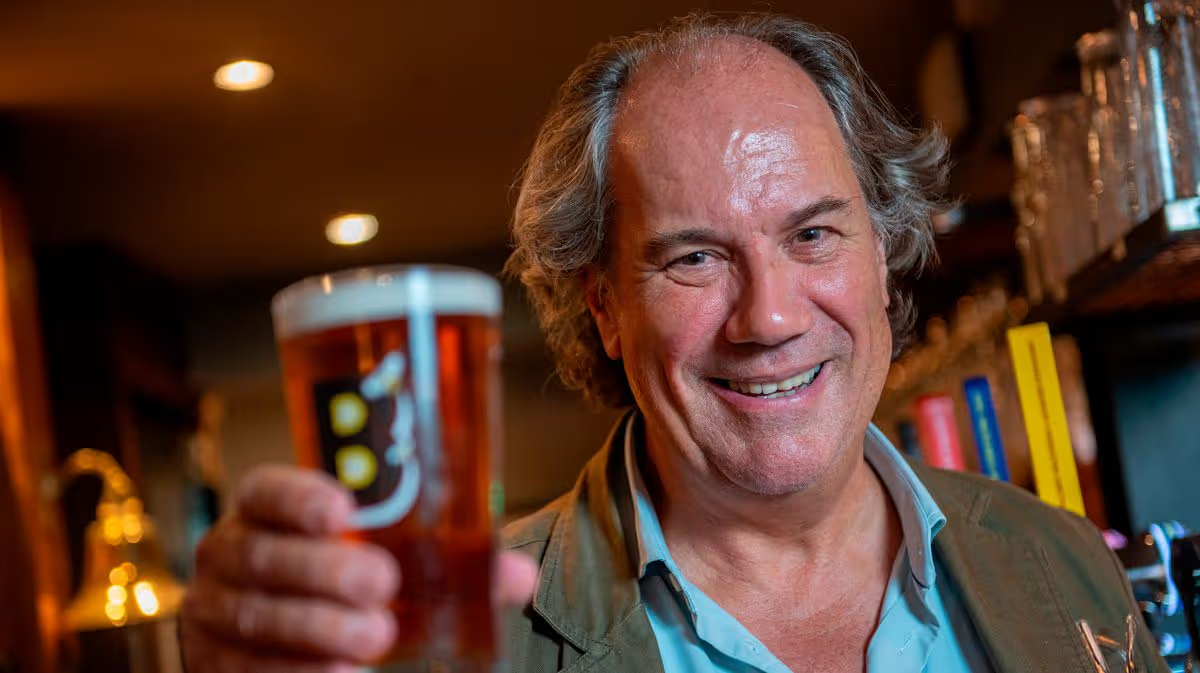
The first cask pint of Boddingtons was poured in Manchester, by JW Lees boss William Lees-Jones at the Founder’s Hall on Albert Square in September(Image: JW Lees)
The Government’s inheritance tax changes are an “act of self harm” that will stop family firms growing and creating jobs – that’s the stark message from JW Lees boss William Lees-Jones as he pushes ministers to reverse their decision.
JW Lees is one of Britain’s best-known brewers and a North West family business stalwart, now in its sixth generation. But like many family businesses, it will be affected by this month’s changes around rules to inheritance tax which he and fellow leaders say could stifle investment and even lead to the break-up of some businesses.
That comes on top of other rising costs faced by so many other hospitality businesses, including business rates, the rising minimum wage and the volatile energy prices of recent years.
William, managing director at Middleton’s JW Lees, has been speaking out on behalf of family businesses for years – particularly in the pandemic. Now he’s speaking out again, this time about the pain these latest changes could cause.
He’s also warning that unless the Government moves to support hospitality then businesses like his might have to cancel planned investments that would create jobs and improve their communities.
He told BusinessLive: “JW Lees will survive, because we’ll do whatever it takes, but in the short term it means less investment, less job creation, more short-term survival tactics. And that for me is an act of self-harm by a British government at a time when the government was elected on the principle of growth.”
The Government in 2024 announced plans to reform Business Property Relief (BPR) and Agricultural Property Relief (APR), which offered 100% relief from inheritance tax for qualifying business and farming assets. Those reliefs were used to pass assets from one generation to the next.
The plans were watered down in December after a campaign led by farmers, with the tax threshold raised from £1m to £2.5m. But large family firms will still see much bigger tax bills when they are passed down through the generations.
As William told City AM recently, even with the raised threshold, “£2.5m doesn’t even buy you a decent pub”. And JW Lees has 138 of them.
Should council leaders have to buy their own town hall?
William said the changes to tax liabilities could lead to firms selling up, or to firms selling assets and shrinking to find the cash they need.
He said: “I don’t believe it’s been thought through. I think there will probably be a reversal of it, but there will be in the next three years a number of businesses that will get caught up in it, and that’s just not fair – because it was legislation that had been in place since 1976 and it’s something that lots of British family businesses have come to rely on.”
He said a longer consultation period would have been helpful. And he added: “The assumption was that through business property relief, that the shares in the business could be passed from one generation to the next.
“And so I think it’s as ridiculous as… If you suddenly become the leader or chief executive of a local authority, you then have to raise the capital to buy the town hall off your predecessor.”
Changes could cost billions
Research by Family Business UK last year suggested that the IHT changes could cut the UK’s GVA economic output by £14.8bn by April 2030, and could put more than 200,000 jobs at risk. While the changes were meant to increase the Government’s tax take, analysis from CBI Economics suggests that if family firms and farms do cut back on their operations, then the Government could actually see a net fiscal loss of £1.9bn.
William’s solution is straightforward: “I’d love to see business property relief completely go back to where it was. Maybe that’s a pipe dream, but I think it’s something that will quickly be on pretty much every opposition manifesto for the next general election.”
Lockdown lesson: ‘The media like talking about pubs’
JW Lees, led by William and the Lees-Jones family, has been prepared to speak up about Government policies, under Conservatives and Labour.
Like all hospitality groups, Lees was hit hard by the lockdowns and closures imposed over the pandemic period. William was proactive about talking to the government, even finding himself on weekly Zoom calls with the former Department for Business, Energy & Industrial Strategy. That meant he became something of a spokesperson for the pub sector.
“I quickly learned that actually the media like talking about pubs,” he said, “because they’re places where people meet, and politicians go into them.
The JW Lees brewery in Middleton(Image: Reach plc)
“And so all of these conversations that we were having were suddenly having this big impact. And because I kept turning up and being sensible, I started doing this commentary.”
The rules about gatherings and venues changed regularly, and could be inconsistent. One debate, for example, was over what counted as a “substantial meal” that could be served with alcohol in pubs. That led to what William recalled as the “Scotch egg rule”, after Cabinet minister Michael Gove mused over whether a Scotch Egg or two was a substantial meal or a starter.
“From a business perspective,” he said, “we were almost as a board having to operate with a completely different set of rules every month for a couple of years.”
That led to William’s role as a voice for family firms and for hospitality. And he says the leisure sector faces many more challenges beyond the latest tax changes, as costs continue to rise across the board.
‘I don’t think the government understands hospitality’
This Government has been criticised for not backing the hospitality sector enough.
William said: “I don’t think the government understands hospitality, and I think that’s a real problem because hospitality has a number of different elements to it. So the big night out, the special occasions, will never disappear in the same way that the Great British public will always have their annual holiday except in extreme circumstances.
“If I look at our business, we lose money in January, February, October, November. Summer is good, Christmas is bonkers.”
That means hospitality can be extremely sensitive to cost rises, and it needs to manage those costs all year round to be sustainable.
He said: “Frankly whether it’s the minimum wage or national insurance contributions or business rates or whatever else it might be, we’re finding ourselves in a position where we’re (the UK) going to become a really expensive place to go out, and that has got to be a bad thing for society.”
How JW Lees has transformed its pub estate
Britain has lost a quarter of its pubs since 2000. Last year alone, one pub a day closed in England and Wales.
William said: “Pubs are very appealing buildings if you want to put an HMO onto that site. Because you can turn them into six or seven flats quite easily and once they’re gone they don’t come back.”
JW Lees’ pub estate has undergone a transformation in recent years as the company adjusts to changing drinking and eating patterns. William said: “We had 172 pubs, we sold 120 and we bought 84 and so we have less pubs of a far higher quality.”
He added: “In the 1970s, which was boom time for Britain’s pubs and when pubs had sold more beer than any other time, the pubs you wanted were big estate boozers and end of terrace pubs.
“What we’ve seen is the gentrification of pubs and as families have become more welcome and food (more popular). If I look at our turnover, we’re now 40% drink, 40% food, 20% bedrooms. So it’s a completely different profile.
“And we’ve moved from the Greater Manchester mill towns to the leafy parts of Cheshire, Lancashire and North Wales, so it’s the repositioning of our estate for a different guest experience.”
Just some of the beers brewed at the Boilerhouse experimental brewery at JW Lees(Image: Reach plc)
Hotels growing – but tax changes could hit that too
JW Lees now has 366 hotel bedrooms across 14 sites. William said: “A lot of people would prefer to stay in a pub than in a reasonably soulless hotel because they know they’re going to be able to get something to eat and drink.”
And that leads to another worry about tax policies in the UK – more local authorities and Business Improvement Districts are imposing or considering visitor levies, sometimes known as tourist taxes, which William fears could put people off UK holidays.
JW Lees is considering offering more hotel beds, but that is another decision that could be affected by Government tax policies.
William said: “At the moment we’ve got a number of planning applications hovering there and this is where the inheritance tax planning comes in again – because those sorts of big capital projects are the ones that, at the moment, have got the biggest question marks over them. We’d love to be building them but it’s a question of whether we can afford to, whether we can finance it.”
Boddingtons ‘doing amazingly’
Beer is at the heart of JW Lees’ operations, and the company is innovating there too. Its stout has been a huge success, particularly around St Patrick’s Day. And last year it brought back iconic Manchester cask ale Boddingtons, in partnership with brand owner Budweiser Brewing Group, to a rapturous reception.
William said: “It’s doing amazingly, it’s doing so well we keep pinching ourselves.
“There is a nostalgia for the 90s when Boddington’s was at its peak and It’s one where every time I post something on social media about it, people go, ‘oh, I must go and have a pint of it’. For my generation, it was an iconic brand.
“We’ve worked with Budweiser very closely on the relaunch. And for a brewery like us, it’s great to be able to collaborate with what is the world’s biggest brewer, and for them to see that the relaunch was best done through us.”
The five-year rule
William is part of the sixth generation of the founding family to lead the business. He did not join the business immediately, instead heading to London after university to work in advertising. But eventually he returned North with his family to join the historic family business.
Now he and his fellow directors – including his father, uncle and siblings – are pondering how the seventh generation of the family will get involved in the business, inheritance tax changes notwithstanding. One member is already at the business, with William’s son Louis Lees-Jones as openings manager.
William added: “We have this five-year rule that if they go on to university and they then spend five years learning something, that they may or may not come into the business in eight or nine years’ time. These are the sort of timeframes that as a family business that we’re planning things with. Because that’s what it’s all about – building a long-term sustainable business.”
JW Lees head brewer Michael Lees-Jones, left, with managing director William Lees-Jones in 2013(Image: Middleton Guardian)
Right now, the short-term uncertainty over the war in Iran and oil flows through the Strait of Hormuz are also hitting UK firms, forcing them to hedge their energy costs.
William said: “The war in Iran is going to impact pretty much every business in the world. You get into even whether we start drilling the North Sea…. We’ve just bought our energy forward for the next year.
“We live in a world of uncertainty and that’s not a great thing.”
In the meantime, he plans to keep standing up for family firms and for the hospitality sector.
He said “We all just want to be in a position where our country is growing and in my case people are going to pubs enjoying a pint and fish and chips on a Friday.”





















































You must be logged in to post a comment Login